Disclosure: airfryerkitchensupply.com is reader-supported. When you buy through links on our site, we may earn an affiliate commission at no extra cost to you.
Where to buy
In this guide ‘mixers’ means stand mixers — the countertop baking kind — in white finishes, and every model below was confirmed in its white variant specifically, because a mixer that exists in white in a catalogue photo is not always the white model on sale.
KitchenAid 5.5-Qt Bowl-Lift Stand Mixer KSM55, Porcelain White (Best Overall): check price on Amazon
KitchenAid Artisan 5-Qt Tilt-Head Stand Mixer KSM150PS, Porcelain White (Best for Most Bakers): check price on Amazon
Cuisinart Stand Mixer SM-50, 5.5 Quart, White Linen (Best Value Full-Size): check price on Amazon
KitchenAid Artisan Mini KSM3316X, White (Best for Small Kitchens): check price on Amazon
Dash Everyday Stand Mixer, White, 3-Quart (Best Budget): check price on Amazon
Kitchen in the Box Stand Mixer 3.5QT, White (Best Compact Value): check price on Amazon
Shoppers looking for the best white mixers usually have two requirements hiding in one search: a stand mixer that can actually bake, and a white finish that belongs in their kitchen. The finish is not vanity — a stand mixer is the one appliance that lives on the counter permanently, in photographs, in the background of every family kitchen moment. The best white mixers are the ones where the white model is a real, current variant of a genuinely good machine, not a leftover colourway of a mediocre one.
White is also the most honest finish a mixer can wear. It shows flour dust and turmeric honestly, which sounds like a drawback until you realise it also shows you exactly where to wipe — and quality white enamel and powder-coat finishes clean back to bright with a damp cloth. The picks below span the real range of white stand mixers: two KitchenAid architectures, a Cuisinart, and two compact machines for small kitchens, all verified in white.
A note on what ‘white’ means in listings: Porcelain White, White Linen, Empire White and plain White are different finishes from different makers, and studio photos flatter all of them. The reviews describe each finish as it presents in a real kitchen — warm, cool, matte or gloss — so the machine that arrives matches the counter you pictured.
In this guide
Quick Picks
KitchenAid 5.5-Qt Bowl-Lift Stand Mixer KSM55, Porcelain White — Best Overall. The serious baker’s white mixer: bowl-lift stability, 5.5 quarts, 11 speeds including a gentle fold, and the full core tool set in the box.
KitchenAid Artisan 5-Qt Tilt-Head Stand Mixer KSM150PS, Porcelain White — Best for Most Bakers. The classic Artisan in Porcelain White: 5 quarts, 10 speeds, tilt-head ease and a pouring shield — the white mixer most kitchens are picturing.
Cuisinart Stand Mixer SM-50, 5.5 Quart, White Linen — Best Value Full-Size. A full-size 5.5-quart, 12-speed mixer in a soft White Linen finish, with whisk, paddle, dough hook and splash guard included — the specification bargain of this list.
KitchenAid Artisan Mini KSM3316X, White — Best for Small Kitchens. The Artisan formula shrunk honestly: 3.5 quarts, 10 speeds and tilt-head design in a lighter, smaller body for compact counters and smaller batches.
Dash Everyday Stand Mixer, White, 3-Quart — Best Budget. The entry point: a compact 3-quart, 6-speed tilt-head mixer in white that covers everyday recipes at the lowest tier in this guide.
Kitchen in the Box Stand Mixer 3.5QT, White — Best Compact Value. A 3.5-quart, 10-speed compact mixer in white, aimed squarely at one-to-two-person households, with a dishwasher-safe bowl for easy cleanup.
How These Picks Were Chosen
Each pick was verified in its white variant: model number, capacity, head style and included accessories all had to match the live white listing. Mixers verified only in other colours were not assumed to exist in white — they were excluded until a white listing confirmed them.
Performance judging followed the standard stand-mixer questions, in the order bakers actually ask them: Will it knead bread dough without walking across the counter or straining? Is the bowl big enough for a double batch but manageable for a single egg white? Do the included tools cover the core jobs — flat beater, dough hook, whip — without an immediate accessory purchase? And is the head style right: tilt-head for easy bowl access in smaller machines, bowl-lift for stability under heavy dough loads.
No static prices and no fixed ratings appear anywhere in this guide. White variants are sometimes priced differently from other colours of the same machine, which is one more reason to check the current price on Amazon through the links at the moment you buy.
The 6 Best White Mixers
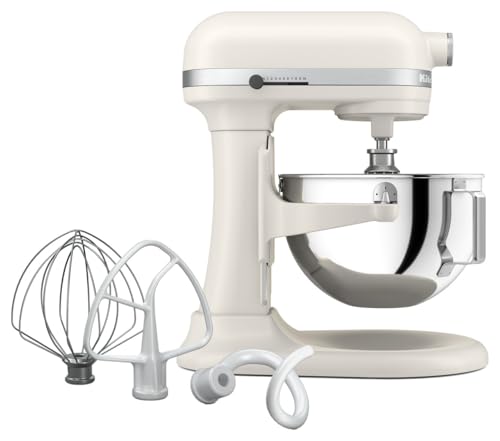
KitchenAid 5.5-Qt Bowl-Lift Stand Mixer KSM55, Porcelain White — Best Overall
The KSM55 in Porcelain White is the mixer for kitchens where bread is a weekly event. The bowl-lift design locks the stainless bowl onto a lifting arm rather than tilting the head, which keeps the machine planted and calm when a stiff dough starts slapping the bowl sides. Eleven speeds include the half-speed fold that folding-in flour and whipped egg whites actually requires — the difference between a sponge that rises and one that sighs. Porcelain White on this body reads warm and slightly creamy, closer to a ceramic than a fridge door.
Strengths
- Bowl-lift stability under heavy bread and pizza doughs
- 11 speeds with a true gentle fold setting
- 5.5-qt bowl handles double batches without overflow drama
Trade-offs
- Bowl-lift takes more vertical clearance and a moment longer to swap bowls
- Heavier than tilt-head rivals — it will live where you first put it
- The white finish shows dough splatter honestly; wipe-down is part of the ritual
| Detail | Verified from the listing |
|---|---|
| Capacity | 5.5-Qt stainless steel bowl (per Amazon title) |
| Speeds | 11 mixing speeds |
| Included | Flat beater, dough hook, wire whip |
| Design | Bowl-lift, Porcelain White |
Day to day, the KSM55’s virtues are quiet ones: the motor note stays even as dough comes together, the speed dial is precise enough to add flour at a speed that does not redecorate the kitchen, and the bowl handle is where your hand expects it. It is the pick for the baker who has outgrown a tilt-head’s wobble and wants the machine that ends the upgrade cycle. If your baking is cakes and cookies rather than loaves, the Artisan below is friendlier and lighter; if dough is the point, this is the white mixer to buy.
Best for: Bread bakers and double-batch households / Not suited for: Tight kitchens that store the mixer in a cupboard
Check the current price on Amazon

KitchenAid Artisan 5-Qt Tilt-Head Stand Mixer KSM150PS, Porcelain White — Best for Most Bakers
If you close your eyes and picture a white stand mixer, you are picturing something very close to the Artisan. The tilt-head design is its enduring genius: head back, bowl off, scrape down, head down — a rhythm home bakers have loved for decades because it matches how baking actually flows. Ten speeds cover the honest range from folding to whipping, the 5-quart bowl is the household sweet spot, and the included pouring shield tames the flour-cloud moment that every new baker meets exactly once.
Strengths
- Tilt-head access makes adding ingredients and scraping effortless
- Pouring shield included — cleaner flour additions from day one
- The deepest accessory ecosystem in stand mixers, if you expand later
Trade-offs
- Tilt-head can rock slightly under the stiffest doughs
- 10 speeds are plenty, but no half-speed fold like the KSM55
- White shows every bake — expect a quick wipe after each session
| Detail | Verified from the listing |
|---|---|
| Capacity | 5-Qt (per Amazon title) |
| Speeds | 10 speed settings |
| Included | Pouring shield |
| Design | Tilt-head, Porcelain White |
The Artisan’s case is balance. It kneads a standard loaf happily, whips a bowl of cream without complaint, and its footprint and weight are reasonable enough to slide back against the wall between bakes. It is not the dough specialist the bowl-lift is, and competition-level bread schedules will find its limits — but for the cakes, cookies, mash, meringues and weekly loaf of a normal keen household, it is the mixer that disappears into the routine. In Porcelain White it is also, simply, the prettiest object on most counters it lands on.
Best for: Most home bakers — cakes, cookies, weekly bread / Not suited for: Very heavy dough schedules
Check the current price on Amazon

Cuisinart Stand Mixer SM-50, 5.5 Quart, White Linen — Best Value Full-Size
Cuisinart’s SM-50 is the mixer that makes you check the spec sheet twice: 5.5-quart stainless bowl, twelve speeds, and all three core tools plus a splash guard with a pour spout in the box. White Linen is the gentlest white here — a soft, slightly warm off-white that sits comfortably in kitchens where a stark porcelain white would glare. For bakers who want full-size capacity without paying for the most famous badge in the category, this is the rational centre of the market.
Strengths
- 12 speeds and 5.5-qt capacity at a mid-tier position
- Complete tool set included: whisk, paddle, dough hook, splash guard
- White Linen finish is forgiving in warm-toned kitchens
Trade-offs
- Tilt-head stability under stiff dough trails the KitchenAid bowl-lift
- Accessory ecosystem is thinner than KitchenAid’s
- The die-cast body is substantial — plan its counter spot
| Detail | Verified from the listing |
|---|---|
| Capacity | 5.5 Quart stainless steel bowl (per Amazon title) |
| Speeds | 12 speed |
| Included | Chef’s whisk, mixing paddle, dough hook, splash guard |
| Finish | White Linen, SM-50NAS |
In use, the SM-50 covers the home repertoire completely: cakes come together cleanly, whipped cream peaks on cue, and a standard bread dough kneads without protest, if with a little more head movement than the bowl-lift KitchenAid shows. The speed control’s low end is well judged for adding dry ingredients, and the splash guard’s pour spout is the version of that accessory that actually gets used. Choose it when the budget matters and the baking is broad rather than extreme — it gives up bragging rights, not capability.
Best for: Full-size baking on a mid-tier budget / Not suited for: Dough maximalists
Check the current price on Amazon

KitchenAid Artisan Mini KSM3316X, White — Best for Small Kitchens
Small kitchens usually get offered toy mixers. The Artisan Mini is instead a real KitchenAid, scaled: the same tilt-head design and 10-speed range as its big sibling, wrapped around a 3.5-quart bowl sized for the batches small households actually make — a single loaf, a dozen cookies, a cake for four. In plain White it keeps the classic silhouette that makes the full-size machine a counter fixture, at a weight you can genuinely move one-handed when the counter needs to be a counter again.
Strengths
- Real stand-mixer performance in a compact, lighter body
- 3.5-qt bowl matches small-household batch sizes
- 10 speeds and tilt-head ease, same as the full Artisan
Trade-offs
- Double batches and big bread doughs are beyond its brief
- Fewer included accessories than the larger picks
- Per-quart, you pay for the miniaturisation
| Detail | Verified from the listing |
|---|---|
| Capacity | 3.5-Qt (per Amazon title) |
| Speeds | 10 speeds |
| Design | Tilt-head |
| Included | 3 accessories (per Amazon title) |
The Mini’s honesty is its charm: it does not pretend to feed a bake sale, and in return it never dominates the kitchen it serves. Apartment bakers, couples, and anyone whose mixer must share a counter with an air fryer and a coffee machine will find its footprint transformative — a stand mixer you can leave out is a stand mixer you actually use. If your household grows into double batches, it graduates gracefully to second-mixer duty for whipping and small jobs while a bigger machine takes the dough.
Best for: Apartments, couples and small batches / Not suited for: Double batches and bake sales
Check the current price on Amazon
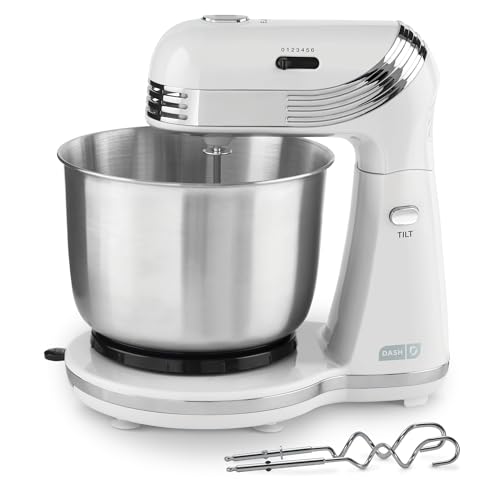
Dash Everyday Stand Mixer, White, 3-Quart — Best Budget
The Dash Everyday exists for a specific and honourable job: the baker who makes a cake or a batch of cookies a few times a month and wants a machine to do the creaming and mixing, without a serious appliance investment. Six speeds, a 3-quart stainless bowl and a tilt-head design cover that job description completely. In white it looks clean and cheerful on the counter, and its compact body stores in a cupboard without a negotiation — something none of the full-size picks can claim.
Strengths
- Lowest tier in this guide — an accessible first stand mixer
- Compact and light enough for cupboard storage
- Covers everyday cakes, batters and frostings without fuss
Trade-offs
- Not a bread-dough machine — stiff doughs are beyond it
- 6 speeds and a smaller motor mean less finesse at the extremes
- Build is lighter throughout; treat it as an appliance, not an heirloom
| Detail | Verified from the listing |
|---|---|
| Capacity | 3-Quart stainless steel bowl (per Amazon title) |
| Speeds | 6-speed |
| Design | Compact tilt-head |
| Finish | White |
Set expectations correctly and the Dash delights: butter and sugar cream properly, egg whites whip, batters come together evenly, and cleanup is a bowl and two beaters. Ask it to knead a stiff loaf weekly and you are shopping outside its design brief — the KitchenAids above exist for that cook. As a first mixer, a second-home mixer, or a gift for a young baker, it is the sensible white option at its tier, and its existence keeps the rest of this list honest about what money buys: capacity, dough strength and decades of service.
Best for: Occasional bakers and first stand mixers / Not suited for: Bread dough and heavy use
Check the current price on Amazon

Kitchen in the Box Stand Mixer 3.5QT, White — Best Compact Value
Kitchen in the Box has built its name on a demographic the big brands underserve: households of one or two, baking in real quantities for one or two. This 3.5-quart white mixer gives that household a proper 10-speed range — more granular control than the budget Dash — in a compact body, and makes the bowl dishwasher-safe, which for a small household is not a detail but the difference between baking on a weeknight and not bothering.
Strengths
- 10 speeds in a compact 3.5-qt format
- Dishwasher-safe bowl lowers the weeknight baking barrier
- Sized honestly for 1–2 person households
Trade-offs
- Small capacity rules out family-scale batches
- Brand support and accessory range trail the big names
- Dough work should stay within small, standard loaves
| Detail | Verified from the listing |
|---|---|
| Capacity | 3.5 QT (per Amazon title) |
| Speeds | 10-speed |
| Bowl | Dishwasher-safe |
| Design | Compact, for 1–2 people |
The comparison that matters here is with the Artisan Mini: the KitchenAid brings the deeper ecosystem and the famous build, while this machine brings a friendlier tier and cleanup that asks nothing of you. For a solo baker or a couple whose repertoire is cakes, pancakes, small loaves and whipped everything, it covers the map. Buy it as the right-sized tool rather than a stepping stone, and it will not feel like a compromise — it will feel like the first mixer that was actually designed around your kitchen.
Best for: One-to-two-person households wanting compact value / Not suited for: Family-scale baking
Check the current price on Amazon
Comparison Table
| Pick | Badge | Key spec | Best for |
|---|---|---|---|
| KitchenAid 5.5-Qt Bowl-Lift Stand Mixer KSM55, Porcelain White | Best Overall | 5.5-qt bowl-lift, 11 speeds, Porcelain White | Bread bakers and double-batch households |
| KitchenAid Artisan 5-Qt Tilt-Head Stand Mixer KSM150PS, Porcelain White | Best for Most Bakers | 5-qt tilt-head, 10 speeds, pouring shield | Most home bakers — cakes, cookies, weekly bread |
| Cuisinart Stand Mixer SM-50, 5.5 Quart, White Linen | Best Value Full-Size | 5.5-qt, 12 speeds, White Linen | Full-size baking on a mid-tier budget |
| KitchenAid Artisan Mini KSM3316X, White | Best for Small Kitchens | 3.5-qt tilt-head, 10 speeds, compact | Apartments, couples and small batches |
| Dash Everyday Stand Mixer, White, 3-Quart | Best Budget | 3-qt, 6 speeds, budget tier | Occasional bakers and first stand mixers |
| Kitchen in the Box Stand Mixer 3.5QT, White | Best Compact Value | 3.5-qt, 10 speeds, dishwasher-safe bowl | One-to-two-person households wanting compact value |
How to Choose a White Stand Mixer
Start with the head, because it decides how the mixer behaves under load and how it fits your cabinets. Tilt-head models — the Artisan, the Cuisinart, and both compacts here — swing the head back for bowl access and fit under standard wall cabinets more easily. Bowl-lift models like the KSM55 raise the bowl to the head instead, which keeps heavy dough work stable and calm, at the cost of height and a slightly slower bowl swap. Bread-heavy bakers should lean bowl-lift; cake-and-cookie bakers will be happier with tilt-head convenience.
Capacity is the second decision, and it is really a batch-size decision. A 3–3.5 quart bowl is right for one or two people and small cakes; 5–5.5 quarts covers family baking and double batches of cookies. Oversizing has a real cost beyond money: a big bowl does a poor job on a single egg white or a half-batch of frosting, because the beater cannot reach small volumes properly. Match the bowl to the batch you make most, not the batch you make at Christmas.
Then read the included-tool list before comparing anything else. A mixer that arrives with a flat beater, dough hook and wire whip is ready for the whole repertoire; one that arrives with beaters only will send you shopping before your first loaf. Every pick in this guide was checked for its in-box tools, and the reviews say plainly where a set is complete.
Finally, the white itself. Porcelain whites run warm and creamy; White Linen is a soft off-white; plain whites are brighter and cooler. In a white kitchen, mismatched whites are visible in a way mismatched blacks never are — if your cabinets and appliances are a warm white, the warm finishes above will blend; in a cool, grey-toned kitchen, the brighter whites sit better. All of them clean the same way: a damp cloth, promptly, and an occasional paste of bicarbonate for turmeric-level events.
Living With a White Mixer: Care and Counter Craft
A white mixer asks for one habit: wipe it while the bake is in the oven, not after dinner. Flour dust lifts off enamel with a dry cloth in seconds; butter splashes wipe clean with a damp one. The finishes on these machines — porcelain enamel and quality powder-coat — are chosen for exactly this life, and a white mixer that is wiped as a ritual stays bright for decades. What dulls white finishes is not use but neglect plus abrasive pads: keep scourers away from it and it will keep its gloss.
Placement matters more than owners expect. A stand mixer used weekly should live on the counter, plugged in, with the bowl on and the cord managed — every barrier between you and the machine is a bake that does not happen. Give it the spot with headroom to tilt or lift fully, slide it forward for dough work so it is not under a cabinet lip, and park the attachments in the bowl or a drawer within arm’s reach. The white finish earns its keep here: of all the colours a permanent counter appliance can wear, white is the one that makes a small kitchen look bigger and a busy one look calmer.
Dough, Batter and Cream: Matching the Mixer to the Mixture
Stand mixers are bought for a repertoire, so judge them against the three mixtures that stress them differently. Bread dough is the strength test: it loads the motor continuously, tries to climb the hook, and pushes back against the head — which is why bowl-lift stability and a dough speed designed for the job matter, and why the reviews above are blunt about which compact machines should stay away from stiff doughs. A mixer that kneads well will tell you in its sound: a steady, unbothered note from first mix to smooth dough.
Batters and cake mixes are the finesse test: the question is whether the beater reaches the bowl’s bottom and sides closely enough that you are not stopping every thirty seconds to rescue a flour pocket — the clearance adjustment described in the setup section is the difference between a mixer that incorporates and one that merely stirs. Cream and egg whites are the volume test: a whip with enough wires, a bowl shape that lets small quantities engage, and speeds that climb gradually so the first splash stays in the bowl. The Artisan-class machines earn their reputation by passing all three tests in one body; the compacts pass two brilliantly and should be forgiven the dough exam they were never built to sit.
Use the matrix in reverse when shopping: list your five most-made recipes, mark which test each one sets, and buy the mixer that passes your tests rather than the internet’s. A household of cakes and creams served by a compact white mixer will be happier than the same household wrestling an oversized bowl that cannot whip two whites — fit is a feature, and in white finishes across this guide, every size of fit is available.
Attachments and the Second Life of a Stand Mixer
A stand mixer’s first life is mixing; its second life is everything the attachment hub or ecosystem adds — pasta rollers, grain mills, mincers, slicers, ice-cream makers. KitchenAid’s hub is the deepest version of this idea, and it is a legitimate reason the Artisan picks anchor this guide: a machine bought for cakes in 2026 can be rolling fresh pasta in 2028 without a second motor on the counter. Cuisinart and the compact brands offer narrower ranges; if your ambitions are mixing-only, that costs you nothing.
The discipline is sequencing. Buy the mixer for its bowl, motor and included core tools — beater, hook, whip — and let attachments arrive as gifts and later decisions, one at a time, each earning its drawer space by being used monthly. The graveyard of stand-mixer ownership is the attachment bought in the first flush of enthusiasm and used twice. And keep the hub cap and fittings clean: flour works into every seam of a working mixer, and a thirty-second wipe after a bake — the white-mixer ritual this guide keeps recommending — is what keeps a decade-old machine looking like the counterpiece it is.
Storage of the tools themselves deserves one practical note: beaters and hooks live happily in the bowl, whips prefer not to be crushed under them, and the pouring shield — the accessory owners actually use weekly — should live on the bowl or in the nearest drawer, not in the box in the garage. A mixer’s ecosystem only exists if its parts are within arm’s reach at the moment of inspiration.
White Finishes Compared: Enamel, Powder-Coat and Care
Not all whites age alike, and since the finish is half the reason for this guide, it deserves a direct comparison. Porcelain enamel — the KitchenAid tradition — is glass fused to metal: the hardest, glossiest and most stain-resistant surface here, and the one most likely to look new in fifteen years. Quality powder-coat, used across much of the rest of the market, is a step behind in ultimate hardness but entirely serviceable, with a slightly softer sheen that many kitchens prefer. Painted plastic accents and trim are the weak point on budget machines: they yellow first in sunlight and mark first in use, which is a cosmetic tax the Dash-class picks pay for their tier.
Care is simple and identical in rhythm for all of them: wipe during the bake, not after the meal; use a damp cloth and mild detergent; reach for a bicarbonate paste, never an abrasive pad, on a turmeric or tomato event; and keep the machine out of a permanent sunbeam, which is ultraviolet slowly editing every white in the room, not just the mixer’s. Flour dust, the daily reality, is not a stain at all — it is a dry cloth and five seconds.
The deeper truth owners report is that white is the self-policing finish: because it shows the mess, it gets cleaned, and because it gets cleaned, it stays bright — while darker finishes quietly accumulate a film nobody sees until it is archaeology. If your kitchen runs warm-toned, the warm whites (Porcelain White, White Linen) will disappear into it; in a cool-toned kitchen, the brighter whites read as deliberate design. Either way, choose the finish family once, and let the machine be the calm white constant in a room that changes around it.
The Secondhand and Hand-Me-Down Question
White stand mixers have an unusual second life: the enamelled KitchenAids especially are inherited, gifted onward and bought used in a way few appliances are, because the design has been stable for decades and the machines are repairable. If a used white Artisan enters your life, the checks are simple: run it through its speeds listening for grinding or hesitation, knead one test dough to see the head’s behaviour under load, inspect the bowl and tools for damage, and check the beater clearance with the adjustment described earlier. A machine that passes those tests has years in it, and a deep clean plus a fresh wipe-down ritual usually returns an older white finish to surprising brightness.
The same longevity logic applies in reverse when buying new: a white mixer is one of the few kitchen purchases where ‘will I still like looking at it in ten years?’ is a practical question rather than an aesthetic one, because the good ones will still be there. That is the quiet argument for the classic silhouettes in this guide over fashionable redesigns — white, simple and proven is the combination that survives a decade of kitchen trends without looking dated.
Small Batches, Big Batches: Technique Notes
Small-batch technique rescues more disappointing bakes than any upgrade: chill the bowl for whipped cream in summer; bring butter to the cool, pliable stage — it should bend, not melt — before creaming; add eggs one at a time with a spoon of the flour if a batter threatens to split; and stop the mixer to scrape with intent, once midway, rather than anxiously every twenty seconds. In a compact 3.5-quart bowl these habits are the whole game, because small volumes punish sloppy sequencing proportionally harder.
Big-batch technique is about order and temperature: double recipes mix best when the dry ingredients are whisked together separately first, when liquids go in at low speed in stages, and when a dough is rested for ten minutes mid-knead to let the flour hydrate — the mixer works less, the dough develops more, and the machine’s head stays cooler. On the bowl-lift KSM55 and the full-size Artisan, a double batch of cookies is routine; on the compacts, bake the double batch as two singles and enjoy the fact that the second bowlful mixes while the first tray is in the oven. Right-sizing technique to the machine is what separates bakers who love their mixer from bakers shopping for its replacement.
Mixing for Special Diets Without Special Equipment
Modern home baking asks more of a stand mixer than the classic repertoire: gluten-free batters that behave like wet cement and then like soup, aquafaba and egg-white foams that need a patient, gradual whip, nut-butter-based doughs that load the motor in a low, grinding way. The full-size picks here handle that range without complaint — the whip work rewards the multi-wire whisks and the gradual low speeds, and the dough work rewards the bowl-lift’s calm. Compact owners should work in the smaller batches their bowls prefer and lean on the mixer’s patience rather than its power: special-diet baking is technique-led, and a right-sized machine in a practised hand outperforms a big machine used hopefully, every single bake.
Noise, Vibration and the Lived-In Kitchen
A stand mixer is an appliance you hear as much as use, and the models here have distinct voices worth choosing between. Bowl-lift machines under dough load produce a low, steady working note; tilt-heads are a touch brighter; compacts run at a higher pitch that carries further in a small flat. None is loud in absolute terms, but a household that bakes at 6 a.m. while others sleep will feel the difference, and the practical counters are universal: mix on a stable, level surface, keep the machine’s feet clean so it sits true, and let rubber shelf liner audition as a mat if vibration walks the bowl on a stone counter.
Vibration is information as well as annoyance: a mixer that begins to rock, chatter or walk under a familiar dough is telling you the load is beyond its brief or the head needs its adjustment checked. Listen to your machine the way you listen to a car — the change in the sound is the message. The white finish helps here in its own way: a machine you wipe after every bake is a machine you inspect after every bake, and small problems get caught at the damp-cloth stage rather than the repair stage.
The Counter Test: One Week of Real Life
Before the return window closes on any mixer, give it the week it will actually live: a batter, a foam, a dough within its brief, a midweek pancake emergency, and the daily reality of sliding it back against the wall and wiping it down. Machines reveal themselves in that week — the head that is awkward at your counter’s height, the bowl handle your hand keeps missing, the speed dial your floury fingers love or hate. The picks in this guide were chosen to pass that week in their respective households, but your counter, your hands and your recipes are the final reviewers. Trust the week over the unboxing: a mixer is a ten-year colleague, and the interview should be a working one.
How to Set Up and Get the Best From a New Stand Mixer
Ten minutes of setup on day one prevents the three classic new-mixer disappointments: the flour explosion, the walking mixer, and the beater that misses the bowl bottom.
- Wash the bowl and tools in warm soapy water before first use, dry them fully, and run the empty mixer for ten seconds at low speed to confirm everything seats and locks as it should.
- Check beater-to-bowl clearance: the flat beater should pass close to the bowl bottom without striking it. Most models have an adjustment screw in the head or hinge — the manual shows it, and five minutes here ends a lifetime of unscraped bowl bottoms.
- Learn the flour discipline: add dry ingredients at the lowest speed, in two or three additions, using the pouring shield if your model includes one. Every ‘this mixer is messy’ story begins with flour added at speed six.
- For dough, respect the flour-power reality: knead at the maker’s recommended dough speed (usually speed 2), keep batches within the bowl’s honest capacity, and let the machine rest if the head grows hot on a long knead.
- Sequence a test bake: something forgiving — a simple sponge or a batch of cookies — to learn your machine’s speeds and sounds before a celebration cake depends on them.
- Store the tools with the machine: beaters and hooks in the bowl or the drawer beside it, the whip where it will not bend. A mixer whose tools are findable is a mixer that gets used.
After a month, revisit the clearance adjustment — new machines settle, and a beater that was perfect in week one can drift. And keep the white finish’s one ritual: a thirty-second wipe while the oven does the work. That is the entire maintenance contract of a white stand mixer, and it is a light one.
Common Buying Mistakes
Buying capacity for the biggest day of the year. A 7-quart bowl that cannot whip two egg whites properly is a bad trade for 360 days to serve five. Size for your normal batch; borrow, split or sequence for the exceptional one.
Assuming all whites match. Porcelain White, White Linen and bright white are visibly different next to cabinets and appliances. Decide whether your kitchen runs warm or cool, and pick the finish family that belongs to it.
Adding flour at speed. The flour cloud is not the mixer’s personality; it is a technique error. Lowest speed, staged additions, shield on — the problem disappears permanently.
Kneading beyond the machine’s brief. Compact and budget mixers are honest cake machines that will strain and walk under stiff dough. If bread is weekly, buy the bowl-lift or full-size tilt-head and let the small mixers do what they are built for.
Judging by the accessory mountain. Pasta rollers and grain mills are wonderful — later. The purchase decision should rest on bowl, motor behaviour and included core tools. Accessories can join a good machine any time; they cannot rescue a weak one.
Hiding it in a cupboard. A stand mixer stored deep is a stand mixer retired. If counter space is the constraint, choose a compact pick you can leave out — the best white mixer is the one that is plugged in when inspiration arrives.
Final Recommendation
For most bakers, the KitchenAid Artisan in Porcelain White is the white mixer: balanced, beautiful and equal to a normal household’s whole repertoire. Bread-led kitchens should step up to the bowl-lift KSM55; value-led full-size shoppers to the Cuisinart SM-50 in White Linen. Small kitchens split by budget: the Artisan Mini for the classic build, the Kitchen in the Box for compact value, and the Dash Everyday as the honest entry point.
Whichever white you choose, do the day-one clearance check and learn the low-speed flour habit. A stand mixer is a decade-long kitchen companion — in white, it is also the hardest-working piece of calm in the room.
Related reading: Best White Paint For Smokers House · Best 1.6 Cu Ft White Microwaves · Best 36 Inch White Electric Cooktops · Best White Queen Cotton Sheet Sets · Best White Towels Stay Fresh · Best White Dining Chairs
Frequently Asked Questions
Does a white stand mixer stain or yellow over time?
Quality porcelain enamel and powder-coat finishes resist staining well; turmeric and tomato can mark any finish if left sitting, which is why the wipe-as-you-bake habit matters. Yellowing is a problem of cheap plastics in sunlight, not of the enamelled metal bodies on the main picks in this guide. Keep the mixer out of permanent direct sun and wipe spills promptly, and white stays white.
Is bowl-lift or tilt-head better?
Bowl-lift is more stable for heavy bread dough and suits bakers who knead often; tilt-head is quicker for adding ingredients, scraping and swapping bowls, and fits more easily under cabinets. Neither is universally better — match the mechanism to your baking. Dough-led: bowl-lift. Cake-and-cookie-led: tilt-head.
What size stand mixer do I need for a family?
A 5 to 5.5-quart bowl covers family baking comfortably — double batches of cookies, a family cake, a standard loaf. Households of one or two are usually happier with 3.5 quarts, which handles small volumes properly. Oversized bowls struggle with small quantities because the beater cannot reach them.
Can a compact white mixer knead bread?
A compact mixer can knead a small, standard loaf if the maker rates it for dough — the Artisan Mini and the Kitchen in the Box both handle modest doughs. What compacts cannot do is stiff, large or back-to-back dough work. If bread is a weekly staple in quantity, buy a full-size machine.
Are white mixers harder to keep clean than other colours?
They show mess sooner, which is not the same as being harder to clean — flour and splashes wipe off white enamel exactly as they do off any colour, and seeing the mess means it gets wiped before it bakes on. Owners generally report white mixers end up cleaner in practice, because nothing hides.
Do white variants cost more than other colours?
Sometimes a colourway is priced differently from the same machine in another finish, and the difference moves with promotions. That is why this guide carries no fixed prices: check the current price on Amazon for the white listing itself before assuming it matches the headline price of another colour.


