Disclosure: airfryerkitchensupply.com is reader-supported. When you buy through links on our site, we may earn an affiliate commission at no extra cost to you.
Where to buy
Every pick in this guide to the best type smokers for beginners is a current model sold through Amazon, so you can compare the beginner-friendly types side by side and then check price on Amazon for the exact configuration you want. Use the Check on Amazon link under any pick to confirm the listing before ordering, and if a listing has drifted to a different variant, search the exact model name from our review instead of accepting a near-match substitute.
Masterbuilt 30-inch Digital Electric Smoker MB20071117 — Check on Amazon
Traeger Pro 22 Pellet Grill & Smoker — Check on Amazon
Weber Smokey Mountain Cooker 18-inch — Check on Amazon
EAST OAK 30-inch Electric Smoker — Check on Amazon
Z GRILLS ZPG 550B2 Pellet Smoker — Check on Amazon
Masterbuilt Gravity Series 600 — Check on Amazon
Introduction: Your First Smoker Should Teach You, Not Punish You
The best type smokers for beginners share one quality that has nothing to do with smoke flavor: they forgive. A first smoker will be overfilled, underfilled, opened too often, started too late and seasoned too enthusiastically, and the right type absorbs those mistakes and still produces dinner. The wrong type — usually a cheap offset bought because it looked the part — turns every beginner error into a ruined cook, and quietly convinces a lot of people that barbecue is not for them. It is for them. They just started on the hardest setting.
This guide ranks smoker types by how they treat a first-year owner. Electric cabinets and pellet grills automate the single hardest skill in barbecue — holding a steady temperature — so a beginner can concentrate on seasoning, timing and tenderness. Charcoal bullets ask a little more and teach a lot more. We have included one genuine fire-management cooker, the Weber Smokey Mountain 18-inch, for beginners who know they want to learn the craft properly, plus the Masterbuilt Gravity 600 as the step-up machine for people who expect to outgrow a starter cooker quickly. What you will not find here is an offset stick burner, and that is deliberate: it is the most demanding type in barbecue, and recommending one to a beginner is how patios end up decorated with rusting metal.
Every pick below was verified as a current, real model through Amazon listing. For each one we explain what your first cook actually looks like, what the type does for you automatically, what it still expects you to learn, and the honest ceiling you will hit if you stay with it for years.
In this guide
Quick Picks
- Best Overall for Beginners — Masterbuilt 30-inch Digital Electric Smoker MB20071117: set the temperature, add chips through the side loader, and learn smoking without learning fire at the same time. Check on Amazon
- Best Hands-Off Type — Traeger Pro 22 Pellet Grill & Smoker: the pellet type holds temperature like an oven while feeding real hardwood smoke automatically. Check on Amazon
- Best First Charcoal Smoker — Weber Smokey Mountain Cooker 18-inch: the gentlest way to learn real charcoal fire management, with a water pan that forgives your early mistakes. Check on Amazon
- Best Budget Start — EAST OAK 30-inch Electric Smoker: a window, a built-in meat probe and a long-burning side chip loader make the electric type even easier to start on. Check on Amazon
- Best Pellet Value — Z GRILLS ZPG 550B2 Pellet Smoker: PID temperature control and 553 square inches make the pellet route accessible without the premium badge. Check on Amazon
- Best Grow-Into-It Pick — Masterbuilt Gravity Series 600: digital control today, real charcoal flavor for the cook you will become in two seasons. Check on Amazon
How These Picks Were Chosen
We judged every candidate type and model against a beginner’s first ten cooks, not against a competition scorecard. The criteria, in order: how automatically the cooker holds temperature; how much smoke flavor it delivers without technique; how forgiving it is of the classic beginner errors (opening the lid, under-seasoning, starting late, misjudging fuel); how much cleaning and storage burden it imposes on someone who has not yet built the habit; and whether parts, fuel and community knowledge are easy to find when something confuses you. Every model also had to be a current-production unit verified, with no safety recalls.
We weighted the first ten cooks because that is where smoker ownership is decided. A cooker that produces three good meals in its first month gets used for years; a cooker that produces two failures and one success in the same month gets listed for sale by spring. Flavor ceilings matter — and we state them plainly in every review — but for a beginner the floor matters more. The picks below raise the floor as high as each type allows.
The 6 Best Type Smokers for Beginners

Masterbuilt 30-inch Digital Electric Smoker MB20071117 — Best Overall for Beginners
An electric cabinet removes fire from the equation entirely. Inside the insulated box of the MB20071117, a heating element cycles on and off under digital control, wood chips smolder in a tray above it, and your food cooks on four chrome racks across 710 square inches. The feature that matters most for a beginner is the side wood chip loader: you twist in a fresh handful of chips without opening the door, so the temperature you set is the temperature the food actually experiences. Your first cook is genuinely simple — season a pork shoulder, set 225°F, load chips a few times, and learn what smoked meat tastes like while the machine handles the thermodynamics.
Strengths
- Digital temperature control with nothing to light, tend or extinguish — the lowest-stress first cooks in barbecue.
- Side chip loading preserves heat and smoke, removing the beginner’s most common self-inflicted problem: constant door opening.
- Outstanding for fish, cheese, jerky and sausage, the foods where gentle precision beats brute smoke.
Trade-offs
- Smoke flavor is mild because chips smolder rather than burn; brisket bark stays soft compared with charcoal or wood fires.
- Poultry skin will not crisp at cabinet temperatures — plan a short hot finish elsewhere for chicken.
- It needs a weather-protected outlet and a cover; the electronics do not forgive being left in the rain.
The honest ceiling: after a year you will know exactly what this type cannot do, and you will describe it the way most owners do — as the machine that taught them to love smoked food and still handles every salmon fillet and batch of jerky in the house. Many owners keep an electric cabinet permanently even after buying a bigger charcoal cooker, because the jobs it is best at are jobs the other types do awkwardly. As a first smoker it has the highest success rate of anything on this page.
Best for: true beginners, apartment and condo cooks, fish and jerky fans / Not suited for: brisket bark purists or off-grid cooking
Check on Amazon — check price on Amazon for the current MB20071117 listing.

Traeger Pro 22 Pellet Grill & Smoker — Best Hands-Off Type
The pellet type automates fire itself. Hardwood pellets sit in an 18 lb hopper and an auger feeds them into a fan-stoked fire pot, while a controller holds your dialed temperature across 572 square inches of cooking space, up to about 450°F. For a beginner, the experience is closer to using an oven than to running a smoker: fill the hopper, set the dial, put the meat on, and the machine manages the burn for hours. Unlike the electric cabinet, the smoke here comes from a genuine wood fire, so brisket, ribs and pork emerge tasting like barbecue rather than like oven food with a smoke accent.
Strengths
- Oven-simple operation with real hardwood smoke in a choice of pellet flavors — hickory, apple, cherry, mesquite and blends.
- Long unattended cooks are realistic from your very first month, including overnight pork shoulders.
- Grills credibly at its upper range, so one machine covers weeknight burgers as well as weekend brisket.
Trade-offs
- Smoke intensity is cleaner and lighter than charcoal; your brisket will be very good, not transcendent.
- Pellets must be stored bone dry — humidity-swollen pellets jam augers, the classic pellet-grill beginner failure.
- Moving parts and electronics mean more maintenance than a charcoal cooker: vacuum the fire pot, keep the grease path clear.
Choose the Pro 22 if your life has the least slack in it. It is the pick for the beginner who wants barbecue to fit around work and family rather than reorganizing a Saturday around a fire. The skills it teaches — seasoning judgment, wrapping decisions, tenderness testing, rest discipline — are the skills that transfer to every other type later, while the fire skill it skips is the one you can learn any time on a cheap kettle if curiosity strikes.
Best for: busy beginners who want real smoke with oven effort / Not suited for: cooks without outdoor power or anyone chasing competition bark
Check on Amazon — check price on Amazon for the current Pro 22 configuration.
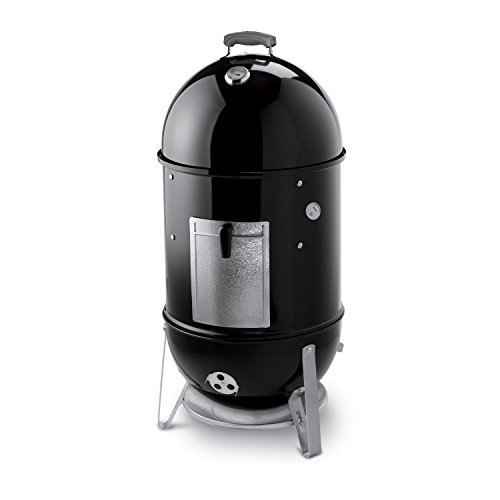
Weber Smokey Mountain Cooker 18-inch — Best First Charcoal Smoker
The bullet smoker is where beginners who want to learn fire go, and the 18-inch Smokey Mountain is its kindest teacher. The design is a porcelain-enameled steel tower: charcoal and wood chunks in the base, a large water pan above the fire, and two cooking grates above that. The water pan is the beginner’s best friend — it absorbs temperature spikes, adds humidity, and widens the margin between “slightly overcooked” and “ruined” on every early cook. There are no electronics and nothing to plug in; temperature is managed with the bottom and top vents, and the cooker settles into a steady burn with a predictability that surprises most first-time owners.
Strengths
- Deep, genuine charcoal-and-wood smoke flavor that automated types approximate but do not equal.
- The water pan makes temperature forgiving while you learn vent control — the core skill of all charcoal cooking.
- Nothing electronic to fail, every part replaceable, and a vast community of owners documenting every technique you will ever need.
Trade-offs
- You are the thermostat: long cooks need occasional vent and fuel attention, especially in wind or cold weather.
- The middle section lifts off for lower-grate access, which takes two hands and a plan when the cooker is hot and full.
- Ash cleanup and charcoal storage are part of the routine; this type is tidier than an offset but messier than pellets.
The 18-inch size is the right starting point for most households — big enough for a brisket or two pork shoulders, small enough to heat efficiently for a single rack of ribs. Expect your first cook to run a little hot while you learn the vents, your second to be close, and your third to feel like a skill you own. That learning curve is the product here. If reading that paragraph sounds appealing rather than tiring, this is your smoker, and it may still be your smoker in ten years.
Best for: beginners who want to learn real fire craft and love charcoal flavor / Not suited for: anyone who wants to set a dial and leave for the day
Check on Amazon — check price on Amazon for the current 18-inch listing.

EAST OAK 30-inch Electric Smoker — Best Budget Start
EAST OAK’s 30-inch cabinet takes the electric type — already the easiest way to start — and removes two of its small frictions. A clear viewing window and a built-in meat probe mean a beginner can watch the food and read its internal temperature without opening the door, which is the single behavior that wrecks more first cooks than any other. Its side chip loader is designed to stretch a single load of chips across a much longer stretch of the cook, so the rhythm of the day is calmer. Across roughly 725 square inches there is room to learn on forgiving foods and still feed a gathering.
Strengths
- Window plus built-in probe directly attack the beginner’s door-opening habit, the top cause of temperature chaos.
- Long-burning chip loading means fewer interventions during the exact hours a new owner is most anxious.
- Sits in the budget tier of the electric category while keeping the digital controls that make the type beginner-proof.
Trade-offs
- Same structural limits as all electric cabinets: mild smoke, soft bark, no crisp poultry skin without a hot finish.
- The window clouds with smoke residue and needs regular cleaning to stay useful.
- Brand ecosystem and long-term parts depth are thinner than Masterbuilt’s.
This is the pick for the beginner who wants the gentlest possible on-ramp at the friendliest tier of the market. Start with salmon, chicken thighs finished under a broiler, sausages and a pork shoulder, and you will build a season of wins before you ever attempt a brisket. If budget is the deciding factor in your household, this cooker respects it without punishing you for it.
Best for: budget-conscious first-time buyers and visual learners who want to watch the cook / Not suited for: heavy smoke seekers
Check on Amazon — check price on Amazon for the current EAST OAK 30-inch listing.

Z GRILLS ZPG 550B2 Pellet Smoker — Best Pellet Value
The ZPG 550B2 is the pellet type with the premium badge removed. A PID controller — the more precise generation of pellet temperature management — holds your set temperature across 553 square inches, with an included meat probe and the same auger-and-fan automation that makes the category so beginner-friendly. For a new owner, PID control matters in a practical way: the temperature swings that make a first brisket stressful are smaller, so the food forgives you while you learn everything else.
Strengths
- PID temperature holding reduces the swing-and-guess cycle that discourages new pellet owners.
- Full pellet convenience — hopper, auger, automatic ignition — at a value tier of the category.
- 553 square inches is honestly sized for a family: a brisket, or ribs for a small party, without heating a cavern for two chicken breasts.
Trade-offs
- Fit, finish and long-term parts support trail the category leaders; treat the cover as essential, not optional.
- Like all pellet grills it needs power, dry pellet storage and periodic fire-pot cleaning.
- Smoke profile is the clean, mild pellet signature — a feature for poultry and fish, a limit for bark chasers.
Choose the ZPG 550B2 if you have decided the pellet type is right but the flagship names stretch the budget further than the hobby has yet earned. It teaches the same lessons, cooks the same first-year menu, and leaves room in the budget for the thermometer, cover and pellet supply you genuinely need. Beginners routinely under-buy accessories and over-buy the cooker; this pick reverses that error.
Best for: value-focused beginners set on the pellet type / Not suited for: buyers who prioritize decade-long brand support above all
Check on Amazon — check price on Amazon for the current ZPG 550B2 listing.

Masterbuilt Gravity Series 600 — Best Grow-Into-It Pick
Some beginners know themselves well enough to predict year two: they will want charcoal flavor, and a starter cooker will feel like a compromise by then. The Gravity Series 600 is built for that person. Charcoal sits in a gravity-fed hopper and burns at the base under fan control, with a digital thermostat and WiFi monitoring holding temperature across 600 square inches. On day one it behaves like the automated types — set the temperature and cook — but the smoke it lays down is real charcoal smoke, and it can also run genuinely hot for searing, which no other pick here except the bullet can claim in its own way.
Strengths
- Charcoal depth of flavor with digital, set-and-hold control from your very first cook.
- Fast heat-up and real searing range make it a credible grill replacement as your skills grow.
- Long hopper burns cover overnight cooks without refueling rituals.
Trade-offs
- More to learn than a pure starter: charcoal sizing, hopper behavior and ash management join the beginner curriculum.
- Electronics plus charcoal means both maintenance worlds apply — dry storage, cover, and ash discipline.
- It sits in a higher tier than the electric and bullet starters; you are paying now for the cook you expect to become.
Buy the Gravity 600 if you have already cooked on other people’s charcoal smokers, know you love that flavor, and want automation as training wheels rather than as the destination. It is the only pick here that a beginner can plausibly still call their main cooker five years later without an asterisk.
Best for: ambitious beginners who want charcoal flavor without fire-tending / Not suited for: absolute first-time cooks wanting the simplest possible start
Check on Amazon — check price on Amazon for the current Gravity Series 600 listing.
Comparison Table
| Pick | Badge | Key Spec | Best For |
|---|---|---|---|
| Masterbuilt MB20071117 | Best Overall for Beginners | 710 sq in electric, side chip loader | Stress-free first cooks |
| Traeger Pro 22 | Best Hands-Off Type | 572 sq in, 18 lb pellet hopper | Real smoke, oven effort |
| Weber Smokey Mountain 18 | Best First Charcoal | Water pan, two grates, no electronics | Learning fire craft |
| EAST OAK 30-inch | Best Budget Start | ~725 sq in, window + probe | Gentlest low-cost start |
| Z GRILLS ZPG 550B2 | Best Pellet Value | 553 sq in, PID control | Pellet type on a budget |
| Masterbuilt Gravity 600 | Best Grow-Into-It | 600 sq in, gravity charcoal + WiFi | Charcoal flavor, automated |
How to Choose Your First Smoker Type
Decide first how much of the process you want to own. Barbecue has three jobs: holding temperature, generating smoke, and judging the meat. Automated types — electric and pellet — do the first two for you, leaving you the third, which is the job that actually improves your cooking fastest. Manual charcoal asks you to do all three from day one. Neither answer is more virtuous; they are different hobbies wearing the same apron. The beginner who cooks twice a month on an automated smoker learns more in a season than the beginner who fights an offset four times and quits.
Next, match the type to your space rules. Balconies and some patios prohibit open flame, which makes electric the only legal answer in many buildings. Pellet and gravity cookers need a dry corner and an outlet within cord reach. Charcoal needs ash disposal and a safe surface. Check your lease, your local fire rules and your storage before falling in love with a type, because a smoker you cannot legally or practically run is not a bargain at any tier.
Then think about your menu. If your imagination runs to salmon, jerky, cheese and sausages, the electric cabinet is not the compromise — it is the specialist. If it runs to brisket with a dark, firm bark, be honest that electric and pellet will get you close but not all the way, and weigh the bullet or the Gravity 600. If it runs to everything, in quantity, on Saturdays, the pellet type’s combination of capacity and calm is hard to beat for a first year.
One more beginner-specific filter: community size. A first-year owner will have fifty questions, and the types and models with large owner communities — Traeger, Weber, Masterbuilt — have effectively already answered all of them in searchable form. An obscure cooker with no community leaves you alone with the manual at the exact moment you most need a stranger’s hard-won trick. That invisible support network is a genuine feature, and it is one reason the picks on this page lean toward established names.
Finally, budget for the whole hobby, not the box. A dual-probe thermometer, a fitted cover, fuel for the season, heat-resistant gloves and a chimney starter if you go charcoal will together decide more of your early success than the difference between two cookers in the same type. The picks above were chosen partly on this basis: each leaves a sane household budget room to equip itself properly.
Your First Five Cooks: A Beginner Curriculum That Works on Any Type
Cook one: chicken thighs or a whole spatchcocked chicken. Poultry is inexpensive, cooks in one to two hours, and teaches you your cooker’s hot spots and your seasoning hand. On electric and pellet types, finish briefly at high heat or under a broiler for skin. Cook two: ribs, using the bend test — pick the rack up with tongs and watch for the bark to crack — rather than a clock. Ribs teach smoke management and the difference between “done” and “tender.”
Cook three: a pork shoulder, the most forgiving long cook in barbecue. It will stall — the temperature will plateau for hours as moisture evaporates — and learning not to panic at the stall is a rite of passage on every type. Cook four: salmon or another fish, low and gentle, which teaches temperature delicacy and shows you the mild side of your smoker. Cook five: repeat whichever cook disappointed you most, changing exactly one variable. That discipline — one change at a time, notes after every cook — is the entire difference between owners who improve and owners who plateau, and it works identically on a budget electric cabinet and a premium pellet grill.
Keep a simple log from the very first cook: date, meat, weight, rub, fuel, set temperature, weather, when you wrapped, when it probed tender, and one honest sentence about the result. It feels excessive for exactly one week. After that it becomes the most valuable barbecue book you own, because it is about your cooker, your climate and your taste — and when a cook disappoints you, the log tells you which single variable to change next time instead of leaving you to guess among six.
Two habits protect every early cook. First, cook to tenderness cues, not times: a probe should slide into brisket and shoulder with almost no resistance. Second, rest meat properly — large cuts need at least an hour wrapped — because a rested mediocre cook beats an unrested good one at the table. Master those two habits in your first five cooks and your type choice almost stops mattering.
How to Set Up and Season a New Smoker
Unbox on a level, non-combustible surface with the clearances your manual specifies — every type on this page produces heat and exhaust, and “it seemed fine” is not a clearance standard. Wash removable racks with warm soapy water to clear manufacturing oils, dry everything thoroughly, then run the cooker empty at a moderate temperature for the seasoning burn your manual describes, with a light coat of high-heat cooking oil on interior surfaces if the manufacturer recommends it. This burn is not optional theater: it removes residues you do not want on your first chicken and lays down the first layer of protection on the steel.
During that first empty run, practice the controls with nothing at stake. On electric and pellet types, set a temperature and watch how long stabilization takes and how much the display wanders. On the bullet, light a small fire and rehearse vent adjustments — a quarter-turn at a time, then wait — so your hands learn the patience your first real cook will demand. Note where the smoke leaks and where the heat concentrates. A cooker you have rehearsed on is a cooker you will not panic over.
Also during the empty run, learn your cooker’s sounds and smells while everything is safe. A pellet grill’s auger cycle, a cabinet element’s click, the faint tick of expanding steel on the bullet — these become your background diagnostics later, the things that tell an experienced owner “that doesn’t sound right” before any thermometer moves.
Before the first food cook, assemble your support kit in one place: thermometer with at least one food probe and one grate probe, gloves, a spray bottle, foil for wrapping, fuel staged and dry, and a notebook. Beginners consistently discover mid-cook that something lives in a drawer across the house; five minutes of staging removes that failure mode entirely.
Temperature Control, Explained the Way a Beginner Actually Experiences It
Every beginner question eventually becomes a temperature question, so it pays to understand what your type is doing. On an electric cabinet, a thermostat switches the element on and off around your set point; the temperature graph looks like a gentle wave, and the food does not care. On a pellet grill, the controller feeds pellets in cycles — smarter PID controllers, like the one in the Z GRILLS pick, vary those cycles finely, while simpler controllers swing wider. A swing of 15 to 25 degrees around your target is normal on pellet equipment and is not a defect; barbecue is cooked across hours, and the average is what the meat experiences.
On the charcoal bullet, you are the controller, and the physics are slower and more honest. Charcoal burns as fast as oxygen reaches it, so the bottom vents are your throttle and the top vent should stay mostly open to keep smoke flowing rather than stagnating. Changes take ten to fifteen minutes to show themselves, which is why beginners overshoot: they adjust, see nothing, adjust again, and twenty minutes later the cooker is racing. The water pan damps all of this — it is a thermal flywheel — and it is the main reason we steer charcoal-curious beginners to the bullet instead of a kettle or an offset, where there is no such forgiveness built in.
The gravity cooker splits the difference: a fan does the vent work, stoking the charcoal fire when the probe asks for heat and idling when it does not. Your job shrinks to choosing charcoal that feeds smoothly and keeping the hopper filled. Across all types, one tool upgrades a beginner more than any other: a grate-level thermometer probe, because the temperature that matters is the one beside the meat, and lid thermometers — where fitted — routinely read differently from grate level. Trust the probe at the grate, cook to the probe in the meat, and the mysteries of your first season mostly evaporate.
Wood Choices for Your First Season: Flavor Without Tears
Beginners overthink wood and underthink smoke quality, when the reverse would serve them better. For your first season, keep the wood library small: a mild fruitwood such as apple or cherry for poultry, pork and fish; a medium wood such as oak or pecan for beef and ribs; and hickory as your strong option, used sparingly until you learn your own taste. Mesquite is the wood most likely to punish a beginner — it burns hot and flavors aggressively, and a heavy hand with it is behind many “smoking isn’t for me” stories that were really seasoning errors.
Form matters by type. Electric cabinets use chips, which should be dry — soaking chips mostly delays smoke with steam and is a habit worth skipping. Bullets and kamados use chunks buried in the charcoal, which ignite gradually and flavor the cook in waves. Pellet grills take their wood as the fuel itself, so changing flavor means changing the hopper’s contents; blends are the pragmatic beginner choice, giving balanced flavor without commitment to a single species. Gravity cookers accept chunks in the ash pan for an extra layer of smoke over the charcoal base.
Above species and form sits the rule that decides whether any of it tastes good: smoke should be thin and pale, almost blue, never thick and white. Thick white smoke means an inefficient, smoldering burn, and it coats food with bitter compounds no seasoning can rescue. On automated types this state is rare and usually means a dirty fire pot or damp fuel. On the bullet it means the fire is choked — open the top vent, let the fire breathe, and wait for the smoke to thin before the meat goes on. Learn to read smoke color in your first season and you have learned the deepest skill in barbecue, the one every type on this page is ultimately trying to manage for you or teach you.
Safety and Placement Basics Every New Owner Should Know
Smokers are outdoor appliances, full stop. Every type in this guide — including the electric cabinets that look kitchen-adjacent — belongs outside, on a level, non-combustible surface, with the clearances from walls, fences and overhangs that the manual specifies. Carbon monoxide is the reason there are no exceptions: charcoal, pellets and even smoldering chips produce it, and a garage with the door open is still an enclosed space. Set up where smoke drifts away from windows and neighbors’ patios if you can; courtesy costs nothing and prevents the one complaint that can end a hobby in an apartment setting.
Fire safety for beginners reduces to three habits. First, manage grease: drip pans emptied, grease paths kept clear on pellet grills, and never let a cabinet’s floor become a grease reservoir, because accumulated grease plus a long hot cook is the recipe behind most smoker fires. Second, dispose of ash like it is still alive — because it can be, for up to 48 hours. Ash goes into a metal container with a lid, on a non-combustible surface, away from the house, before it ever meets a trash bin. Third, keep the extinguisher you hope to never use: a rated fire extinguisher within reach, and the knowledge that a grease fire gets the lid closed and the fuel or power cut, never a splash of water.
Electrical safety matters on four of our six picks. Use a properly rated outdoor outlet, keep connections off wet ground, and do not run a smoker on a lightweight indoor extension cord. In rain, the correct move for electric and pellet types is a covered cooking position or a postponed cook; water and heating elements are a combination no brisket justifies. None of this is meant to alarm — millions of people run these cookers safely every weekend — but the beginner season is exactly when these habits form, and they should form correctly.
Common Buying Mistakes Beginners Make
The most expensive mistake is buying the type your most opinionated friend owns. Their schedule, palate and patience are not yours, and their “anything else is cheating” stance is a personality trait, not buying advice. The second mistake is buying an offset as a first smoker because it looks like the ones on television. Television edits out the fourteen hours of fire tending; your Saturday will not.
The third mistake is oversizing. A huge cooker bought for the one annual party spends fifty weekends heating empty space, burning extra fuel and cooking small meals badly. Buy for your monthly cook, rent or borrow capacity for the annual one. The fourth mistake is skipping the cover and the thermometer to stay “under budget” — together they protect the cooker and the food, and their absence costs more than they do. The fifth mistake is judging the hobby by the first cook. Every type has a learning curve measured in cooks, not hours; give yours five honest attempts with notes before you decide anything.
A quieter mistake is ignoring your building’s rules until the cooker arrives. Balcony fire codes, HOA restrictions and lease clauses have ended more beginner barbecue careers than bad brisket ever has. Five minutes of checking before you order is the cheapest step in this entire guide.
What Beginner-Friendly Costs You Later — the Honest Trade
It is worth stating plainly what you give up when you choose an easy type, because you will read about it in forums within a month of buying. Automated smokers trade a measure of smoke depth and bark quality for consistency and free time. Your pellet brisket will be juicy, tender and pleasantly smoky; it will not have the mahogany, almost-crunchy bark of a log-fired brisket, and a competition judge would score them differently. Your electric-cabinet ribs will be tender and mild; a charcoal cook’s ribs will carry an extra layer of flavor you can taste blindfolded. These are real differences, and pretending otherwise would be dishonest.
But the comparison that matters is not your food against a pitmaster’s — it is your food against what you would actually have cooked otherwise. A beginner on an offset often produces, in month one, one dry brisket, one undercooked shoulder and a growing reluctance to try again. A beginner on a pellet grill produces a month of good dinners and the confidence to attempt the brisket at all. Skills compound: seasoning judgment, meat selection, trimming, wrapping and resting learned on an easy cooker are permanent, and they transfer completely when — if — you later buy the demanding type. The cooks who sneer at easy smokers forget that the destination is dinner, not suffering. Choose the type that gets you cooking weekly; mastery follows mileage, and mileage requires a machine you do not dread.
Final Recommendation
For the typical beginner, the Masterbuilt MB20071117 electric cabinet is the safest first smoker money can buy: it removes fire from the learning process and produces a season of successful cooks while you build judgment. If you want real wood-fire flavor with the same calm, take the Traeger Pro 22, or the Z GRILLS ZPG 550B2 if the budget needs relief. If you know you want to learn charcoal properly, the Weber Smokey Mountain 18-inch is the finest first teacher in barbecue. And if you are the rare beginner certain they will want charcoal depth for years, skip the starter stage and take the Gravity Series 600.
Related guides in this cluster: Best Type Of Meat Smokers compares every smoker type head-to-head beyond the beginner lens, Best Uds Smokers covers the drum branch in depth, and for type-specific budget shopping see Best Electric Smokers Under $200 and Best Electric Smokers With Bluetooth.
Frequently Asked Questions
What is the easiest smoker type for a complete beginner?
Electric cabinet smokers are the easiest: set a digital temperature, add wood chips occasionally, and there is no fire to manage. Pellet grills are nearly as easy and add stronger wood flavor. Both let a beginner focus on seasoning and tenderness instead of fire control.
Should a beginner start with charcoal?
Only if learning fire management sounds like fun rather than work. A bullet smoker like the Weber Smokey Mountain is the gentlest charcoal starting point thanks to its water pan. If you mainly want good food with minimal fuss, start automated and add charcoal skills later.
How much should a beginner spend on a first smoker?
Think in tiers rather than a fixed number: budget-tier electrics and value pellet grills are legitimate starting points, while mid-tier buys better insulation, controls and parts support. Reserve part of the budget for a thermometer, cover and fuel — they matter more than a small step up in the cooker itself.
What should a beginner smoke first?
Chicken thighs or a whole chicken first, then ribs, then a pork shoulder. That order teaches hot spots, smoke control and the famous stall on forgiving, inexpensive meat before you attempt a brisket.
Do beginner smokers work in winter?
Yes, with expectations adjusted. Insulated electric cabinets and pellet grills with a thermal blanket hold temperature well; thin charcoal cookers burn more fuel and need wind shelter. Keep electronics dry and fuel stored indoors regardless of type.
Can I leave a beginner smoker unattended overnight?
Pellet grills and electric cabinets are designed for long, low-attention cooks, and many owners run pork shoulders overnight on them — with conditions: the cooker sits in a safe, clear position outdoors, the grease path is clean, fuel is sufficient, and a remote thermometer alarm watches the meat and the grate. Charcoal bullets can also run overnight once you know your unit’s burn rate, but a true beginner should earn a few daytime long cooks first before trusting any fire through the night.
When will I outgrow a beginner smoker?
Most owners feel the ceiling after one to two seasons, usually wanting deeper smoke, more capacity or both. Electric and bullet owners often keep their first cooker for the jobs it does best — fish, jerky, small cooks — even after upgrading.


