Disclosure: airfryerkitchensupply.com is reader-supported. When you buy through links on our site, we may earn an affiliate commission at no extra cost to you.
Where to buy
If you are shopping for the best stand mixers food processors, start with this verified shortlist. Every product in this guide — mixers and processors alike — was verified as a current Amazon listing before a link was attached, with capacities and functions taken from the listings themselves. We do not print prices; use each link to check price on Amazon and confirm the exact configuration, since both categories are sold in bundles that change what is in the box.
- Bosch Universal Plus Stand Mixer, 6.5-Qt, with Dough Hook Extender Bundle — Best System That Does Both
- KitchenAid Artisan 5-Qt Tilt-Head Stand Mixer KSM150PS, Contour Silver — Best Mixer With Processor Attachments
- KitchenAid 7-Cup Food Processor KFP0718 — Best Everyday Food Processor
- Cuisinart 14-Cup Food Processor DFP-14BCNY — Best Batch Food Processor
- Cuisinart Precision Master 5.5-Qt Stand Mixer SM-50, White Linen — Best Mixer for Processor-Curious Bakers
- Breville Sous Chef 12-Cup Food Processor BFP710 — Best Premium Food Processor
People searching for the best stand mixers food processors are usually asking one question in two ways: can one machine do both jobs, or do I need two? The honest answer is that a stand mixer and a food processor are built around opposite motions. A mixer works slowly and powerfully, orbiting a beater, whisk or hook through a bowl for minutes to build structure — creamed butter, whipped egg whites, developed dough. A processor works fast, spinning a blade or disc for seconds to cut — chopped onions, sliced potatoes, shredded cheese, pastry rubbed together in moments. Neither motion substitutes well for the other, which is why this guide covers both, plus the system machines that genuinely bridge them.
There are three sensible strategies, and this guide is organised around them. Strategy one: buy a stand mixer whose hub or drive accepts food-processing attachments, and let one motor serve both jobs — the Bosch and KitchenAid route. Strategy two: buy a dedicated mixer and a dedicated processor, each best at its own work — the classic two-machine kitchen. Strategy three: if your cooking is prep-heavy and your baking is light, buy the processor first and let a hand mixer cover the little mixing you do. The six products below cover all three strategies with verified, current listings.
What you will not find here is a claim that one box magically does everything brilliantly. Combination blender-processor units exist, but for the stand mixer jobs — real dough, real creaming — and the processor jobs — fast, even slicing and chopping — the machines below are the ones that respect the physics of both tasks.
In this guide
Quick Picks
Best System That Does Both — Bosch Universal Plus Stand Mixer, 6.5-Qt, with Dough Hook Extender Bundle: The true bridge machine: a dough-devoted stand mixer whose base also drives a wide food-processing accessory range. Check the current price on Amazon.
Best Mixer With Processor Attachments — KitchenAid Artisan 5-Qt Tilt-Head Stand Mixer KSM150PS, Contour Silver: The classic mixer platform whose powered hub accepts processing attachments, so one purchase can grow into both jobs. Check the current price on Amazon.
Best Everyday Food Processor — KitchenAid 7-Cup Food Processor KFP0718: The everyday processor pick: 7 cups, tidy in-bowl storage, and enough pace for daily chopping, slicing and shredding. Check the current price on Amazon.
Best Batch Food Processor — Cuisinart 14-Cup Food Processor DFP-14BCNY: The batch processor: 14 cups and a 720-watt motor for slaw, soup prep and cheese by the block. Check the current price on Amazon.
Best Mixer for Processor-Curious Bakers — Cuisinart Precision Master 5.5-Qt Stand Mixer SM-50, White Linen: A strong 5.5-quart mixer for bakers who process occasionally and would rather spend on mixing quality first. Check the current price on Amazon.
Best Premium Food Processor — Breville Sous Chef 12-Cup Food Processor BFP710: The premium processor for prep-led kitchens: 12 cups, dicing capability and a motor that shrugs at hard vegetables. Check the current price on Amazon.
How These Picks Were Chosen
We chose this six as a system, not as two separate lists stapled together. The two bridge-capable mixers (Bosch and KitchenAid) had to offer genuine processing routes through their own accessory ecosystems, verified from their listings and platforms. The dedicated processors had to cover the realistic home range — everyday 7-cup, batch 14-cup and premium 12-cup — with functions taken from their Amazon listing. The sixth slot went to a mixer for the reader who realises, reading this, that their cooking is 90 percent mixing and only occasionally processing.
Every product was verified as a current Amazon listing. Where a machine’s processing ability comes from optional accessories rather than the base box, we say so in its review, because the honest total cost of the ‘one machine’ strategy includes the attachments that make it true.
We also applied a truth-in-labelling filter to combination claims. Several machines in the wider market advertise themselves as complete kitchen systems on the strength of a blender jug and optimism. To earn a place here, a bridge machine needed a genuine, manufacturer-supported processing route — real slicing and shredding tools driven by the base — and the dedicated processors needed to be processors first, not blenders with a chopping anecdote. The six that remain are the ones whose claims survive contact with an actual onion.
The 6 Best Stand Mixers Food Processors — Reviewed
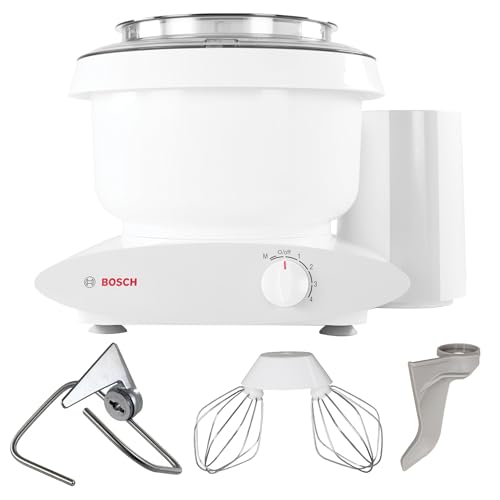
Bosch Universal Plus Stand Mixer, 6.5-Qt, with Dough Hook Extender Bundle — Best System That Does Both
The Bosch Universal Plus suits the cook who kneads seriously and processes regularly: its bottom-drive base is a dough specialist first, and the same base drives Bosch’s blender and food-processing accessories, making it the closest thing here to a genuine one-motor kitchen system.
Set against a food processor, the Bosch Universal Plus Stand Mixer, 6.5-Qt, with Dough Hook Extender Bundle plays the other half of the kitchen: where a processor’s blade chops and slices in seconds, this machine’s tools build structure — creaming, whipping and kneading over minutes — and a complete kitchen usually ends up wanting both halves.
Strengths
- Famous dough capacity: the bottom-drive design kneads large, heavy batches without the head bouncing
- The open-top bowl makes adding ingredients mid-knead the easiest of any design here
- A huge accessory ecosystem, from blenders to food processing attachments, driven off the same base
Trade-offs
- The whips-and-bowl arrangement is less intuitive for delicate batters until you learn it
- It looks and sounds different from a classic stand mixer, which puts some bakers off
- The plastic bowl on many bundles is practical but less premium-feeling than steel
| Specification | Detail |
|---|---|
| Bowl | 6.5 qt |
| Design | Belt-driven, bottom-drive bowl |
| Power | 500 watts (per listing) |
| Included | Wire whips, dough hook, NutriMill dough hook extender (bundle per listing) |
The Bosch Universal Plus is the bread baker’s open secret. Instead of a motor in a head above the bowl, the drive sits underneath, and the dough hook works the full mass of dough from the centre. The result is a machine that treats a big batch of wholemeal loaves as a warm-up rather than a stress test. This bundle’s dough hook extender helps smaller batches gather properly, answering the classic Bosch criticism. If flour goes into your bowl by the kilo, put this machine on your shortlist first.
Best for: bread bakers who also want one base for processing accessories / Not suited for: tiny kitchens with no storage for accessories
Check the current price on Amazon

KitchenAid Artisan 5-Qt Tilt-Head Stand Mixer KSM150PS, Contour Silver — Best Mixer With Processor Attachments
The KitchenAid Artisan suits the baker-first household that processes second: buy it as the mixer it superbly is, then add hub-powered processing capability when the need proves itself, rather than paying for a second motor up front.
The honest comparison for the KitchenAid Artisan 5-Qt Tilt-Head Stand Mixer KSM150PS, Contour Silver is not ‘mixer or processor’ but ‘which jobs dominate your cooking’; for the mixing jobs, this is the tool shaped for them, and the processors elsewhere in this guide cover the rest.
Strengths
- Ten speeds anchored by a true stir setting, so folding and flour-starting stay gentle
- The pouring shield in the box saves the first flour cloud most bakers otherwise wear
- A metal, serviceable build with the widest spare-bowl and beater market in home baking
Trade-offs
- You pay for the platform and the finish, not for extra bowl volume
- Under maximum dough loads the tilt-head can nod where a bowl-lift would not
- So many colours are listed that prices vary by finish — check more than one
| Specification | Detail |
|---|---|
| Bowl | 5 qt, stainless steel |
| Design | Tilt-head |
| Speeds | 10 speed settings |
| Included | Pouring shield, flat beater, dough hook, wire whip (per listing) |
Spend time with the Artisan and the appeal is not novelty but completeness. Every ordinary baking job — creaming, whisking, folding, a standard dough — is handled at the level a recipe assumes, and every extraordinary job is one attachment away rather than one appliance away. Owners describe a particular satisfaction: the machine stops being a purchase and becomes the kitchen’s fixed point, the thing recipes are planned around. In a category full of machines that do most things, the Artisan’s distinction is doing all the ordinary things without an asterisk.
Best for: bakers who want to add processing later via the hub / Not suited for: cooks who process daily at volume from day one
Check the current price on Amazon
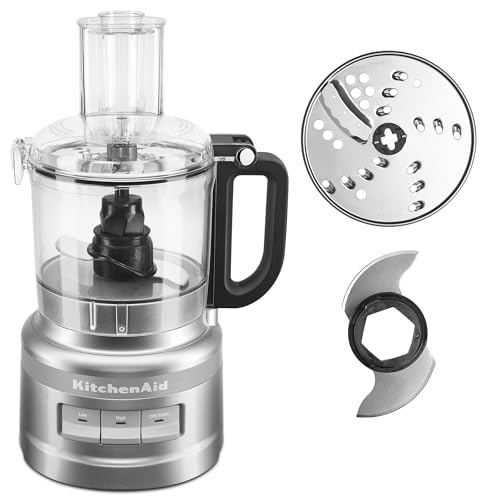
KitchenAid 7-Cup Food Processor KFP0718 — Best Everyday Food Processor
The KitchenAid KFP0718 suits daily prep cooks — the onion-a-day, salad-every-evening kitchen — who want a processor that stores its own sharp parts safely and comes out for five-minute jobs without a production.
Set against a food processor, the KitchenAid 7-Cup Food Processor KFP0718 plays the other half of the kitchen: where a processor’s blade chops and slices in seconds, this machine’s tools build structure — creaming, whipping and kneading over minutes — and a complete kitchen usually ends up wanting both halves.
Strengths
- All the blades and discs store inside the bowl — no drawer full of sharp loose parts
- Three speeds plus pulse cover chopping, shredding, slicing and puréeing for everyday prep
- The 2-in-1 feed tube handles both whole potatoes and slender carrots sensibly
Trade-offs
- Seven cups is mid-size: big slaws and double doughs will need batching
- It processes; it does not mix cake batter or whip like a stand mixer
- Disc-based slicing thickness choice is narrower than premium processors
| Specification | Detail |
|---|---|
| Capacity | 7-cup work bowl |
| Controls | Three speed control |
| Feed tube | 2-in-1 feed tube |
| Storage | All-in-one storage for blades and discs (per listing) |
The KFP0718 is the food processor for kitchens that prep daily but not industrially. Its cleverest feature is storage: everything nests in the bowl, which is why owners actually keep the discs in rotation instead of buried in a cupboard. For onions, slaw, grated cheese, salsa and pastry dough in home quantities it is quick and tidy. Pair it with a stand mixer and you have the classic two-machine kitchen, each doing the job its geometry suits.
Best for: everyday chopping, slicing and shredding for families / Not suited for: batch prep for crowds
Check the current price on Amazon

Cuisinart 14-Cup Food Processor DFP-14BCNY — Best Batch Food Processor
The Cuisinart DFP-14BCNY suits batch cooks: meal-prep Sundays, big families, garden gluts and anyone who has ever shredded one cabbage too many by hand. Its bowl and motor are sized for volume, not for a single onion.
The honest comparison for the Cuisinart 14-Cup Food Processor DFP-14BCNY is not ‘mixer or processor’ but ‘which jobs dominate your cooking’; for the mixing jobs, this is the tool shaped for them, and the processors elsewhere in this guide cover the rest.
Strengths
- The 14-cup bowl is genuine batch capacity for slaws, soups and big prep sessions
- A 720-watt motor keeps discs moving through hard vegetables without bogging down
- One of the longest-running, best-understood processor designs on the market
Trade-offs
- A large footprint and a bowl that is overkill for a single onion
- It will knead small doughs, but a stand mixer still develops dough better
- More parts to wash than a mini chopper after small jobs
| Specification | Detail |
|---|---|
| Capacity | 14-cup work bowl |
| Power | 720-watt motor (per listing) |
| Jobs | Mincing, dicing, shredding, purée and kneading dough (per listing) |
| Finish | Stainless steel |
The DFP-14BCNY descends from the machine that taught America what a food processor was, and the formula still works: a big bowl, a strong motor and discs that slice and shred at a pace no knife matches. For meal-prep Sundays — cabbage by the kilo, cheese by the block, pastry for a crowd — it earns its counter space in minutes saved. It complements rather than replaces a stand mixer: the processor is a blade doing prep, the mixer is a beater and hook doing structure.
Best for: meal prep and big-batch vegetable processing / Not suited for: small daily jobs where a mini chopper is faster to wash
Check the current price on Amazon

Cuisinart Precision Master 5.5-Qt Stand Mixer SM-50, White Linen — Best Mixer for Processor-Curious Bakers
The Cuisinart SM-50 suits the baker who processes rarely — breadcrumbs, pastry, the occasional pesto-scale job in a separate small tool — and would rather have mixing budget spent on a 5.5-quart bowl and 12 speeds.
Set against a food processor, the Cuisinart Precision Master 5.5-Qt Stand Mixer SM-50, White Linen plays the other half of the kitchen: where a processor’s blade chops and slices in seconds, this machine’s tools build structure — creaming, whipping and kneading over minutes — and a complete kitchen usually ends up wanting both halves.
Strengths
- A 5.5-quart bowl that takes the double batches a 5-quart bowl makes awkward
- Low speeds that genuinely creep, protecting whisked sponges and flour starts
- Splash guard with pour spout included — an extra that rivals charge for
Trade-offs
- The accessory world is Cuisinart’s own; no vast third-party ecosystem behind it
- At maximum dough the lighter frame is livelier than a bowl-lift’s
- White Linen and Onyx finishes show flour and cocoa differently — choose for your baking
| Specification | Detail |
|---|---|
| Bowl | 5.5 qt, stainless steel |
| Design | Tilt-head style head lift |
| Speeds | 12 speeds |
| Included | Chef’s whisk, mixing paddle, dough hook, splash guard with pour spout |
The SM-50’s character is quiet competence at a fair tier. It does not ask to be admired; it asks to be used, and in use its virtues are the practical ones — a bowl that fits the batch, speeds that behave at the bottom of the dial, a guard that keeps the work in the bowl. Bakers upgrading from hand mixers often land here and stop shopping, because the machine answers the questions they actually had. That is a higher compliment than any specification: it is the sound of a brief being met.
Best for: baking-first kitchens that process occasionally / Not suited for: prep-led cooking as the main event
Check the current price on Amazon

Breville Sous Chef 12-Cup Food Processor BFP710 — Best Premium Food Processor
The Breville Sous Chef 12 suits the vegetable-forward kitchen where prep is the main event: consistent slices for gratins, sealed-bowl purées, and dicing that turns soup prep into a ten-minute job.
The honest comparison for the Breville Sous Chef 12-Cup Food Processor BFP710 is not ‘mixer or processor’ but ‘which jobs dominate your cooking’; for the mixing jobs, this is the tool shaped for them, and the processors elsewhere in this guide cover the rest.
Strengths
- Breville’s Sous Chef line is known for strong motors and well-sealed bowls that handle liquids well
- 12 cups is the sweet spot between daily prep and batch cooking
- Dicing capability (per listing) goes beyond the standard slice-and-shred disc set
Trade-offs
- Premium pricing within the food processor category
- A second full-size appliance to store alongside a stand mixer
- Disc and blade storage needs a plan, as with all full-size processors
| Specification | Detail |
|---|---|
| Capacity | 12-cup capacity |
| Jobs | Chop, slice, shred and dice (per listing) |
| Finish | Brushed stainless steel |
| Maker | Breville Sous Chef line |
Breville builds the Sous Chef range for cooks who process with intent: consistent slices for gratins, sealed bowls for soups, and motors that do not flinch at hard roots. The 12-cup size covers most households’ biggest prep days without the storage pain of the largest bowls. In a stand-mixer-versus-processor decision, this is the machine that makes the strongest case for the processor side — if your cooking is vegetable-forward and prep-heavy, it may genuinely be the first machine to buy.
Best for: prep-heavy, vegetable-forward cooking / Not suited for: buyers who mainly need mixing and whipping
Check the current price on Amazon
Comparison Table
| Pick | Badge | Key spec | Best for |
|---|---|---|---|
| Bosch Universal Plus Stand Mixer, 6.5-Qt, with Dough Hook Extender Bundle | Best System That Does Both | 6.5 qt | bread bakers who also want one base for processing accessories |
| KitchenAid Artisan 5-Qt Tilt-Head Stand Mixer KSM150PS, Contour Silver | Best Mixer With Processor Attachments | 5 qt, stainless steel | bakers who want to add processing later via the hub |
| KitchenAid 7-Cup Food Processor KFP0718 | Best Everyday Food Processor | 7-cup work bowl | everyday chopping, slicing and shredding for families |
| Cuisinart 14-Cup Food Processor DFP-14BCNY | Best Batch Food Processor | 14-cup work bowl | meal prep and big-batch vegetable processing |
| Cuisinart Precision Master 5.5-Qt Stand Mixer SM-50, White Linen | Best Mixer for Processor-Curious Bakers | 5.5 qt, stainless steel | baking-first kitchens that process occasionally |
| Breville Sous Chef 12-Cup Food Processor BFP710 | Best Premium Food Processor | 12-cup capacity | prep-heavy, vegetable-forward cooking |
Stand Mixer vs Food Processor: What Each Machine Actually Does
A stand mixer builds structure over time. The flat beater creams butter and sugar into an aerated emulsion; the whisk traps air in egg whites and cream; the dough hook stretches and folds dough until gluten develops. These jobs take minutes of sustained, relatively slow work, and the result — texture — cannot be rushed. A food processor destroys structure at speed. Its blade and discs cut ingredients into smaller pieces in seconds: chopping, slicing, shredding, and rubbing fat into flour for pastry before the fat can melt. Ask each machine to do the other’s job and both fail instructively: a processor turns cake batter into soup and dough into a torn mess, while a mixer cannot chop an onion at all.
The overlap zone is real but narrow. Both can make pastry — the processor by cutting fat in quickly, the mixer by rubbing and binding more gently. Both can handle breadcrumbs, nut butters at a stretch, and emulsions like mayonnaise with the right technique. Everything outside that narrow band belongs clearly to one machine or the other, which is why the ‘which one first’ question is answered by your cooking, not by specifications: count last week’s recipes and see which motions dominate.
Capacity is measured differently, too. Mixer bowls are rated by volume but limited by flour weight for dough; processor bowls are rated by cups but limited by how much food the blade can move evenly. A 14-cup processor does not chop 14 cups of onions in one go to an even result — it does it in two calm batches instead of four cramped ones. Buy for the batch pattern you actually cook in.
The One-Machine Strategies, Honestly Assessed
The hub-and-accessory strategy — KitchenAid’s powered front hub, Bosch’s accessory drives — genuinely works, within limits. Attachment processors driven by a mixer motor handle slicing, shredding and chopping for family quantities perfectly well, and you store one motor instead of two. The limits are throughput and convenience: swapping attachments mid-recipe is friction, the working bowls are smaller than dedicated processors, and if the mixer is busy kneading, it is not available to slice. Households that cook one dish at a time rarely feel these limits; households that run a mixer and a processor simultaneously every Sunday will.
The other one-machine strategy is choosing the machine that matches your dominant cooking and letting the second job go to a small tool: a mini chopper for the baking-led kitchen, a hand mixer for the prep-led one. This is the strategy most small kitchens should choose, because the second machine in most homes is used a tenth as often as the first — and a small, cheap specialist beats a large, compromised generalist for occasional work.
Building the Two-Machine Kitchen in the Right Order
If you will eventually own both, order matters. Buy first the machine for the job you do weekly; its absence is costing you time or results every week. Buy second the machine for the monthly job, and buy it at the size your biggest regular occasion demands — the processor for the family slaw and holiday prep, not for Tuesday’s single onion, which a knife handles fine. The pairings in this guide are chosen to complement: the Bosch or Artisan as the mixing anchor, the KitchenAid 7-cup for daily processing or the Cuisinart 14-cup for batch work, and the Breville for kitchens where processing is the senior partner.
Storage is the hidden specification of the two-machine kitchen. A processor whose discs live in a separate box in a high cupboard will be used less than its specification deserves. The KitchenAid KFP0718’s in-bowl storage is a genuine ownership feature, and for the larger machines, plan the cupboard shelf before the machine arrives, not after.
Attachments in Detail: What Mixer-Driven Processing Really Includes
Mixer-driven food processing comes in two mechanical forms. Hub-driven attachments, the KitchenAid pattern, mount at the front of the head and typically offer slicing, shredding and dicing-style tools in a compact housing with its own small work bowl or a direct chute. Base-driven systems, the Bosch pattern, put the processing bowl on the same drive that turns the mixing bowl, and tend to offer larger capacity and a wider tool range because the platform was designed for it. Both forms share one trait: the motor is excellent — mixer motors are built for torque — so the cutting performance is rarely the weak point. The weak points are capacity per batch and the choreography of swapping systems mid-recipe.
Price the strategy honestly before committing. The attachment set that makes a mixer a processor is a real purchase, sometimes rivalling a mid-size dedicated processor, and it buys you smaller bowls and single-machine-at-a-time working. It still wins for many kitchens — one motor to store, one machine to maintain, family-scale processing on demand — but it wins on storage and simplicity, not on price. If a dedicated 7-cup processor costs about the same as the attachment set and you have the cupboard, the dedicated machine is the better tool; if the cupboard does not exist, the attachment set is not a compromise, it is the only version of the idea that fits your kitchen.
Matching the Pair to Your Cooking Style
Vegetable-forward cooking — stir-fries, slaws, soups, curries, gratins — is processor-led: the knife work is the labour, and the mixer is a supporting player for flatbreads, noodles and the occasional cake. For that kitchen, the Breville or the big Cuisinart should be the first and larger purchase, and the mixer can be the value pick. Baking-led cooking inverts the pairing: the mixer is the altar, the processor a useful side chapel for pastry, breadcrumbs and the odd salsa, and the 7-cup KitchenAid processor or even a hub attachment covers it entirely.
The genuinely mixed kitchen — the one that bakes on Saturday and batch-preps on Sunday — is where the bridge machines earn their complexity. A Bosch base driving both a dough bowl and a processing bowl across a weekend is a system, not a gadget, and households that cook that way feel the difference in cupboard space and in workflow. The mistake is buying the system for the cooking you admire rather than the cooking you do; count last month’s actual meals before choosing which machine leads.
How to Use a Stand Mixer and Food Processor Together in One Recipe
Take a chicken and vegetable pie as the model. Start with the processor for pastry: pulse the flour, salt and cold butter to a breadcrumb texture, add water through the tube and pulse just until the dough gathers — ninety seconds, no warm hands, no overworking. Rest the pastry in the fridge while the processor, rinsed, slices the leeks and carrots on its slicing disc in under a minute. The filling cooks on the stove; no machine is needed, and knowing when not to use one is part of the skill.
Now the mixer earns its place. If the pie is topped with a soft enriched dough or served with whipped accompaniments, the mixer’s sustained work — kneading, whipping — is the part no blade can imitate. For a cobbler-style topping, the beater creams butter and sugar properly, something a processor would simply melt into a paste. Sequence matters: process first (dry, clean jobs), mix second, and the wash-up is one bowl and one work bowl instead of a counter of gadgets.
Apply the same division everywhere. Processor: salsa, slaw, grated cheese, sliced potatoes, pastry, breadcrumbs. Mixer: cakes, frostings, whipped cream, meringue, dough, meatball and burger mixtures that need gentle combining rather than cutting. Mayonnaise and pesto sit on the border — the processor is faster, the mixer’s whisk gives a silkier emulsion — and either answer is defensible, which is exactly what a border job looks like.
Clean as you sequence: processor parts rinsed immediately after vegetable work can return for a second job in the same session, while a mixer bowl used for dough should soak while the oven works. Kitchens that run both machines well are not doing more washing; they are doing it in a smarter order.
A note on pastry, the border job both machines claim. For a single pie crust, the processor’s speed keeps butter cold and the result is reliably flaky; for double-crust batches and enriched doughs, the mixer’s gentler rubbing gives you control the blade cannot. Many experienced bakers own both and choose per recipe without thinking about it — which is the real destination of the mixer-versus-processor question: not a verdict, but a reflex.
Whichever machine leads your kitchen, keep the other job small and sharp: a mini chopper beside a great mixer, a hand mixer beside a great processor. The small tool handles the small jobs at the speed they deserve, and the big machine is reserved for the work that justifies it. Kitchens fail not from lacking capability but from using a 14-cup machine to chop one onion and then resenting the washing up.
The Counter-Space Audit: Deciding What Your Kitchen Can Actually Hold
Before choosing a strategy, audit the counter honestly. Measure the run of worktop each machine would occupy, including the space to use it — a processor needs room in front for the bowl to come off, a mixer needs head or lift clearance above. Then apply the usage test: a machine used weekly may claim permanent counter; a machine used monthly must earn a cupboard shelf at waist height, or it will migrate to a high shelf and into disuse. Many two-machine kitchens fail this audit on paper before they fail in practice, and the bridge machines exist precisely for kitchens where the audit says one footprint, two jobs.
Storage of parts is the audit’s second half. Processor discs, mixer beaters and attachment sets each need a home within arm’s reach of the machine, or they will be ‘somewhere’ when a recipe calls. The KitchenAid processor’s in-bowl storage is the category’s neatest answer; for other machines, a single labelled box per machine, kept with it, is the system that survives real life.
Run the audit with your actual cooking in mind and the strategy usually chooses itself: space and budget for two, buy two; space for one, buy the bridge or the leader-plus-mini-tool; space for one small machine only, buy the one that matches your dominant cooking and let a knife and a hand whisk cover the rest without shame.
Worked Pairings: Three Kitchens, Three Answers
Kitchen one belongs to a family of five that cooks from scratch most nights: salads and slaws through the week, a roast with grated-everything on Sunday, cakes for birthdays. Their labour is split evenly between prep and baking, their cupboards are ordinary. Their answer from this guide is the classic pairing — the Artisan as the mixing anchor and the KitchenAid 7-cup processor for daily prep — two machines, each mid-sized, each used constantly, neither waiting for a bigger kitchen to justify itself.
Kitchen two belongs to a bread obsessive who batch-preps vegetables for fermentation projects and cooks for a supper club monthly. Dough is the religion; processing is the weekly chore at serious volume. Their answer is the Bosch as the single base: dough bowl for the religion, processing accessories for the chore, one motor earning its counter space twice. The supper club’s volume is the detail that makes the bridge strategy beat a small dedicated processor here.
Kitchen three belongs to a vegetable-forward cook in a small flat who bakes four times a year. Their answer inverts the usual advice: the Breville processor is the main machine, bought first and bought well, and the mixing gap is covered by a hand mixer that lives in a drawer. Forcing a stand mixer into this kitchen because a guide said ‘complete kitchen’ would be the error this whole article exists to prevent. The best stand mixers food processors answer is sometimes, honestly, mostly processor.
Care and Blades: Keeping Both Machines Honest
Two machines means two care rhythms, and both are mostly about edges and seals. Processor blades and discs should be washed by hand, dried immediately and stored in their case or in-bowl system — a blade left wet in a sink dulls, rusts at the edge and eventually finds a hand. Mixer tools want the opposite laziness: prompt washing because dough sets like cement, then drying so the bowl is ready for the next tenant. Neither rhythm is burdensome; both are destroyed by the phrase ‘I will wash it later’, which in a two-machine kitchen compounds twice as fast.
Once a season, run the honesty checks: the processor’s bowl seal inspected for nicks that will leak on soup day, the mixer’s beater clearance tested over a sheet of paper, cords and plugs looked at with adult eyes. Ten minutes, twice a year, across both machines — the entire maintenance contract of the two-machine kitchen, and the reason these pairings last decades in homes that cook daily.
Common Buying Mistakes
Expecting a food processor to knead bread dough properly. Processor dough blades exist and will form a dough, but the high-speed blade tears and heats the dough rather than developing it the way a hook does over minutes. For the occasional small pizza dough it passes; for real bread, it is the wrong tool wearing the right label.
Trying to cream butter and sugar in a processor. The blade cuts and warms; it does not beat air in. The result is a dense, greasy paste and a dense, greasy cake. Creaming is the mixer’s defining skill — if you bake cakes, no processor feature list changes that.
Buying the biggest processor for daily small jobs. A 14-cup bowl used for one onion means more washing than the job saved. Match the processor to your batch pattern: daily family prep sings in a 7-cup; the big bowls earn their keep on prep days.
Paying for a mixer’s processing attachments you never fit. Attachment strategies only save money if the attachments get used. If your processing is a weekly five-minute job, a small dedicated chopper is cheaper and faster than hub attachments that live in a drawer.
Overfilling either bowl and blaming the machine. Processors chop unevenly when crowded and mixers stall or splash when overloaded. Both machines have a working capacity well below their headline capacity for many jobs; two calm batches beat one violent one in both cases.
Storing processor discs loose in a drawer. Loose discs dull, get lost and eventually cut a hand reaching for a spoon. In-bowl storage or a dedicated case is a safety feature, not an accessory upsell.
Final Recommendation
Decide by dominant motion. If your week is baking-led, anchor the kitchen with the KitchenAid Artisan (and add processing through its hub later) or the Cuisinart SM-50, and let the KitchenAid KFP0718 handle daily processing. If your week is prep-led, the Breville Sous Chef 12 or the Cuisinart 14-cup should arrive first. If you knead seriously and process regularly, the Bosch Universal Plus is the one-motor answer. Explore the neighbours in Best Kitchen Stand Mixers, Best Food Processors and Best Stand Mixers For Baking before deciding.
Whichever strategy you choose, confirm on the live listing exactly what is in the box — attachments are where bundles differ — because the one-machine strategies in particular depend on which accessories are included and which are later purchases.
The shortlist, if you are deciding today: Bosch Universal Plus Stand Mixer, 6.5-Qt, with Dough Hook Extender Bundle for the headline recommendation, KitchenAid Artisan 5-Qt Tilt-Head Stand Mixer KSM150PS, Contour Silver as the value alternative, and KitchenAid 7-Cup Food Processor KFP0718 where the specific need in this guide is strongest. Each name links to its verified listing, where you can check price on Amazon and confirm the exact configuration before you commit.
Frequently Asked Questions
Can a stand mixer replace a food processor?
Only partially, and only with attachments. A mixer’s hub or drive can power slicing and shredding accessories that cover family-quantity processing well. But the base mixer alone cannot chop, slice or shred at all — its tools are a beater, whisk and hook. If you process daily at volume, a dedicated processor is the better tool; if you process occasionally, the attachment route is sound.
Can a food processor replace a stand mixer?
For cakes and dough, no. A processor cannot cream butter and sugar with air, whip egg whites to stable peaks or knead bread dough with proper development. It excels at pastry, breadcrumbs and prep. Kitchens that bake need mixing motion; kitchens that mostly prep need cutting motion; many need both, in the order their cooking dictates.
Which should I buy first, a stand mixer or a food processor?
The one matching the job you do weekly. Bakers who make cakes, cookies or bread every week should buy the mixer first. Cooks who chop, slice and shred for daily meals should buy the processor first. The second machine can be smaller and cheaper than the first, because occasional jobs forgive modest capacity.
Are mixer food-processor attachments as good as a dedicated processor?
For slicing, shredding and chopping in family quantities, yes — the cutting tools are similar and the mixer motor is strong. Dedicated processors win on bowl size, feed-tube design, disc variety and the freedom to process while the mixer is busy. The gap is convenience and throughput, not basic capability.
What size food processor pairs best with a 5-quart stand mixer?
A 7-cup processor covers daily family prep and matches a 5-quart mixer’s household scale. Step up to 12–14 cups only if you batch-prep, preserve garden produce or regularly cook for gatherings — otherwise the big bowl becomes washing-up overhead on small jobs.
Do Bosch and Ankarsrum-style machines change the answer?
They soften it. Bottom-drive systems like the Bosch Universal Plus were designed as multi-function bases, so their processing accessories feel like part of the machine rather than an afterthought. If one-motor versatility genuinely tops your list, that platform is the strongest version of the idea in this guide.
Is a blender-processor combo a third option?
For smoothies and light chopping, kitchen-system combos are convenient, and some verified systems appear in our wider food processor research. But their mixing side is a blender’s — it cannot cream, whip or knead like a stand mixer — so for the jobs this guide is about, they are processors with benefits, not stand mixer replacements. If your ‘mixing’ is really blending, they are worth a look; if it is baking, they are not the machine you are searching for.


