Disclosure: airfryerkitchensupply.com is reader-supported. When you buy through links on our site, we may earn an affiliate commission at no extra cost to you.
Where to buy
If you are shopping for the best stand mixers and prices, start with this verified shortlist. Every mixer in this guide was verified as a current Amazon listing before a link was attached. We do not print prices in this article — stand mixer pricing shifts with sales, seasons and colour choices, so any figure printed here would mislead you within weeks. Instead, each pick is placed honestly in its price tier, and every link lets you check price on Amazon today and compare the live figure against the tier guidance in the buying guide below.
- KitchenAid Artisan 5-Qt Tilt-Head Stand Mixer KSM150PS, Contour Silver — Best Overall
- KitchenAid Classic Series 4.5-Qt Tilt-Head Stand Mixer K45SS, Onyx Black — Best Budget KitchenAid
- Cuisinart Precision Master 5.5-Qt Stand Mixer SM-50, White Linen — Best Value 5.5-Qt
- Hamilton Beach 4-Qt Electric Stand Mixer, 7 Speeds, Black — Best Low-Cost Planetary Mixer
- KitchenAid 5.5-Qt Bowl-Lift Stand Mixer KSM55, Porcelain White — Best Bowl-Lift Value
- KitchenAid 7-Qt Bowl-Lift Stand Mixer KSM70, Cast Iron Black — Best Premium for Big Batches
Searching for the best stand mixers and prices runs into one problem immediately: the price of a stand mixer is the least stable fact about it. The same machine can sit in different tiers in different months, colours of the same model are priced differently, and bundle deals appear and vanish. So this guide does something more useful than printing numbers that rot — it maps the six best stand mixers onto the price tiers they actually live in, explains what each step up the ladder buys you, and links every pick to its live listing so you can check price on Amazon at the moment you are ready to buy.
The spread is wider than most shoppers expect. At the bottom, honest planetary mixers cost about what a good hand mixer plus a bowl once did; at the top, premium bowl-lift machines cost several times that, and the difference is not decoration. Bowl capacity, frame design, motor gearing and the accessory ecosystem all step up with the tiers. The trick is knowing which tier your baking actually needs, because the most common pricing mistake is not overspending or underspending in the abstract — it is buying the wrong tier for the batches you really make.
Below you will find six verified machines covering the realistic price ladder: a budget planetary mixer, the entry-level KitchenAid, a value 5.5-quart alternative, the classic all-rounder, a bowl-lift step-up and a premium big-batch machine. For each one we explain what its tier buys, what it quietly leaves out, and who should stop at that rung of the ladder and be happy.
In this guide
Quick Picks
Best Overall — KitchenAid Artisan 5-Qt Tilt-Head Stand Mixer KSM150PS, Contour Silver: The benchmark all-rounder whose tier is justified by build, ecosystem and resale strength; the price benchmark every other mixer is compared against. Check the current price on Amazon.
Best Budget KitchenAid — KitchenAid Classic Series 4.5-Qt Tilt-Head Stand Mixer K45SS, Onyx Black: The cheapest honest route into the KitchenAid system — same speeds and attachment hub, smaller bowl, fewer extras in the box. Check the current price on Amazon.
Best Value 5.5-Qt — Cuisinart Precision Master 5.5-Qt Stand Mixer SM-50, White Linen: More bowl and more speeds than the famous names at its tier; the value pick for bakers who comparison-shop specifications. Check the current price on Amazon.
Best Low-Cost Planetary Mixer — Hamilton Beach 4-Qt Electric Stand Mixer, 7 Speeds, Black: Planetary mixing at the lowest tier in this guide; light, simple and honest about being a cakes-and-frostings machine. Check the current price on Amazon.
Best Bowl-Lift Value — KitchenAid 5.5-Qt Bowl-Lift Stand Mixer KSM55, Porcelain White: Bowl-lift stability without jumping to the largest premium frame; the tier where serious bread bakers should start looking. Check the current price on Amazon.
Best Premium for Big Batches — KitchenAid 7-Qt Bowl-Lift Stand Mixer KSM70, Cast Iron Black: The top rung here: 7-quart capacity and a folding half-speed for bakers whose batches have outgrown every 5-quart machine. Check the current price on Amazon.
How These Picks Were Chosen
We chose these six by tier coverage first and specification second. A prices guide that lists six machines in the same tier teaches you nothing, so each pick anchors a distinct rung: entry planetary, entry KitchenAid, value mid-size, benchmark all-rounder, bowl-lift step-up and premium capacity. Every model had to be a real, current listing verified, with its capacity, speed count and included tools taken from the listing itself rather than from marketing summaries.
We also weighed cost of ownership, not just purchase tier. A mixer that accepts a wide attachment range, has replacement bowls and beaters readily available, and can be repaired rather than replaced will usually be the cheaper machine over ten years even if it starts a tier higher. Where a pick is a value play with a thinner support network, we say so plainly in its review so you can make the trade with open eyes.
One more filter shaped this list: honesty about empty tiers. There are price points in the stand mixer market where no machine we could verify deserved recommendation — ultra-cheap no-name mixers whose listings promise flagship specifications at toy prices. Rather than fill those rungs with products we would not buy, this guide leaves them empty and tells you the lowest tier at which each job is honestly served. A prices guide that will not name a bad deal is just a catalogue; this one is a map, including the parts marked ‘do not stop here’.
The 6 Best Stand Mixers and Prices — Reviewed

KitchenAid Artisan 5-Qt Tilt-Head Stand Mixer KSM150PS, Contour Silver — Best Overall
The Artisan is the machine the whole market is priced against, and spending a day with it explains why: the controls, the bowl fit and the accessory range all feel like the reference standard. If your budget reaches this tier, the question is rarely whether it is worth it, but whether a different shape — bowl-lift, bigger bowl — suits your baking better.
On value, the KitchenAid Artisan 5-Qt Tilt-Head Stand Mixer KSM150PS, Contour Silver earns its place in this line-up because the money goes where it counts for this kind of baking — and you can verify exactly what it costs today by following the listing link, since we track value by tier and specification rather than by a printed figure that would be stale within the week.
Strengths
- The tilt-head design makes adding ingredients and swapping beaters genuinely easy, which matters more in daily use than any headline spec
- Ten speeds with a gentle start cover everything from folding egg whites to kneading a standard loaf without drama
- The attachment hub opens the door to pasta, grinding and spiralising accessories later, so the machine can grow with your cooking
Trade-offs
- The 5-quart bowl is the right size for most homes but a double batch of stiff dough will test it
- Tilt-head models can rock slightly under very heavy loads compared with bowl-lift designs
- It is a serious countertop commitment in both footprint and weight for a small kitchen
| Specification | Detail |
|---|---|
| Bowl | 5 qt, stainless steel |
| Design | Tilt-head |
| Speeds | 10 speed settings |
| Included | Pouring shield, flat beater, dough hook, wire whip (per listing) |
What keeps the Artisan at the centre of so many shortlists is balance rather than any single headline number. The bowl is big enough for a birthday cake, a batch of pizza dough and a holiday cookie marathon, yet the machine still behaves politely with a single egg white. The metal construction feels like it was built to be repaired rather than replaced, and the sheer number of colours and second-hand accessories in circulation means ownership costs stay predictable. If you buy one mixer to cover a decade of ordinary home baking, this is the shape that decade usually takes.
Best for: most home bakers wanting a decade-long all-rounder / Not suited for: tiny kitchens or anyone who will never bake beyond single small batches
Check the current price on Amazon

KitchenAid Classic Series 4.5-Qt Tilt-Head Stand Mixer K45SS, Onyx Black — Best Budget KitchenAid
The Classic is for the buyer who wants the KitchenAid name and ecosystem at the lowest rung that still buys the real thing. It suits kitchens where baking is a weekly pleasure rather than a production schedule, and where the 4.5-quart bowl matches the size of the recipes actually cooked.
Judged on cost per year of service rather than sticker shock, the KitchenAid Classic Series 4.5-Qt Tilt-Head Stand Mixer K45SS, Onyx Black makes a straightforward case: it sits in its tier for a reason, and checking the live listing is the only honest way to compare it against this week’s alternatives.
Strengths
- Same 10-speed range and attachment compatibility as its bigger siblings, in a simpler, lighter package
- The 59-touchpoint mixing action reaches around the bowl well, so fewer mid-mix scraping stops
- A proven, repairable design with parts and accessories that are easy to find years later
Trade-offs
- The 4.5-quart bowl fills up fast with double batches or large doughs
- No pouring shield in the box on this trim, so flour clouds are on you to manage
- Fewer included accessories than the Artisan line at the point of purchase
| Specification | Detail |
|---|---|
| Bowl | 4.5 qt |
| Design | Tilt-head, metal construction |
| Speeds | 10 speeds |
| Mixing action | 59 touchpoints around the bowl (per listing) |
The Classic is the honest entry point into the KitchenAid ecosystem: the same basic architecture, the same hub for attachments, and a bowl sized for the way most people actually bake — one cake, one batch of cookies, one loaf at a time. It skips cosmetic extras and keeps the money in the motor and the metalwork. For a first stand mixer it is hard to outgrow quickly, because the limitation you will hit first is bowl volume, and that only matters once you are regularly doubling recipes.
Best for: first-time KitchenAid buyers on a controlled budget / Not suited for: regular double batches or large doughs
Check the current price on Amazon

Cuisinart Precision Master 5.5-Qt Stand Mixer SM-50, White Linen — Best Value 5.5-Qt
The Cuisinart SM-50 suits the specification shopper: the person who lines up bowl size, speed count and included accessories against price and notices this machine keeps winning the spreadsheet. It is a particularly good fit for bakers upgrading from a hand mixer who want room to grow.
On value, the Cuisinart Precision Master 5.5-Qt Stand Mixer SM-50, White Linen earns its place in this line-up because the money goes where it counts for this kind of baking — and you can verify exactly what it costs today by following the listing link, since we track value by tier and specification rather than by a printed figure that would be stale within the week.
Strengths
- Twelve speeds give finer low-end control than most rivals, useful for creaming and folding
- The 5.5-quart bowl is a useful step up from 4.5–5 qt machines without going oversize
- A complete accessory set in the box, including a splash guard with a pour spout
Trade-offs
- The lighter build can move a little on the counter under the heaviest dough loads
- Accessory ecosystem is smaller than KitchenAid’s hub-based range
- Head-lift clearance still needs checking against low wall cabinets
| Specification | Detail |
|---|---|
| Bowl | 5.5 qt, stainless steel |
| Design | Tilt-head style head lift |
| Speeds | 12 speeds |
| Included | Chef’s whisk, mixing paddle, dough hook, splash guard with pour spout |
Cuisinart’s SM-50 is the thinking person’s alternative to the default choice: a touch more bowl, a touch more speed control, and a price position that usually undercuts the equivalent big-name machine. In use it feels composed with cake batters and cookie doughs, and the low speeds are genuinely low, which is where cheaper mixers often cheat by starting too fast and throwing flour. It is a strong pick when you want capability per pound spent rather than a badge on the counter.
Best for: value-focused bakers who want 5.5 quarts and 12 speeds / Not suited for: buyers who want the deepest attachment ecosystem
Check the current price on Amazon

Hamilton Beach 4-Qt Electric Stand Mixer, 7 Speeds, Black — Best Low-Cost Planetary Mixer
The Hamilton Beach is the honest budget answer for light-duty kitchens — rented flats, first homes, occasional bakers — where a premium machine would be money parked on the counter. It asks little money and little space, and gives back proper hands-free mixing for soft jobs.
Judged on cost per year of service rather than sticker shock, the Hamilton Beach 4-Qt Electric Stand Mixer, 7 Speeds, Black makes a straightforward case: it sits in its tier for a reason, and checking the live listing is the only honest way to compare it against this week’s alternatives.
Strengths
- Planetary mixing action gives full bowl coverage at a budget-friendly tier
- Light enough to lift in and out of a cupboard thanks to the carry handle — rare at this size
- All three core attachments plus a splash guard are in the box
Trade-offs
- The 300-watt motor works harder with stiff, low-hydration doughs; keep batches modest
- Four quarts is a single-batch ceiling for most bread and cookie recipes
- The lighter body can creep on smooth counters under load; a mat underneath helps
| Specification | Detail |
|---|---|
| Bowl | 4 qt |
| Design | Planetary mixing action, easy-carry handle |
| Speeds | 7 speeds |
| Power | 300 watts (per listing) |
| Included | Whisk, flat beater, dough hook, splash guard |
Hamilton Beach built this mixer for the baker who cannot justify a premium machine but still wants hands-free mixing. The planetary action is the headline: the beater orbits the bowl while spinning, which is the same principle the expensive machines use, and it shows in even cookie doughs and properly creamed butter. It will not pretend to be a bread factory, and it does not need to be — for weekly cakes, frostings and soft doughs it delivers the core stand-mixer experience at an entry tier.
Best for: light, occasional baking on the smallest budget / Not suited for: stiff bread dough or big batches
Check the current price on Amazon
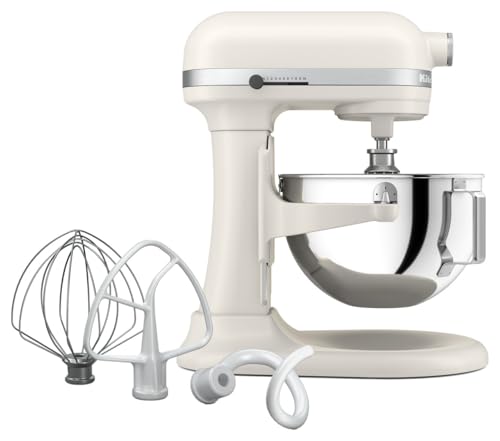
KitchenAid 5.5-Qt Bowl-Lift Stand Mixer KSM55, Porcelain White — Best Bowl-Lift Value
The KSM55 is the first rung where bread bakers should pay attention: bowl-lift composure under dough loads at a mid-premium tier. It fits households whose baking has become a serious hobby and whose tilt-head experiences have started to feel like a limitation.
On value, the KitchenAid 5.5-Qt Bowl-Lift Stand Mixer KSM55, Porcelain White earns its place in this line-up because the money goes where it counts for this kind of baking — and you can verify exactly what it costs today by following the listing link, since we track value by tier and specification rather than by a printed figure that would be stale within the week.
Strengths
- Bowl-lift stability keeps the machine planted when dough gets stiff and heavy
- Eleven speeds, including a gentle fold setting, give finer control than most home mixers
- The 5.5-quart bowl handles bigger batches than tilt-head models without going full commercial size
Trade-offs
- Bowl-lift machines need clearance above and a bit more counter depth than tilt-head designs
- Removing the bowl is a two-handed job compared with the tilt-head’s quick tilt
- Heavier to move in and out of a cupboard, so it really wants a permanent counter spot
| Specification | Detail |
|---|---|
| Bowl | 5.5 qt, stainless steel |
| Design | Bowl-lift |
| Speeds | 11 mixing speeds |
| Included | Flat beater, dough hook, wire whip |
The KSM55 is where KitchenAid’s home line starts behaving like its professional line. The bowl locks onto a lifting arm rather than twisting into a base, so the whole machine stays composed when a lean dough starts slapping the sides. That composure is what you are paying for: less walking across the counter, less head bounce, and more consistent kneading over a ten-minute dough cycle. Bakers who found a tilt-head model lively under load will feel the difference in the first batch.
Best for: bread-leaning bakers who want bowl-lift stability / Not suited for: small counters or cupboard storage
Check the current price on Amazon

KitchenAid 7-Qt Bowl-Lift Stand Mixer KSM70, Cast Iron Black — Best Premium for Big Batches
The KSM70 sits at the top of this ladder for a reason: it is the machine for bakers whose constraint is no longer skill but batch size. Wedding cakes, bake sales and big family gatherings are its home territory, and its tier only makes sense if that is genuinely your territory too.
Judged on cost per year of service rather than sticker shock, the KitchenAid 7-Qt Bowl-Lift Stand Mixer KSM70, Cast Iron Black makes a straightforward case: it sits in its tier for a reason, and checking the live listing is the only honest way to compare it against this week’s alternatives.
Strengths
- The 7-quart bowl swallows double and triple batches that overwhelm 5-quart machines
- The half-speed fold setting handles delicate batters and additions without knocking the air out
- A generous accessory bundle in the box, including the Double Flex Edge Beater for bowl scraping
Trade-offs
- This is a large, heavy machine that effectively becomes a permanent counter fixture
- The capacity is wasted on small single batches, which can mix unevenly in a big bowl
- It sits in a premium tier, so the value case depends on genuinely baking at volume
| Specification | Detail |
|---|---|
| Bowl | 7 qt |
| Design | Bowl-lift |
| Speeds | 11 speeds, including a 1/2 speed for folding |
| Included | Double Flex Edge Beater and four further accessories (per listing) |
Think of the KSM70 as the batch baker’s KitchenAid. Wedding-cake tiers, bake-sale weekends and freezer-stocking bread sessions are its natural habitat, and the bowl-lift frame stays calm while it works through them. The folding half-speed is a thoughtful touch: big mixers often bully delicate mixtures, and this one can stir in flour or chocolate chips at a pace that respects the batter. If your recipes routinely start with a kilo or more of flour, this is the home machine that stops feeling like a compromise.
Best for: high-volume baking, tiers and double batches / Not suited for: small households making single small recipes
Check the current price on Amazon
Comparison Table
| Pick | Badge | Key spec | Best for |
|---|---|---|---|
| KitchenAid Artisan 5-Qt Tilt-Head Stand Mixer KSM150PS, Contour Silver | Best Overall | 5 qt, stainless steel | most home bakers wanting a decade-long all-rounder |
| KitchenAid Classic Series 4.5-Qt Tilt-Head Stand Mixer K45SS, Onyx Black | Best Budget KitchenAid | 4.5 qt | first-time KitchenAid buyers on a controlled budget |
| Cuisinart Precision Master 5.5-Qt Stand Mixer SM-50, White Linen | Best Value 5.5-Qt | 5.5 qt, stainless steel | value-focused bakers who want 5.5 quarts and 12 speeds |
| Hamilton Beach 4-Qt Electric Stand Mixer, 7 Speeds, Black | Best Low-Cost Planetary Mixer | 4 qt | light, occasional baking on the smallest budget |
| KitchenAid 5.5-Qt Bowl-Lift Stand Mixer KSM55, Porcelain White | Best Bowl-Lift Value | 5.5 qt, stainless steel | bread-leaning bakers who want bowl-lift stability |
| KitchenAid 7-Qt Bowl-Lift Stand Mixer KSM70, Cast Iron Black | Best Premium for Big Batches | 7 qt | high-volume baking, tiers and double batches |
How to Choose a Stand Mixer by Price Tier
Stand mixer pricing falls into recognisable tiers, and each tier has a personality. The entry tier buys you planetary mixing and hands-free convenience with lighter motors and 3–4.5-quart bowls; it is the tier of cakes, frostings and soft doughs. The mid tier — where the Classic, the SM-50 and the Artisan live — buys metal construction, 10–12 speeds, bowls around 5 quarts and, in KitchenAid’s case, the attachment hub that turns the mixer into a platform. The step-up tier buys bowl-lift frames and bigger motors for dough confidence. The premium tier buys capacity: 7-quart bowls, folding speeds and accessory bundles for people who bake in volume.
Notice what the tiers do not buy. A higher price does not make a small batch mix better — in fact oversized bowls mix small quantities worse. It does not make a machine quieter in any reliable, comparable way, and it does not guarantee better cake texture, because creaming technique matters more than the badge. Spend for the constraints you actually have: batch size, dough stiffness, counter space and how often the machine will run. If none of those constraints bite, the mid tier is not a compromise; it is the correct answer.
Finally, treat colour and bundle as pricing variables, not product differences. The same model in a less fashionable colour, or in a bundle without the extra beater you will never use, often sits a tier lower in practice. Check the live listing in more than one colour before deciding a machine is out of reach — that single habit saves more money than any coupon.
What Actually Drives Stand Mixer Prices
Four things move a mixer up the price ladder. First, the frame: tilt-head designs are simpler to build, while bowl-lift mechanisms with their lifting arms and heavier castings cost more and handle load better. Second, the drive: gearing, motor size and the speed range — especially a genuinely slow fold speed — separate engineered machines from adequate ones. Third, capacity, because a 7-quart bowl needs a frame and motor that can control it. Fourth, the ecosystem: a hub that accepts dozens of attachments, spare bowls in several materials and a repair network are real costs baked into the price of the established brands.
What does not justify a price jump is wattage printed in large type. Wattage figures are measured differently across brands and say little about torque at the beater, which is what dough actually tests. Two machines with similar wattage can behave completely differently under a stiff load; the frame design and gearing tell you more. Read price alongside design, not alongside the biggest number on the box.
Setting a Sensible Budget for Your Baking
Work backwards from your last month of baking. If the mixer would have been used twice, for a cake and a batch of cookies, the entry or lower-mid tier will serve you for years and the premium tiers are money asleep on the counter. If it would have been used weekly, with bread in the rotation, the mid to step-up tiers pay for themselves in reliability and in batches that do not need splitting. If you regularly cook for gatherings, clubs or a young family’s endless appetite, capacity becomes the binding constraint and the premium tier stops being a luxury.
Also budget for the second year, not just the first. A spare bowl transforms batch baking, a flex-edge beater saves constant scraping, and pasta or grinding attachments can replace separate appliances. None of that requires buying everything today — it requires buying a machine whose ecosystem lets you add pieces later, which is one of the quiet reasons the mid-tier benchmark machines hold their value.
Refurbished, Open-Box and Second-Hand: The Shadow Price Ladder
There is a second price ladder running beneath the new one, and stand mixers are unusually good candidates for it because the good ones are repairable, long-lived and simple to inspect. Manufacturer-refurbished units from the established brands carry warranties and typically sit a clear tier below new. Open-box returns from major retailers are similar value when the return reason is cosmetic. The true second-hand market — the Artisan on a local marketplace — rewards buyers who know the three-minute inspection: run every speed and listen for grinding, check the beater-to-bowl clearance, and confirm the bowl, beater, whisk and hook are all present, because replacing a missing set eats the saving.
What to avoid in the shadow market: machines with unknown histories sold as ‘commercial grade’ with no brand behind them, listings where the model number in the photographs differs from the model number in the text, and any mixer missing its bowl, because bowls are the one part whose replacement cost can rival a budget machine. Bought carefully, the shadow ladder lets a mid-tier budget hold a premium machine; bought carelessly, it is how money leaves without a receipt worth the name.
When Paying More Genuinely Buys More — and When It Buys a Colour
The honest dividing line in mixer pricing runs through the frame and the drive. Paying more for a bowl-lift mechanism, a larger motor with proper gearing, a genuine fold speed or a bigger bowl buys capability you will feel in the first heavy batch. Paying more for a limited-edition colour, a decorative bowl finish or a bundle of attachments you did not choose buys a photograph. Both kinds of premium are on sale in this category, often on the same product page, and the discipline is simply to ask, for each step up: what does this do in the bowl that the cheaper version does not?
There is one more legitimate premium: the platform. A machine whose maker sells spare bowls, replacement beaters and hub attachments at fair prices, and supports the model for years, is worth more than an identical-specification orphan — because the second bowl you buy in year three, and the beater you replace in year six, are part of the machine’s real price. The benchmark machines in this guide hold their tiers partly on that invisible infrastructure, and it is infrastructure you genuinely use.
How to Compare Stand Mixer Prices Without Being Misled
Start by fixing the specification you are comparing: same bowl size class, same frame type, same included attachments. Most ‘this mixer is cheaper’ claims dissolve once the comparison is like for like, because the cheaper listing quietly has a smaller bowl or one fewer beater. Write the specification down from the listing itself before you look at any figure.
Next, check the live price on Amazon for each shortlisted model in at least two colours and, where offered, with and without bundle extras. Colour-based price differences on identical hardware are common and can be larger than the gap between two competing models. The listing link on each pick in this guide takes you to the exact verified model, so the comparison starts from solid ground.
Then apply the tier test from the buying guide: name the constraint that pushes you up a tier — batch size, dough, capacity — in one sentence. If you cannot name one, you are shopping a tier too high and the honest saving is to step down. If you can name one, the step up is not indulgence; it is the cost of the job.
Finally, sanity-check the total cost of the kitchen you are building. A mixer plus the two attachments you will genuinely use, on a platform with available spares, beats a flagship machine whose accessories you never buy. Prices reward a plan; they punish impulse in both directions.
Keep a simple price diary when you are not in a hurry to buy. Note the live figure for your chosen model — and its two nearest rivals — once a week for a month. Stand mixer pricing has a rhythm of promotions, and a month of notes teaches you the model’s true street tier versus its headline tier, so that when a genuine drop appears you recognise it instantly instead of guessing. This sounds like effort; it is five minutes a week, and on a purchase meant to last a decade it is the best-paid five minutes in the whole transaction.
When the day comes, run the final checklist on the live listing before paying: model number matches the review you read, bowl size and material match, the beater set in the box matches (bundles differ), the colour is the one whose price you checked, and the seller is the retailer or the brand — not a third-party listing borrowing the model’s good name. Prices reward the careful at the exact moment care is cheapest.
A Worked Example: Three Buyers, Three Correct Tiers
Buyer one bakes a cake most weekends for a family of four and has never made bread. Her correct tier is the lower middle: the Classic or the SM-50 covers every recipe in her repertoire with quality to spare, and the money she does not spend on a bowl-lift flagship becomes a stand mixer’s worth of good butter, chocolate and vanilla over the machine’s life. If she had bought the premium tier, she would own a better machine and bake identical cakes.
Buyer two has fallen for sourdough and bakes two loaves every weekend, plus pizza dough on Fridays. His correct tier is the step-up: the KSM55’s bowl-lift composure will be felt in every single knead, and the tier premium divides by hundreds of batches into pennies per loaf. If he had bought the budget tier to save money, he would have paid for the saving weekly, in split batches and a machine working at its limit.
Buyer three runs a market stall one Saturday a month and doubles every recipe as a matter of routine. Her correct tier is the top of this guide: the KSM70’s capacity is not indulgence but equipment, and its cost is a business input recovered across a season of stalls. Three buyers, three budgets, three different ‘best value’ answers — which is why this guide maps tiers to baking lives instead of crowning one machine the best buy for everyone.
Seasonal Pricing: Reading the Mixer Calendar
Stand mixer pricing has a calendar, and reading it is worth real money. The deepest, most predictable discounting clusters around the major shopping events of late autumn, when kitchen appliances are headline categories and the established brands compete in public. A second, quieter window opens in January, when returns and open-box stock swell the shadow ladder described earlier. Spring brings smaller, targeted promotions around baking seasons and wedding registries. None of this requires clairvoyance: it requires deciding your model and tier in a calm month, so that when the calendar delivers its window you are executing a plan rather than improvising one.
The calendar cuts the other way too. Buying in a hurry — the week the old mixer dies before a birthday, the day before a holiday bake — is buying at the market’s convenience, not yours. Households that can keep a dying machine limping for a few weeks, or borrow a neighbour’s for one event, routinely convert an emergency purchase into a planned one at a better tier. The difference is rarely dramatic on any single machine; across a decade of kitchen equipment, it is the difference between a kitchen bought well and a kitchen bought at retail panic.
One final calendar note: new colours and minor model refreshes arrive on their own schedule, and their arrival quietly reprices the outgoing versions. If your heart is not set on the newest finish, the refresh cycle is a standing invitation to buy last season’s identical capability at this season’s kinder tier — the same advice as the colour rule, applied to time instead of taste.
Common Buying Mistakes
Comparing printed prices instead of live listings. Mixer prices move constantly with promotions and colour variants. Any article — including the search results that brought you here — that quotes a figure is quoting history. Decide your tier from specifications, then check price on Amazon on the day you buy.
Paying for capacity you will never use. A 7-quart bowl is a wonderful thing for a bake sale and a nuisance for a single sponge, because small quantities spread thin and mix unevenly. Oversizing is the most respectable-looking way to waste money in this category.
Chasing wattage numbers. Wattage is not measured to a common standard across brands and does not equal torque. Frame design, gearing and bowl size predict dough performance far better than the biggest number on the box.
Ignoring the cost of the ecosystem. Spare bowls, beaters and attachments are where ownership costs live. A slightly pricier machine on a deep platform is often cheaper over five years than a bargain machine whose spares are scarce.
Buying the bundle instead of the machine. Bundles photograph well and pad margins. If the extra pieces duplicate what you own or serve food you never make, the ‘saving’ is fiction — price the base machine and add only what you will use.
Assuming the top tier mixes small batches better. Premium machines are optimised for their capacity. For a two-person household, a mid-tier or compact mixer will produce better everyday results than a flagship loafing through tiny quantities.
Final Recommendation
If you want one answer: the KitchenAid Artisan is the benchmark for a reason, and its tier is the right home for most serious home bakers. If the budget is firm, the Classic buys the same ecosystem for less, and the Cuisinart SM-50 is the value specification to beat. Bread-leaning bakers should stretch to the bowl-lift KSM55, batch bakers to the KSM70, and light-duty kitchens can honestly stop at the Hamilton Beach and spend the difference on ingredients. Round out your research with Best Stand Mixers Under $200 and Best Stand Mixers For Baking, and compare shapes in Best Kitchen Stand Mixers.
Whichever tier you choose, make the final decision on the live listing: confirm the colour, the bundle and the current figure there, because that is the only price that exists. The machines above were all verified as current listings when this guide was written, and each link takes you straight to the model reviewed.
The shortlist, if you are deciding today: KitchenAid Artisan 5-Qt Tilt-Head Stand Mixer KSM150PS, Contour Silver for the headline recommendation, KitchenAid Classic Series 4.5-Qt Tilt-Head Stand Mixer K45SS, Onyx Black as the value alternative, and Cuisinart Precision Master 5.5-Qt Stand Mixer SM-50, White Linen where the specific need in this guide is strongest. Each name links to its verified listing, where you can check price on Amazon and confirm the exact configuration before you commit.
Frequently Asked Questions
Why doesn’t this article print exact prices?
Because stand mixer prices change too often for print to stay honest — promotions, colour variants and bundles move the same model between tiers within weeks. We place every pick in its correct tier, explain what that tier buys, and link to the live listing so you can check price on Amazon at the moment it matters: when you are buying.
How much should a first stand mixer cost, in tier terms?
Most first-time buyers belong in the entry or lower-mid tier: enough machine for cakes, cookies and soft doughs, on a platform with available spares. Move up a tier only when a specific constraint — bread dough, batch size — is already frustrating you, not in anticipation of a baking life you may never live.
Is a more expensive stand mixer always better made?
Not always, but the correlation is real at the frame and drive level: bowl-lift mechanisms, metal gearing and serviceable construction cost money. What extra money does not reliably buy is better results on small, easy jobs, where a modest machine in its comfort zone performs identically.
Why do colours of the same mixer have different prices?
Retailers price colour variants independently based on stock and demand, and unpopular colours are discounted to move. The machine is identical. Checking two or three colours of your chosen model before buying is the simplest saving in this entire category.
Should I wait for a sale to buy a stand mixer?
If your tier is decided and the need is not urgent, stand mixers are among the most reliably discounted kitchen appliances around major sale events. But the saving only counts if you buy the machine you had already chosen — a discount on the wrong tier is still the wrong mixer.
What hidden costs should I budget for after buying?
A second bowl if you batch-bake, a flex-edge beater if your model lacks one, and any hub attachments you genuinely plan to use. None are required on day one. The platform matters more than the accessories: buy a machine whose extras exist and are easy to source later.
Do stand mixers hold their value?
The established mid and premium machines hold value unusually well for kitchen appliances, because they are durable, repairable and stylistically stable — a ten-year-old Artisan is still recognisably the current product’s sibling. Budget machines depreciate to nearly nothing, which is fine: their value case is cost per year while you own them, not resale. Factor that in if you expect to upgrade: the mid tier’s true cost is purchase minus a meaningful resale, which narrows the gap to the budget tier considerably.

