Disclosure: airfryerkitchensupply.com is reader-supported. When you buy through links on our site, we may earn an affiliate commission at no extra cost to you.
Where to buy
Sound quality is the one part of a DJ setup you cannot fix later with a better cable or a louder speaker, so every mixer below links to its Amazon listing where you can check the current price on Amazon and confirm the exact revision before you buy. Buy from a seller who accepts returns: a mixer has to be heard on your own speakers, in your own room, before you can judge its converters and its EQ honestly.
- Pioneer DJ DJM-A9 — Check the current price on Amazon
- Allen & Heath XONE:96 — Check the current price on Amazon
- Allen & Heath Xone:92 Mk2 — Check the current price on Amazon
- Pioneer DJ DJM-S11 — Check the current price on Amazon
- RANE SEVENTY — Check the current price on Amazon
- Ecler WARM4 — Check the current price on Amazon
Finding the best sounding dj mixers starts with an uncomfortable truth: two mixers with identical channel counts and near-identical feature lists can sound noticeably different once a record is actually playing. The difference lives in the phono preamps, the summing stage, the EQ curves and, on digital models, the converters. A warm, forgiving mixer flatters older pressings and makes long blends sound glued together. A clinical mixer exposes every flaw in a bad rip but rewards clean files with real separation and air.
This guide ranks six mixers purely on how they sound first, and on workflow second. Analog rotaries and flagship digital battle mixers sit side by side here because the question is not which format wins — it is which box makes your music sound best in the way you actually play. If you mix long, blended house sets, your ears will pull you toward a different pick than a DJ who cuts aggressively and lives on the crossfader, and the reviews below say so plainly.
We also need to be honest about sources. No mixer can rescue a low-bitrate file or a worn stylus, and the best sounding dj mixers will actually reveal those problems faster than a cheap mixer does. Budget for your source chain alongside the mixer itself, and treat the picks here as the last, most revealing link in that chain rather than a magic upgrade in isolation.
In this guide
Quick Picks
Six mixers, six different sound signatures. Read the badge first, then the review — the right answer depends on whether you blend, cut, or play vinyl.
Pioneer DJ DJM-A9 — Best Overall Sound. The flagship club standard, with the cleanest digital summing and the most forgiving high end of any digital mixer here. Check price on Amazon.
Allen & Heath XONE:96 — Best Analog Sound. A fully analog signal path with the famous Xone filters — the warmest, most three-dimensional sound in this list. Check price on Amazon.
Allen & Heath Xone:92 Mk2 — Best Classic Club Sound. The updated icon: the 92’s legendary filters and warm EQ in a refreshed build for a new generation of booths. Check price on Amazon.
Pioneer DJ DJM-S11 — Best Sounding Battle Mixer. A two-channel battle mixer whose sound quality is far beyond battle-grade — crisp, punchy and recording-ready. Check price on Amazon.
RANE SEVENTY — Best for Serato Purists. Rane’s two-channel flagship: dense, powerful sound with the best-feeling faders in the business. Check price on Amazon.
Ecler WARM4 — Best Rotary Sound. A four-channel analog rotary with a subharmonic trick up its sleeve — slow, smooth, luxurious mixing. Check price on Amazon.
How These Picks Were Chosen
From that verified shortlist we shortlisted mixers with a documented reputation for their sound stage: flagship digital models with high-resolution internal processing, and analog designs whose summing and EQ are the entire point of the product.
The listening criteria were consistent across all six. First, phono stage honesty: how a mixer treats a real record, including surface noise and worn grooves. Second, EQ behaviour at extremes — a musical EQ stays usable when you pull the lows fully out; a harsh one turns thin and nasty. Third, headroom: what happens to the sound when two channels are summed hot during a long blend. Fourth, the master output stage, because that is what the room, the stream and the recording actually hear.
We deliberately left out mixers that are excellent value as controllers or battle tools but unremarkable as listening devices. A mixer can be a great product and still not belong in a guide about sound. Where a pick has a real weakness — a steep price, a learning curve, a fader feel some DJs dislike — it is stated in the trade-offs rather than smoothed over.
The 6 Best Sounding DJ Mixers

Pioneer DJ DJM-A9 — Best Overall Sound
The DJM-A9 is what most clubs install when the budget allows, and its sound is the reason it keeps that job. The internal processing runs at high resolution, and you hear it most in the top end: hi-hats and vocal air stay open instead of turning glassy when the channel gains run warm. Long blends sit together without the low-mid congestion that gives away cheaper digital summing.
It suits DJs who play across genres in one night and need the mixer to disappear. House, disco edits, hip-hop and open-format peaks all pass through without the box imposing a strong personality of its own. If your taste runs to deliberately coloured, vintage analog warmth, that neutrality may feel almost too honest — this mixer reports your records rather than romanticising them.
Strengths
- Exceptionally clean, open top end even with gains pushed
- Colour and Beat FX that stay musical instead of gimmicky at sensible settings
- Phono stages that treat vinyl respectfully for a digital mixer
Trade-offs
- Premium tier pricing that is hard to justify for a home-only setup
- Large footprint for small booths and bedroom rigs
- Neutral character will not add warmth your sources do not have
Key specs: 4 channels, digital processing, dual USB audio interfaces for changeovers.
The detail that sells the A9 in a real booth is changeover behaviour. Two DJs can plug in, blend across each other’s channels and hand over without a dropout or a level lurch, and the outgoing recording stays clean. For a resident or a back-to-back act, that reliability is a sound-quality feature too: nothing ruins a set’s sound like a technical stumble in the middle of it. Buy it if it will be played loud, in public, for years.
Best for: working club and event DJs who need a neutral, high-resolution sound / Not suited for: vinyl purists chasing deliberate analog colour
Check the current price on Amazon
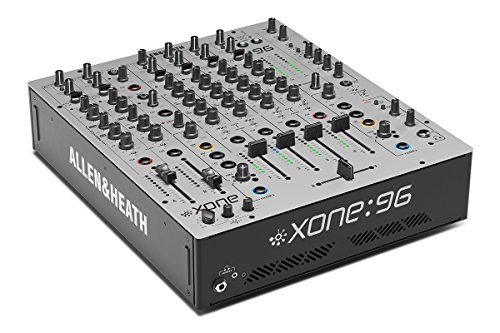
Allen & Heath XONE:96 — Best Analog Sound
The XONE:96 is the mixer analog believers point to when digital fans say format no longer matters. Its signal path is analog end to end, and the summing has a depth that makes long, layered blends feel almost orchestral: kick drums stay round, basslines keep their texture, and the stereo image holds together at high master levels where lesser analog mixers start to smear.
The dual filters are the other half of its sound. Swept gently, a Xone filter is a mixing instrument in its own right, letting you carve space for an incoming record without touching the EQ. It suits patient, blend-led DJs — house, techno, disco — who mix with their ears over thirty-two bars rather than cutting on the one. Battle DJs will find the crossfader options and layout aimed elsewhere.
Strengths
- Deep, warm analog summing that flatters long blends
- Two assignable filters with resonance control for creative mixing
- Excellent phono stages for vinyl-led sets
Trade-offs
- Analog path means no onboard effects beyond the filters
- Takes practice to mix well; the filters punish careless hands
- Premium tier pricing, and it rewards equally good speakers
Key specs: 6+2 channels, fully analog, dual VCF filters, dual USB audio interfaces.
One honest warning: the 96 reveals your room. In a treated space or on a good club system it sounds expensive; on boomy bedroom speakers the extra low-end information can read as mud until you learn to EQ for the room rather than the headphones. That is not a flaw in the mixer — it is the cost of a tool that hides nothing from you. DJs who make that adjustment rarely go back.
Best for: blend-led house and techno DJs and vinyl players who want analog depth / Not suited for: scratch DJs and anyone wanting onboard digital effects
Check the current price on Amazon

Allen & Heath Xone:92 Mk2 — Best Classic Club Sound
For two decades the original Xone:92 defined what a techno club sounded like, and the Mk2 keeps that sonic signature intact while fixing the details that dated the original. The sound is recognisably the same family as the 96 — warm, weighty, forgiving in the low mids — with the twin filters that made a generation of DJs mix with resonance as a musical voice.
The Mk2 suits DJs who want that classic analog club sound without paying the 96’s flagship price or needing its extra channels and interfaces. Four channels, two filters, an EQ that stays musical at full kill: it is a focused instrument. DJs who rely on per-channel digital effects, screens or software integration should look at the digital picks instead, because the 92 Mk2 makes no apology for being an analog mixer first.
Strengths
- The classic Xone filter sound, updated and tightened
- Warm, club-proven EQ that never turns harsh
- Simpler and more focused than the 96 for four-channel players
Trade-offs
- No onboard digital effects section
- Fewer interface options than the flagship 96
- Analog warmth can feel soft if you prefer a clinical sound
Key specs: 4+2 channels, analog, twin VCF filters with LFO.
Where the Mk2 earns its place in a sound-first guide is consistency. Rig after rig, it behaves the same: the filters sweep predictably, the gains stage cleanly, and the master stays composed when the room fills and you push the system. For a touring DJ who rents or requests a mixer on a rider, that predictability is worth real money. It is the safe pair of hands of this entire list.
Best for: techno and house DJs who want the classic analog club signature / Not suited for: DJs who need screens, onboard FX or deep software control
Check the current price on Amazon

Pioneer DJ DJM-S11 — Best Sounding Battle Mixer
Battle mixers used to sound like tools: functional, a little hard, built to survive rather than to flatter. The DJM-S11 changed that expectation. Its processing is clean and fast, the EQ is voiced to keep cuts intelligible without turning brittle, and the output stage holds together when you are hammering the crossfader and the pads at the same time.
It suits turntablists and open-format DJs who perform rather than blend. The touchscreen, the performance pads and the effects levers all serve that performance style, but none of it costs you sound quality — recordings taken straight from the S11 sound like finished mixes, which is why so many routine videos are captured through one. Four-channel players will simply outgrow its two channels, and that is its only real limit.
Strengths
- Punchy, intelligible sound voiced for cutting and performance
- Magvel crossfader feel that encourages precise technique
- Direct recordings from the mixer sound polished
Trade-offs
- Two channels only — no room for a third or fourth source
- Touchscreen workflow divides opinion among traditionalists
- Built-in effects invite overuse that dates a mix quickly
Key specs: 2 channels, touchscreen, performance pads, dual USB interfaces.
Judge the S11 by what it does to a scratch recording. Chirps and flares stay distinct instead of collapsing into noise, and the low end of a juggled break keeps its shape under rapid fader work. That clarity comes from headroom, and headroom is the least glamorous, most important sound specification a battle mixer has. If your craft is fader work, this is the best-sounding tool ever built specifically for it.
Best for: turntablists and performance DJs recording their routines / Not suited for: four-deck or multi-source players
Check the current price on Amazon

RANE SEVENTY — Best for Serato Purists
The RANE SEVENTY sounds dense in a way Pioneer mixers do not. Where the S11 is crisp and open, the Seventy is weighty and concentrated, with a low end that feels physically present on a big system. DJs who play hip-hop, breaks and bass-heavy open format often prefer exactly this presentation: the record feels anchored, and cuts land with real authority.
Its faders are the other reason it exists. The magnetic faders are famously light, fast and consistent, and they make advanced techniques feel easier than they are. It suits committed Serato players who want a mixer that feels like an instrument built around the fader. DJs outside the Serato ecosystem, or who want four channels and a touchscreen, will find the S11 or A9 a better fit for their workflow.
Strengths
- Dense, powerful low end that suits hip-hop and breaks
- Outstanding magnetic faders with adjustable tension and cut
- Akai performance pads that feel like proper MPC pads
Trade-offs
- Serato-first design; other software users get less from it
- Two channels, like all dedicated battle mixers
- Heavier and more expensive than entry battle options
Key specs: 2 channels, magnetic faders, MPC pads, internal effects.
The Seventy rewards a specific listening test: play the same break on this and on a budget battle mixer, and listen to the kick drum during a juggle. On the budget box it thins out as the fader works; on the Seventy it stays round. That is the entire case for spending flagship money on a two-channel mixer, and it is a convincing one if your genre lives in the low end.
Best for: Serato turntablists and hip-hop DJs who prioritise low-end weight / Not suited for: rekordbox-only or four-channel players
Check the current price on Amazon

Ecler WARM4 — Best Rotary Sound
Rotary mixers make a different promise: no crossfader, no line faders, just big knobs, long blends and a sound that seems to pour rather than play. The Ecler WARM4 keeps that promise with an analog path voiced warm and smooth, and adds a subharmonic synthesizer that can thicken thin recordings by generating low octave weight underneath them.
It suits disco, house and listening-bar DJs who mix like sommeliers — slowly, tastefully, never cutting. The rotary layout forces patience and rewards it: gains are set with a twist, blends last minutes, and the music never jerks. Anyone who scratches, quick-cuts or plays high-energy open format will feel handcuffed within ten minutes, and should take that feeling seriously rather than fighting the format.
Strengths
- Silky analog rotary summing made for long blends
- Subharmonic synthesis rescues thin or bass-light recordings
- Beautiful, unhurried control feel that changes how you mix
Trade-offs
- No crossfader — wrong tool for cutting or scratching
- Rotary technique has a real learning curve
- A niche instrument; poor resale audience compared with flagships
Key specs: 4 channels, analog rotary, subharmonic synthesizer, FX send.
The subharmonic feature deserves honest framing. Used subtly under a bass-shy seventies pressing, it restores the record’s intended weight. Used greedily, it turns every track into the same artificial rumble and tires a room quickly. Treat it like salt: a little transforms the dish, a lot ruins it. With that discipline, the WARM4 is the most characterful listening experience in this guide.
Best for: disco, house and listening-bar DJs who blend slowly on vinyl / Not suited for: scratch, hip-hop performance or quick-cut styles
Check the current price on Amazon
Comparison Table
| Pick | Badge | Key spec | Best for |
|---|---|---|---|
| Pioneer DJ DJM-A9 | Best Overall Sound | 4ch digital, high-resolution processing, dual USB | working club and event DJs who need a neutral, high-resolution sound |
| Allen & Heath XONE:96 | Best Analog Sound | 6+2ch analog, dual filters, dual USB | blend-led house and techno DJs and vinyl players who want analog depth |
| Allen & Heath Xone:92 Mk2 | Best Classic Club Sound | 4+2ch analog, twin filters, LFO | techno and house DJs who want the classic analog club signature |
| Pioneer DJ DJM-S11 | Best Sounding Battle Mixer | 2ch digital battle, touchscreen, Magvel fader | turntablists and performance DJs recording their routines |
| RANE SEVENTY | Best for Serato Purists | 2ch, magnetic faders, MPC pads | Serato turntablists and hip-hop DJs who prioritise low-end weight |
| Ecler WARM4 | Best Rotary Sound | 4ch analog rotary, subharmonic synth | disco, house and listening-bar DJs who blend slowly on vinyl |
How to Choose the Best Sounding DJ Mixer for Your Ears
Start with your mixing style, because it decides which sound signature serves you. Blend-led DJs live inside long overlaps, so summing quality and filter behaviour matter most — that points to the analog picks. Performance DJs live on the fader, so headroom and intelligibility under rapid cuts matter most — that points to the battle picks. Club all-rounders need neutrality and reliability above character, which is the flagship digital brief.
Next, be honest about your sources. A vinyl-heavy player should weight the phono stage heavily: it is a dedicated amplifier for a tiny signal, and its quality is audible on every record. A digital-file player should weight converter and processing quality instead, and should also audit their files — a revealing mixer will expose low-quality rips mercilessly, and upgrading the library is part of upgrading the sound.
Finally, listen for headroom, not loudness. Any mixer can be turned up. The question is what the sound does when two channels run hot together for thirty seconds. On a good mixer the image stays stable and the low end stays shaped. On a poor one the middle congests and the top turns hard. That thirty-second test, on speakers you know, tells you more than any specification sheet.
Analog Warmth vs Digital Clarity: What Actually Differs
The analog-versus-digital argument in DJ mixers is really an argument about pleasant imperfection. A good analog summing stage adds tiny amounts of harmonic richness and softens transients in a way most listeners describe as warmth or glue. Long blends benefit most, because two records summed through analog circuitry seem to occupy one shared space rather than sitting side by side.
Digital mixers counter with accuracy. High-resolution processing preserves separation, stereo detail and low-level ambience that analog stages gently blur. On a well-tuned club system playing modern productions, that accuracy can sound bigger and cleaner than analog warmth. The mistake is declaring one side universally better: the right answer depends on your repertoire, your room and how you mix.
A practical compromise exists. Several DJs in this guide’s audience run a digital flagship for open-format work and keep an analog or rotary mixer for vinyl nights. If your budget only stretches to one box, choose by the sets you play most often, not the sets you admire most.
The Phono Stage, EQ and Filters: Where Mixer Sound Is Really Made
Ask experienced vinyl DJs what separates mixers and most will name the phono stage before anything else. A cartridge outputs a whisper of a signal that must be amplified and equalised precisely; noise or inaccuracy there is amplified along with the music. The analog picks in this list invest heavily here, and it shows on worn records, which sound dignified rather than merely noisy.
EQ voicing is the second maker of sound. A musical EQ uses broad, overlapping curves that stay useful at extremes, so pulling the bass out for a blend thins the track gracefully. A poorly voiced EQ turns nasal and harsh at the same settings. Filters add a third voice: a resonant filter, used gently, is an expressive mixing tool; used carelessly, it is a whistle that empties dancefloors.
When you audition a mixer, test all three deliberately. Play a worn record you know. Pull each EQ band fully out and back. Sweep the filter slowly across a vocal. The mixer that behaves most gracefully under those small abuses is the one that will sound best at hour three of a real night.
What Sounding Good Means at 2 A.M. in a Real Room
A specification sheet is written in a laboratory; a DJ mixer earns its reputation in a room full of people at the moment the night peaks. Bodies absorb high frequencies, a filled dancefloor changes the bass balance, and the system gets pushed harder than any soundcheck predicted. The mixers in this guide were chosen partly on how gracefully they handle that drift: analog summing that stays forgiving when levels creep, digital processing that stays clean when the master is worked hard, and EQ curves that let you correct a room’s mood without carving the music apart.
There is also a fatigue factor nobody prints in brochures. Harsh, brittle sound tires an audience physically; people leave a dancefloor they cannot explain leaving. A mixer with a smooth top end and controlled low mids keeps a room dancing longer, which is a commercial fact for working DJs even if it never appears in a review metric. When engineers describe a mixer as ‘easy to listen to all night’, they are describing the difference between a good night and a legendary one.
Practical translation: if you play long sets, weight smoothness over spectacle. If you play short, high-impact sets, weight punch and clarity. The guide’s badges already encode that split — the analog picks for the long night, the battle picks for the explosive hour, the flagship digital for the DJ who must do both in the same booking.
Vinyl, DVS and Files: Matching the Mixer to Your Source Chain
Vinyl players should interrogate the phono stage hardest, because it is an amplifier dedicated to one of the smallest signals in audio. A great phono stage keeps surface noise in proportion — present, honest, but never the loudest thing in the record — and preserves the low-level detail that makes vinyl feel alive. The Xone models and the WARM4 invest there; the digital flagships have closed much of the gap, but a vinyl-first DJ should still audition with their most worn, beloved record, not a pristine reissue.
DVS players live downstream of a different truth: the mixer’s job is to stay transparent to a digital file while adding performance control. Converter quality and processing resolution decide whether a timecode set sounds like the file or like a photocopy of it. The DJM-A9 and S11 are built for exactly that transparency, which is why so much recorded DVS content sounds clean enough to release.
File-based DJs without turntables should spend their phono-stage money elsewhere — on the room, the speakers, the library. A revealing mixer fed immaculate files is a joy; the same mixer fed tired rips is an audit. Wherever you sit in the source triangle, buy the mixer that flatters your actual chain, and upgrade the weakest link in that chain before upgrading the strongest one.
Budget Reality: Where the Money Actually Goes in a DJ Setup
It is tempting to pour the entire budget into the mixer because it is the glamorous centrepiece, but sound quality obeys the weakest link. A flagship mixer feeding entry-level speakers in an untreated room will lose, sonically, to a mid-tier mixer feeding good speakers in a decent space — every experienced DJ has heard both rigs and knows which room they would rather play in. A sane allocation for a home setup puts the mixer at roughly a third of the total, with speakers and source quality sharing the rest.
That arithmetic also explains this guide’s spread of badges. The DJM-A9 makes sense when the rest of the chain is already strong and the booth is public. The Xone:92 Mk2 makes sense when the chain is vinyl-led and the room is yours. The WARM4 makes sense when the entire evening’s aesthetic is slowness and warmth. None of them can compensate for a chain that starves them, and all of them reward a chain that feeds them properly.
If you are building from zero, sequence the purchases: sources and speakers first, mixer second, and the decorative extras last. You will sound better at every intermediate stage, and you will arrive at the flagship purchase knowing exactly which of its virtues your room can actually reveal.
Care and Longevity: Keeping a Great-Sounding Mixer Great
Mixers die quietly, one fader and one pot at a time, and the killers are dust, spilled drinks and heat. A cover — even a simple decksaver-style lid or a cloth — is the cheapest sound-quality accessory in DJing, because a fader full of dust crackles, and a crackling fader is a sound defect no specification can outrun. Keep the booth’s drinks on a separate surface as a rule of the house; every veteran DJ enforces it because every veteran DJ has buried a mixer that a pint murdered.
Heat is the slow killer of digital mixers in particular. Ventilation slots blocked by stacked gear or a booth built like an oven will age capacitors and invite intermittent faults that masquerade as software bugs. Give the mixer air, and give its power supply the same courtesy. Once a year, exercise every control through its full travel, blow out the fader slots, and check the RCA and ground connections for the green creep of corrosion.
Treated this way, the mixers in this guide are decade purchases. The second-hand market proves it: twenty-year-old Xone:92s and battle-worn Ranes still command respect and money because their owners maintained them like instruments. Buy once, maintain lightly, and the cost per night of great sound becomes almost embarrassingly small.
A Listening Session, Conducted Properly: How to Audition Before You Commit
Most mixer purchases are made on reputation, rider familiarity and other people’s rooms. If sound is genuinely your priority — and this guide assumes it is — an audition is worth engineering properly. Assemble three reference tracks you know to the second: one vocal record with air and space in it, one dense electronic production, and one worn, imperfect pressing that you love anyway. Those three will interrogate a mixer’s top end, its summing under load and its phono honesty more completely than an afternoon of random listening.
Run the audition in a fixed order and take notes like an engineer, not a fan. First, each track flat, at a matched level, because level differences masquerade as quality differences more reliably than any other trick in audio — a slightly louder mixer almost always ‘sounds better’ until the levels are honest. Second, repeat the dense track with two channels summed hot, listening specifically to whether the low mids congest. Third, work the EQ and filters the way you actually mix, at the extremes you actually use, and listen for grace under abuse rather than beauty at rest.
Then walk away for a day. Ears adapt and enthusiasm decays; the mixer that still sounds right on a second, calmer listen is the one to buy. If a retailer or a fellow DJ will lend you a unit for a weekend in your own room, that weekend is worth more than a month of reviews — including this one. Sound is personal, spatial and habitual, and the final authority in this entire category is a pair of rested ears in a familiar room, listening to records it already loves.
Key Takeaways
Sound is a chain, not a product. The best sounding dj mixers reveal your sources, your speakers and your room as faithfully as they reveal themselves, so budget for the whole chain and upgrade its weakest link first.
Match the signature to the style. Analog warmth serves long blends, digital clarity serves precision and variety, rotary serves slowness, and battle clarity serves the fader — the badges in this guide are that map, drawn for you.
Headroom is the hidden specification. Judge every mixer by a thirty-second test with two channels summed hot; the one whose image and low end stay composed is the one that will sound best at the peak of a real night.
Audition with your own records, at matched levels. Louder always seems better until levels are honest, and unfamiliar speakers tell you about the shop, not the mixer. Borrowed weekends beat borrowed opinions.
Buy once, maintain lightly, keep it a decade. A cover, clean faders, ventilation and a no-drinks rule at the booth will preserve a great mixer’s sound longer than any upgrade cycle.
One Last Thought Before You Spend
Every mixer in this guide will be somebody’s perfect answer and somebody else’s expensive detour, and the difference is rarely the hardware — it is the honesty of the match between the machine and the music it will actually play. Write down your real sets before you order: the genres, the sources, the room, the length of a typical night. Then read the badges again with that list in your hand. The pick that serves the list, rather than the fantasy, is the one whose sound you will still be praising in five years, long after the unboxing has been forgotten and the mixer has become simply the way your records sound.
A Note on Second-Hand Flagships
The used market in flagship DJ mixers is unusually healthy, because these machines are built for booths and maintained by professionals. A used A9 or Xone with a known history can be a genuinely smart buy — provided you test every channel, every fader and the phono stages with your own records before money changes hands, and provided the saving against new is large enough to honour the risk. Buy the seller’s care as much as the mixer itself.
How to Set Up a DJ Mixer for the Cleanest Possible Sound
Most mixer sound problems are setup problems. Gains staged badly, outputs clipped, cables unbalanced over long runs — these undo a good mixer before the first blend. Work through this setup once, carefully, and then leave it alone.
- Connect the master output with balanced cables to your speakers or amplifier, and keep unbalanced runs as short as your booth allows.
- Set the master output to a conservative level — around two-thirds — and control room volume at the speakers or amplifier instead, so the mixer’s output stage is never straining.
- Play a well-mastered reference track you know deeply, set its channel gain so peaks sit just below the red on the channel meter, and repeat for every source you use.
- Set phono/line switches correctly for each input; a turntable accidentally run through a line input will sound thin and quiet, and the reverse will distort violently.
- Zero every EQ and filter, then confirm the setup sounds right flat before you start shaping anything — flat is your diagnostic baseline.
- Record a ten-minute test mix directly from the mixer and listen back on headphones you trust; recording exposes hiss, hum and clipping that booth excitement hides.
- If you hear hum on a phono channel, reseat the turntable ground wire first — it cures the majority of vinyl hum problems before any cable replacement is needed.
Once staged, resist re-tuning the setup for every track. Consistent gain staging is what lets you judge blends by ear instead of by meter panic, and it is the habit that most separates clean-sounding DJs from loud ones. Revisit the full setup only when you change speakers, room or sources.
Common Buying Mistakes
Buying sound quality before fixing your sources. A revealing flagship mixer playing worn styli and low-quality files sounds worse, not better, than a modest mixer playing clean sources. Upgrade the chain in order: records and files first, stylus second, mixer third.
Judging a mixer in a shop on unfamiliar speakers. You cannot evaluate sound on a system you do not know, in a room you have never heard. Always audition with your own reference tracks, and ideally borrow or rent before committing to a premium tier purchase.
Running channel gains into the red for loudness. Digital mixers clip harshly and analog mixers congest when gains live in the red. Loudness belongs to the amplifier and the system engineer; your job is a clean, well-staged signal.
Choosing a rotary for a cutting style, or a battle mixer for long blends. Format is sound. A rotary cannot cut and a two-channel battle mixer cannot layer four sources. Mismatching format to style makes even a great-sounding mixer feel like the wrong purchase.
Ignoring the recording output. If you publish mixes, the record output is your product. Test it during audition: some otherwise fine mixers have noisy or poorly staged recording outputs that only reveal themselves at home.
Final Recommendation
If one recommendation has to stand: the Pioneer DJ DJM-A9 is the best sounding dj mixer for the widest range of working DJs, because its neutrality and headroom serve every genre and every booth. Choose the Allen & Heath XONE:96 instead if your sets are long, blended and vinyl-led, and the Xone:92 Mk2 if you want that classic analog club voice in a simpler box.
Performance players should decide between the DJM-S11’s crisp clarity and the RANE SEVENTY’s low-end density by genre, not by brand loyalty. And if your idea of a perfect night is a slow disco blend that lasts four minutes, the Ecler WARM4 will make you happier than any flagship here. Whichever you choose, check price on Amazon, confirm the listing matches the exact model, and give your ears a week with it before you judge it finally.
Related reading in this programme: Best 2 Channel Dj Mixers Best 4 Channel Dj Mixers Best Dj Mixers Ever Best Cdj Mixers
Best 2 Channel Dj Mixers Best 4 Channel Dj Mixers Best Dj Mixers Ever Best Cdj Mixers
Frequently Asked Questions
What makes one DJ mixer sound better than another?
Four things: the phono preamps that amplify a cartridge’s tiny signal, the summing stage where channels combine, the voicing of the EQ and filters, and — on digital mixers — the quality of the converters and internal processing. Headroom ties them together: a mixer with generous headroom keeps all four behaving well when levels run hot during a blend.
Do analog DJ mixers really sound warmer than digital ones?
Good analog mixers add small amounts of harmonic richness and soften transients slightly, which most listeners perceive as warmth, especially across long blends. Modern flagship digital mixers counter with greater separation and detail. Neither is automatically better; blended, vinyl-led sets flatter analog, while precise modern productions often shine on digital.
Is a rotary mixer better sounding than a fader mixer?
A rotary mixer is not better sounding by specification, but its format encourages slower gains and longer blends, which many listeners experience as smoother and more musical. It is the wrong tool for cutting or scratching. Choose rotary for how you want to mix, and judge its sound within that style.
Can a better mixer fix bad-sounding files or records?
No — a revealing mixer exposes weak sources faster. Low-bitrate files, worn styli and scratched records will sound more obviously flawed through a high-quality mixer. Budget for source quality alongside the mixer, or the upgrade can feel like a downgrade for the first few weeks.
How many channels do I actually need?
Two channels cover turntablist and simple two-source setups. Four channels suit most club and open-format work and leave room for a third deck or a sampler. Six-channel analog flagships serve players layering multiple sources and effects returns. Buy for the sets you play now plus one source of growth, not for an imagined rig.
Should I buy a mixer for its effects or its sound?
Sound first, always. Effects date quickly and can be added externally or in software, but the summing stage and output quality are fixed for the life of the mixer. Every pick in this guide was chosen on sound; their effects are a bonus, not the argument.


