Disclosure: airfryerkitchensupply.com is reader-supported. When you buy through links on our site, we may earn an affiliate commission at no extra cost to you.
Where to buy
A smoothie mixer lives or dies on one test: can it turn frozen fruit, ice and fibrous greens into a drink with no chunks, no burnt-motor smell and no need to stop and shake the jar every ten seconds? Every blender below was verified against the manufacturer’s current retail listing before it earned a place here, and each spec box sticks to what that listing actually states — motor wattage, jar size and included cups — rather than marketing shorthand.
- Vitamix 5200 (Best Overall) — Check the current price on Amazon
- nutribullet Pro+ (Best Personal Blender) — Check the current price on Amazon
- Blendtec Classic 575 (Best for Frozen Fruit and Ice) — Check the current price on Amazon
- Ninja Professional Blender BL610 (Best Value Family Pitcher) — Check the current price on Amazon
- Vitamix Propel Series 750 (Best with Preset Programs) — Check the current price on Amazon
- Hamilton Beach Power Elite 58148AG (Best Budget) — Check the current price on Amazon
Prices in this category move constantly with promotions, so this guide never prints a fixed number: use the links to check the current price on Amazon, and judge each machine against the budget tiers described in the buying guide further down. If you mostly blend for one, skip straight to the personal-blender pick; if you blend for a household every morning, the full-size machines will save you real time.
The best smoothie mixers are not simply the most powerful blenders on the shelf. Smoothies punish a blender in a specific way: frozen strawberries and mango are dense and cold, kale and spinach are fibrous and float, protein powder clumps, and ice needs to be shattered rather than merely stirred. A machine that handles soup or margaritas beautifully can still leave a green smoothie gritty. This guide therefore ranks blenders purely as smoothie machines — how completely they liquefy frozen and fibrous ingredients, how well the jar shape pulls food down into the blades, how honest the single-serve options are, and how much cleanup friction you face on a weekday morning.
The market splits into three honest camps. Full-size high-performance blenders from Vitamix and Blendtec sit at the premium tier and genuinely pulverize anything you load. Mid-range countertop machines from Ninja and nutribullet’s full-size line trade a little refinement for much friendlier pricing and clever jar designs. Personal blenders — the nutribullet Pro+ class — blend directly in the cup you drink from, which is the single biggest convenience win for solo smoothie drinkers, at the cost of batch size. All three camps are represented below, because the right answer depends on how many people you blend for and how frozen your ingredients get.
One honesty note before the picks: wattage numbers are not comparable across brands in any strict engineering sense, and a higher wattage figure does not guarantee a smoother drink. Jar geometry, blade design and whether the machine can sustain a vortex matter more. Where a listing states a wattage we report it as a stated figure in the spec box, but the rankings below are built on blending format, jar design and track record with frozen and fibrous loads — the things that actually decide whether your smoothie is smooth.
In this guide
Quick Picks
- Vitamix 5200 — Best Overall. The classic high-performance benchmark: a 64-ounce container, variable speed plus a high-speed switch, and stainless blades that pull frozen fruit and greens into a genuine vortex until nothing gritty survives. Check the current price on Amazon
- nutribullet Pro+ — Best Personal Blender. Blends straight into 32-ounce and 24-ounce to-go cups with lids included, adds a pulse button the smaller nutribullets lack, and the cups go in the dishwasher — the lowest-friction daily smoothie routine on this list. Check the current price on Amazon
- Blendtec Classic 575 — Best for Frozen Fruit and Ice. The WildSide+ jar’s fifth side pulls frozen loads down into a blunt, powerful blade, and four preprogrammed cycles include the one-button smoothie routine — the frozen-fruit specialist of the group. Check the current price on Amazon
- Ninja Professional Blender BL610 — Best Value Family Pitcher. A stacked-blade 72-ounce pitcher with a stated 1000W motor that turns ice to snow and handles family-size batches at a mid-range tier price — the value workhorse for households. Check the current price on Amazon
- Vitamix Propel Series 750 — Best with Preset Programs. The 5200’s high-performance formula plus four preset programs — including smoothies and a self-cleaning program — and a low-profile 64-ounce container that fits under more cabinets. Check the current price on Amazon
- Hamilton Beach Power Elite 58148AG — Best Budget. A glass-jar budget staple with a stated 700 watts, 12 functions and a Wave Action system designed to keep pulling the load into the blades — honest smoothies at the lowest tier here. Check the current price on Amazon
How These Picks Were Chosen
We started from the blenders that dominate real smoothie routines — daily green smoothies, frozen-fruit blends, protein shakes and smoothie bowls — and verified each candidate against its current listing data, confirming the exact model, jar configuration and included accessories before writing a word. Models whose listings had drifted to a different configuration than the name suggests were dropped rather than guessed at.
Each pick then had to pass four smoothie-specific tests on paper and in design: a jar or cup shape that sustains a vortex so ingredients cycle through the blades instead of riding above them; a blade and drive design suited to ice and frozen fruit rather than soft foods alone; a realistic capacity for its stated audience, because a 72-ounce pitcher is a liability for a single 12-ounce drink; and cleanup that a tired person will actually do daily — dishwasher-safe jars, self-cleaning cycles or cups that go straight to the sink. The six survivors each win a different brief, and the badges say which.
We also deliberately excluded two fashionable categories. Cordless portable blenders are charming for travel shakes but lack the sustained power for frozen fruit and fibrous greens as a daily routine, so they belong in a travel guide rather than this one. And we treated headline jar volumes with suspicion throughout: where a listing’s stated capacity is the jar’s total volume rather than a sensible working fill, the review says so, because planning a four-person batch around a number you should never actually fill to is how buyers end up disappointed.
The 6 Best Smoothie Mixers

Vitamix 5200 — Best Overall
The Vitamix 5200 is the machine most other smoothie blenders are quietly measured against, and for daily smoothie duty it still earns that position. Its tall 64-ounce container is shaped to fold ingredients back down into the stainless blades, and the variable-speed dial plus a separate high-speed switch give you the two things smoothies actually need: a gentle start so powder and greens incorporate instead of exploding upward, and a sustained top speed that liquefies frozen fruit completely.
Strengths
- Tall container geometry creates a strong vortex that cycles fibrous greens through the blades instead of leaving them stranded on top
- Variable speed with a high-speed switch lets you start slow for powders and finish at full power for frozen fruit
- Self-cleaning routine — warm water, a drop of soap, thirty seconds on high — removes most of the cleanup excuse
Trade-offs
- Tall profile may not slide under low kitchen cabinets, so measure your counter-to-cabinet clearance first
- Premium tier pricing: it costs several times what a basic countertop blender does
- Single full-size container format means small single servings are less efficient than in a personal blender
- Container: 64 oz (as listed)
- Controls: Variable speed dial + high-speed switch
- Blades: Stainless steel
- Cleaning: Self-cleaning program routine with water and soap
What separates the 5200 in smoothie work is time-to-smooth. Frozen mango, a banana, a handful of kale and ice reach a pourable, grit-free texture without the stop-shake-restart dance that cheaper jars demand, because the container’s narrow base keeps the blend column tight around the blades even at moderate volumes. Green smoothies are the real test — kale stems and spinach fibres are where weak blenders leave flecks — and the 5200’s sustained high speed simply runs long enough, with enough circulation, to break them down fully.
The trade-offs are practical rather than performance-based. It is a tall, single-purpose footprint on the counter, it is loud at full speed like every high-performance blender, and it is priced in the premium tier. Buy it if smoothies are a daily habit and you want one machine that ends the upgrade cycle; the design has been in production for years precisely because the format works.
Best for: daily smoothie households that blend frozen fruit and fibrous greens and want one long-term machine / Not suited for: solo drinkers who only ever make one small cup and would rather blend in the cup itself
Check the current price on Amazon

nutribullet Pro+ — Best Personal Blender
The nutribullet Pro+ exists for one person with one habit: a smoothie every morning, made fast, drunk from the same cup it was blended in. The listing states a 1200W base with a pulse function, a 32-ounce cup and a 24-ounce cup, both with travel lids. That pulse button matters more than it sounds — it is how you knock down an air pocket or break up a frozen chunk without over-blending everything else.
Strengths
- Blend-in-the-cup format removes the pitcher wash-up entirely; cups and lids are dishwasher safe per the listing
- Pulse function gives control for thick blends and smoothie bowls that standard nutribullets handle clumsily
- Two cup sizes with travel lids cover both a meal-size smoothie and a standard single serving
Trade-offs
- Cup capacity caps batch size — this is a one-person machine, not a family pitcher
- Personal-blender format is not built for hot liquids or large volumes of hard dry ingredients
- Texture on very fibrous greens is good but a step behind the full-size high-performance machines
- Motor: 1200W (as listed)
- Cups: 32 oz and 24 oz to-go cups with travel lids
- Controls: Twist-to-blend + pulse button
- Cleaning: Cups dishwasher safe
The daily-driver argument for the Pro+ is friction arithmetic. A pitcher blender costs you a jar wash, a lid wash and a spatula scrape every single morning; the Pro+ costs you one cup, which you were going to wash anyway because you drank from it. Over a year of weekday smoothies that difference decides whether the habit survives February. The stated 1200W output is strong for the format, and frozen fruit in the 24-ounce cup blends to a genuinely smooth result as long as you respect the fill line and give liquid a path to the blades.
Respect its limits and it will not disappoint: overfilling past the max line stalls circulation, and trying to blend for three people in sequence is slower than using a pitcher. Within its brief — one person, one smoothie, minimal washing — it is the most sensible design here.
Best for: solo smoothie drinkers who want blend-and-go convenience with almost no washing up / Not suited for: families blending multiple servings at once or anyone making big frozen batches
Check the current price on Amazon

Blendtec Classic 575 — Best for Frozen Fruit and Ice
Blendtec built its name on destroying frozen things in public, and the Classic 575 with the WildSide+ jar remains its smoothie specialist. The jar’s extra fifth side changes the flow pattern so frozen fruit and ice get drawn into the blade path instead of bouncing around the corners, and the four preprogrammed cycles — including a dedicated smoothie cycle — mean one button press runs a timed ramp designed for exactly this job.
Strengths
- WildSide+ jar geometry is specifically shaped to pull dense frozen ingredients into the blades
- Four preprogrammed cycles including a smoothie cycle give repeatable one-button results
- Blunt blade design crushes ice by impact and is easier to wipe clean safely than razor-edged designs
Trade-offs
- The jar’s stated 90-ounce figure is total jar volume; the practical blending capacity is lower, as the listing’s asterisk hints
- Very loud at full power, like all high-performance machines — not a quiet early-morning appliance
- Flat control panel takes a session or two to learn compared with a simple dial
- Jar: WildSide+ jar, 90 oz total volume (as listed)
- Controls: 5 speeds + 4 preprogrammed cycles
- Cleaning: Self-cleaning routine
- Format: Full-size countertop
Frozen-first smoothie drinkers — the people whose freezer holds more fruit than their fridge — are the Classic 575’s natural audience. Where vortex-dependent jars need enough liquid and volume to circulate, the WildSide+ jar’s flow disruption keeps a thick, icy load moving, which is why Blendtec machines are a fixture in smoothie shops. The programmed smoothie cycle ramps speed up and down to shift the load, doing the ‘pulse and settle’ work for you.
The honest caveats: the headline jar number is the jar’s total volume rather than a sensible fill level, small single servings are not its strength, and the premium tier price buys frozen performance you may not need if your smoothies are mostly fresh fruit and yoghurt. For ice-heavy, frozen-heavy blending, though, it is the specialist pick.
Best for: frozen-fruit and ice-heavy smoothie drinkers who want one-button programmed cycles / Not suited for: small households making tiny fresh-only smoothies who do not need commercial-style power
Check the current price on Amazon
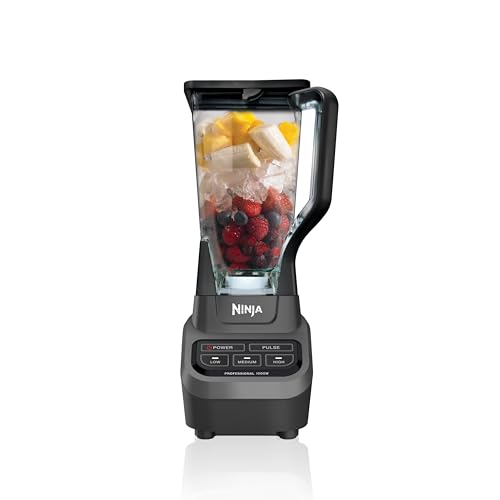
Ninja Professional Blender BL610 — Best Value Family Pitcher
The Ninja BL610 takes the opposite design route to Vitamix: instead of a vortex pulling food down to a bottom blade, its stacked blade column cuts at several heights of the pitcher at once. The listing states 1000W, a 72-ounce pitcher and Total Crushing technology aimed at ice, smoothies and sauces. For family batches — four smoothies in one load — that format is fast, effective and considerably cheaper than the premium tier.
Strengths
- Stacked-blade pitcher processes a full family batch evenly without needing a perfect vortex
- 72-ounce pitcher is the joint-largest working format here, ideal for multiple servings in one cycle
- Dishwasher-safe parts keep daily cleanup simple for a full-size machine
Trade-offs
- Ultra-fine texture on fibrous greens is a step behind the high-performance pair; expect good, not silken
- The blade column is sharp and must be handled carefully when washing by hand
- Small single servings under-fill the big pitcher and blend less efficiently
- Motor: 1000W (as listed)
- Pitcher: 72 oz
- Blade: Stacked Total Crushing blade column
- Cleaning: Dishwasher-safe parts
Judge the BL610 by its brief and it shines: volume, ice and value. A pitcher of frozen strawberries, bananas, yoghurt and ice for four people comes out even and drinkable in one cycle, and the stacked blades mean the top of the load gets processed instead of waiting its turn. Smoothie-shop silkiness on raw kale is not the claim here, and buyers who run daily green smoothies with tough stems will notice the difference against the Vitamix — everyone else gets most of the result for a mid-range tier outlay.
It is also the forgiving choice for households still building the habit: if the smoothie routine fades by spring, the BL610 still earns its counter space on frozen drinks, sauces and crushing ice for parties. That versatility at its tier is exactly why it takes the value badge.
Best for: families blending multiple smoothies per batch who want strong ice performance at a mid-range tier / Not suited for: texture perfectionists blending fibrous green smoothies daily
Check the current price on Amazon

Vitamix Propel Series 750 — Best with Preset Programs
The Propel Series 750 answers the two most common objections to the classic 5200: it adds preset programs for people who do not want to babysit a dial, and its 64-ounce container is the low-profile shape that slides under standard cabinets. The listing confirms four programs, pulse, variable speed underneath the presets, and a self-cleaning program — the full convenience layer on top of the same professional-grade blending format.
Strengths
- Four preset programs include a smoothie cycle and a self-cleaning program for true one-touch routines
- Low-profile 64-ounce container fits under more kitchen cabinets than the tall classic jar
- Variable speed and pulse remain available when you want manual control instead of a program
Trade-offs
- Sits at the top of this list’s price tiers — you pay for both the performance and the programs
- Programs are timed templates; unusual loads may still need a manual second run
- Still a large countertop footprint compared with personal blenders
- Container: 64 oz low-profile (as listed)
- Controls: 4 programs + variable speed + pulse
- Cleaning: Self-cleaning program
- Format: Full-size countertop
Programs sound like a gimmick until a household shares one blender. The smoothie program makes the result repeatable across different users — a partner or teenager gets the same texture you do, because the machine runs the same speed ramp every time. Combined with the self-cleaning program, the Propel 750 is the closest thing here to a smoothie appliance you operate with one finger, which is a genuine quality-of-life difference at 7 a.m.
Underneath the convenience it is still a Vitamix-format vortex blender, so frozen fruit and greens get the same complete liquefaction as the 5200. The decision between them is purely about budget tier and how much you value presets and the shorter container — performance is not the differentiator.
Best for: households that want high-performance results with one-touch programs and a cabinet-friendly jar / Not suited for: buyers happy to run a manual dial who would rather keep the spend in the mid tier
Check the current price on Amazon

Hamilton Beach Power Elite 58148AG — Best Budget
Not every smoothie habit justifies a premium machine, and the Hamilton Beach Power Elite is the honest budget answer: a 40-ounce glass jar, a stated 700-watt motor, 12 blending functions including ice crush, and the brand’s Wave Action jar shaping that tries to keep ingredients circulating into the blades rather than stuck to the walls. It will not liquefy kale stems like the Vitamix pair, and this guide will not pretend otherwise — but for fresh and lightly frozen smoothies, it works.
Strengths
- Lowest price tier on this list by a wide margin, with a glass jar many buyers prefer over plastic
- Wave Action system is a real attempt at circulation in a budget jar, reducing the shake-and-restart routine
- 12 functions including puree and crush ice cover the realistic smoothie and drink repertoire
Trade-offs
- Heavy frozen loads and fibrous greens will leave texture; expect to add liquid and blend longer
- 40-ounce jar suits one to two servings, not family batches
- Budget-tier build and motor are not intended as a decade-long daily workhorse
- Motor: 700W (as listed)
- Jar: 40 oz glass
- Functions: 12, including puree and crush ice
- System: Wave Action circulation design
The Power Elite’s smoothie technique is about working with the machine: liquid first, soft ingredients next, frozen fruit last and in smaller pieces, then let the ice-crush function do the heavy breaking before a longer puree. Follow that order and a banana-berry smoothie comes out genuinely pleasant; ignore it and any budget blender will struggle. That small discipline is the real price of the budget tier — technique instead of money.
Choose it if you are testing whether the smoothie habit sticks, equipping a small apartment or dorm-adjacent kitchen, or blending mostly fresh ingredients. Choose anything above it on this list if frozen fruit and greens are the daily default.
Best for: budget buyers and fresh-ingredient smoothie drinkers who want a glass jar and simple functions / Not suited for: daily frozen-and-kale drinkers who will quickly outgrow its power and texture ceiling
Check the current price on Amazon
Comparison Table
| Pick | Badge | Key spec | Best for |
|---|---|---|---|
| Vitamix 5200 | Best Overall | 64 oz container, variable speed + high switch, stainless blades | daily smoothie households that blend frozen fruit and fibrous greens and want one long-term machine |
| nutribullet Pro+ | Best Personal Blender | 1200W stated, 32 oz + 24 oz cups with lids, pulse | solo smoothie drinkers who want blend-and-go convenience with almost no washing up |
| Blendtec Classic 575 | Best for Frozen Fruit and Ice | WildSide+ jar, 4 preprogrammed cycles incl. smoothie | frozen-fruit and ice-heavy smoothie drinkers who want one-button programmed cycles |
| Ninja Professional Blender BL610 | Best Value Family Pitcher | 1000W stated, 72 oz pitcher, stacked blade column | families blending multiple smoothies per batch who want strong ice performance at a mid-range tier |
| Vitamix Propel Series 750 | Best with Preset Programs | 64 oz low-profile, 4 programs incl. smoothie + self-clean | households that want high-performance results with one-touch programs and a cabinet-friendly jar |
| Hamilton Beach Power Elite 58148AG | Best Budget | 700W stated, 40 oz glass jar, Wave Action, 12 functions | budget buyers and fresh-ingredient smoothie drinkers who want a glass jar and simple functions |
How to Choose the Best Smoothie Mixers for Your Routine
Start with servings, not specifications. Count how many smoothies you realistically make in one session. One person, one drink: a personal blender like the nutribullet Pro+ removes the pitcher from your life and is the format most likely to still be in use in six months. Two to four servings at once: a full-size pitcher in the 64–72 ounce class is the efficient choice, and the decision narrows to texture ambition and budget tier. Smoothie bowls and thick blends sit between the camps — they need either a pulse function, a tamper-style jar design or a programmed cycle that shifts the load, because thick mixtures form air pockets that stop circulation in any jar.
Next, be honest about your ingredients. Fresh fruit, yoghurt and protein powder are easy loads that even the budget pick handles well. Frozen fruit is the middleweight test — it demands either strong ice-crushing design or a jar that keeps the load moving. Fibrous greens are the heavyweight test: kale, chard and celery need sustained high-speed circulation, which is where the high-performance vortex machines separate themselves. Match the machine to your hardest regular ingredient, not your easiest, and you will not need to upgrade mid-year.
Jar shape matters more than headline wattage
Brands print wattage because it is a single comparable-looking number, but smoothie texture is decided by circulation. A narrow-based vortex jar (the Vitamix format) keeps even small loads tight around the blades. A flow-disrupting jar (Blendtec’s WildSide+) excels with big icy loads. A stacked-blade pitcher (Ninja’s format) cuts throughout the column and shines on volume. A personal cup blends well precisely because the load is small and close to the blades. When you compare listings, read the jar and blade description before the watt figure — it predicts your smoothie better.
Budget tiers, honestly framed
This guide prints no product prices, because they change too often to print responsibly — check price on Amazon for the current figure on any pick. The tiers, though, are stable. The budget tier buys fresh and lightly frozen competence and shorter expected service life. The mid tier buys family volume and strong ice work. The premium tier buys complete liquefaction of fibrous ingredients, programmed convenience and machines built for a decade of daily use. None of those tiers is the ‘wrong’ one; the wrong purchase is paying premium money for fresh-fruit needs, or budget money for a daily frozen-green habit.
Smoothie Bowls, Protein Shakes and Other Special Cases
Three common routines bend the general advice, and they are worth handling explicitly. Smoothie bowls are blended thick on purpose, which breaks the liquid-first rule’s spirit: you still add liquid first, but deliberately less of it, and the machine must survive a load that barely circulates. That brief favours a pulse function, a programmed load-shifting cycle or a jar designed to disrupt flow — the nutribullet Pro+ with its pulse, the Blendtec with its cycles and jar, and the Propel 750 with its programs are the natural picks; a basic dial machine with a standard jar will need spatula stops, which is fine occasionally and tiresome daily.
Protein shakes sit at the opposite extreme: powder, liquid and ice are an easy load, and the deciding factor is not power but whether powder clumps against the cup wall. Personal blenders win here almost by default, because the cup is the shaker and the drinking vessel in one, and a short pulse at the end breaks any surviving clump. Gym-bag routines also value the sealed travel lid over any pitcher feature, which is why so many committed shake drinkers own a personal blender even when a full-size machine already lives in the kitchen.
Baby and toddler smoothies add a safety and texture angle rather than a power one: the blend must be genuinely lump-free, and small volumes argue for the personal format or a vortex jar run at a sensible minimum volume. Whichever machine you use, blend a full cycle, then strain your judgement rather than the drink — run a spoon through it; if anything solid survives, run another short cycle. It is the one smoothie job where ‘smooth enough’ is not a matter of taste.
Keeping a Smoothie Mixer Alive: Care, Noise and Counter Reality
Daily blending is a harder service life than occasional cooking, and three care habits decide whether a machine reaches its design lifespan. First, respect duty cycles: personal blenders are built for short bursts, so blend, rest a few seconds, and blend again rather than holding one long continuous run on a frozen load. Second, keep seals and blade assemblies rinsed and dried — smoothie sugars and acids left sitting on a gasket are what produce the stale smell people blame on the jar. Third, descale your expectations about the base: never immerse a motor base, wipe it down, and store jars unsealed so trapped moisture escapes.
Noise deserves an honest paragraph, because it is the complaint premium buyers least expect. High-performance blending is loud — a machine pulverising ice at full speed cannot also be quiet, and no listing claim changes that physics. If smoothies happen at 6 a.m. in a house of light sleepers, plan around it: blend the night before and refrigerate (texture survives fine for fruit smoothies; green smoothies are best within a day), or choose the personal format, which is not silent but runs for shorter bursts. What you should not do is pay a premium expecting hush — the money buys texture and durability, not quiet.
Finally, measure your kitchen before you fall for any full-size pick. Two dimensions matter: the height from counter to the underside of your wall cabinets, and the depth the machine needs with its jar seated. The low-profile container on the Propel 750 exists precisely because the classic tall jar fails this test in many kitchens. A blender that must live in a cupboard gets used weekly; a blender that lives on the counter gets used daily — and in this category, frequency of use is the entire point of the purchase.
What Actually Makes a Smoothie Smooth?
Smoothness is particle size. A gritty smoothie is one where frozen fruit cells and plant fibres were cut coarsely or not at all; a silky one is where circulation kept passing every particle through the blade zone until nothing detectable remained. Three variables control it: how long the load circulates at effective speed, whether the jar geometry returns settled and floating material to the blades, and the order you load ingredients. Liquid first creates the current; soft ingredients feed it; frozen and fibrous items added last get pulled down into it instead of jamming the base dry.
Temperature plays a quiet role too. A fully frozen load blends smoother with a small amount of liquid than with none, because the liquid carries particles. Too much liquid, though, lets chunks surf above the blades. The practical ratio most routines settle on is enough liquid to just cover the blades and reach the bottom of the solid load — then let the machine run a full cycle rather than stopping at the first moment the mixture looks combined. Thirty extra seconds is the cheapest texture upgrade in this entire category, whichever tier you buy.
How to Use a Smoothie Mixer for Grit-Free Results Every Time
Technique closes half the gap between budget and premium machines. This loading and blending order works in every format on this list — pitcher, jar or personal cup.
- Add liquid first — water, milk, yoghurt or juice — enough to cover the blades and give the load a current to move in.
- Add soft ingredients next: banana, fresh fruit, yoghurt, protein powder and sweeteners, so they incorporate before the heavy items arrive.
- Add greens after the soft layer, pressing them down lightly so they start inside the liquid rather than floating dry on top.
- Add frozen fruit and ice last, in pieces no larger than a strawberry where you can, so the crush phase breaks them progressively.
- Start on low or pulse for a few seconds to pull the load down, then run high speed or the smoothie program for a full cycle without stopping early.
- Check texture before pouring: if flecks of green or fruit remain, run another 20–30 seconds rather than adding more liquid.
- For thick bowls, stop once, push the mixture down with a spatula (machine off), then pulse again to collapse the air pocket.
- Clean immediately: rinse, or run the self-cleaning routine with warm water and a drop of soap before residue dries onto the jar.
Two habits protect the machine itself. Never run a personal blender continuously beyond its short duty cycle — blend in bursts and let the motor rest — and never blend hot liquids in a sealed personal cup, where steam pressure has nowhere to go. Pitcher machines with vented lids handle warm loads; sealed cups do not.
Troubleshooting texture on the fly becomes second nature with practice. If the load is spinning but a dome of unblended fruit sits on top, the vortex has stalled: stop, add a splash of liquid, and restart low before going high again. If the blend is smooth but thin, your liquid ratio crept up — next time start with less and add through the lid opening only if circulation fails. If a personal cup leaks at the seal, the usual causes are an overfilled cup, a gasket seated with residue on it, or hot ingredients building pressure; all three are user-fixable in seconds. And if a burnt smell appears on a heavy frozen load in any machine, stop and let the motor cool rather than pushing through — thermal protection may save the motor once, but repeated overheating is cumulative damage. Learning these four recoveries turns the first month with a new blender from a series of small failures into a routine you stop thinking about, which is the real goal: a smoothie habit that runs on autopilot, with the machine matched to the load and the load loaded in the right order.
Common Buying Mistakes
- Buying wattage instead of format. A high watt figure in the wrong jar size for your household still disappoints. Choose the format — personal, family pitcher, high-performance — first, then compare within it.
- Overfilling a personal cup past its max line. The load cannot circulate, the motor strains, and the result is chunky at the top and scorched at the bottom. Blend two smaller cups instead.
- Loading frozen fruit first. Dry frozen chunks jam around the blades before any current forms. Liquid first, frozen last, every time.
- Stopping at the first smooth-looking moment. Fibre breakdown happens in the last third of the cycle. Let the program finish, or give manual blends the full time they need.
- Expecting a budget blender to be a juicer, mill and food processor too. Budget machines do smoothies and drinks well. Grinding dry grains or processing thick dough is outside the design brief and shortens motor life.
- Letting smoothie residue dry in the jar. Dried berry and greens residue is what makes cleanup feel like a chore and breeds odours. A thirty-second rinse or self-clean cycle immediately after pouring prevents all of it.
Final Recommendation
For most households, the Vitamix 5200 is the end of the search: it handles the hardest smoothie brief — frozen fruit plus fibrous greens, daily — with the least technique required from you. If you want that same performance with one-touch programs and a shorter jar, step up to the Propel Series 750. Frozen-first drinkers who love a programmed cycle should look at the Blendtec Classic 575, and families blending in volume on a mid-tier budget are best served by the Ninja BL610.
Solo drinkers should not buy any of the pitchers first: the nutribullet Pro+ removes the washing-up that kills smoothie habits, and its pulse button handles thicker blends than the format usually manages. And if the budget is genuinely tight, the Hamilton Beach Power Elite plus the loading technique in this guide produces honest smoothies today, with a clear upgrade path later when the habit has proved itself.
Whichever tier you choose, buy for the smoothie you actually drink on a tired Tuesday, not the elaborate recipe you make twice a year. The machine that matches your real routine — your real servings, your real ingredients, your real tolerance for washing up — is the one still earning its counter space next year, and that, more than any specification, is what makes a smoothie mixer the best one.
Keep exploring the cluster: Best Blenders For Smoothies And Ice Best Portable Blenders For Smoothies Best Blenders For Green Smoothies Best Sound Mixers Best Small Kitchen Mixers
Frequently Asked Questions
What is the difference between a smoothie mixer and a regular blender?
In practice, ‘smoothie mixer’ describes blenders judged on smoothie work: liquefying frozen fruit, ice and fibrous greens into a drinkable texture. Any good blender can make a smoothie, but designs differ — vortex jars, stacked blades, programmed smoothie cycles and personal blend-in cups all optimise different parts of the job, which is why this guide ranks by format and use case rather than treating every blender as interchangeable.
Can a personal blender handle frozen fruit?
Yes, within its limits. A strong personal blender like the nutribullet Pro+ blends frozen fruit well in single servings as long as you include enough liquid, respect the max fill line and use pulse to break up jams. What it cannot do is match a full-size high-performance machine on large frozen batches or the finest green-smoothie texture.
Why is my smoothie still gritty even with a powerful blender?
Usually circulation or time, not power. Loading frozen ingredients first, under-filling the liquid, or stopping the cycle early all leave particles unprocessed. Load liquid first and frozen last, then run a complete cycle — and for greens, give the blend the extra seconds fibre needs to break down.
Is a glass jar better than a plastic jar for smoothies?
Glass feels premium, resists scratching and does not hold odours, but it is heavier and usually appears on smaller, budget-tier machines. High-performance jars use tough engineered plastic that survives drops and thermal shock better. For smoothies specifically, jar shape affects your drink far more than jar material.
How long should a smoothie blender last?
It depends on tier and duty. Premium high-performance machines are built for years of daily use; budget machines are built for lighter service and will wear faster under daily frozen loads. Matching the machine to your hardest regular ingredient — and not overfilling or running sealed personal blenders beyond their duty cycle — is what protects lifespan at any tier.
Do I need a tamper for smoothies?
Only for very thick mixtures in vortex-style jars. Standard smoothies with reasonable liquid circulate on their own; smoothie bowls and frozen desserts are where a tamper or a load-shifting program earns its keep. If thick blends are your main use, choose a machine whose design addresses air pockets — a program, a pulse routine or a jar shaped to disrupt the flow.


