Disclosure: airfryerkitchensupply.com is reader-supported. When you buy through links on our site, we may earn an affiliate commission at no extra cost to you.
Where to buy
Shopping for the best six volt batteries for rv? The fastest way to buy any pick in this guide is through Amazon, where stock, delivery and returns are handled in one place. Start with our top recommendation, the Trojan T-105 6V 225Ah Deep-Cycle Flooded Battery (Check the current price on Amazon), then compare it against the other five picks below before you decide. Prices move with stock and season, so we never print a fixed price in the article itself — use the check-price links to see the current figure on Amazon.
If you are searching for the best six volt batteries for rv, you are probably trying to solve a very specific problem rather than browse a whole category. An RV house bank built on 6 volt batteries is almost always a series-wired deep-cycle bank: two 6V units make a 12V pair, and pairs are paralleled to add capacity. Done well, it is the most durable lead-acid arrangement you can tow. Done carelessly — mixed ages, thin cables, a charger that never reaches absorption — it disappoints quickly.
The honest headline about this market is that it is a flooded lead-acid market. The proven 6V deep-cycle batteries are GC2 and L16 flooded units from a handful of industrial makers; sealed and lithium alternatives exist at other voltages, but the classic 6V RV bank is a watering-and-venting commitment, and every pick below is presented with that reality up front.
This guide narrows the field to six picks that genuinely fit the brief behind the best six volt batteries for rv — not six near-misses padded out to fill a table. Each pick earned its place for a different reason, each one carries an honest limitation, and the buying-guide and hands-on sections further down explain the trade-offs in plain language so you can match a pick to your own setup instead of guessing.
In this guide
Quick Picks
- Trojan T-105 6V 225Ah Deep-Cycle Flooded Battery — Best Overall. The T-105 is the battery this entire category is measured against, and for an RV house bank built from series pairs it remains the reference design: a GC2 case, thick plates, and a long track record in exactly the deep-discharge, recharge-daily duty an RV imposes. Check the current price on Amazon
- Crown CR-235 6V 235Ah Flooded Deep-Cycle Battery — Best Capacity per Battery. Crown builds its CR-235 in the same GC2 footprint as the Trojan but squeezes out a little more rated capacity, and its heavy-duty plate construction has a loyal following among full-timers who cycle their banks hard. Check the current price on Amazon
- Trojan T-105 Plus 6V 225Ah Deep-Cycle Battery — Best for Easy Maintenance Checks. The T-105 Plus takes the proven T-105 platform and adds ownership-friendly details — most notably a cap design that makes checking and topping up cells quicker, which matters more than it sounds when the bank lives in a cramped RV compartment. Check the current price on Amazon
- Crown CR-305 6V 305Ah Flooded Deep-Cycle Battery — Best for Big Boondocking Banks. When a GC2 bank is not enough, the CR-305 steps up to a taller commercial case with 305Ah per battery — the route full-time boondockers take when they want serious amp-hours without switching chemistry. Check the current price on Amazon
- Crown CR-430 6V 430Ah Deep-Cycle Battery (L16) — Best Maximum Capacity. The CR-430 in the tall L16 case is the heavyweight of this list: 430Ah from a single 6V unit, aimed at RVs and off-grid cabins whose owners think in kilowatt-hours, not weekends. Check the current price on Amazon
- Trojan T-105 Plus (Pack of 6 Listing) — Best for Full-Bank Replacement. Replacing a whole bank at once is the correct way to renew an RV house system, and multi-pack listings of the T-105 exist precisely for that job — matched batteries, one delivery, no mixing of ages inside a string. Check the current price on Amazon
How These Picks Were Chosen
We started from the real-world shortlist that buyers of the best six volt batteries for rv actually cross-shop: the established brands in this niche, the current value challengers, and the specialist models that solve one problem unusually well. From that long list we applied four filters. First, the product had to match the core specification in the search itself — voltage, size class and intended use — with no stretching of the definition to make a pick fit. Second, it had to be a product a buyer can actually obtain through normal retail channels today, not a discontinued listing kept alive by third-party markups. Third, the design had to suit the way these products are really used, which for this category means daily deep discharge followed by a full recharge, tolerance of vibration and temperature swings in an exterior compartment, and terminals and cases that standard RV trays and cables already fit. Fourth, we weighed ownership as heavily as first impressions: parts availability, documentation quality, warranty support and how forgiving the product is when something goes wrong six months in.
Products that failed any filter were cut, even when they were heavily marketed. Where a tier of the market turned out to be thin or effectively empty, we say so openly in the relevant review instead of inventing a filler pick. Specifications quoted in the mini spec boxes come from the verified catalog listing for that exact model; where a figure could not be confirmed for a specific pick, we left the box out rather than guess. The result is six picks that divide the market by job, not by marketing label.
The 6 Best Six Volt Batteries for an RV

Trojan T-105 6V 225Ah Deep-Cycle Flooded Battery — Best Overall
The T-105 is the battery this entire category is measured against, and for an RV house bank built from series pairs it remains the reference design: a GC2 case, thick plates, and a long track record in exactly the deep-discharge, recharge-daily duty an RV imposes.
Strengths
- 225Ah per battery gives a four-battery 12V bank roughly 450Ah of nameplate capacity
- Thick-plate flooded design tolerates deep daily cycling better than thin-plate starting batteries
- GC2 footprint is the industry standard, so trays, cables and hold-downs are easy to source
Trade-offs
- Flooded cells need watering checks and ventilation — they are not fit-and-forget
- Heavy: a full bank is a serious payload and needs a secure, vented compartment
- Must be bought in matched pairs for a 12V bank, so budget and plan in multiples of two
Key specs: 6V, 225Ah at the 20-hour rate, GC2 case, flooded lead-acid
In practice the T-105 rewards owners who treat the bank as a system: equal-length interconnect cables, a proper multi-stage converter-charger, and a monthly specific-gravity check with a hydrometer. Owners who do that routinely report banks lasting through many seasons of regular travel; owners who let cells run dry or sit discharged over winter kill the same battery quickly. The chemistry is honest — it gives back exactly the care it gets.
For RV use the sweet spot is a four-battery bank in a vented exterior compartment, charged by a converter with a genuine absorption stage. If your rig lives on hookups most nights and only occasionally boondocks, the T-105 bank is arguably more capacity than you need; if you dry-camp for days at a time, it is the benchmark the alternatives below are trying to beat on price, weight or maintenance.
Best for: most RV owners building a proven 12V house bank / Not suited for: sealed, maintenance-free installations — this battery needs watering and venting
Check the current price on Amazon

Crown CR-235 6V 235Ah Flooded Deep-Cycle Battery — Best Capacity per Battery
Crown builds its CR-235 in the same GC2 footprint as the Trojan but squeezes out a little more rated capacity, and its heavy-duty plate construction has a loyal following among full-timers who cycle their banks hard.
Strengths
- 235Ah rating edges the class benchmark in the same physical case
- Robust plate design aimed at commercial motive-power duty, not weekend-only use
- Widely stocked by battery specialists, which helps when one unit needs replacing mid-trip
Trade-offs
- Same flooded maintenance burden: watering, venting and terminal cleaning
- Slightly less ubiquitous than Trojan, so confirm local availability before committing
- Like all flooded GC2s, it hates being left partially discharged
Key specs: 6V, 235Ah, GC2 case, flooded lead-acid
The CR-235 makes the most sense when you are replacing a whole bank at once and your dealer stocks Crown — mixing brands or ages inside one series string is poor practice, because the weakest battery dictates the behaviour of the pair. As a matched set of four, it delivers a deep, durable bank with a touch more headroom than the benchmark for running a microwave or a CPAP through an inverter overnight.
Charging discipline matters as much as the badge on the case. Set your converter or solar controller to the absorption voltage Crown publishes for flooded cells, equalise only as directed, and keep the electrolyte above the plates with distilled water. Do that and the CR-235 is one of the longest-lived flooded options in this class.
Best for: buyers who want a little more capacity in the same GC2 footprint / Not suited for: owners who will not keep up with flooded maintenance
Check the current price on Amazon
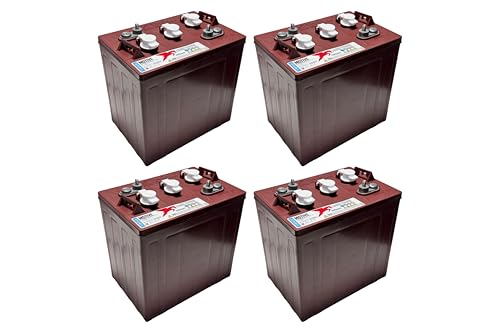
Trojan T-105 Plus 6V 225Ah Deep-Cycle Battery — Best for Easy Maintenance Checks
The T-105 Plus takes the proven T-105 platform and adds ownership-friendly details — most notably a cap design that makes checking and topping up cells quicker, which matters more than it sounds when the bank lives in a cramped RV compartment.
Strengths
- Same proven 225Ah GC2 platform as the standard T-105
- Cap and vent design speeds up the monthly watering routine
- Interchangeable footprint with standard T-105 trays and cabling
Trade-offs
- Still a flooded battery: it vents gas on charge and needs a vented box
- Premium positioning within the Trojan line for what is mainly a convenience upgrade
- Sold singly and in packs — check the listing quantity carefully before ordering
Key specs: 6V, 225Ah, GC2 case, flooded, Plus-series cap design
If you already run T-105s and simply dread the maintenance ritual, the Plus is the natural like-for-like upgrade at replacement time: same cables, same tray, same charger settings, less fumbling with caps in a dark compartment. That convenience is not trivial — the number one killer of flooded RV banks is skipped watering, and anything that makes the check easier genuinely extends bank life.
Beyond the caps, expect the same character as the standard battery: strong deep-cycle endurance, honest capacity, and a firm requirement to be recharged promptly after deep discharges. Pair it with a battery watering system if your compartment access is truly awkward, and the maintenance objection to flooded batteries mostly disappears.
Best for: T-105 owners upgrading at replacement time for easier upkeep / Not suited for: shoppers expecting sealed-battery convenience from a flooded design
Check the current price on Amazon

Crown CR-305 6V 305Ah Flooded Deep-Cycle Battery — Best for Big Boondocking Banks
When a GC2 bank is not enough, the CR-305 steps up to a taller commercial case with 305Ah per battery — the route full-time boondockers take when they want serious amp-hours without switching chemistry.
Strengths
- 305Ah per unit builds very large 12V banks from fewer, bigger batteries
- Commercial motive-power construction suits daily deep cycling
- Flooded design keeps the cost per amp-hour low versus lithium conversions
Trade-offs
- Taller and much heavier than GC2 — measure the compartment before falling in love
- Fewer, larger batteries mean a single failure removes a bigger share of the bank
- Still needs watering, venting and prompt recharging
Key specs: 6V, 305Ah at the 20-hour rate, flooded lead-acid, taller commercial case
A pair of CR-305s gives a 12V bank with roughly 305Ah nameplate — and two pairs approach the kind of storage that runs a residential-style RV load list through a cloudy weekend. The trade is physical: these are tall, heavy industrial batteries that demand a reinforced, vented compartment and a plan for how you will ever lift them out again.
Choose this route when you have the space, the payload margin and a genuine off-grid load. For a weekend rig it is overkill that adds weight you will tow for no benefit; for a full-timer who has done the amp-hour maths, it is one of the most cost-effective deep banks you can build from flooded cells.
Best for: boondockers who have measured their compartment and their daily amp-hour use / Not suited for: small rigs without the space, payload or need for a bank this size
Check the current price on Amazon

Crown CR-430 6V 430Ah Deep-Cycle Battery (L16) — Best Maximum Capacity
The CR-430 in the tall L16 case is the heavyweight of this list: 430Ah from a single 6V unit, aimed at RVs and off-grid cabins whose owners think in kilowatt-hours, not weekends.
Strengths
- 430Ah per battery — the largest capacity in this guide
- L16 format is a long-established size for serious off-grid banks
- Flooded construction keeps replacement and recycling straightforward
Trade-offs
- Very heavy and tall; many RV compartments simply cannot take it
- Overkill — and wasted payload — for hookup-based travel
- A bank of these is a two-person, equipment-assisted installation job
Key specs: 6V, 430Ah, L16 case (BCI 903), flooded lead-acid
Treat the CR-430 as infrastructure, not an accessory. It belongs in rigs with a dedicated battery bay, a high-output charging source and an inverter sized to match. In that setting a four-battery bank stores energy on a scale that changes how you travel: multi-day autonomy without generator runs becomes normal rather than aspirational.
The cautions are equally structural. Confirm floor loading, door clearance and ventilation before ordering, and plan the cable runs — at these capacities, undersized interconnects waste the very capacity you paid for. This is the right battery for a small number of serious builds, and the wrong battery for almost everyone else, which is exactly why it sits at the specialist end of the list.
Best for: full-timers building a large, dedicated battery bay / Not suited for: almost any casual or hookup-based RV use
Check the current price on Amazon

Trojan T-105 Plus (Pack of 6 Listing) — Best for Full-Bank Replacement
Replacing a whole bank at once is the correct way to renew an RV house system, and multi-pack listings of the T-105 exist precisely for that job — matched batteries, one delivery, no mixing of ages inside a string.
Strengths
- Matched set avoids the weak-link problem of mixing old and new batteries
- One purchase covers a complete six-battery installation
- Same benchmark GC2 platform as our top pick
Trade-offs
- A six-pack is a freight-scale delivery — plan where it will be unloaded
- Highest upfront commitment in this guide, even though the per-battery logic is sound
- You still supply cables, watering kit and charging discipline yourself
Key specs: 6V, 225Ah each, GC2 case, flooded lead-acid, multi-pack listing
Six GC2 batteries suit larger rigs running a 12V bank of six, or owners splitting a set across an RV and a golf cart at a seasonal site. The key virtue is matching: batteries bought together, from the same production run, age together, which keeps series strings balanced and charging predictable.
Before ordering a pack, weigh the compartment, confirm your converter-charger can deliver a proper absorption charge to a bank this size, and arrange help for installation day. Flooded batteries ship with handling requirements that reward preparation — gloves, eye protection, baking soda for spills and a clear path from pallet to battery bay.
Best for: owners replacing an entire bank with matched batteries in one order / Not suited for: buyers who only need a single replacement unit
Check the current price on Amazon
Comparison Table
| Pick | Badge | Key spec | Best for |
|---|---|---|---|
| Trojan T-105 6V 225Ah Deep-Cycle Flooded Battery (Check the current price on Amazon) | Best Overall | 6V, 225Ah at the 20-hour rate, GC2 case, flooded lead-acid | most RV owners building a proven 12V house bank |
| Crown CR-235 6V 235Ah Flooded Deep-Cycle Battery (Check the current price on Amazon) | Best Capacity per Battery | 6V, 235Ah, GC2 case, flooded lead-acid | buyers who want a little more capacity in the same GC2 footprint |
| Trojan T-105 Plus 6V 225Ah Deep-Cycle Battery (Check the current price on Amazon) | Best for Easy Maintenance Checks | 6V, 225Ah, GC2 case, flooded, Plus-series cap design | T-105 owners upgrading at replacement time for easier upkeep |
| Crown CR-305 6V 305Ah Flooded Deep-Cycle Battery (Check the current price on Amazon) | Best for Big Boondocking Banks | 6V, 305Ah at the 20-hour rate, flooded lead-acid, taller commercial case | boondockers who have measured their compartment and their daily amp-hour use |
| Crown CR-430 6V 430Ah Deep-Cycle Battery (L16) (Check the current price on Amazon) | Best Maximum Capacity | 6V, 430Ah, L16 case (BCI 903), flooded lead-acid | full-timers building a large, dedicated battery bay |
| Trojan T-105 Plus (Pack of 6 Listing) (Check the current price on Amazon) | Best for Full-Bank Replacement | 6V, 225Ah each, GC2 case, flooded lead-acid, multi-pack listing | owners replacing an entire bank with matched batteries in one order |
How to Choose Six Volt Batteries for RV Use
Series pairs, parallel strings: how 6V becomes an RV bank
Two 6V batteries wired in series produce 12V at the amp-hour rating of one battery; adding a second series pair in parallel doubles the capacity. That simple arithmetic drives every decision in this category. A four-GC2 bank of 225Ah batteries is a 12V, roughly 450Ah bank — of which about half is comfortably usable if you follow the classic guidance of not routinely discharging flooded lead-acid below about half its capacity.
Wiring quality decides whether you get the capacity you paid for. Use interconnect cables of equal length and generous gauge, keep the main positive and negative take-offs at opposite ends of the bank so current shares evenly, and torque terminals to spec, then re-check them after the first trips. Resistance you cannot see becomes heat and lost amp-hours you definitely can.
Flooded, AGM or lithium: the honest chemistry talk
Every pick in this guide is flooded lead-acid, because that is where the proven 6V deep-cycle products are. Flooded cells give the lowest cost per usable amp-hour and tolerate deep cycling well, in exchange for watering, venting and a vented compartment. AGM removes the watering and venting burden at higher cost per amp-hour, but true 6V AGM deep-cycle choices are thin. Lithium changes the whole system — charger profiles, low-temperature protection, monitoring — and is normally bought as 12V units rather than 6V building blocks.
Choose flooded 6V when you have an accessible vented compartment, a charger with a proper flooded profile, and the habit of a monthly check. Choose another chemistry when the compartment is sealed, interior or genuinely inaccessible — forcing flooded batteries into a space you cannot service is how banks die young.
Sizing the bank to your real loads
List what actually runs overnight: furnace fan, lights, water pump, phone charging, a CPAP, the fridge control board. Add the watt-hours, convert to amp-hours at 12V, then double the figure for flooded depth-of-discharge headroom and add a margin for cold weather, which temporarily reduces lead-acid capacity. Most couples land between a two-battery and a four-battery GC2 bank; large residential fridges and heavy inverter use push you toward the CR-305 or L16 end of this guide.
Oversizing has a cost beyond money: an undercharged big bank sulphates just as happily as a small one. Match the bank to a charging source — converter, solar or both — that can return it to full regularly. A smaller bank that reaches full charge weekly will outlive a huge bank that lives at partial charge.
How to Install and Commission a 6V RV Battery Bank
Work methodically and treat this as electrical work, because it is. Photograph the old wiring before touching anything, and keep metal tools away from exposed terminals.
- Remove shore power and switch the converter off; remove the negative cable first and insulate it so it cannot spring back onto a terminal.
- Lift out the old batteries with a carrying strap, clean the tray, and neutralise any acid residue with a baking-soda solution before drying the compartment.
- Set the new batteries in matched series pairs, confirm the tray and hold-downs fit the case size, and check the compartment vent is clear.
- Connect series jumpers between pairs first, then parallel links, using equal-length cables; take the main positive and negative feeds from opposite ends of the bank.
- Torque every terminal, coat with a corrosion protectant, and label each battery with its position and install date.
- Charge the bank fully on the flooded profile before first use, then check electrolyte levels and record a hydrometer baseline for future comparisons.
For the first month, check levels and terminal tightness weekly — new installations settle, and a loose interconnect found early is a nuisance, while the same fault found after a season of arcing is a repair bill. Keep a simple log: dates watered, any equalisation charges, and winter storage charge dates. That notebook is what turns a three-season bank into a six-season bank.
In storage, flooded banks self-discharge and sulphate if ignored. Either keep a quality maintainer on the bank or recharge it fully every few weeks, and never store it discharged. If the RV winters somewhere cold, a fully charged flooded battery resists freezing far better than a discharged one — charge state is freeze protection.
Common Buying Mistakes
Mixing old and new batteries in one string. The aged battery drags the pair down and the new battery is overworked to compensate. Replace banks as matched sets, or at minimum as matched pairs.
Buying capacity without a charging plan. A big bank on a weak single-stage converter lives chronically undercharged and sulphates. Budget for the charger when you budget for the batteries.
Sealing flooded batteries in an unvented box. Flooded cells vent hydrogen on charge. They belong in a vented compartment, full stop.
Never checking the water. Plates exposed to air are permanently damaged. Distilled water only, filled to the ring, checked monthly in season.
Undersized or uneven cables. Mismatched interconnect lengths unbalance the bank so one pair works harder and ages faster. Equal lengths, generous gauge, clean torque.
Watering, Equalising and the Monthly Ten Minutes
Flooded ownership reduces to a short ritual. Once a month in season: open the compartment, check each cell, top up with distilled water after charging — never before a charge, when expansion can push electrolyte out — wipe the tops dry, and glance at the cables for corrosion or chafing. Every few months, a hydrometer reading across all cells tells you whether the bank is charging evenly; one persistently low cell is an early warning worth acting on.
Equalisation — a controlled, higher-voltage charge — can rebalance a flooded bank and dissolve soft sulphation, but only when the battery maker and your charger both support it, and only with ventilation and supervision. Treat it as a deliberate maintenance procedure from the manual, not a folk remedy, and never equalise sealed batteries. Done on schedule, these small habits are the entire difference between the lifespan flooded sceptics quote and the lifespan flooded owners actually get.
Cold Weather, Storage and Sulphation: the Three Killers
Cold does not damage a charged flooded battery, but it temporarily reduces available capacity, so winter trips need more nameplate amp-hours for the same loads. The real cold-weather danger is a discharged battery, whose electrolyte can freeze and crack the case. Keep storage charge topped up and the risk mostly disappears.
Sulphation is the slow killer: lead sulphate crystals harden on plates left at partial charge, permanently removing capacity. It is prevented by the dullest advice in this guide — recharge promptly and fully, and do not let the bank sit discharged between trips.
Reading a Hydrometer Without Guessing
A hydrometer measures electrolyte density cell by cell, which is the closest thing a flooded battery has to a fuel gauge per cell. Readings taken after a full charge and a short rest should be close to each other across the bank; a cell that lags its neighbours after charging is ageing or sulphated, and a bank whose pairs disagree is telling you where the weak link lives.
Keep the baseline you recorded at commissioning. Trends matter more than any single number: a bank whose readings drift down together needs charging attention, while one diverging cell needs a battery decision before it strands the pair on a trip.
Living With a 6 volt RV battery bank: the First Season and Beyond
The first month with a 6 volt RV battery bank teaches you the gap between the brochure and the routine. Controls that seemed fiddly become automatic, the sounds the bank makes become a background language you read without thinking, and the one specification you obsessed over at purchase time turns out to matter less than the two you barely noticed. This is normal, and it is why this guide weighted ownership factors — support, parts, documentation and forgiveness — as heavily as headline performance when the picks were chosen.
By the end of the first season, patterns settle. You will know the settings you actually use, the accessories that earned their storage space and the ones still in their packaging. You will also know whether your original sizing decision was right: owners of the best six volt batteries for rv who bought for their real pattern rather than their imagined one report the appliance disappearing into their routine, which is the highest praise any product in this category can earn. Owners who bought for an imagined life spend the season working around the mismatch.
Year two and beyond is where the picks in this guide separate from the market’s disposable tier. The established brands publish documentation, stock consumables and answer questions; the products keep performing because their wear items were designed to be serviced rather than sealed away. None of that appears in a first-week review, and all of it decides whether you are still satisfied — or shopping again — three seasons from now.
The Maintenance Rhythm That Actually Works
Every product behind the best six volt batteries for rv has a maintenance rhythm, and the owners who thrive are not the ones with the longest checklist — they are the ones whose short checklist actually happens. Anchor the routine to events that already exist in your life: the start of a trip, the first weekend of the month, the change of a season. A check tied to a calendar abstraction gets skipped; a check tied to packing the vehicle or opening the pool gets done.
Keep the consumables on hand before they are needed. The pattern repeats across this whole category: the part is inexpensive, the shipping delay is the expensive part, and the failure chooses the least convenient weekend of the year. A small spares kit bought calmly in advance — informed by the specific pick you own and its manual — converts most mid-season failures from trip-ending events into twenty-minute interruptions.
Finally, keep a notebook or a notes file. Dates, settings that worked, parts replaced, the dealer’s name, the exact model variant: ownership knowledge compounds, and the owner who can say precisely what was done and when gets better help from every support line, forum and technician they ever call. The notebook is also what turns a future replacement decision from guesswork into arithmetic.
Troubleshooting: Reading Symptoms Before Spending Money
When a 6 volt RV battery bank misbehaves, work the symptom ladder from the free end upward. First, power and connections: is the supply actually delivering what the product expects, at the plug, under load? A remarkable share of ‘failures’ in every category in this guide are supply problems wearing the product’s clothes. Second, the consumables and the airflow, water flow or signal path — whichever medium the bank works in — because blockages imitate breakdowns perfectly. Third, settings: a mode changed by a guest, a child or your own elbow can produce symptoms indistinguishable from a fault.
Only after those three should money move. When it does, spend it on diagnosis before parts: a technician’s hour that names the fault is cheaper than a sequence of hopeful components. And use the symptom’s timing as evidence — faults that appear after a move, a storm, a service or a new accessory are usually about that event, not about the product’s age. Tell whoever helps you the whole timeline; it is the most diagnostic information you own.
Know, too, when a symptom is a retirement notice rather than a repair ticket. Every category has a component whose failure, on an old and heavily used example, costs a meaningful fraction of replacement — and whose replacement reveals the next tired component behind it. The picks in this guide were chosen partly for graceful ageing, but no product escapes the arithmetic forever, and recognising the moment keeps money in your pocket.
Who Should Skip This Purchase Entirely
An honest guide to the best six volt batteries for rv should name the buyers it cannot help. Skip this purchase if your real need belongs to the neighbouring category — the guide’s own comparisons point at those neighbours repeatedly, and forcing this product class to do that job produces the disappointed reviews that litter every marketplace. Skip it, too, if the supporting system it depends on — the power supply, the space, the venting, the water, the vehicle — cannot be made right: a good product on a bad foundation performs badly and takes the blame.
Skip it if you are buying for a single event with no life afterwards. Hiring, borrowing or buying the cheapest adequate option serves one-off needs better than a quality purchase that will sit unused, ageing, in a cupboard. And skip it if the honest reason is a sale rather than a need: the discount on the wrong product is the most expensive money in this entire category.
For everyone else — the buyers whose pattern matches what these products genuinely do — the picks above are ordered so that the first one is the default and each subsequent one exists for a named reason. If none of the named reasons is yours, the default is your answer, and the time to stop researching and start using is now.
Resale, Spares and the End of the Story
Products bought well in this category hold a second life. The established brands’ examples sell on used markets because buyers trust the badge and can verify the model — another quiet return on choosing the names in this guide over anonymous alternatives. Keep the manual, the receipt and any spare consumables together; a complete, documented example is worth visibly more than a bare one, and costs you nothing but a drawer.
When the end does come, dispose of the product through the proper channel for its type — several categories in this guide involve materials that local rules govern — and let the replacement decision reuse everything you learned. Your notebook of settings, sizes and mistakes is the real asset you carry into the next purchase; the hardware was always just renting your attention.
That is the perspective this guide was written from: the best six volt batteries for rv is not a trophy purchase but a working part of a vehicle, a home, a pool or a stage. Bought with clear eyes, maintained with a light rhythm and replaced without sentimentality when the arithmetic says so, it is one of the more satisfying corners of ownership — a problem genuinely solved, season after season.
The Cost of Ownership, in Plain Terms
The purchase price of a 6 volt RV battery bank is the entry fee, not the cost. The real ledger adds the consumables it eats on schedule, the energy it draws across a season, the accessories that turned out to be necessities rather than luxuries, and — the line nobody budgets — the cost of the cheap first purchase replaced early. Worked through honestly, that ledger is why this guide’s ordering puts durable, supported products first: their per-season cost is routinely lower than the bargain alternative’s, even when the till receipt says otherwise.
Energy deserves a specific mention because it is the cost owners feel monthly rather than once. The efficient picks in this guide were not chosen for their green credentials but for their arithmetic: a product that runs every day, or all night, or all season, repays efficiency in the currency of smaller supporting systems — smaller batteries, smaller bills, fewer compromises elsewhere. When you compare two finalists, compare them as systems across a year, not as stickers across a counter.
The final line of the ledger is your own time. Products that need constant adjustment, rescue and research tax the hours they were bought to free. A 6 volt RV battery bank that simply works — set up once, maintained lightly, understood completely — is worth a premium measured in weekends, and owners consistently undervalue that premium at purchase time and overvalue it ever after.
Accessories: the Short List That Earns Its Keep
Every 6 volt RV battery bank attracts an ecosystem of accessories, most of which exist because they can, not because they should. The ones that earn their keep share a trait: they remove a recurring friction you have actually felt. Buy accessories in that order — after the friction, not in anticipation of it — and your storage stays as lean as your routine.
The exceptions are protective and consumable items, which should be bought with the product itself: the cover, the filter, the spare, the correct cable or fitting whose absence on the first weekend turns a new purchase into a sculpture. Those are not accessories in the shopping sense; they are the second half of the product, and the listings and manuals of the picks above name them plainly.
Resist, finally, the bundle. Kits that package the essential with the ornamental price the ornamental as if it were essential. Buy the product, live with it for a month, and let your own routine write the accessories list. It will be shorter than the manufacturer’s, cheaper than the bundle, and — uniquely — composed entirely of things you use.
Final Recommendation
For most RV owners, start with the Trojan T-105 as a matched set of four: it is the proven centre of this market. Step to the Crown CR-235 for a little more capacity in the same footprint, the CR-305 or CR-430 only when your measured loads and compartment genuinely justify industrial-size batteries, and a multi-pack T-105 listing when the whole bank is due at once. Whichever you choose, the charger, cables and monthly watering matter as much as the badge on the case.
Related guides on this site: Best 12 Volt Batteries For An Rv Best 12 Volt Batteries Best 12 Volt Rv Refrigerator Best 12 Volt Fan For Rv Best 12 Volt Marine Deep Cycle Battery
Frequently Asked Questions
How many 6 volt batteries does an RV need?
Most RVs run either two 6V batteries as a single 12V pair or four as two pairs in parallel. Two suit light, hookup-heavy travel; four suit regular dry camping. Six appear in large rigs with heavy inverter loads. The right number comes from your overnight amp-hour use, not from the size of the compartment alone.
Can I replace one failed 6V battery and keep the other?
You can, but it is rarely wise inside a series pair: the new battery will be dragged toward the old one’s performance. At minimum replace the pair together, keep the surviving old battery as a spare for a golf cart or workshop, and never mix brands or capacities within a pair.
How long do 6V RV batteries last?
With full recharges, correct watering and no long periods sitting discharged, quality flooded GC2 batteries commonly serve for many seasons of regular use. Abuse — chronic undercharging, dry plates, deep discharges left unrecharged — can ruin the same battery in a single season. Lifespan is mostly a record of habits.
Do 6V batteries need a special charger?
They need a charger or converter with a proper multi-stage flooded lead-acid profile that reaches the absorption voltage the maker specifies, sized to the bank. A basic single-stage unit will leave a deep-cycle bank undercharged. Solar controllers must likewise be set to the flooded profile and the correct voltage for a 12V bank.
Are 6V batteries better than two 12V batteries?
For lead-acid house banks, generally yes: true 6V deep-cycle units have thicker plates built for repeated deep discharge, while many 12V batteries are dual-purpose compromises. Two GC2s in series usually out-cycle two 12V dual-purpose batteries wired in parallel, at similar total capacity.
Can I switch my 6V bank to lithium later?
Yes, but treat it as a system change: charger profiles, low-temperature charge protection, cabling take-off points and monitoring all change, and lithium replacements are normally 12V units rather than 6V blocks. The tray and cables you install well today still serve you then.