Disclosure: airfryerkitchensupply.com is reader-supported. When you buy through links on our site, we may earn an affiliate commission at no extra cost to you.
Where to Buy
Pro-level pump machines are sold in several configurations — boiler size, colour, bundled grinder or not — and every model below was verified against Amazon’s catalogue data for this site, with the exact variant matched before a link was allowed. Check the listing carefully for which configuration is actually being offered.
- Breville Dual Boiler (BES920XL) — check price on Amazon
- Ascaso Steel DUO PID V3 — check price on Amazon
- Nuova Simonelli Appia Life (1 Group, Volumetric) — check price on Amazon
- Diletta Alto (Dual Boiler) — check price on Amazon
- Breville Oracle Touch (BES990) — check price on Amazon
- Diletta Bello+ — check price on Amazon
At this level prices vary by configuration and season, and this guide prints no fixed prices. Use the links to check the current price on Amazon, and confirm whether a listing is the machine alone or a bundle, because pro machines are frequently sold both ways. At this level it is also worth checking the seller: pro machines are best bought from Amazon itself or the maker’s authorised store, because warranty handling on commercial-grade equipment depends on an authorised first sale.
The best pump pro espresso machines are where home equipment stops apologising to cafés. ‘Pro’ in this guide means something specific: machines built around the same architecture as commercial equipment — dual boilers or heat exchangers, E61 or saturated groups, generous steam, metal construction, and pumps and valves chosen for duty rather than for a price point. Some are true single-group commercial machines that happen to be sold for homes and small cafés; others are prosumer machines that bring café workflow to a kitchen counter. All of them assume a serious grinder beside them and an owner who wants control.
What the money buys, concretely, is simultaneity and stability. You can extract while steaming. Temperature holds across a round of drinks instead of drifting. Pressure can be profiled, pre-infusion timed, and every wear part sourced from commercial suppliers. The six picks below map the territory: a dual-boiler benchmark, a dual-thermoblock design that heats in minutes, a genuine commercial single-group, a dual-boiler value challenger, an automated pro machine that tamping beginners can run, and an E61 heat-exchanger classic. If the standard pump roundup is about getting into espresso, this one is about removing its ceilings.
A word about what this guide is not: it is not a list of the most expensive machines we could find. Two of the six picks are challenger-priced, one is an automation play, and the commercial machine is included because small cafés and serious offices genuinely shop this category. Pro, as defined here, is an engineering standard — and the reviews below hold each machine to it, including where a famous badge’s service model or a challenger’s short history counts against it.
In this guide
Quick Picks
Six pro-grade pump machines, from dual-boiler benchmarks to a true commercial single-group. The shortlist first; detailed reviews follow. All six were verified as exact catalogue matches before earning a link, and each represents a different branch of pro architecture rather than a variation on one formula.
Breville Dual Boiler (BES920XL) — Best Overall Pro. Dual stainless boilers, precise PID temperature, programmable pre-infusion and live pressure feedback — the most controllable pump machine Breville makes. Check the current price on Amazon.
Ascaso Steel DUO PID V3 — Best Fast-Heat Pro. Dual thermoblocks instead of boilers: pro-level simultaneous brew and steam with heat-up measured in minutes, PID control and volumetric dosing. Check the current price on Amazon.
Nuova Simonelli Appia Life (1 Group, Volumetric) — Best True Commercial. A genuine café machine in single-group form: commercial boiler, volumetric dosing and build quality designed for all-day service — for homes and small cafés that mean it. Check the current price on Amazon.
Diletta Alto (Dual Boiler) — Best Dual-Boiler Value. A retailer-developed dual boiler with PID, shot timer and adjustable over-pressure valve — the enthusiast specification sheet at a challenger price. Check the current price on Amazon.
Breville Oracle Touch (BES990) — Best Automated Pro. Dual boilers with automatic grinding, tamping and milk texturing behind a touchscreen — pro output for households where not everyone wants to be a barista. Check the current price on Amazon.
Diletta Bello+ — Best E61 Heat-Exchanger Classic. An E61-group heat-exchanger machine in the classic Italian pattern: brew and steam together, mechanical ritual, and parts any espresso technician on earth recognises. Check the current price on Amazon.
How These Picks Were Chosen
Pro is a word this category abuses, so this guide defined it before selecting: a pick had to offer simultaneous or near-simultaneous brew and steam capability, temperature control beyond a thermostat’s guess, commercial-standard 58mm or commercial group hardware, and construction intended for service rather than replacement. Every model was then verified against Amazon’s catalogue data — brand, model and configuration matched exactly — before receiving a link.
The six survivors were chosen to represent the pro territory’s real branches rather than six versions of one machine: dual boiler with deep control (Breville), dual thermoblock for speed (Ascaso), true commercial single-group (Nuova Simonelli), dual boiler with adjustable pressure at a challenger price (Diletta Alto), full automation on pro hardware (Oracle Touch), and the E61 heat-exchanger tradition (Diletta Bello+). Grinders are deliberately not bundled into the judgements — at this level the grinder is a separate, equally serious purchase, and several of our cluster guides cover it.
A final selection note: we excluded several famous flagship machines from this guide not on merit but on verifiability — models we could not match exactly through this site’s catalogue channel do not receive links here, however strong their reputations. The six that remain are the pro machines a buyer can actually inspect and purchase through the links on this page today.
- Every linked ASIN verified against Amazon catalogue data for this site
- ‘Pro’ defined by architecture — dual systems, temperature control, serviceable construction — not by price or badges
- One pick per pro branch: dual boiler, dual thermoblock, commercial, value dual boiler, automated pro, E61 heat exchanger
- No fixed prices or star ratings printed anywhere in this guide
The 6 Best Pump Pro Espresso Machines

Breville Dual Boiler (BES920XL) — Best Overall Pro
The Dual Boiler is the thinking enthusiast’s machine: separate boilers for brew and steam, a heated group, adjustable pre-infusion power and duration, and shot temperature you set to the degree. It rewards owners who experiment with light roasts and keep notes. It is a 58mm machine with a dedicated following and strong parts support. Its limits are Breville’s appliance-style service model — repairs route through the maker rather than any café technician — and a footprint that needs a permanent station.
Strengths
- True dual boilers: brew and steam simultaneously at stable temperatures
- Programmable pre-infusion and PID control suit light-roast experimentation
- 58mm portafilter and a pressure gauge support a full pro workflow
Trade-offs
- Service runs through the manufacturer, not local café technicians
- Dense feature set has a learning curve beyond its friendly styling
- Needs a top-tier grinder to justify its precision
| Machine type | Prosumer dual-boiler pump machine |
| Pump | 15-bar Italian pump with programmable pre-infusion |
| Boilers | Dual stainless-steel boilers, PID brew temperature |
| Portafilter | 58mm |
| Milk system | Dedicated steam boiler, manual wand |
The Dual Boiler’s party trick is control density. Brew temperature, pre-infusion duration and pre-infusion power are all adjustable from the front panel, which lets an owner replicate the gentle profiles that make light, acidic roasts taste sweet instead of sour. The steam boiler is always ready, so milk drinks stop being a sequence and become a flow. In blind workflow terms it behaves like a small commercial machine that happens to speak appliance.
The honest reservation is longevity culture. Italian pro machines are built to be opened by any technician for thirty years; Breville builds a superb five-to-ten-year appliance with manufacturer service. For most buyers the Dual Boiler’s performance-per-dollar and controllability outweigh that — it remains the benchmark against which other prosumer machines in this guide are measured — but buyers planning a multi-decade heirloom should read the Diletta and Nuova Simonelli reviews closely.
Best for: enthusiasts who want maximum extraction control and dual-boiler workflow / Not suited for: buyers wanting any-technician repairability over decades
Check on Amazon — confirm the current price on Amazon today, since offers and included extras vary by listing.

Ascaso Steel DUO PID V3 — Best Fast-Heat Pro
The Steel DUO answers the dual boiler’s one weakness — warm-up time — by replacing boilers with two independent thermoblocks, one for brewing and one for steam. The result is a pro workflow ready in a few minutes, with PID temperature, volumetric shot programming and a professional portafilter. It suits households that entertain unpredictably and will not plan drinks around a boiler’s half-hour warm-up. Purists debate thermoblock versus boiler steam feel; the DUO’s steam is strong and dry, but the machine’s electronics-forward design asks for authorised service rather than home tinkering.
Strengths
- Dual thermoblocks give simultaneous brew and steam with fast heat-up
- PID temperature and volumetric dosing make shots repeatable
- Fresh water per shot — no boiler water sitting and ageing
Trade-offs
- Thermoblock steam character differs subtly from big-boiler steam
- Electronics-forward design is less home-serviceable than E61 machines
- Premium pricing for the convenience of speed
| Machine type | Prosumer dual-thermoblock pump machine |
| Pump | Professional pump with PID-controlled extraction |
| Heating system | Dual thermoblocks, brew and steam simultaneously |
| Controls | PID, volumetric programming, shot timer |
| Portafilter | Professional 58mm class |
The DUO’s engineering argument is freshness and readiness. Boiler machines hold litres of hot water that turn over slowly in home use; thermoblocks heat only what each shot and each steam session needs, so water is always fresh and the machine is always nearly ready. Temperature stability — the classic thermoblock weakness — is handled with PID control and thermal mass in the group, and in practice the DUO holds its set point through the shot sequences home users actually run.
Living with it feels modern: switches and displays rather than levers and gauges, programmes rather than rituals. Owners who came from E61 machines sometimes miss the mechanical theatre; owners who came from appliances wonder why anyone waited thirty minutes for coffee. As the pro machine for households whose drinking is spontaneous, the Steel DUO has no real rival in this guide.
Best for: households wanting pro workflow without boiler warm-up times / Not suited for: traditionalists who want mechanical E61 ritual and home serviceability
Check on Amazon — confirm the current price on Amazon today, since offers and included extras vary by listing.

Nuova Simonelli Appia Life (1 Group, Volumetric) — Best True Commercial
The Appia Life is not a home machine styled like a café machine; it is the café machine, in its one-group volumetric form. Nuova Simonelli supplies commercial espresso equipment worldwide, and this model brings that duty cycle — large heat-exchanger boiler, commercial group, volumetric shot programming, cool-touch steam — to a counter that can support it. It suits small cafés, offices, studios and the rare home with a dedicated coffee station and possibly a water line. It is oversized, heavy and entirely wasted on a one-shot-a-day habit.
Strengths
- True commercial construction and duty cycle
- Volumetric dosing gives café-repeatable shots across users
- Steam capacity that laughs at dinner-party rounds
Trade-offs
- Size, weight and warm-up belong to a café, not a kitchen corner
- Installation and water treatment are owner responsibilities
- Complete overkill — in cost and capacity — for light home use
| Machine type | Commercial single-group pump machine |
| Pump | Commercial rotary-class pump system |
| Boiler | Large heat-exchanger boiler |
| Dosing | Volumetric, programmable |
| Use case | Cafés, offices and serious home coffee stations |
What commercial architecture buys is indifference to workload. The Appia Life’s boiler and group hold temperature through a queue of drinks that would have a home machine drifting; its volumetric system doses each shot identically whoever is standing at it; its steam recovers instantly. In a small café or a busy office kitchen, those are not luxuries — they are the difference between a drinks programme and a bottleneck with a power cord.
The ownership terms are commercial too. The machine wants treated water, a proper warm-up, bench space with clearance, and a service relationship with a technician — all normal in a café, all new habits in a home. Buyers who accept those terms get the most capable machine in this guide by a wide margin; buyers who wanted a prettier kitchen appliance should take the hint from its dimensions and choose the Dual Boiler or the Alto instead.
Best for: small cafés, offices and dedicated home coffee stations with real drink volume / Not suited for: ordinary kitchens or one-drink-a-day households
Check on Amazon — confirm the current price on Amazon today, since offers and included extras vary by listing.

Diletta Alto (Dual Boiler) — Best Dual-Boiler Value
The Alto comes from Seattle Coffee Gear’s own Diletta line, designed by people who sell and service the Italian establishment. Its specification reads like an enthusiast’s wishlist: dual boilers, PID temperature, a shot timer, an externally adjustable OPV for tuning extraction pressure, and clean modern styling. It suits hobbyists who know what those features do and want them without flagship pricing. As a younger house brand, its long-term track record is still being written, and service runs through the retailer’s network rather than a global dealer web.
Strengths
- Adjustable OPV lets you tune brewing pressure to taste
- Dual boilers with PID and shot timer cover the enthusiast checklist
- Challenger pricing against established dual-boiler rivals
Trade-offs
- House brand — shorter track record than Italian or Breville lines
- Service network is the retailer’s, not a worldwide dealer web
- Styling and finish are clean but less storied than E61 classics
| Machine type | Prosumer dual-boiler pump machine |
| Pump | Vibratory pump, adjustable OPV |
| Boilers | Dual boilers, PID control |
| Feedback | Shot timer, pressure indication |
| Finishes | Black or stainless (listing-dependent) |
The Alto’s significance is what it normalises. Adjustable pressure used to require opening a machine and turning a valve with the power off and a prayer; the Alto treats it as a user feature, and combined with PID temperature it gives the home barista the two variables that most change a shot’s flavour. Dual boilers keep steam permanently available, so the machine flows like the Dual Boiler while inviting more mechanical experimentation.
The trade is provenance. Diletta machines are designed and supported by a respected specialist retailer, which is a different kind of assurance than a century-old Italian factory — arguably more responsive, certainly less proven across decades. For enthusiasts who service their own machines and value specification over heritage, the Alto is the sharpest value in this guide; for buyers who want their grandchildren to inherit the machine, the E61 below is the traditional answer.
Best for: enthusiasts who want adjustable pressure and dual boilers at a challenger price / Not suited for: heritage buyers wanting decades of brand history behind the badge
Check on Amazon — confirm the current price on Amazon today, since offers and included extras vary by listing.
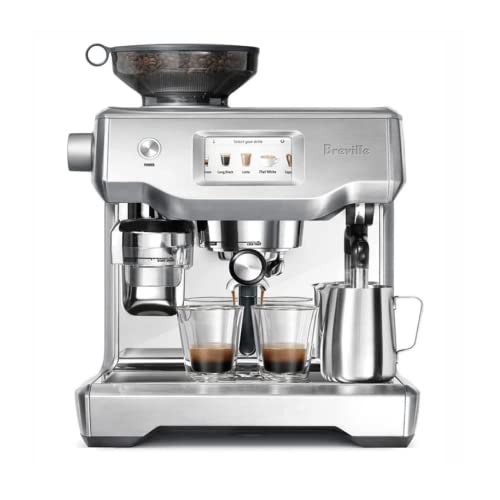
Breville Oracle Touch (BES990) — Best Automated Pro
The Oracle Touch automates the three skills that gatekeep espresso — dosing, tamping and milk texturing — while keeping the dual-boiler, heated-group hardware of a pro machine underneath. A touchscreen walks any household member to a flat white in under a minute. It suits affluent households and offices that want café drinks without a resident expert. It does not suit tinkerers: the automation that makes it effortless also fixes most variables, and its service model is the manufacturer’s.
Strengths
- Automatic grind, tamp and milk produce consistent drinks for any user
- Dual boilers and heated group deliver genuine pro extraction hardware
- Touchscreen drink customisation saves per-person preferences
Trade-offs
- Automation caps the experimentation dual-boiler manuals allow
- Manufacturer service model, like the Dual Boiler
- The most appliance-like ownership experience in this guide
| Machine type | Automated prosumer dual-boiler machine |
| Pump | 15-bar Italian pump, automatic extraction |
| Boilers | Dual stainless boilers |
| Automation | Auto grind, dose, tamp and milk texturing |
| Interface | Touchscreen with saved favourites |
The Oracle Touch resolves a real household problem: pro machines concentrate skill in one person. By automating preparation, it spreads café-quality drinks across everyone — partner, teenager, guest — while the dual boilers keep quality honest. Its automatic tamping is consistently level, its milk system produces repeatable microfoam, and its shots, while not endlessly tunable, are reliably in the zone that manual owners spend months learning to hit.
Enthusiasts will feel the ceiling: grind and dose are the machine’s decisions, profiles are presets rather than programming, and the ritual is pressing a picture of a drink. But judged as what it is — the pro machine for people who value output over process — the Oracle Touch is unmatched in this guide, and in mixed-skill households it will produce more good drinks per week than any manual rival.
Best for: households and offices wanting pro drinks without a skilled operator / Not suited for: hobbyists who want manual control and experimentation
Check on Amazon — confirm the current price on Amazon today, since offers and included extras vary by listing.
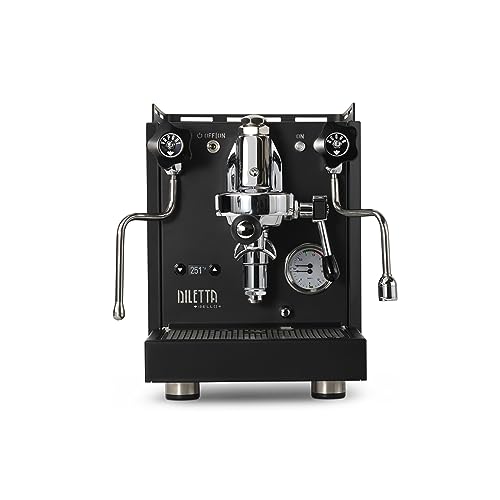
Diletta Bello+ — Best E61 Heat-Exchanger Classic
The Bello+ represents the traditional prosumer architecture: an E61 group with its thermosyphon circulation and mechanical pre-infusion, a heat-exchanger boiler that steams while you brew, a vibratory pump and a polished steel body. It suits owners who want the classic ritual — lever, gauge, flush, extract — and a machine any technician can service with standard parts. It asks for the classic skills in return: cooling flushes to manage temperature, warm-up patience, and a grinder worthy of it.
Strengths
- E61 group gives mechanical pre-infusion and legendary parts support
- Heat exchanger brews and steams simultaneously
- Traditional construction is serviceable by any espresso technician
Trade-offs
- Heat-exchanger temperature needs a cooling-flush routine
- Warm-up is measured in tens of minutes, not minutes
- No PID or volumetric programming — control is manual craft
| Machine type | Prosumer heat-exchanger pump machine |
| Pump | Vibratory pump |
| Group | E61 with thermosyphon circulation |
| Boiler | Heat-exchanger boiler |
| Body | Polished stainless steel |
The E61 group is the most successful design in espresso history, and the Bello+ shows why it endures. Hot water circulates through the massive group constantly, holding it at brewing temperature; lifting the lever starts a gentle mechanical pre-infusion before full pump pressure arrives; and the whole assembly is rebuildable with gaskets and seals that have been standard for sixty years. Shots have the soft, forgiving ramp that made the design famous, flattering a wide range of coffees.
The heat-exchanger bargain is temperature management: idle groups run hot, and a short flush before the shot is part of the liturgy. Owners who love the ritual find the flush meditative; owners who wanted push-button precision should buy the Ascaso or the Dual Boiler. As the classic, serviceable, simultaneous-brew-and-steam machine in this guide, the Bello+ is the pick for buyers who think in decades.
Best for: traditionalists wanting E61 ritual, simultaneity and universal serviceability / Not suited for: buyers wanting fast heat-up or digital temperature precision
Check on Amazon — confirm the current price on Amazon today, since offers and included extras vary by listing.
Comparison Table
| Pick | Badge | Key Spec | Best For |
|---|---|---|---|
| Breville Dual Boiler (BES920XL) | Best Overall Pro | Dual boilers, PID, programmable pre-infusion | enthusiasts who want maximum extraction control and dual-boiler workflow |
| Ascaso Steel DUO PID V3 | Best Fast-Heat Pro | Dual thermoblock, PID, volumetric dosing | households wanting pro workflow without boiler warm-up times |
| Nuova Simonelli Appia Life (1 Group, Volumetric) | Best True Commercial | Commercial 1-group, volumetric, heat exchanger | small cafés, offices and dedicated home coffee stations with real drink volume |
| Diletta Alto (Dual Boiler) | Best Dual-Boiler Value | Dual boiler, PID, adjustable OPV, shot timer | enthusiasts who want adjustable pressure and dual boilers at a challenger price |
| Breville Oracle Touch (BES990) | Best Automated Pro | Dual boiler with full preparation automation | households and offices wanting pro drinks without a skilled operator |
| Diletta Bello+ | Best E61 Heat-Exchanger Classic | E61 group, heat exchanger, vibratory pump | traditionalists wanting E61 ritual, simultaneity and universal serviceability |
The table’s real divide is philosophy. The Breville pair and the Ascaso treat the machine as a controlled appliance; the Diletta pair and the Nuova Simonelli treat it as serviceable equipment. Both philosophies produce superb espresso — choose by whether you want the manufacturer or any technician holding the screwdriver in year nine. Warranty and service terms deserve a row of their own in your notes, even though they cannot fit in this table: at pro prices, the difference between a manufacturer-only service model and any-technician serviceability compounds over a decade of ownership, and it is the one specification that never appears in a headline. Read the steam column of your own notes, too: for milk-drink households, the difference between these machines at the wand is larger than the difference at the group, every single morning.
Dual Boiler vs Heat Exchanger vs Dual Thermoblock
Dual boilers give each job its own water: a brew boiler held precisely at extraction temperature and a steam boiler held hot and ready. The result is the most stable and the most adjustable architecture, at the cost of size, price and warm-up. Heat exchangers run one boiler at steam temperature and pass brew water through a coil inside it, buying simultaneity more cheaply and compactly, at the cost of needing a cooling flush to pin brew temperature. Dual thermoblocks heat water on demand for each circuit, buying simultaneity and near-instant readiness, at the cost of a subtly different steam character and more electronics in the loop.
For flavour, all three can be excellent; the differences show in workflow. Perfectionists who dial light roasts gravitate to dual boilers and their set-and-hold temperatures. Traditionalists accept the flush ritual for the E61’s forgiving extraction. Households with spontaneous patterns get the most from dual thermoblocks. Let your drinking pattern, not a hierarchy chart, choose the architecture.
The Grinder Rule at Pro Level
Every machine in this guide can be made to taste ordinary by a mediocre grinder, and none can rescue stale beans. At pro level the grinder is not an accessory but half the system: budget for a grinder with stepless or fine stepped adjustment, low retention and a burr set sized for daily home use, and expect it to cost a substantial fraction of the machine. If the total budget forces a choice, step the machine down one branch — an E61 with a great grinder outperforms a dual boiler with a poor one in the cup, every single morning.
- Match the grinder to the machine’s portafilter: 58mm workflows want espresso-fine, consistent output
- Single-dosing suits experimenters; hopper-fed grinding suits households with one house bean
- Retention matters: old grounds in the path flavour the first shot of the day
- A scale and a distribution tool complete the pro station more cheaply than any machine upgrade
Installation and Water: The Pro Buyer’s Homework
Pro machines shift two responsibilities onto the buyer that appliances absorb silently. The first is water chemistry. Large boilers concentrate minerals with every steam cycle, and a pro machine descaled rarely and fed hard water will need professional attention years earlier than it should. Fit filtration matched to your local water, test hardness rather than guessing, and put descaling or filter changes on a calendar the whole household can see.
The second is placement engineering. These machines are heavy, hot and occasionally plumbed; they want a level, load-bearing surface, clearance for tank removal or top filling, and a power circuit that is not already carrying a kettle and a toaster oven through the same morning. Measure the station — including the grinder’s footprint and the working room your hands need — before ordering, because a pro machine that does not fit its station will be resented daily and used rarely, which is the most expensive outcome in this entire guide.
Setting Up a Pro Coffee Station
Pro machines deserve a station, not a corner. Start with power and water: a dedicated circuit is wise where boilers and grinders share a kitchen ring, and the machine’s water should be filtered and mineral-balanced — at this level, many owners test their water and mix to a recipe, because boilers concentrate minerals and pro machines are expensive to descale professionally. Leave clearance above the machine for cup warming and tank access, and behind it for the inevitable day a hose or valve needs attention.
Workflow layout follows the drink: grinder within a step of the machine, knock box and tamper between them, milk and cups on the steam side. A small scale lives under the cup, a towel lives on the wand, and a notebook or phone note tracks each bean’s settings. None of this is decoration — a pro machine’s advantage is repeatability, and a station laid out for repetition is what converts its hardware into the same excellent drink on a tired Tuesday as on a careful Sunday.
When Pro Is Too Much Machine
Honesty requires the counter-case. A pro machine that is used for one drink a day is mostly a warm-up bill and a descaling obligation; a dual boiler’s advantages appear at the third drink and in experimentation, not in a solitary morning shot. Households that drink one or two simple drinks daily are usually better served by the best machines in our main pump espresso guide, with the savings spent on beans and a grinder. Pro machines earn their keep through volume, variety or obsession — if none of those three describes your household, the correct pro decision is not to buy one yet.
Pre-Infusion and Pressure Profiling, Explained
Two control features separate pro machines from competent home machines, and both manipulate what the pump does before and during extraction. Pre-infusion wets the puck at low pressure for a few seconds before full pressure engages, letting the coffee swell and seal so the main extraction flows evenly instead of channelling. On E61 machines it happens mechanically as the lever opens the group; on the Breville Dual Boiler it is programmable in duration and power; on volumetric commercial machines it is a programmed stage. The flavour effect is forgiveness and sweetness, especially with fresh, gassy beans.
Pressure profiling goes further, varying extraction pressure through the shot — a gentle start, a peak, a declining tail — to shape which compounds dominate the cup. True profiling lives on flagship machines and manual flow-control kits; adjustable OPV machines like the Alto offer a simpler static version, letting you set the ceiling lower for delicate coffees. Neither feature rescues poor grinding, but on a well-prepared puck both are audible in the cup, which is why they anchor the pro category’s price ladder.
Steam Power: The Pro Difference You Feel First
Ask owners what upgraded first when they moved to a pro machine and most will not say espresso — they will say steam. A dedicated steam boiler or a large heat exchanger stores enough energy to texture a jug of milk in seconds, with a dry, rolling vortex that produces glossy microfoam almost faster than a beginner can react. Small machines steam in tens of seconds with wetter steam, and the milk spends that time heating unevenly.
The practical consequences compound. Drinks for guests arrive together instead of sequentially; latte art becomes a pouring exercise instead of a race against cooling milk; and the wand purges and recovers instantly between jugs. If your household’s drinking is mostly milk drinks for several people, steam capacity — not extraction sophistication — is the pro feature that will change your mornings, and it is worth weighting the dual-system picks in this guide accordingly.
Warm-Up, Scheduling and Living With Thermal Mass
Pro machines are thermal systems, and their one daily friction is the heat soak: boilers, groups and portafilters need tens of minutes to reach equilibrium, and shots pulled early drift in temperature. Owners solve this with routine rather than patience — a timer plug or the machine’s own auto-start wakes it before the household, so the warm-up happens while everyone sleeps. The dual-thermoblock Ascaso exists precisely for households unwilling to live on that schedule.
Energy worries are usually overstated: a boiler holding temperature sips power compared with the heat-up cycle, and insulated modern boilers sip less. The real cost of thermal mass is not electricity but planning — a spontaneous afternoon espresso on a cold machine means a wait. Choose the architecture that matches your household’s spontaneity, and the warm-up stops being a flaw and becomes part of the ritual’s rhythm.
Resale, Longevity and the Pro Machine as an Asset
An underappreciated property of serviceable pro machines is that they hold value. An E61 or commercial machine with a known service history sells used for a substantial fraction of its new price, because the buyer is purchasing decades of remaining mechanical life, not a sealed appliance’s unknown remaining months. This changes the ownership arithmetic: the most expensive machine in this guide may be the cheapest to own per year if it is maintained, resold or simply never replaced.
It also changes buying advice for the patient. A used pro machine from a careful home, bought at the price of a new mid-range appliance, is often the smartest purchase in the entire category — provided you budget for a service, new gaskets and a descale, and you buy a model whose parts are standard. The machines in this guide were chosen partly with that afterlife in mind: standard groups, standard fittings and makers with parts catalogues are what make a machine an asset instead of a countdown.
How to Set Up and Dial In a Pro Espresso Machine
Pro machines arrive with more variables than home machines. This sequence sets them in an order that converges quickly instead of chasing interactions.
- Fill with filtered, mineral-balanced water; power on and allow full warm-up — boilers and groups need their full heat soak, not just a ready light
- Set brew temperature to a middle starting point for your roast level; darker roasts start cooler, lighter roasts warmer
- Grind and dose a standard double, distribute, tamp level, and pull a timed shot, weighing the output
- Adjust grind until the shot runs in your target window, changing nothing else; only then touch temperature or pre-infusion
- Change one variable per experiment: temperature for roast character, pre-infusion length for delicate or channel-prone coffees, pressure (where adjustable) for body
- Steam-test the wand’s purge and pressure, and set any volumetric programme only after the manual recipe tastes right
- Record the full recipe — bean, dose, yield, time, temperature, pre-infusion — so the machine’s repeatability works for you
Dialled in this way, a pro machine stops being a panel of settings and becomes an instrument you play the same way each morning. Revisit the recipe with every new bean; the machine’s stability means the coffee is now the variable, which is exactly the point of owning one. Expect the first week to feel like calibration rather than coffee-making; that investment is front-loaded, and by the second week the machine’s consistency turns your recorded recipe into a thirty-second routine whose results you can predict before the cup fills.
Common Buying Mistakes
Pairing a pro machine with an entry grinder. The most expensive mistake in this category. The grinder sets the ceiling; a pro machine merely lets you reach it.
Ignoring water treatment. Pro boilers scale expensively. Filtered, balanced water and scheduled descaling are ownership requirements, not suggestions.
Buying commercial capacity for a home habit. A true commercial machine in a one-drink home is cost, warm-up and maintenance with no audience. Match capacity to volume.
Chasing settings before routine. Owners twiddle PID and pre-infusion while their dose and distribution wander. Fix the hands first; the settings will suddenly start working.
Skipping warm-up. Pro machines are thermal systems. Shots pulled during warm-up drift in temperature and teach you false lessons about the beans.
Final Recommendation
For most enthusiasts, the Breville Dual Boiler is the pro machine to buy: the deepest control, true dual boilers and a workflow that scales from one careful shot to a round of drinks. The Ascaso Steel DUO is the same idea re-engineered for speed, the Diletta Alto adds adjustable pressure at a challenger price, and the Bello+ keeps the E61 faith for owners who think in decades and service manuals. The Oracle Touch is the pro answer for mixed-skill households, and the Appia Life stands apart as the genuine commercial article for cafés and serious stations.
Whichever branch you choose, remember the system rule that governs this whole category: machine, grinder, water and routine multiply together. A pro pump machine raises the ceiling of that product higher than any other purchase — provided the other three factors are already holding up their side.
If you are hesitating between two branches, let your drinks decide: mostly straight espresso and experimentation points to the Dual Boiler or the Alto; mostly milk drinks for a household points to the Oracle Touch or the Ascaso’s speed; mostly ritual and longevity points to the Bello+; and actual commerce points to the Appia Life. The wrong pro machine is merely an expensive one — the right one disappears into your routine and is simply how coffee happens, every day, for years.
The shortlist in one line: Breville Dual Boiler (BES920XL), Ascaso Steel DUO PID V3, Nuova Simonelli Appia Life (1 Group, Volumetric), Diletta Alto (Dual Boiler), Breville Oracle Touch (BES990), Diletta Bello+. Check the current price on Amazon for the one that matches your kitchen, then commit to learning it properly for a month before judging it.
Keep researching inside this cluster: Best Pump Espresso Machines Best Dual Boilers Espresso Machines Best E61 Grouphead Espresso Machines Best Commercial Espresso Machines For Home Use Best Commercial Single Group Espresso Machines Best Pump Driven Espresso Machines
Frequently Asked Questions
What makes an espresso machine ‘pro’?
Architecture and duty: dual boilers or a heat exchanger for simultaneous brew and steam, real temperature control, commercial-standard groups and portafilters, metal construction and parts that technicians can source. Price follows those things; it does not define them.
Do pro machines need a special grinder?
They need a genuinely espresso-capable one — fine, consistent, adjustable in small steps. At this level the grinder influences flavour as much as the machine, and pairing a pro machine with a basic grinder is the category’s most common waste of money.
Can a pro machine be plumbed in?
Some prosumer and most commercial models offer plumb-in kits or are designed for a water line, usually with drainage as well. It is a convenience for dedicated stations; tank-fed operation with good water is entirely respectable and more flexible.
How long do pro espresso machines last?
Serviceable Italian-style machines are routinely kept running for decades with gaskets, valves and pumps replaced as wear items. Appliance-style pro machines trade some of that horizon for control features and manufacturer service. Maintenance and water quality decide most of the difference.
Is a heat exchanger as good as a dual boiler?
For most drinking, yes — the flavours are comparable and the workflow identical. Dual boilers win on set-and-forget temperature precision, especially for light roasts; heat exchangers win on price, size and the E61 extraction character many owners prefer.
Should a small café buy a home pro machine or a commercial one?
Volume decides. A low-volume café can run happily on a top prosumer machine; sustained queues, multiple staff and all-day duty point to a true commercial single-group like the Appia Life, with the water treatment and service relationship that class assumes.
Do pro machines make sense with supermarket beans?
They will brew them consistently, but consistency applied to mediocre coffee produces reliably mediocre drinks, and pro hardware will expose stale beans more clearly than forgiving pressurised systems do. Fresh beans from a roaster are not an indulgence at this level; they are the input the machine was built for.


