Disclosure: airfryerkitchensupply.com is reader-supported. When you buy through links on our site, we may earn an affiliate commission at no extra cost to you.
Where to buy
The best slow pressure cookers in this guide are sold through Amazon, where availability and specifications can be checked against each listing before you order. Use the links below to check the current price on Amazon for each pick, and confirm the capacity and wattage figures in the listing title match your kitchen before buying.
- Instant Pot Duo Plus 9-in-1 Electric Pressure Cooker — Best Overall: Check the current price on Amazon
- Instant Pot Pro 10-in-1 Electric Pressure Cooker 8 Qt — Best Premium and Largest: Check the current price on Amazon
- Cosori Pressure Cooker 6QT 9-in-1 with Ceramic Coating Pot — Best Nonstick Inner Pot: Check the current price on Amazon
- Midea 12-in-1 Electric Pressure Cooker 6 Quarts — Best Value: Check the current price on Amazon
- Chefman 13-in-1 Electric Pressure Cooker 6-Quart Multicooker — Best Touchscreen Controls: Check the current price on Amazon
- CHEF iQ Smart Pressure Cooker with WiFi and Built-in Scale — Best Smart Features: Check the current price on Amazon
If you are shopping for the best slow pressure cookers, start with the honest context: A slow pressure cooker — an electric multicooker that genuinely does both jobs — is the answer to the two opposite kitchen emergencies: the dinner that needs eight hours you planned for, and the dinner that needs to exist in forty minutes because you did not. Pressure mode builds flavour fast and tenderises tough cuts on a weeknight; slow mode gives you the set-and-forget rhythm of a crock for weekends and workdays. The honest caveat, repeated in the guide below, is that multicooker slow modes heat from the base and behave a little differently from a ceramic crock. Every pick here has both pressure and slow credentials in its verified listing, so the dual promise is real.
Key Takeaways
Buy the size your household fills at least halfway on an ordinary week, because underfilled and overfilled machines both disappoint. Trust only specifications you can find in the product’s own listing — every pick in this guide was verified that way. Match the headline feature to your calendar: the timer for the working household, the sensor for the reheating household, the capacity for the batch household. And remember that technique — the habits in the how-to and troubleshooting sections — closes more of the gap between machines than any upgrade does.
In this guide
Quick Picks
- Best Overall — Instant Pot Duo Plus 9-in-1 Electric Pressure Cooker: The Duo Plus is the machine that defined this category, and its verified listing still reads like the search itself: pressure cooker, slow cooker, rice cooker, steamer, sauté, yogurt maker and warmer in one pot. Check price on Amazon
- Best Premium and Largest — Instant Pot Pro 10-in-1 Electric Pressure Cooker 8 Qt: The Pro takes the dual-cooker brief and scales it: 8 quarts, ten functions, and slow cooking listed in its verified title next to sauté and sous vide. Check price on Amazon
- Best Nonstick Inner Pot — Cosori Pressure Cooker 6QT 9-in-1 with Ceramic Coating Pot: Cosori’s differentiator is the pot itself: a ceramic coating that suits the sticky, saucy dishes slow cooking produces, inside a 9-in-1 pressure platform whose listing confirms slow cook and sauté. Check price on Amazon
- Best Value — Midea 12-in-1 Electric Pressure Cooker 6 Quarts: Midea’s 12-in-1 undercuts the big names while its verified listing says the quiet part out loud: it is a programmable slow cooker and a sauté pan as well as a pressure cooker. Check price on Amazon
- Best Touchscreen Controls — Chefman 13-in-1 Electric Pressure Cooker 6-Quart Multicooker: Chefman’s 13-in-1 wraps the dual brief in a touchscreen format: slow cooker, steamer and sauté are all named in its verified listing, with delay start and keep warm for scheduling. Check price on Amazon
- Best Smart Features — CHEF iQ Smart Pressure Cooker with WiFi and Built-in Scale: CHEF iQ is the technologist’s answer to the dual cooker: a built-in scale, WiFi and hundreds of guided recipes wrapped around a verified slow cooker and pressure platform. Check price on Amazon
How These Picks Were Chosen
Every product in this roundup of the best slow pressure cookers was verified against Amazon listing data before inclusion: the brand, model, capacity and headline features in each review come from the verified listing title, not from marketing summaries. Products whose listings did not confirm the defining feature of this search were excluded, however famous the brand. Six picks survived, chosen to cover distinct needs — overall balance, budget awareness, size extremes and specialist features — rather than six near-identical boxes ranked by trivia.
Within each review you will find a badge used consistently from the Quick Picks, three strengths and three trade-offs drawn from the product’s actual specification and design, a mini spec box limited to verified figures, and a plain verdict stating who the product suits and who should skip it. Where a pick has a real limitation — a smaller turntable, a lower wattage, a capacity convention that needs care — the review says so in words, because a roundup that hides trade-offs is an advert, not a guide.
The 6 Best Slow Pressure Cookers

Instant Pot Duo Plus 9-in-1 Electric Pressure Cooker — Best Overall
The Duo Plus is the machine that defined this category, and its verified listing still reads like the search itself: pressure cooker, slow cooker, rice cooker, steamer, sauté, yogurt maker and warmer in one pot.
Strengths
- The verified listing names slow cooker and pressure cooker roles in one machine — the exact brief
- Sauté mode browns meat in the pot before either cooking method takes over
- The largest recipe and accessory ecosystem of any multicooker line
Trade-offs
- Slow mode needs modest timing adjustments versus a ceramic crock
- Sealing ring absorbs strong flavours and benefits from a spare for desserts
- Counter footprint grows once the lid and accessories are counted
| Specification | Verified detail |
|---|---|
| Key spec | 9-in-1 · Slow cook and pressure cook · Sauté, rice, steam, yogurt and warmer functions |
Its strength is the handover between modes. Sear on sauté, then choose pressure for speed or slow for the afternoon — the fond, the liquid and the ingredients never leave the pot. For households learning both methods, the sheer volume of recipes written for this exact machine removes the guesswork.
In daily use, the Instant Pot Duo Plus 9-in-1 Electric Pressure Cooker settles into a routine quickly: its best overall brief matches the way its owners actually cook, week after week, rather than the way a specification sheet imagines they might. The controls become muscle memory within a fortnight, the cleaning rhythm establishes itself, and the machine’s character — what it does brilliantly and where its trade-offs show — becomes familiar enough to plan meals around. That settling-in is the real test of any pick in this guide, and it is why each review weighs ordinary-week usefulness as heavily as headline features.
Best for: Most households — it is the balanced default for both cooking styles / Not suited for: Slow-cooker purists who never intend to use pressure at all
Check on Amazon — check price on Amazon before ordering, and re-confirm the specification in the listing.

Instant Pot Pro 10-in-1 Electric Pressure Cooker 8 Qt — Best Premium and Largest
The Pro takes the dual-cooker brief and scales it: 8 quarts, ten functions, and slow cooking listed in its verified title next to sauté and sous vide.
Strengths
- 8-quart capacity is the family and batch size in this category
- Slow cook is named among its verified functions alongside sauté and sous vide
- Sous vide and sterilize functions extend it well beyond the basic duo
Trade-offs
- Premium tier within the multicooker market
- 8 quarts is oversized for one- or two-person slow cooks
- More functions means a longer learning curve for new owners
| Specification | Verified detail |
|---|---|
| Key spec | 8 Qt · 10-in-1 · Slow cooks, rice and grains, steam, sauté, sous vide, yogurt, sterilize |
Big-pot slow cooking suits joints, stocks and double batches, and the pressure side means the same pot can turn that joint around fast when plans change. If your household cooks at scale and likes technique-driven extras, this is the flagship pick.
In daily use, the Instant Pot Pro 10-in-1 Electric Pressure Cooker 8 Qt settles into a routine quickly: its best premium and largest brief matches the way its owners actually cook, week after week, rather than the way a specification sheet imagines they might. The controls become muscle memory within a fortnight, the cleaning rhythm establishes itself, and the machine’s character — what it does brilliantly and where its trade-offs show — becomes familiar enough to plan meals around. That settling-in is the real test of any pick in this guide, and it is why each review weighs ordinary-week usefulness as heavily as headline features.
Best for: Large families and keen cooks who want slow, pressure and sous vide in one pot / Not suited for: Small households who will rarely fill even half the pot
Check on Amazon — check price on Amazon before ordering, and re-confirm the specification in the listing.
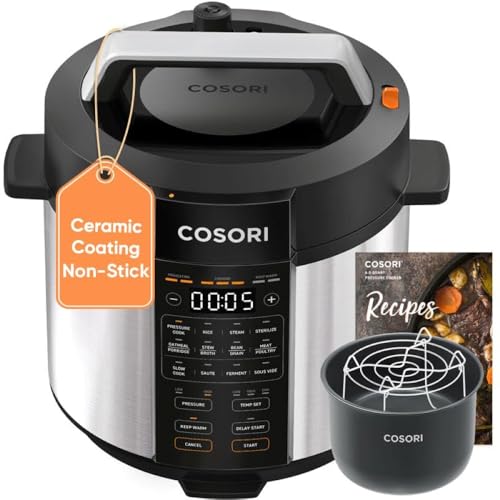
Cosori Pressure Cooker 6QT 9-in-1 with Ceramic Coating Pot — Best Nonstick Inner Pot
Cosori’s differentiator is the pot itself: a ceramic coating that suits the sticky, saucy dishes slow cooking produces, inside a 9-in-1 pressure platform whose listing confirms slow cook and sauté.
Strengths
- Ceramic-coated pot makes slow-cooked sauces and pressure-cooked rice release easily
- Slow cook and sauté both appear in the verified function list
- 12 safety features are highlighted in the listing for cautious first-time pressure users
Trade-offs
- Ceramic coating wants non-metal utensils to stay at its best
- 6QT only — no larger sibling in this exact listing
- Coated pots are consumables over years in a way stainless is not
| Specification | Verified detail |
|---|---|
| Key spec | 6QT · 9-in-1 · Ceramic coating pot · Slow cook, sous vide, saute · 1100W |
Rice, congee, braises with sugary glazes — the dishes that weld themselves to stainless lift out of this pot with far less soaking. The trade is utensil discipline, and for cleanup-focused cooks that trade is worth it every single wash.
In daily use, the Cosori Pressure Cooker 6QT 9-in-1 with Ceramic Coating Pot settles into a routine quickly: its best nonstick inner pot brief matches the way its owners actually cook, week after week, rather than the way a specification sheet imagines they might. The controls become muscle memory within a fortnight, the cleaning rhythm establishes itself, and the machine’s character — what it does brilliantly and where its trade-offs show — becomes familiar enough to plan meals around. That settling-in is the real test of any pick in this guide, and it is why each review weighs ordinary-week usefulness as heavily as headline features.
Best for: Cooks who prioritise easy cleanup and gentle food release in both modes / Not suited for: Metal-utensil households who want a stainless pot they never have to baby
Check on Amazon — check price on Amazon before ordering, and re-confirm the specification in the listing.

Midea 12-in-1 Electric Pressure Cooker 6 Quarts — Best Value
Midea’s 12-in-1 undercuts the big names while its verified listing says the quiet part out loud: it is a programmable slow cooker and a sauté pan as well as a pressure cooker.
Strengths
- Verified listing explicitly calls it a programmable slow cooker as well as a pressure cooker
- Stainless inner pot handles hard searing and metal utensils
- 12 presets give beginners structured starting points for both modes
Trade-offs
- Preset labels still require recipe judgment — they are guides, not guarantees
- Stainless needs deglazing care after searing
- Fewer third-party recipes name this model than the category leaders
| Specification | Verified detail |
|---|---|
| Key spec | 6 Quarts · 12 presets · Programmable slow cooker role · Stainless steel inner pot · Sauté function |
The stainless pot is the value pick’s secret weapon — it sears properly, shrugs off metal spoons and will outlast coated alternatives. For households buying one machine to do both jobs for years, this is the spend-smart option.
In daily use, the Midea 12-in-1 Electric Pressure Cooker 6 Quarts settles into a routine quickly: its best value brief matches the way its owners actually cook, week after week, rather than the way a specification sheet imagines they might. The controls become muscle memory within a fortnight, the cleaning rhythm establishes itself, and the machine’s character — what it does brilliantly and where its trade-offs show — becomes familiar enough to plan meals around. That settling-in is the real test of any pick in this guide, and it is why each review weighs ordinary-week usefulness as heavily as headline features.
Best for: Value-focused buyers who want stainless durability and both cooking modes / Not suited for: Cooks who want the largest published recipe ecosystem for their exact machine
Check on Amazon — check price on Amazon before ordering, and re-confirm the specification in the listing.

Chefman 13-in-1 Electric Pressure Cooker 6-Quart Multicooker — Best Touchscreen Controls
Chefman’s 13-in-1 wraps the dual brief in a touchscreen format: slow cooker, steamer and sauté are all named in its verified listing, with delay start and keep warm for scheduling.
Strengths
- 13 functions with slow cooker and sauté confirmed in the verified listing
- Touchscreen controls suit cooks who prefer a modern, wipe-clean panel
- Delay start and keep warm support the slow-cooker scheduling routine
Trade-offs
- Touchscreens and wet, floury hands are natural enemies
- Delay start must be used with food safety in mind for raw meats
- Stainless pot needs the usual deglaze step after sautéing
| Specification | Verified detail |
|---|---|
| Key spec | 6-Quart · 13-in-1 · Touchscreen controls · Slow cooker, steamer, sauté · Delay start and keep warm |
The breadth suits exploratory cooks — soup and chilli presets sit alongside the slow programme — while the panel keeps the front wipe-clean. Just keep a dry corner of a towel nearby; touchscreen cooking is a two-towel discipline.
In daily use, the Chefman 13-in-1 Electric Pressure Cooker 6-Quart Multicooker settles into a routine quickly: its best touchscreen controls brief matches the way its owners actually cook, week after week, rather than the way a specification sheet imagines they might. The controls become muscle memory within a fortnight, the cleaning rhythm establishes itself, and the machine’s character — what it does brilliantly and where its trade-offs show — becomes familiar enough to plan meals around. That settling-in is the real test of any pick in this guide, and it is why each review weighs ordinary-week usefulness as heavily as headline features.
Best for: Modern kitchens and cooks who like panel controls and many presets / Not suited for: Anyone who prefers physical dials and the fewest possible modes
Check on Amazon — check price on Amazon before ordering, and re-confirm the specification in the listing.

CHEF iQ Smart Pressure Cooker with WiFi and Built-in Scale — Best Smart Features
CHEF iQ is the technologist’s answer to the dual cooker: a built-in scale, WiFi and hundreds of guided recipes wrapped around a verified slow cooker and pressure platform.
Strengths
- Built-in scale weighs ingredients in the pot, removing a whole prep step
- Guided recipes walk both pressure and slow cooks step by step
- Slow cooker role is confirmed in the verified listing alongside rice cooking
Trade-offs
- Smart features carry a smart-tier price and an app learning curve
- WiFi functions depend on your home network behaving
- Over-featured for cooks who just want two buttons and dinner
| Specification | Verified detail |
|---|---|
| Key spec | 10-in-1 · Built-in scale · WiFi · 500+ guided recipes · Rice cooker and slow cooker roles |
The scale genuinely changes prep — ingredients are weighed as they land in the pot, and guided recipes adjust to the amount you actually added. For cooks who follow recipes closely and love data, nothing else here competes; for instinct cooks, the simpler picks above will feel like home.
In daily use, the CHEF iQ Smart Pressure Cooker with WiFi and Built-in Scale settles into a routine quickly: its best smart features brief matches the way its owners actually cook, week after week, rather than the way a specification sheet imagines they might. The controls become muscle memory within a fortnight, the cleaning rhythm establishes itself, and the machine’s character — what it does brilliantly and where its trade-offs show — becomes familiar enough to plan meals around. That settling-in is the real test of any pick in this guide, and it is why each review weighs ordinary-week usefulness as heavily as headline features.
Best for: Guided-cooking fans and anyone who weighs ingredients for baking-style precision / Not suited for: Offline, app-free cooks who want a machine that ignores the internet
Check on Amazon — check price on Amazon before ordering, and re-confirm the specification in the listing.
Comparison Table
| Pick | Badge | Key spec | Best for |
|---|---|---|---|
| Instant Pot Duo Plus 9-in-1 Electric Pressure Cooker | Best Overall | 9-in-1 · Slow cook and pressure cook · Sauté, rice, steam, yogurt and warmer functions | Most households — it is the balanced default for both cooking styles |
| Instant Pot Pro 10-in-1 Electric Pressure Cooker 8 Qt | Best Premium and Largest | 8 Qt · 10-in-1 · Slow cooks, rice and grains, steam, sauté, sous vide, yogurt, sterilize | Large families and keen cooks who want slow, pressure and sous vide in one pot |
| Cosori Pressure Cooker 6QT 9-in-1 with Ceramic Coating Pot | Best Nonstick Inner Pot | 6QT · 9-in-1 · Ceramic coating pot · Slow cook, sous vide, saute · 1100W | Cooks who prioritise easy cleanup and gentle food release in both modes |
| Midea 12-in-1 Electric Pressure Cooker 6 Quarts | Best Value | 6 Quarts · 12 presets · Programmable slow cooker role · Stainless steel inner pot · Sauté function | Value-focused buyers who want stainless durability and both cooking modes |
| Chefman 13-in-1 Electric Pressure Cooker 6-Quart Multicooker | Best Touchscreen Controls | 6-Quart · 13-in-1 · Touchscreen controls · Slow cooker, steamer, sauté · Delay start and keep warm | Modern kitchens and cooks who like panel controls and many presets |
| CHEF iQ Smart Pressure Cooker with WiFi and Built-in Scale | Best Smart Features | 10-in-1 · Built-in scale · WiFi · 500+ guided recipes · Rice cooker and slow cooker roles | Guided-cooking fans and anyone who weighs ingredients for baking-style precision |
Slow Mode on a Multicooker vs a Dedicated Slow Cooker
The difference is geometry. A dedicated slow cooker wraps a ceramic crock in a heating jacket, warming gently from the sides as well as the base. A multicooker heats from a plate underneath its metal pot. In slow mode that means the base runs hotter, evaporation behaves differently, and recipes written for crocks sometimes need a stir, a touch more liquid or a shorter programme in a multicooker.
None of that makes multicooker slow cooking bad — millions of stews prove otherwise — but it rewards awareness. Use the low slow setting for long cooks, keep the lid closed, and the first time you adapt a beloved crock recipe, check it an hour early. Beans, braises and soups adapt almost seamlessly; delicate egg-based dishes and lean chicken are where the crock still wins.
The counter-argument is everything the multicooker adds: searing in the same pot, pressure speed when the day collapses, and one appliance doing the work of two or three. For most kitchens the versatility wins; for slow-cooking traditionalists, the dedicated roundups on this site exist for a reason.
When to Pressure Cook and When to Slow Cook the Same Dish
Pressure and slow are two routes up the same mountain. Tough, collagen-rich cuts — chuck, shin, shoulder, short ribs — become tender either way: hours of gentle heat, or a pressurised sprint that forces the same transformation quickly. Pressure keeps more of the volatile aromatics trapped in the pot; slow cooking melds flavours and lets sauces reduce and deepen if the lid is vented at the end.
Choose pressure when time is the constraint, when cooking dried beans without an overnight soak, or when you want grains and meat in one fast pot. Choose slow when the schedule is the point — food ready when you walk in — when you want the house to smell like dinner all afternoon, or when a recipe’s texture depends on gradual melding, like a ragù.
Hybrid cooking is the multicooker’s party trick: pressure-cook a joint most of the way, then hold or finish on slow; or slow-cook a stew and give it a short pressure finish to rescue an underdone batch. Owning both modes in one pot means the plan can change at 5 p.m. without the menu changing with it.
Inner Pots, Seals and the Unglamorous Details That Decide Ownership
The inner pot is the part you will touch daily, so choose its material deliberately. Stainless steel sears hardest, tolerates metal utensils and lasts indefinitely, but sticks more and needs deglazing. Ceramic-coated pots release sticky slow-cooked food beautifully and wash in moments, at the cost of gentler handling. Both appear in the picks above precisely because neither is universally right.
Sealing rings are the second consumable. Silicone rings absorb the smell of strong dishes — curry today can haunt a cheesecake tomorrow — so keen dual-mode cooks keep a second ring for mild and sweet dishes and replace rings when they stretch or stain heavily. Rings are cheap; flavour cross-contamination is forever.
Finally, valves and lids reward a rinse routine. Pressure valves clog with starchy foam if ignored, and slow mode with the pressure lid sealed behaves differently from slow mode vented. Read your model’s guidance on which lid position its slow programme expects — it is the single most common cause of ‘my slow mode doesn’t work’ complaints.
A Week of Real Cooking: Where This Appliance Earns Its Place
Monday is the test every countertop cooker has to pass: a tired household, a fridge of odds and ends, and ninety minutes of evening. This is where a well-chosen cooker stops being a specification sheet and becomes infrastructure. The Sunday batch — a stew, a pot of beans, a braise — has already filled the fridge with building blocks, and Monday’s dinner is assembly rather than cooking: last night’s pulled pork over rice, the bean pot becoming soup with a handful of greens stirred through at the end. The machine’s job across the week is not heroics; it is the quiet conversion of cheap, tough, unglamorous ingredients into food that tastes like someone cared.
By Wednesday the pattern repeats with variations — a curry built on the same technique as Sunday’s stew, because the technique is the transferable part: brown for depth, add aromatics, respect the liquid, let time or pressure do the tenderising. Households that cook this way spend less on takeaway not because they are virtuous but because the marginal effort of dinner has fallen below the effort of ordering. That is the real return on a cooker purchase, and it compounds weekly.
The weekend is where capacity and programmability justify themselves. A full pot cooking while the house does other things — a joint for Sunday lunch set going in the morning, a stock quietly building from the week’s bones and vegetable trimmings — turns the cooker into the hardest-working seat in the kitchen. None of this requires talent. It requires the right size, the right features for your schedule, and the small habits the how-to section of this guide lays out.
Care, Cleaning and Making It Last a Decade
Cookers die of neglect in predictable places. Seals and gaskets absorb flavours and perish if they are never removed and washed; a ring that smells of last month’s curry will perfume next week’s rice pudding, which is why experienced owners keep a spare and rotate them. Valves clog with starch foam when they are ignored, and a clogged valve is the difference between a cooker that behaves and one that spits. A monthly ritual — seals out, valve rinsed, lid washed properly rather than wiped — prevents nearly all of it.
Pots reward the same modest attention. Stainless wants a deglaze and, occasionally, a paste of bicarbonate of soda for rainbow heat stains and polymerised oil. Ceramic nonstick wants soft sponges and no thermal shock: let the pot cool before cold water touches it. Stoneware crocks want to be lifted with two hands, dried before they are stored, and never moved straight from fridge to full heat. None of this is burdensome; all of it is the difference between a two-year appliance and a ten-year one.
Storage is the final quiet factor. A cooker stored with its lid ajar or inverted does not grow the stale, sealed smell that greets neglected machines, and a cord wrapped rather than yanked keeps the flex alive. Treat the appliance like the infrastructure it is and it will repay you in the least dramatic way possible: by simply working, every week, for years.
Warranties, Spares and the Long View
The unglamorous advantage of the established names in this guide is the spare-parts trail: replacement crocks, lids, gaskets and sealing rings that remain orderable years after a model launches. A cooker is a system of consumables wearing at different speeds — the base may outlive two crocks and three rings — and a brand that sells those parts turns accidents into errands instead of replacements. Before buying any model here, a two-minute check for its spare crock and ring prices tells you more about its cost of ownership than any feature list.
Warranty length matters less than warranty behaviour: whether the maker services, replaces parts or simply swaps whole units, and how far you must ship a heavy, fragile crock to claim. Keep the receipt with the manual, register the product if the maker asks, and photograph the model plate — the three habits that turn a warranty claim from an archaeology project into an email.
Finally, think about the second life of the machine you are replacing. A working cooker with a chipped crock is a parts donor; a working cooker you have simply outgrown is a gift that starts someone else’s habit. The secondhand market in this category is honest because the machines are simple — which is also why, if your budget is tight, a used example of a well-supported model plus a new sealing ring is a legitimate strategy this guide endorses openly.
Seasonal Cooking: The Calendar This Appliance Serves
Winter is this category’s home season — braises, bean pots, stocks and the slow Sunday joints that heat the kitchen while they cook — but a well-chosen cooker earns its counter in every month. Spring brings lighter braises and the first bean-and-herb soups; summer, counter-intuitively, is a strong season, because a slow cooker cooks dinner without heating the kitchen the way an oven does, and a multicooker’s pressure mode turns corn, artichokes and quick curries into weeknight food. Autumn is batch season: the freezer filling with the stews that winter will reheat.
Occasions map to features. The holiday overflow — a second joint, a hot side, a mulled drink held at serving temperature — is where capacity and keep-warm stop being specifications and become hospitality. The game-day chilli, the potluck dish that travels in its own cooker: that is the locking lid’s entire biography. Buying with your calendar open, picturing the four or five biggest cooking days of your year, is the most reliable sizing method this guide can offer.
And there is a quieter seasonal rhythm: the January reset, when the cooker turns festive excess into stocks and soups, and the September restart, when new routines make the timer models earn their panels all over again. Appliances that serve the calendar get kept; appliances bought for a single recipe get cupboarded. Choose for the year, not the week.
Budget Tiers, In Plain Language
Budget in this category divides into three honest tiers, and the best slow pressure cookers sit across all of them. The budget tier buys the core job done simply: fewer programmes, plainer finishes, and controls that ask a little more of you. Nothing about that is a failure — for a household whose needs are narrow and known, the budget tier is often the correct purchase, and several picks in this guide prove that simple machines cooked with good habits beat complicated machines cooked carelessly. The mid-range tier is where most households should land: it buys the features that change weekly life — the timer you actually use, the sensor that judges the reheat, the capacity that fits your real plates and pots — without paying for theatre. The premium tier buys build, materials and intelligence: stainless pots that outlast coatings, fuzzy logic that handles every grain, commercial duty cycles, smart guidance. Premium is worth it when the appliance will be used daily for a decade; it is wasted on a machine that comes out twice a year. Judge your own usage honestly before you judge the tiers — the most expensive mistake in this category is buying a tier above your habits, and the second most expensive is buying below them and replacing the machine in eighteen months.
Who Should Skip This Category
There is a household this category does not serve, and naming it is part of an honest guide to the best slow pressure cookers. If your cooking happens at a scale these machines cannot reach — catering quantities, whole animals, dinner parties of twenty — you already know it, and your answer is commercial equipment or multiple machines, not a bigger hope. If, at the other extreme, the appliance would be used a handful of times a year, the honest recommendation is to borrow, rent the counter space in your mind first, and buy only when a borrowed month proves the habit exists. And if your real problem is different from the one this search names — you need speed when these machines offer patience, or patience when these offer speed — the related guides linked in the final recommendation exist precisely so you can redirect before money moves. The right appliance in the wrong kitchen is still the wrong purchase.
Troubleshooting Common Problems
- Problem: Food finished too early or too late. Check the fill level first — an underfilled pot runs fast and hot, an overfilled one lags. Then check the setting: high and low reach the same final temperature; they differ in how long they take to get there.
- Problem: Sauce thinner than expected. Slow cooking traps moisture that hob cooking evaporates. Reduce the sauce at the end with the lid off, or stir in a small cornflour slurry and give it a few minutes to thicken.
- Problem: Meat tender but bland. The usual culprits are skipped browning, under-seasoning before the long cook, and no finishing lift. A squeeze of lemon, a splash of vinegar or fresh herbs added at serving transform a flat pot.
- Problem: Burn notice on a multicooker. Fond or thick sauce has caught on the base. Deglaze thoroughly after searing, layer thick sauces on top rather than stirring them to the bottom, and respect the liquid minimum.
- Problem: Lid smells of the last dish. Wash the sealing ring separately, store the lid ajar, and keep a second ring for mild dishes if you cook strongly spiced food often.
How to Convert a Slow Cooker Recipe for a Slow Pressure Cooker
- Start with liquid discipline. Pressure cooking loses almost no moisture, so reduce the recipe’s liquid modestly for pressure mode; for slow mode in the multicooker, keep close to the original amount the first time and note the result.
- Sear first using the sauté function, exactly as you would before a crock cook, and deglaze thoroughly — the fond carries the slow-cooked depth into the fast version.
- For pressure mode, use the familiar conversion: dishes that take eight hours on low often need roughly an hour or less under pressure, but follow a tested conversion for your specific cut rather than guessing with expensive meat.
- For slow mode, choose the low setting for long cooks, keep the lid position as your manual directs for slow cooking, and check a new recipe an hour before its stated finish the first time you run it.
- Finish deliberately: reduce a thin sauce with a short sauté, stir in fresh herbs and acid after cooking, and let joints rest in their liquid so the meat reabsorbs moisture before serving.
Common Buying Mistakes
- Assuming slow mode behaves identically to a crock. Base heating changes evaporation and timing. Check adapted recipes early the first time and adjust liquid.
- Using the wrong lid position for slow mode. Many models specify vented or unsealed for slow cooking. The manual’s guidance prevents most slow-mode complaints.
- One sealing ring for everything. Rings absorb strong flavours. Keep a second ring for mild and sweet dishes.
- Filling to the brim for pressure mode. Pressure cooking needs headspace, especially with foaming foods like beans and grains. Respect the max fill line.
- Skipping the deglaze after sautéing. Fond left on the base can trigger burn warnings under pressure and wastes the flavour you built.
Final Recommendation
For most buyers, the first pick in this guide — Instant Pot Duo Plus 9-in-1 Electric Pressure Cooker (Best Overall) — is the safest answer to the best slow pressure cookers: check price on Amazon. If your needs are more specific, match them honestly: Instant Pot Pro 10-in-1 Electric Pressure Cooker 8 Qt suits readers who recognise themselves in its verdict, while CHEF iQ Smart Pressure Cooker with WiFi and Built-in Scale serves the specialist end of this category. Every pick here earned its place on verified specifications, so the right choice is the one whose strengths match your kitchen and whose trade-offs you can live with daily.
One last piece of advice before you order: re-read the trade-offs of your chosen pick, not just its strengths. Every machine in this guide is the right answer for someone and the wrong answer for someone else, and the trade-off list is where that difference lives. If you can read your pick’s three trade-offs and shrug at all of them, you have found your machine. If one of them stings — the size, the pace, the missing feature — go back to the comparison table and choose the pick whose trade-offs you can shrug at instead. That thirty-second honesty is worth more than any badge in this guide, including ours.
Related guides on this site: Best Slow Cookers With Searing · Best Slow Cookers With Timers · Best Small 2 To 4 Cups Rice Cookers · Best Small Apartment Microwaves
Frequently Asked Questions
Is a multicooker’s slow cook as good as a real slow cooker?
Very close for braises, soups, beans and stews, with small differences in evaporation and timing because multicookers heat from the base. Dedicated crocks keep an edge for delicate, very long cooks. Most households find the versatility worth the tiny adaptation.
What size slow pressure cooker should I buy?
Six quarts is the standard family size and the most common in this roundup. Choose the 8-quart Pro if you batch cook, cook whole joints or feed a crowd — and remember big pots should still be filled at least halfway for best results.
Can I leave a multicooker slow cooking while I am out?
Slow mode is designed for unattended cooking in the same spirit as a crock, provided the cooker is on a clear, heat-safe surface and the programme is set correctly. Follow the maker’s guidance and keep the area around the cooker clear.
Stainless or ceramic-coated inner pot?
Stainless sears hardest and lasts longest but sticks more. Ceramic coating releases sticky food and cleans easily but needs gentle utensils. Pick stainless for durability and searing, ceramic for cleanup and saucy dishes.
Do I need two sealing rings?
It is a cheap, high-value accessory if you cook both strong savoury dishes and mild or sweet ones. Rings absorb odours over time; a second ring keeps last week’s curry out of this week’s rice pudding.
Can these cookers replace my rice cooker too?
For most households, yes — every pick here lists a rice function, and pressure-cooked rice and grains are genuinely good. Dedicated rice cooker devotees chasing perfect small batches may still prefer a specialist machine, which is why this site also rounds those up separately.
How long should an appliance in this category last?
With the light care described in this guide — seals, pots and cavities kept clean, ventilation respected, consumables replaced when they wear — a well-chosen model should serve for many years of weekly use. Longevity in this category is mostly a maintenance story, which is why the picks favour established ranges with orderable spares over novelty models with none.


