Disclosure: airfryerkitchensupply.com is reader-supported. When you buy through links on our site, we may earn an affiliate commission at no extra cost to you.
Where to buy
If you are shopping for the best kitchenaid mixers for cooks, start with this verified shortlist. Every KitchenAid below was verified as a current Amazon listing before a link was attached. This guide is written for cooks rather than bakers specifically — so before you check the current price on Amazon for any pick, read how each model behaves across a whole cooking life: doughs and batters, yes, but also the attachment-driven jobs like pasta, grinding and shredding that decide a cook’s mixer.
- KitchenAid Artisan 5-Qt Tilt Head Stand Mixer KSM150PS — Best Overall for Cooks: check price on Amazon.
- KitchenAid 5.5-Qt Bowl-Lift Stand Mixer KSM55 — Best for Cooks Who Bake Bread: check price on Amazon.
- KitchenAid 7 Quart Bowl-Lift Stand Mixer KSM70 — Best for Big Family Cooking: check price on Amazon.
- KitchenAid Classic Series 4.5 Quart Tilt-Head Stand Mixer K45SS — Best First KitchenAid for Cooks: check price on Amazon.
- KitchenAid Artisan Mini 3.5-Qt Tilt Head Stand Mixer — Best for Small Kitchens: check price on Amazon.
- KitchenAid Commercial KSM8990 — Best Semi-Pro Option: check price on Amazon.
For cooks, the bundle matters as much as the machine: confirm on the listing which beaters and bowl are included with the exact model, since KitchenAid sells the same platform in several trims and the attachment you want first is cheaper bought later only if the hub — which all these models share — is present. It is.
The best kitchenaid mixers for cooks are not simply the best KitchenAid mixers with a different label, because cooks ask different things of a mixer than bakers do. A baker’s mixer lives in a world of dough, batter and cream, measured in batches. A cook’s mixer is a prep station: it kneads the pizza dough on Friday, grinds meat for Sunday’s ragu, rolls pasta sheets on a weeknight, shreds a rotisserie chicken in seconds with the flat beater, and still has to produce a cake when a birthday appears. Versatility across that whole range — especially the powered hub that turns one machine into a shelf of tools — is what this guide ranks.
That is why the attachment ecosystem is weighted so heavily here. Every pick shares KitchenAid’s front hub, but the models differ in how well they drive attachments under load, how much bowl capacity they bring to family cooking, and how their head design suits a cook’s stop-start workflow, where ingredients are added constantly and bowls are swapped mid-prep. A tilt-head you can flip open one-handed is a different tool in a busy kitchen than a bowl-lift built for set-and-knead production, and cooks feel that difference more than bakers do.
We have ranked six models by their usefulness across a cooking life, from the all-round Artisan to the small-kitchen Mini and the semi-pro Commercial. If you bake more than you cook, our general stand mixer guide will serve you better; if your mixer must earn its counter space at dinner as well as dessert, this is your list.
In this guide
Quick Picks
Read these badges as cooking roles: the all-rounder, the bread engine, the batch machine, the first step, the small-kitchen answer and the semi-pro ceiling.
- Best Overall for Cooks — KitchenAid Artisan 5-Qt Tilt Head Stand Mixer KSM150PS: the cook’s all-rounder: tilt-head access for constant adding, a 5-quart bowl for family prep and the full attachment hub for pasta, grinding and more.
- Best for Cooks Who Bake Bread — KitchenAid 5.5-Qt Bowl-Lift Stand Mixer KSM55: bowl-lift stability and eleven speeds for the cook whose week includes real bread, pizza and pasta doughs alongside dinner prep.
- Best for Big Family Cooking — KitchenAid 7 Quart Bowl-Lift Stand Mixer KSM70: seven quarts and five accessories for the cook who feeds a crowd — holiday prep, batch cooking and multi-loaf days without splitting recipes.
- Best First KitchenAid for Cooks — KitchenAid Classic Series 4.5 Quart Tilt-Head Stand Mixer K45SS: the metal-bodied entry to the platform: full hub compatibility and ten speeds in the most affordable current KitchenAid a cook should start with.
- Best for Small Kitchens — KitchenAid Artisan Mini 3.5-Qt Tilt Head Stand Mixer: the Artisan formula in a smaller body: 3.5 quarts, ten speeds and hub compatibility for cooks short on counter, not ambition.
- Best Semi-Pro Option — KitchenAid Commercial KSM8990: KitchenAid’s commercial bowl-lift platform for cooks whose home kitchen behaves like a small professional one — catering, supper clubs and serious volume.
How These Picks Were Chosen
Verification was identical to our other KitchenAid guides: each model matched against Amazon’s catalogue, title to model, before any link was attached. Cooks are especially exposed to variant confusion — the same platform appears in multiple capacities, head designs and bundles — so the model codes in the headings are the ones to match when you buy.
Judgement, though, used a cook’s criteria. First, hub performance: how the platform drives attachments like pasta rollers, grinders and spiralizers, which draw sustained power differently from mixing. Second, workflow: how easily the head or bowl accommodates the cook’s habit of adding, tasting and swapping mid-task. Third, capacity matched to family cooking — doughs for a crowd, meat mixtures, big salads of slaw and potato salad that stand mixers mix better than any spoon. Fourth, the familiar pillars of build and parts support, because a cook’s mixer works more days per year than a baker’s.
We also penalised specialisation. A pure dough machine ranks lower here than in a baker’s guide, however excellent, because cooks need range. The winner is the model we would install in a busy family kitchen and never think about again — which is the highest compliment a cook can pay an appliance.
The 6 Best KitchenAid Mixers for Cooks
Ranked by usefulness across a whole cooking life — prep, dough, attachments and desserts together — not by baking performance alone.

KitchenAid Artisan 5-Qt Tilt Head Stand Mixer KSM150PS — Best Overall for Cooks
The Artisan is the cook’s default because its design matches a cook’s rhythm: the head flips back for adding ingredients, swapping bowls and scraping, ten times a session, without a crank or a lift to plan around. For households where the mixer preps dinner as often as dessert, this is the platform to build around.
Strengths
- Fast, open tilt-head access suits stop-start cooking workflows
- Full hub compatibility for pasta, grinder, slicer and other attachments
- 5-quart bowl handles family-size prep and doughs
Trade-offs
- Head hinge is the weak point under constant heavy dough
- Attachments are bought separately and add up
- Counter footprint is permanent-resident sized
| Specification | Detail |
|---|---|
| Bowl capacity | 5 quart (from Amazon listing title) |
| Design | Tilt-head |
| Speeds | 10 |
| Included extra | Pouring shield |
| Colour verified | Contour Silver |
Cooks discover the Artisan’s virtues in the jobs between recipes: shredding warm chicken with the flat beater in under a minute, mixing meatball and sausage blends evenly without cold hands, mashing a family pot of potatoes in the bowl it will be served from. The tilt-head makes all of these grab-and-go tasks effortless, and the pouring shield earns its keep when flour joins a roux-based dough or a dusty spice blend meets a meat mixture.
Then there is the hub, the cook’s real reason to buy KitchenAid. Pasta rollers turn this mixer into a fresh-pasta station; the grinder turns it into a butcher’s assistant; slicers and spiralizers extend it further. Rivals mix well, but no rival platform feeds a cook’s ambitions across this many cuisines from one motor. For cooks, that ecosystem is not an accessory — it is the product.
Best for: family cooks who want one hub machine for prep, dough, pasta and baking / Not suited for: cooks whose main event is high-volume bread production
Check the current price on Amazon for the KitchenAid Artisan 5-Qt Tilt Head Stand Mixer KSM150PS — our Best Overall for Cooks pick in this guide.

KitchenAid 5.5-Qt Bowl-Lift Stand Mixer KSM55 — Best for Cooks Who Bake Bread
Many cooks are also the household’s bread baker, and the KSM55 is the model for that dual life. The bowl-lift frame kneads pizza, focaccia and sandwich doughs calmly several times a week, while the 5.5-quart bowl still handles the cook’s mixing prep — with a workflow adjustment for the lift mechanism that bread-minded cooks accept happily.
Strengths
- Rigid bowl-lift frame for frequent dough work
- 11 speeds including gentle folding pace
- Beater, hook and whip included for the full prep range
Trade-offs
- Lift workflow is slower for constant adding and tasting
- Height may challenge low cabinets
- Costs more of a cook’s budget than the Classic
| Specification | Detail |
|---|---|
| Bowl capacity | 5.5 quart stainless steel (from Amazon listing title) |
| Design | Bowl-lift |
| Speeds | 11 |
| Included tools | Flat beater, dough hook, wire whip |
The cook who kneads twice a week learns the tilt-head’s limits physically — the nodding head, the walking base, the sense of a machine working at its edge. The KSM55 removes that whole category of experience. Doughs develop in a clamped bowl under a fixed head, and the machine’s composure frees the cook to prep toppings while the dough kneads itself, which is how a mixer should behave in a working kitchen.
The compromise is the mid-prep moment: adding oil to a dough or tasting a mixture means lowering the bowl rather than flipping a head. Cooks who graze and adjust constantly will feel it; cooks who work from mise en place will not notice. If your cooking is dough-led, this is your KitchenAid — the sturdiest platform in this guide that still behaves like a home machine.
Best for: cooks who bake bread and pizza dough several times a week / Not suited for: taste-as-you-go cooks who open the bowl constantly
Check the current price on Amazon for the KitchenAid 5.5-Qt Bowl-Lift Stand Mixer KSM55 — our Best for Cooks Who Bake Bread pick in this guide.

KitchenAid 7 Quart Bowl-Lift Stand Mixer KSM70 — Best for Big Family Cooking
The KSM70 suits cooks whose normal is large: big households, batch cookers who fill freezers on Sundays, holiday hosts whose mashed potatoes, doughs and mixtures overflow standard bowls. Its capacity is not a spec-sheet flourish; it is the difference between one batch and two, all winter long.
Strengths
- 7-quart bowl swallows family and batch-cooking volumes
- Half-speed folds without deflating delicate mixtures
- Five accessories including double flex-edge beater in the box
Trade-offs
- Size and weight demand permanent counter space
- Small quantities mix less efficiently in the big bowl
- Top-tier price within the home range
| Specification | Detail |
|---|---|
| Bowl capacity | 7 quart (from Amazon listing title) |
| Design | Bowl-lift |
| Speeds | 11, including 1/2 speed for folding |
| Included tools | Double Flex Edge Beater and 4 other accessories, per Amazon listing title |
Cooks feel capacity in their shoulders: splitting a double batch means double washing, double timing, double chances to err. The KSM70’s seven quarts collapse that — a full holiday’s stuffing mix, a freezer session of meatballs, dough for a week of lunches, each in one run. The included accessory set, led by the double flex-edge beater that scrapes as it works, means the big bowl is also a thorough one.
The honest cautions are scale-related: a single small cake batter spreads thin in seven quarts, and the machine’s height and weight make it a fixture, not a guest. Households that cook big weekly will call it the best purchase in their kitchen; households of two should look at the Artisan and spend the difference on the pasta attachment they will actually use.
Best for: large households, batch cookers and holiday hosts / Not suited for: small households or small-batch cooking
Check the current price on Amazon for the KitchenAid 7 Quart Bowl-Lift Stand Mixer KSM70 — our Best for Big Family Cooking pick in this guide.

KitchenAid Classic Series 4.5 Quart Tilt-Head Stand Mixer K45SS — Best First KitchenAid for Cooks
The Classic is for cooks buying into the KitchenAid ecosystem for the first time — renters upgrading, new households, anyone whose cooking is varied but whose batches are standard size. It delivers the platform’s essential promise: the same hub, the same attachment future, in a metal body at the range’s friendliest step.
Strengths
- Metal construction at the platform’s entry point
- Same attachment hub as the flagship models
- 59-point planetary action mixes thoroughly
Trade-offs
- 4.5-quart bowl is the tightest here for family prep
- No pouring shield included on this trim
- Fewer refinements than the Artisan trim
| Specification | Detail |
|---|---|
| Bowl capacity | 4.5 quart (from Amazon listing title) |
| Design | Tilt-head |
| Speeds | 10 |
| Construction | Metal, per Amazon listing title |
Strategically, the Classic is the smartest first purchase in this guide. A cook’s needs evolve — pasta this year, grinding next — and the Classic’s hub accepts the same attachments as every model above it, so the machine grows with the cook instead of being replaced by the growth. The metal body and proven planetary action mean the growth happens on a sound mechanical base.
The limits are capacity and trim: family-size doughs and mixtures press against 4.5 quarts, and you will buy the pouring shield the Artisan includes. Neither matters for standard-recipe cooking. If your cooking life is one recipe at a time and your ambitions are attachment-shaped, start here and spend on the hub tools that turn a mixer into a prep station.
Best for: first-time KitchenAid buyers and cooks building an attachment collection gradually / Not suited for: large-batch cooking or cooks wanting the fullest trim from day one
Check the current price on Amazon for the KitchenAid Classic Series 4.5 Quart Tilt-Head Stand Mixer K45SS — our Best First KitchenAid for Cooks pick in this guide.
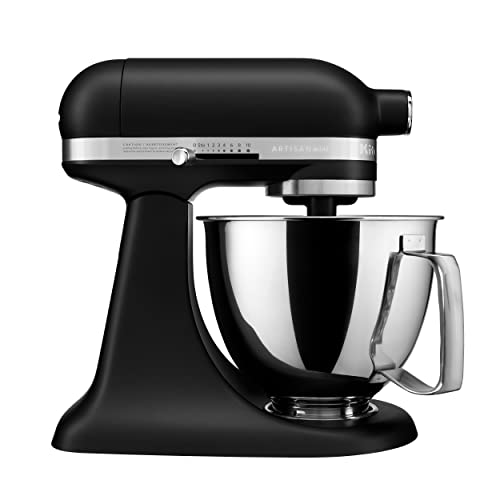
KitchenAid Artisan Mini 3.5-Qt Tilt Head Stand Mixer — Best for Small Kitchens
The Mini is the answer for cooks in apartments, small houses and anywhere the counter is contested ground. It keeps the Artisan’s tilt-head workflow, ten speeds and — crucially for cooks — the same attachment hub, in a machine sized for smaller batches and smaller rooms.
Strengths
- Compact footprint with genuine Artisan platform features
- Full hub compatibility despite the smaller body
- Ten speeds, matching its bigger sibling
Trade-offs
- 3.5-quart bowl caps family-size prep
- Not the choice for regular dough batches
- Premium price for its capacity class
| Specification | Detail |
|---|---|
| Bowl capacity | 3.5 quart (from Amazon listing title) |
| Design | Tilt-head |
| Speeds | 10 |
| Included tools | 3 accessories, per Amazon listing title |
| Model | KSM3316XBM |
| Colour verified | Black Matte |
Small-kitchen cooks are usually told to buy a lesser machine; the Mini instead gives them a smaller flagship. The prep jobs that define a cook’s mixer use — shredding, mixing, mashing, small doughs, batters — all happen comfortably in 3.5 quarts when your household is one to three people, and the hub means the pasta roller and grinder you buy later fit this machine, not a hypothetical future one.
The boundary is batch scale: holiday cooking for twelve will have you mixing in shifts. But cooks in small kitchens already cook in shifts, in smaller pans, by necessity — the Mini simply matches the mixer to the kitchen that actually exists, with no apology in build or features.
Best for: apartment cooks and small households wanting the full KitchenAid platform in miniature / Not suited for: large families or batch cooking
Check the current price on Amazon for the KitchenAid Artisan Mini 3.5-Qt Tilt Head Stand Mixer — our Best for Small Kitchens pick in this guide.

KitchenAid Commercial KSM8990 — Best Semi-Pro Option
The Commercial is for the cook who has outgrown home machines: the home caterer, the supper-club host, the preserves-and-batch producer whose mixer runs for hours. It is included as this guide’s ceiling — the point where a cook’s needs meet professional equipment and its different ownership terms.
Strengths
- Commercial platform built for sustained, heavy use
- Bowl-lift stability at production volumes
- The natural upgrade path for cooks outgrowing home models
Trade-offs
- Commercial terms differ from home models — check warranty scope on the listing
- Size, weight and cost exceed most home needs
- Trim and colours are work-first, not kitchen-decor
| Specification | Detail |
|---|---|
| Model | KSM8990, per Amazon listing title |
| Platform | KitchenAid Commercial bowl-lift line |
Most cooks will never need this machine, and the guide is honest about that — it exists here because some home kitchens genuinely operate at semi-pro intensity, and for those cooks the home range’s duty cycle, not its power, is the binding constraint. The Commercial platform is built for sustained running and heavy bowls, day after day, which is a different engineering brief from even the KSM70’s enthusiastic home use.
If you are weighing it, weigh the ownership terms too: commercial equipment carries different warranty and service expectations, which suit a producing kitchen and puzzle a domestic one. For the cook who is effectively running a small food business from home, it is the correct ceiling. For everyone else, it is useful as a marker of where the home range legitimately ends.
Best for: home caterers, supper-club hosts and production-level home cooking / Not suited for: ordinary home cooking at any enthusiasm level below semi-pro
Check the current price on Amazon for the KitchenAid Commercial KSM8990 — our Best Semi-Pro Option pick in this guide.
Comparison Table
For cooks, the deciding columns are capacity, head design and what the machine becomes once attachments enter the picture. The table covers the first two; the hub is common to all six.
| Pick | Badge | Key spec | Best for |
|---|---|---|---|
| KitchenAid Artisan 5-Qt Tilt Head Stand Mixer KSM150PS | Best Overall for Cooks | 5-qt tilt-head, 10 speeds, full attachment hub | family cooks who want one hub machine for prep, dough, pasta and baking |
| KitchenAid 5.5-Qt Bowl-Lift Stand Mixer KSM55 | Best for Cooks Who Bake Bread | 5.5-qt bowl-lift, 11 speeds | cooks who bake bread and pizza dough several times a week |
| KitchenAid 7 Quart Bowl-Lift Stand Mixer KSM70 | Best for Big Family Cooking | 7-qt bowl-lift, 11 speeds plus half speed | large households, batch cookers and holiday hosts |
| KitchenAid Classic Series 4.5 Quart Tilt-Head Stand Mixer K45SS | Best First KitchenAid for Cooks | 4.5-qt tilt-head, 10 speeds, metal body | first-time KitchenAid buyers and cooks building an attachment collection gradually |
| KitchenAid Artisan Mini 3.5-Qt Tilt Head Stand Mixer | Best for Small Kitchens | 3.5-qt tilt-head, 10 speeds, hub compatible | apartment cooks and small households wanting the full KitchenAid platform in miniature |
| KitchenAid Commercial KSM8990 | Best Semi-Pro Option | Commercial bowl-lift platform | home caterers, supper-club hosts and production-level home cooking |
Because every pick shares the hub, the real choice is workflow and scale. Pick the head design that matches how you cook — open access for grazers, lift stability for dough-led cooks — and the capacity that matches your largest regular batch, not your largest imaginable one.
How to Choose the Best KitchenAid Mixers for Cooks, Not Just Bakers
Cooks should start with the hub, because for a cook the mixer is a motor with a future. List the attachments you genuinely foresee — pasta roller and cutter for the Italian-leaning kitchen, grinder for the sausage and burger maker, slicer-shredder for the salad-and-slaw household, spiralizer for the vegetable-led cook — and confirm your model drives them. All six here share the hub, which simplifies the decision to capacity and workflow, but the exercise matters: cooks who skip it sometimes buy a second platform later, which is the expensive outcome.
Workflow comes next, and it is personal. Taste-as-you-go cooks who add, adjust and swap constantly should buy tilt-head access and never apologise for it. Cooks who work from prepared ingredients in set sequences can take the bowl-lift’s stability without feeling its friction. Neither style is more serious; they are different crafts sharing a counter, and the right KitchenAid is the one whose head design disappears into your style.
Capacity last: size for your largest weekly batch, not your annual feast. A 4.5 to 5-quart bowl covers most family cooking; step to 5.5 or 7 quarts when doughs or mixtures regularly overflow, and accept the Mini’s 3.5 quarts only when your household and kitchen both run small. Cooks who size honestly find their mixer used daily; cooks who size aspirationally find it used monthly.
The Attachment Ecosystem: A Cook’s Real Reason to Choose KitchenAid
Run the numbers on a cook’s five-year kitchen and the hub often outweighs the mixer itself. Fresh pasta from a roller and cutter set rivals dedicated machines costing as much as the mixer. A grinder attachment turns trim into burgers and sausages at a quality supermarkets cannot match. Slicers make slaw, salads and gratins a two-minute job. Each attachment is a separate purchase, but each rides on a motor you already own, stores in a drawer, and shares one learning curve.
This is also why the entry Classic ranks so respectably in this guide: it is the same doorway. A cook can start with the platform’s most affordable metal machine and add capabilities for years without replacing the base. When comparing against rival brands, cooks should price the whole system they intend to own — mixer plus the three attachments they actually want — because that total, not the mixer’s shelf price, is the true cost of the platform.
Mixer Prep Techniques Cooks Underuse
The flat beater is a prep tool hiding in a baking accessory. It shreds warm cooked chicken and pork to sandwich texture in under a minute, creams butter into compound butters with herbs and citrus evenly, and mashes potatoes and root vegetables in the serving bowl with less glueyness than a masher worked by hand — provided the potatoes are hot and the speed stays low. The paddle also mixes meatloaf, meatball and sausage blends more evenly and more gently than hands, keeping the mixture cold and the cook’s hands clean.
Dough hooks and whisks have their prep roles too: the hook brings together rough pastry and flatbread doughs without overworking, and the whisk emulsifies large dressings and marinades that would take minutes by hand. Cooks who think of the mixer as a baking appliance use a third of what they bought; the machine on your counter is a prep station, and this guide’s picks were ranked accordingly.
A Cook’s Week With Each Platform: Where the Differences Actually Appear
Specifications separate these six models on paper, but a cooking week separates them in practice, and it is worth walking through one. Monday’s meatballs: every pick mixes the blend evenly with the flat beater, but the tilt-heads let you add breadcrumbs, taste and adjust in seconds, while the bowl-lifts ask you to lower the bowl for each intervention — a small friction, repeated daily, that shapes how a cook feels about a machine by Friday. Wednesday’s pizza dough reverses the verdict: the KSM55 and KSM70 knead in composed silence while the tilt-heads work visibly, and the cook preps toppings in the confidence that the machine is not negotiating with the dough.
The weekend draws the map completely. Saturday’s pasta session belongs to whichever model you own, because the hub is common to all — but the Mini’s owner rolls for two while the KSM70’s owner rolls for a table of eight without a second thought. Sunday’s roast chicken shreds identically everywhere. By the end of the week the pattern is clear: workflow differences are daily and small, capacity differences are weekly and large, and dough differences are monthly and decisive. Cooks should weight their own week’s pattern in exactly that order when choosing among these six — which is why the guide’s ranking rewards the all-round workflow first and the specialisms after.
Second Bowls, Flex Beaters and the Cook’s Accessory Order of Battle
Ask experienced KitchenAid cooks which accessory they would buy first and the answer is rarely glamorous: a second bowl. Cooking is sequential — marinade in one bowl, mixture in another, dough resting while vegetables are shredded — and the bowl swap is what turns a mixer from an appliance into a station. The flex-edge beater comes second for the same reason: it converts the flat beater, already the cook’s most-used tool, into one that scrapes as it works, which matters more in savoury mixtures — thick, sticky, uneven — than in any batter. Only after those two workhorses do the hub attachments enter, led by whichever matches the household’s cuisine: pasta tools for some, the grinder for others, slicers for the salad-and-prep-heavy kitchen.
The ordering matters because accessory budgets are finite and enthusiasm is front-loaded. A cook who buys the spectacular attachment first and the second bowl never will use the spectacular one monthly and improvise the bowl weekly. Reverse the order and every session gets faster immediately, while the hub tools arrive into a workflow ready for them. This guide’s models all support the full sequence — that is the platform’s point — but the sequence itself is the cook’s to get right, and getting it right is worth more than any single model step in the ranking.
Cleaning and Living With a Cook’s Mixer: The Unglamorous Deciders
Cooks use mixers harder than bakers in one specific way: savoury work is messier. Meat mixtures, oily marinades, turmeric-bearing spice blends and mashed root vegetables all find the hinge, the hub and the bowl rim in ways cake batter politely does not. The models in this guide differ in how gracefully they absorb that life. Tilt-heads expose their hinge to the splash zone but wipe down in seconds; bowl-lifts keep the head cleaner and put the lift arms in the firing line instead. Stainless bowls shrug off savoury staining that would mark other finishes, and every tool here is dishwasher-safe — a fact that matters more after a meatball session than after any cake.
The living-with questions extend to sound and storage. A cook’s mixer runs at breakfast-adjacent hours and in open-plan rooms; the composed machines here earn goodwill that no specification captures. And a cook’s mixer, used daily, never really gets stored — it gets parked, which is why footprint and the discipline of a ninety-second reset after each use decide whether the machine remains a station or becomes an obstacle. None of this appears in a catalogue. All of it decides, by month three, whether the mixer was the right purchase — and it is why this guide weighted workflow as heavily as power.
A Note on Noise, Neighbours and Early-Morning Prep
Cooks keep different hours from bakers, and a cook’s mixer may run at dawn for a slow-ferment dough or late for tomorrow’s marinade, in homes where other people are sleeping through both. The models in this guide are, by the standards of powerful kitchen machinery, composed — but dough work at any hour is a physical sound, transmitted through counters and floors, and bowl-lift machines under load have a voice that carries differently from a tilt-head’s. The practical mitigations are the ones this series recommends everywhere: a solid, level surface, a dense mat where the counter is hollow, and scheduling the heaviest kneading for sociable hours when the household allows it. It is a small consideration that never appears in a specification — and one that, in flats and family homes alike, quietly decides whether a powerful mixer is loved by the whole household or merely by its owner.
One Platform, Many Kitchens: The Argument in a Single Story
Consider two households buying on the same Saturday. The first cooks for two in a small flat: curries on weeknights, a roast on Sundays, bread twice a month, friends fed in batches the kitchen can barely stage. The second cooks for six in a house with a freezer the size of a wardrobe: production weekends, holiday marathons, a teenager learning to bake at full volume. A category organised by product would sell them different brands; this guide sells them the same platform at different sizes — the Mini or the Classic for the first kitchen, the KSM70 for the second — and that is not a failure of imagination. It is the platform idea working as intended: one hub, one set of techniques, one accessory language, scaled to the room.
The deeper point is what happens in year three, when the first household’s cooking grows — a pasta phase, a sausage experiment, a bigger flat — and the second household’s teenager leaves, taking the volume with her. Platforms absorb change: attachments move up, machines are replaced within a family whose tools still fit, knowledge transfers whole. Appliances bought as isolated objects strand their owners at every change. Cooks, whose lives are nothing but change at the counter, benefit from the platform more than any other buyers in the mixer market — which is why this guide, alone among our KitchenAid guides, ranks the ecosystem not as a feature among others but as the headline itself.
Seasonal Cooking on the Platform: The Year-Round Case for the Hub
A cook’s mixer justifies itself across the calendar, and tracing one year on the platform shows why this guide weights versatility so heavily. Spring brings fresh pasta for the first asparagus and peas, rolled on the hub while the tilt-head’s bowl handles a lemon batter for dessert — two courses, one motor, no dedicated pasta machine stored anywhere. Summer is the slicer and shredder’s season: slaws, salads and gratins at a speed that changes what a weeknight cook attempts, plus ice-cream ambitions for households that add that attachment when the weather argues for it.
Autumn turns the platform toward preservation and production: the grinder earns its shelf space in sausage and burger blends from seasonal meat, big doughs return with the baking weather, and the larger bowls in this guide start paying their rent in batch cooking for the freezer. Winter is the stress test — holiday prep at full stretch, where the KSM70’s capacity and the Artisan’s workflow stop being specifications and become the difference between a calm kitchen and a triage ward. A baker buys a mixer for recipes; a cook buys one for this calendar, and the models ranked here were ranked by how completely they cover it.
Teaching Kitchens and Shared Kitchens: The Durability Argument Revisited
Some kitchens teach, and some are shared, and both environments rewrite the mixer calculus in ways worth naming. In a teaching kitchen — a parent cooking with children, a household where friends learn at the counter — the machine must forgive: forgiving controls that cannot be set dangerously wrong, a head design that opens without trapping fingers or confusing novices, and a build that tolerates the occasional ingredient added at the wrong moment by an enthusiastic student. The tilt-head models in this guide, the Artisan above all, are the natural teachers: visible, intuitive, and mechanically honest about what they are doing.
Shared kitchens — houses with several cooks, holiday homes, the family kitchen that hosts everyone’s projects — argue for the platform’s deepest bench: common attachments everyone can find parts for, a machine whose quirks are documented by a generation of owners, and capacity that absorbs other people’s batch ambitions as well as your own. It is no accident that the recommendations converge on the same centre of the range from these different directions. Machines that teach well and share well are machines designed clearly and supported deeply, and those are the properties this guide has been measuring all along under their technical names.
How to Use a KitchenAid Mixer as a Prep Station: Setup and Daily Workflow
A cook’s mixer earns its space through workflow, not specifications. Set it up once for cooking — not just baking — and it becomes the fastest pair of hands in the kitchen.
- Park the mixer where it will be used, with the hub facing your main prep area; a mixer you must fetch is a mixer you will not use for a two-minute job
- Keep the flat beater fitted as the default tool — it is the cook’s most-used attachment — and store the whisk and hook within arm’s reach, not in a distant drawer
- Fit attachments with the machine off and unplugged, seat them until the hub screw or lock engages fully, and give each a gentle pull-test before starting
- For shredding and mashing, work with warm ingredients at low speed in short bursts, checking texture between bursts — the line from shredded to pureed is one burst wide
- For grinding and pasta work, chill ingredients and parts where the recipe calls for it, feed steadily rather than forcing, and let the motor’s pace set yours
- Clean the hub area after messy prep; flour and food residue around the hub cap are the main cause of attachments seating poorly over time
End each session by wiping the head and hub, washing the bowl and tools while residue is fresh, and returning the beater to its default position. Ninety seconds of reset is what makes the next two-minute job possible — and those two-minute jobs, multiplied across a year of cooking, are the entire case for the platform.
Common Buying Mistakes
- Buying a baking flagship for a cooking life, then discovering the workflow or capacity fights your prep style
- Ignoring the hub when comparing prices, and paying for a rival platform twice when attachments enter the picture
- Shredding or mashing at high speed and blaming the machine for puree — low speed and short bursts are the technique
- Forcing pasta or grinding attachments faster than the motor’s pace, which strains the drive and roughens the result
- Letting the mixer live in a cupboard, where its two-minute prep jobs never happen
- Sizing the bowl for the annual feast instead of the weekly batch, then fighting thin mixtures in an oversized bowl all year
The common thread is treating the mixer as a single-purpose purchase. Cooks get the most from this platform when they buy the system — machine, hub, workflow — rather than the appliance alone.
Final Recommendation
For most cooks, the Artisan is the answer: open workflow, family capacity and the full hub future in one proven machine. Dough-led cooks should step to the KSM55, big households to the KSM70, new cooks can start at the Classic without buying a dead end, small kitchens are genuinely served by the Mini, and semi-pro cooks have the Commercial as their ceiling. Every route stays inside one ecosystem, which is precisely the point for a cook.
Check the current price on Amazon for the model that matches your kitchen, confirm the included tools on the listing, and plan your first attachment before you plan your tenth recipe. The related guides below cover the professional range and the large-bowl specialists in their own depth.
Short on time? Start with the KitchenAid Artisan 5-Qt Tilt Head Stand Mixer KSM150PS, KitchenAid 5.5-Qt Bowl-Lift Stand Mixer KSM55, KitchenAid 7 Quart Bowl-Lift Stand Mixer KSM70 — check price on Amazon for each and compare the current bundles before you decide.
Best Kitchen Stand Mixers Best Kitchenaid Professional Mixers Best Kitchenaid Hand Mixers Best Kitchen Mixers Under $300 Best Large Bowl Mixers
Frequently Asked Questions
Which KitchenAid is best for a cook who rarely bakes?
The Artisan or the Classic, depending on budget and household size. Both give you the attachment hub, tilt-head workflow and prep versatility cooks use daily; the Artisan adds capacity and the pouring shield, the Classic keeps the entry price lowest while keeping the same hub future.
Are KitchenAid attachments worth the extra cost for cooks?
For cooks, they are the main event: pasta, grinding and slicing attachments turn one motor into a prep station and generally cost less than the dedicated appliances they replace. Price the system you intend to own, not just the mixer, when comparing platforms.
Can a stand mixer really shred chicken and mix meat?
Yes — the flat beater at low speed shreds warm cooked chicken in under a minute and mixes meatloaf and sausage blends evenly without warming them the way hands do. Work in short bursts at low speed and check texture as you go.
Tilt-head or bowl-lift for a cook?
Tilt-head suits cooks who add, taste and swap constantly; bowl-lift suits dough-led cooks who value stability over access. Most mixed-style cooks are happier with tilt-head workflow, which is why the Artisan leads this guide.
Is the Mini powerful enough for real cooking?
For small households, yes: it keeps the platform’s speeds and hub in a 3.5-quart format sized for smaller batches. Its limit is scale, not capability — large doughs and crowd-size prep belong to its bigger siblings.
When should a cook consider the Commercial model?
When the mixer runs for hours most days — home catering, supper clubs, production batch cooking. At that point duty cycle and commercial build matter more than home-range features, and the different warranty terms should be checked on the listing before buying.

