Disclosure: airfryerkitchensupply.com is reader-supported. When you buy through links on our site, we may earn an affiliate commission at no extra cost to you.
Where to buy
If you are shopping for the best kitchenaid hand mixers, start with this verified shortlist. Five of the six KitchenAid hand mixers below were verified as current Amazon listings and carry purchase links; one — the cordless variable-speed model — is covered without a link because its listing could not be confirmed during verification, and we do not attach links we have not verified. For the linked models, check the current price on Amazon, since hand mixer pricing shifts frequently with promotions.
- KitchenAid 9 Speed Hand Mixer KHM926 — Best Overall: check price on Amazon.
- KitchenAid 7 Speed Hand Mixer KHM7210 — Best Mid-Range Pick: check price on Amazon.
- KitchenAid 5 Ultra Power Speed Hand Mixer KHM512 — Best Budget KitchenAid: check price on Amazon.
- KitchenAid 6 Speed Hand Mixer with Flex Edge Beaters KHM6118 — Best for Cake Batter: check price on Amazon.
- KitchenAid Go Cordless Hand Mixer KHMR762 — Best Cordless: check price on Amazon.
- KitchenAid Cordless Variable Speed Hand Mixer — Best Cordless Alternative — Unlinked: covered without a link below; no verified listing is linked.
KitchenAid sells the same hand mixer in several colours under separate listings. The model number — KHM512, KHM6118, KHM7210, KHM926 — is the machine; the colour is the variant. Buy by model first, colour second.
The best kitchenaid hand mixers all share a family resemblance — a rounded body, a speed slider or buttons on top, and beaters that eject with a press — but they are not the same machine at different prices. The line is a ladder of control: five speeds for simple work, six with flex-edge beaters that scrape the bowl as they go, seven with a proper whisk, nine with the fullest accessory set and the gentlest starting speed, and a cordless branch that trades the mains lead for freedom of movement. Choosing well means knowing which rung your baking actually needs, because the steps are priced as deliberately as they are engineered.
Hand mixers earn their place beside stand mixers rather than beneath them. They whip two egg whites in the bowl you will serve from, mash potatoes in the pot, mix a single cake without washing a 5-quart bowl, and store in a drawer. KitchenAid’s versions are the category’s reference point largely because of two details rivals copy: the slow, splash-free start that does not redecorate your kitchen with flour, and Turbo Beater designs with no centre post, so batter does not climb and pack into the mechanism.
This guide ranks the current ladder rung by rung, including the cordless options, and is frank about the overlaps: the 7-speed and 9-speed machines are closer than their prices suggest, and the 5-speed remains the right answer for a large share of households. One model is covered without a link — read its review for why, and for how to buy it safely if it is the one you want.
In this guide
Quick Picks
Six rungs, six reasons. If you already know you want cordless, jump to the last two reviews; if you bake weekly, the middle rungs are where the value concentrates.
- Best Overall — KitchenAid 9 Speed Hand Mixer KHM926: nine speeds with the softest start in the line, a pro whisk, dough hooks and Turbo Beater II accessories — the fullest hand-mixing system KitchenAid sells.
- Best Mid-Range Pick — KitchenAid 7 Speed Hand Mixer KHM7210: seven speeds, the pro whisk and Turbo Beater II beaters with a lockable swivel cord — most of the flagship’s talent for noticeably less.
- Best Budget KitchenAid — KitchenAid 5 Ultra Power Speed Hand Mixer KHM512: five speeds, Turbo Beaters and an easy-release button in the line’s simplest, lightest body — the entry rung that still feels like a KitchenAid.
- Best for Cake Batter — KitchenAid 6 Speed Hand Mixer with Flex Edge Beaters KHM6118: six speeds with flex-edge beaters that wipe the bowl as they mix — fewer stops to scrape, smoother batters, integrated storage.
- Best Cordless — KitchenAid Go Cordless Hand Mixer KHMR762: seven speeds, a soft-start feature and a removable battery included — the freedom to mix anywhere, from island to stovetop, with no cord to manage.
- Best Cordless Alternative — Unlinked — KitchenAid Cordless Variable Speed Hand Mixer: KitchenAid’s other cordless hand mixer line, with variable-speed control — covered without a purchase link because its listing could not be verified in our API checks.
How These Picks Were Chosen
Each model was verified against Amazon’s catalogue, with the listing title matched to the model number before a link was attached. Five of the six cleared that bar cleanly. The sixth — KitchenAid’s cordless variable-speed hand mixer — could not be confirmed during our verification window because the API was rate-limiting our checks; rather than guess a listing, we cover it without a link and say so openly. That is the rule for every guide in this series: no verification, no link.
Judgement across the ladder rested on control and accessories rather than raw speed counts. We weighted the gentleness of the lowest speed, since hand mixers live or die by their first ten seconds in a bowl of dry ingredients; the usefulness of the included tools, because a pro whisk and dough hooks turn a beater into a small system; and the ergonomics of the body, cord and storage, since a hand mixer is held, carried and put away every single time it is used.
We also considered who should not climb the ladder. More speeds and accessories only pay if your recipes use them, and part of this guide’s job is to tell a twice-a-month baker that the 5-speed is not a compromise — it is the correctly sized tool — while telling a weekly baker exactly which upgrade they will feel.
The 6 Best KitchenAid Hand Mixers
Ordered by the breadth of baker each model serves, from the fullest-featured corded machine to the cordless specialists. Speed counts in the headings are the manufacturer’s own, taken from the verified listing titles.

KitchenAid 9 Speed Hand Mixer KHM926 — Best Overall
The KHM926 is for bakers who use a hand mixer as a primary tool: frequent cakes, meringues, whipped creams, small doughs and everything in between. If your hand mixer comes out weekly and your recipes vary, this is the rung where the ladder stops feeling like a compromise.
Strengths
- Nine speeds with a genuinely gentle first speed
- Pro whisk and dough hooks included, not sold separately
- Soft-start style low speeds keep dry ingredients in the bowl
Trade-offs
- Priced at the top of the corded line
- More accessories to store than simpler rungs
- Over-specified for occasional, simple baking
| Specification | Detail |
|---|---|
| Speeds | 9 (from Amazon listing title) |
| Included tools | Pro whisk attachment, Turbo Beater II beaters, dough hook |
| Accessories | Dishwasher-safe, per Amazon listing title |
| Colour verified | Contour Silver |
What you buy with nine speeds is not top-end power — it is resolution at the bottom. The lowest settings on the KHM926 move slowly enough to fold flour into batter and start a meringue without violence, and the steps up are close enough that you can find the exact pace a recipe wants rather than the nearest available one. For bakers who whip cream weekly, that fine control is the difference between glossy peaks and a bowl you have pushed too far.
The accessory set completes the argument: the pro whisk for aeration, dough hooks for small soft doughs, and Turbo Beater II beaters whose open design sheds batter instead of packing it. Everything goes in the dishwasher. If a hand mixer is your main mixer, this is the one that behaves like it — and the one against which the rest of this guide is measured.
Best for: frequent bakers who want the most capable, best-equipped corded hand mixer / Not suited for: occasional bakers whose needs the 5-speed covers completely
Check the current price on Amazon for the KitchenAid 9 Speed Hand Mixer KHM926 — our Best Overall pick in this guide.
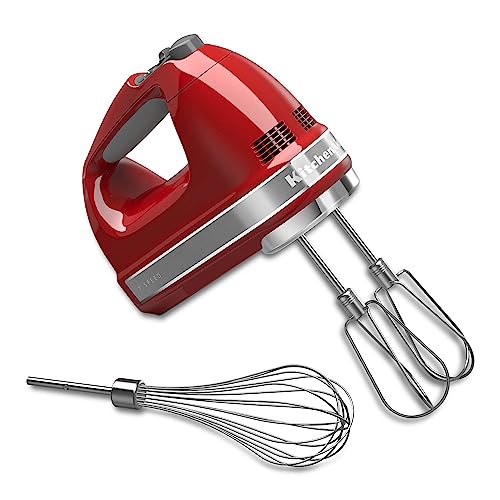
KitchenAid 7 Speed Hand Mixer KHM7210 — Best Mid-Range Pick
The KHM7210 is the ladder’s sweet spot for regular home bakers: enough speed resolution for confident whipping and folding, the whisk the 5-speed lacks, and a swivel cord that locks left or right so it stops fighting your handedness. Weekly bakers who do not knead small doughs by hand mixer will rarely miss the top rung.
Strengths
- Pro whisk included for proper aeration work
- Lockable swivel cord suits left- and right-handed users
- Turbo Beater II beaters release and wash easily
Trade-offs
- No dough hooks in this configuration
- Two fewer speeds than the flagship, felt mainly at the gentlest end
- Colour availability varies by listing
| Specification | Detail |
|---|---|
| Speeds | 7 (from Amazon listing title) |
| Included tools | Pro whisk attachment, Turbo Beater II beaters |
| Cord | Lockable swivel cord, per Amazon listing title |
| Colour verified | Empire Red |
Compare the KHM7210 with the flagship honestly and the gap narrows to two things: dough hooks and the finest low-speed granularity. Everything else — the whisk, the beater design, the dishwasher-safe accessories, the composed start — is shared. For the large class of bakers whose hand mixing is cakes, creams, frostings and batters, that makes the 7-speed the rational purchase and the 9-speed the enthusiast’s one.
The swivel cord deserves more credit than it gets in most roundups. Hand mixers are used at odd angles, over stove-top pans and crowded counters, and a cord that locks to your side rather than draping across the bowl is a daily-quality-of-life feature you notice every session. Mid-range picks win on details like this, and the KHM7210 is full of them.
Best for: regular home bakers wanting flagship features without the flagship step in price / Not suited for: bakers who specifically want dough hooks in the box
Check the current price on Amazon for the KitchenAid 7 Speed Hand Mixer KHM7210 — our Best Mid-Range Pick pick in this guide.
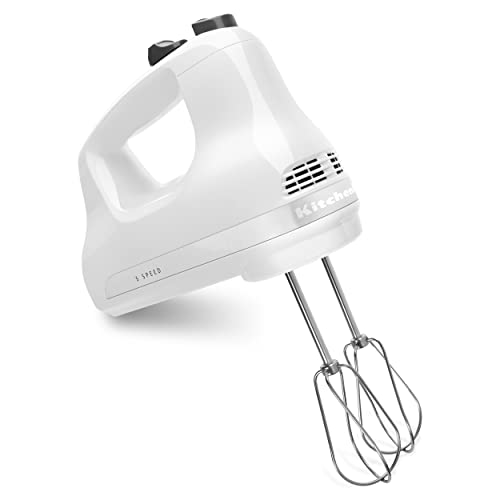
KitchenAid 5 Ultra Power Speed Hand Mixer KHM512 — Best Budget KitchenAid
The KHM512 suits occasional and straightforward baking: box cakes made better, frostings, whipped cream, mashed potatoes, pancake and muffin batters. For households where a hand mixer appears a few times a month for simple jobs, its five speeds are not a limitation — they are the correct specification.
Strengths
- Lightest, simplest model in the line
- Turbo Beaters with easy one-press ejection
- Lockable swivel cord, unusual at this rung
Trade-offs
- No whisk attachment for serious aeration
- Five speeds means coarser control when whipping
- Not the tool for dough in any form
| Specification | Detail |
|---|---|
| Speeds | 5 (from Amazon listing title) |
| Included tools | Turbo Beaters |
| Features | Lockable swivel cord, easy release button, dishwasher-safe beaters, per Amazon listing title |
| Colour verified | White |
There is a discipline to a good entry model: keep the core experience, cut the extras. The KHM512 keeps the things that make a KitchenAid feel like one — the composed motor behaviour, beaters that eject cleanly with a button press instead of a wrestling match, and a cord that locks out of your way — and cuts the whisk, the extra speeds and the accessory wardrobe. For simple mixing, the result is indistinguishable in the bowl from its pricier siblings.
Know its boundaries and it will never frustrate you: egg whites whip better with a whisk attachment it does not have, and delicate folding wants a gentler first speed than five-step ladders provide. As the household’s second mixer, a first-apartment mixer or a gift that will genuinely be used, it is the easiest recommendation in this guide.
Best for: occasional bakers, simple recipes and anyone wanting KitchenAid quality at the entry rung / Not suited for: meringue enthusiasts, dough makers or bakers wanting fine speed control
Check the current price on Amazon for the KitchenAid 5 Ultra Power Speed Hand Mixer KHM512 — our Best Budget KitchenAid pick in this guide.

KitchenAid 6 Speed Hand Mixer with Flex Edge Beaters KHM6118 — Best for Cake Batter
The KHM6118 answers a specific annoyance: the ring of unmixed batter every ordinary beater leaves around the bowl. Its flex-edge beaters carry a flexible fin that sweeps the bowl wall as they turn, which suits cake and cookie bakers who value smooth, fully incorporated batters and hate the stop-scrape-restart rhythm.
Strengths
- Flex-edge beaters scrape the bowl during mixing
- Integrated storage keeps beaters with the body
- Six speeds cover the batter-and-cream range well
Trade-offs
- Flex edges are a batter feature; they add nothing for whipping
- Replacement flex-edge beaters cost more than plain ones
- No pro whisk in this configuration
| Specification | Detail |
|---|---|
| Speeds | 6 (from Amazon listing title) |
| Included tools | Flex Edge Beaters, dishwasher-safe |
| Storage | Integrated storage, per Amazon listing title |
| Colour verified | Contour Silver |
Scraping is the hidden tax on hand mixing: every stop breaks your rhythm and your batter’s consistency. The flex-edge design pays that tax for you, sweeping the bowl’s side with each pass so flour pockets and butter smears rejoin the mix continuously. In side-by-side home baking, the visible result is a smoother batter with fewer raw streaks in the finished crumb — a real, if unglamorous, improvement aimed squarely at cake bakers.
The rest of the machine is the line’s proven formula at a six-speed resolution, with the thoughtful addition of integrated storage so the beaters live on the body rather than loose in a drawer. If your hand mixing is dominated by batters and doughs of the cookie kind, this mid-rung specialist can serve you better than the flagship — a reminder that the best rung is the one matched to your recipes, not the highest one.
Best for: cake and cookie bakers who want smoother batters with less scraping / Not suited for: whipping-focused bakers or those wanting the fullest accessory set
Check the current price on Amazon for the KitchenAid 6 Speed Hand Mixer with Flex Edge Beaters KHM6118 — our Best for Cake Batter pick in this guide.

KitchenAid Go Cordless Hand Mixer KHMR762 — Best Cordless
The Go Cordless suits cooks whose mixing happens wherever the food is: mashing in the pot, whipping at the island, finishing a sauce at the stove, baking in kitchens with one badly placed socket. It also suits households already in KitchenAid’s Go battery family, where the same battery philosophy spans several cordless tools.
Strengths
- True cordless freedom with battery included in the box
- Soft Start feature prevents ingredient splash
- Seven speeds match the corded mid-range for control
Trade-offs
- Battery runtime replaces unlimited mains power
- Heavier in the hand than the lightest corded rungs
- Charging becomes part of your baking routine
| Specification | Detail |
|---|---|
| Speeds | 7 settings (from Amazon listing title) |
| Power | Cordless, battery included |
| Features | Soft Start Feature, per Amazon listing title |
| Tools | Stainless steel beaters |
| Colour verified | Black Matte |
Cordless hand mixing sounds like a luxury until you have whipped cream at a kitchen island with no nearby socket, or mashed potatoes in the pot without a cord trailing across two hot burners. The KHMR762 makes that freedom practical: seven speeds for real control, a soft start that keeps the first second civilised, and a battery in the box rather than sold as an afterthought. In performance terms it sits with the corded mid-range, which is exactly where a cordless tool needs to sit to be taken seriously.
The trade is rhythm: cordless baking includes charging, and a flat battery mid-recipe is a new kind of failure the corded rungs never suffer. Bakers who bake in long, back-to-back sessions should weigh that honestly. For everyone whose mixing is a series of short jobs around the kitchen, the Go is not a novelty — it is the most convenient mixer in this guide.
Best for: cooks who mix all over the kitchen and value cordless freedom with real speed control / Not suited for: marathon baking sessions or buyers who never want to think about charging
Check the current price on Amazon for the KitchenAid Go Cordless Hand Mixer KHMR762 — our Best Cordless pick in this guide.
KitchenAid Cordless Variable Speed Hand Mixer — Best Cordless Alternative — no link
This model suits the same cordless buyer as the Go above, with a variable-speed approach to control rather than fixed steps. We include it because a KitchenAid hand mixer guide that ignored it would mislead cordless shoppers — but we link only to listings we have verified, and this one did not clear verification during our checks, so it is covered without a link.
Strengths
- Cordless format for mixing anywhere in the kitchen
- Variable-speed control for fine adjustments
- Part of the established KitchenAid hand mixer family
Trade-offs
- No verified listing link in this guide — you must source it yourself
- Battery-based runtime, like all cordless models
- Specifications should be confirmed on the retailer’s current listing before buying
Why include a pick we will not link? Because the honest alternative — pretending the model does not exist — would leave cordless shoppers comparing an incomplete field. KitchenAid has sold a cordless variable-speed hand mixer alongside the Go line, and for some buyers its control style is the preference. What we cannot do, under the verification rule every guide in this series follows, is send you to a listing we have not matched against the catalogue ourselves.
If this is the model you want, buy it carefully: search by the full product name on Amazon, confirm the seller and that the listing is for the complete mixer rather than a battery or accessory, and check the current price on Amazon against the corded rungs in this guide. The machine is a legitimate member of the family; it simply sits outside this guide’s verified links, and we would rather say that plainly than dress a guess as a recommendation.
Best for: cordless shoppers who prefer variable-speed control and are comfortable verifying the listing themselves / Not suited for: buyers who want a one-click verified purchase from this guide
Comparison Table
The ladder in one view: speeds climb, accessories accumulate, and the cordless branch splits at the end. Match the rung to your recipes, not to the numbering.
| Pick | Badge | Key spec | Best for |
|---|---|---|---|
| KitchenAid 9 Speed Hand Mixer KHM926 | Best Overall | 9 speeds, pro whisk and dough hooks included | frequent bakers who want the most capable, best-equipped corded hand mixer |
| KitchenAid 7 Speed Hand Mixer KHM7210 | Best Mid-Range Pick | 7 speeds, pro whisk, lockable swivel cord | regular home bakers wanting flagship features without the flagship step in price |
| KitchenAid 5 Ultra Power Speed Hand Mixer KHM512 | Best Budget KitchenAid | 5 speeds, Turbo Beaters, easy-release | occasional bakers, simple recipes and anyone wanting KitchenAid quality at the entry rung |
| KitchenAid 6 Speed Hand Mixer with Flex Edge Beaters KHM6118 | Best for Cake Batter | 6 speeds, flex-edge beaters, integrated storage | cake and cookie bakers who want smoother batters with less scraping |
| KitchenAid Go Cordless Hand Mixer KHMR762 | Best Cordless | Cordless, 7 speeds, Soft Start, battery included | cooks who mix all over the kitchen and value cordless freedom with real speed control |
| KitchenAid Cordless Variable Speed Hand Mixer | Best Cordless Alternative — no link | Cordless, variable speed — no link, unverified listing | cordless shoppers who prefer variable-speed control and are comfortable verifying the listing themselves |
Notice that every rung shares the same core virtues — composed starts, ejectable beaters, dishwasher-safe tools. You are not buying quality as you climb; you are buying control, accessories and freedom. That is a much easier decision than most ladders offer.
How to Choose the Best KitchenAid Hand Mixers for Your Recipes
Start with what you whip. Aeration is the hand mixer’s home turf, and it separates the ladder cleanly: if meringues, mousses and whipped creams are regular events, you want a pro whisk in the box, which means the 7-speed or 9-speed. If your whipping is the occasional cream topping, the 5-speed’s beaters cope adequately and the money saved is real. Batter bakers should look sideways at the 6-speed’s flex-edge beaters, which solve scraping rather than speed.
Next, decide the dough question honestly. Only the 9-speed here includes dough hooks, and even with them, a hand mixer kneads small, soft doughs only — a stand mixer or your hands remain the right tools for bread. Buy the flagship for its control and whisk, not as a bread machine, and it will delight you; buy it as a bread machine and nothing in this guide can save the purchase.
Finally, the cord decision. Cordless models trade unlimited runtime for placement freedom, and the trade favours cooks who mix in short bursts across the kitchen. If your mixer lives beside one socket and your sessions are long, corded is not the boring choice — it is the correct one. If you have ever dragged a pot to the mixer instead of the mixer to the pot, you already know your answer.
Speeds, Beaters and Soft Starts: What Actually Differs Between the Rungs
Speed counts in hand mixers are really about the bottom of the range. Every model here can spin fast enough to whip; what the higher rungs add is finer, gentler low speeds for folding and for starting in dry ingredients. KitchenAid’s soft, splash-free starts are the family’s signature for a reason: the first three seconds in a bowl of flour decide whether hand mixing feels civilised or chaotic, and every rung shares more of that DNA than the prices imply.
Beater design matters as much as speed. The open Turbo Beater pattern has no centre post for batter to climb and pack into, which keeps the mix in the bowl and the cleaning simple. Flex-edge beaters add a bowl-sweeping fin for batter work. The pro whisk, included at the top rungs, is a different tool for a different job — trapping air — and no beater, however shaped, fully substitutes for it in meringue work.
Hand Mixer or Stand Mixer: Owning the Right Tool, or Both
A hand mixer does four things a stand mixer cannot: it goes to the pot, it works in any bowl you own, it handles two-egg-white quantities gracefully, and it stores in a drawer. A stand mixer does the heavy, long and hands-free work: dough, big batches, ten-minute creaming while you do something else. Most serious home bakers eventually own both, using each where it wins, and this guide’s machines are priced to be the second tool as comfortably as the first.
If you can only own one today, choose by your heaviest regular job. Weekly bread or double batches demand the stand mixer; a varied life of cakes, creams, mashes and batters is served beautifully by a good hand mixer alone, especially the flagship rung here. There is no wrong answer — only mismatched ones, and the mismatch is always workload, never quality.
Beater, Whisk or Hook: Matching the Tool to the Mixture
A hand mixer is really three tools sharing one motor, and using the right one matters more than the speed you choose. The beaters are the generalists: their open frames cut through batter, cream butter and sugar, and mash soft vegetables, shedding mixture rather than packing it because there is no centre post for food to climb. Most home mixing is beater work, and most beater failures come from asking them to do the whisk’s job — forcing air into egg whites with a frame designed for blending gives volume slowly and unevenly, which is why the rungs of this ladder that include the pro whisk whip in a different league.
The whisk is an aeration instrument: its many wires slice the mixture into thin sheets that fold air in, building the foams that meringues, mousses and whipped creams are made of. The dough hooks, found here only on the flagship, are the specialists: their shape pulls and folds small, soft doughs without the tearing beaters would inflict. The practical rule is to choose the tool by the mixture’s goal — blend, aerate or develop — before you choose the speed, and to remember that the ladder’s price steps largely buy you access to more of these three tools, in better company, rather than a fundamentally different motor.
Corded vs Cordless, Revisited: The Kitchen Geography Test
The corded-versus-cordless decision in this guide is best made by geography rather than by specifications. Map your kitchen honestly: where are the sockets, where does the mixing actually happen, and how often do those two places fail to meet? A baker whose mixing lives at one counter beside one socket gains nothing from cordlessness except a charging routine, and the corded rungs give that baker finer control and lower prices for the same work. A cook whose mixing migrates — potatoes at the stove, cream at the island, batter wherever the bowl landed — gains something real from the cordless models: the mixer goes to the food, every time, without negotiation.
There is a middle truth worth stating: cordless runtime limits are rarely about a single recipe, which any charged battery handles, but about baking days — the back-to-back sessions where a corded machine’s indifference to endurance quietly wins. Households that bake in marathons should weight the corded flagship accordingly; households that mix in moments should weight the Go and its variable-speed sibling. Neither answer is the modern one or the sensible one in the abstract. Each is correct for exactly one kitchen geography, and you already know which kitchen is yours.
Care and Feeding: Making a Hand Mixer Last a Decade
Hand mixers fail in unglamorous places: the cord, where it enters the body; the vents, where flour accumulates; the beater shafts, where dried batter corrodes the finish that lets them eject smoothly. A decade of service is mostly a matter of not letting those three places be neglected. Coil the cord in loose loops rather than winding it tightly around the body, which fatigues the cable at its fixed point — the commonest hand mixer death of all, and the most preventable. Blow or brush flour from the vents after baking days, before it compacts into insulation the motor did not ask for.
Wash beaters and accessories promptly and dry the shafts before storing them, especially where they enter the body. Store the machine with its tools together — the integrated storage on the flex-edge model exists because loose beaters in drawers get bent, and bent beaters wobble, and wobbling beaters wear the drive. None of this takes five minutes a month. The reward is that a hand mixer — the most frequently used mixer in most kitchens — remains what it was on day one: the tool you reach for without thinking, because it has never given you a reason to think.
The Ladder, Climbed Backwards: Starting From Your Recipes Instead of the Range
Most buyers shop a range like this one from the bottom up, asking how little they can spend; the better method is to shop it from your recipes down, asking which rung your most demanding regular recipe requires. Open your own repertoire honestly. If its ceiling is a boxed cake improved, a frosting, a bowl of whipped cream for a pie — the ladder’s answer is its lower half, and every dollar above it buys accessories your recipes will never request. If the repertoire includes meringues, mousses or anything whose success is measured in stable foam, the whisk becomes a requirement and the ladder’s answer moves to the 7-speed or above, not as an upgrade but as the correct tool arriving at the correct job.
If the repertoire includes the whole kitchen — mashes at the stove, mixtures in odd bowls, baking in a socket-poor room — the cordless rungs enter, and the question becomes geography as much as capability. And if the repertoire is simply everything, weekly, at volume, the flagship stops being the expensive option and becomes the only rung whose control and accessory set do not tax each session a little. Recipes do not care about price bands; they care about tools. Let the most demanding thing you make regularly choose your rung, let everything easier fall where it may, and the ladder — climbed backwards, from the food — will put you on exactly the right step.
The Two-Egg-White Test and Other Quantities That Sort the Ladder
Hand mixers reveal themselves at the extremes of quantity, and the smallest extreme is the most telling. Two egg whites in a deep bowl are a trivial load that exposes everything: whether the beaters reach a shallow mixture at all, whether the lowest speed can start it without spraying, and whether the tool can build a foam from a few tablespoons of liquid. The ladder’s whisk-equipped rungs pass this test with elegance, because the whisk’s wires work in thin mixtures where beater frames mostly stir. Beater-only rungs cope — tilting the bowl, working patiently — and the difference between passing elegantly and coping is, in miniature, what the price steps buy.
The large extreme sorts differently: a double frosting or a big bowl of mashed potatoes rewards motor composure and beater strength over finesse, and here the whole ladder performs respectably, with the flagship’s advantage reduced to stamina across repeated batches. The practical lesson is to buy for the extreme you actually visit. Bakers whose life is small, precise and aerated should climb toward the whisk; bakers whose life is family quantities of straightforward mixing are served by the middle rungs; and nobody should buy the flagship for a large-extreme advantage that barely exists.
Hand Mixers in Savoury Cooking: The Drawer Appliance’s Second Job
Bakers claim the hand mixer, but cooks may use it more. Mashed and whipped potatoes are its savoury home ground — with the discipline that potatoes must be hot, the liquid warm, and the mixing brief, because overworked potatoes turn gluey under any tool and a hand mixer’s speed makes the line arrive faster. Beyond the mash, the hand mixer emulsifies pan sauces and dressings in the vessel they will be served from, whips soft cheeses into dips with herbs folded through evenly, and brings together meatloaf and meatball mixtures in the bowl without chilling the cook’s hands — the same jobs its stand-mounted cousins do, at drawer-appliance scale.
This second job argues for specific rungs. The flex-edge model earns its keep in thick savoury mixtures that cling to bowl walls; the cordless models earn theirs at the stove, where sauces and mashes actually live; and the flagship’s dough hooks, irrelevant to most savoury work, matter less here than its fine low speeds for emulsions. A household choosing a hand mixer for a mixed life — baking and cooking both — should weight those savoury virtues alongside the meringue talk, because across a year they may account for more of the machine’s working hours.
How to Use a Hand Mixer Without Splashes, Overwhipping or Burnt Motors
Hand mixing technique is mostly about the first ten seconds and the last ten seconds. Master those, and even the entry rung produces professional-looking results.
- Start with the beaters in the mixture and the speed at its lowest before you switch on — never start a hand mixer in the air or at full speed
- Tilt the bowl slightly and move the mixer slowly through the mixture rather than holding it still; you are the planetary action now
- For flour, add it in two or three additions and let each disappear at low speed before the next — this is the entire secret to a clean counter
- Whip cream and whites in a deep, narrow bowl to keep the beaters submerged and the volume building, and stop to check earlier than you think
- Rest the motor for a minute between heavy tasks; hand mixer motors are small, and warmth in the body is your signal to pause
- Eject beaters over the bowl with the mixer off and unplugged, rinse them immediately, and never immerse the motor body
Storage finishes the routine: coil the cord loosely rather than wrapping it tightly around the body, which fatigues the cable at its entry point, and keep beaters with the machine — several rungs here include integrated storage for exactly this reason. A hand mixer treated this way is a decade-long tool, not a seasonal one.
Common Buying Mistakes
- Buying the 9-speed for dough hooks and expecting bread — hand mixers knead small soft doughs only
- Starting at high speed in dry ingredients and concluding the mixer is messy, when the technique was
- Skipping the whisk rung while whipping weekly, then fighting meringues with beaters
- Letting batter climb the beaters into the body vents by overfilling small bowls
- Wrapping the cord tightly around the body for storage until the cable fails at the joint
- Choosing cordless for marathon baking days, or corded for a socket-starved kitchen — matching the power source to the kitchen matters as much as the model
Every one of these mistakes is a matching error, not a quality error. The ladder is honest; the buyer’s job is simply to stand on the right rung.
Final Recommendation
Buy the KHM926 if a hand mixer is your primary baking tool and you want the fullest control and accessory set. Buy the KHM7210 if you want most of that for less and do not need dough hooks. Choose the KHM6118 if cake batter is your main event, the KHM512 if your baking is simple and occasional, and the Go Cordless if freedom of movement is worth a charging habit. The variable-speed cordless model remains a legitimate alternative — just verify its listing carefully yourself, since we could not.
Check the current price on Amazon for your rung before buying, confirm the model number on the listing, and then enjoy the most-used small appliance in most kitchens. The guides below cover the stand mixer world when your baking outgrows the drawer.
Short on time? Start with the KitchenAid 9 Speed Hand Mixer KHM926, KitchenAid 7 Speed Hand Mixer KHM7210, KitchenAid 5 Ultra Power Speed Hand Mixer KHM512 — check price on Amazon for each and compare the current bundles before you decide.
Best Kitchen Stand Mixers Best Kitchen Mixers Under $300 Best Kitchen Stand Mixers Under $100 Best Kitchenaid Mixers For Cooks Best Kitchenaid Professional Mixers
Frequently Asked Questions
What is the difference between the KitchenAid 7-speed and 9-speed hand mixers?
The 9-speed adds dough hooks, two extra speeds with finer low-end control, and the fullest accessory set. The 7-speed includes the pro whisk and covers most baking needs. Weekly bakers who whip and fold constantly feel the difference; occasional bakers rarely do.
Can a KitchenAid hand mixer knead bread dough?
Only small, soft doughs, and only the 9-speed includes dough hooks. A hand mixer lacks the weight and torque for regular bread work; treat the hooks as a convenience for enriched doughs and small batches, not as a stand mixer substitute.
Are cordless hand mixers powerful enough?
For the jobs hand mixers are for — batters, creams, whipping, mashing — the cordless models here match the corded mid-range in use. Their limit is runtime, not capability: long back-to-back sessions favour corded models.
Why is one pick in this guide not linked?
The cordless variable-speed model could not be confirmed against the catalogue during our verification checks, which were being rate-limited at the time. Our rule is that unverified products are covered honestly in prose without a purchase link, rather than linked on a guess.
Which KitchenAid hand mixer is best for a beginner?
The 5-speed KHM512: light, simple, forgiving, and built around the same beater design as the top rungs. Beginners who already know they will whip cream and meringue often should start one rung up at the 7-speed for its whisk.
How do I stop my hand mixer splashing ingredients everywhere?
Start at the lowest speed with the beaters submerged, add dry ingredients in stages, and use a deep bowl. KitchenAid’s gentle starting speeds help, but technique — especially starting slow and switched-off placement — is most of the answer.


