Disclosure: airfryerkitchensupply.com is reader-supported. When you buy through links on our site, we may earn an affiliate commission at no extra cost to you.
Where to buy
Every toaster below is sold on Amazon, and every model was matched against Amazon’s own catalog data before it earned a link. Finishes are separate listings in this category, so use the links to check price on Amazon on the exact model and finish named in each review.
- Cuisinart CPT-160P1 2-Slice Metal Classic Toaster (Best Overall) — check price on Amazon
- Breville BTA720XL ‘A Bit More’ Toaster, 2 Slice (Best Premium 2-Slice) — check price on Amazon
- Cuisinart CPT-180P1 4-Slice Toaster (Best 4-Slice for Divided Households) — check price on Amazon
- GE 2 Slice Stainless Steel Toaster (Best for Bagels and Frozen Waffles) — check price on Amazon
- Hamilton Beach Gourmet 2 Slice Toaster 22996 (Best Mid-Range Browning Technology) — check price on Amazon
- Dualit Classic 4 Slice NewGen Toaster (Best Built to Last for Decades) — check price on Amazon
The best kitchen toasters are not the ones with the longest feature lists — they are the ones that make your actual breakfast, evenly, every day, without taking over the counter. That sounds simple until you shop the category: hundreds of models promise wide slots, smart sensors and retro charm, while the differences that matter at 7 a.m. are narrower — browning consistency, slot geometry that fits your bread, controls you can run half-asleep, and a crumb system that does not turn maintenance into a excavation.
This guide takes the whole kitchen into account, not just the toast. We picked six toasters across the realistic range of kitchen life: a mainstream two-slice that suits most homes, a premium two-slice for bread enthusiasts, a four-slice with independent controls for divided households, a high-wattage wide-slot model for bagel-and-waffle families, a mid-range model with genuinely useful browning technology, and a hand-built classic for buyers who measure appliance life in decades. Every pick was verified as a real Amazon listing, with its brand, model and headline features confirmed against the listing title before it received a link.
Two honest notes before the picks. First, no toaster browns every bread identically; the skill is learning your machine’s numbers for your two or three regular breads, and the how-to section below teaches exactly that. Second, we print no prices and no star ratings anywhere in this guide — prices move with promotions and ratings counts change daily, so each review positions its pick in a tier in words and links you to check price on Amazon at the moment you shop.
If you already know your constraint — a tiny counter, four eaters, a sourdough habit — the Quick Picks will route you in seconds. If you are furnishing a kitchen from scratch, read the buying-guide sections after the reviews; they explain the slot, wattage and control decisions that separate a toaster you keep from one you tolerate.
Finally, a word on scope: this guide covers slot toasters for home kitchens — two-slice and four-slice, manual and automatic, budget through premium. It does not cover toaster ovens, conveyor toasters or commercial café equipment, and it does not cover the long-slot specialists, which get their own guide in this cluster because artisan-bread households shop differently from the mainstream.
In this guide
Quick Picks
Six kitchen toasters for six kinds of kitchen, in the order most households should consider them.
- Cuisinart CPT-160P1 2-Slice Metal Classic Toaster — Best Overall. The mainstream answer: 1.5-inch slots, a six-setting dial and brushed stainless construction in a retro-leaning metal body that suits almost any kitchen. — Check on Amazon
- Breville BTA720XL ‘A Bit More’ Toaster, 2 Slice — Best Premium 2-Slice. Breville’s problem-solving two-slice: ‘A Bit More’ rescues underdone toast, ‘Lift & Look’ checks progress without cancelling, and wide slots take artisan bread seriously. — Check on Amazon
- Cuisinart CPT-180P1 4-Slice Toaster — Best 4-Slice for Divided Households. Four extra-wide slots with dual independent controls — two eaters, two shade preferences, one cycle, no arguments. — Check on Amazon
- GE 2 Slice Stainless Steel Toaster — Best for Bagels and Frozen Waffles. The spec-sheet champion: 1,500 watts, seven shades and slots measuring 1.38 x 5.50 inches that are explicitly sized for bagels and waffles, plus a defrost function. — Check on Amazon
- Hamilton Beach Gourmet 2 Slice Toaster 22996 — Best Mid-Range Browning Technology. Sure-Toast technology aimed at even single-slice browning, seven shades, Toast Boost, auto shutoff and a bagel setting, in matte black. — Check on Amazon
- Dualit Classic 4 Slice NewGen Toaster — Best Built to Last for Decades. Hand-built in the UK with replaceable ProHeat elements and a mechanical timer — the toaster you buy once, in a charcoal finish. — Check on Amazon
How These Picks Were Chosen
Our selection started with verification, not opinion: each candidate model was searched in Amazon’s catalog, and only models whose listing titles confirmed the brand, model number and features we intended to describe were eligible for a purchase link. Models we could not match with confidence were dropped, however famous — a guide that links the wrong product has failed at its only job.
We then balanced the six slots across real kitchen archetypes rather than picking six near-identical two-slices. Capacity came first: two-slice models for one-to-three eaters, a four-slice for families and divided households. Slot geometry came second: every pick takes bagels and thick bread, because a kitchen toaster that only fits sandwich slices is a part-time appliance. Third, control philosophy — simple dials, countdown displays, and one fully mechanical classic — because households genuinely differ in what they want to interact with before coffee.
We also weighed build and serviceability. A toaster is a heating appliance used daily; brands with real support channels, available documentation and, in the Dualit’s case, replaceable elements earned their places partly on ownership grounds. Finally, we checked each pick for the daily details: crumb tray access, lift height for small items, cord management and exterior heat behavior.
What we excluded matters too: toaster ovens (a different appliance, covered elsewhere on this site), commercial conveyor and high-volume units meant for cafés, and anonymous listings without model numbers. The six below are the kitchen toasters we would put on our own counters, each for a stated reason.
One methodological honesty note: we do not run a test kitchen, and this guide does not pretend otherwise. Our picks rest on verified listing data, manufacturer specifications stated in those listings, and the accumulated ownership patterns of long-running models — which is why the guide favors established designs whose behavior over years is knowable, over novel launches whose only evidence is their own launch copy.
The 6 Best Kitchen Toasters

Cuisinart CPT-160P1 2-Slice Metal Classic Toaster — Best Overall
If a stranger asked which toaster to buy for a normal kitchen, this is the one we would name before hearing another detail. The CPT-160P1 pairs 1.5-inch slots — wide enough for bagels and thick bakery slices — with a simple six-setting browning dial and a brushed stainless steel body in a retro design that reads as classic rather than themed. It suits couples and small families who toast daily and want competence without ceremony.
Strengths
- 1.5-inch slots cover bagels and thick-cut bread without squeezing
- Simple dial control anyone in the house can run half-asleep
- Brushed stainless body wipes clean and suits most kitchen finishes
Trade-offs
- Six shade settings is a step behind seven-setting rivals for fine tuning
- Two-slice capacity only — bigger households should look at the CPT-180P1 below
- Retro styling is a matter of taste in ultra-modern kitchens
| Slots | 2, 1.5 in. wide (per Amazon listing title) |
| Browning settings | 6-setting dial |
| Body | Brushed stainless steel |
| Design | Retro metal classic |
The CPT-160’s virtue is proportion. The slots are wide without making the body bulky, the dial’s six stops are spaced so the middle range — where most toast lives — offers real gradation, and the metal body feels like an appliance rather than a toy. Cuisinart’s long run with this design means the quirks are known and minor: like most two-slices, the first cycle of the day runs slightly paler than the second, so set your number by the second slice and breakfast becomes predictable.
In a whole-kitchen sense, this is also the easiest toaster here to live with visually. Brushed stainless sits comfortably next to stainless ranges, black appliances or white ones, and the retro silhouette has aged better than the aggressively modern designs of the same era. The crumb tray and wipe-down exterior keep maintenance to the weekly minimum described in our how-to section.
Choose it as the default unless your household clearly points elsewhere: four eaters to the four-slice below, bread obsessives to the Breville, mechanical purists to the Dualit. As a single recommendation for the median kitchen, it has earned this badge across many years of production.
A word about pairing: the CPT-160’s standard footprint and neutral finish make it the easiest toaster here to combine with a kettle — including the matched sets in our kettles and toasters guide — without a style clash. Kitchens are systems, and this model is the team player of the category.
Best for: most couples and small families wanting a dependable everyday toaster / Not suited for: households of four-plus or buyers wanting digital countdown controls
Check on Amazon — check the current price on Amazon before you decide, because listings and finishes change.

Breville BTA720XL ‘A Bit More’ Toaster, 2 Slice — Best Premium 2-Slice
The BTA720XL is built around two ideas that sound like gimmicks until you use them daily. ‘A Bit More’ adds a short extra burst when toast emerges slightly pale — no second full cycle, no dried-out slice. ‘Lift & Look’ raises the carriage mid-cycle so you can inspect browning without cancelling and restarting the timer. Add wide slots aimed at artisanal bread and a defrost function, in brushed stainless, and you have the two-slice for people who care about toast as a craft.
Strengths
- ‘A Bit More’ fixes the most common toast complaint in one button
- ‘Lift & Look’ allows mid-cycle checks without resetting browning
- Wide slots and even heating suit thick, artisan loaves
Trade-offs
- Premium tier price for a two-slice
- Brushed stainless shows fingerprints and wants regular wiping
- Feature set is wasted on households that only toast sandwich bread
| Slots | 2, wide for artisan bread |
| Signature functions | ‘A Bit More’, ‘Lift & Look’, defrost |
| Body | Brushed stainless steel |
Most toaster frustration is not catastrophic failure — it is the slice that comes up one shade light and the choice between eating it pale or committing to a second cycle that overshoots. Breville engineered directly at that moment, and the result is a machine that feels like it was designed by people who eat toast. The browning slider gives fine control, the slots self-center well, and the overall evenness on thick slices is a class above mainstream models.
The ownership details match: a front-access crumb tray, a tidy cord channel, and a body that — fingerprints aside — cleans easily. The price is the honest obstacle; you are paying for mechanism and thought, not capacity. If two people eat excellent bread every morning, that trade is rational. If your household runs on frozen waffles and sandwich loaves, the Cuisinart above delivers your breakfast for much less, and you should let it.
Bread choice note for Breville owners: the wide slots and fine slider reward experimentation. Keep a note of settings for your three regular loaves — the machine’s repeatability makes those numbers stable, and within a week you will be producing bakery-window consistency from a home counter.
Best for: bread enthusiasts and couples who notice one-shade differences / Not suited for: budget-first buyers or families needing four slices
Check on Amazon — check the current price on Amazon before you decide, because listings and finishes change.
Cuisinart CPT-180P1 4-Slice Toaster — Best 4-Slice for Divided Households
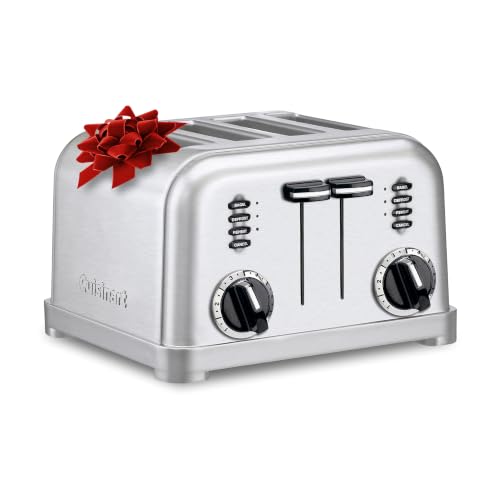
The four-slice problem is rarely capacity; it is diplomacy. One eater wants pale, the other wants dark, and a shared-control four-slice makes someone compromise or wait. The CPT-180P1 solves it with dual independent controls: two pairs of extra-wide slots, each with its own six-setting browning dial, in one brushed stainless body. It suits families, couples with opposite preferences and households that mix bread types at the same breakfast.
Strengths
- Dual independent controls end the shade-preference compromise
- Extra-wide slots across all four positions fit bagels and thick bread
- One appliance replaces the two-batch routine entirely
Trade-offs
- A four-slice footprint claims serious counter space
- Six settings per side, not seven
- Overkill for one- or two-person households with similar tastes
| Slots | 4, extra-wide |
| Controls | Dual independent, 6-setting dials |
| Body | Brushed stainless steel |
Independent controls change how a kitchen runs. Bagels can toast on one side at a bagel-appropriate setting while sandwich bread browns lighter on the other; a parent can run a child’s pale toast alongside their own dark rye without sequencing. In practice, this is the feature owners mention years later, long after they have forgotten the purchase price — the absence of a small daily negotiation.
The body is unapologetically large, as four-slices are, so measure your counter run and be honest about whether the toaster earns permanent residency. If it does, the brushed stainless finish integrates with most appliance suites, and maintenance is the standard tray-and-wipe routine. For the household it fits, no two-slice at any price substitutes; for a single eater, it is counter clutter. The badge is about the match, not the machine alone.
For households with teenagers, the CPT-180’s independence has a second benefit: two people can make different breakfasts simultaneously without a queue, which defuses the school-morning kitchen more effectively than any single feature on this page.
Best for: families and couples with different shade preferences / Not suited for: small counters or single eaters
Check on Amazon — check the current price on Amazon before you decide, because listings and finishes change.
GE 2 Slice Stainless Steel Toaster — Best for Bagels and Frozen Waffles
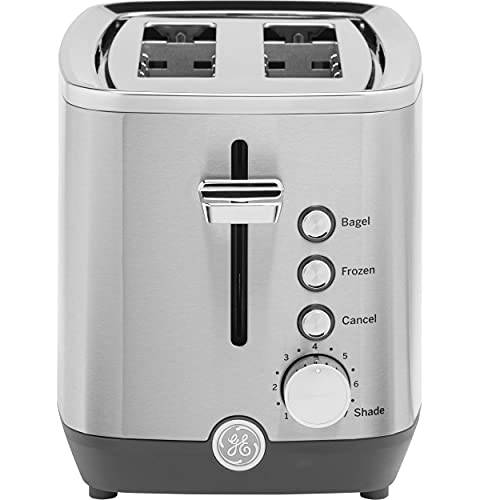
GE’s two-slice is the pick for households whose breakfast is thick and often frozen. Its slots measure 1.38 by 5.50 inches — dimensions the listing states outright — and are described as fitting bagels and waffles; its 1,500 watts is strong for the class; and its seven shade settings pair with a defrost function for freezer-to-table mornings. It suits bagel families, waffle households and anyone who has watched a lesser toaster struggle with a thick slice.
Strengths
- Published slot dimensions take the guesswork out of bagel fit
- 1,500W output handles thick and frozen items with authority
- Seven shades plus defrost cover the full frozen-to-fresh range
Trade-offs
- High wattage plus another appliance can test older kitchen circuits
- Utilitarian GE styling is competent rather than characterful
- Two-slice capacity only
| Slots | 2, measuring 1.38 x 5.50 in. (per Amazon listing title) |
| Power | 1,500 watts |
| Browning settings | 7 shades |
| Functions | Defrost |
| Crumb tray | Removable |
Published dimensions are rarer in this category than they should be, and GE deserves credit for printing them: you can measure your bagels against 1.38 inches of width and know before ordering whether they fit. The 5.50-inch length also swallows long slices that stubbier slots leave pale at the ends. Combined with strong wattage, the result is a toaster that treats thick and frozen items as its home turf rather than edge cases.
The defrost function matters more than its single line on the box suggests — frozen waffles and bread brown more evenly when the cycle starts gently instead of blasting a frozen surface. Seven shades then give you the resolution to land a frozen waffle exactly where your kids want it. If your kitchen’s wiring is elderly, note the combined-draw advice in our mistakes section; otherwise, this is the hardest-working mainstream two-slice in the guide.
Renters should note the GE’s counter-friendly standard footprint: it delivers its power without demanding the residency a four-slice does, and its published specs make it the easiest pick to buy confidently without seeing it in person first.
Best for: bagel and frozen-waffle households that want published specs / Not suited for: buyers seeking a design statement or four-slice capacity
Check on Amazon — check the current price on Amazon before you decide, because listings and finishes change.

Hamilton Beach Gourmet 2 Slice Toaster 22996 — Best Mid-Range Browning Technology
The quiet technical problem in two-slice toasters is the single slice: with one slot empty, many machines brown the lone slice unevenly. Hamilton Beach’s Gourmet line attacks exactly that with its Sure-Toast technology, and wraps it in a complete package — seven shades, extra-wide slots, a bagel setting, Toast Boost for small items and auto shutoff — in a matte black finish. It suits singles and couples who usually toast one or two slices and want them right.
Strengths
- Sure-Toast technology targets even browning, including single slices
- Toast Boost retrieves muffins and small items safely
- Matte black finish hides fingerprints better than stainless
Trade-offs
- Mid-range tier costs more than the budget picks for refinement, not capacity
- Matte finishes can show light-colored crumbs and dust
- Two-slice only
| Slots | 2, extra-wide |
| Technology | Sure-Toast (per Amazon listing title) |
| Browning settings | 7 shades |
| Functions | Bagel setting, Toast Boost, auto shutoff |
| Finish | Matte black |
Single-slice households are the majority of two-slice owners, yet most toasters are tuned as if both slots were always full. A technology aimed at that reality is worth more than a novelty mode you will press twice. In daily terms, the 22996’s pitch is consistency: your one slice on a weekday should match your two slices on a weekend, at the same dial number, without a compensation ritual.
The supporting cast is complete — Toast Boost for the muffin problem, auto shutoff for the distracted-morning problem, a bagel setting for the weekend problem — and the matte black finish suits modern kitchens while hiding the fingerprint evidence. It sits a tier above the budget picks in price positioning, and the refinement is where the money goes. If your breakfast is usually one or two slices and you are tired of uneven results, this is the considered choice.
The matte black Gourmet also coordinates unusually well with modern appliance suites — black refrigerators, black ranges — where a stainless toaster can look like a leftover from a previous kitchen. Finish continuity is a legitimate buying criterion when the appliance lives in view.
Best for: singles and couples who toast one or two slices and want them even / Not suited for: families or buyers who only need basic function at the lowest tier
Check on Amazon — check the current price on Amazon before you decide, because listings and finishes change.
Dualit Classic 4 Slice NewGen Toaster — Best Built to Last for Decades
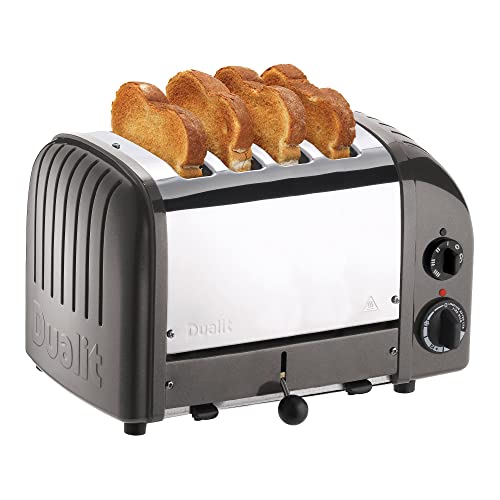
The Dualit Classic is the anti-disposable toaster. It is hand-built in the UK, its ProHeat elements are replaceable rather than sealed in, and its mechanical timer clicks through the cycle with no electronics to fail. Four slots, a defrost function for bread and a stainless body in charcoal make it as practical as it is principled. It suits buyers who keep appliances for decades, repair rather than replace, and want a toaster with genuine presence on the counter.
Strengths
- Replaceable elements make it repairable for the long term
- Mechanical timer — no circuit boards to age out
- Hand-built stainless construction with real heft and presence
Trade-offs
- Premium pricing, several times the mainstream picks
- Mechanical operation means no countdown displays or one-touch programs
- Four-slice footprint and weight demand a permanent counter home
| Slots | 4 |
| Elements | Replaceable ProHeat (per Amazon listing title) |
| Timer | Mechanical |
| Functions | Defrost bread |
| Origin | Hand-built in the UK |
| Finish | Charcoal |
Every other pick in this guide is, eventually, a replacement purchase. The Dualit is designed against that fate: when an element eventually fails, it can be swapped; when the timer wears, it can be serviced. That repairability reframes the price — the relevant comparison is not one Dualit versus one mainstream toaster, but one Dualit versus the three or four mainstream toasters you would otherwise buy across the same decades.
Using it is a tactile pleasure of a different era: a mechanical timer you set and hear, a manual presence that suits slow weekend breakfasts. It defrosts bread, handles four slices, and its slots take thick items well. What it will not do is pamper you with electronics — no lift-and-look, no countdown. Buyers who find that honest will love it for a very long time; buyers who want the Breville’s cleverness should buy the Breville and accept its different lifespan logic.
Dualit ownership includes a small ritual economy: elements and timers are service items, so keep the model’s paperwork and the brand’s service contacts with your appliance documents. Owners who do this routinely report decades of service; the toaster rewards record-keeping like a car does.
Best for: buy-once buyers, repair-minded households and traditional kitchens / Not suited for: budget shoppers or fans of digital convenience features
Check on Amazon — check the current price on Amazon before you decide, because listings and finishes change.
Comparison Table
The six split by philosophy as much as by size: mainstream competence (Cuisinart CPT-160), engineered cleverness (Breville), household diplomacy (CPT-180’s dual controls), published-spec power (GE), single-slice consistency (Hamilton Beach Gourmet) and mechanical permanence (Dualit).
| Pick | Badge | Key spec | Best for |
|---|---|---|---|
| Cuisinart CPT-160P1 2-Slice Metal Classic Toaster | Best Overall | 2 slots at 1.5 in., 6-setting dial, brushed stainless | most couples and small families wanting a dependable everyday toaster |
| Breville BTA720XL ‘A Bit More’ Toaster, 2 Slice | Best Premium 2-Slice | 2 wide slots, ‘A Bit More’ and ‘Lift & Look’, brushed stainless | bread enthusiasts and couples who notice one-shade differences |
| Cuisinart CPT-180P1 4-Slice Toaster | Best 4-Slice for Divided Households | 4 extra-wide slots, dual independent 6-setting controls | families and couples with different shade preferences |
| GE 2 Slice Stainless Steel Toaster | Best for Bagels and Frozen Waffles | Slots 1.38 x 5.50 in., 1,500W, 7 shades, defrost | bagel and frozen-waffle households that want published specs |
| Hamilton Beach Gourmet 2 Slice Toaster 22996 | Best Mid-Range Browning Technology | Sure-Toast technology, 7 shades, Toast Boost, matte black | singles and couples who toast one or two slices and want them even |
| Dualit Classic 4 Slice NewGen Toaster | Best Built to Last for Decades | 4 slots, replaceable ProHeat elements, mechanical timer | buy-once buyers, repair-minded households and traditional kitchens |
How to Choose the Best Kitchen Toasters: Slots, Power and Controls
Slot geometry decides what your toaster can be. Width first: 1.38 to 1.5 inches covers bagels and thick bakery slices; narrower slots limit you to sandwich bread. Length second: long slices from round loaves need either a long slot or a willingness to flip mid-cycle. Count third: two slots for up to three eaters, four for families — with dual controls if your household’s shade preferences differ, because a shared dial on a four-slice is a daily negotiation disguised as a feature list.
Power and controls are about matching, not maximizing. Wattage in the mainstream range handles standard bread easily; higher wattage helps thick and frozen items. Controls should match your mornings: a dial for the half-asleep, a slider or display for the precise, a mechanical timer for the traditional. Every control style appears among the picks above, deliberately.
- Measure your thickest regular bread against published slot dimensions
- Four slices + divided preferences = dual independent controls
- Defrost is a core function if anything you toast comes from the freezer
- High-lift or Toast Boost matters if you toast muffins or mini slices
- Choose the control style you will enjoy using before coffee, not after
Browning Evenness: What Actually Causes It
Evenness comes from three things: element design, slot centering and the bread itself. Self-centering slots hold a slice equidistant from both elements; without them, a leaning slice browns dark on one face. Element coverage determines whether the top of a tall slice keeps pace with its middle. And bread moisture varies — fresh loaves steam, day-old loaves scorch — so no toaster can make every bread behave identically at one setting.
This is why the honest goal is repeatability, not perfection: a good kitchen toaster gives the same result for the same bread at the same setting, cycle after cycle. The Breville’s check-without-cancelling and the Hamilton Beach’s single-slice technology are two different engineering answers to that goal; the Dualit’s answer is mass, simplicity and time-tested geometry. Pick the answer that matches your bread.
Where a Slot Toaster Beats a Toaster Oven (and Vice Versa)
A slot toaster is faster to first bite, smaller on the counter and more energy-efficient for bread alone; its elements are inches from the slice and its cycle is tuned for exactly one job. A toaster oven melts cheese, bakes small items, reheats pizza properly and handles foods no slot can admit. Kitchens with room for one should ask what breakfast actually is: if it is toast, bagels and waffles, the slot toaster wins on speed and simplicity every single morning.
Many kitchens eventually own both, using the slot toaster daily and the oven for everything else — which is why this guide treats them as complements, not rivals. If you are choosing your first, choose by the food you make weekly, not the food you imagine making someday.
Finishes and Placement in a Real Kitchen
Brushed stainless hides crumbs and blends with appliance suites but shows fingerprints; matte black hides fingerprints but shows pale crumbs; colored and retro finishes make the toaster a deliberate accent. None is best — match the maintenance you mind least. Placement matters as much: a toaster needs clearance above its slots, distance from the kettle’s steam path, and a cord route that does not cross its hot top. Under-cabinet placement is common but should leave genuine headroom, because slot heat rises straight into whatever is above it.
Toaster Placement, Circuits and Counter Workflow
A kitchen toaster draws serious current for short bursts, and its placement should respect both electricity and workflow. Put it on the counter run where breakfast actually happens — near the bread storage and the butter, not across the kitchen by the sink. Keep its cord off its own hot top. If it shares a circuit with a kettle, remember the pair can peak together; modern kitchens handle this easily, older ones may prefer the kettle started a minute before the toast drops.
Height clearance deserves a tape measure, not a guess. Slots radiate heat straight up, and low cabinets or shelves above a toaster will discolor and, in bad cases, suffer heat damage over time. If your only counter run sits under low cabinets, pull the toaster forward during use and push it back for storage — a common, sensible compromise in small kitchens.
What the Numbers on a Toaster Listing Really Mean
Wattage is the most quoted and least understood number. Within the mainstream band, wattage differences change speed at the margins, not toast quality; a well-designed 900W toaster beats a sloppy 1,500W one on evenness. Where wattage genuinely helps is thick and frozen loads, which is why the GE’s figure matters for its stated job. Shade-setting counts work similarly: six well-spaced settings beat nine cramped ones. The numbers worth trusting are physical — slot width and length in inches — because you can verify them against your bread with a ruler before the box arrives.
Treat trademarked technology names as hypotheses, not facts. A named browning system is a claim about element control or sensor logic; it earns belief when the brand is accountable and the mechanism is plausible, as with the two named systems among our picks. When a listing stacks five invented-sounding technologies with no model number behind them, you are reading marketing, not engineering — one more reason this guide verifies models before it praises them.
When to Replace a Kitchen Toaster
Replace a toaster when it becomes inconsistent in a way cleaning cannot fix, when the carriage or lever mechanism sticks or fails to latch, when the exterior or cord shows heat damage, or when one element visibly stops glowing — uneven stripes that survive a thorough crumb clean-out are the classic symptom. Do not attempt element repairs on sealed mainstream models; the exception is a toaster designed for service, like the Dualit above, whose elements are replaceable by design.
Age alone is not a reason. A toaster that browns evenly, latches reliably and shows no damage can serve indefinitely, and many do. When you do replace, let the failure teach the purchase: if you outgrew capacity, buy the four-slice; if you fought unevenness, buy the consistency technology; if you hated the controls, buy the other philosophy. The best kitchen toaster is the one chosen from experience, and a replacement is the one purchase where you have plenty.
How to Use Your Kitchen Toaster Like a Pro
Professional results from a home toaster come from calibration and a few habits, not from a more expensive machine. Set up once, then repeat.
- Break in a new toaster with two empty medium cycles in a ventilated kitchen to clear manufacturing residues before food touches it.
- Calibrate per bread: toast one slice of your daily bread at the middle setting, adjust a click at a time, and note the number. Repeat for bagels and any dense loaf you eat weekly.
- Always center slices in their slots; use the second cycle of the day as your reference, since a warm toaster browns darker and more evenly than a cold one.
- Use bagel mode for bagels — it balances heat toward the cut side — and defrost mode for anything frozen rather than double-cycling, which dries bread.
- Retrieve small items with the lift lever or Toast Boost; if an item is truly stuck, unplug the toaster and use wooden tongs, never metal.
- Empty the crumb tray weekly under daily use, and brush out the slots monthly with the toaster unplugged and fully cool.
- Rest thick artisan slices for thirty seconds after toasting; the crumb finishes setting and slices cleaner for sandwiches.
Keep a small notebook or phone note with your three numbers — daily bread, bagels, dense loaf — and every person in the house can produce identical toast. It takes one weekend to build and removes the last inconsistency a good toaster cannot remove for you: human dial-guessing.
Cleaning separates the toasters that age well from the ones that smoke by year two. Beyond the tray, wipe the exterior while it is cool — crumbs and butter aerosols bake onto warm surfaces — and never immerse any toaster or use oven cleaner on it. A soft brush through the slots, appliance unplugged and cool, dislodges what the tray misses. Five minutes a month is the entire contract, and it is cheaper than any replacement on this page.
Common Buying Mistakes
Buying slots by slice count alone. Width and length matter as much as count. A four-slice that cannot fit your bagels is a two-purpose disappointment; check dimensions where listings publish them.
Sharing one shade control across a divided household. If your family argues about toast color weekly, dual independent controls are not a luxury — they are the fix. Sequential batches are the alternative, and they waste the four-slice’s point.
Judging a toaster by its first-ever cycle. New elements and a cold body brown pale. Calibrate from the second cycle and re-check after a week before deciding a machine is inconsistent.
Running the toaster and kettle at peak on an old circuit. Two heating appliances can trip marginal breakers. Stagger starts by a minute; the kettle first, since it takes longer anyway.
Storing things on top of the toaster. Bread bags and papers resting on hot slots are a genuine fire and melting hazard. The top of a toaster is a work surface only for toast.
Ignoring the crumb tray until it smokes. Crumbs scorch, flavor later toast and eventually smoke. Weekly emptying is the entire maintenance contract for most models — honor it.
Final Recommendation
For the median kitchen, the Cuisinart CPT-160P1 remains the toaster to buy: right-sized slots, a simple dial and a body that suits any counter. Bread enthusiasts should step up to the Breville BTA720XL’s problem-solving controls; divided or large households to the dual-control CPT-180P1; bagel-and-waffle families to the GE’s published dimensions and wattage; single-slice perfectionists to the Hamilton Beach Gourmet; and buy-once traditionalists to the Dualit Classic, which may outlast the kitchen it sits in.
Check price on Amazon through the links above on the day you buy, and confirm the finish in the listing title — stainless, matte and color variants are separate listings across this category. If your constraint is money first or length first, the cluster guides below take the same six-slot honesty to the budget and long-slice corners of the category.
Our three first stops: Cuisinart CPT-160P1 — the overall pick; Breville BTA720XL ‘A Bit More’ — the premium two-slice pick; Cuisinart CPT-180P1 4-Slice — the divided-household pick.
Keep reading in this cluster:
- Best Inexpensive Toasters
- Best Long Slice Toasters
- Best Kitchenaid Toasters
- Best Kettles And Toasters
- Best Four Slice Toasters
Frequently Asked Questions
What is the best all-around kitchen toaster for most homes?
A two-slice with wide slots, a simple shade dial and a removable crumb tray — the Cuisinart CPT-160P1 profile. It covers daily bread, bagels and frozen items without costing premium money or counter space. Step up only when a specific need — four slices, divided preferences, artisan loaves — points at a specific pick.
Is a four-slice toaster worth the counter space?
For households of four, or two eaters with different shade preferences (with dual controls), yes — it removes a daily bottleneck. For one or two similar-taste eaters, it is mostly furniture. Measure your counter and be honest about residency before buying.
Why does toast brown darker in the second cycle?
The elements and body are already hot, so the same setting delivers more total heat. This is normal physics in every toaster; calibrate your number on the second cycle and, for a single first slice, consider one click lighter.
Do I need a defrost function?
If anything you toast comes from the freezer — waffles, bread stored frozen, bagels — yes. Defrost cycles start gently so the interior thaws before the surface browns, which a plain second cycle cannot do without drying the item out.
How long should a kitchen toaster last?
A mainstream model with daily use and basic crumb care should serve for years. The repairable exception is the Dualit model in this guide, whose replaceable elements are designed to extend service across decades — the reason it costs what it does.
Slot toaster or toaster oven for a small kitchen?
If breakfast is toast-shaped, the slot toaster: faster, smaller, cheaper to run. If you regularly melt, bake or reheat flat foods, the oven earns its larger footprint. Many small kitchens do best with a slot toaster plus a microwave, and skip the oven entirely.
What does ‘extra-wide slot’ actually mean in numbers?
Look for published dimensions where brands give them — around 1.38 to 1.5 inches of width covers standard bagels and thick bakery slices. If a listing only says ‘wide’ with no number and no bagel claim, treat the claim cautiously and measure your bread before ordering.
Can a kitchen toaster sit under my cabinets?
Only with real clearance above the slots and ideally pulled forward while toasting. Heat rises directly from the slots; cabinets immediately above will age fast and collect grease-laden steam. When in doubt, give the toaster open air — it is the cheapest insurance in this guide.
Are expensive toasters actually better, or just prettier?
Both, in different proportions by model. Premium money buys mechanism — self-centering slots, finer controls, check-without-cancelling features, repairable construction — before it buys looks. Whether that mechanism matters depends on your bread and your standards: sandwich-bread households will taste little difference, while thick artisan loaves expose every single shortcut a cheap toaster took.


