Disclosure: airfryerkitchensupply.com is reader-supported. When you buy through links on our site, we may earn an affiliate commission at no extra cost to you.
Where to buy
If you are shopping for the best kitchen stand mixers, start with this verified shortlist. Every machine below was verified as a current Amazon listing before a link was attached. We do not print prices — they move too often to be trustworthy in print — so each pick links to its live listing where you can check price on Amazon and confirm the exact colour and bundle before buying.
- KitchenAid Artisan 5-Qt Tilt Head Stand Mixer KSM150PS — Best Overall: check price on Amazon.
- KitchenAid 7 Quart Bowl-Lift Stand Mixer KSM70 — Best for Bread and Big Batches: check price on Amazon.
- Cuisinart Stand Mixer SM-50 — Best Mid-Range Alternative: check price on Amazon.
- Ankarsrum AKM6230 Assistent Original — Best for Serious Dough: check price on Amazon.
- Hamilton Beach Classic Stand and Hand Mixer — Best Budget Flexibility: check price on Amazon.
- SMEG SMF04 Classico Stand Mixer — Best Design-Led Mixer: check price on Amazon.
Stand mixers are sold in colour and bundle variants that share one model number. When you follow a link, confirm the listing title still matches the model named here; if a variant bundles extra tools, that is a bonus, not a different machine.
Choosing among the best kitchen stand mixers is really choosing a mixing philosophy. A stand mixer is the one appliance most home bakers keep for a decade or more, so the decision is less about this month’s recipes and more about how you bake across years: the tilt-head you can thread a spatula into without thinking, the bowl-lift that shrugs at stiff dough, the design-led machine that earns its counter space even when idle. This guide compares the strongest current examples of each philosophy, all verified as live listings.
The field divides into three honest camps. KitchenAid remains the default for most buyers, not because rivals are bad, but because its two platforms — tilt-head and bowl-lift — are proven, its attachment hub is an ecosystem no one else matches, and its parts pipeline is measured in decades. Cuisinart and Smeg compete on features and design respectively, offering more in the box or more beauty on the counter. And a small group of specialists, led by Ankarsrum, rejects the planetary formula entirely in favour of a rotating bowl that treats dough more gently.
We picked six machines that each win a real category rather than six near-identical mid-range models. If you bake weekly bread, your answer is here; if you bake birthday cakes and want the counter to look good doing it, your answer is also here — they are just different machines, and the badges say which is which without ambiguity.
In this guide
Quick Picks
Start with the badge that matches your baking life. Every machine here is good; they are good at different things, and the quick picks are written to route you to the right review first.
- Best Overall — KitchenAid Artisan 5-Qt Tilt Head Stand Mixer KSM150PS: the benchmark: a 5-quart tilt-head with ten speeds, a pouring shield in the box and the deepest attachment ecosystem in home baking.
- Best for Bread and Big Batches — KitchenAid 7 Quart Bowl-Lift Stand Mixer KSM70: a 7-quart bowl-lift with eleven speeds, a dedicated half-speed for folding and a double flex-edge beater among five accessories.
- Best Mid-Range Alternative — Cuisinart Stand Mixer SM-50: twelve speeds, a 5.5-quart bowl and a complete tool set including splash guard — the strongest non-KitchenAid value in the category.
- Best for Serious Dough — Ankarsrum AKM6230 Assistent Original: the Swedish rotating-bowl design that kneads like nothing else here — the dough specialist’s machine, covered for its unique working method.
- Best Budget Flexibility — Hamilton Beach Classic Stand and Hand Mixer: a 4-quart stand mixer whose head detaches to work as a hand mixer — two appliances in one footprint, with QuickBurst for stubborn moments.
- Best Design-Led Mixer — SMEG SMF04 Classico Stand Mixer: 1950s styling over a 600W planetary platform with smooth start and a steady-mix system — the mixer as kitchen centrepiece that still does the work.
How These Picks Were Chosen
Verification came first: each model was matched against Amazon’s catalogue, title to model, and only confirmed listings received links. That process matters in this category because stand mixers accumulate near-identical variants — colours, bundles, retailer exclusives — and an unverified roundup can easily link you to last year’s trim or a marketplace lookalike.
Judgement came second, and it rested on four pillars. Mixing geometry: planetary action, where the tool orbits the bowl, versus rotating-bowl designs, judged on how completely they incorporate ingredients. Load behaviour: how the frame, hinge or lift copes with stiff dough over minutes, not seconds. Ecosystem: attachments, extra bowls and replacement tools you can actually buy later. And daily ergonomics: bowl handling, head clearance, cleaning, and whether the machine invites use or demands ceremony.
We also weighted honesty of positioning. A machine marketed for everything but built for batter scored lower than a machine that knows its job. The result is a list where the budget pick is genuinely recommendable, the design pick is genuinely capable, and the overall pick is the one we would hand to a friend without a follow-up text of caveats.
The 6 Best Kitchen Stand Mixers
The order reflects how broadly each machine serves a typical home baker, from the most universal to the most specialised. Specialised is not a demotion — the last pick here is the best dough machine in the guide.

KitchenAid Artisan 5-Qt Tilt Head Stand Mixer KSM150PS — Best Overall
The Artisan is for the baker who wants the question settled. It handles the full home repertoire — cakes, cookies, frosting, whipped cream, moderate bread — with a calm competence that has made this platform the reference point rivals are measured against. If you bake a bit of everything and want one machine for the long term, this is the centre of the category.
Strengths
- Balanced 5-quart size suits most home batch patterns
- Pouring shield included for flour-heavy mixing
- Attachment hub opens the full KitchenAid accessory range
Trade-offs
- Tilt-head hinge flexes slightly under very stiff dough
- Premium pricing versus feature-led rivals
- Popular colours sell out and restock unevenly
| Specification | Detail |
|---|---|
| Bowl capacity | 5 quart (from Amazon listing title) |
| Design | Tilt-head |
| Speeds | 10 |
| Included extra | Pouring shield |
| Colour verified | Contour Silver |
What the Artisan gets right is proportion. Five quarts is the bowl size that matches how people actually bake: a full cake, a double cookie batch, a single generous loaf. Ten speeds cover the useful range without theatre, the first speed is slow enough to fold, and the planetary action keeps the bowl’s contents moving so you scrape once, not constantly. The included pouring shield sounds minor until your first high-flour mix, when it keeps the counter — and your lungs — out of the recipe.
Long-term, the Artisan’s case is the ecosystem and the service network. Extra bowls, flex-edge beaters, pasta and grinding attachments, replacement tools: all exist, all fit, all will still exist when a rival brand has moved on to a new platform. Among stand mixers, boring reliability compounds like interest, and that is why this machine, rather than any flashier rival, takes the overall badge.
Best for: the majority of home bakers wanting one proven, versatile, long-lived mixer / Not suited for: high-volume bread specialists who should look at bowl-lift or rotating-bowl designs
Check the current price on Amazon for the KitchenAid Artisan 5-Qt Tilt Head Stand Mixer KSM150PS — our Best Overall pick in this guide.

KitchenAid 7 Quart Bowl-Lift Stand Mixer KSM70 — Best for Bread and Big Batches
This is the KitchenAid for households that bake like small bakeries: multiple loaves, double and triple batches, holiday production runs. The bowl-lift frame and 7-quart bowl are built for sustained, heavy work, and the accessory bundle is the richest KitchenAid includes at this level.
Strengths
- 7-quart capacity for serious batch scaling
- Half-speed setting folds delicate mixtures properly
- Double flex-edge beater scrapes while it mixes
Trade-offs
- Large, tall and heavy — measure cabinet clearance first
- Overkill for small, occasional batches
- Premium tier pricing within the KitchenAid range
| Specification | Detail |
|---|---|
| Bowl capacity | 7 quart (from Amazon listing title) |
| Design | Bowl-lift |
| Speeds | 11, including 1/2 speed for folding |
| Included tools | Double Flex Edge Beater and 4 other accessories, per Amazon listing title |
| Colour verified | Cast Iron Black |
The KSM70’s party trick is range. At the top end it has the bowl and the rigid lift frame to knead dough for several loaves without the head-flex that afflicts tilt-heads; at the bottom end, its half speed does something most powerful mixers cannot — fold beaten egg whites or whipped cream into a base without knocking the air out. Big mixers usually punish small, delicate jobs; this one was clearly engineered not to.
The accessory bundle deserves its own sentence: five tools including the double flex-edge beater means the box contains the beater most owners of lesser trims end up buying separately. Factor that into any price comparison. If your baking life is high-volume but still home-based, this is the ceiling of the sensible — beyond it lies commercial equipment with commercial compromises.
Best for: prolific home bakers, bread makers and large households / Not suited for: small kitchens, small batches or buyers who will never use the capacity
Check the current price on Amazon for the KitchenAid 7 Quart Bowl-Lift Stand Mixer KSM70 — our Best for Bread and Big Batches pick in this guide.
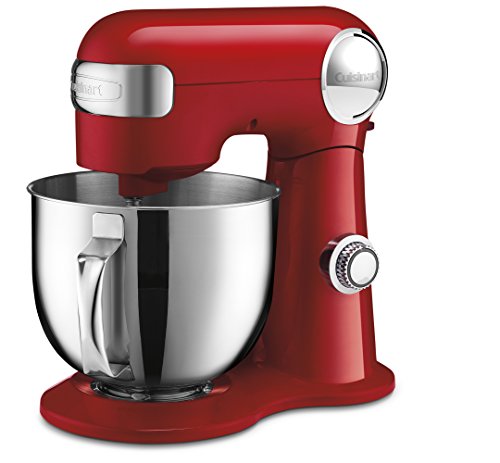
Cuisinart Stand Mixer SM-50 — Best Mid-Range Alternative
Choose the SM-50 if you like the Artisan’s job description but want more equipment in the box and a slightly bigger bowl for the money. It suits cake, batter and cream bakers especially, and households that would rather spend the difference on ingredients than on a badge.
Strengths
- 12 speeds with gentle low-end control
- Complete bundle: whisk, paddle, hook and splash guard
- 5.5-quart bowl beats the Artisan on capacity
Trade-offs
- Smaller attachment ecosystem than KitchenAid
- Frame less rigid under sustained heavy dough
- Fewer colour and trim options
| Specification | Detail |
|---|---|
| Bowl capacity | 5.5 quart stainless steel (from Amazon listing title) |
| Speeds | 12 |
| Included tools | Chef’s whisk, mixing paddle, dough hook, splash guard with pour spout |
| Colour verified | Ruby Red |
Cuisinart’s SM-50 is the rationalist’s mixer. On paper it out-specs the Artisan — bigger bowl, more speeds, fuller box — and in batter work it delivers on the paper: the low speeds are genuinely gentle, the splash guard’s pour spout is the best-shaped in the class, and the whisk produces excellent meringue volume. For the cake-centred baker, it is not a consolation prize; it is arguably the better tool.
The gap appears at the extremes: sustained stiff dough works the frame harder than a KitchenAid, and the accessory shelf at any retailer tells the ecosystem story in one glance. Neither matters if your baking is batter-led. Buy the SM-50 for what it is — the category’s best-equipped mid-range machine — and it will reward you every time you open the box instead of an accessories page.
Best for: cake and batter bakers who want maximum equipment per dollar / Not suited for: attachment collectors or heavy daily dough work
Check the current price on Amazon for the Cuisinart Stand Mixer SM-50 — our Best Mid-Range Alternative pick in this guide.
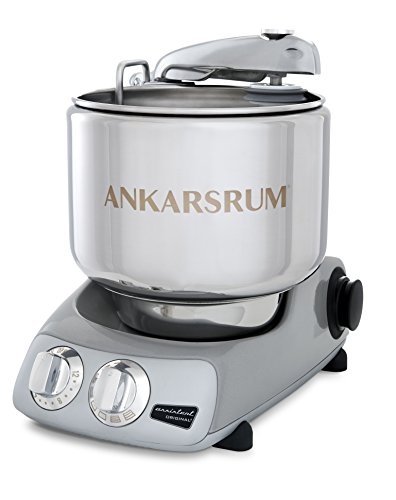
Ankarsrum AKM6230 Assistent Original — Best for Serious Dough
The Ankarsrum is for bakers whose centre of gravity is dough: sourdough devotees, bagel and pizza makers, anyone who has burned out a conventional mixer on wholegrain. Its bowl rotates while a scraper and roller or hook work the dough, mimicking hand-kneading more closely than any planetary machine.
Strengths
- Rotating-bowl action develops dough gently and thoroughly
- Very large effective dough capacity for a home machine
- Long-standing Swedish design with a devoted user base
Trade-offs
- A learning curve unlike any other mixer here
- Less intuitive for creaming butter and sugar
- Premium, specialist pricing; accessories are their own ecosystem
| Specification | Detail |
|---|---|
| Model | AKM6230, per Amazon listing title |
| Design | Rotating bowl (manufacturer’s Assistent platform) |
| Colour verified | Jubilee Silver |
Every other machine in this guide beats ingredients around a fixed bowl. The Ankarsrum turns the bowl itself, pressing dough against a roller with a scraper keeping the sides clean, and the difference with high-hydration and wholegrain doughs is not subtle: development is even, the dough stays cooler, and the machine works large quantities without the protest noises planetary mixers make. Bakers who switch for dough rarely switch back.
The honesty paragraph: creaming and whipping happen in a separate plastic bowl with different tools, the workflow must be relearned, and the first week frustrates almost everyone. This is a specialist’s instrument that happens to do general work, not a generalist that does dough. If dough is your religion, it is the best machine here. If dough is a hobby within baking, the KSM70 serves you better.
Best for: dedicated bread and dough bakers working at volume / Not suited for: beginners, cake-first bakers or anyone who dislikes relearning technique
Check the current price on Amazon for the Ankarsrum AKM6230 Assistent Original — our Best for Serious Dough pick in this guide.
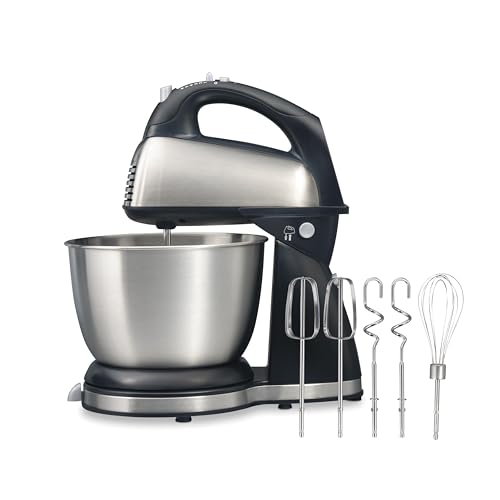
Hamilton Beach Classic Stand and Hand Mixer — Best Budget Flexibility
This hybrid suits small kitchens and modest budgets where one appliance must cover both worlds: stand mixing for cakes and doughs, hand mixing for a quick bowl of frosting or mashed potatoes at the stove. First-apartment bakers and occasional bakers get the most from it.
Strengths
- Detachable head works as a full hand mixer
- Bowl Rest feature stabilises the hand unit on the bowl edge
- QuickBurst adds a power surge on any speed
Trade-offs
- 290 watts peak is modest for heavy dough
- Stand stability below the dedicated machines here
- Plastic-forward construction at this price
| Specification | Detail |
|---|---|
| Bowl capacity | 4 quart (from Amazon listing title) |
| Speeds | 6, with QuickBurst |
| Motor | 290 watts peak power, per Amazon listing title |
| Design | Stand mixer with detachable hand mixer head |
| Colour verified | Black and Stainless |
The hybrid concept survives because it solves a real problem: most households need stand-mixer hands-free mixing occasionally and hand-mixer convenience constantly. Hamilton Beach’s execution is the proven one — the head locks onto the stand for planetary-style work with a 4-quart bowl, then lifts off for the saucepan and the small bowl jobs a stand mixer cannot reach. The Bowl Rest notch, which parks the hand unit on the bowl rim mid-recipe, is a small feature you will use every session.
Compromises are structural: the stand is lighter, the motor is rated in peak watts, and stiff dough is an occasional guest rather than a resident. Within its brief — flexible, affordable, space-saving — it is the budget pick we can recommend without crossing our fingers, which is more than most of its price class can claim.
Best for: small kitchens, first homes and bakers who want stand and hand mixing in one purchase / Not suited for: frequent bread bakers or anyone wanting a lifetime-heirloom machine
Check the current price on Amazon for the Hamilton Beach Classic Stand and Hand Mixer — our Best Budget Flexibility pick in this guide.

SMEG SMF04 Classico Stand Mixer — Best Design-Led Mixer
Buy the Smeg if your mixer will live on the counter permanently and you want it to look like it belongs in a design magazine while performing like a real appliance. It suits style-conscious bakers whose workload is cakes, creams and moderate doughs — the majority of home baking.
Strengths
- Distinctive retro design in a category of lookalikes
- Smooth Start reduces flour clouds and splashes
- 600W motor with planetary action and a 5-quart bowl
Trade-offs
- You pay a real premium for the design
- Accessory range is narrower than KitchenAid’s
- Gloss finishes show every fingerprint and splash
| Specification | Detail |
|---|---|
| Bowl capacity | 5 quart stainless steel (from Amazon listing title) |
| Speeds | 10 |
| Motor | 600W, per Amazon listing title |
| Features | Smooth Start and Steady Mix System, per Amazon listing title |
| Colour verified | Cream |
It is easy to dismiss design-led appliances until you live with one. A mixer that pleases you earns counter space; counter space earns use; use is the entire point. Smeg’s SMF04 backs the styling with substance — a 600W motor, ten speeds, planetary mixing and a smooth-start system that ramps up gently instead of detonating your flour. In batter and cream work it performs at the level its price implies.
Where the premium stops paying is heavy dough and accessories: the platform is capable but not the one to choose for weekly stiff loaves, and the attachment shelf is a boutique compared with KitchenAid’s department store. As a design statement that genuinely bakes, though, nothing else in this guide is close, and for the right kitchen that is a legitimate engineering brief, not vanity.
Best for: design-conscious bakers with counter space and a batter-led repertoire / Not suited for: budget buyers, heavy dough work or attachment-driven cooking
Check the current price on Amazon for the SMEG SMF04 Classico Stand Mixer — our Best Design-Led Mixer pick in this guide.
Comparison Table
Six machines, three design philosophies. The table strips each to its badge, its defining specification and its natural owner.
| Pick | Badge | Key spec | Best for |
|---|---|---|---|
| KitchenAid Artisan 5-Qt Tilt Head Stand Mixer KSM150PS | Best Overall | 5-qt tilt-head, 10 speeds, pouring shield included | the majority of home bakers wanting one proven, versatile, long-lived mixer |
| KitchenAid 7 Quart Bowl-Lift Stand Mixer KSM70 | Best for Bread and Big Batches | 7-qt bowl-lift, 11 speeds plus half speed | prolific home bakers, bread makers and large households |
| Cuisinart Stand Mixer SM-50 | Best Mid-Range Alternative | 5.5-qt, 12 speeds, full tool bundle | cake and batter bakers who want maximum equipment per dollar |
| Ankarsrum AKM6230 Assistent Original | Best for Serious Dough | Rotating-bowl dough specialist | dedicated bread and dough bakers working at volume |
| Hamilton Beach Classic Stand and Hand Mixer | Best Budget Flexibility | 4-qt 2-in-1, 6 speeds, 290W peak | small kitchens, first homes and bakers who want stand and hand mixing in one purchase |
| SMEG SMF04 Classico Stand Mixer | Best Design-Led Mixer | 5-qt planetary, 10 speeds, 600W, retro design | design-conscious bakers with counter space and a batter-led repertoire |
Notice what the table cannot show: ecosystem depth and service life, which is why the Artisan leads despite rivals out-speccing it in places. A stand mixer is a ten-year purchase; buy the platform, not just the machine.
How to Choose the Best Kitchen Stand Mixers for Your Baking Life
Begin with an honest census of your last twenty baking sessions. Count how many were dough, how many were batter and cream, and how many were big. That census, not a showroom impression, should pick your machine: dough-heavy points to bowl-lift or the Ankarsrum; batter-heavy points to tilt-heads with gentle low speeds; big-batch points to 6 quarts and above. Most buyers discover they are batter bakers with dough ambitions, and the correct purchase for that person is a strong tilt-head, not a dough specialist that will frustrate their cakes.
Then interrogate the platform questions. Does the brand sell a second bowl, a flex-edge beater, the attachments you foresee? What does a replacement whisk cost, and can you buy one in five years? Stand mixers fail slowly — a worn tool here, a cracked bowl there — and the brands that support old machines turn those moments into purchases instead of replacements. This is the unglamorous core of the KitchenAid advantage and the first thing to check on any alternative.
Finally, fit the machine to the room. Measure the counter-to-cabinet gap with the head tilted or the bowl lifted, allow for the bowl’s removal path, and decide honestly whether it lives out or gets stored — a stored mixer must be light enough that you actually fetch it. The best kitchen stand mixer is the one whose size, weight and workflow disappear into your routine.
Planetary, Bowl-Lift and Rotating Bowl: The Three Mixing Geometries Explained
Planetary mixing moves the tool on two axes at once — spinning while orbiting — so a single beater covers a fixed bowl thoroughly. It is the dominant geometry because it does everything reasonably: creaming, whipping, mixing, moderate kneading. Tilt-head and most bowl-lift machines both use it; the difference between them is frame rigidity, not mixing action.
Bowl-lift design keeps the same planetary tools but mounts them on a fixed head, raising the bowl to meet them. The gain is stability under torque: no hinge, no flex, less walking on the counter. The loss is access — you work around the head rather than into an open bowl — and height. Rotating-bowl design, the Ankarsrum way, abandons the orbiting tool: the bowl turns, and a roller, knife or hook works the contents against the bowl wall. For dough development it is superb; for aeration tasks it needs its second bowl and whisk setup. Choose geometry by your dominant task, and the rest of the spec sheet falls into place.
Speeds, Watts and Other Numbers That Mislead Mixer Shoppers
Speed counts are the most inflated number in this category. What matters is the character of the lowest speed — can it fold flour without a cloud, stir without splashing — and the honesty of the highest for whipping. Ten well-spaced speeds outperform twelve crowded ones, and features like the KSM70’s half speed or Smeg’s Smooth Start are worth more than extra notches at the top.
Wattage misleads differently: it measures electrical consumption, not torque at the beater, and gearing decides how much of that power becomes useful work. A lower-wattage machine with metal gears and sensible gearing can out-knead a higher-wattage machine built down to a price. Use watts only to compare within a brand’s own range, and let dough behaviour in reviews — including this one — carry the real verdict.
How Stand Mixers Age: The Five-Year View Nobody Puts on the Box
A stand mixer’s first month tells you almost nothing about its fifth year, and since this category is bought for the fifth year, it is worth describing what age actually does to these machines. The hinge or lift mechanism accumulates the most honest wear: thousands of small flexes under load slowly loosen tolerances, which is why bowl-lift frames and metal tilt-head hinges age more gracefully than budget hinges asked to do flagship work. Gears wear by load history rather than by calendar — a machine that kneaded weekly carries a different fifth year from one that creamed butter — and the brands with deep parts pipelines turn that wear into a service event instead of a replacement event.
Cosmetics age separately and matter more than buyers admit. Enamel chips at bowl rims, plastic trim yellows, and the machine that lives on the counter is looked at ten thousand times between uses. This is the unspoken logic behind both the Artisan’s conservative design and the Smeg’s expressive one: both are built to be looked at for a decade, in opposite dialects. When you choose among the machines in this guide, you are choosing a five-year relationship with a heavy object in your kitchen’s most visible square foot — weight that knowledge accordingly, alongside torque and capacity.
Mixing Science in Plain Language: Why Geometry Beats Horsepower
Stand mixer marketing leads with watts because watts are easy to print; bakers should lead with geometry because geometry is what touches the food. Planetary action works because the beater’s orbit keeps repositioning the tool through the mixture, so every part of the bowl’s contents is visited repeatedly — the same reason stirring a pot in a wandering pattern beats stirring it in one circle. The quality differences between planetary machines are differences of coverage and clearance: how close the tool passes to the bowl’s wall and floor, and whether that clearance survives years of use or drifts until a permanent unmixed layer forms at the bottom.
Rotating-bowl and bottom-drive designs attack the same problem from the other side, moving the food past the tool instead of the tool through the food, which is why their dough development feels different in the hand of the finished loaf: more folding, less tearing. None of these geometries is magic, and a well-made machine of any type outmixes a badly made one of the fashionable type. But when two machines in this guide cost similar money, the one whose geometry matches your dominant mixture — dough, batter or cream — will feel like the more powerful machine every single day, whatever the motor plate says.
The Attachment Decision: Planning Your Mixer’s Second Career
Somewhere in year two or three, many stand mixer owners discover the machine’s second career: the hub-driven attachments that turn a mixer into a pasta studio, a grinder, a slicer or an ice-cream maker. Planning for that career at purchase time is the difference between an ecosystem and an orphan. KitchenAid’s hub is the industry’s deepest, with first-party and third-party tools spanning decades of models, which is a structural reason — not a sentimental one — for its dominance in this guide. Cuisinart and Smeg offer smaller ranges; the Ankarsrum and Hamilton Beach hybrid live in their own accessory worlds entirely.
The planning questions are concrete. Which three attachments do you genuinely foresee — not admire, foresee? Are they made for the platform you are buying, by the manufacturer or by reputable third parties? What do they cost as a set, added to the machine’s price, and does that total change which machine you should buy? A cheaper mixer plus its three attachments can cost more than a flagship whose bundle or broader market keeps accessory prices competitive. Run that arithmetic before the first purchase, and your mixer will still be growing in year five instead of being replaced by its own ambitions.
A Note on Colour, Bundles and Buying the Exact Machine in This Guide
Stand mixers are the most colour-fragmented category in the kitchen: a single model may appear in a dozen finishes, several retailer-exclusive bundles and seasonal trims, all sharing one platform and one model code. That fragmentation is why this guide names model codes in every heading and instructs you to match the code on the listing before anything else. A bundle that adds a second bowl or a flex-edge beater to the machine reviewed here is the same machine wearing a better kit, and is often the smarter purchase; a listing whose code differs, however similar the photograph, is a different machine that this guide has not reviewed. Buy the code, then enjoy the colour — in that order, and the fragmentation becomes a benefit rather than a trap, because it lets a decade-long appliance also be a considered piece of your kitchen’s design.
The same discipline applies to the photographs in any listing: finishes photograph differently under showroom light, bundles are staged with accessories that may not be included, and the only reliable inventory of a box is its written contents list. Read that list against the review you are following, confirm the bowl and tools named there appear in it, and the machine that arrives will be the machine this guide reviewed — which is, after all, the entire point of verifying anything.
The Verdict Behind the Verdicts: How This Guide’s Ranking Would Change for You
Rankings in a guide like this one are arguments, not measurements, and an honest guide should show its working so readers can re-run the argument with their own weights. Ours weighted versatility first, which is why the Artisan leads: it is the machine with the fewest situations in which it is the wrong tool. Weight dough above all else and the ranking inverts at the top — the Ankarsrum and the KSM70 become the story and the Artisan becomes the safe, slightly dull alternative. Weight the counter’s appearance, in a kitchen where the machine is furniture, and the Smeg’s case strengthens beyond what its specifications alone would earn. Weight the next decade’s parts and attachments, and the KitchenAid pair separate from the field entirely.
This transparency is deliberate, because the reader’s weights are the ones that will be lived with. What should not change under any weighting is the verification discipline underneath the ranking: every machine here exists as the listing it claims to be, every specification quoted came from that listing, and every limitation is stated where its machine is praised. A ranking you can re-weight is useful; a ranking built on unverified machines would not be worth re-weighting at all. Choose your weights, re-read the two or three reviews they elevate, and buy the machine your own argument selects — that process, more than any single badge in this guide, is what a good purchase looks like.
Stand Mixer Workflow: Mise en Place for Machine Baking
Stand mixers reward the cook who treats them as a station rather than an event, and the core habit is mise en place — everything weighed, measured and within reach before the motor starts. Machine baking moves faster than hand baking at the moments that matter: once flour meets liquid, the clock on gluten and leavening is running, and the baker who is still hunting for the baking powder is losing the batch’s best minutes. Weighing dry ingredients into one bowl and wet into another, with butter softening beside the machine, converts a stand mixer session from a series of interruptions into a single flowing operation — which is, not coincidentally, when the machine’s hands-free advantage is actually realised.
The second habit is sequencing bowls and tools like a professional: dry goods measured into the mixing bowl last, tools staged in the order the recipe uses them, a scraper and a small bowl for eggs waiting at the machine’s elbow. None of this requires equipment beyond a scale and a routine. What it produces is the experience stand mixers promise in advertisements and deliver only to organised kitchens: the baker conducting, the machine working, and the gap between recipe and result closing to almost nothing.
What to Do in the First Week: A New Owner’s Checklist That Pays for Years
The first week with a stand mixer sets patterns that persist for the machine’s life, and five small acts in that week repay themselves for a decade. Register the warranty and photograph the model label; both are trivial now and invaluable in year six. Run the beater-clearance check and adjust it before the first real recipe rather than after the first badly mixed one. Make one deliberately varied test session — a batter, a whip, a moderate dough — while the return window is open, because a machine that is wrong for your baking will tell you so in that session and in no other way.
Then start the two habits that separate ten-year machines from three-year ones: a recipe notebook note, even one line per bake, recording batch size and how the machine handled it; and a cleaning reset — ninety seconds of wiping the head, hub and hinge — after every session rather than a monthly excavation. Finally, price the second bowl and the flex-edge beater for your model while the purchase is fresh, even if you buy them later: knowing what your platform’s growth costs, in real numbers, turns future accessory decisions from surprises into plans.
How to Set Up and Use a Stand Mixer Correctly From Day One
A stand mixer rewards ten minutes of setup with years of better results. Do these steps in order when yours arrives, and repeat the clearance check whenever you change tools or bowls.
- Place the mixer on a level, stable surface with the ventilation unobstructed, and measure the head-tilt or bowl-lift clearance against your cabinets before the first use
- Fit the bowl until it locks or seats fully — a bowl that is almost seated will announce itself loudly mid-mix
- Check beater clearance: the flat beater should pass just above the bowl bottom; use the manufacturer’s adjustment if it scrapes or floats
- Run the empty machine through every speed once, listening for grinding or surging that would justify an immediate exchange
- Start every recipe at the lowest speed, add dry ingredients gradually, and let the planetary action work before increasing speed
- For dough, stay at the designated low dough speed, work in the manufacturer’s batch range, and rest the dough ten minutes mid-knead for easier development
Day-to-day, wipe the machine after use rather than weekly — dried batter in the hinge and hub area is the main source of ‘old mixer’ smells and stiff controls. Keep the hub cap clean if you use attachments, and store tools in the bowl only with a cloth between metal surfaces to protect the bowl’s finish. None of this is glamorous; all of it is why some ten-year-old mixers look and run like new ones.
Common Buying Mistakes
- Choosing by colour and speed count instead of by mixing geometry and batch size
- Buying a dough specialist for a cake-led kitchen, or a design piece for a dough-led one
- Skipping the cabinet-clearance measurement and discovering the fit problem after unboxing
- Overloading the bowl because the capacity number sounds generous — working capacity for dough is always less than the bowl’s brim volume
- Never buying the second bowl or flex-edge beater that would transform back-to-back baking days
- Storing the mixer in a low cupboard despite its weight, then quietly stopping baking
The unifying mistake is buying the machine as an object rather than as a routine. The right stand mixer is the one that fits your counter, your batches and your patience — and then gets out of your way for a decade.
Final Recommendation
For most readers the answer is the KitchenAid Artisan: balanced, proven and supported like nothing else in the category. Step up to the KSM70 if your batches are big or your dough is serious, step sideways to the Cuisinart SM-50 if you want the fullest box for the money, and consider the Ankarsrum only if dough is truly your main event. The Hamilton Beach hybrid and the Smeg prove that budget and beauty can each be legitimate briefs when the machine is honest about its limits.
Check the current price on Amazon for the model you choose, confirm the colour and bundle on the listing, and measure your cabinets one last time. Then bake something. Related guides below cover the budget tiers and the large-bowl specialists in more depth.
Short on time? Start with the KitchenAid Artisan 5-Qt Tilt Head Stand Mixer KSM150PS, KitchenAid 7 Quart Bowl-Lift Stand Mixer KSM70, Cuisinart Stand Mixer SM-50 — check price on Amazon for each and compare the current bundles before you decide.
Best Kitchen Mixers Under $300 Best Kitchen Stand Mixers Under $100 Best Kitchenaid Mixers For Cooks Best Kitchenaid Professional Mixers Best Large Bowl Mixers
Frequently Asked Questions
What is the best stand mixer for most people?
The KitchenAid Artisan 5-quart tilt-head is the safest all-round recommendation: balanced capacity, ten speeds, an included pouring shield and the deepest attachment and parts ecosystem in the category. Bakers with specialised needs should follow the badges in this guide instead.
Is a bowl-lift mixer better than a tilt-head?
For heavy dough and large batches, yes — the fixed head and clamped bowl are more stable. For everyday batter work and easy bowl access, tilt-heads are friendlier. Neither is better in the abstract; your dominant baking task decides.
How long should a stand mixer last?
A well-built machine from the established brands should serve a decade or more of home use, which is why parts availability and replacement tools matter so much at purchase. Budget hybrids are built to a shorter horizon and priced accordingly.
Do I need more than 5 quarts?
Only if your batches say so. Five quarts covers most home recipes including double cookie batches. Regular multi-loaf baking or very large households justify 6 to 7 quarts; smaller households often mix small quantities better in 3.5 to 4.5-quart bowls.
Are expensive designer mixers worth it?
If the machine lives on your counter and its look makes you use it more, the premium buys something real — and the Smeg in this guide performs properly beneath the styling. If it will live in a cupboard, spend the difference on capacity or attachments instead.
Can a stand mixer replace a hand mixer completely?
Almost. A stand mixer cannot reach into a saucepan on the stove or whip two egg whites in a small jug comfortably. Many households keep an inexpensive hand mixer alongside; the Hamilton Beach hybrid in this guide exists precisely for those who want one purchase to cover both.


