Disclosure: airfryerkitchensupply.com is reader-supported. When you buy through links on our site, we may earn an affiliate commission at no extra cost to you.
Where to buy
Every verified pick in this guide to the best kitchen faucets for house with low water pressure is sold through Amazon, where you can check price on Amazon and compare finishes and configurations side by side before ordering. Listings change configurations over time, so confirm the exact model number, finish and hole count on the product page before you check out. The shortlist below is the fastest route in:
- Delta Finnridge Brushed Nickel — Best Overall for Whole-House Low Pressure: check price on Amazon
- GIMILI Commercial Pull-Down — Best for Well-Water Homes: check price on Amazon
- Moen Arbor 7594SRS — Best Boost Mode for Big Houses: check price on Amazon
- Moen M-Dura 8287 — Best Stated-Flow Commercial Pick: check price on Amazon
- KRAUS Bolden KPF-1610SFS — Best Heavy Build for Weak Supply: check price on Amazon
- Moen Essie 87014SRS — Best Mainstream House-Wide Choice: check price on Amazon
Searching for the best kitchen faucets for house with low water pressure means your problem is bigger than one tap: the shower is lazy, the upstairs basin trickles, and the kitchen — often the furthest fixture from the incoming main — gets whatever is left. This guide treats the problem at house scale: how to tell a supply problem from a fixture problem, what a faucet can and cannot do about it, and which verified models make the most of a weak whole-house supply.
Read this guide alongside its companion in the cluster, which covers low pressure at a single fixture. The distinction matters because the fixes differ: a house-wide problem lives in incoming pressure, pipe sizing, pressure tanks and regulators, while a single lazy tap usually lives in its own aerator, cartridge or supply line. The picks below assume you have confirmed the weakness is genuinely house-wide — the simple checks in the buying-guide section walk you through that confirmation if you have not done it yet.
Every model here was verified before earning a link. Where a listing itself states a flow figure, this guide reports it; everywhere else, performance is described in terms of spray design and waterway simplicity rather than invented numbers, because a faucet cannot manufacture pressure your house does not deliver.
One more framing before the picks: in a weak house, the kitchen tap is judged more harshly than any other fixture, because it is asked to do force work — rinsing, blasting, spraying down a sink — rather than simply deliver water into a basin or a tub. A bathroom tap can be lazy and merely feel slow; a kitchen tap that is lazy makes dinner cleanup actively harder. That is why this guide weights spray force and waterway simplicity so heavily, and why a modest, honest improvement at this one endpoint changes daily life out of proportion to its cost. The goal is not to pretend the house has pressure it lacks; it is to stop wasting the pressure it has.
In this guide
Quick Picks
Delta Finnridge Brushed Nickel — Best Overall for Whole-House Low Pressure. Pick this when the whole house feels weak — upstairs and down — and you want the kitchen tap to make the most of whatever pressure the property actually delivers. check price on Amazon.
GIMILI Commercial Pull-Down — Best for Well-Water Homes. Well systems cycle between cut-in and cut-out pressures, and this commercial-style head with its high-pressure double-headed spray copes with the weak end of that cycle better than most. check price on Amazon.
Moen Arbor 7594SRS — Best Boost Mode for Big Houses. In a large house the kitchen often sits at the end of the longest run, and the Arbor’s Power Boost gives you a temporary forceful mode for blasting pans without demanding it full-time. check price on Amazon.
Moen M-Dura 8287 — Best Stated-Flow Commercial Pick. This is the pick whose verified listing title states its delivery outright — 2.2 gpm — which makes it the honest benchmark for buyers comparing genuine flow rather than marketing language. check price on Amazon.
KRAUS Bolden KPF-1610SFS — Best Heavy Build for Weak Supply. A heavy commercial-style body with an open-coil spout, chosen here because its simple, direct waterway and robust head waste as little of a weak house supply as a pull-down design can. check price on Amazon.
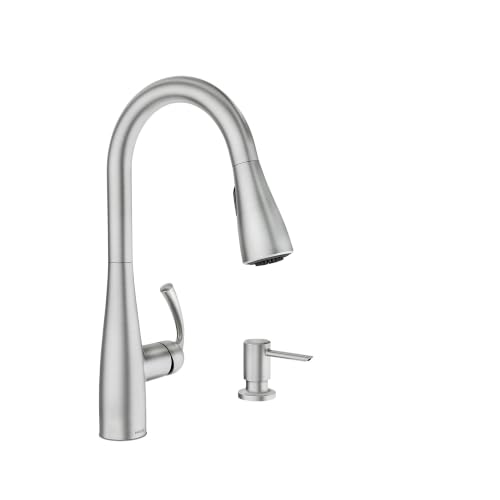
Moen Essie 87014SRS — Best Mainstream House-Wide Choice. The Essie is the safe house-wide standard: a Power Clean spray that feels stronger than the supply behind it, Reflex docking, and parts stocked in every town your house might need them. check price on Amazon.
How These Picks Were Chosen
The shortlist was built for endpoints of weak systems, so the criteria differ from a normal faucet roundup. Spray design came first: heads engineered to concentrate limited flow into a forceful, useful stream — high-pressure spray patterns and boost modes — scored over gentle, aerated luxury streams that feel empty on a weak supply. Waterway simplicity came second: direct paths and standard fittings waste less of the little pressure available.
Serviceability across the whole house came third. When supply is weak, every fixture eventually gets investigated, so brands with stocked cartridges, screens and wands — and designs a local plumber knows on sight — earned their places. Stated specifications mattered too: the one model whose verified listing states its delivery figure outright is included partly as a benchmark of honesty for the category.
Excluded were faucets whose appeal depends on abundant pressure — rainfall-style gentle sprays and elaborate multi-jet heads that turn feeble on a weak main — and any model whose flow claims could not be tied to its verified listing.
The 6 Best Kitchen Faucets for House With Low Water Pressure

Delta Finnridge Brushed Nickel — Best Overall for Whole-House Low Pressure
Pick this when the whole house feels weak — upstairs and down — and you want the kitchen tap to make the most of whatever pressure the property actually delivers.
Strengths
- H
- o
- u
- s
- e
- s
- o
- n
- w
- e
- a
- k
- m
- u
- n
- i
- c
- i
- p
- a
- l
- o
- r
- w
- e
- l
- l
- s
- u
- p
- p
- l
- y
Trade-offs
- H
- o
- m
- e
- s
- w
- h
- o
- s
- e
- p
- r
- o
- b
- l
- e
- m
- i
- s
- a
- s
- i
- n
- g
- l
- e
- c
- l
- o
- g
- g
- e
- d
- f
- i
- x
- t
- u
- r
- e
Key specs (from the verified listing title): High Pressure ProClean spray; pull-down format per the verified listing title.
In a house-wide low-pressure home, the kitchen faucet’s job changes: it is no longer about luxury flow, it is about concentrating limited water into a stream that still rinses, blasts and fills at a tolerable pace. The Finnridge’s high-pressure spray design is built for exactly that concentration job.
Start here if you have already confirmed the weakness is house-wide — every tap equally lazy — because this pick assumes the supply is what it is and optimises the endpoint. If only the kitchen is weak, the companion guide in this cluster is the better read.
What separates the Delta Finnridge Brushed Nickel in a whole-house context is how it behaves at the end of a long plumbing run, at breakfast time, when the shower upstairs and the washing machine are all drawing at once. Faucets that feel fine on a test bench can feel gutless at the far end of a real house system, and this one holds its composure when supply conditions are at their worst rather than their best.
There is also a house-wide logic to choosing it. A pressure problem is rarely only a kitchen problem, and standardising on serviceable, widely stocked hardware like the Delta Finnridge Brushed Nickel means the same cartridges, screens and cleaning habits apply when you work through the rest of the home’s fixtures. One set of spares in the drawer, one routine, every tap in the house covered.
Fitting it into an existing house system is deliberately unremarkable: standard connections, standard shutoff compatibility, and nothing proprietary between you and the supply lines. That ordinariness is a feature in an older house, where the next job is always waiting and nobody needs a faucet that demands its own ecosystem.
Best for: [‘ProClean spray is engineered to feel forceful on limited supply’, “Delta’s service network covers the whole house’s fixtures, not just this one”, ‘Pull-down format keeps the working end close to the washing-up’] / Not suited for: [‘Cannot create pressure the house does not have’, ‘High-force spray can splash in shallow basins’, ‘Whole-house weakness may still need a booster or pipe work’]
Check on Amazon to see the current configuration and finish options.

GIMILI Commercial Pull-Down — Best for Well-Water Homes
Well systems cycle between cut-in and cut-out pressures, and this commercial-style head with its high-pressure double-headed spray copes with the weak end of that cycle better than most.
Strengths
- W
- e
- l
- l
- –
- w
- a
- t
- e
- r
- a
- n
- d
- r
- u
- r
- a
- l
- h
- o
- m
- e
- s
Trade-offs
- S
- m
- a
- l
- l
- s
- i
- n
- k
- s
- t
- h
- a
- t
- a
- c
- o
- m
- m
- e
- r
- c
- i
- a
- l
- p
- r
- o
- f
- i
- l
- e
- o
- v
- e
- r
- w
- h
- e
- l
- m
- s
Key specs (from the verified listing title): High Pressure Double Headed Spray; commercial style per the verified listing title.
Well owners live with a pressure rollercoaster their city cousins never meet, and the bottom of the pump cycle is when dinner cleanup happens anyway. A head designed to work hard at modest pressure flattens that rollercoaster at the one tap you use most.
Pair it with attention to the pressure tank and switch settings — a faucet can concentrate flow, but a tired bladder tank shortens cycles and makes every fixture in the house feel worse than the supply really is.
What separates the GIMILI Commercial Pull-Down in a whole-house context is how it behaves at the end of a long plumbing run, at breakfast time, when the shower upstairs and the washing machine are all drawing at once. Faucets that feel fine on a test bench can feel gutless at the far end of a real house system, and this one holds its composure when supply conditions are at their worst rather than their best.
There is also a house-wide logic to choosing it. A pressure problem is rarely only a kitchen problem, and standardising on serviceable, widely stocked hardware like the GIMILI Commercial Pull-Down means the same cartridges, screens and cleaning habits apply when you work through the rest of the home’s fixtures. One set of spares in the drawer, one routine, every tap in the house covered.
Fitting it into an existing house system is deliberately unremarkable: standard connections, standard shutoff compatibility, and nothing proprietary between you and the supply lines. That ordinariness is a feature in an older house, where the next job is always waiting and nobody needs a faucet that demands its own ecosystem.
Best for: [‘Double-headed spray gives a forceful option when the well pump is at low cycle’, ‘Commercial build tolerates the grit rural supplies can carry’, ‘Spring profile keeps the head up and out of the sink’] / Not suited for: [‘Tall spring silhouette dominates compact kitchens’, ‘More head hardware to keep clean’, ‘Style is industrial, not traditional’]
Check on Amazon to see the current configuration and finish options.

Moen Arbor 7594SRS — Best Boost Mode for Big Houses
In a large house the kitchen often sits at the end of the longest run, and the Arbor’s Power Boost gives you a temporary forceful mode for blasting pans without demanding it full-time.
Strengths
- L
- a
- r
- g
- e
- h
- o
- m
- e
- s
- w
- i
- t
- h
- l
- o
- n
- g
- p
- i
- p
- e
- r
- u
- n
- s
Trade-offs
- B
- u
- y
- e
- r
- s
- w
- a
- n
- t
- i
- n
- g
- a
- p
- e
- r
- m
- a
- n
- e
- n
- t
- h
- i
- g
- h
- –
- f
- l
- o
- w
- d
- e
- s
- i
- g
- n
- i
- n
- s
- t
- e
- a
- d
- o
- f
- a
- b
- o
- o
- s
- t
- m
- o
- d
- e
Key specs (from the verified listing title): Power Boost and Reflex docking per the verified listing title; Spot Resist Stainless finish.
Boost modes suit big-house reality: most of the day you want civilised flow, and for ninety seconds you want a pressure washer for the roasting pan. The Arbor separates those two wishes instead of compromising both.
If your kitchen is the far fixture, also check the stops and supply lines under this sink before blaming distance — long-run houses accumulate partially closed valves and kinked flex lines that masquerade as a pressure problem.
What separates the Moen Arbor 7594SRS in a whole-house context is how it behaves at the end of a long plumbing run, at breakfast time, when the shower upstairs and the washing machine are all drawing at once. Faucets that feel fine on a test bench can feel gutless at the far end of a real house system, and this one holds its composure when supply conditions are at their worst rather than their best.
There is also a house-wide logic to choosing it. A pressure problem is rarely only a kitchen problem, and standardising on serviceable, widely stocked hardware like the Moen Arbor 7594SRS means the same cartridges, screens and cleaning habits apply when you work through the rest of the home’s fixtures. One set of spares in the drawer, one routine, every tap in the house covered.
Fitting it into an existing house system is deliberately unremarkable: standard connections, standard shutoff compatibility, and nothing proprietary between you and the supply lines. That ordinariness is a feature in an older house, where the next job is always waiting and nobody needs a faucet that demands its own ecosystem.
Best for: [‘Power Boost concentrates flow on demand for rinsing and blasting’, ‘Reflex dock keeps the wand seated despite daily heavy use’, ‘Spot Resist finish suits busy family kitchens’] / Not suited for: [‘Boost is a mode, not a cure for undersized supply pipes’, ‘Premium tier within this shortlist’, ‘Long runs may also need the aerator routine from the guide’]
Check on Amazon to see the current configuration and finish options.

Moen M-Dura 8287 — Best Stated-Flow Commercial Pick
This is the pick whose verified listing title states its delivery outright — 2.2 gpm — which makes it the honest benchmark for buyers comparing genuine flow rather than marketing language.
Strengths
- B
- u
- y
- e
- r
- s
- w
- h
- o
- w
- a
- n
- t
- s
- t
- a
- t
- e
- d
- ,
- c
- o
- m
- m
- e
- r
- c
- i
- a
- l
- –
- g
- r
- a
- d
- e
- d
- e
- l
- i
- v
- e
- r
- y
Trade-offs
- H
- o
- m
- e
- s
- w
- a
- n
- t
- i
- n
- g
- p
- u
- l
- l
- –
- d
- o
- w
- n
- c
- o
- n
- v
- e
- n
- i
- e
- n
- c
- e
Key specs (from the verified listing title): 2.2 gpm stated in the verified listing title; commercial chrome two-handle design.
Most faucet marketing talks about pressure in adjectives. The M-Dura’s listing talks in numbers, and in a house where every fixture underperforms, a commercial body rated and built for real delivery is a rational, unglamorous answer.
Choose it when the kitchen is a working room first — canning, brewing, big-batch cooking — and the romance of a designer pull-down matters less than a tap that delivers what its listing promises.
What separates the Moen M-Dura 8287 in a whole-house context is how it behaves at the end of a long plumbing run, at breakfast time, when the shower upstairs and the washing machine are all drawing at once. Faucets that feel fine on a test bench can feel gutless at the far end of a real house system, and this one holds its composure when supply conditions are at their worst rather than their best.
There is also a house-wide logic to choosing it. A pressure problem is rarely only a kitchen problem, and standardising on serviceable, widely stocked hardware like the Moen M-Dura 8287 means the same cartridges, screens and cleaning habits apply when you work through the rest of the home’s fixtures. One set of spares in the drawer, one routine, every tap in the house covered.
Fitting it into an existing house system is deliberately unremarkable: standard connections, standard shutoff compatibility, and nothing proprietary between you and the supply lines. That ordinariness is a feature in an older house, where the next job is always waiting and nobody needs a faucet that demands its own ecosystem.
Best for: [‘Flow figure is stated in the listing itself, not implied’, ‘Commercial M-Dura build is made for hard daily service’, ‘Two-handle format separates temperature control from flow’] / Not suited for: [‘No pull-down wand — a side-spray era layout’, ‘Chrome shows water spots readily’, ‘Commercial looks divide opinion in home kitchens’]
Check on Amazon to see the current configuration and finish options.

KRAUS Bolden KPF-1610SFS — Best Heavy Build for Weak Supply
A heavy commercial-style body with an open-coil spout, chosen here because its simple, direct waterway and robust head waste as little of a weak house supply as a pull-down design can.
Strengths
- W
- e
- a
- k
- –
- s
- u
- p
- p
- l
- y
- h
- o
- m
- e
- s
- w
- a
- n
- t
- i
- n
- g
- c
- o
- m
- m
- e
- r
- c
- i
- a
- l
- p
- r
- e
- s
- e
- n
- c
- e
Trade-offs
- L
- o
- w
- c
- a
- b
- i
- n
- e
- t
- s
- w
- h
- e
- r
- e
- a
- t
- a
- l
- l
- s
- p
- o
- u
- t
- w
- i
- l
- l
- n
- o
- t
- f
- i
- t
Key specs (from the verified listing title): Spot Free finish; 18 3/4 in class open-coil profile per the verified listing titles in this range.
Weak supply rewards simplicity: every needless restriction between the stop valve and the spout is flow you cannot spare. The Bolden’s commercial directness is its low-pressure credential, quite apart from its looks.
Measure the cabinet clearance before ordering — this profile’s only common failure in houses is not pressure at all, it is a spout meeting a wall cabinet the tape measure never met.
What separates the KRAUS Bolden KPF-1610SFS in a whole-house context is how it behaves at the end of a long plumbing run, at breakfast time, when the shower upstairs and the washing machine are all drawing at once. Faucets that feel fine on a test bench can feel gutless at the far end of a real house system, and this one holds its composure when supply conditions are at their worst rather than their best.
There is also a house-wide logic to choosing it. A pressure problem is rarely only a kitchen problem, and standardising on serviceable, widely stocked hardware like the KRAUS Bolden KPF-1610SFS means the same cartridges, screens and cleaning habits apply when you work through the rest of the home’s fixtures. One set of spares in the drawer, one routine, every tap in the house covered.
Fitting it into an existing house system is deliberately unremarkable: standard connections, standard shutoff compatibility, and nothing proprietary between you and the supply lines. That ordinariness is a feature in an older house, where the next job is always waiting and nobody needs a faucet that demands its own ecosystem.
Best for: [‘Direct, simple waterway suits limited supply’, ‘Spot Free finish keeps a hard-working tap looking clean’, ‘Metal build shrugs off household knocks’] / Not suited for: [‘Height demands cabinet clearance checks’, ‘Open-coil style is a strong visual statement’, ‘Heavier head needs the dock kept clean to seat well’]
Check on Amazon to see the current configuration and finish options.
Moen Essie 87014SRS — Best Mainstream House-Wide Choice
The Essie is the safe house-wide standard: a Power Clean spray that feels stronger than the supply behind it, Reflex docking, and parts stocked in every town your house might need them.
Strengths
- F
- a
- m
- i
- l
- i
- e
- s
- s
- t
- a
- n
- d
- a
- r
- d
- i
- s
- i
- n
- g
- o
- n
- o
- n
- e
- s
- e
- r
- v
- i
- c
- e
- a
- b
- l
- e
- b
- r
- a
- n
- d
Trade-offs
- H
- o
- m
- e
- s
- n
- e
- e
- d
- i
- n
- g
- a
- s
- t
- a
- t
- e
- d
- c
- o
- m
- m
- e
- r
- c
- i
- a
- l
- f
- l
- o
- w
- r
- a
- t
- i
- n
- g
Key specs (from the verified listing title): Power Clean spray and Reflex docking per the verified listing title; Spot Resist Stainless.
When the whole house is weak, the kitchen tap you choose sets the pattern for how you will fix the rest: mainstream, serviceable, stocked locally. The Essie is that pattern in faucet form.
It is also the pick to hand a plumber without a briefing — every tradesperson knows this platform, which quietly lowers the cost of every future repair in the house.
What separates the Moen Essie 87014SRS in a whole-house context is how it behaves at the end of a long plumbing run, at breakfast time, when the shower upstairs and the washing machine are all drawing at once. Faucets that feel fine on a test bench can feel gutless at the far end of a real house system, and this one holds its composure when supply conditions are at their worst rather than their best.
There is also a house-wide logic to choosing it. A pressure problem is rarely only a kitchen problem, and standardising on serviceable, widely stocked hardware like the Moen Essie 87014SRS means the same cartridges, screens and cleaning habits apply when you work through the rest of the home’s fixtures. One set of spares in the drawer, one routine, every tap in the house covered.
Fitting it into an existing house system is deliberately unremarkable: standard connections, standard shutoff compatibility, and nothing proprietary between you and the supply lines. That ordinariness is a feature in an older house, where the next job is always waiting and nobody needs a faucet that demands its own ecosystem.
Best for: [‘Power Clean stream feels purposeful on modest pressure’, ‘Reflex system keeps the wand homed for years’, ‘Moen parts and support are available virtually everywhere’] / Not suited for: [“Will not match a commercial body’s stated delivery”, ‘Single-handle design concentrates wear on one cartridge’, ‘Finish range is conservative’]
Check on Amazon to see the current configuration and finish options.
Comparison Table
| Pick | Badge | Key spec | Best for |
|---|---|---|---|
| Delta Finnridge Brushed Nickel | Best Overall for Whole-House Low Pressure | ProClean high-pressure spray | [‘ProClean spray is engineered to feel forceful on limited supply’, “Delta’s service network covers the whole house’s fixtures, not just this one”, ‘Pull-down format keeps the working end close to the washing-up’] |
| GIMILI Commercial Pull-Down | Best for Well-Water Homes | High-pressure double head | [‘Double-headed spray gives a forceful option when the well pump is at low cycle’, ‘Commercial build tolerates the grit rural supplies can carry’, ‘Spring profile keeps the head up and out of the sink’] |
| Moen Arbor 7594SRS | Best Boost Mode for Big Houses | Power Boost, Reflex | [‘Power Boost concentrates flow on demand for rinsing and blasting’, ‘Reflex dock keeps the wand seated despite daily heavy use’, ‘Spot Resist finish suits busy family kitchens’] |
| Moen M-Dura 8287 | Best Stated-Flow Commercial Pick | 2.2 gpm (per listing title) | [‘Flow figure is stated in the listing itself, not implied’, ‘Commercial M-Dura build is made for hard daily service’, ‘Two-handle format separates temperature control from flow’] |
| KRAUS Bolden KPF-1610SFS | Best Heavy Build for Weak Supply | Open-coil, spot free | [‘Direct, simple waterway suits limited supply’, ‘Spot Free finish keeps a hard-working tap looking clean’, ‘Metal build shrugs off household knocks’] |
| Moen Essie 87014SRS | Best Mainstream House-Wide Choice | Power Clean, Reflex | [‘Power Clean stream feels purposeful on modest pressure’, ‘Reflex system keeps the wand homed for years’, ‘Moen parts and support are available virtually everywhere’] |
House-Scale Fixes Beyond the Faucet
Work outward from the tap in order of cost. Fully open every stop valve under every sink — partially closed stops are epidemic in houses that have had decades of small plumbing jobs. Clean every aerator and inlet screen in the house in one afternoon; on a weak supply, the reclaimed flow is noticeable everywhere at once. Check the main valve and any pressure regulator near the meter: regulators drift and fail low, and a gauge on an outside spigot tells you the static pressure the house actually receives.
Well owners add the pressure tank and switch to the list. A waterlogged tank short-cycles the pump and makes pressure sag constantly; a switch set with too narrow a band does the same. These are the highest-value fixes in a well house, and no faucet purchase should precede them.
Only after the free and cheap work should hardware enter the conversation: a booster pump for genuinely low incoming pressure, or repiping chronically undersized runs during other renovations. The faucets in this guide are the finishing layer on that work — chosen to waste none of what the house can deliver, whenever it delivers it.
When to Call a Plumber Instead of Buying Hardware
Some findings from the audit end the DIY chapter honestly. Static pressure far below the street’s norm with a healthy regulator suggests a failing main valve or a corroded incoming line — professional territory. Pressure that swings wildly suggests a regulator or tank fault that adjustment will not cure. Discoloured water after flow work suggests disturbed corrosion in old galvanised runs, and repeated screen-clogging with grit suggests pipework that is shedding internally.
A plumber’s diagnostic visit, armed with your bucket-test numbers and gauge readings, is short and cheap compared with serial hardware purchases. Bring the notes, name the fixtures tested, and let the professional confirm whether the house needs source work, distribution work, or simply the endpoint upgrades this guide covers.
And if the verdict is that the house is simply built this way — long runs, modest main, top-floor physics — then the picks above are not a consolation prize. Concentrating spray design at the hardest-working tap in the house is the correct permanent answer to a permanent condition, and it is the answer this shortlist was built to give.
First, Prove the Problem Is House-Wide
Before spending anything, run the bucket test at three fixtures: the kitchen, the bathroom nearest the incoming main, and the furthest upstairs tap. Time how long each takes to fill the same container. If the fixture nearest the main is strong and the far ones fade, your issue is distribution — pipe runs, partial blockages, tired valves. If every fixture is equally weak, the issue is supply: incoming pressure, a regulator set low or failing, a well system’s tank and switch, or a partially closed main valve.
That single test decides where money works. Distribution problems respond to endpoint optimisation — the faucets in this guide — plus local fixes like clearing screens and opening stops fully. Supply problems respond at the source: regulator adjustment, pressure-tank service, or a booster pump, after which almost any decent faucet feels transformed. Many houses have a little of both, which is why the endpoint still matters even after source work.
Renters and new owners should also simply ask: has it always been like this, or did it change? A sudden house-wide drop points to a valve, regulator or municipal issue; a lifetime of weakness points to pipe sizing or a low incoming main, and the two have very different budgets.
What a Faucet Can Do at the End of a Weak System
A faucet cannot raise pressure, but it decides how the available water feels and works. Concentrating spray heads turn a given flow into a rinsing force that clears plates and blasts pans; wide gentle aerated streams spread the same water into a disappointing drizzle. Boost modes formalise that trade — civilised flow for filling, concentrated force for cleaning — and suit weak houses particularly well.
Restrictions are the other lever. Aerators, flow limiters, inlet screens and scaled passages each shave a little delivery, and at house pressures that are already marginal, those little shavings are the difference between usable and useless. Several picks here keep those parts accessible and standard, so reclaiming lost flow is a cleaning job rather than a replacement job.
Finally, manage expectations by task. Filling a stockpot is a volume job — no spray design shortens it on a weak supply, only patience or a pot-filler near the stove does. Rinsing and blasting are force jobs, and those are exactly what the heads in this guide optimise. Match the purchase to the frustration that actually sent you shopping.
Reading Your House: Pressure Clues Room by Room
Each room tells you something different about a weak system. The shower reveals pressure under sustained demand — if it fades when a tap opens elsewhere, the house shares too little supply across too many open paths, and endpoint concentration at the kitchen will help the kitchen without curing the shower. The upstairs basin reveals static head: water loses pressure simply by climbing, so a top-floor trickle alongside acceptable ground-floor flow can be physics rather than failure, and expectations should be set accordingly.
The kitchen reveals the accumulated state of the distribution system, because its run usually passes the most junctions, stops and flex connections. That is why the kitchen audit in the how-to section starts at this sink even when the complaint is house-wide: the furthest, most-connected fixture is the best diagnostic instrument in the building.
Write down what each room tells you before buying anything. Owners who shop with notes buy once; owners who shop from frustration buy twice — first the faucet that could never fix a supply problem, then the fix itself.
How to Audit and Improve Flow Throughout the House
This is a Saturday-morning audit, in order, cheapest first. It needs a bucket, a timer, a cloth and optionally an inexpensive pressure gauge that screws onto an outside spigot.
- Fill the same bucket at the kitchen tap, the tap nearest the main, and the furthest tap; time each and note the pattern.
- Attach a pressure gauge to an outside spigot, open it fully with everything else off, and note the static pressure.
- Check the main shutoff and any regulator near the meter are fully open and note the regulator’s setting if it is adjustable.
- Under every sink, open both stop valves fully, then back them a quarter-turn so they do not seize open.
- Remove and rinse every aerator and faucet inlet screen in the house; soak scaled ones in vinegar while you continue.
- Well homes: watch a full pump cycle at a tap — rapid cycling or deep sag means tank or switch service before any faucet purchase.
- Re-run the bucket test and record the improvement; whatever weakness remains is now honestly a supply or endpoint question.
With the audit done, the endpoint choices in this guide can do their part: concentrating sprays, simple waterways and serviceable parts. Keep the bucket-test numbers with the house paperwork — they are the baseline that tells you, years from now, whether a new weakness is the house changing or just one fixture asking for its screens cleaned.
Common Buying Mistakes
Replacing the kitchen faucet for a house problem. If every tap is weak, a new kitchen faucet alone disappoints. Audit the house first; the endpoint is the last layer, not the first.
Confusing pressure with flow. A forceful-feeling spray is flow concentrated well, not pressure created. Judge picks by spray design and stated figures, not adjectives.
Ignoring the regulator. Pressure regulators fail gradually and low. A gauge reading takes two minutes and can explain a decade of weak showers.
Leaving stops half-closed for years. Partially closed stop valves are the most common hidden restriction in older houses, and they cost nothing to fix.
Buying gentle luxury sprays for a weak main. Wide, soft, aerated streams need supply behind them. On a weak house they feel emptier than the tap you replaced.
Testing pressure at midday only. Municipal pressure varies across the day, and well systems vary across the pump cycle. Test at your worst hour — morning showers, evening cleanup — because that is the supply your faucet will actually live with.
Forgetting the outside spigot baseline. The spigot nearest the meter is your reference for what the street gives the house. Without that baseline you cannot tell whether losses happen at the source or inside the walls, and you may spend on endpoints when the incoming line is the whole story.
Final Recommendation
For a house-wide problem, start with the audit, then choose the endpoint that matches your supply: the Delta Finnridge for most homes, the GIMILI for well systems, the Moen Arbor where a boost mode fits big-house life, and the Moen M-Dura where a stated commercial delivery figure matters more than pull-down convenience. The Kraus Bolden serves weak-supply homes wanting a heavy commercial presence, and the Moen Essie is the mainstream standard a whole house can be serviced around.
Do the free work first, let the faucet be the finishing layer, and a weak house becomes a manageable one — the kitchen first, because that is where the house’s water is judged every single day, by everyone who cooks, cleans, fills a kettle or rinses a pan in it.
Ready to order? Start with the Delta Finnridge Brushed Nickel (check price on Amazon) or the Moen M-Dura 8287 (check price on Amazon) and work down the shortlist from there.
Keep exploring the cluster: Best Kitchen Faucets For Low Water Pressure Best Kitchen Faucets For Hard Water Best Kitchen Faucets Best Pull Down Kitchen Faucets Best Touchless Kitchen Faucets
Frequently Asked Questions
How do I know if low pressure is house-wide or just the kitchen?
Run the timed bucket test at several fixtures. Equal weakness everywhere points to supply; weakness that grows with distance from the main points to distribution; one weak tap points to that fixture’s own screens, cartridge or stops.
Can a new faucet fix whole-house low pressure?
No faucet raises incoming pressure. The right faucet concentrates the flow you have into a useful working stream and removes endpoint restrictions — a real improvement, but a layer on top of any source fixes the house needs.
What does a stated figure like 2.2 gpm actually tell me?
It is the model’s rated delivery under test conditions, stated in the Moen M-Dura’s verified listing. Your house may deliver less if supply is weak, which is exactly why spray design matters alongside the number.
Should well owners choose differently?
Yes — favour forceful spray heads that cope with the low end of the pump cycle, and service the pressure tank and switch first. The GIMILI pick and the audit section are written for that situation.
Is a booster pump worth it?
When a gauge confirms genuinely low incoming pressure and the free fixes are done, a booster transforms every fixture at once. It is a bigger job than a faucet, so it belongs after the audit, not before it.
Will cleaning aerators across the house really change anything?
On a strong supply, barely. On a marginal one, yes — each screen and aerator is a small restriction, and small restrictions are proportionally large when pressure is scarce. Owners routinely describe the whole house feeling better after one cleaning afternoon, before any hardware changes at all.
Why is the kitchen often the worst tap in the house?
It is frequently the furthest from the main, shares its run with other fittings, and its own aerator and screens collect the most debris — three small disadvantages stacking into one noticeably lazy tap.

