Disclosure: airfryerkitchensupply.com is reader-supported. When you buy through links on our site, we may earn an affiliate commission at no extra cost to you.
Where to buy
Every linked pick in this guide to the best ice cream compressor ice cream makers was verified against Amazon’s catalog data for this site before writing, so capacities and compressor claims match real current listings. Use the links in this box, in Quick Picks, and under each review to check price on Amazon on the day you buy. Every machine here has a built-in compressor — that is the entry ticket to this guide — so none of them requires a pre-frozen bowl, and the differences that matter are capacity, control, and specialization.
- Cuisinart ICE-100 1.5 Qt Compressor Ice Cream Maker (Best Overall) — check price on Amazon
- Whynter ICM-201SB Upright Ice Cream Maker 2.1 Qt Compressor (Best Capacity) — check price on Amazon
- Breville BCI600XL Smart Scoop Ice Cream Maker (Best Premium) — check price on Amazon
- Whynter ICM-200LS Ice Cream Maker 2.1 Qt Compressor (Best Stainless Classic) — check price on Amazon
- Whynter ICM-220SSY Ice Cream Maker & Yogurt 2 Qt Compressor (Best for Yogurt Makers) — check price on Amazon
- Cuisinart Automatic Ice Cream Maker, No Pre-Freezing, 1-Qt (Best Compact Compressor) — check price on Amazon
The best ice cream compressor ice cream makers all share one superpower, and it is worth stating plainly: they freeze while they churn. A built-in refrigeration compressor means no bowl living in your freezer for a day before you can make ice cream, no ‘we cannot have that tonight, the bowl is not frozen,’ and no limit of one batch per freezing cycle. Ice cream becomes an impulse the machine can honor — decide after dinner, eat within the hour — and for most households that tempo change, not any spec, is what they are actually buying.
Within that shared superpower, the real decisions are capacity, control, and specialization. Capacity runs in this guide from a 1-quart personal batch to 2.1-quart production churns, and the right size is the one that matches your table: too small and dessert runs out mid-evening; too large and every batch is a commitment. Control runs from automatic simplicity to the Breville’s texture-led judgment. Specialization appears once, in a machine that also makes the yogurt it later freezes. This guide maps those differences honestly rather than crowning a single winner for every kitchen.
A note on what a compressor costs you, because honesty is the house style: these machines are heavier, larger, and pricier as a class than freezer-bowl models, and they contain a refrigeration system that wants to sit level and rest after being moved. The picks below earn those costs back in tempo and freedom — but if you make ice cream twice a year, the general ice cream guide in this cluster, covering freezer-bowl and other formats, may serve you better, and it is linked at the end.
Consider the freezer-space dividend, which owners mention more than any other after a month. A freezer-bowl household permanently surrenders a large, awkward volume of freezer to an empty bowl — space that, in most kitchens, is the scarcest storage there is. A compressor household surrenders counter space instead, once, visibly, and gets the freezer back whole. Which currency your kitchen is richer in — counter or freezer — is a legitimate deciding factor, and for many households it settles the category question by itself.
Read the badges as household matches rather than a league table. The largest machine is not the best machine for a couple, and the smartest machine is not the best value for a twice-a-month maker. Each review names its household plainly in its verdict line; find yours, and the shortlist usually narrows to one or two names without further agonizing.
In this guide
Quick Picks
Cuisinart ICE-100 1.5 Qt Compressor Ice Cream Maker — Best Overall. The compressor benchmark for home kitchens: 1.5 quarts, no pre-freezing, and two paddles — one for ice cream, one for gelato — so the machine handles both textures the way they are supposed to be handled. Check price on Amazon.
Whynter ICM-201SB Upright Ice Cream Maker 2.1 Qt Compressor — Best Capacity. The big batch compressor: 2.1 quarts — the largest verified capacity in this guide — in an upright format, with an LCD display and timer to manage the longer churn a bigger batch needs. Check price on Amazon.
Breville BCI600XL Smart Scoop Ice Cream Maker — Best Premium. The connoisseur’s compressor: Breville’s Smart Scoop, in brushed stainless, built around the idea that the machine should sense the ice cream’s hardness and churn to the texture you chose — sorbet, gelato, frozen yogurt, or ice cream. Check price on Amazon.
Whynter ICM-200LS Ice Cream Maker 2.1 Qt Compressor — Best Stainless Classic. The other 2.1-quart Whynter: an automatic compressor machine with LCD and timer, for buyers who want the big batch and the specialist brand in a classic, straightforward package. Check price on Amazon.
Whynter ICM-220SSY Ice Cream Maker & Yogurt 2 Qt Compressor — Best for Yogurt Makers. The dual-culture machine: a 2-quart compressor ice cream maker with a yogurt function, for households whose frozen ambitions include frozen yogurt as a first-class citizen rather than an afterthought. Check price on Amazon.
Cuisinart Automatic Ice Cream Maker, No Pre-Freezing, 1-Qt — Best Compact Compressor. The small compressor: one quart, automatic, no pre-freezing — proof that the compressor advantage is not reserved for big machines, sized for couples, small households, and experimental batches. Check price on Amazon.
How These Picks Were Chosen
The filter was absolute: verified listings confirming a built-in compressor and no pre-freezing, plus stated capacity. Machines that merely churn a pre-frozen bowl were excluded from this guide entirely — they belong to the general ice cream makers guide — because mixing the two categories under a ‘compressor’ keyword would mislead exactly the readers this page exists for.
Within verified compressors, we spread the picks across the genuine decision space: the balanced benchmark, the two largest-capacity Whynters in their different forms, the premium texture-led Breville, the yogurt-dual machine, and the compact 1-quart compressor. Brand repetition here is honest: Whynter specializes in this category, and its presence reflects the market rather than a quota.
Spec discipline was strict: capacities and features in the spec boxes come only from the verified listing titles. Where a title did not state a detail — a wattage, a capacity — this guide does not claim it, and says so in the review rather than filling the gap with category folklore.
We also considered noise and presence, because compressor machines run refrigeration cycles in your kitchen for the length of a churn and then sit on the counter permanently. Picks that present as considered appliances — stable, finished, and quiet in their design language — were favored over novelty styling. A machine you will look at every day for a decade should be one you are pleased to look at.
Prices and bundles in this category shift between listings and seasons, which is why this guide anchors its claims to verified capacities and functions and sends you to the live listing for the day’s configuration. Confirm the paddles, lids, and accessories in the specific box you are ordering, especially on the multi-accessory models.
The 6 Best Ice Cream Compressor Ice Cream Makers

Cuisinart ICE-100 1.5 Qt Compressor Ice Cream Maker — Best Overall
Compressor machines exist to delete one sentence from your life: ‘the bowl is not frozen yet.’ The ICE-100’s built-in compressor freezes as it churns, which means ice cream becomes a decision you can make after dinner rather than a plan you must make yesterday. The two paddles are the connoisseur’s detail — the gelato paddle incorporates less air for a denser result, the ice cream paddle whips in more for a lighter one — and the 1.5-quart capacity is honestly sized for a household batch: enough for a family dessert, small enough to churn evenly and freeze consistently.
Strengths
- Built-in compressor: no pre-freezing, no freezer-bowl planning, ice cream on impulse
- Two paddles for ice cream and gelato textures — a distinction most machines ignore
- 1.5 Qt capacity churns evenly and suits real household batches
Trade-offs
- Compressor machines are heavy and counter-hungry compared with freezer-bowl models
- 1.5 Qt is a batch, not a party: big events need sequential batches
- Premium over freezer-bowl pricing as a category — the compressor is the cost
| Specification | Verified detail |
|---|---|
| Capacity | 1.5 Qt (from Amazon title) |
| Freezing | Built-in compressor, no pre-freezing (from Amazon title) |
| Paddles | 2 paddles included (from Amazon title) |
The ownership experience is about tempo. A custard base made in the morning churns the same evening; a whim at 7 p.m. is dessert by 8. Back-to-back batches are possible because nothing needs re-freezing — the second batch simply starts when the first is scooped into a container to firm up. That tempo changes how a household uses an ice cream maker: from a planned project appliance to a standing capability, reached for the way a kettle is reached for.
Texture management is the skill to build. Compressor machines let you watch the churn and stop at the consistency you want — soft-serve straight from the machine, or a firmer set after an hour in the freezer. Because there is no bowl warming against a deadline, you can also churn slowly and deliberately, which suits gelato’s dense, low-air ideal. The machine removes the time pressure; what you do with that calm is the craft.
Best for: households that want real ice cream and gelato on impulse, in family-size batches / Not suited for: party-scale producers and anyone unwilling to give a heavy machine counter space
Check on Amazon — check price on Amazon before you buy, because included accessories and bundle contents vary between listings.
Whynter ICM-201SB Upright Ice Cream Maker 2.1 Qt Compressor — Best Capacity
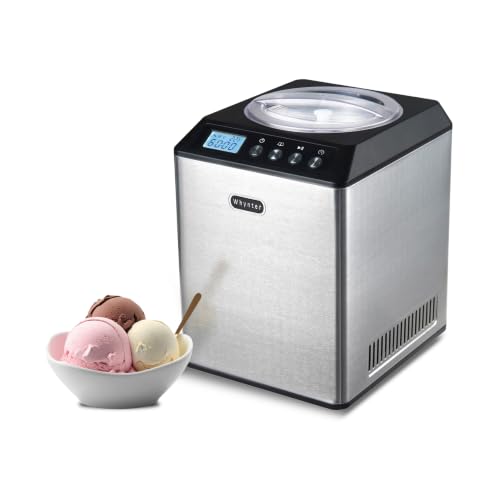
Capacity is a quality feature in ice cream, not just a quantity: a household that entertains, or freezes portions for the week, wants one churn that fills the container rather than two churns and a compromise. The ICM-201SB’s 2.1 quarts answer that, and the upright design keeps the footprint more vertical than its capacity suggests. Whynter is the specialist name in this category — compressor cooling is their home turf — and the LCD-and-timer control set suits the machine’s rhythm: set the churn, watch the consistency develop, and let the timer keep the schedule while you make the cones ready.
Strengths
- 2.1 Qt is the largest verified batch in this guide — one churn for entertaining or weekly portions
- Upright format uses vertical space efficiently for its capacity
- LCD display and timer bring order to longer, larger churns
Trade-offs
- The largest batch is also the longest churn; physics charges for capacity in minutes
- Size and weight make this a parked appliance, not a cupboard traveler
- Big batches demand a properly chilled, well-balanced base — errors scale up too
| Specification | Verified detail |
|---|---|
| Capacity | 2.1 Qt (from Amazon title) |
| Freezing | Built-in compressor, no pre-freezing (from Amazon title) |
| Controls | LCD display and timer (from Amazon title) |
Run this machine like the small production unit it is. Bases benefit from being made ahead and thoroughly chilled — not because the compressor needs help, but because a cold base churns to a smoother, finer crystal structure in any machine. Fill to the recommended level rather than the brim; ice cream expands as it incorporates air, and an overfilled big batch churns unevenly. Scoop the finished churn into pre-chilled containers, and the texture you made is the texture you keep.
For households that host — the barbecue that ends with homemade ice cream, the family that goes through a tub a week — the capacity argument is decisive, and Whynter’s compressor specialization is the reassurance behind it. This is the pick that treats homemade ice cream as a standing household supply rather than an occasional treat.
Best for: entertainers and high-consumption households wanting the largest single batch / Not suited for: small kitchens and occasional makers, for whom 1.5 Qt or less is the honest size
Check on Amazon — check price on Amazon before you buy, because included accessories and bundle contents vary between listings.

Breville BCI600XL Smart Scoop Ice Cream Maker — Best Premium
Premium in this category buys judgment. A basic compressor freezes and churns on a timer; the Smart Scoop’s proposition is that it monitors consistency and holds your chosen texture, which matters because the difference between perfect gelato and over-churned gelato is a few minutes and a degree of firmness. Breville’s fit and finish — the stainless body, the way the lid and bowl seat — are the visible part of the same philosophy: this is an appliance engineered as a long-term counter resident for people who make frozen desserts as a craft, weekly, and notice differences.
Strengths
- Texture-led design philosophy: churn to a chosen consistency rather than a blind timer
- Breville build quality in brushed stainless — a decade-class counter appliance
- Compressor freedom: the full frozen-dessert repertoire without pre-freezing
Trade-offs
- Premium tier — the most considered purchase in this guide; check price on Amazon
- Capacity details are not stated in the verified title, so we make no batch-size claims for it
- Its refinements are wasted on twice-a-year use; this is a frequent maker’s machine
| Specification | Verified detail |
|---|---|
| Build | Brushed stainless steel (from Amazon title) |
| Line | Breville Smart Scoop (from Amazon title) |
The honest way to evaluate the premium is cost per churn across years. A household making ice cream twice a month, experimenting with sorbets and gelatos, will feel the Smart Scoop’s consistency control and build quality in every batch, and the machine’s steadiness becomes part of the hobby’s pleasure. A household making ice cream for one birthday will feel only the price. Both judgments are correct; the badge is aimed at the first household.
Within the churn itself, the machine rewards good bases the way all great equipment rewards good inputs: a balanced custard, properly chilled, churned to a watched consistency, produces scoops with the dense, clean melt that separates serious homemade ice cream from the merely sweet. If that sentence describes your ambitions, this is your machine in this guide.
Best for: frequent, craft-minded makers who churn weekly and value consistency control and build / Not suited for: occasional makers, who get the same joy from the Cuisinart at a lower tier
Check on Amazon — check price on Amazon before you buy, because included accessories and bundle contents vary between listings.

Whynter ICM-200LS Ice Cream Maker 2.1 Qt Compressor — Best Stainless Classic
Choice within a brand is a good problem. The ICM-200LS matches the guide’s largest capacity and adds the same LCD-and-timer discipline as its upright sibling; the differences are in form and presentation rather than in the fundamental proposition — Whynter compressor, 2.1 quarts, no pre-freezing. For many buyers the decision between the two Whynters will come down to which shape suits their counter and which listing’s configuration suits their kitchen on the day — a legitimate way to choose between near-equals, and this guide will not manufacture a fake distinction.
Strengths
- 2.1 Qt capacity ties for the largest batch in this guide
- Automatic operation with LCD display and timer for set-and-monitor churns
- Whynter’s compressor specialization underpins the whole proposition
Trade-offs
- Two similar Whynters in one guide means the buyer must compare listings carefully — a burden we acknowledge rather than hide
- Large, heavy machine; a parked appliance by design
- Longer churns come with the capacity, as with its sibling
| Specification | Verified detail |
|---|---|
| Capacity | 2.1 Qt (from Amazon title) |
| Freezing | Built-in compressor, no pre-freezing (from Amazon title) |
| Controls | LCD display and timer (from Amazon title) |
In service, expect the same production rhythm as the ICM-201SB: chilled bases, sensible fill levels, containers pre-chilled for the transfer. The automatic program style suits cooks who want to start a churn and attend to the rest of dinner, returning to a finished batch held at temperature rather than a melting one. That hold-at-cold behavior is an underappreciated compressor virtue: the machine is not merely a churner but a small, patient freezer that waits for your schedule.
If you are choosing between this and the upright model, let the counter decide — measure the space, consider the height clearance, and take the shape that lives better in your kitchen. The ice cream will not know the difference, and neither, honestly, will your guests.
Best for: big-batch makers who prefer this model’s form and automatic style / Not suited for: anyone for whom the upright sibling’s shape fits the counter better — take that one instead
Check on Amazon — check price on Amazon before you buy, because included accessories and bundle contents vary between listings.

Whynter ICM-220SSY Ice Cream Maker & Yogurt 2 Qt Compressor — Best for Yogurt Makers
Frozen yogurt is not ice cream with a health halo; it is a different product — tangier, lighter, and at its best when the yogurt itself is excellent. A machine that makes the yogurt and then freezes it closes the loop: culture a batch, flavor it, churn it, all in one appliance’s workflow. The ICM-220SSY’s 2-quart capacity sits just under the guide’s maximum, its LCD and timer manage both the culturing patience and the churn, and the compressor keeps the no-pre-freeze promise that defines this entire guide.
Strengths
- Yogurt function plus compressor freezing: make the yogurt, then the frozen yogurt, in one machine’s orbit
- 2 Qt capacity is near the top of this guide’s range
- LCD digital display and timer suit both the long culture and the churn
Trade-offs
- Jack-of-two-trades positioning: pure ice-cream specialists should compare it honestly against the dedicated picks
- Yogurt making adds time and process to your routine — a virtue only if you will actually do it
- Large-machine footprint and weight, as with all 2-quart compressors
| Specification | Verified detail |
|---|---|
| Capacity | 2 Qt (from Amazon title) |
| Functions | Ice cream and yogurt (from Amazon title) |
| Freezing | Built-in compressor, no pre-freezing (from Amazon title) |
| Controls | LCD digital display and timer (from Amazon title) |
The household this serves has a specific rhythm: a yogurt culture started in the morning becomes the evening’s frozen yogurt, flavored with fruit or honey, churned to a soft tanginess that store-bought versions sweeten into anonymity. The same machine, on another day, is simply a strong 2-quart ice cream maker, so the yogurt function is an expansion of repertoire rather than a compromise of the main job.
Frozen yogurt texture rewards restraint: churn to soft-serve consistency and serve promptly, or freeze briefly for scoops, because its lower fat content turns icy with long hard freezing faster than custard-based ice cream does. The machine gives you the control; the recipe discipline — good cultures, balanced sweetness, prompt serving — completes it.
Best for: households that will genuinely use both yogurt making and ice cream churning / Not suited for: ice-cream-only makers, who should spend on a dedicated pick instead
Check on Amazon — check price on Amazon before you buy, because included accessories and bundle contents vary between listings.

Cuisinart Automatic Ice Cream Maker, No Pre-Freezing, 1-Qt — Best Compact Compressor
Small is a strategy in ice cream. A 1-quart batch is tonight’s dessert for two, a test of a new flavor at no great cost in ingredients, or a single perfect pint of something intense — espresso, olive oil, a sorbet — that a household wants in small amounts. Compressors at this size were once a contradiction; this Cuisinart makes the format real, with automatic operation and the brand’s Freeze Ease positioning around exactly the promise this guide cares about: frozen dessert without the frozen-bowl ritual.
Strengths
- True compressor convenience at a 1-Qt, small-household scale
- Automatic operation suits its set-it-and-serve-it purpose
- Ideal test-batch size for new flavors and small, intense recipes
Trade-offs
- One quart is genuinely small: a family dessert or a party exhausts it in one serving round
- Per-quart, small compressors are the least economical way to make volume
- Frozen yogurt and ice cream share the format; neither gets a dedicated machine’s depth
| Specification | Verified detail |
|---|---|
| Capacity | 1-Qt (from Amazon title) |
| Freezing | No pre-freezing, Freeze Ease technology (from Amazon title) |
| Functions | Ice cream and frozen yogurt (from Amazon title) |
The experimental case deserves emphasis. Serious home ice-cream makers develop flavors iteratively — a basil sorbet adjusted three times, a brown-butter base tweaked by degrees — and a 1-quart automatic machine makes each iteration cheap, fast, and same-day. Paired with a notebook, it becomes a development kitchen in a corner of the counter. Couples will simply call it the right size: dessert for two, no freezer Tetris with leftover tubs, no bowl hogging the freezer between uses.
If your household’s pattern is small, frequent, and curious, this is the compressor to buy, and the larger machines in this guide are the wrong kind of more. Scale honesty cuts both ways, and this pick is its smallest, most cheerful proof.
Best for: couples, small households, and flavor experimenters making small batches often / Not suited for: families and entertainers, who need the 1.5–2.1 Qt picks
Check on Amazon — check price on Amazon before you buy, because included accessories and bundle contents vary between listings.
Comparison Table
| Pick | Badge | Key spec | Best for |
|---|---|---|---|
| Cuisinart ICE-100 1.5 Qt Compressor Ice Cream Maker | Best Overall | 1.5 Qt compressor, 2 paddles | households that want real ice cream and gelato on impulse, in family-size batches |
| Whynter ICM-201SB Upright Ice Cream Maker 2.1 Qt Compressor | Best Capacity | 2.1 Qt compressor, LCD + timer | entertainers and high-consumption households wanting the largest single batch |
| Breville BCI600XL Smart Scoop Ice Cream Maker | Best Premium | Compressor, brushed stainless, premium line | frequent, craft-minded makers who churn weekly and value consistency control and build |
| Whynter ICM-200LS Ice Cream Maker 2.1 Qt Compressor | Best Stainless Classic | 2.1 Qt compressor, LCD + timer | big-batch makers who prefer this model’s form and automatic style |
| Whynter ICM-220SSY Ice Cream Maker & Yogurt 2 Qt Compressor | Best for Yogurt Makers | 2 Qt compressor, yogurt function, LCD | households that will genuinely use both yogurt making and ice cream churning |
| Cuisinart Automatic Ice Cream Maker, No Pre-Freezing, 1-Qt | Best Compact Compressor | 1-Qt compressor, Freeze Ease | couples, small households, and flavor experimenters making small batches often |
How to Choose a Compressor Ice Cream Maker
Capacity first, in quarts, against your real dessert math. One quart serves two to four modest scoops — a couple’s dessert or a test batch. One and a half quarts is the family standard. Two quarts and above is entertaining and weekly-supply territory. Remember that ice cream expands as it churns, so working capacity is always a little below the headline figure; buy the size whose working volume matches your typical batch, not your largest imaginable one.
Control style second. Automatic machines with timers suit cooks who want to start a churn and cook dinner around it. Texture-led machines suit makers who adjust by consistency and recipe. Neither is better in the abstract; they serve different temperaments, and the premium in this guide is charged for judgment, not for freezing power — every compressor here freezes perfectly well.
Budget framing, in tiers: compact compressors and the mid-range benchmarks occupy the category’s value center; large-capacity specialists sit above them; the premium tier buys build and consistency control. Against freezer-bowl machines, all compressors look expensive — until the comparison is made honestly, in cost per year of spontaneous desserts rather than in sticker terms. Frequent makers should buy once, at the tier their frequency justifies.
A word about sorbet and the non-dairy repertoire, where compressors quietly shine brightest. Fruit sorbets depend on rapid, calm freezing for their fine texture, and dairy-free bases — coconut, oat, fruit — churn without the freezer-bowl drama in exactly the same workflow as custard. Households cooking for mixed dietary needs find that a compressor machine serves every eater from one appliance and one method, with only the base changing. That inclusivity, repeated across a summer, is worth real money and counter space.
What the Compressor Changes — and What It Does Not
The compressor changes scheduling, not physics. Your base still determines the ice cream: fat, sugar, and stabilizers in balance; a base that is too lean freezes icy in any machine, and a base that is too sweet stays soft in all of them. What the compressor removes is the freezer-bowl bottleneck — the day of pre-planning, the one-batch limit, the bowl’s permanent residence in your freezer — and replaces it with a machine that is ready when you are and can run batch after batch.
It also changes texture management at the margins. With no bowl warming against you, the churn can proceed calmly to the consistency you choose, and the finished ice cream can be held at serving temperature in the machine while the table finishes dinner. That patience particularly suits gelato and sorbet, where a few minutes either way is the difference between dense and fluffy, bright and dull.
What it does not change: the need for a cold base for the finest texture, the expansion of the mixture as it churns, or the improvement every ice cream gets from a short firming rest in the freezer after churning. Compressor owners who keep those disciplines make the best ice cream in this guide’s whole cluster; compressor owners who expect the machine to repeal them make expensive, mediocre ice cream on impulse.
Mix-Ins, Ripples, and Finishing Like a Creamery
Mix-ins obey a timing law: add them in the last few minutes of churning, when the ice cream is thick enough to suspend them and the churn is nearly done. Added early, chocolate chips sink and chill into bullets, cookie pieces pulverize into dust, and fruit turns to streaks. Added at the end, they stay distinct — which is the entire pleasure of a mix-in. Chill solid mix-ins before adding, so they do not melt the surface of the churn on contact.
Ripples and variegates — fudge, caramel, fruit swirls — are layered, not churned: spoon a third of the finished ice cream into the container, drizzle the ripple, repeat, and pass a knife through once or twice. Churning a ripple in makes flavored ice cream; layering it makes rippled ice cream, and the difference is visible in every scoop.
Alcohol deserves a measured word: a small amount in a base lowers the freezing point and can improve scoopability, while a generous amount prevents proper freezing in any machine, compressor included. When a recipe fails to set, audit the alcohol and the sugar before blaming the equipment — in compressor machines as in all others, the machine executes the recipe it is given, faithfully and without opinion.
Counter Space, Noise, and Living with a Compressor
Plan the machine’s home before it arrives: a level counter position with ventilation clearance around it, within reach of an outlet, where its weight will not need moving for cleaning days. Compressor machines reward being parked; every move is a small event involving settling time, and kitchens that treat the machine as furniture get the most reliable service from it.
Expect the sound of a small refrigerator doing focused work — a hum and a cycle, present but civilized — for the duration of a churn. Households sensitive to kitchen noise should schedule churns with the rest of cooking, when the kitchen is already alive, rather than in a silent house at midnight. It is a minor consideration that becomes major exactly once, at the wrong hour, for the unprepared.
Long-term care is mostly respect: keep the vents unobstructed, wipe spills before they migrate, wash the removable parts promptly, and store the machine with its bowl clean and dry. Refrigeration systems that are treated this way run for many years, and the category’s best machines — several of which are in this guide — have the service histories to prove it.
How to Make Ice Cream in a Compressor Machine
The workflow is the same across every pick in this guide, and its simplicity is the category’s whole argument: no step in it happens yesterday. From decision to dessert is roughly an hour, most of it unattended.
- Make or take out your base — custard, Philadelphia-style, sorbet, or yogurt — and chill it thoroughly in the refrigerator; a cold base churns smoother in any machine.
- Set the machine level, add the dasher and bowl components per its design, and let the compressor pre-chill the bowl for a few minutes if the model supports it.
- Pour in the base to the recommended fill level — never to the brim, since the mixture expands as it incorporates air.
- Start the churn and watch the consistency develop: soft-serve texture arrives first; continue for a firmer set, adding mix-ins in the final minutes so they distribute without being pulverized.
- Serve soft straight from the machine, or transfer to a pre-chilled container and freeze for one to two hours for scoopable firmness.
- Clean promptly: rinse the bowl and dasher, wipe the machine body, and let any refrigeration components rest level before moving the machine.
Two habits elevate compressor results from good to excellent. First, pre-chill your storage containers — warm containers melt the surface of a perfect churn into an icy refreeze. Second, keep a simple churn log for new recipes: base, churn time, consistency at stopping, result after firming. Compressor machines are consistent enough that your notes become reliable instructions, and within a season you will have a personal repertoire dialed in to your machine’s temperament.
Finally, label what you freeze — flavor and date, on tape, every time. Compressor owners accumulate experimental tubs faster than memory can track, and the label is what turns a freezer of mysteries into a small, curated creamery.
Serving temperature is the final, free upgrade. Ice cream scooped straight from a hard freeze is too cold to taste fully; ten minutes on the counter — or service straight from the machine’s soft churn — opens the flavor noticeably. Compressor owners have the luxury of timing the churn to the meal, so the dessert can be served at its peak rather than excavated from a deep freeze. Plan the churn to finish as dinner ends and you will taste why this category has devotees.
Keep the machine’s surroundings as considered as the machine: a clear landing zone for the hot dasher, pre-chilled containers stacked ready, and a label and tape within reach. Compressor ice cream rewards a mise en place as much as any cooking does, because the churn waits for no one’s searching.
Common Buying Mistakes
Overfilling the bowl. Ice cream expands as it churns; a brim-full bowl churns unevenly, overflows, and freezes with a coarse top layer. Respect the fill line — it is a quality specification, not a suggestion.
Churning a warm base and blaming the machine. A compressor can freeze a warm base, eventually, but the crystal structure suffers and the texture turns icy. Chill the base thoroughly first; the machine’s job is churning and holding, not rescuing impatience.
Expecting the compressor to fix an unbalanced recipe. Too little fat or too much sugar produces bad ice cream at any level of refrigeration technology. Balance the base; the machine will faithfully execute whatever recipe you hand it, good or bad.
Moving the machine right before or after use. Compressor systems like to sit level and settle, like any refrigeration equipment. Give the machine a parked home, and let it rest after any necessary move before churning.
Skipping the firming rest for scoop service. Straight-from-churn ice cream is soft-serve, which is glorious if that is what you wanted and disappointing if you wanted firm scoops. An hour or two in a pre-chilled container completes the texture.
Judging a churn too early and over-churning in doubt. Ice cream firms as it rests; a churn stopped at glossy soft-serve becomes perfect scoops after firming, while a churn pushed until it looks like scoops becomes hard and buttery after the same rest. Stop earlier than your eyes suggest, especially while learning a new machine.
Storing the machine in a cupboard and hauling it out per use. Weight plus settling time quietly taxes every session until the habit dies. A compressor machine belongs parked on the counter; if your kitchen truly cannot park it, a lighter category from the general guide may honestly serve you better.
Final Recommendation
For most households, the Cuisinart ICE-100 is the compressor to buy: the benchmark balance of capacity, dual paddles, and no-fuss operation. Volume points to the two 2.1-quart Whynter models — upright or classic, let your counter decide; craft and consistency point to the Breville Smart Scoop; yogurt households should take the ICM-220SSY; and small, curious households will be happiest with the 1-quart Cuisinart. Whichever you choose, chill the base, respect the fill line, and enjoy dessert as an impulse again. Keep exploring the cluster: Best Ice Cream Machines Makers Best Ice Cream And Frozen Yogurt Makers Best Food Processors For Making Smoothies Best Food Processors For Making Nut Butter Best Blenders
Frequently Asked Questions
What is the advantage of a compressor ice cream maker over a freezer-bowl model?
Freedom from pre-freezing. A compressor machine freezes as it churns, so there is no bowl to freeze for a day in advance, no one-batch-per-freeze limit, and no freezer space permanently occupied by a bowl. You can decide to make ice cream and eat it within the hour, and run back-to-back batches for a party.
What capacity compressor ice cream maker do I need?
One quart suits couples and test batches; 1.5 quarts is the family standard; 2 quarts and above serve entertaining and weekly-supply households. Remember that mixtures expand during churning, so working capacity sits a little below the stated figure — size for your typical batch, not your biggest imaginable one.
How long does a compressor machine take to make ice cream?
Typically under an hour of churning for a standard batch, depending on the base’s starting temperature and the firmness you want, plus an optional one to two hours of freezer firming for hard scoops. A thoroughly chilled base is the biggest lever on churn time and texture quality.
Can a compressor machine make gelato and sorbet too?
Yes. Gelato wants less incorporated air and a slightly warmer serving temperature — the Cuisinart ICE-100’s dedicated gelato paddle addresses exactly that — while sorbets churn beautifully in any compressor here, with their bright flavors benefiting from the machine’s calm, unhurried freezing.
Are compressor ice cream makers hard to maintain?
No more than any quality counter appliance: keep the machine level and parked, wipe it down after use, wash the bowl and dasher promptly, and let the refrigeration system rest after moving the machine before churning again. There is no bowl to keep frozen and no special consumables.
Is a compressor model worth it if I make ice cream only occasionally?
Honestly, it depends on the occasions. Twice a year, a freezer-bowl machine from the general guide in this cluster is the rational spend. Monthly or more, the compressor’s spontaneity transforms the habit — most owners make ice cream far more often once the pre-freezing barrier is gone, which is the real return on the premium.
Do compressor ice cream makers need to rest between batches?
Generally no — back-to-back batches are one of the category’s defining advantages, since nothing needs re-freezing. Give the machine a brief pause to scoop out and wipe down between batches, let the next base be properly chilled, and the compressor will happily run a production afternoon. If a model has specific duty guidance, its manual governs.
Can I make soft-serve in a compressor machine?
In effect, yes: every churn passes through a soft-serve consistency on its way to firm, and serving at that moment gives you the soft-serve experience. Compressor machines are particularly good at this because they hold the temperature steadily, so the soft stage is a destination you can pause at rather than a moment that melts away.