Disclosure: airfryerkitchensupply.com is reader-supported. When you buy through links on our site, we may earn an affiliate commission at no extra cost to you.
Where to buy
The fastest way to compare the best espresso machines for baristas in this guide is on Amazon, where every pick below is listed with its full piece list, lid type and care instructions on one page. Use the links in this section to jump straight to a pick, or read the full reviews first and use the check-price links inside each one.
- Diletta Bello+ Espresso Machine — Best Overall. Check the current price on Amazon.
- Breville Dual Boiler Espresso Machine (BES920XL) — Best Dual Boiler Control. Check the current price on Amazon.
- Fellow Espresso Series 1 — Best Pressure Profiling. Check the current price on Amazon.
- Rancilio Silvia Espresso Machine — Best Single-Boiler Classic. Check the current price on Amazon.
- Gaggia Classic Pro E24 Espresso Machine (RI9380/46) — Best Value Pro Spec. Check the current price on Amazon.
- Breville Barista Pro Espresso Machine (BES878) — Best With Built-In Grinder. Check the current price on Amazon.
The best espresso machines for baristas — working baristas buying for home, and home baristas who think like professionals — are defined by control, not convenience. When we verified the field on 2026-11-22, we looked for the hardware vocabulary of the café: 58mm commercial portafilters, three-way solenoid valves, E61 group heads, PID temperature control, dual boilers, pressure profiling. The six machines below speak that language at different fluencies, from a handmade Italian E61 machine to an Italian single-boiler that has trained more home baristas than any other.
Notice what is not here: no fully automatic machines, however expensive, because a barista’s machine must hand over the variables — dose, grind, pressure, temperature, time — rather than manage them. Every pick is a manual or semi-automatic instrument that will expose your technique honestly and reward it completely. Prices sit where professional features sit; check the links for today’s figures, and read the buying guide for the grinder truth that matters even more at this level.
In this guide
Quick Picks
If you are short on time, these are the best espresso machines for baristas we would shortlist first. Each pick carries its own badge, and the same badge appears again at the top of its full review further down the page, so you can jump between the summary and the detail without losing track of which set or machine is which.
- Best Overall — Diletta Bello+ Espresso Machine: Handmade in Italy around the E61 group, with PID control, a shot timer and programmable pre-infusion — the classic barista instrument, complete.
- Best Dual Boiler Control — Breville Dual Boiler Espresso Machine (BES920XL): Dual stainless boilers with precise temperature control and simultaneous extraction and steam — the technician’s Breville, built for repeatability.
- Best Pressure Profiling — Fellow Espresso Series 1: The new-school instrument: pressure profiling on a 58mm portafilter, sub-two-minute heat-up and shot feedback that coaches your grind.
- Best Single-Boiler Classic — Rancilio Silvia Espresso Machine: The iron-framed Italian single boiler with a commercial-grade group — the machine that has trained a generation of home baristas.
- Best Value Pro Spec — Gaggia Classic Pro E24 Espresso Machine (RI9380/46): The most professional checklist at the friendliest tier here: 58mm commercial portafilter, three-way solenoid, commercial steam wand, steel housing, made in Italy.
- Best With Built-In Grinder — Breville Barista Pro Espresso Machine (BES878): For the barista who wants one footprint: an integrated precision conical burr grinder, fast ThermoJet heating and a proper manual steam wand.
How These Picks Were Chosen
Candidates were searched by brand and model, and the features that qualify a machine for this guide were taken from the listing text itself: the Gaggia E24’s listing states a stainless steel 58mm commercial portafilter, a commercial three-way solenoid valve and a commercial steam wand; the Diletta Bello+ listing states an E61 group, PID temperature control, a shot timer and programmable pre-infusion; the Rancilio Silvia’s features cite a commercial-grade group head and an articulating steam wand. The Breville Dual Boiler, Barista Pro and Fellow Espresso Series 1 listings were verified the same way, with the Fellow’s 58mm portafilter and pressure profiling in its title.
Ranking weighed the variables a barista actually manipulates: temperature stability and adjustability, pressure control, steam power and recovery, and the honesty of the feedback the machine gives. Two excellent machines were left on the bench deliberately — the Breville Oracle Touch automates tamping and milk, which is the opposite of this search, and the La Pavoni lever machines we verified are romantic instruments whose listings centre craft over the repeatable control this guide prioritises; both are discussed in our home-use guide instead.
The 6 Best Espresso Machines for Baristas
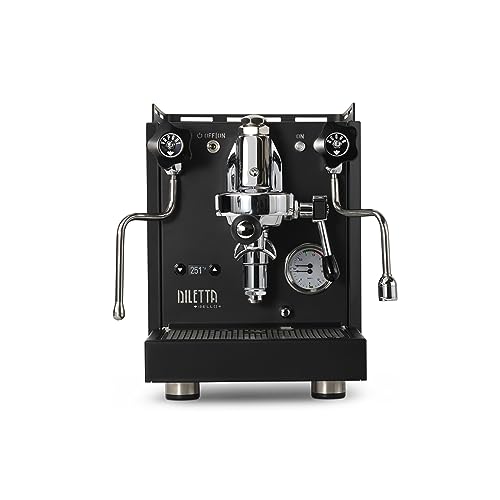
Diletta Bello+ Espresso Machine — Best Overall
The Bello+ is what a barista draws when asked to sketch a home machine: an E61 group head — the thermosyphon design that has defined espresso since 1961 — with PID temperature control displayed on a front screen that doubles as a shot timer, programmable pre-infusion, and a heat-exchange boiler that brews and steams simultaneously. Its listing states it is handmade in Italy, and the spec reads like a café checklist translated for a countertop.
Strengths
- E61 group with PID temperature control — set your brew temperature and hold it
- Programmable pre-infusion and a shot timer built into the PID display
- Heat-exchange boiler: pull shots and steam milk at the same time, like a café machine
Trade-offs
- Heat-exchange temperature management takes learning — flushing routines are part of E61 ownership
- E61 groups heat slowly; this is a machine you switch on ahead or put on a timer plug
- Premium prosumer tier, and it deserves a grinder of similar seriousness
| Group | E61, thermosyphon |
| Control | PID temperature control, shot timer (per listing) |
| Pre-infusion | Programmable |
| Boiler | Heat exchange — brew and steam simultaneously |
| Origin | Handmade in Italy (per listing) |
The E61’s magic is thermal mass and gentle physics: water circulates continuously through the massive group, holding it at brew temperature, and the mechanical pre-infusion chamber wets the puck progressively as the lever-cam opens. Layer a PID over the boiler and programmable pre-infusion over the group and you have the modern version of the formula — classic shot character with digital repeatability. For a barista, that combination is the point: the machine becomes a known instrument, so the variables you are exploring are the coffee’s, not the equipment’s.
Ownership has rituals — a cooling flush after idle periods, a warm-up you plan around, periodic group gasket care — and baristas tend to enjoy rather than resent them, because each one is the same ritual as the café’s, scaled down. If your home espresso ambition is a permanent station rather than an appliance, the Bello+ is the centrepiece this guide recommends without hesitation.
Best for: experienced home baristas who want the full E61, PID-controlled café workflow at home / Not suited for: anyone wanting espresso in five minutes from cold, or a machine that forgives guesswork
Check the current price on Amazon for the Diletta Bello+ Espresso Machine.

Breville Dual Boiler Espresso Machine (BES920XL) — Best Dual Boiler Control
The Dual Boiler is the machine Breville builds for people who read spec sheets: separate stainless steel boilers for brew and steam, an actively heated group head, precise PID temperature control, and a low-pressure pre-infusion that ramps gently to full pump pressure. Its listing’s included kit tells the story — a 58mm stainless portafilter, single and dual wall baskets, a dosing tool, a milk jug and a water hardness test strip. This is laboratory-grade home espresso.
Strengths
- Dual boilers give café workflow: extract and steam simultaneously, with instant recovery
- Precise, adjustable brew temperature with a heated group for shot-to-shot consistency
- 58mm commercial-format portafilter and a complete included accessory kit
Trade-offs
- A complex machine with more components to maintain and eventually service
- No built-in grinder — correctly, for this audience, but budget accordingly
- Large footprint and prosumer pricing
| Model | BES920XL Dual Boiler |
| Boilers | Dual stainless steel boilers (brew and steam) |
| Portafilter | 58mm stainless steel (per listing kit) |
| Power | 1700W (per listing) |
| Tank | 84 oz water tank (per listing) |
Repeatability is the Dual Boiler’s religion. Where a heat-exchange machine asks you to manage temperature with flushes, this machine simply holds the set temperature at the group, shot after shot, while the steam boiler sits ready at full pressure — so your fourth drink of a brunch service tastes like your first, and milk steaming never waits for a boiler to recover. For baristas running experiments — same coffee, three temperatures, two pre-infusion profiles — it is the most scientific instrument in this guide.
The trade is mechanical complexity and a ownership style closer to maintaining an instrument than an appliance: water quality matters (hence the included hardness strip), descaling is a real procedure, and servicing is a specialist job when it eventually comes. Baristas who accept that bargain get the closest thing to a commercial dual-boiler’s control that fits under a kitchen cabinet.
Best for: methodical baristas who prioritise temperature precision and simultaneous workflow / Not suited for: minimalists who want the fewest possible components between them and a shot
Check the current price on Amazon for the Breville Dual Boiler Espresso Machine (BES920XL).

Fellow Espresso Series 1 — Best Pressure Profiling
Fellow’s Espresso Series 1 is the machine in this guide designed by people who asked what a barista would build with modern electronics: pressure profiling — the ability to shape extraction pressure through the shot — on a 58mm portafilter, temperature control, heat-up in under two minutes per its title, and built-in shot feedback that detects fast or slow extractions and suggests grind adjustments. It is profiling, once a five-figure café feature, on a home counter.
Strengths
- Pressure profiling opens techniques — gentle starts, declining finishes — no other pick here offers
- Heats in under two minutes, ending the prosumer warm-up ritual
- Shot feedback system actively coaches consistency between drinks
Trade-offs
- A first-generation platform — early adopters carry the usual new-product unknowns
- Guided interface philosophy will grate on baristas who want purely mechanical control
- Premium tier pricing for a compact single-boiler-class footprint
| Portafilter | 58mm (per listing title) |
| Profiling | Pressure profiling |
| Heat-up | Under 2 minutes (per listing) |
| Control | Temperature control, guided presets, shot feedback |
| Steam | Steam wand for milk drinks |
Pressure profiling changes what espresso can taste like: a soft, low-pressure opening extracts sweetness without harshness, a full-pressure middle builds body, and a declining finish avoids the bitter tail — a curve you simply cannot pull on a fixed-pressure machine. Light-roast coffees, notoriously unforgiving, become dramatically more approachable. The Series 1 wraps that capability in guidance that shortens the learning curve without removing the control, which is exactly the balance a working barista teaching themselves profiling would design.
The honest caveats are about novelty, not capability. A first-generation machine from a company known for kettles and grinders is a different bet from a fifth-generation Italian design, in firmware, parts pipelines and resale alike. If you are the barista who profiles shots and reads extraction curves for fun, it is the most interesting machine in this guide. If you want the proven instrument, the Bello+ above is waiting.
Best for: experimental baristas who want pressure profiling and fast heat-up in one machine / Not suited for: traditionalists who prefer established, purely mechanical platforms
Check the current price on Amazon for the Fellow Espresso Series 1.
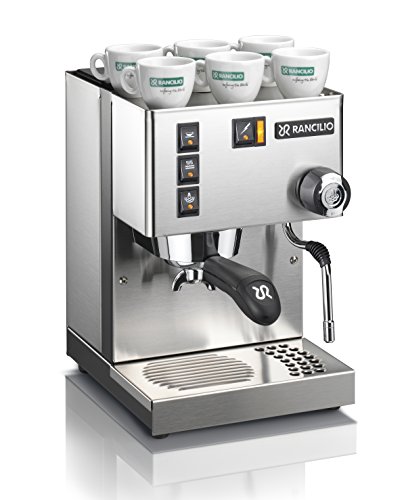
Rancilio Silvia Espresso Machine — Best Single-Boiler Classic
The Silvia is a legend with a spec sheet: an iron frame with stainless panels, a commercial-grade group head for heat stability, an ergonomic portafilter handle from Rancilio’s commercial machines, and an articulating steam wand with a professional steaming knob — all stated in its listing’s features. It is a single-boiler machine, so you brew, then steam, in sequence; within that discipline, it is built like the café equipment it descends from.
Strengths
- Commercial-grade group head and portafilter ergonomics from Rancilio’s professional line
- Iron frame and stainless panels — built to be serviced and kept, not replaced
- Articulating steam wand with precise manual control for real microfoam
Trade-offs
- Single boiler means a brew-steam sequence with a temperature wait between
- No PID as standard — temperature surfing is part of classic Silvia technique
- Unforgiving of sloppy puck prep; it will show you every channel in the cup
| Frame | Iron frame, stainless steel side panels |
| Group | Commercial-grade group head (per listing) |
| Steam | Articulating steam wand, professional steaming knob |
| Boiler | Single boiler — brew and steam in sequence |
| Footprint | Compact prosumer footprint |
Owning a Silvia is an education you can taste. Without electronic forgiveness, you learn temperature by routine — the famous temperature surf — and puck preparation by consequence, because the commercial group delivers exactly what your preparation deserves. Baristas who trained on one tend to speak of it the way musicians speak of a strict teacher: nothing was hidden, so everything was learned. The build supports that long relationship — a frame and panels that come apart for service, parts that exist because the model has been in production for decades.
The modern question is whether to add a PID (a thriving aftermarket exists) or step straight to the Bello+ or Dual Boiler. Our view: buy the Silvia if the craft discipline is the attraction and the price of entry matters; buy the PID machines if your goal is café output with café consistency from week one. Either way, the Silvia remains the benchmark single-boiler against which this category is judged.
Best for: baristas who want the classic, serviceable single-boiler and the technique it teaches / Not suited for: anyone wanting set-and-forget temperature or simultaneous milk drinks
Check the current price on Amazon for the Rancilio Silvia Espresso Machine.
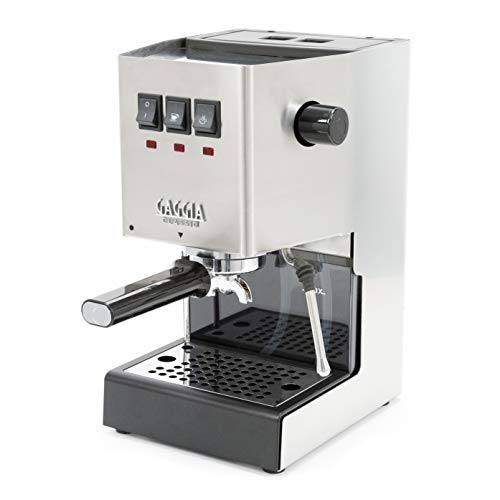
Gaggia Classic Pro E24 Espresso Machine (RI9380/46) — Best Value Pro Spec
Read the E24’s listing features aloud and you could be describing a café machine: solid steel housing, made in Italy, stainless steel 58mm commercial portafilter, a commercial three-way solenoid valve, and a commercial steam wand. The three-way solenoid is the detail baristas check first — it releases pressure after the shot, drying the puck for a clean knock-out and letting you pull back-to-back shots like a professional. No other machine near its tier offers the full list.
Strengths
- 58mm commercial portafilter — the professional standard, with the full accessory ecosystem
- Three-way solenoid valve for dry pucks and true back-to-back workflow
- Commercial steam wand and steel housing, made in Italy per the listing
Trade-offs
- Single boiler: brew and steam in sequence, with the usual temperature management
- Small water tank and drip tray need attention in heavy sessions
- Temperature stability is good for the class, not PID-class
| Model | RI9380/46 E24, brushed stainless steel |
| Portafilter | 58mm commercial, stainless steel (per listing) |
| Valve | Commercial three-way solenoid valve |
| Steam | Commercial steam wand |
| Origin | Made in Italy (per listing) |
The Classic Pro’s genius is that its compromises are about capacity, not capability. The group, portafilter, solenoid and wand — the parts that touch the coffee and define the technique — are professional pattern; the savings are in boiler size, tank size and electronics. A barista’s hands cannot tell the difference in the shot routine, only in the session length: two drinks are effortless, six drinks are a workout of refills and temperature waits. For home service, that trade is close to perfect.
It is also the most modifiable machine in this guide, with a vast owner community, documented PID retrofits and every gasket and screen available — a machine you can grow with for years. If the budget for machine-plus-grinder is fixed, the E24 is how you buy professional technique now and professional temperature control later, in that order, without replacing the machine.
Best for: baristas on a real-world budget who refuse to compromise on the professional fundamentals / Not suited for: households pulling many back-to-back milk drinks
Check the current price on Amazon for the Gaggia Classic Pro E24 Espresso Machine (RI9380/46).
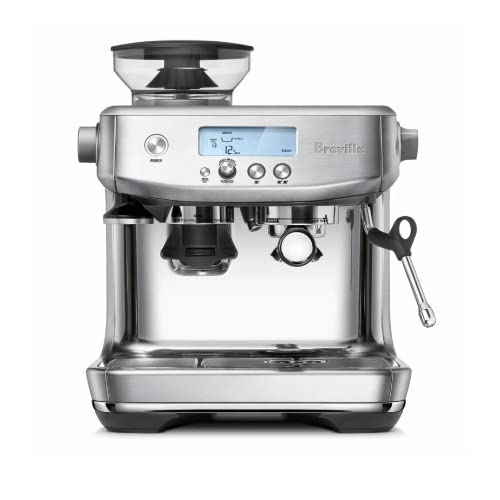
Breville Barista Pro Espresso Machine (BES878) — Best With Built-In Grinder
Most machines in this guide assume a separate grinder, as café machines do. The Barista Pro is the exception for baristas whose space or workflow demands one box: its listing describes an integrated precision conical burr grinder that doses on demand, ThermoJet heating for near-instant readiness, and a powerful manual steam wand for hand-textured microfoam and latte art. It is a complete espresso station that still leaves the craft — dosing, distribution, tamping, steaming — in your hands.
Strengths
- Integrated conical burr grinder with on-demand dosing — a genuine one-footprint station
- ThermoJet heat-up in seconds, with shot-to-shot speed no boiler machine here matches
- Manual steam wand with real microfoam power for latte art practice
Trade-offs
- The built-in grinder is good, not great — a dedicated grinder remains the upgrade path
- Thermoblock workflow: brew and steam in sequence
- 54mm Breville portafilter format, outside the 58mm commercial ecosystem
| Model | BES878 Barista Pro |
| Grinder | Integrated precision conical burr grinder |
| Heating | ThermoJet, near-instant |
| Steam | Manual steam wand, microfoam capable |
| Portafilter | 54mm Breville format |
The Barista Pro’s argument is workflow integrity. Grind, dose, tamp, extract, texture — one machine, one footprint, no transfer between stations, and a heat-up so fast the station is always on. For a working barista’s home kitchen, where the ritual is a morning constant rather than a weekend project, that integration has real value, and the manual controls keep it honest: the machine assists with grinding and heating, never with judgement.
Its ceiling is the grinder, as with all integrated designs — excellent for fresh, consistent home espresso, a step behind a dedicated prosumer grinder for the lightest, trickiest coffees. Many owners run it for years as-is; others add a single-dose grinder later and keep the Pro as the station’s engine. Either path is respectable, and for space-constrained baristas this is the one-box answer that does not insult the craft.
Best for: space-limited baristas who want a complete, fast, manual station in one footprint / Not suited for: 58mm purists, or anyone planning a top-tier separate grinder from day one
Check the current price on Amazon for the Breville Barista Pro Espresso Machine (BES878).
Comparison Table
| Pick | Badge | Key spec | Best for |
|---|---|---|---|
| Diletta Bello+ Espresso Machine | Best Overall | E61 group, PID, programmable pre-infusion | experienced home baristas who want the full E61, PID-controlled café workflow at home |
| Breville Dual Boiler Espresso Machine (BES920XL) | Best Dual Boiler Control | Dual boiler, PID, 58mm portafilter | methodical baristas who prioritise temperature precision and simultaneous workflow |
| Fellow Espresso Series 1 | Best Pressure Profiling | Pressure profiling, 58mm, sub-2-min heat-up | experimental baristas who want pressure profiling and fast heat-up in one machine |
| Rancilio Silvia Espresso Machine | Best Single-Boiler Classic | Commercial group, iron frame, single boiler | baristas who want the classic, serviceable single-boiler and the technique it teaches |
| Gaggia Classic Pro E24 Espresso Machine (RI9380/46) | Best Value Pro Spec | 58mm portafilter, 3-way solenoid, made in Italy | baristas on a real-world budget who refuse to compromise on the professional fundamentals |
| Breville Barista Pro Espresso Machine (BES878) | Best With Built-In Grinder | Built-in burr grinder, ThermoJet, manual wand | space-limited baristas who want a complete, fast, manual station in one footprint |
Lever Machines and Other Roads Not Taken
Two honourable omissions deserve explanation, because barista readers will look for them. Lever machines — we verified listings for La Pavoni’s Europiccola and Professional models through the same API — offer the most direct pressure control of all: your arm is the profile. They are magnificent instruments and a genuine barista tradition, but their listings and their nature centre on individual craft over the repeatable, settable control this guide ranked for, and their temperature management is an advanced art in itself. Readers drawn to them will find them covered in our lever-machine guide, linked from the final recommendation.
The second omission is automation at the top end, represented in our checks by Breville’s Oracle Touch: a superb machine that grinds, tamps and textures milk automatically. It is excluded not on quality but on definition — a barista’s machine must leave the variables in the barista’s hands. If your household contains both a barista and several people who simply want lattes, the honest two-machine answer (an automatic for the house, a manual for the craft) is a pattern this guide endorses without irony.
How to Choose an Espresso Machine as a Barista
Shop for variables, not drinks menus. The questions that separate these machines are: Can I set and hold brew temperature? (PID or dual boiler versus surfing a single boiler.) Can I shape pressure? (Profiling on the Fellow, pre-infusion curves elsewhere.) Can I brew and steam at once? (Dual boiler and heat-exchange yes; single boilers no.) Is the portafilter the 58mm commercial standard, with its universe of baskets and tampers? A machine that answers your questions yes is a barista’s machine; the drinks are downstream of the answers.
The grinder is not an accessory
Every machine in this guide — the Barista Pro’s integrated unit partially excepted — assumes a grinder budget that beginners find shocking and baristas find obvious. Espresso grind adjustment happens in microns, and the difference between a choked shot and a gushing one is a fraction of a turn. Allocate for a grinder with stepless or fine-stepped adjustment, low retention and a burr set sized for espresso duty, or the finest machine here will spend its life under-extracting your intentions. Machine second, grinder first is a cliché because it keeps being true.
Serviceability is a feature
Barista machines live hard lives of heat cycles and pressure, and the ones worth owning are the ones that can be maintained: standard group gaskets, available solenoids and pumps, manuals and parts diagrams, an owner community that has documented every failure mode. The Italian picks and the Silvia score heavily here. Before buying any prosumer machine, spend ten minutes checking that its wear parts are findable — that ten minutes is worth more than any extended warranty.
Barista Workflows: Matching the Machine to Your Service
Think in services, not shots. A solo morning espresso rewards heat-up speed and simplicity — the Fellow’s two-minute readiness or even the Silvia’s ritual. A two-person flat-white routine rewards steam recovery and either simultaneous boilers or a heat exchanger, because milk waits for no thermoblock. A brunch for six is where dual boilers and the Bello+ earn their tiers outright, and where single-boiler owners learn to sequence drinks like a café: shots first, milk in one big batch, serve together.
None of these workflows is the “right” one — but buying the machine for the service you actually run is the difference between a station that delights daily and a specification that impresses once. Be honest about your mornings, and let the picks above sort themselves.
Temperature, Pressure, Time: The Barista’s Three Dials
Every machine in this guide is a different arrangement of three dials. Temperature decides which compounds extract eagerly: cooler water favours brightness and can under-extract into sourness; hotter water pulls deeper, darker flavours and tips into bitterness. PID machines (Bello+, Dual Boiler, Fellow) let you set this dial numerically; single-boiler classics (Silvia, Gaggia E24) ask you to find it by routine. Neither is morally superior — but you should know which game you are playing before you buy, because switching games means switching machines.
Pressure is the dial the Fellow Series 1 reopens. The classic 9-bar extraction is a convention, not a law, and profiling — soft openings, declining finishes — demonstrably changes what light roasts and delicate coffees give up. Pre-infusion, present across this guide in mechanical (E61), programmed (Bello+, Dual Boiler) and automatic (Barista Pro) forms, is profiling’s first chapter: a gentle wetting that prevents the channeling no amount of tamping fully eliminates. Time, the third dial, is the one you already own: a scale and a timer turn recipes into records, and records into repeatability.
The working method that unifies all three: change one dial, record the result, taste against the last shot. Baristas are sometimes imagined as artists and sometimes as engineers; in practice they are experimentalists with good notebooks, and the machines in this guide are simply the benches that make the experiments clean.
Maintenance Rituals That Keep a Pro Machine Honest
Barista machines repay a maintenance rhythm that mirrors the café’s, compressed. Daily: backflush with water after the last shot, purge and wipe the wand the moment milk leaves it, and empty the drip tray before it becomes a science project. Weekly: backflush with espresso-machine detergent, soak the portafilter and baskets, and scrub the shower screen. Seasonally: inspect the group gasket for hardness and cracking, check the anti-vacuum and safety valves’ behaviour, and descale on the schedule your water hardness dictates rather than the calendar’s.
None of this is optional garnish on machines at this level, because the failure modes are cumulative: coffee oils varnish into rancid flavours inside a neglected group, milk bakes into wand tips one drink at a time, and scale narrows boiler passages until temperature and flow both drift — at which point owners blame the machine for what the calendar did. The picks in this guide were chosen partly for maintainability: standard parts, documented procedures, communities that have published every fix. Fifteen minutes a week is the rent on café performance at home, and it is cheaper than the alternative in every currency.
Keep a small parts drawer from day one: a spare group gasket, a shower screen, the correct descaler and a food-safe lubricant for E61 cams and lever mechanisms where applicable. When a gasket eventually weeps mid-service, the barista with the drawer loses ten minutes; the barista without one loses a week of mornings to a delivery estimate. Professionalism, at home as in the café, is mostly preparation wearing an apron.
Setting Up a Barista Station at Home
A barista’s home station succeeds or fails on layout before it succeeds on equipment. The working triangle is grinder, machine, sink — in that order of daily traffic — with the knock box and cloth living between machine and sink, and cups stored warm-side up within one step of the group head. Water management deserves the same forethought as the machine choice: a filled jug station for boiler machines, filter cartridges on a calendar rather than a guess, and a drip-tray routine that never lets a session end with a full tray. These are café habits transplanted, and they are why two identical machines produce different ownership experiences in different kitchens.
Lighting and measurement finish the station. A scale that fits under your cup on the drip tray, a timer you can start with wet hands, and light good enough to read a puck’s surface turn the station from a shrine into a bench. Add a small notebook or a notes app habit — coffee, dose, yield, time, one tasting word — and you have replicated the entire professional feedback system at home scale. The machines in this guide supply the pressure and the heat; the station supplies the repeatability, and repeatability is the whole craft.
How to Dial In a New Coffee on a Barista Machine
Dialing in — adjusting grind, dose and yield until a new coffee tastes balanced — is the core barista skill, and every machine in this guide supports the same disciplined method.
- Fix your constants first: an 18-gram dose in the double basket, a 1:2 ratio target (36 grams of espresso out), water at your machine’s set temperature, and a consistent distribution and tamp routine. Only the grind changes from here.
- Pull the first shot and time it. Aim for the target yield in roughly 25–30 seconds from pump start, pre-infusion included on machines that have it.
- Taste before you adjust. Sour, salty and thin usually means under-extraction (too fast); bitter, dry and hollow usually means over-extraction (too slow). Let the taste confirm what the timer suggested.
- Adjust the grind one small step — finer if fast and sour, coarser if slow and bitter — purge a little ground coffee through the grinder, and pull again with everything else identical.
- Once time and taste agree, fine-tune with ratio: a slightly longer pull (1:2.2) sweetens many light roasts; a shorter ristretto-style pull (1:1.8) intensifies dark, chocolatey coffees. On profiling machines, experiment last with a gentler opening pressure for delicate beans.
- Record the recipe — coffee, dose, yield, time, grind setting, temperature — on the bag or a notebook. A written recipe is what turns one great shot into a repeatable service.
Dialing in wastes a few shots by design; budget the first 100 grams of any new bag as tuition. The baristas whose espresso you admire pay the same tuition on every coffee — they just pay it systematically.
Common Buying Mistakes
Buying the machine and starving the grinder
A prosumer machine fed by a basic grinder produces expensive frustration: shots that channel, gush and choke within the same bag. The grinder sets the ceiling for everything in this guide. If the total budget is fixed, step the machine down a pick and the grinder up — the cup will be better for it every day.
Judging a machine by its first week
New machines, new grinders and new coffees all need dialing in, and E61 and single-boiler machines additionally need their routines learned. A fortnight of systematic shots is the fair trial. Most “disappointing” prosumer machines are undialled, not incapable.
Ignoring water
Scale is the leading cause of prosumer machine failure, and over-mineralised or distilled water also ruins extraction chemistry. Use water you would happily drink, filtered to the machine maker’s guidance — the Dual Boiler even ships a hardness test strip to make the point. Descale on schedule, not on symptoms.
Chasing every variable at once
Changing grind, dose, temperature and profile in the same morning produces data you cannot interpret. Barista method is one variable at a time, recorded. The machines here give you many levers precisely so you can move them one by one.
Final Recommendation
The Diletta Bello+ is this guide’s centre of gravity — E61, PID, programmable pre-infusion, handmade in Italy — with the Breville Dual Boiler beside it for those who prize laboratory repeatability and simultaneous workflow. The Fellow Series 1 is the future-facing pick for profiling experimenters, the Rancilio Silvia the classic single-boiler education, the Gaggia Classic Pro E24 the professional checklist at the kindest tier, and the Barista Pro the one-footprint station for baristas without room for a separate grinder.
Round out the picture with Best Espresso Machines For Home Use for the broader home field these machines top, Best Espresso Machines For 300 Dollars to see how far the entry frame stretches, Best Espresso Machines For Every Day Use for the convenience end of the spectrum, Best Espresso Machines For Commercial Use if your ambitions outgrow the kitchen, and Best 1 Group Lever Espresso Machines for the fully manual path.
Start your shortlist with the top three picks: Diletta Bello+ Espresso Machine, Breville Dual Boiler Espresso Machine (BES920XL), Fellow Espresso Series 1 — each link goes to the current listing so you can check the current price on Amazon and confirm the piece list before you buy.
Frequently Asked Questions
What makes an espresso machine a “barista” machine?
Control and feedback: a commercial-format portafilter (58mm on most picks here), temperature that can be set or at least managed, honest pressure delivery, a steam wand with real power, and construction that can be serviced. Fully automatic machines remove those variables on purpose, which is why none appear in this guide regardless of price.
Is a dual boiler better than a heat-exchange machine?
They solve the same problem — brewing and steaming at once — differently. A dual boiler (Breville BES920) holds brew temperature directly and precisely. A heat-exchange machine (Diletta Bello+) uses one large boiler with a brew-water heat exchanger, giving enormous steam capacity with temperature managed by routine. Baristas thrive on both; choose by whether you value set-and-forget precision or classic E61 character and steam.
Why does the 58mm portafilter matter?
It is the commercial standard, so baskets, precision tampers, distribution tools and replacement parts exist in depth, and the wide, shallow puck geometry is forgiving of distribution. Machines here with 58mm portafilters (Gaggia E24, Fellow Series 1, Breville Dual Boiler, and the E61 Bello+) plug straight into that ecosystem.
What does a three-way solenoid valve do?
At the end of the shot it vents the pressure above the puck to the drip tray, instantly stopping extraction and drying the puck so it knocks out cleanly. It is a small component that signals professional intent — the Gaggia E24’s listing highlights it — because it enables tidy back-to-back workflow and protects against pressure-related mess.
How important is PID temperature control?
It converts temperature from a routine you manage into a number you set, which matters most for light roasts and for repeatability across a session. Skilled baristas produce great espresso without it — the Silvia’s decades of devotees prove that — but PID removes a whole category of variance, and every flagship pick in this guide includes it.
What grinder should pair with these machines?
An espresso-capable burr grinder with fine, repeatable adjustment and low retention, sized to your routine: single-dose grinders suit bean-swappers and experimenters; hopper-fed grinders suit one-house-blend households. The Barista Pro’s integrated grinder is the exception that proves the rule — capable for its station, and the first upgrade its owners eventually make.
Should a working café barista buy the same machine for home?
Usually a smaller one. Café skills transfer completely, but home service is two drinks, not two hundred — so heat-up speed and footprint (Fellow, Barista Pro) often matter more at home than boiler capacity. Baristas who want to keep café rituals sharp choose the E61 or Dual Boiler; baristas who want café-quality drinks without café process choose the fast machines. Both instincts are professional.
How do I choose between the E61 Bello+ and the Breville Dual Boiler?
Choose by temperament and service pattern. The Bello+ offers the classic E61 extraction character, enormous steam from its heat exchanger and mechanical longevity, with temperature managed by routine. The Dual Boiler offers set-and-forget numerical temperature, simultaneous workflow and the most repeatable experiments, with more electronics in the loop. Café traditionalists land on the E61; methodical experimenters land on the dual boiler. Both are defensible endgame home machines.
What water should a barista machine drink?
Water with moderate mineral content — enough for proper extraction chemistry and for the machine’s level sensors to read correctly, not so much that scale builds quickly. Filtered tap water is the home standard; the Dual Boiler in this guide even ships a hardness test strip so owners can measure rather than guess. Whatever you choose, be consistent: changing water changes extraction, and a barista’s notebook assumes the water is a constant.
Do these machines hold their value?
Established prosumer models from serviceable brands historically hold value far better than consumer appliances, because they can be maintained indefinitely with standard parts. The Italian machines and the Silvia in this guide are the strongest examples — decades-old units still trade and still get serviced. Treat resale as a soft benefit rather than a reason to buy, but it is real, and it is another argument for choosing the maintainable machine over the sealed one.
Is an E61 machine difficult to live with day to day?
It asks for two habits: warm-up time (most owners use a timer plug so the group is heat-soaked before the first drink) and a short cooling flush after long idle periods on heat-exchange models. In exchange it delivers the most tactile, traditional extraction in this guide and a steam capacity that embarrasses smaller machines. Baristas who enjoy ritual call this character; baristas who want speed choose the Fellow or the Barista Pro. Neither answer is wrong.
What is the first upgrade after buying one of these machines?
Almost always the grinder, if it is not already at the machine’s level — followed by a precision basket and a scale you trust. Machine-side, the classic first services are a fresh group gasket and shower screen on a used purchase. Resist the accessory spiral until your notebook shows consistent recipes; upgrades compound on consistency and evaporate on chaos.


