Disclosure: airfryerkitchensupply.com is reader-supported. When you buy through links on our site, we may earn an affiliate commission at no extra cost to you.
Where to buy
Every pick below was cross-checked against the Amazon catalog before it earned a link, so the buying box stays simple: while comparing the best coffee makers that make really hot coffee, start with the Technivorm Moccamaster KBGV Select 10-Cup if you want the safest all-round choice, then compare the specialist picks underneath it. Prices move, so each pick links out with a prompt to check price on Amazon rather than a printed number that would be stale within weeks.
- Technivorm Moccamaster KBGV Select 10-Cup — Best Overall for Hot Coffee: Check on Amazon — check price on Amazon
- Bonavita 8 Cup Coffee Maker BV1900TS — Best Value Hot Brewer: Check on Amazon — check price on Amazon
- BUNN BT Speed Brew 10-Cup Thermal — Best for Speed and Heat: Check on Amazon — check price on Amazon
- Cuisinart DCC-3200 PerfecTemp 14-Cup — Best Large Hot Pot: Check on Amazon — check price on Amazon
- Mr. Coffee 10-Cup Programmable Thermal Carafe Maker — Best Budget Hot: Check on Amazon — check price on Amazon
- Café Specialty Drip Coffee Maker 10-Cup — Best Customisable Heat: Check on Amazon — check price on Amazon
If you are hunting for the best coffee makers that make really hot coffee, you have probably already discovered the dirty secret of the category: many drip brewers never get their water hot enough to extract properly, and their carafes arrive at the mug merely warm. Brewing science puts the ideal extraction window at roughly 195–205°F, and the six machines below are the ones whose designs — certified, specified or purpose-built — actually respect it.
Every pick was verified against the Amazon catalog before receiving a link, and where a listing itself states a temperature range or a hotter-brewing claim, the spec box quotes it. Where it does not, the review explains the design reason the machine belongs here rather than inventing a number.
In this guide
Quick Picks
Technivorm Moccamaster KBGV Select 10-Cup — Best Overall for Hot Coffee. The hand-built Dutch brewer famous for holding proper brewing temperature — the reference point every hot-coffee claim gets judged against. Check on Amazon — check price on Amazon.
Bonavita 8 Cup Coffee Maker BV1900TS — Best Value Hot Brewer. SCA-certified brewing temperature with a thermal carafe that keeps the pot hot without cooking it — the value pick of the serious brewers. Check on Amazon — check price on Amazon.
BUNN BT Speed Brew 10-Cup Thermal — Best for Speed and Heat. BUNN’s home Speed Brew keeps its water hot and ready around the clock, so a full thermal carafe brews in minutes and pours hot immediately. Check on Amazon — check price on Amazon.
Cuisinart DCC-3200 PerfecTemp 14-Cup — Best Large Hot Pot. The big-family answer: PerfecTemp hotter brewing, a 14-cup carafe and an adjustable warming plate so the last cup is as hot as the first. Check on Amazon — check price on Amazon.
Mr. Coffee 10-Cup Programmable Thermal Carafe Maker — Best Budget Hot. The budget hot pick whose listing promises exactly what this search wants — brews hotter and faster — with a thermal carafe and a strong-brew selector. Check on Amazon — check price on Amazon.
Café Specialty Drip Coffee Maker 10-Cup — Best Customisable Heat. The control freak’s brewer: precision temperature control across a listed 185–205°F range, four strength modes and SCA credentials. Check on Amazon — check price on Amazon.
How These Picks Were Chosen
Temperature claims were treated with suspicion by design. Machines qualified through specialty certification (SCA), through a manufacturer-stated temperature range or hotter-brewing system in the verified listing, or through a heating design — always-hot tank, copper element discipline — with an established record of full-temperature brewing.
Holding temperature was judged separately from brewing temperature, because a machine can brew hot and then let the pot go lukewarm, or stew it on a plate. Thermal carafes, adjustable plates and tank designs each appear, with their holding behaviour described honestly per pick.
Capacity and programmability were deliberately not allowed to outrank temperature. A 14-cup programmable pick is here because it also brews hotter — not as a general recommendation wearing a temperature badge.
The 6 Best coffee makers that make really hot coffee

Technivorm Moccamaster KBGV Select 10-Cup — Best Overall for Hot Coffee
If serving temperature is the whole question, the Moccamaster is the answer the coffee world gives first. Technivorm builds these brewers around a copper heating element designed to bring water to a proper brewing temperature quickly and hold it there through the whole cycle — the discipline most drip machines quietly fail. The result in the cup is twofold: fuller extraction while brewing, and coffee that arrives in the mug genuinely hot rather than merely warm.
The KBGV Select adds a half/full carafe selector to the classic formula, and the machine’s honest, mechanical character is part of its appeal: a switch, a selector, no app, no screen. It is a premium, long-service machine with replaceable parts and a price tier to match. Buyers who want programmability should look elsewhere in this list; buyers who want the hottest, most consistent drip brew available at home start and usually end here.
Strengths
- Brewing temperature discipline is the machine’s founding purpose
- Fast, full-pot brewing without temperature sag
- Simple, repairable, long-service mechanical design
Trade-offs
- Premium tier pricing
- No timer or programmability
- Glass carafe model needs its hot plate managed thoughtfully
| Spec (from verified listing) | 10-cup coffee maker, 40 ounce / 1.25 litre, Polished Silver per verified listing title |
|---|
Best for: drinkers for whom serving temperature is non-negotiable / Not suited for: anyone wanting to schedule coffee the night before
Check on Amazon — check price on Amazon.

Bonavita 8 Cup Coffee Maker BV1900TS — Best Value Hot Brewer
Bonavita built its reputation on a simple promise: specialty-standard brewing temperature without specialty pricing. The BV1900TS carries SCA certification, which means its brewing temperature and extraction have been measured against the specialty coffee standard rather than merely asserted in marketing. Its pre-infusion mode lets fresh grounds bloom before the main brew, a detail borrowed from pour-over practice that genuinely improves the cup.
The thermal carafe is the other half of the hot-coffee story. Instead of sitting on a warming plate slowly stewing, the brewed coffee waits in an insulated stainless carafe and stays serving-hot by keeping its heat in, not by adding more. For households that drink a pot over an hour or two, that is the difference between a second cup that tastes like the first and one that tastes like a diner at closing time.
Strengths
- SCA Certified temperature and extraction performance
- Thermal carafe holds heat without stewing the coffee
- Pre-infusion bloom mode for fresher, fuller cups
Trade-offs
- 8-cup capacity is smaller than family-size brewers
- No programmability or auto-start
- Thermal carafe needs prompt rinsing to stay fresh
| Spec (from verified listing) | 8-cup coffee maker with thermal carafe, one-touch pour-over style brewing, SCA Certified per verified listing title |
|---|
Best for: value-focused drinkers who want certified-hot brewing / Not suited for: large households needing a 12- to 14-cup pot
Check on Amazon — check price on Amazon.

BUNN BT Speed Brew 10-Cup Thermal — Best for Speed and Heat
BUNN’s approach to hot coffee is industrial logic brought home: keep a reservoir of water at brewing temperature at all times, and a pot can brew the moment you ask. The BT Speed Brew pairs that always-hot tank with a thermal carafe, so the coffee is brewed fast at full temperature and then held hot by insulation. For households where coffee is requested unpredictably all day — shift workers, home offices, multi-generational homes — the readiness is transformative.
The trade is written into the design: an always-hot tank uses standby energy and asks to be kept filled and used regularly, so it suits daily-drinking homes far better than weekend-only ones. It is also a deliberately simple machine — no programmes, no settings to speak of. What it does, it does at temperature and at speed, which is precisely this search.
Strengths
- Always-ready hot tank brews a full pot in minutes
- Thermal carafe keeps coffee hot without a warming plate
- Commercial-bred simplicity and durability
Trade-offs
- Standby energy use from the always-hot reservoir
- No programmability or brew customisation
- Best suited to daily use, not occasional brewing
| Spec (from verified listing) | Speed Brew 10-cup thermal carafe home coffee brewer per verified listing title |
|---|
Best for: all-day coffee households that hate waiting / Not suited for: occasional drinkers and feature customisers
Check on Amazon — check price on Amazon.

Cuisinart DCC-3200 PerfecTemp 14-Cup — Best Large Hot Pot
Cuisinart aimed the DCC-3200 squarely at the lukewarm-pot complaint. Its PerfecTemp system brews hotter than the brand’s standard machines — the verified listing says so in as many words — and the adjustable warming plate lets you choose how aggressively the pot is kept hot afterwards. Combined with a 14-cup capacity, full programmability and brew-strength control, it is the most complete large-pot package in this list for households whose priority is a big, hot, ready pot.
Glass carafe plus warming plate is the classic arrangement, with the classic caveat: coffee held on a hot plate for hours slowly cooks. The adjustable plate temperature softens that trade considerably, and households that finish a pot within a couple of hours will simply enjoy pot after pot at proper temperature. For all-day holding, a thermal model above is the better tool.
Strengths
- PerfecTemp system brews demonstrably hotter
- 14-cup capacity serves families and gatherings
- Adjustable warming plate tempers the stewing trade-off
Trade-offs
- Glass carafe coffee still degrades over long holding
- Large footprint on the counter
- More settings than minimalist drinkers want
| Spec (from verified listing) | Programmable 14-cup glass carafe coffee maker; PerfecTemp hotter brewing with adjustable warming plate per verified listing title |
|---|
Best for: large households wanting a big, hot, programmable pot / Not suited for: slow all-day sippers better served by a thermal carafe
Check on Amazon — check price on Amazon.
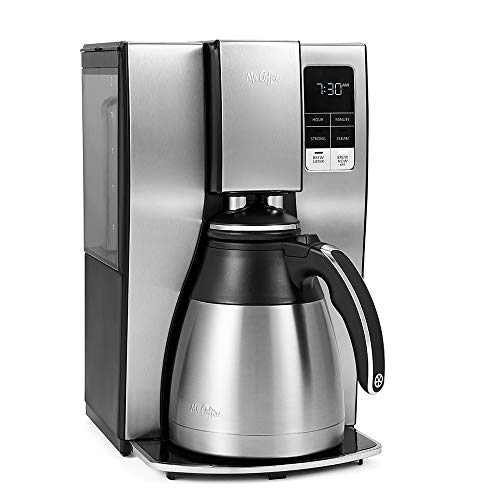
Mr. Coffee 10-Cup Programmable Thermal Carafe Maker — Best Budget Hot
Mr. Coffee’s thermal 10-cup machine is the accessible route into properly hot coffee. Its verified listing leads with the two claims that matter here — it brews hotter and faster — and then adds the features that make hotter coffee useful: an insulated thermal carafe to hold the temperature without a plate, a strong brew selector for drinkers who like their hot coffee assertive, and auto pause for the impatient first cup. Programmability rounds out a package that covers the whole keyword at a budget tier.
At this tier the compromises are materials and refinement rather than function: plastics where premium machines use steel, and a less polished fit overall. The thermal carafe also rewards prompt pre-warming and rinsing. Judge it as what it is — the least expensive honest answer to the hot-coffee brief — and it is a very easy recommendation.
Strengths
- Brews hotter and faster, per the verified listing
- Thermal carafe holds temperature without stewing
- Strong brew selector and programmability at a budget tier
Trade-offs
- Build materials reflect the price tier
- Carafe performance improves with pre-warming
- Brand support and longevity a step below premium picks
| Spec (from verified listing) | 10-cup programmable maker with insulated thermal carafe; brews hotter and faster, strong brew selector, auto pause per verified listing title |
|---|
Best for: budget buyers who refuse to accept lukewarm coffee / Not suited for: shoppers prioritising premium materials and finish
Check on Amazon — check price on Amazon.

Café Specialty Drip Coffee Maker 10-Cup — Best Customisable Heat
Where other machines promise ‘hotter’, the Café Specialty hands you the thermostat. Its verified listing specifies precision brew control across a 185–205°F range — the full span from delicate lighter roasts at the cooler end to the hottest extractions at the top — alongside four strength modes and SCA recognition. For the drinker who has a preferred temperature and wants it repeated exactly, no other pick here offers this level of deliberate control.
It also brews hot or iced, adding versatility the pure temperature specialists lack. The considerations are price tier and complexity: this is a premium, settings-rich machine for someone who will actually use the control. If your household’s entire temperature requirement is ‘make it hot’, the Moccamaster or Bonavita deliver it more simply.
Strengths
- Adjustable brewing temperature across a listed 185–205°F range
- Four strength modes plus hot-or-iced versatility
- SCA-recognised specialty brewing credentials
Trade-offs
- Premium tier pricing
- Settings depth is overkill for set-and-forget drinkers
- Glass carafe rather than thermal holding
| Spec (from verified listing) | Specialty drip maker, 10-cup glass carafe, hot or iced, SCA listed, with precision brew control and 185-205°F temperature range per verified listing title |
|---|
Best for: precise drinkers who want to set their exact brew temperature / Not suited for: anyone who wants hot coffee with zero decisions
Check on Amazon — check price on Amazon.
Comparison Table
Read this table by heating design: certified brewers, an always-hot tank, a hotter-brewing pot system, a budget thermal and a precision-control machine are six different routes to the same hot cup. If you read one row closely, read the BUNN BT Speed Brew 10-Cup Thermal (Check on Amazon) — it is the pick readers most often underestimate.
| Pick | Badge | Key spec | Best for |
|---|---|---|---|
| Technivorm Moccamaster KBGV Select 10-Cup (Check on Amazon) | Best Overall for Hot Coffee | 10-cup, 1.25 L | drinkers for whom serving temperature is non-negotiable |
| Bonavita 8 Cup Coffee Maker BV1900TS (Check on Amazon) | Best Value Hot Brewer | 8-cup thermal, SCA Certified | value-focused drinkers who want certified-hot brewing |
| BUNN BT Speed Brew 10-Cup Thermal (Check on Amazon) | Best for Speed and Heat | 10-cup thermal, speed brew | all-day coffee households that hate waiting |
| Cuisinart DCC-3200 PerfecTemp 14-Cup (Check on Amazon) | Best Large Hot Pot | 14-cup, hotter brewing, adjustable plate | large households wanting a big, hot, programmable pot |
| Mr. Coffee 10-Cup Programmable Thermal Carafe Maker (Check on Amazon) | Best Budget Hot | 10-cup thermal, brews hotter | budget buyers who refuse to accept lukewarm coffee |
| Café Specialty Drip Coffee Maker 10-Cup (Check on Amazon) | Best Customisable Heat | Precision temp control, SCA | precise drinkers who want to set their exact brew temperature |
How to Choose a Coffee Maker That Makes Really Hot Coffee
Start by separating two temperatures that marketing merges: brewing temperature and serving temperature. Brewing temperature — the water hitting the grounds — decides extraction and flavour, and belongs in the mid-190s to low-200s Fahrenheit. Serving temperature is what survives the carafe, the mug and the milk. A machine can ace the first and fail the second, so judge both: how it heats, and how it holds.
For holding, the honest ranking is thermal carafe first, adjustable warming plate second, fixed hot plate last. Insulation keeps coffee hot by conserving heat; plates keep adding heat and slowly cook the coffee. If your household drinks a pot within the hour, any system works. Over two or more hours, thermal is the only method whose last cup still tastes like the first.
Why So Many Coffee Makers Brew Too Cool
Most inexpensive drip brewers use small heating elements that struggle to push a full reservoir to proper extraction temperature, especially in the first minutes of the cycle. The coffee that results is doubly disappointing: under-extracted, so it tastes sour and thin, and served warm rather than hot, so it feels stale from the first sip. Owners often blame the beans for what is actually a thermometer problem.
Serious brewers solve it with heating discipline: powerful elements with controlled flow, certified temperature profiles, or BUNN’s always-hot reservoir that removes warm-up from the equation entirely. That engineering is most of what the premium tiers in this category actually buy — not features, but degrees.
Serving Habits That Keep Coffee Hotter
The machine is only half the system. Pre-warm the carafe with hot water before brewing and a thermal pot holds its temperature markedly longer. Warm the mug, too — a cold ceramic mug is a heat sink that can strip the first pour of its edge. Add cold milk after pouring rather than expecting the brewer to compensate, and consider milk warmed separately if you take a lot of it.
Finally, brew the amount you will drink. A half-pot made fresh at midday beats a full morning pot reheated at three o’clock by every measure — flavour, temperature and honesty. Machines with small-batch or half-carafe settings, like the Moccamaster KBGV Select, exist precisely for that habit.
How to Set Up a Coffee Maker for the Hottest Possible Cup
Whatever model you choose, these setup habits extract the most heat its design can give. None of them cost anything.
- Start with cold, fresh water in the reservoir — hot tap water is often stale-tasting and can confuse temperature-regulated brewers.
- Pre-warm a thermal carafe (or glass carafe) with hot tap water while you measure coffee, and empty it just before brewing.
- Use the machine’s full-temperature or strong programme for the first brew of the day, when the machine is coldest.
- Warm your mug with hot water while the pot brews; pour the water out just before filling the mug.
- Serve promptly, close the thermal carafe lid fully between pours, and keep the carafe off cold stone counters if it will sit.
- If the first cup still disappoints, descale the machine — mineral scale on a heating element is the most common hidden cause of falling temperatures.
If temperatures still sag after descaling and pre-warming, the brewer’s element itself is the limit — and that is exactly the upgrade case for the certified and precision machines in this roundup.
Common Buying Mistakes
Judging temperature by the first sip from a cold mug. A cold mug steals heat instantly. Pre-warm the vessel before concluding the machine brews cool.
Leaving coffee on a hot plate for hours. Plates hold temperature by cooking the coffee. After a couple of hours the cup is hot and unpleasant; a thermal carafe is the fix.
Never descaling. Scale insulates the heating element from the water. A machine that once brewed hot and now brews warm is usually a machine asking for descaler.
Assuming a bigger number on the box means hotter coffee. Advertised wattage and pressure figures do not certify brewing temperature. Look for SCA certification or a stated temperature range.
Brewing a full pot for one cup. Coffee held for hours degrades however it is stored. Use small-batch settings or a smaller brewer for solo cups.
Final Recommendation
For the definitive hot drip coffee, the Moccamaster is the recommendation, with the SCA-certified Bonavita as the value alternative and the Café Specialty for drinkers who want to set the exact degree. BUNN’s Speed Brew owns all-day readiness, the Cuisinart DCC-3200 serves big households a hotter programmable pot, and the Mr. Coffee thermal proves the keyword can be satisfied on a budget. Choose by holding style — thermal versus plate — and any of the six will end your lukewarm era.
Start with the Technivorm Moccamaster KBGV Select 10-Cup (Check on Amazon) if you want the safest first choice, or the Bonavita 8 Cup Coffee Maker BV1900TS (Check on Amazon) if its badge matches your household more closely — check price on Amazon for either.
Keep exploring the same cluster before you decide: Best Coffee Makers Timer Best Coffee Makers That Turn Off Best Coffee Makers That Make Espresso Best Coffee Makers That Use K Cups Best Clean Edge Can Openers
The Science of Brewing Temperature, Without the Mystique
Water extracts different compounds from coffee at different rates, and temperature is the throttle. Too cool, and the acids extract while the sugars and deeper flavours lag — the sour, thin, salty cup that gives ‘weak coffee’ its reputation. In the proper window, roughly the mid-190s to low-200s Fahrenheit at the grounds, extraction balances: sweetness develops, bitterness stays proportionate, and the cup tastes complete. Far above the window, extraction runs to harsh and bitter compounds, which is why ‘as hot as possible’ is not the goal — controlled hot is.
This is also why certification matters in this category more than in most. An SCA-certified brewer has had its temperature behaviour measured across the whole brew cycle, not sampled at the easiest moment. Many uncertified machines spike early or sag late, brewing half the pot at temperature and half below it, and the blended result tastes like exactly that compromise. When this guide leans on certification and stated temperature ranges, it is leaning on the only temperature evidence a buyer can actually verify before purchase.
Altitude quietly joins the story for some households: water boils cooler in the mountains, and machines that regulate to a set brewing temperature rather than to a simple boil behave more consistently there. It is a niche consideration for most, and a decisive one for the households it touches.
Thermal Carafes vs Warming Plates: the Holding Debate, Settled
Every hot-coffee household eventually has this argument, so here is the evidence-based settlement. A warming plate wins the first twenty minutes: it can keep a glass carafe at a marginally higher raw temperature than insulation alone, and it keeps the pot visibly, reassuringly hot. A thermal carafe wins every hour after that — not necessarily on raw degrees, where a good thermal holds serving temperature for hours, but decisively on flavour, because it is not cooking the coffee while holding it. Plate-held coffee past the two-hour mark is a different, worse beverage that happens to share a carafe with the morning’s brew.
The practical rule follows: drink fast, either system works, and the choice can be made on price and looks. Drink slow — a pot across a morning, a cup now and a cup at eleven — and thermal is not a preference but a requirement. That is why this guide’s thermal picks (Bonavita, BUNN, Mr. Coffee) are aimed squarely at slow households, and its plate picks (Cuisinart’s adjustable plate) are specified with adjustable temperatures that narrow the cooking penalty as far as a plate can.
One thermal discipline decides most of the real-world gap: pre-warming. A cold stainless carafe steals the first pot’s edge exactly as a cold mug does. Thirty seconds of hot tap water in the carafe before brewing recovers those degrees for free, and households that adopt the habit consistently report the largest single improvement in their coffee’s heat — from a machine they already owned.
When Hot Is Not Hot Enough: a Diagnostic Walkthrough
Before replacing a brewer over temperature, run the diagnosis in order, because the machine is the culprit less often than the system around it. First, descale: mineral scale coats heating elements and is the single most common cause of a brewer that has gradually cooled over a year. A machine that was hot in January and warm by December is almost always a scaled machine, not a dying one. Second, measure honestly: temperature taken in a pre-warmed mug, immediately after brewing, not after the pot has sat — many ‘cool brewers’ are actually ‘slow households’.
Third, check the variables the machine cannot control. A half-pot brewed in a full-pot machine often runs cooler, because small volumes meet heating systems tuned for large ones; the small-batch and half-carafe settings on machines like the Moccamaster exist precisely to correct this. Cold rooms, cold counters and cold carafes each take their tax. A brewer dragged through a winter kitchen’s worth of cold ceramic will taste its degrees disappear one vessel at a time.
If the diagnosis still convicts the machine — descaled, full pot, warm vessels, still lukewarm — then the element or its regulation was never up to the standard, and replacement with a certified or specified machine from this guide is the correct spend. Temperature is one of the few coffee complaints where the upgrade genuinely is the answer, provided the cheap answers were honestly tried first.
Reading Temperature Claims Like an Engineer
Coffee marketing speaks about heat in a dialect that rewards translation. ‘Hotter brewing’ is a comparison without a baseline — hotter than the brand’s other machines, usually, which may or may not reach the specialty window. ‘Fast heating’ describes how quickly a machine is ready, not how hot its water is at the grounds. Wattage figures describe the size of the heating element, which correlates with temperature stability but certifies nothing. A buyer who cannot translate the dialect ends up comparing adjectives, which is precisely what the dialect is for.
The claims that survive translation are the measurable ones. A stated temperature range — the Café Specialty’s listed 185–205°F — is a specification you can hold the machine to. SCA certification is stronger still: an external body has measured the brewer against a published standard. Design facts come third: an always-hot reservoir (BUNN) or a heating system built around temperature discipline (Technivorm) are engineering commitments with predictable consequences. Everything else is weather reporting from the marketing department.
This guide applied that hierarchy ruthlessly, which is why some famous names are absent and a budget Mr. Coffee is present: its listing makes the hotter-brewing claim plainly, in a thermal design whose holding behaviour can be reasoned about. When you shop beyond this list, apply the same order — specification, certification, design, adjectives — and the category becomes far less confusing than its packaging wants it to be.
Hot Coffee for Every Kind of Drinker
Temperature preference is partly physiology and partly biography — people genuinely perceive and enjoy heat differently, and households contain multitudes. The black-coffee drinker is the purest temperature customer: with no milk to cool or mask, the serving temperature is the experience, and this drinker should buy the best brewing discipline the budget allows, because there is nowhere for a mediocre brew to hide. Moccamaster and Bonavita territory exists for this person.
The milky-coffee drinker has a different equation. Milk added cold from the fridge taxes a cup’s temperature heavily, and this household’s honest fix is often not a hotter brewer but warmer milk — a jug warmed under the tap, or milk heated separately for the first cup. A brewer at the top of the proper window, plus warm milk, beats a scorched brew plus cold milk every time. Latte-heavy households should therefore read this guide alongside the espresso and frother options rather than chasing degrees alone.
The slow drinker — the writer, the reader, the home worker whose cup accompanies a morning — should buy holding, not heating. Their coffee’s enemy is the hour, not the element, and a thermal carafe with a pre-warming habit will serve them better than the most powerful brewer pouring into glass. Match the machine to the drinker’s actual relationship with the clock, and ‘really hot’ stops being a specification and becomes a daily fact.
The Last Five Degrees: Vessels, Rooms and Rituals
Between a perfect brewer and a perfect cup stand the last five degrees, and they are lost in predictable places. The carafe, addressed elsewhere in this guide, is the first. The mug is the second: thick ceramic holds heat kindly once warm and steals it ruthlessly when cold, thin glass loses it to the air, and insulated travel mugs — even indoors — are the connoisseur’s quiet cheat, holding a serving at temperature through a long chapter or a long call. There is no rule that a travel mug must travel.
The room is the third thief. A pot brewed in a cold kitchen, poured beside an open window in January, lives a different thermal life from the same pot in August — which is why some households’ ‘the machine got worse’ reports arrive with the seasons. Warming the carafe and mug matters most exactly when the room is coldest, and the ritual is worth most in the months it is most likely to be skipped.
None of this diminishes the machine’s role; it completes it. Buy the brewer that reaches and holds proper temperature — that part cannot be improvised — and then defend its work with warm vessels and prompt pouring. The drinkers who perform both halves of that bargain are the ones other people describe, accurately, as making really hot coffee.
Decaffeinated, Half-Caff and Other Hot Cases
Temperature discipline matters just as much to the drinks nobody brags about. Decaf coffee — often older, often pre-ground, always fighting a reputation — is punished twice by a cool brewer: under-extraction on top of modest raw material. A machine that holds the proper window gives decaf its fairest possible hearing, and households with an evening decaf drinker will notice the difference in the cup before they can name it. The same applies to half-caf blends mixed at home, where dose and temperature are the only variables standing between the drinker and a thin, apologetic cup.
Tea drinkers sharing the kitchen deserve a footnote: these brewers are coffee machines, and their water — however hot — arrives through coffee-flavoured pathways. A household serious about both drinks keeps the kettle’s job separate. The honest hot-coffee machine does one thing at full temperature and does it properly, which is the entire argument of this guide in miniature.
Heat, Freshness and the Clock Inside the Cup
Hot coffee is a race against two clocks, and temperature is only one of them. The first clock is aromatic: the volatile compounds that make fresh coffee smell like itself begin leaving the moment brewing ends, and no holding method — plate, thermal or otherwise — stops that clock. The second clock is thermal, and it is the one this guide’s machines manage. Confusing the two clocks produces the classic misdiagnosis: coffee that is perfectly hot and unmistakably stale, blamed on the brewer’s temperature when the true culprit was time.
The practical synthesis is simple and worth stating as the guide’s closing principle: brew at the right temperature, in the amount the next hour can drink, into vessels that were warmed to receive it. Repeat smaller and fresher rather than holding larger and longer. A household that internalises that rhythm will find that almost any machine in this six keeps its promise — and that the promise, properly understood, was never only about degrees.
A Note on Altitude, Water and Other Local Variables
Brewers are tested at sea level with laboratory water, and then they go to live in the real world. At altitude, water boils at a lower temperature, which narrows every machine’s headroom and rewards the designs — certified profiles, regulated elements, always-hot tanks — that control temperature deliberately rather than approximately. A household in the mountains reading this guide should weight the Café Specialty’s stated range and the certified Bonavita and Moccamaster more heavily than a coastal household needs to, because their margin for a lazy heater is smaller.
Water itself is the second local variable. Very soft water can under-extract and taste flat even at perfect temperature; very hard water scales the element that produces the temperature. The practical middle — filtered water with moderate mineral content — flatters both the cup and the machine, and in hard-water districts it converts descaling from a quarterly emergency into a scheduled chore. Neither variable appears on any box, and both decide more real-world cups than the difference between this guide’s first and sixth picks.
Which is the fitting place to end the temperature argument: the machine sets the ceiling, and the household’s water, vessels and habits decide how close to that ceiling the daily cup lands. Buy a high ceiling — that part is not negotiable — and then live up to it.
Hosting With Hot Coffee: Keeping a Crowd’s Cups Full and Hot
Serving coffee to a table is where domestic temperature discipline is truly tested, because the enemies multiply: a carafe opened every two minutes, mugs of every temperature and material, a pot asked to stretch across an hour of conversation. The host’s answers are the guide’s principles at larger scale. Brew the largest sensible batch in the best-holding vessel you own — thermal if the talk will be long — pre-warm everything that will touch the coffee, including the sugar bowl’s spoon hand, metaphorically, and your guests’ mugs, literally.
Then protect the pot’s privacy. Every pour that leaves the thermal carafe open, or lifts the glass carafe off its plate and sets it on cold stone, spends degrees the brewer worked to make. A small tray that keeps the carafe, the mugs and the milk in one warm station is the host’s whole secret. Guests will not notice the system; they will notice, and remark on, coffee that is still properly hot at the second cup — which is, in the end, the entire reputation this category of machine exists to build.
A Final Word on Patience
Hot coffee rewards the drinker who gives it sixty seconds. A cup poured at full temperature and sipped immediately scalds the tongue that was supposed to judge it, and a surprising share of ‘this coffee tastes thin’ verdicts are actually numb-palate verdicts. Let the cup settle for a minute — the temperature drops barely at all in a warm mug, the aromatics open, and the flavour arrives intact. The machines in this guide work hard to put heat into the cup; the drinker’s one contribution is not to waste the first, hottest minute proving it.
One Last Check Before You Order
Before ordering, take your current machine’s temperature honestly if you can — a kitchen thermometer in a pre-warmed mug, straight after brewing. If it already pours near the specialty window, your problem lives in the carafe, the mug or the clock, and this guide’s holding sections will fix it for free. If it pours lukewarm despite descaling and warm vessels, you have measured your way to the correct purchase, and any of the six machines here will feel less like an upgrade and more like a correction. Either outcome is a win; the measurement is what turns a suspicion into a decision.
And If You Remember One Thing
Remember that hot coffee is a system, not a specification. The brewer’s element, the carafe’s insulation, the mug’s warmth, the household’s pace — the cup in your hand is the product of all four, and the weakest of them sets the temperature you actually taste. This guide has given you six brewers that hold up their end completely. Hold up the other three ends, and the phrase ‘really hot coffee’ stops being a search term and becomes, simply, breakfast.
Frequently Asked Questions
What temperature should coffee brew at?
Specialty standards centre on roughly 195–205°F at the grounds. Below that range extraction is incomplete and coffee tastes sour and thin; the machines in this list are chosen for respecting that window.
Why does my current coffee maker brew lukewarm coffee?
Usually a small or scaled-up heating element that cannot reach or hold extraction temperature. Descaling helps if scale is the cause; if the machine was never capable, a certified or purpose-built hot brewer is the real fix.
Does a thermal carafe keep coffee hotter than a warming plate?
It keeps it tasting better for longer. A plate can hold raw temperature but slowly cooks the coffee, while a good thermal carafe holds serving temperature for hours with the flavour intact.
Will hotter brewing make coffee bitter?
Water far above the ideal window can over-extract, which is why control matters. Machines with certified profiles or adjustable ranges brew hot within the correct window rather than simply as hot as possible.
How can I make my existing coffee hotter without replacing the machine?
Descale it, pre-warm the carafe and mug, brew full or strong programmes, and serve promptly. Those steps recover most of the temperature a typical home setup loses.
Is really hot coffee a safety concern?
Treat it like any hot beverage: let very hot coffee settle for a moment before drinking, keep the carafe away from children, and remember thermal carafes hide how hot their contents are — pour with care.


