Disclosure: airfryerkitchensupply.com is reader-supported. When you buy through links on our site, we may earn an affiliate commission at no extra cost to you.
Where to buy
This is our verified shortlist for the best italian mixers. Italian mixers reach this market through two very different channels: design-led Italian brands such as SMEG sell through mainstream retail, while Italy’s specialist spiral-mixer makers sell through baking specialists. The linked picks below are the models we could verify; the specialist machines are covered without a link with direct buying guidance, because an unverified link would help nobody.
- SMEG SMF05 Forte 5-Qt Stand Mixer — Check the current price on Amazon
- SMEG SMF04 Classico Stand Mixer, Cream — Check the current price on Amazon
The best italian mixers are not a single product type, and understanding that is the key to buying one well. Italy contributes two distinct schools to the mixer world: the design-led planetary stand mixers of brands like SMEG and Ariete, enamelled in retro colours and built for the full range of home baking, and the specialist spiral mixers of makers like Famag and Sunmix, which do exactly one thing — knead dough — at a level planetary machines cannot match. Both schools are genuinely Italian; they simply answer different questions.
This guide therefore refuses to pretend the two are interchangeable. If your baking spans torte, biscotti, whipped creams, fresh pasta and a weekly loaf, a planetary machine is your mixer, and the choice narrows to how much power and polish you want to pay for. If your baking is a standing pizza night, a sourdough schedule and little else, a spiral mixer will change your results more than any upgrade within the planetary world — cooler dough, better gluten development, less babysitting.
Every linked pick below was verified against Amazon’s catalogue data; the specialist Italian machines, which are sold through baking suppliers rather than mainstream listings we could verify, are written unlinked with honest notes on how to buy them safely. There are no prices printed in this guide — Italian models are frequently imported in small batches and pricing moves — so use the check price links and judge each machine against the tier guidance in the buying guide section.
In this guide
Quick Picks
Six picks, two schools: three planetary machines spanning flagship to value, two specialist spirals for dough devotees, and one earlier-generation SMEG worth hunting only at the right tier.
- SMEG SMF05 Forte 5-Qt Stand Mixer — Best Overall: SMEG’s strongest current stand mixer: 750W, 10 speeds, Steady-Mix control and a 5 Qt bowl in full retro Italian dress. — Check price on Amazon
- SMEG SMF04 Classico Stand Mixer, Cream — Best for Design-Led Kitchens: The classic SMEG silhouette with a 600W motor, 10 speeds and Steady Mix control — the design pick that still bakes properly. — Check price on Amazon
- SMEG SMF02 Stand Mixer (earlier 4.8L generation) — Best Remaining-Stock Hunt: The earlier SMEG generation — same retro presence, worth it only when remaining stock is priced honestly below the SMF04. — unlinked pick (see the review below for buying guidance)
- Famag IM-5 Spiral Mixer — Best for Pizza and Bread Dough: Italy’s specialist answer: a true spiral mixer that exists only for dough — and does that one job better than any planetary rival. — unlinked pick (see the review below for buying guidance)
- Sunmix SUN6 Spiral Mixer — Best Alternative Spiral: The other Italian spiral specialist — cooler kneading and professional dough structure in a home-scale cabinet. — unlinked pick (see the review below for buying guidance)
- Ariete Vintage Stand Mixer — Best Value Italian: Italian design at an everyday tier — Ariete’s Vintage line is the budget-honest route into the Italian school. — unlinked pick (see the review below for buying guidance)
How These Picks Were Chosen
We built this list by separating Italian mixers into their two real schools before ranking anything, because a single league table across planetary and spiral machines misleads everyone. Within the planetary school we weighted motor headroom on stiff dough, speed-control refinement at low settings — where flour clouds and splashing happen — bowl size against typical Italian home batch sizes, and the included attachment set. Within the spiral school we weighted kneading quality, batch range and the realism of buying and servicing the machine outside Italy.
Verification followed our standing rule: a purchase link appears only where the exact model could be matched confidently in verified catalogue data. SMEG’s current SMF05 Forte and SMF04 Classico met that bar. The earlier SMF02, both spiral specialists and Ariete’s regionally variable Vintage line did not, so they are presented unlinked — the analysis is the same, but the buying route is the maker or an authorised specialist, and we say so at each pick rather than dressing up an uncertain link.
We also excluded machines that merely use Italian styling without an Italian brand or manufacture behind them, and audio mixers that pollute searches for this search — this is a kitchen guide. Where a model’s specification could not be verified, we left the specification box out entirely rather than filling it with plausible numbers.
The 6 Best italian mixers
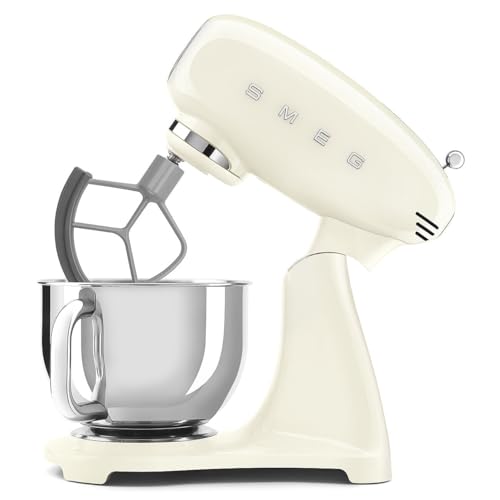
SMEG SMF05 Forte 5-Qt Stand Mixer — Best Overall
This is the pick for bakers who want the Italian option to also be the strongest everyday workhorse in the group. The SMF05 Forte is SMEG’s more powerful current stand mixer, built in the brand’s retro idiom but specified for regular bread, pizza and enriched dough work rather than occasional cake batter only.
Strengths
- 750W motor is the strongest in SMEG’s current stand mixer line, so dense dough stalls less
- Steady-Mix System and Smooth Start reduce flour puff and bowl splash at start-up
- Flex-edge beater, wire whisk and dough hook are all included in the box
Trade-offs
- Retro styling drives the price tier up versus plain-looking rivals of similar power
- 5 Qt bowl is mid-sized — very large double batches still need splitting
- Heavier head design makes it a leave-it-out machine rather than a store-away one
| Specification | Detail |
|---|---|
| Capacity | 5 Qt stainless steel bowl |
| Motor | 750W (per Amazon title) |
| Speeds | 10, with Smooth Start |
| Action | Planetary mixing, Steady-Mix System |
What separates the Forte from the older SMEG mixers most buyers picture is intent. The earlier retro models were styled first and specified second; the SMF05 pairs the same Italian design language with a 750W motor and a control system that actively holds speed when the load changes, which is exactly the moment cheaper mixers bog down in baguette or brioche dough. In practice that means fewer mid-knead interventions, less walking across the counter, and a dough hook cycle you can actually walk away from. The planetary action covers the bowl well, and the flex-edge beater cuts down the stop-and-scrape routine on batters and frostings. It is still a style-led purchase — you are paying for the object as much as the output — but unlike purely decorative retro mixers, the specification underneath the enamel genuinely supports daily baking, including the yeast doughs Italian home baking revolves around.
Ownership is straightforward flagship fare: wipe the enamel after flour-heavy sessions, wash the bowl and tools promptly, and store attachments in the bowl to save cupboard space. The machine is built to live on the counter — plan its permanent spot, with clearance to tilt or lift as the design requires, rather than hauling it from a cupboard weekly.
Read through the northern lens of an Italian kitchen — Sunday ragù-day baking, a midweek pizza dough, panettone season — and the Forte’s load control earns its flagship place: enriched holiday doughs are exactly the heavy, sticky loads where lesser motors surge and stall, and the SMF05 simply holds its pace.
Best for: Regular bread, pizza and pasta-adjacent dough work in a design-led Italian kitchen / Not suited for: Bakers who need 6 Qt-plus capacity or who judge purely on value per watt
Check on Amazon — check the current price on Amazon before you decide, and confirm the exact model code on the listing matches the model reviewed here.

SMEG SMF04 Classico Stand Mixer, Cream — Best for Design-Led Kitchens
Choose the SMF04 Classico if the SMEG look is the point of the purchase but you still want modern speed control underneath it. At 600W it sits a step below the Forte, which matters for very stiff doughs but not for the cakes, whipped creams, meringues and moderate doughs most home bakers make weekly.
Strengths
- Full 1950s SMEG styling with a modern 10-speed, smooth-start control set
- Steady Mix System helps hold pace through thicker batters
- 5 Qt stainless bowl is a practical family-baking size
Trade-offs
- 600W motor works harder than the Forte on low-hydration dough
- Cream retro finish shows every flour dusting and splash
- Fewer included accessories than some value rivals at this tier
| Specification | Detail |
|---|---|
| Capacity | 5 Qt stainless steel bowl |
| Motor | 600W (per Amazon title) |
| Speeds | 10, with Smooth Start |
| Action | Planetary mixing, Steady Mix System |
The Classico is best understood as the design purchase done properly. Plenty of retro-styled mixers are underpowered shells; SMEG instead put a 600W motor, ten speeds and its Steady Mix load control into the curved body, so the machine behaves like a current appliance rather than a tribute act. For sponge cakes, pandoro-style enriched batters at moderate batch sizes, fresh pasta dough in household quantities and everyday cookie dough, it has headroom to spare. Where it asks for compromise is at the extremes: a double batch of stiff pizza dough will make it labour audibly, and the Forte exists precisely for buyers who live at that end of the range. If your baking is celebration-centred — torta, biscotti, whipped and folded batters — the SMF04 delivers the Italian countertop presence without paying for power you will rarely call on.
Living with the Classico means embracing a visible appliance: it earns its counter space daily, so give it a permanent home with room to work. The cream finish rewards a quick wipe after baking sessions. Keep the attachment set together in the bowl, and register the warranty — design-led appliances deserve their paperwork kept as carefully as their enamel.
The Classico’s case strengthens in a kitchen that is also a room you live in: it will sit on the counter permanently, so it may as well be the object you enjoy looking at — and unlike most beautiful appliances, it still kneads a family pizza dough without complaint.
Best for: Style-first bakers making cakes, batters and moderate doughs / Not suited for: High-volume bread bakers who regularly knead stiff, low-hydration dough
Check on Amazon — check the current price on Amazon before you decide, and confirm the exact model code on the listing matches the model reviewed here.
SMEG SMF02 Stand Mixer (earlier 4.8L generation) — Best Remaining-Stock Hunt
The SMF02 is the earlier SMEG stand mixer generation that many buyers still find through secondary sellers and remaining stock. It offers the same retro Italian styling in a slightly smaller format and is worth considering only when it is clearly positioned below the current models on price — check price on the listing rather than assuming older means cheaper.
Strengths
- The original retro SMEG format that defined the category’s look
- Planetary mixing action with the familiar SMEG attachment set
- Slightly smaller footprint suits compact Italian-style kitchens
Trade-offs
- Earlier generation — control refinement trails the SMF04 and SMF05
- Availability is inconsistent, so colour choice may be limited
- Support and accessory stock will age out sooner than current models
Treat the SMF02 as a stock-dependent opportunity rather than a default recommendation. When a reputable seller lists it meaningfully below the current Classico, it is a perfectly capable machine for cakes, creams and household dough work, and it carries exactly the countertop presence buyers come to SMEG for. When it is listed at or near current-model money, the rational move is to step up: the newer machines add smoother start behaviour and better load control for a small real-world difference. Because listings for discontinued generations fluctuate and third-party sellers vary, we have written this pick unlinked — verify the exact model code, the included attachments and the seller’s returns terms on the listing itself before committing, and walk away from any listing that blurs SMF02 and SMF03 codes, since the two are not identical machines.
Ownership of a discontinued generation is about foresight: buy the attachments and wear parts you expect to need while they are stocked, keep the seller’s invoice and model plate details safe, and confirm which service route applies before you need it. Looked after that way, an SMF02 will bake happily for years; bought casually, its ageing support curve becomes your problem.
With discontinued generations, the listing is the product: two sellers can offer machines a model year apart under near-identical descriptions. Budget ten minutes to confirm the code plate details with the seller — that small diligence is what separates a genuine bargain SMF02 from an overpriced one.
Best for: Bargain hunters who find verified remaining stock below current-model pricing / Not suited for: Anyone paying near-current-model money for an earlier generation
Unlinked pick: we could not verify a marketplace listing for this model with confidence, so it carries no purchase link. Buy it through the maker or an authorised specialist seller, and verify the model code, specification and warranty terms directly with that seller.
Famag IM-5 Spiral Mixer — Best for Pizza and Bread Dough
Famag, made in Italy, builds spiral mixers for one job: dough. The IM-5 is the home-scale entry to that range and it suits bakers whose mixing is overwhelmingly pizza, bread and pasta dough — people who knead several times a week and care about dough temperature and gluten development more than whipping versatility.
Strengths
- True spiral action kneads with less friction heat than planetary hooks
- Purpose-built for pizza and bread dough consistency
- Italian-made specialist machine with a strong dough-baker following
Trade-offs
- Essentially a one-task machine — no whisking, beating or attachment ecosystem
- Sold through specialist channels, so buying and support differ from mainstream retail
- Bowl and format are optimised for dough batch sizes, not small test batches
A spiral mixer works differently from every planetary machine in this roundup: the bowl rotates while a fixed spiral hook and breaker bar work the dough, which develops gluten efficiently while adding noticeably less heat — a real quality difference in pizza dough, where a few degrees of friction heat changes fermentation timing. Famag’s IM-5 brings that professional Italian pizzeria mechanism down to a domestic batch size. The compromise is absolute focus: there is no planetary versatility here, no cake batter programme, no mincing attachment. Buyers who bake bread twice a month will find it indulgent; buyers running weekly pizza nights and sourdough schedules will find every other machine in this list is the compromise. We list it unlinked because Famag distribution runs through specialist baking suppliers rather than the marketplace listings we verify — buy from an authorised specialist and confirm voltage and plug specification for your kitchen before ordering.
Spiral ownership is workshop ownership: keep the bowl and spiral clean and dry, follow the maker’s lubrication and belt guidance, and treat the machine’s manual as required reading rather than packaging. Parts come through the specialist channel you bought from — another reason the dealer relationship matters. In return the machine asks little: no electronics to age, no modes to learn, just dough in and dough out.
For the pizza specialist the Famag reframes the whole purchase: instead of asking which mixer kneads least badly, you get the mechanism pizzerias actually use, scaled down. If dough is more than half of everything you mix, this is not the extravagant option — it is the correct one.
Best for: Dedicated pizza and bread bakers who knead several times a week / Not suited for: Generalist bakers who need one machine for cakes, creams and dough alike
Unlinked pick: we could not verify a marketplace listing for this model with confidence, so it carries no purchase link. Buy it through the maker or an authorised specialist seller, and verify the model code, specification and warranty terms directly with that seller.
Sunmix SUN6 Spiral Mixer — Best Alternative Spiral
Sunmix is the other Italian name home dough specialists cross-shop against Famag. The SUN6 sits in the small spiral class aimed at serious home and micro-bakery use, and it suits bakers who want spiral dough quality with a slightly more contemporary machine presentation.
Strengths
- Spiral kneading action for cooler, better-developed dough
- Built for repeated dough duty rather than occasional use
- Compact spiral format for a dedicated baking corner
Trade-offs
- Dough-only focus, like all true spiral machines
- Specialist distribution means fewer mainstream buying options
- Premium tier positioning for a single-purpose appliance
Cross-shopping Sunmix against Famag is the classic Italian home-bakery debate, and the honest summary is that both deliver the core spiral advantage — efficient gluten development with restrained friction heat — while differing in control feel, finish and the dealer network behind them. The SUN6 makes sense when a local or national specialist stocks it with proper support, because with imported specialist machinery the seller’s parts and service pipeline matters as much as the machine’s specification sheet. Dough performance at this level is genuinely a class above planetary hooks for pizza and bread, which is why these machines keep appearing in serious home setups despite doing nothing else. Written unlinked for the same distribution reason as the Famag: verify the exact model, electrical specification and warranty route through the specialist seller, and treat any marketplace listing using the Sunmix name without model detail as a red flag rather than a bargain.
Sunmix ownership mirrors the Famag pattern: a specialist machine maintained through its dealer, with cleaning centred on the bowl, spiral and breaker bar, and servicing planned rather than improvised. Keep the import paperwork, electrical details and dealer contacts together. Owners who treat these machines as small commercial equipment — which is what they are — report the fewest surprises.
Choose between the Italian spirals the way you would choose between two good local bakeries: the product is comparable, so the deciding factors are the dealer who will support you, the control feel you prefer, and which machine’s batch range brackets your typical dough weight most comfortably.
Best for: Dough specialists with a good specialist dealer within reach / Not suited for: Buyers who want mainstream retail convenience and multi-task versatility
Unlinked pick: we could not verify a marketplace listing for this model with confidence, so it carries no purchase link. Buy it through the maker or an authorised specialist seller, and verify the model code, specification and warranty terms directly with that seller.
Ariete Vintage Stand Mixer — Best Value Italian
Ariete, an Italian brand within the De’Longhi group, is the accessible end of Italian mixer design: retro-styled planetary machines at everyday tiers rather than design-object prices. The Vintage line suits bakers who want the Italian look and a competent all-rounder without paying SMEG money.
Strengths
- Genuinely Italian brand heritage at an accessible tier
- Retro Vintage styling in the classic Italian colour palette
- Planetary all-rounder format handles cakes, batters and household dough
Trade-offs
- Power and refinement sit below SMEG’s current line
- Regional model variants make exact specification checking essential
- Attachment ecosystem is thinner than the biggest global brands
Ariete is the pragmatic way to buy Italian. The Vintage stand mixers deliver the rounded retro forms and colours the Italian school is known for, wrapped around a conventional planetary mechanism that any home baker already understands: beaters for batters, a whisk for creams and a hook for everyday dough. What you give up versus SMEG is polish — motor headroom on stiff dough, the finesse of the speed control, and the sheer object quality of the enamel and fittings. What you keep is money, and for the large majority of home baking — torte, biscotti, pizza dough for a family night — the Ariete’s ceiling is rarely the limiting factor. Because Ariete sells regional variants under shifting model codes, this pick is not linked: match the exact code on the listing to the specification you researched, confirm which attachments are in the box, and treat it as the value-Italian choice it is rather than a SMEG equivalent.
Ariete ownership is deliberately ordinary: standard planetary care, attachments washed and stored with the machine, and a note of the exact regional model code kept for any future parts order. That ordinariness is the value proposition — an Italian-styled all-rounder that asks no more of its owner than any mainstream mixer, at a tier that leaves budget for ingredients.
Ariete’s role in this list is to keep the Italian option open at an everyday tier — and for many households that matters more than flagship polish, because a mixer that gets bought and used beats a design icon deferred for another year.
Best for: Value-minded bakers who want Italian styling and honest all-round ability / Not suited for: Buyers expecting SMEG-level finish or heavy daily dough duty
Unlinked pick: we could not verify a marketplace listing for this model with confidence, so it carries no purchase link. Buy it through the maker or an authorised specialist seller, and verify the model code, specification and warranty terms directly with that seller.
Comparison Table
| Pick | Badge | Key spec | Best for |
|---|---|---|---|
| SMEG SMF05 Forte 5-Qt Stand Mixer | Best Overall | 5 Qt stainless steel bowl | Regular bread, pizza and pasta-adjacent dough work in a design-led Italian kitchen |
| SMEG SMF04 Classico Stand Mixer, Cream | Best for Design-Led Kitchens | 5 Qt stainless steel bowl | Style-first bakers making cakes, batters and moderate doughs |
| SMEG SMF02 Stand Mixer (earlier 4.8L generation) | Best Remaining-Stock Hunt | Earlier-generation planetary — see review | Bargain hunters who find verified remaining stock below current-model pricing |
| Famag IM-5 Spiral Mixer | Best for Pizza and Bread Dough | Spiral dough mixer — see review | Dedicated pizza and bread bakers who knead several times a week |
| Sunmix SUN6 Spiral Mixer | Best Alternative Spiral | Spiral dough mixer — see review | Dough specialists with a good specialist dealer within reach |
| Ariete Vintage Stand Mixer | Best Value Italian | Planetary, regional variants — see review | Value-minded bakers who want Italian styling and honest all-round ability |
Read the table by school first: the planetary rows compete with each other, and the two spiral rows compete with each other. Cross-school comparisons only make sense once you know which kind of baker you are.
How to Choose italian mixers
Planetary or spiral: the first and biggest decision
Planetary mixers move a beater around a stationary bowl and do everything adequately: cakes, creams, batters, dough. Spiral mixers rotate the bowl against a fixed spiral hook and do dough superbly — cooler, faster gluten development, quieter loads — and nothing else at all. Decide by your real baking diary, not your aspirational one. If dough is under half your mixing, planetary versatility wins; if dough is nearly all of it, the spiral’s specialisation is not a limitation but the entire point.
Power, and why headline watts mislead
Judge power by behaviour on stiff dough, not by the biggest number on the box. Low-hydration pizza and baguette doughs are the stress test: a good machine holds speed without surging, walking or overheating. Load-control systems such as SMEG’s Steady Mix matter here because they respond when the dough fights back. As a rule, regular bread bakers should buy at the stronger end of any range they shortlist, while cake-led bakers can safely prioritise control finesse and attachments instead.
Bowl size against Italian batch reality
A 5 Qt-class bowl covers the honest centre of home baking: a family pizza batch, a standard loaf or two, celebration cakes. Bakers regularly doubling recipes should size up or split batches deliberately, because an overfilled bowl kneads badly and whips worse. Spiral buyers should think in dough weight rather than bowl volume, and check the machine’s minimum as well as maximum — a big spiral asked to knead a single small test dough can struggle to engage it.
Buying imported and specialist machines safely
For the specialist Italian makers, the seller is part of the product. Confirm the electrical specification matches your supply, that the plug and voltage are correct for your country without adapters on a high-draw appliance, what the warranty route actually is, and whether wear parts are stocked domestically. Keep invoices and serial numbers. None of this is bureaucracy for its own sake: a specialist machine bought well is a decade-long tool, and one bought carelessly is an expensive ornament with no service path.
Accessories that are actually worth it
Buy attachments in the order your habits demand them. For most Italian kitchens that order is: a second bowl if you bake in sequence, pasta rollers if fresh pasta is weekly, and only then the long tail of mincers and graters. Each attachment should pass the monthly-use test before it earns cupboard space. And because fit is model-specific, photograph your model plate before ordering anything — a thirty-second habit that prevents the most common returns in this category.
Counter space, noise and living with the machine
A stand mixer is furniture that makes noise. Planetary machines at dough speeds are conversation-compatible; at whisk speeds they are not, and spiral machines run quieter but occupy a dedicated footprint. Measure your counter’s depth and the clearance above it before choosing, especially for bowl-lift and specialist models. The right machine in the wrong spot becomes a cupboard machine, and cupboard machines — whatever their badge — bake nothing.
Ready to shortlist? Start with the benchmark of this guide, the SMEG SMF05 Forte 5-Qt Stand Mixer: Check the current price on Amazon.
Why Italian mixers split into two schools
Italy’s mixer culture grew from two different kitchens. The domestic school — the one SMEG and Ariete serve — descends from the post-war Italian home, where one handsome appliance had to handle Sunday baking, festival doughs and everyday creams, and where an object left permanently on display was expected to be beautiful. Design was not decoration added to engineering; it was a requirement of a machine that would live in the family’s main room.
The professional school grew from pizzerias and small bakeries, where the mixer has one sacred task and dough temperature is money: a few degrees of friction heat shifts fermentation, and fermentation is flavour and schedule alike. Spiral mechanisms, refined in that world, migrated down to serious home bakers as home pizza culture professionalised. When you shop Italian, you are choosing which of those two kitchens you actually cook in — and the happiest buyers are the ones who choose honestly.
Attachments and the pasta question
Italian buyers reasonably ask about pasta, so let us be precise. A stand mixer’s dough hook handles pasta dough in household quantities well, and roller or cutter attachments — where offered for a given model — turn it into a respectable fresh-pasta station for family meals. Dedicated spiral mixers play no part in this: they knead the dough, and rolling remains a separate tool’s work.
Before paying for attachment ecosystems, check the specific model’s compatibility rather than the brand’s general promises, and price the attachments into the comparison honestly — a mid-tier machine plus rollers can cost what a flagship costs bare. For most households the sensible sequence is mixer first, one attachment you know you will use second, and the rest only when a real habit demands them.
A short history of the Italian kitchen mixer
The Italian stand mixer descends from the post-war boom, when makers like SMEG — founded in Guastalla in 1948 — began treating kitchen appliances as designed objects for modern homes. The rounded, enamelled forms that now read as retro were then futuristic, and the colours were a deliberate break from the white-box utility of earlier appliances. That design-first DNA is why Italian mixers still lead with silhouette: the object was always meant to be seen.
In parallel, Italy’s pizzeria trade professionalised its dough rooms around spiral mixers, valuing the cool, gentle kneading that protects fermentation. As home pizza culture adopted professional standards — high-hydration doughs, long fermentations, weighed recipes — those machines followed the knowledge home. Today’s Italian mixer market is those two histories on one shelf, which is why this guide insists on choosing your school before your brand.
Planetary versus spiral, tested by dough type
The school’s difference shows clearest across three doughs. Pizza dough at moderate hydration: both succeed, the spiral with less heat and less supervision. Enriched doughs like brioche and panettone, where butter is worked in stages: the planetary’s hook and bowl access win, because additions and scraping are part of the process. Stiff, low-hydration doughs for bagels or some regional breads: the spiral’s torque and the planetary flagship’s load control are the two credible answers, while mid-tier planetary machines labour audibly.
Whipped and batter work is not a contest at all — spirals simply do not compete there. So the practical verdict stands: dough-only diaries justify spiral; mixed diaries demand planetary; and the large middle of home bakers, who make pizza monthly and cakes weekly, belong to the planetary school with the strongest motor their budget reaches.
Which Italian Mixer Fits Your Kitchen? A Buyer-by-Buyer Verdict
The celebration baker — torte, panettone at Christmas, biscotti for gifts — should buy the SMEG SMF04 Classico and spend the saving versus the Forte on ingredients and a second bowl. Your loads are batter-led, your mixer lives on display, and the Classico’s balance of beauty and competence is aimed precisely at your year.
The weekly bread and pizza household should buy the SMF05 Forte if planetary versatility must be kept, and should at least price the Famag IM-5 before deciding — if dough turns out to be three-quarters of your mixing, the spiral is not the indulgence it first appears. The value-led household should start with Ariete and upgrade only against a named frustration, while the hunter of remaining stock should keep the SMF02 on a watchlist and strike only when the listing diligence in this guide can be completed at a genuinely lower tier.
How to Use an Italian Stand Mixer for Pizza Dough, Step by Step
This workflow suits the planetary picks in this guide and shows the habits that separate good home pizza dough from frustrating dough — including the temperature awareness the spiral school is built around.
Step 1: Weigh everything, water first
Add the water to the bowl first, then flour, so dry pockets at the base disappear. Weighing — rather than scooping cups — is the single biggest consistency upgrade in dough work, and Italian recipes assume it.
Step 2: Mix on the lowest speed to combine
Run the mixer at its gentlest setting with the hook until no dry flour remains, using the smooth-start behaviour if your machine has it. Fast starts throw flour and stress the motor for no benefit.
Step 3: Rest the shaggy dough (autolyse)
Stop and rest the rough dough for twenty minutes. Hydration does quietly what kneading does loudly, and the dough will come together faster and cooler afterwards.
Step 4: Add salt and oil, then knead low and steady
Knead on a low speed — never the high settings — until the dough is smooth and elastic, checking with a small windowpane stretch. If the machine labours or walks, your batch is too big or too dry; split or adjust rather than forcing it.
Step 5: Watch dough temperature, not just time
Aim for a finished dough that feels cool-warm, not hot. Friction heat is the hidden variable in home dough; if the bowl feels warm, shorten kneads and lengthen rests.
Step 6: Bulk ferment with one or two folds
Move the dough to a lightly oiled container, ferment as your recipe directs, and give one or two gentle folds early on to build structure without degassing.
Step 7: Clean the hook and bowl promptly
Dried dough cements itself to hooks and bowl seams. A warm soak immediately after use is a two-minute job; tomorrow it is a twenty-minute one.
Master those habits and the gap between a mid-tier planetary and a flagship narrows considerably — technique is the cheapest upgrade in baking. The spiral machines still hold their edge for pure dough, but a well-run planetary dough, rested and temperature-aware, will satisfy all but the most devoted pizza specialists.
Common Buying Mistakes
Buying the badge instead of the school
Choosing a retro planetary for daily pizza production — or a spiral for a cake-led kitchen — is the classic Italian-mixer error. The school decision comes first; brand and model come second.
Kneading on high speed
Dough hooks are low-speed tools. High settings overheat dough, stress gears and can walk a machine off the counter. If a recipe’s timing assumes hand kneading, convert by feel and windowpane, not by cranking the dial.
Overfilling the bowl
A bowl filled past its working capacity kneads unevenly and whips badly. Split big batches; two good kneads beat one bad one every time.
Ignoring electrical specification on imports
Specialist Italian machines bought across borders can arrive with the wrong voltage or plug for your supply. Confirm specification in writing before paying, never after unboxing.
Paying current-model money for old generations
Earlier models like the SMF02 are buys only at honest remaining-stock pricing. If the gap to the current model is small, the current model’s control refinements are worth more than the saving.
Skipping the attachment compatibility check
Attachments are model-specific more often than brand-wide. Verify your exact model code against the attachment before ordering, and keep the receipt until it has been fitted and run.
Final Recommendation
For most readers the answer is the SMEG SMF05 Forte: it is the Italian planetary machine with the fewest compromises — real dough headroom, refined control and the design presence that makes an Italian mixer an Italian mixer. The SMF04 Classico is the right buy when your baking is cake- and batter-led and the look matters as much as the spec sheet, while Ariete’s Vintage line keeps the Italian route open at an everyday tier for value-led households.
The specialists deserve their own sentence: if dough is your baking life, skip the planetary contest entirely and buy spiral — Famag IM-5 or Sunmix SUN6 through a reputable specialist, chosen by dealer support as much as by machine. And if you find a verified SMF02 at genuine remaining-stock pricing, take it with our blessing; just do the listing diligence first.
Start with the SMEG SMF05 Forte 5-Qt Stand Mixer if you want the safest single recommendation in this list: Check the current price on Amazon.
The strongest alternative is the SMEG SMF04 Classico Stand Mixer, Cream: Check the current price on Amazon.
Keep exploring the cluster: Best Electric Smokers Under $400 Best Stand Mixers Best Mixers Best Electric Smokers Best Italian Mixers
Frequently Asked Questions
Are Italian stand mixers actually made in Italy?
It varies by brand and model, and the honest answer is to check the specific model rather than assume. SMEG is an Italian company with its design rooted in Guastalla, Italy, and its appliances are positioned as Italian design products; specialist makers like Famag and Sunmix build their spiral mixers in Italy. Ariete is an Italian brand within the De’Longhi group. Where manufacture matters to you, confirm the country of origin for the exact model code with the seller before buying.
Is a spiral mixer better than a stand mixer for pizza dough?
For dough alone, yes — a spiral mixer develops gluten with less friction heat, which protects fermentation timing and flavour in pizza and bread dough. For everything else — cakes, creams, whipping, attachments — a planetary stand mixer is incomparably more versatile. Most households should buy planetary; dedicated dough bakers who knead several times a week are the ones who gain from spiral specialisation.
What size mixer do I need for family baking?
A 5 Qt-class bowl covers the centre of family baking: one pizza batch, standard loaves, celebration cakes and cookie dough. If you routinely double recipes, size up or split batches deliberately rather than overfilling, which kneads and whips poorly. Spiral buyers should check the maker’s dough-weight range, including the minimum, against their typical batch.
Can an Italian stand mixer make fresh pasta?
Yes, in household quantities. The dough hook handles pasta dough well, and roller or cutter attachments — where offered for the exact model — make a capable fresh-pasta setup for family meals. Verify attachment compatibility against your model code before ordering, since fit is model-specific more often than brand-wide.
Why are SMEG mixers more expensive than similar-spec rivals?
You are paying for two products in one: a competent modern mixer and a piece of Italian industrial design that lives permanently on your counter. Whether that premium is rational depends on how much the object itself matters in your kitchen. Buyers who judge purely on performance per dollar should look at the value end of this guide; buyers who will look at the machine daily for a decade often find the design premium easy to justify.
Where should I buy a Famag or Sunmix mixer?
Through a reputable specialist baking supplier or the maker’s authorised channel for your country. Confirm the electrical specification, plug, warranty route and parts availability in writing before paying. These are capital tools bought on a decade horizon; the seller’s support pipeline is part of the product in a way that simply is not true of a mainstream stand mixer.


