Disclosure: airfryerkitchensupply.com is reader-supported. When you buy through links on our site, we may earn an affiliate commission at no extra cost to you.
Where to buy
This guide to the best induction cookers is built entirely on verified listings, so every model below can be checked by its exact name and model number as you read. Portable induction cookers are sold by exact model, and near-identical housings hide different wattages and coil sizes. Buy the verified listing that names the model in the review — Duxtop alone sells three of the picks below, each a different machine for a different job. The verified picks in this guide are sold through Amazon: Duxtop Portable Induction Cooktop 9600LS — 1800W, ChangBERT Induction Cooktop — Commercial Grade, 1800W, Duxtop LCD Portable Double Induction Cooktop 9620LS, Nuwave Double Pro Induction Cooktop, Duxtop Portable Induction Cooktop 8100MC — 1800W, COOKTRON Portable Double Induction Cooktop — Knob Control. Check the current price on Amazon for the model you choose, because bundle contents, carafe styles, and included accessories change more often than model names do.
The best induction cookers heat the pan itself with a magnetic field, which makes them faster than gas at boiling water, precise at holding a gentle simmer, and cool to the touch everywhere except under the pot. A portable induction cooker brings that performance anywhere there is an outlet: a small apartment, a dorm, an RV, a holiday kitchen that needs one more burner, or a dining table set for hot pot.
Choosing one is mostly about three honest variables: power, coil size, and control style. Most plug-in singles share an 1800-watt ceiling — the limit of a standard household circuit — so the real differences are how the coil spreads that power across your pan, whether the controls are touch or knob, and whether you need one burner or two sharing that same 1800 watts. This guide explains those trade-offs plainly instead of pretending a shared-power double is two full burners.
All six picks were verified, with wattage, coil, and control details taken from the listed listings. The set covers the reference single burner, a commercial-grade stainless model, two doubles with different philosophies, the budget classic, and the knob-control double for cooks who hate touch panels.
In this guide
Quick Picks
Six verified portable induction cookers: three singles for full power, three doubles for flexibility, all honestly rated:
- Best Overall Single Burner — Duxtop Portable Induction Cooktop 9600LS — 1800W: the reference portable induction cooker: 1800 watts, an LCD sensor-touch panel, and a silver finish that lives happily on any counter. Check price on Amazon.
- Best Commercial-Grade — ChangBERT Induction Cooktop — Commercial Grade, 1800W: a stainless, NSF-certified commercial portable with a large 8-inch heating coil and a 10-hour timer for serious, sustained cooking. Check price on Amazon.
- Best Double Burner — Duxtop LCD Portable Double Induction Cooktop 9620LS: two induction zones with sensor-touch control from the reference brand — a main dish and a side, on one plug. Check price on Amazon.
- Best Temperature Range — Nuwave Double Pro Induction Cooktop: a double cooktop with a remarkable 50-to-575-degree temperature range, dynamic wattage options, and shatter-proof ceramic glass. Check price on Amazon.
- Best Budget Single — Duxtop Portable Induction Cooktop 8100MC — 1800W: the long-running budget classic: full 1800-watt induction in the simplest, most proven package in the category. Check price on Amazon.
- Best Knob Control — COOKTRON Portable Double Induction Cooktop — Knob Control: a double induction cooktop with real knobs, continuous low-power heating for gentle work, and a 4-hour timer. Check price on Amazon.
How These Picks Were Chosen
We required true induction — magnetic heating of the pan — verified in each listing, and excluded generic electric hot plates that borrow the vocabulary. Power, coil diameter, and control type were taken from Amazon listing data-returned titles; where a listing stated a temperature range or timer length, it is printed, and where it did not, we did not invent one.
The list is deliberately split between full-power singles and shared-power doubles, because that is the category’s central trade-off and buyers deserve it stated in the open: a single gives one pan the whole 1800 watts; a double splits that budget between two zones for simmering, warming, and side dishes. Both are legitimate tools for different kitchens, and the reviews say which is which.
We also weighed the daily-life details: sensor-touch versus knob control with wet hands, timer length for long simmers, commercial build for heavy use, and the sheer track record of the budget classic. Every pick is a plug-in countertop unit — no hardwired cooktops, no range replacements — because that is what this search’s shoppers are equipping.
The 6 Best Induction Cookers
Badges match the Quick Picks. Check the format line first: single burners deliver full power to one pan, doubles share it between two.
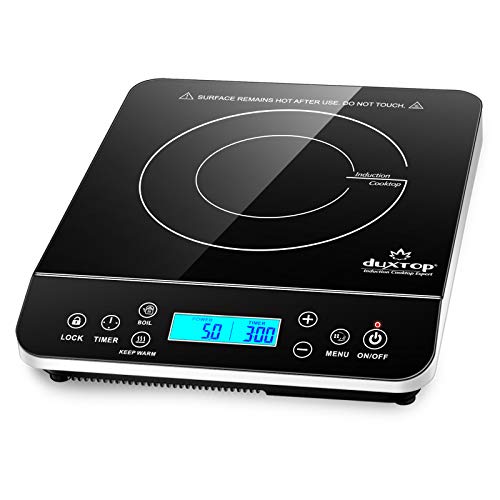
Duxtop Portable Induction Cooktop 9600LS — 1800W — Best Overall Single Burner
The 9600LS suits the buyer who wants the category’s benchmark and no drama. It delivers the full 1800 watts to a single pan — water boils with gas-beating speed — through a sensor-touch panel with an LCD readout, and its countertop footprint is small enough to store in a cabinet between uses. Dorms, small apartments, RVs, and overflow-burner duty are its natural habitats.
Strengths
- Full 1800W to one pan for the fastest boils in this guide
- LCD sensor-touch controls with a clear readout
- Compact and light enough for cabinet storage and travel
Trade-offs
- One burner only — multitaskers should look at the doubles
- Touch controls can be finicky with wet or floury hands
- Requires induction-compatible cookware, like every pick here
| Spec | Detail |
|---|---|
| Format | Single burner, portable |
| Power | 1800W |
| Control | LCD sensor touch |
| Model | 9600LS / BT-200DZ (from verified listing) |
There is a reason this model is the category’s reference point: it does the fundamental job — fast, controllable, magnetic heat — without a single gimmick, and it has done so across years of production. The sensor-touch panel gives fine power steps and a timer, the surface wipes clean because nothing burns onto a cool cooktop, and the pan-detection safety means it simply will not run without a suitable pan on it.
Buy it as your first induction cooker or your spare burner and it will not be outgrown quickly. It sears in cast iron, holds a rice-gentle simmer without scorching, and travels to wherever the cooking is happening. In a category full of near-copies, the original formula, well executed, remains the recommendation.
Ownership notes: the 9600LS becomes more valuable the longer you own it, because it keeps finding jobs — the holiday overflow burner, the patio hot-pot station, the dorm-bound kid’s first stove. Its sensor panel wipes clean in seconds since spills never bake on, and pan detection means a lifted pot simply pauses the show. Keep one flat-bottomed, induction-ready skillet dedicated to it and the pair will handle most weeknight cooking a household of two can invent.
Best for: anyone wanting one fast, proven induction burner / Not suited for: cooks who regularly run two pans at once
Check on Amazon — check the current price on Amazon before you buy.

ChangBERT Induction Cooktop — Commercial Grade, 1800W — Best Commercial-Grade
The ChangBERT suits the cook who will work the machine hard: caterers, serious home canners, hot-pot hosts, and anyone whose portable burner sees daily, hours-long service. Its commercial build centers on a large 8-inch heating coil — the detail that decides how evenly big pans heat — inside a premium stainless housing, with NSF certification and a 10-hour timer that dwarfs the home models’ limits.
Strengths
- Large 8-inch coil heats wide pans evenly
- NSF-certified commercial stainless build
- 10-hour timer for long simmers and holding
Trade-offs
- Commercial size and weight versus the home portables
- Premium tier pricing for a single burner
- Utilitarian styling — it looks like equipment, proudly
| Spec | Detail |
|---|---|
| Format | Single burner, commercial portable |
| Power | 1800W |
| Coil | Large 8-inch heating coil |
| Timer | 10 hours |
| Certification | NSF Certified |
| Housing | Premium stainless steel |
Coil size is the under-reported spec in induction. A small coil under a wide pan concentrates heat in a ring, scorching the center of a sauce while the edges lag. The ChangBERT’s 8-inch coil spreads the field across the pans people actually cook stocks, curries, and hot-pot broths in, and the stainless housing shrugs off the splashes and knocks of working service. It is the difference between a gadget and a tool, visible the first time you run a stockpot on it.
The 10-hour timer completes the professional brief: long broths, slow reductions, and all-evening hot pot service without babysitting a control panel. If your portable induction cooker will earn money, feed crowds, or run daily for years, this is the one built for that life — and its price makes sense precisely to the buyers who need it.
Ownership notes: the ChangBERT’s stainless housing shrugs off the working kitchen — splashes, knocks, and daily wiping leave it looking like equipment rather than aging like a gadget. Its long timer makes it the set-and-forget broth station, and the big coil’s even field shows its worth in a wide sauté pan, where edge-to-edge browning replaces the usual hot-ring shuffle. It is the pick whose owners stop thinking of it as ‘portable’ and start thinking of it as the good burner.
Best for: heavy users, caterers, and hot-pot hosts / Not suited for: occasional users who just need a spare burner
Check on Amazon — check the current price on Amazon before you buy.

Duxtop LCD Portable Double Induction Cooktop 9620LS — Best Double Burner
The 9620LS suits the cook whose meals come in pairs: pasta and sauce, rice and curry, eggs and bacon. Two zones on one countertop unit, with Duxtop’s LCD sensor-touch control on each, let a small kitchen run a two-pan menu without a stove at all. It is the dorm-suite, studio, and cabin answer — with the shared-power honesty explained in the deep dive below.
Strengths
- Two independent zones for real two-pan cooking
- Sensor-touch LCD control consistent with the single-burner reference
- One unit replaces a basic stove for small kitchens
Trade-offs
- The two zones share the 1800W household budget — both cannot boil at full power at once
- Larger footprint than any single here
- Two pans means two induction-compatible pans to own
| Spec | Detail |
|---|---|
| Format | Double burner, portable |
| Power | 1800W total, shared between zones |
| Control | LCD sensor touch |
| Model | 9620LS / BT-350DZ (from verified listing) |
Understand the shared-power bargain and this machine delights: a standard outlet offers about 1800 watts, so a double cooktop divides it. Boil pasta on one zone at high power while the sauce simmers gently on the other — that is the real two-burner workflow, and it works beautifully. Demand two simultaneous full-power boils and physics declines. Cooks who plan around the split get a genuine small stove; cooks who ignore it blame the machine for arithmetic.
Duxtop’s execution is the safe choice in doubles: the controls are clear about each zone’s level, the surface is one wipe-clean sheet, and the brand’s induction track record is the longest in this guide. For a studio apartment or a teaching kitchen station, this is the double we would install and forget about.
Ownership notes: the 9620LS teaches its power-sharing lesson in the first week — pasta water on one side at high, sauce murmuring on the other — and households adapt their menus to the rhythm quickly. Label which zone you favor for the main pan and keep that pan’s base matched to the coil. In studio service, a small heat-safe mat under the unit protects rental counters and quiets the fan’s conversation with the countertop.
Best for: small kitchens cooking two-pan meals without a stove / Not suited for: anyone needing two simultaneous full-power boils
Check on Amazon — check the current price on Amazon before you buy.

Nuwave Double Pro Induction Cooktop — Best Temperature Range
The Nuwave Double Pro suits the precision cook. Its verified temperature range runs from 50 to 575 degrees Fahrenheit — a span no other pick approaches — which means it can proof and warm at the bottom, hold a chocolate-melting gentleness in the middle, and sear at the top. Dynamic wattage settings (900, 1500, or 1800 watts) let it behave in older buildings and RVs where full draw is not available, and the ceramic glass is shatter-proof.
Strengths
- 50°F–575°F range for warming, precision cooking, and searing
- Selectable wattage suits older circuits and RVs
- Shatter-proof ceramic glass and seamless touch panel
Trade-offs
- Double-zone power is still shared, whatever the range
- Temperature-based control is a learning curve for power-level cooks
- Premium tier within the double category
| Spec | Detail |
|---|---|
| Format | Double burner, portable |
| Temperature range | 50°F–575°F (from verified listing) |
| Wattage options | 900 / 1500 / 1800W dynamic |
| Coil | 8-inch heating coil |
| Surface | Shatter-proof ceramic glass |
Temperature control, rather than abstract power levels, is how serious cooks think, and the Nuwave speaks that language across an unusually wide vocabulary. Fifty degrees holds a sauce through a dinner party; the low hundreds keep chocolate and butter in their narrow happy zones; the top end sears a steak in cast iron with genuine violence. One appliance covering that span replaces a warmer, a precision cooker for small tasks, and a burner.
The wattage selector is the quietly brilliant feature for real buildings. Set it to 900 watts in the old apartment or the RV and the breaker stays silent; open it to 1800 at home when speed matters. If your cooking locations vary — home, cabin, camper — the Double Pro is the one machine that adapts to all of them, and its double format means the adaptation covers a two-pan meal.
Ownership notes: the Double Pro’s temperature mode rewards a calibration afternoon: verify a few set points against your usual tasks — the chocolate melt, the sauce hold, the steak sear — and note the numbers on the unit itself. Its wattage flexibility makes it the traveler of the list, equally at home on a cabin’s older wiring and a modern kitchen’s circuit. The shatter-proof surface is not a dare, but it does forgive the clumsiness of real cooking better than standard glass.
Best for: precision cooks and multi-location cooking (home, RV, cabin) / Not suited for: buyers who want the simplest possible controls
Check on Amazon — check the current price on Amazon before you buy.
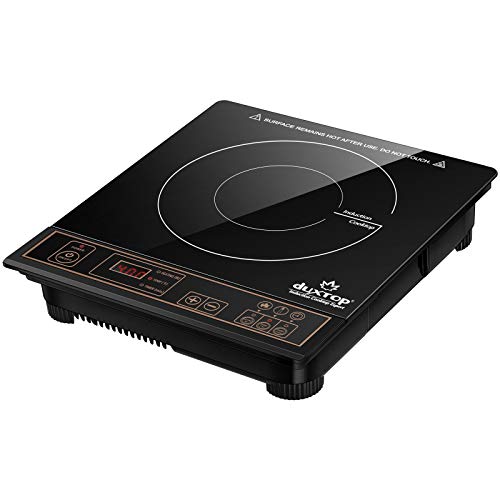
Duxtop Portable Induction Cooktop 8100MC — 1800W — Best Budget Single
The 8100MC suits the buyer who wants induction’s benefits at the category’s friendliest tier: a first apartment, a dorm, a spare burner for holidays, or a trial run before committing to a premium model. It has introduced more cooks to induction than any machine here — full power, straightforward controls, and a production history long enough that its behavior is a known quantity in every sense.
Strengths
- Full 1800W induction at a budget tier
- The longest track record of any pick here
- Simple controls that suit every skill level
Trade-offs
- Basic feature set — no commercial build, no wide temperature theatre
- Touch panel shows its design age next to the newer picks
- Single burner, like the other full-power picks
| Spec | Detail |
|---|---|
| Format | Single burner, portable |
| Power | 1800W |
| Model | 8100MC / BT-180G3 (from verified listing) |
Longevity is a feature. A model that has sold for years in enormous numbers has had its failure modes found, fixed, and documented; replacement and advice are everywhere. The 8100MC boils, simmers, and sears with the same magnetic fundamentals as its premium siblings — the differences are in refinement, materials, and extras, not in the physics of dinner.
It is also the rational way to test your kitchen’s compatibility with the technology: confirm your pans are magnetic, learn the simmer behavior, and discover whether induction’s speed changes how you cook, all at the lowest cost of entry here. Many owners later upgrade and keep the 8100MC as the spare — which tells you everything about its value.
Ownership notes: the 8100MC’s genius is that there is almost nothing to learn — power on, set level, cook — which is why it survives in workshops, offices, and rental kitchens where manuals vanish. Its long production run means a replacement, if ever needed, is identical to the original, a continuity premium brands rarely offer. Pair it with one good cast-iron skillet and you own the most cost-effective high-heat station in this entire guide.
Best for: first-time induction buyers and spare-burner duty / Not suited for: heavy daily users who need commercial build
Check on Amazon — check the current price on Amazon before you buy.

COOKTRON Portable Double Induction Cooktop — Knob Control — Best Knob Control
The COOKTRON suits the cook who hates touch panels — with cause. Knobs work with wet hands, floury hands, and gloves; they adjust by feel without looking down; and they never miss a tap because a droplet sat on the sensor. This double pairs that control honesty with continuous low-power heating, the feature that keeps a sauce at a bare simmer instead of pulsing on and off, plus child lock and a 4-hour timer.
Strengths
- Physical knobs that work with wet or messy hands
- Continuous low-power heating for true gentle simmers
- Two zones with a 4-hour timer and child lock
Trade-offs
- Shared 1800W across zones, like every plug-in double
- Knob design is less sleek than the seamless touch models
- Fewer temperature theatrics than the Nuwave Double Pro
| Spec | Detail |
|---|---|
| Format | Double burner, portable |
| Power | 1800W total, shared |
| Control | Knob control, 9 power levels, 10 temperature settings |
| Timer | 4 hours |
| Extras | Continuous low-power heating, child lock |
Continuous low power is a technical phrase for a culinary pleasure: sauces, custards, and slow braises that hold a lazy bubble for an hour without scorching or cycling. Many induction units pulse at low settings — on, off, on — which shows in delicate work. The COOKTRON’s steady low output, turned up or down with a knob’s tactile certainty, is the closest a portable comes to the feel of a good gas valve.
Choose this double if your cooking is sauce-and-simmer centered, if the cook’s hands are rarely dry, or if the unit will serve an older cook who trusts knobs and distrusts glass panels — a real and respectable preference. It trades the Nuwave’s range and the Duxtop’s polish for the most human controls in the guide, and for many kitchens that trade is the right one.
Ownership notes: the COOKTRON’s knobs develop a household shorthand within a month — ‘sauce at three, rice at two’ — because tactile settings are memorable in a way touch levels are not. Its continuous low heat makes it the risotto and custard station, and the child lock matters in the family kitchens where it tends to live. Wipe around the knobs when you clean the surface; the one place an induction top can collect grime is the one place this design has texture.
Best for: sauce cooks, wet-handed cooks, and knob loyalists / Not suited for: buyers wanting the widest temperature range
Check on Amazon — check the current price on Amazon before you buy.
Comparison Table
| Pick | Badge | Key spec | Best for |
|---|---|---|---|
| Duxtop Portable Induction Cooktop 9600LS — 1800W | Best Overall Single Burner | Single, 1800W, LCD sensor touch | anyone wanting one fast, proven induction burner |
| ChangBERT Induction Cooktop — Commercial Grade, 1800W | Best Commercial-Grade | Single, 1800W, 8-inch coil, NSF, 10-hour timer | heavy users, caterers, and hot-pot hosts |
| Duxtop LCD Portable Double Induction Cooktop 9620LS | Best Double Burner | Double, 1800W shared, LCD sensor touch | small kitchens cooking two-pan meals without a stove |
| Nuwave Double Pro Induction Cooktop | Best Temperature Range | Double, 50–575°F, 900/1500/1800W selectable | precision cooks and multi-location cooking (home, RV, cabin) |
| Duxtop Portable Induction Cooktop 8100MC — 1800W | Best Budget Single | Single, 1800W, budget classic | first-time induction buyers and spare-burner duty |
| COOKTRON Portable Double Induction Cooktop — Knob Control | Best Knob Control | Double, knob control, continuous low power | sauce cooks, wet-handed cooks, and knob loyalists |
Singles give one pan everything; doubles share. If your typical meal is one pan at full tilt, buy a single and enjoy the speed. If it is a main plus a side, buy a double and plan the power split — the table’s format column is the decision.
How to Choose an Induction Cooker
Check your pans before your burner. Induction only heats magnetic cookware: cast iron and most stainless steel with a magnetic base work; pure aluminum, copper, and glass do not, unless they carry an induction-ready bonded base. The fridge-magnet test settles any pan in two seconds — if the magnet sticks firmly to the base, the pan will work. Budget honestly: a household whose pans all fail the test is buying cookware too, and should know it on day one.
Decide single versus double by workflow, not by envy. A single delivers the full 1800 watts to one pan — the fastest boils and hardest sears a plug-in can offer. A double shares that same wattage between zones, which suits a main at moderate power beside a simmering side, and fails only the cook who demands two simultaneous full-power boils. Most real meals are the first pattern; be honest about yours.
Match the coil to your pans. A large coil — 8 inches is the generous standard among these picks — heats wide pans evenly; a small coil under a wide pan rings the heat and scorches the center. If your cooking leans on big skillets and stockpots, coil size is not a detail, it is the decision. Hot-pot and family-style cooking, where one wide vessel serves the table, belongs on a large-coil machine.
Finally, choose controls for your hands. Sensor touch is sleek, wipeable, and precise, and it sulks under water droplets and flour. Knobs are tactile, glove-friendly, and instantly adjustable without looking. Neither is more advanced; they suit different cooks. Add timer length for your longest regular simmer, and the right machine usually names itself.
Getting the Most From Induction: Speed, Simmer, and Safety
Speed is induction’s headline and it is real: because the pan is the heater, energy goes into the food instead of the room, and water boils noticeably faster than on a comparable electric or gas burner. The flip side is responsiveness in both directions — turn it down and the heat leaves instantly, which is why sauces stop boiling over and chocolate stops seizing. Cook actively the first few times; your gas-trained timing will be early.
The simmer is induction’s quiet masterpiece. A good unit holds a bare, steady bubble that a gas flame struggles to match without scorching, which makes induction superb for rice, custards, and long sauces. This is where control quality shows: continuous low power beats pulsing, and fine steps beat coarse ones. If delicate work is your cooking’s center, weight the simmer behavior over the boil bragging.
Safety and cleanup complete the case. The surface stays comparatively cool — only the pan’s contact patch warms — spills do not bake on, and most units shut off when the pan lifts or runs dry. Keep the usual respects: the pan itself is every bit as hot as on any stove, steam is steam, and pacemaker wearers should follow their device guidance about distance from induction fields. For everyone else, it is the calmest high-performance heat in the kitchen.
Induction in Real Kitchens: Noise, Power, and Pan Strategy
Expect a soundtrack and do not mistake it for a defect. Induction units carry a cooling fan that runs during and briefly after cooking, and some pans — especially light, multi-ply ones — hum or buzz in the magnetic field, most noticeably at high power. Heavier pans sit quieter, lower settings hush everything, and within a week most cooks stop hearing any of it. Judge a unit’s noise after your third meal, not during your first boil, when every sound is new.
Power management is the household skill induction teaches. A portable at full draw shares its circuit with whatever else lives on it — the kettle, the microwave, the toaster oven — and older kitchens will introduce you to the breaker if you run them all at once. The Nuwave pick’s selectable wattage exists for exactly this reality. Map your kitchen’s circuits once, cook accordingly, and the technology’s speed stops competing with the house’s wiring.
Pan strategy completes the picture. You do not need a new set; you need a core: one flat, heavy skillet, one medium pot, and one large pot, all magnetic, cover most cooking a portable will ever do. Cast iron is induction’s oldest friend — preheat it a touch more gently than on gas, because the field heats it fast and evenly — and enameled cast iron adds easy cleanup. Build the kit around the pans you already love that pass the magnet test, and induction will feel like an upgrade to your cooking rather than a replacement of it.
Hot Pot, Fondue, and Tabletop Cooking: Induction at the Table
The portable induction cooker’s second career begins when it leaves the counter. Because the surface stays comparatively cool, the unit is flameless, and the temperature holds with unusual steadiness, it is the ideal tabletop heat source: a bubbling hot-pot broth at a rolling simmer for two hours, a cheese fondue that never scorches its bottom layer, a chocolate fondue held exactly at silk temperature. Gas tabletop burners do this with open flame and fuel canisters; induction does it with a cord and a dial, which is why restaurants and home hosts alike have quietly switched. The ChangBERT’s long timer and the Nuwave’s low temperature range are the table-service specialists in this guide.
Hot pot is the format’s showcase, and it plays to every induction strength. The broth comes to the boil fast, settles to a precise simmer that does not creep, and recovers quickly after each round of cold ingredients — with no flame to blow out, no canister to change mid-meal, and a surface that wipes clean of splashes that never baked on. A wide, induction-ready pot on a large-coil unit serves six people comfortably, and the cooktop’s own footprint is smaller than the lazy Susan it replaces. If your household hosts, this use alone can justify the purchase price across a winter of gatherings.
The same steadiness serves quieter tables: a keep-warm station for a holiday buffet, a gentle bain-marie for sauces during a long brunch, a simmering mulled drink in December that perfumes the room without a flame’s vigilance. Induction’s party trick is that its precision is portable — the exact temperature discipline you bought for Tuesday’s rice is available at Saturday’s table, in the dining room, on an extension of the same idea. Choose a pick with the timer and temperature range for the table you imagine, and the cooker will spend as many hours hosting as it spends cooking.
Care and Longevity for a Portable Induction Cooker
Induction cooktops are the easiest serious appliances in the kitchen to keep: the surface never bakes anything on, so a damp cloth after cooking covers daily care, and a ceramic-glass cleaner handles the occasional ring a sugary spill leaves. The real enemies are mechanical, not culinary — pans dragged across the glass, heavy canners dropped rather than placed, and vents slowly clogging with kitchen dust. Lift your pans, place your pots, and vacuum or wipe the vents monthly, and the surface will look new for years.
Electronics care is the second half: keep the unit dry underneath, let the fan finish its cool-down run before unplugging after heavy use, and coil the cord loosely in storage rather than wrapping it tight around a warm body. Portable units that travel — to cabins, RVs, and patios — should ride padded and upright; the glass is tough, but it is still glass, and its one true vulnerability is the corner impact in a bouncing trunk.
Treated this way, a portable induction cooker is close to immortal by appliance standards: no flame parts to corrode, no element to burn out in the usual sense, and a control board that asks only for air and dryness. The picks in this guide come from the category’s most established lines for a reason — a decade from now, the Duxtop you buy today is the spare burner at a holiday kitchen, still boiling faster than anything else in the room.
How to Set Up and Use a Portable Induction Cooker
Step 1: Give it a proper home. Place the cooker on a flat, stable, heat-safe surface with a few inches of air around its vents — the fan underneath or behind is part of the machine. Plug it directly into a wall outlet where possible; a portable induction cooker at full power is a serious load for a tired power strip.
Step 2: Test your cookware. Run the magnet test on every pan you plan to use, and check the pan’s base is flat — warped pans buzz, heat unevenly, and underperform. Center the pan on the coil marking; an off-center pan on induction is not a style choice, it is lost power.
Step 3: Learn your unit’s language. Boil a measured pot of water on your most-used pan and note the time; then find the settings that hold a bare simmer and a gentle fry. Every brand’s levels differ, and ten minutes of calibration now saves a season of scorched rice and timid sears.
Step 4: Cook with the lid and the timer. Induction’s efficiency multiplies with a lid on — boils arrive faster and simmers hold steadier. Use the timer for rice, grains, and long sauces; it is the feature that turns a portable burner into a set-and-forget station, and on doubles it keeps the side dish honest while you work on the main.
Step 5: Clean by wiping, store by space. The cool glass surface wipes clean with a damp cloth once the pan’s residual heat fades — no burned-on scrubbing, ever. Store the unit upright in a cabinet or on its side if the manufacturer allows, with the cord loose. A portable that stores easily is a portable that gets used, which is the entire point of owning one.
Common Buying Mistakes
Buying the burner before testing the pans. A kitchen full of non-magnetic cookware turns a bargain burner into an expensive lesson. Magnet-test first; if your favorite pan fails, a steel induction interface disc exists, but it costs you the speed that justified the purchase.
Expecting a double to boil two big pots at once. Plug-in doubles share one circuit’s wattage. They are superb at main-plus-simmer and physically incapable of two full-power boils. Buy a double for workflow, not for doubled power.
Using a pan far larger than the coil and blaming the cooker. The field heats the coil’s footprint; a huge pan on a small coil cooks in a ring. Match pan base to coil size, or choose a large-coil model for your wide cookware.
Sliding pans across the glass. Induction surfaces are tough but not immortal, and gritty cast-iron bases can scratch them. Lift, place, lift. Your cooktop will look new in year three if your pans travel vertically.
Blocking the vents with a towel or wall. The electronics cool themselves with airflow. A cooker suffocated against a wall or draped in linens will throttle or shut down mid-service — give it breathing room and it will give you full power.
Final Recommendation
Most buyers should take the Duxtop 9600LS: full power, proven controls, and a decade of category leadership in one compact unit. Heavy users and hot-pot hosts should step up to the ChangBERT’s commercial build and 8-inch coil; budget buyers and the induction-curious get the same physics for less in the 8100MC. Two-pan kitchens should choose between the Duxtop Double for polish, the Nuwave Double Pro for its extraordinary temperature range and wattage flexibility, and the COOKTRON for knobs and a true gentle simmer. Every pick here will boil faster and simmer calmer than the burner it replaces.
Do the two-minute homework that makes it all work — magnet-test your pans, calibrate your settings with one pot of water — and a portable induction cooker becomes the hardest-working square foot in the kitchen, at home or anywhere with an outlet.
A last word for the buyer deciding whether portable induction is a supplement or a replacement, because both answers are respectable and the picks divide accordingly. As a supplement — the overflow burner, the tabletop host, the travel companion — the budget Duxtop or the commercial ChangBERT will serve for a decade without ever needing to justify a remodel. As a replacement for a failing stove in a small kitchen, the doubles in this guide genuinely carry the job for one- and two-pan cooking, provided your pans pass the magnet test and your menus respect the shared wattage. What portable induction will not do is run a four-burner holiday production or heat a giant canner on a small coil, and no honest guide should pretend otherwise; that work belongs to hardwired cooktops and ranges. Within its true territory, though — speed, simmer, safety, cleanliness, and heat that obeys instantly — a portable induction cooker is the most capable square foot of cooking equipment most kitchens will ever own. Buy the single if your cooking is one great pan at a time, the double if it is a main and a side, the commercial build if it will work for its living, and the knobbed COOKTRON if your hands are always wet. Then boil one pot of water, learn your settings, and enjoy the quiet shock of a burner that keeps up with you.
Best Immersion Cookers Best Indoor Steak Cookers Best Pressure Cookers Best Rice Cookers Best Slow Cookers
Frequently Asked Questions
Do I need special pans for an induction cooker?
You need magnetic pans: cast iron works, as does stainless steel with a magnetic base, and many modern pans are sold as induction-ready with a bonded base. Pure aluminum, copper, and glass will not heat unless they include a magnetic layer. Test any pan with a fridge magnet — a firm stick to the base means it will work.
Is a portable induction cooker as powerful as a built-in cooktop?
A plug-in portable tops out at about 1800 watts because that is what a standard household outlet supplies, while hardwired cooktops can draw far more per burner. Within that limit, portables are genuinely fast — faster than comparable gas or radiant electric for boiling — and entirely sufficient for searing, frying, and family cooking. Doubles share the 1800 watts between zones.
Why does my pan buzz or click on induction?
Lightweight or multi-ply pans can vibrate microscopically in the magnetic field, producing a hum or buzz, especially at high power. It is harmless. Heavier pans, a lower setting, or a pan with a thicker bonded base usually quiet it. Warped pans buzz more and heat worse — flat bases are worth having in this technology.
Can I use an induction cooker for canning or a pressure cooker?
Only with an induction-compatible pot, a coil large enough for its base, and attention to weight limits and the manufacturer’s guidance — heavy canners on glass surfaces deserve respect, and some pressure cookers cycle in ways that suit induction better than others. The commercial-grade pick in this guide is the natural choice for sustained heavy work; for any canning, follow current tested canning guidance for your altitude and recipe.
Is induction safe around pacemakers and children?
Induction fields fall off rapidly with distance, and device guidance generally advises pacemaker wearers to keep a sensible distance from an operating hob and consult their device manufacturer. For children, the surface itself stays far cooler than gas or radiant electric — only the pan and its contact area get hot — but the pan is a real burn risk, so normal stove discipline applies.
What is the difference between power levels and temperature settings?
Power levels control how much energy the coil delivers; temperature settings ask the unit to hold the pan near a target temperature using its sensor. Power is direct and predictable for boiling and frying; temperature mode shines for holding chocolate, butter, and delicate sauces in a narrow band. The Nuwave pick in this guide offers the widest temperature range; the knob-controlled COOKTRON emphasizes fine power steps.


