Disclosure: airfryerkitchensupply.com is reader-supported. When you buy through links on our site, we may earn an affiliate commission at no extra cost to you.
Where to buy
Start with this shortlist of the best hot plate for large pots. Every linked pick below was verified against Amazon’s own catalog data for this site before this guide was written, so the model names and capacities in this article match real, current listings. Use the links in this box, in Quick Picks, and under each review to check price on Amazon on the day you buy, because bundles and included accessories change between listings. If a pick is marked as unlinked anywhere in this guide, that means we could not confirm the exact configuration, and you should compare live listings carefully instead of trusting a headline claim.
- Duxtop Portable Induction Cooktop 9600LS (Best Overall for Large Pots) — check price on Amazon
- ChangBERT Induction Cooktop, Commercial Grade (Best Commercial-Grade for Big Batches) — check price on Amazon
- Cuisinart Cast-Iron Single Burner CB-30P1 (Best Cast-Iron Plate for Simmering) — check price on Amazon
- CUSIMAX Electric Burner Hot Plate, Cast Iron Single, 1500W (Best Value Cast-Iron Plate) — check price on Amazon
- Waring Portable Double Burner WDB600X (Best Double Burner: Large Pot Plus a Side) — check price on Amazon
- Duxtop Portable Induction Cooktop 8100MC (Best Budget Induction) — check price on Amazon
If you are shopping for the best hot plate for large pots, the specification that matters most is the one listings shout about least: the size of the heating surface relative to the base of your pot. A stockpot, canner, or Dutch oven that overhangs a small burner heats unevenly, boils slowly, and can tip a small portable plate — while a plate matched to the pot, with the wattage to drive a large volume of water, turns a countertop burner into a genuine second range. The six picks below were verified in this site’s catalog data and chosen for exactly that match: plate and coil sizes, stated wattage, and build suited to heavy, full pots.
There are three technologies here, and the guide treats them honestly. Induction plates (the Duxtop and ChangBERT picks) heat fast and control precisely, but only work with magnetic cookware — a magnet must stick firmly to your pot’s base. Cast-iron plates (Cuisinart, CUSIMAX, Waring) work with every pot, hold heat through the doorbell moment, and suit long simmers, but heat and cool slowly. For a large pot specifically, also think about stability and clearance: a full 12-quart stockpot is heavy, and the plate’s footprint and your counter’s heat tolerance are part of the purchase.
Every linked pick was verified against Amazon’s catalog data for this site; spec boxes quote only what the verified listings confirm. Prices are never printed here — check price on Amazon on the day you buy.
In this guide
Quick Picks
Short on time? Two induction plates lead for speed with big magnetic pots, three cast-iron options cover every-cookware simmering, and a double burner handles a large pot plus a side.
- Best Overall for Large Pots — Duxtop Portable Induction Cooktop 9600LS: The benchmark portable induction plate: 1800 watts, sensor-touch control, and the fast, even heating a big magnetic stockpot rewards. Check on Amazon
- Best Commercial-Grade for Big Batches — ChangBERT Induction Cooktop, Commercial Grade: A commercial-grade induction plate with a large 8-inch coil, stainless build, NSF certification in its listing, and a 10-hour timer for long stock days. Check on Amazon
- Best Cast-Iron Plate for Simmering — Cuisinart Cast-Iron Single Burner CB-30P1: A coil-less 7.4-inch cast-iron plate with six heat settings — the steady, even heat a long-simmering large pot wants, with any cookware you own. Check on Amazon
- Best Value Cast-Iron Plate — CUSIMAX Electric Burner Hot Plate, Cast Iron Single, 1500W: A 1500-watt cast-iron plate that works with all cookware, on non-slip feet, in stainless that cleans easily — the value pick for a big-pot second burner. Check on Amazon
- Best Double Burner: Large Pot Plus a Side — Waring Portable Double Burner WDB600X: Two heavy-duty 7.5-inch cast-iron plates in a commercial-grade body — run the large pot on one burner and the sauce, gravy, or side on the other. Check on Amazon
- Best Budget Induction — Duxtop Portable Induction Cooktop 8100MC: Duxtop’s long-running 1800-watt induction classic — the same fast, efficient heating as the top pick at a friendlier tier. Check on Amazon
How These Picks Were Chosen
Picks were chosen by matching verified catalog data to large-pot work: heating surface diameter where the listing states it, wattage, and whether the design suits heavy vessels — commercial-style construction, cast-iron plates that support weight evenly, and footprints that stay stable under a full pot. Listings from this program’s cooktop and cooker verification caches were re-checked for the exact model and configuration before inclusion.
We balanced the two real-world camps: induction for speed and control with compatible cookware, cast iron for universal compatibility and simmering. No prices, star ratings, or review counts are used anywhere in this guide, and no capacity or wattage figure appears unless the verified listing states it.
The 6 Best Hot Plate for Large Pots
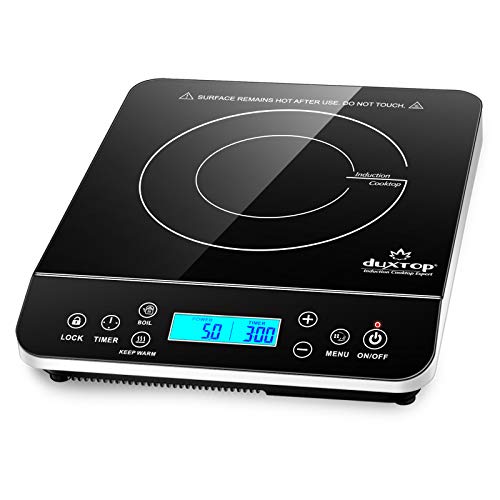
1. Duxtop Portable Induction Cooktop 9600LS — Best Overall for Large Pots
Choose the Duxtop 9600LS if your large pots are induction-compatible — stainless with a magnetic base, cast iron, or enamelled steel. Induction puts the heat into the pot base itself, so a large volume of water comes to the boil faster than on a radiant plate, and the sensor-touch controls hold a simmer precisely once you get there. It suits canning prep, stock making, and pasta water at scale. It is useless with aluminium, copper, or glass pots, so check your cookware with a magnet before choosing it.
Strengths
- 1800W induction — fastest water heating here for compatible pots
- Precise sensor-touch temperature control for simmers
- Flat glass surface wipes clean after boil-overs
Trade-offs
- Only works with magnetic cookware
- Large pots wider than the coil heat less evenly at the edges
- Glass surface demands care with very heavy cast iron
| Spec | Detail |
|---|---|
| Power | 1800 watts |
| Type | Induction hot plate |
| Controls | LCD sensor touch per listing |
| Model | 9600LS (BT-200DZ) |
For large pots, induction’s advantage compounds with volume. Bringing ten quarts of water to a rolling boil is the slowest job in a home kitchen, and an 1800-watt induction plate does it markedly faster than a cast-iron plate of similar rating because the energy goes directly into the pot base instead of heating a plate first. The 9600LS has been a category benchmark for years precisely because it sustains that power without fuss and its controls make the jump from boil to bare simmer without a wrestling match.
Match the pot to the coil for best results: a stockpot whose base is close to the induction coil’s diameter heats most evenly, while a much wider pot will show a cooler ring at the edges — acceptable for soups and stocks, noticeable for frying. If your big-pot cooking is mostly stocks, pasta, and canning water baths with magnetic pots, this is the most capable single plate on the list.
Best for: Fast boiling and precise simmering with magnetic pots / Not suited for: Aluminium, copper, or glass cookware
Check on Amazon — check the current price on Amazon before you buy.

2. ChangBERT Induction Cooktop, Commercial Grade — Best Commercial-Grade for Big Batches
Pick the ChangBERT if your large-pot work is serious and long: all-day stocks, big-batch soup for freezing, or semi-commercial use at a market stall or catering prep table. The large 8-inch coil suits wide pot bases better than standard coils, the stainless body shrugs off hard use, and the 10-hour timer fits long, low cooking that domestic plates often cap. Like all induction, it needs magnetic cookware. Home cooks with occasional pasta water will find the Duxtop above simpler and sufficient.
Strengths
- Large 8-inch coil matches wide stockpot bases
- Commercial-grade stainless build, NSF certified per listing
- 10-hour timer suits long stocks and batch cooking
Trade-offs
- Commercial positioning — more machine than casual use needs
- Induction-only cookware compatibility
- Larger and heavier than domestic plates
| Spec | Detail |
|---|---|
| Power | 1800 watts |
| Coil | Large 8-inch heating coil per listing |
| Build | Premium stainless steel, NSF certified per listing |
| Timer | 10-hour timer per listing |
The coil size is the headline for this article’s specific question. A large pot on a small coil concentrates heat in the center; the ChangBERT’s 8-inch coil spreads induction across more of a wide base, which means more even heating for the thick soups and stews where a hot center and cool edges actually matter. Combined with 1800 watts and a build intended for professional environments, it is the pick that treats a 16-quart stockpot as a normal Tuesday.
The 10-hour timer deserves its mention: stock making and low braising in a big Dutch oven often run past the two-hour caps on domestic appliances. Set it, and the plate manages the long tail of the cook. If your large-pot ambitions are commercial in spirit even at home, this is your plate; if they are a weekly pasta pot, save the difference and take the Duxtop.
Best for: Serious batch cooking and long stock sessions / Not suited for: Occasional use or non-magnetic cookware
Check on Amazon — check the current price on Amazon before you buy.

3. Cuisinart Cast-Iron Single Burner CB-30P1 — Best Cast-Iron Plate for Simmering
Choose the Cuisinart CB-30P1 if your large-pot cooking is simmer-led: beans, braises, chilli, and curries that sit at a bare bubble for hours. A solid cast-iron plate spreads heat evenly under a heavy pot, holds temperature through lid lifts, and works with every pot you own — no magnet test required. The six settings are simple and repeatable. It is not the fastest boiler here; cast iron heats up slowly, so pasta-water urgency belongs to the induction picks.
Strengths
- Works with all cookware — no compatibility test
- Solid plate supports heavy pots evenly and stably
- Six clear heat settings; even, steady simmering
Trade-offs
- Slow to heat up and slow to cool down
- 7.4-inch plate is best with pots of similar base size
- No timer or digital precision
| Spec | Detail |
|---|---|
| Plate | 7.4-inch cast-iron plate, coil-less |
| Controls | 6 adjustable heat settings |
| Indicators | Indicator lights per listing |
| Finish | Stainless steel |
Cast iron’s virtue for large pots is thermal mass. Once the plate and a heavy pot are at temperature, the system resists fluctuations — the simmer stays a simmer when you lift the lid, add ingredients, or the kitchen door opens. For the long, low cooking that big pots usually mean, that stability is worth more than raw speed, and the coil-less flat plate also wipes clean in a way exposed coils never do.
The 7.4-inch plate dimension is your matching rule: pots with bases near that size get the most even service, while a much wider stockpot will heat from its center outward — fine for soups, slower for a water bath. As a second burner for the holidays, a simmer station for beans, or the main plate in a small kitchen with mixed cookware, the CB-30P1 is the dependable classic of this list.
Best for: Long simmers and mixed cookware collections / Not suited for: Fastest-possible boiling
Check on Amazon — check the current price on Amazon before you buy.

4. CUSIMAX Electric Burner Hot Plate, Cast Iron Single, 1500W — Best Value Cast-Iron Plate
Pick the CUSIMAX if you want cast-iron universality at a budget tier. The listing confirms the points that matter under a large pot: it works with all cookware, and non-slip rubber feet keep the plate planted when a full stockpot goes on or comes off. Adjustable temperature covers the simmer-to-boil range for soups and pasta. It gives up some wattage to the 1800-watt induction picks, so big water volumes take longer, and it shares cast iron’s slow heat-up and cool-down.
Strengths
- All-cookware compatibility at a budget tier
- Non-slip feet — a real safety point under heavy pots
- Stainless body cleans easily after boil-overs
Trade-offs
- 1500W — slower for very large water volumes
- Cast iron’s usual slow response to setting changes
- Basic controls without timer or presets
| Spec | Detail |
|---|---|
| Power | 1500 watts |
| Plate | Cast-iron single plate |
| Compatibility | Works with all cookware per listing |
| Stability | Non-slip rubber feet per listing |
Value picks earn their place by getting the safety and compatibility basics right, and the CUSIMAX does: a full stockpot is a serious weight of near-boiling liquid, and a plate that stays put on non-slip feet while you maneuver it is not a detail. The cast-iron plate then does what cast iron does — even, steady heat for the soups, beans, and braises that fill big pots most often.
Set expectations on speed. At 1500 watts, a very large pot of water is a patience exercise compared with the induction picks. If your big-pot work is a weekly pasta night and occasional stock, that is a fair trade for the price tier and total cookware freedom. If boiling speed is your main metric, step up to the Duxtop and check your pots with a magnet.
Best for: Budget second burner for any pot you own / Not suited for: Speed-critical boiling of very large volumes
Check on Amazon — check the current price on Amazon before you buy.
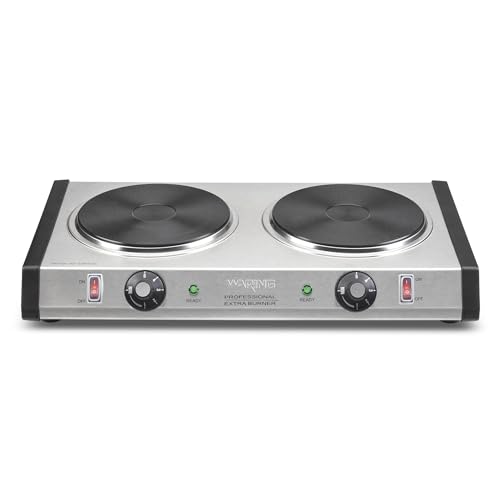
5. Waring Portable Double Burner WDB600X — Best Double Burner: Large Pot Plus a Side
Choose the Waring when your large-pot cooking travels with a companion: stock on one plate and a reducing sauce on the other, a canner plus a small pot of lids, a chilli plus rice. The heavy-duty build is positioned for commercial kitchens and catering, which translates to a plate that tolerates heavy pots and hard use, and cast iron means every pot works. It is the biggest footprint here, and a cook who only ever runs one pot pays for capacity they will not use — the single plates above are the tighter buy for them.
Strengths
- Two plates — large pot plus a simultaneous side
- Heavy-duty commercial-grade construction
- Cast iron works with all cookware
Trade-offs
- Largest footprint on this list
- Two plates share one appliance’s total draw — check your circuit for two big loads
- Overkill for strictly one-pot cooks
| Spec | Detail |
|---|---|
| Plates | Two heavy-duty 7.5-inch cast-iron plates per listing |
| Build | Heavy-duty; positioned for commercial kitchens and catering per listing |
| Power | 120V |
Holiday and batch cooking rarely fail on the main pot; they fail on the second thing that also needs heat. The Waring’s answer is structural: two proper cast-iron plates, each 7.5 inches, in a body built for catering environments. A large stockpot fits one plate with the base well matched, while the second handles the gravy, the melted butter, or the small pot keeping a sauce at a bare simmer.
Be sensible about electrical load: two burners working hard on one circuit deserve the same respect as any range. Used with that awareness, the WDB600X is the closest thing on this list to a portable range, and for caterers, canners, and big-family cooks it is the most capable answer to the large-pot question.
Best for: Cooks who run a large pot and a side together / Not suited for: One-pot-only cooks or tight counters
Check on Amazon — check the current price on Amazon before you buy.
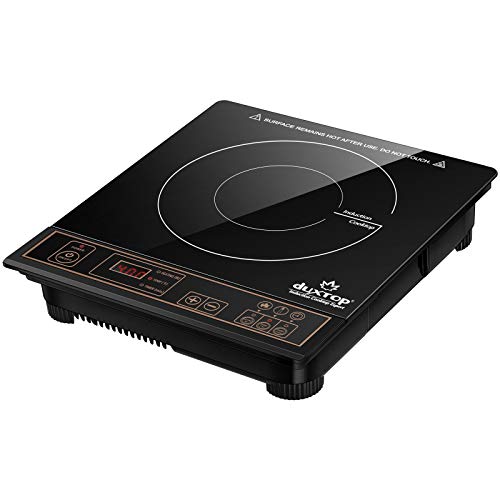
6. Duxtop Portable Induction Cooktop 8100MC — Best Budget Induction
Pick the 8100MC if you want induction speed for large pots on a budget. It delivers the full 1800 watts that makes induction boil big volumes quickly, in Duxtop’s long-established BT-180G3 platform. The trade-offs for the tier are in refinement — the 9600LS above has the more polished sensor-touch experience — and the standing induction rule applies: magnetic cookware only. For a first induction plate to pair with a big stainless stockpot, it is the value entry point.
Strengths
- Full 1800W induction power at a budget tier
- Established platform with a long production history
- Fast, efficient heating for large water volumes
Trade-offs
- Less refined controls than the 9600LS
- Magnetic cookware only
- Basic finish compared with the premium picks
| Spec | Detail |
|---|---|
| Power | 1800 watts |
| Type | Induction countertop burner |
| Model | 8100MC (BT-180G3) |
The honest summary of the 8100MC is that the expensive parts of induction — the power electronics that push 1800 watts into your pot — are present in full, and the savings are in the interface and finish. For large-pot work, where you mostly set a boil or a simmer and leave it, that trade favors the buyer. A big stockpot of water does not care about touch-panel elegance; it cares about watts, and it gets all of them here.
Choose between the two Duxtops by temperament: the 8100MC if you want the function at the friendlier tier, the 9600LS if you will use the plate daily and value its controls and finish over years. Either way, run the magnet test on your largest pots first — induction’s one hard rule decides whether this whole branch of the list is open to you.
Best for: Induction speed on a budget / Not suited for: Non-magnetic cookware or buyers wanting premium controls
Check on Amazon — check the current price on Amazon before you buy.
Comparison Table
Match the plate to your pot’s base size and material first. Induction wins on speed with magnetic pots; cast iron wins on compatibility and simmer stability; the double burner wins when two pots run at once.
| Pick | Badge | Key spec | Best for |
|---|---|---|---|
| Duxtop Portable Induction Cooktop 9600LS | Best Overall for Large Pots | 1800W induction, LCD sensor touch | Fast boiling and precise simmering with magnetic pots |
| ChangBERT Induction Cooktop, Commercial Grade | Best Commercial-Grade for Big Batches | 1800W, large 8-inch coil, NSF certified, stainless body | Serious batch cooking and long stock sessions |
| Cuisinart Cast-Iron Single Burner CB-30P1 | Best Cast-Iron Plate for Simmering | 7.4-inch cast-iron plate, 6 heat settings | Long simmers and mixed cookware collections |
| CUSIMAX Electric Burner Hot Plate, Cast Iron Single, 1500W | Best Value Cast-Iron Plate | 1500W cast iron, all cookware, non-slip feet | Budget second burner for any pot you own |
| Waring Portable Double Burner WDB600X | Best Double Burner: Large Pot Plus a Side | Two 7.5-inch cast-iron plates, heavy-duty build | Cooks who run a large pot and a side together |
| Duxtop Portable Induction Cooktop 8100MC | Best Budget Induction | 1800W induction, classic BT-180G3 platform | Induction speed on a budget |
How to Choose the Best Hot Plate for Large Pots
Start with your largest pot, literally: measure its base diameter and check its material. The heating surface should be close to the base size — a plate much smaller than the pot concentrates heat in the center and wastes the edges, while a plate much larger wastes energy and heats the handles and the room. The listings here give you the anchors: 7.4- and 7.5-inch cast-iron plates, and an 8-inch induction coil on the ChangBERT. A typical large stockpot base sits in that range or a little above, which is why these plates suit the category.
Then decide the technology by cookware and cooking style. Run a magnet along your big pots: if it sticks firmly to the base, induction is open to you and offers the fastest boils and the most precise simmers. If your prized pot is aluminium or copper, cast iron plates are your branch — slower to respond, but universal, stable, and excellent at holding a long, low simmer. Mixed collections usually land on cast iron for the big plate and, budget allowing, induction as the speed burner.
Finally, the practicalities of weight and power. A full large pot can weigh as much as a small child; the plate must sit stably (note the CUSIMAX’s non-slip feet and the Waring’s heavy-duty build), your counter must tolerate heat beneath and around it, and your circuit must handle the draw — an 1800-watt plate is a serious appliance, and two burners at once deserve a thought about what else shares the circuit.
- Base match: plate or coil diameter close to your pot’s base
- Magnet test: decides whether induction is an option at all
- Wattage: 1800W for fast large-volume boils; 1500W suffices for simmer-led work
- Stability: non-slip feet and a heavy body under a heavy pot
- Controls: a timer earns its keep on long stocks; simple dials suit simmering
Induction vs Cast-Iron Plates for Big Pots
Induction heats the pot, not the plate, which is why it boils large volumes fastest and responds instantly when you lower the setting — valuable when a big pot of milk or a foaming stock threatens to boil over. Its weaknesses are compatibility and edge fall-off: a pot much wider than the coil heats unevenly at the rim, and non-magnetic pots do not heat at all. Cast iron heats the plate, which then heats any pot you own; it is slower both ways — slower to boil, slower to stop — but its thermal mass makes it the better long-simmer device, and a solid plate supports heavy pots with no glass to worry about.
For most large-pot repertoires — stocks, soups, beans, pasta — either technology succeeds, which is why this list splits its picks across both. Choose by your pots and your patience: induction for speed merchants with magnetic cookware, cast iron for mixed collections and simmer-led cooking, and the ChangBERT’s larger coil if your wide pots make edge fall-off your main frustration with induction.
Safety and Setup for Heavy Pots on Portable Plates
A large pot of hot liquid is the most dangerous object in a home kitchen, and a portable plate adds two variables a range does not have: a smaller, lighter base and a power cord. Set the plate on a flat, heat-tolerant surface with the cord routed where it cannot be caught by a passing hip or a curious child. Fill the pot after it is on the plate rather than carrying it full across the kitchen, and lift with two hands and dry grips — or better, ladle the contents down before moving the pot at all.
Leave clearance around the plate: portable burners vent heat, and a plate tucked under low cabinets or beside a wall of utensils runs hotter and ages faster. Let cast-iron plates cool fully before moving or storing them — they hold heat far longer than they appear to. These habits cost nothing and are the difference between a plate that serves for years and an accident that ends the experiment.
How to Set Up a Hot Plate Station for a Large Stockpot
Ten minutes of setup makes a portable plate behave like a proper range burner for big pots. This sequence works with every pick on the list.
- Choose the spot: a flat, heat-tolerant counter section with clearance on all sides, near the outlet, away from the sink’s splash zone and out of the walkway. Confirm the circuit is not already carrying another heavy appliance.
- Seat the plate and check stability with the empty pot on it. The pot should sit flat with no rocking, and its base should sit centered on the plate or coil. If you are using induction, confirm the pot is detected and heats before filling it.
- Fill the pot in place using a smaller vessel or a nearby kettle rather than carrying the full pot. Leave headroom for the boil — a large pot filled to the brim will find your counter the moment it rolls.
- Bring the liquid up on the highest setting, then drop to the working simmer as soon as it boils. On cast iron, anticipate: lower the setting a few minutes early, because the plate carries heat. On induction, adjustments are immediate.
- When cooking ends, switch off and let the system cool where it stands. Ladle contents down before moving the pot, and let a cast-iron plate cool completely before storing it.
If a big pot boils sluggishly, check the two usual causes before blaming the plate: a lid makes a dramatic difference to boil time, and a pot base much larger than the heating surface wastes the plate’s output at the edges. Match, lid, and patience solve nearly every large-pot complaint.
Large-Pot Cooking Jobs, Matched to the Plates
It sharpens the choice to walk the actual jobs. Pasta water for a crowd is a pure power test: the largest volume of water, wanted at a rolling boil, fast — the 1800-watt induction picks win it, with the lid on and the pot matched to the coil. Stock is the opposite test: a long, gentle simmer where cast iron’s thermal mass and the ChangBERT’s 10-hour timer earn their keep, and where raw wattage matters only at the start. Canning sits between the two and adds weight: a full canner is the heaviest load in home cooking, which is why the heavy-duty Waring and the commercial-style ChangBERT are the appropriate class, always subject to your canner’s own manufacturer guidance.
Beans, braises, and chilli are simmer jobs with a stirring rhythm, and they forgive nearly every plate here — though induction’s instant response is genuinely useful when a pot of milk-based soup threatens to foam over, because turning it down actually turns it down now, not in three minutes. Frying in a large Dutch oven — a batch of chicken, a big shallow fry — favors the even, sustained heat of a matched cast-iron plate or the larger induction coil, since a small hot spot under a wide pot shows up as uneven browning.
The pattern across all five jobs is the guide’s refrain: match the base, respect the technology’s nature, and the portable plate stops feeling like a compromise. Most large-pot disappointment traces back to a mismatch — an aluminium pot bought for induction, a wide pot on a narrow plate, a simmer job judged by boil speed — rather than to any plate being genuinely poor at its own game.
Power, Circuits, and Countertop Reality
An 1800-watt hot plate draws about as much as a kettle or a microwave, and it deserves the same circuit respect. On a shared kitchen circuit, running the plate at full power alongside another heavy appliance is how breakers trip mid-boil — usually at the worst moment, with guests in the kitchen. The practical habits are simple: give the plate its own outlet run where you can, avoid extension cords entirely for an appliance of this draw, and if two burners must work, stagger their peaks — bring one pot up, then the other — rather than slamming both to maximum together.
Heat management around the plate is the second reality. Induction plates keep their surfaces comparatively cool — the pot is the hot object — while cast-iron plates radiate like the stovetops they imitate, warming the counter zone and anything left beside them. Keep utensils, oil bottles, and the power cord itself out of that zone, and remember that a cast-iron plate stays burn-hot long after the food is done; a household rule about who touches the plate after cooking is worth more than any warning light.
None of this is a reason to avoid portable plates — ranges demand the same respect — but it is the difference between a plate integrated into your kitchen’s routine and one that lives in a cupboard after two alarming experiences. Set the station up properly once, as the how-to section describes, and a large-pot plate becomes the most quietly useful appliance in a small or busy kitchen.
A Note on Cookware: Getting the Most From Each Plate Type
The plate is half the system; the pot is the other half, and large pots reward a few specific virtues. A heavy, flat base is the first: it sits stably on the plate, makes full contact with the heating surface, and resists the warping that turns a cheap stockpot into a rocking, hot-spotted frustration. Test an existing pot by spinning it on a flat counter — a pot that spins or rocks has a bowed base that will underperform on every plate in this guide, and replacing it may improve your results more than replacing the plate.
For induction, the base must also be magnetic across its whole footprint, not just in a decorative ring: run the magnet test at several points, including the edges. Multi-ply stainless with an encapsulated magnetic base is the ideal large-pot construction for induction — even heating, full compatibility, and a base thick enough to resist scorching during long simmers. For cast-iron plates, nearly everything works, but the same flatness rule applies, and enamelled cast iron Dutch ovens are the plate’s natural partner for braises.
Handles and lids complete the system. On a crowded portable station, short loop handles beat long ones that reach over the plate’s edge into the walkway, and a well-fitting lid is worth measurable minutes on every boil and measurable fuel on every simmer. Buy the plate for your pots as they are — or admit you are buying a pot-and-plate system and choose them together. Either way, decide consciously; the unhappy middle is a great plate under the wrong pot.
Storing and Transporting a Portable Plate
Portable plates earn part of their value away from their home counter — at a rental, a holiday house, a market stall, or a relative’s kitchen during the holidays — and a little transport discipline keeps them ready for it. Let a cast-iron plate cool completely before it moves; wrap the cord rather than letting it dangle; and keep the original box if space allows, because a plate’s flat, heavy awkwardness is exactly what factory packaging was designed around. Induction plates travel lighter but their glass surfaces deserve a layer of protection against the pot traveling with them.
At home, store the plate where it will actually be used from — a plate exiled to a high cupboard is a plate that gets skipped in favor of juggling range burners. If it lives on the counter, a simple cover or board over a cast-iron plate keeps dust off the cooking surface between uses. The goal across all of this is the same as the goal for the cooking itself: remove friction, and the tool gets used; add friction, and even the best plate in this guide becomes furniture.
Common Buying Mistakes
The most common buying mistake is ignoring the magnet test until the induction plate arrives. Aluminium stockpots, copper pots, and many older stainless pots without a magnetic base simply will not work on induction. Thirty seconds with a fridge magnet before ordering decides which half of this list is actually available to you.
The second mistake is sizing by the pot’s rim or capacity instead of its base. A plate heats the base it touches; a flared pot with a narrow base on a wide plate, or a wide base on a small plate, both disappoint. Measure the flat base and compare it with the plate and coil dimensions quoted in the listings.
- Skipping the magnet test — induction compatibility is binary and checkable in seconds
- Sizing by rim, not base — heat enters through the flat base only
- Carrying full pots — fill and empty in place; the weight surprises everyone once
- Ignoring the circuit — an 1800W plate plus another appliance can trip a breaker mid-boil
- Storing a warm cast-iron plate — it holds heat long after it looks cool
A final mistake is expecting a portable plate to match a full range burner on every axis. These picks are excellent at what they are — a powerful second burner and a small-kitchen solution. Judge them on boil time, simmer control, and stability with your largest pot, and they will not disappoint.
Final Recommendation
For most large-pot cooks with magnetic cookware, the Duxtop 9600LS is the recommendation: full induction power, precise control, and a proven platform. If your batches are bigger and longer, the ChangBERT’s 8-inch coil and 10-hour timer step up; on a budget, the Duxtop 8100MC keeps the same 1800 watts.
If your pots fail the magnet test, the Cuisinart CB-30P1 is the simmerer’s cast-iron classic, the CUSIMAX is its value counterpart, and the Waring double burner is the answer when a side pot always seems to need heat too. Measure your pot’s base, run the magnet test, and the right branch of this list chooses itself.
- Duxtop Portable Induction Cooktop 9600LS — check price on Amazon
- ChangBERT Induction Cooktop, Commercial Grade — check price on Amazon
- Cuisinart Cast-Iron Single Burner CB-30P1 — check price on Amazon
Keep exploring this category with related guides from the same program: Best Hot Pot Pots Best Electric Skillets Best Stock Pots Best Induction Cooktops Best Portable Burners
To close, a word on expectations across the seasons. A large-pot hot plate works hardest at the two ends of the year — the preserving and holiday season, when every burner is spoken for, and the high summer, when a big pot of corn or a stock can cook without heating the whole kitchen from the range. In between, it is the quiet second burner that makes two-pot weeknight cooking possible in a small kitchen. Judged across that whole year rather than on any single boil, the right plate — matched to your pots, honest about its technology, and set up with the safety habits in this guide — is one of the highest-utility purchases a serious home cook can make.
One more practical note belongs here: mark your settings. Every plate in this guide has a personality — the dial position that holds your stockpot at a bare simmer, the setting that keeps a braise honest — and those positions are worth learning once and recording, on a note inside the cupboard door if necessary. A marked, known simmer setting converts the plate from an appliance you supervise into one you trust, and trust is what frees you to cook the rest of the meal while the big pot minds itself. That, ultimately, is what a second burner is for.
Frequently Asked Questions
What size hot plate do I need for a large stockpot?
Match the heating surface to the pot’s base. Plates and coils in the 7.4- to 8-inch range, as on these picks, suit most large stockpot bases; a much smaller surface concentrates heat in the center, and a much larger one wastes energy. Measure the flat base of your pot, not its rim.
Can I use a hot plate for canning with a large canner?
Many home canners do use heavy-duty portable plates, but check two things: the plate must support the canner’s full weight steadily, and your canner’s manufacturer guidance governs whether portable burners are acceptable for it. The heavy-duty and commercial-style picks here are the appropriate class; follow the canner’s own instructions first.
Why won’t my pot work on an induction hot plate?
Induction requires a magnetic base. Test with a magnet: if it sticks firmly to the pot’s base, the pot works; if it slides or barely holds, it will not heat reliably. Aluminium, copper, and glass need a cast-iron plate instead — several picks here cover them.
Is 1500 watts enough for a large pot?
For simmer-led cooking — soups, beans, braises — yes, with patience on the initial heat-up. For the fastest boils of very large water volumes, 1800 watts is noticeably quicker. Match wattage to how boil-driven your big-pot cooking is.
Can a hot plate replace a stove for large-pot cooking?
For one large pot at a time, effectively yes — that is exactly the use these picks are built for, and the Waring double extends it to a pot plus a side. A full range still wins when several large pots must run together at maximum power.
How do I stop a large pot from heating unevenly on a portable plate?
Center the pot on the plate or coil, keep base sizes matched, use a lid, and stir large volumes occasionally. On induction, a pot much wider than the coil will always have a cooler rim — the larger-coil ChangBERT exists for exactly that case.
Can I use a hot plate outdoors or in an RV?
Portable plates are commonly used in RVs, on covered patios, and at campsites with mains power, and several picks here are positioned for exactly that portability. Observe the basics: a stable, heat-tolerant surface, protection from rain, a circuit that can carry the draw, and full cooling before the plate travels or is stored in a vehicle.

