Disclosure: airfryerkitchensupply.com is reader-supported. When you buy through links on our site, we may earn an affiliate commission at no extra cost to you.
Where to buy
High BTU is a claim any manufacturer can print, so this guide verified the number on every listing: each pick below states its total output in its Amazon listing, and the figure in the spec box is that stated figure — main burners and specialty burners as the manufacturer counts them. Where a brand counts a side or rear burner inside its total, the review says so, because that detail changes what the main grate actually receives.
- Best Overall: Napoleon Rogue PRO-S 625 Gas Grill — check price on Amazon before you buy, because grill pricing moves with the season.
- Best Smart High-Output: Monument Grills Denali 605Pro 6+1 Burner Smart Gas Grill — check price on Amazon before you buy, because grill pricing moves with the season.
- Best Natural Gas Power: Nexgrill Deluxe 6-Burner Natural Gas Grill — check price on Amazon before you buy, because grill pricing moves with the season.
- Best Budget Power: Royal Gourmet GA6402S 6-Burner Propane Gas Grill — check price on Amazon before you buy, because grill pricing moves with the season.
- Best Premium Natural Gas: Napoleon Rogue PRO 625 Natural Gas Grill with Infrared Side Burner — check price on Amazon before you buy, because grill pricing moves with the season.
- Best Built-In Power: SPIRE 36-Inch Built-In 6-Burner Dual Fuel Grill — check price on Amazon before you buy, because grill pricing moves with the season.
Before ordering, glance at the listing’s own BTU figure and burner count together, not the BTU alone. A high total spread across six burners is a different tool from the same total across four, and the reviews below walk through exactly that maths for each pick, in plain language, with no invented numbers.
The best gas grills with high btu are built for cooks who have felt a grill fail them at the critical moment: the grate loaded with steaks, the temperature sagging, the sear turning into a steam. Total burner output — measured in British Thermal Units — is the raw horsepower that prevents that sag. The six grills in this guide state outputs from 73,000 to 88,500 BTU in their listings, placing them at the top of the residential market.
But horsepower needs an honest frame, and this guide provides it. Total BTU includes every burner the manufacturer counts — sometimes a side or rear burner inflates the headline — and it says nothing by itself about how well the firebox holds heat. The useful measure is heat per square inch of grate, plus the quality of the box the burners fire into. Every review below therefore pairs the BTU figure with burner count and cooking area, so you can see whether the power is concentrated where your food cooks.
A word on how this guide treats the numbers, because it matters for trust. Every output and area figure in the reviews comes from the pick’s own verified Amazon listing, quoted as the manufacturer states it. Where a total bundles side or rear burners into the headline — a common and legitimate practice, as long as it is visible — the review notes it, so you can compare main-grate power fairly across the six. Nothing here is estimated, rounded up, or borrowed from a different model in the same line.
Who actually needs this much fire? Steak specialists searing thick cuts, hosts cooking full grates for a crowd, cold-climate grillers fighting winter air, and anyone who reverse-sears, blackens fish, or runs a griddle insert hard. If your cooking is gentle and small-batch, a high-BTU grill is wasted money and wasted fuel — and this guide will tell you that plainly too, because the right grill is the one matched to your cooking, not the one with the biggest number.
In this guide
Quick Picks
Six verified high-output grills, ranked by what their power is actually for. The one-line verdicts first; the per-burner maths is in the reviews and guide sections. Every output figure quoted in this guide was stated in the grill’s own listing at verification time — if a number is not in a spec box, it is because the listing did not publish it, not because we forgot to look.
- Best Overall — Napoleon Rogue PRO-S 625 Gas Grill: The highest verified output here — 88,500 BTU across five main burners plus rear and side burners, over 988 square inches.
- Best Smart High-Output — Monument Grills Denali 605Pro 6+1 Burner Smart Gas Grill: 78,000 BTU from six main burners plus a side burner, with smart monitoring and extras like a pizza stone in the box.
- Best Natural Gas Power — Nexgrill Deluxe 6-Burner Natural Gas Grill: 75,000 BTU on an endless house gas line, 775 square inches, a cast iron grate and a griddle insert included.
- Best Budget Power — Royal Gourmet GA6402S 6-Burner Propane Gas Grill: 74,000 BTU of stated output across six burners with a side burner, at the budget end of the high-BTU class.
- Best Premium Natural Gas — Napoleon Rogue PRO 625 Natural Gas Grill with Infrared Side Burner: 74,000 BTU, 988 square inches and an infrared side burner on a gas line — premium plumbed power with a sear station.
- Best Built-In Power — SPIRE 36-Inch Built-In 6-Burner Dual Fuel Grill: 73,000 BTU in a 304 stainless built-in head with 915 square inches — island power with dual-fuel flexibility.
How These Picks Were Chosen
Verification for this list had a hard numerical edge: a candidate’s listing had to state its total BTU output explicitly, and that figure had to place the grill in genuinely high-output territory for its size. Grills with impressive marketing but no stated figure were excluded, and so were grills whose totals quietly depended on burners a buyer might not receive in the listed configuration.
Next we normalised the numbers. For each pick we set the stated output against its burner count and cooking area to judge heat intensity where food actually cooks, and we favoured grills whose power serves a clear purpose — a sear station, a huge grate, a built-in island format — over grills that are merely loud on paper. Established brands with real parts support were preferred, because high-output burners and valves live harder lives than average.
We also tested each candidate against the category’s most common disappointment: the grill that is powerful on paper and timid at the grate because its firebox leaks heat around a thin lid. Weight in the lid, a box that closes with authority, and grates with real mass were treated as part of the BTU story, not separate from it — because stored and retained heat is what turns burner output into seared food, and several high-number candidates failed exactly here.
Finally, we kept the list honest about fuel and format: propane and natural gas both appear, freestanding and built-in both appear, and prices range from budget to premium. What never appears is a price figure or an invented specification — outputs and areas are quoted only where the listing states them, and you should check price on Amazon on the listing itself.
The 6 Best Gas Grills With High BTU
Each review leads with the verified output figure, then explains what that power buys in real cooking — and what it costs in fuel and money. Strengths, trade-offs, spec boxes from the listings, and a verdict close each one.
One counting note that applies throughout: manufacturers total BTU differently. Some sum only main burners; most add the side burner; a few add rear and specialty burners too. The spec boxes report each listing’s stated total as published, and the review text flags where specialty burners form part of the figure, so comparisons stay honest.

Napoleon Rogue PRO-S 625 Gas Grill — Best Overall
The Rogue PRO-S 625 tops this guide on verified numbers and earns it in design: 88,500 BTU total, five main burners, a rear burner and a side burner, spread across 988 square inches of stainless-grate cooking space. It is a grill built for hosts — the firepower to sear a full grate of steaks while a roast turns over the rear burner and sauce simmers at the side.
Strengths
- Highest verified total output in this guide at 88,500 BTU, with power to spare for full-grate searing
- Five main burners plus rear and side burners let three cooking jobs run at once
- 988 sq. in. of cooking area with SafetyGlow knobs, a folding shelf and locking casters
Trade-offs
- Premium price and a large, heavy footprint to match the capability
- Stainless grates need correct preheat and oiling technique to release food cleanly
- Total output includes specialty burners — main-grate power, while excellent, is not the full headline figure
| Specification | Detail |
|---|---|
| Burners | 5 main burners plus rear and side burners |
| Output | 88,500 BTU (stated total) |
| Cooking area | 988 sq. in. |
| Grates | Stainless steel |
| Extras | SafetyGlow knobs, folding shelf, locking casters |
| Fuel | Propane |
The real test of a high-BTU grill is recovery: load the grate with cold meat and watch whether the surface stays in searing territory. With five burners under nearly a thousand square inches, the PRO-S 625 holds its heat through a full load in a way three-burner grills cannot imitate, because there is simply more fire replacing what the food absorbs. Hosts cooking steak night for eight will feel the difference in every batch — there is no second, sadder batch.
Napoleon surrounds the power with the right details: knobs that glow to show which burners are live (a genuine safety feature on a grill this size), casters that lock, and a shelf that folds when the patio is tight. It is the most complete high-output freestanding grill we verified, and the one to buy if the budget stretches and the guest list justifies it.
Best for: frequent hosts who cook full grates and want the strongest verified output in a freestanding grill / Not suited for: small households, small patios, or anyone whose cooking is mostly two portions at a time
Check the current price on Amazon

Monument Grills Denali 605Pro 6+1 Burner Smart Gas Grill — Best Smart High-Output
Monument’s Denali 605Pro pairs serious output — 78,000 BTU — with the smart features younger grill brands do better than the old guard: app-connected temperature monitoring on a big 6+1 burner stainless platform. Six main burners mean the power is spread for control as much as force, and the box includes a pizza stone and round cooking plate that widen what the grill can do.
Strengths
- 78,000 BTU across six main burners plus a side burner — power with fine zone control
- Smart temperature monitoring suits long cooks and distracted hosts
- Included pizza stone and cooking plate add genuine versatility beyond grilling
Trade-offs
- Smart features add complexity and an app dependency some cooks will never use
- Monument’s long-term parts depth is less proven than Napoleon or Weber
- Six burners lit for a two-person dinner waste fuel — discipline required
| Specification | Detail |
|---|---|
| Burners | 6 main burners plus 1 side burner |
| Output | 78,000 BTU (stated total) |
| Extras | Smart monitoring, pizza stone, round cooking plate |
| Body | Stainless steel |
| Fuel | Propane |
Six burners is the control freak’s layout: you can run a fierce left zone for searing, a medium centre for chicken, a low right zone for vegetables, and still have burners in reserve. The Denali’s output makes each of those zones honest — the hot zone is truly hot even with the lid opening and closing for a crowd — while the smart probes watch internal temperatures on long cooks so the host can be a host.
The honest trade is ecosystem maturity. Monument builds appealing, feature-rich grills and supports them, but it does not yet have the decades-deep parts catalogue of the oldest brands. Buyers who value the smart monitoring and the included accessories will find the 605Pro the most modern-feeling grill in this guide; buyers who keep grills for fifteen years should weigh that against the Napoleon above.
Best for: tech-comfortable hosts who want high output, fine zone control and monitored long cooks / Not suited for: minimalists who dislike apps, or buyers optimising purely for decades-long parts support
Check the current price on Amazon
Nexgrill Deluxe 6-Burner Natural Gas Grill — Best Natural Gas Power
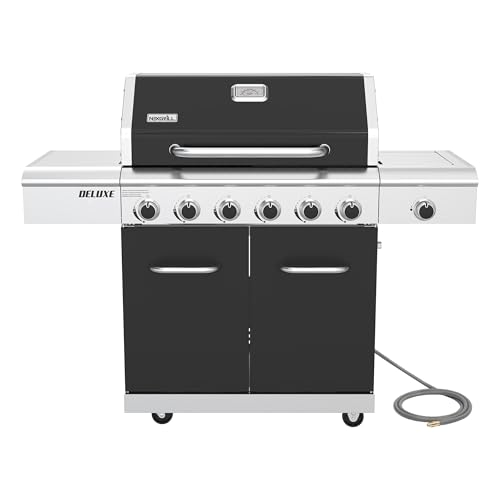
High output and natural gas are a natural pairing: the grill can be as thirsty as it likes because the supply never empties. Nexgrill’s Deluxe 6-Burner NG states 75,000 BTU across six burners and a side burner, over 775 square inches, with a cast iron grate and a griddle insert in the box — a big, versatile, plumbed cooking station.
Strengths
- 75,000 BTU with natural gas convenience — full power, no tank, ever
- Cast iron grate stores heat, reinforcing the burners’ output at the food surface
- Griddle insert included for smash burgers, breakfasts and flat-top work
Trade-offs
- Fixed to the gas line’s location, like every plumbed grill
- Nexgrill’s parts support trails the premium brands for very long ownership
- Six burners on a big box is overkill for couples — size it to your household
| Specification | Detail |
|---|---|
| Burners | 6 main burners plus side burner |
| Output | 75,000 BTU (stated total) |
| Cooking area | 775 sq. in. |
| Grates | Cast iron |
| Extras | Griddle insert, built-in thermometer, electronic ignition |
| Fuel | Natural gas |
The combination to notice is burners plus iron. Cast iron’s stored heat covers the micro-gaps in burner output — the seconds after cold food lands — so a high-BTU box with cast iron grates sears with an authority that the same output under thin steel cannot match. Add the griddle plate over a couple of burners and the grill becomes a flat-top with serious recovery heat for smash burgers and fajitas.
Ownership is the plumbed story: no refills, lower fuel cost per cook, and a grill that is always ready for the big Saturday cookout it was bought for. Confirm the gas line position before ordering, have the connection checked by a professional, and this Nexgrill will out-muscle most propane rivals while asking the least of its owner week to week.
Best for: plumbed patios that entertain often and want high output with cast iron and griddle versatility / Not suited for: renters, propane households, or small families who will rarely light more than two burners
Check the current price on Amazon

Royal Gourmet GA6402S 6-Burner Propane Gas Grill — Best Budget Power
Royal Gourmet’s GA6402S is the proof that high output is not a premium-only feature: its listing states 74,000 BTU of total cooking power across six burners with a side burner, in a silver cabinet grill priced for value buyers. The construction is budget-grade and the review will say so, but the firepower figure is real, stated, and matched to a grate big enough to use it.
Strengths
- 74,000 BTU stated output — genuinely high-BTU territory at a budget position
- Six burners give wide zone control for family and party cooking
- Side burner included, which many budget six-burners omit
Trade-offs
- Thinner materials and lighter hardware than the premium picks — expect a shorter lifespan
- Heat evenness is good for the price, not flawless; rotate food on full loads
- Brand parts support is thinner than Napoleon, Weber or Broil King
| Specification | Detail |
|---|---|
| Burners | 6 main burners plus side burner |
| Output | 74,000 BTU (stated total) |
| Body | Cabinet style, silver |
| Fuel | Propane |
Where does budget high-BTU power show its value? In recovery and in zones. A full grate of chicken pieces over six lit burners keeps cooking instead of steaming, and a two-zone setup still leaves four burners of working space — luxuries that small grills cannot offer at any price. For big families feeding teenagers, that day-to-day capacity matters more than stainless thickness.
The ownership contract is maintenance: cover it, clean the firebox, keep the grease path clear, and a budget grill with this much burner will serve for years. Leave it exposed and neglected and the thin firebox will age fast. Buyers who accept that contract get the most BTU per dollar in this guide, and for many households that is the right trade.
Best for: large families and value buyers who need real output and area without premium pricing / Not suited for: buyers wanting a decade-plus flagship, or perfectionists about fit and finish
Check the current price on Amazon
Napoleon Rogue PRO 625 Natural Gas Grill with Infrared Side Burner — Best Premium Natural Gas
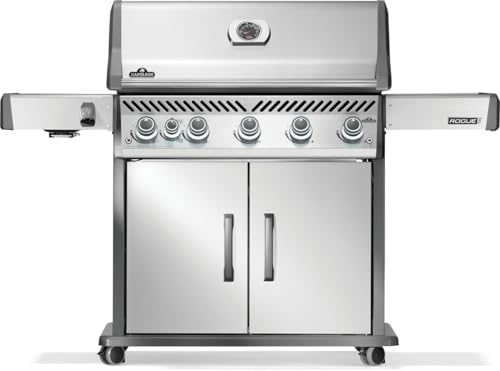
This Rogue PRO 625 shares the platform of our top pick but trades some headline output for two refinements: natural gas fuel and an infrared side burner. The stated 74,000 BTU drives five main burners across 988 square inches, while the infrared station delivers concentrated searing heat that raw BTU totals cannot describe — a reminder that how heat arrives matters as much as how much arrives.
Strengths
- Infrared side burner sears at intensities beyond the main burners’ reach
- 74,000 BTU and 988 sq. in. handle party loads on an endless gas supply
- Backlit knobs, folding shelf and locking casters make a big grill practical
Trade-offs
- Requires a natural gas outlet; the grill lives where the line is
- Stainless grates need technique — full preheat and patience for clean release
- Premium pricing, and the infrared station is wasted on cooks who never sear hard
| Specification | Detail |
|---|---|
| Burners | 5 main burners plus infrared side burner |
| Output | 74,000 BTU (stated total) |
| Cooking area | 988 sq. in. |
| Grates | Stainless steel |
| Extras | Backlit knobs, folding shelf, locking caster wheels |
| Fuel | Natural gas |
Think of this grill as two heat systems sharing a cart. The main box is a high-output volume cooker: five burners, huge area, steady recovery under load. The infrared side burner is a specialist that gets steak surfaces crusting in about a minute a side. Cooks who reverse-sear — gentle in the box, violent at the station — will use both systems in a single dinner, which is exactly what the design intends.
On natural gas the whole package becomes effortless to run hard and often. If your patio is plumbed and your cooking mixes big family loads with serious steaks, this is the most capable combination in the guide. If you never sear beyond a burger’s needs, the Nexgrill NG above delivers plumbed power for less.
Best for: plumbed households that both entertain at volume and sear steaks seriously / Not suited for: propane patios, small households, or buyers who will not use the infrared station
Check the current price on Amazon

SPIRE 36-Inch Built-In 6-Burner Dual Fuel Grill — Best Built-In Power
Built-in grills play by different rules: the head must be powerful enough for a permanent station and durable enough to live outdoors for years. SPIRE’s 36-inch dual fuel head — 6 burners at 73,000 BTU with 915 square inches — is built from 304 stainless steel, the correct material for island duty, with electronic ignition and a built-in thermometer.
Strengths
- 304 stainless steel construction suits permanent outdoor kitchen installation
- 73,000 BTU across five burners with 904 sq. in. of cooking space
- Dual fuel design offers fuel flexibility at installation time
Trade-offs
- Needs an island or suitable cart and professional gas installation — a project purchase
- Ceramic burner components reward careful cleaning, as the listing’s configuration includes them
- Less established brand support than the biggest built-in names
| Specification | Detail |
|---|---|
| Burners | 6 main burners |
| Output | 73,000 BTU (stated total) |
| Cooking area | 915 sq. in. |
| Construction | 304 stainless steel body |
| Extras | Built-in thermometer, electronic ignition |
| Format | Built-in grill head, dual fuel |
In an island, output is about confidence: the grill is the kitchen, guests gather around it, and a full grate of mixed food must cook without apology. Seventy-three thousand BTU across six burners and 915 square inches delivers that confidence, with zones wide enough to run a genuine production line — searing here, roasting there, holding at the edge.
Buy it as part of a planned build, with the cut-out, ventilation and gas work done professionally, and confirm the fuel configuration at installation. Outdoor kitchen owners who do that get flagship-class power in the format this guide’s freestanding picks cannot serve. Everyone else should admire it and choose a cart.
Best for: outdoor kitchen builders wanting high output in a durable built-in format / Not suited for: freestanding buyers, renters, or anyone not building an island
Check the current price on Amazon
Comparison Table
Read the output column with the area column — heat per square inch is the honest comparison, and the reviews explain each total’s burner maths.
| Pick | Badge | Key spec | Best for |
|---|---|---|---|
| Napoleon Rogue PRO-S 625 Gas Grill | Best Overall | 88,500 BTU, 5 burners + rear/side, 988 sq. in. | frequent hosts who cook full grates and want the strongest verified output in a freestanding grill |
| Monument Grills Denali 605Pro 6+1 Burner Smart Gas Grill | Best Smart High-Output | 78,000 BTU, 6+1 burners, smart monitoring | tech-comfortable hosts who want high output, fine zone control and monitored long cooks |
| Nexgrill Deluxe 6-Burner Natural Gas Grill | Best Natural Gas Power | 75,000 BTU, natural gas, 775 sq. in., cast iron grate | plumbed patios that entertain often and want high output with cast iron and griddle versatility |
| Royal Gourmet GA6402S 6-Burner Propane Gas Grill | Best Budget Power | 74,000 BTU, 6 burners, side burner, budget cabinet | large families and value buyers who need real output and area without premium pricing |
| Napoleon Rogue PRO 625 Natural Gas Grill with Infrared Side Burner | Best Premium Natural Gas | 74,000 BTU, natural gas, infrared side burner, 988 sq. in. | plumbed households that both entertain at volume and sear steaks seriously |
| SPIRE 36-Inch Built-In 6-Burner Dual Fuel Grill | Best Built-In Power | 73,000 BTU, built-in, 304 stainless, 915 sq. in. | outdoor kitchen builders wanting high output in a durable built-in format |
The table makes the guide’s central point visible: the highest total (Napoleon PRO-S 625) and the most concentrated power are different things, and the right pick depends on your grate size and cooking style. Budget power (Royal Gourmet) and premium power (Napoleon, SPIRE) state similar figures; what separates them is build, evenness and how long the performance lasts. If two rows still look equal after that, choose by fuel and format — propane carts move, natural gas carts stay near the line, and the built-in belongs to a kitchen project — because those are the differences you will live with every single day.
BTU Explained: Total Output vs Heat Per Square Inch
BTU — British Thermal Units — measure how much heat a burner produces per hour. A grill’s stated total is simply the sum of its burners at full throttle. That sum is useful for comparing grills of similar size, and nearly useless across sizes: 60,000 BTU under a compact grate is ferocious, while the same figure under a six-burner party grate is merely adequate. The figure that predicts searing is output divided by cooking area — heat per square inch.
As a rough field guide, mainstream family grills land in the moderate band, while the picks in this guide sit deliberately above it. High heat per square inch buys three things: faster preheats, a grate that stays in searing territory when loaded with cold food, and the ability to keep cooking in wind and winter. It costs two things: fuel, and forgiveness — a very hot grill burns food faster when the cook wanders off.
Treat manufacturer totals with one more grain of salt: counting methods differ. Some brands sum main burners only; most add the side burner; totals that include rear and infrared burners flatter the headline further. That is why every review in this guide names what the figure includes where the listing makes it clear, and why the comparison that matters is always output, burners and area read together.
How to Choose a High-BTU Grill Without Overbuying
Start from your hardest regular cook, not your easiest. If that cook is a full grate of steaks for eight, you need recovery power and area together — the top picks here. If it is four chicken breasts on a Tuesday, you need neither, and a moderate grill will cook them better for less fuel; high-BTU fireboxes are at their worst simmering small loads, where their minimum temperatures run hot and their fuel use is disproportionate.
Next, match power to format. Freestanding hosts should look at five-to-six-burner models with totals in the seventies and eighties. Plumbed households can exploit natural gas’s endless supply with the Nexgrill or the Napoleon NG. Island builders need built-in heads whose output and materials suit permanent installation, like the SPIRE. Each format appears in this guide precisely because ‘high BTU’ means something different on each.
Finally, weigh the supporting cast: grate material (cast iron stores the heat the burners make; stainless is tougher against neglect), lid and firebox weight (heavy boxes hold the heat in), and parts support (high-output burners work hard and eventually need replacing). A slightly lower total on a heavy, well-supported grill routinely out-cooks a headline number on a thin one after the first season.
What High BTU Actually Changes at the Grate
Preheat time is the first change: a high-output grill reaches searing temperature in minutes rather than the better part of half an hour, which quietly makes weeknight grilling more likely to happen. The second change is recovery — the grate’s ability to stay hot when cold, wet food lands on it. Recovery is the difference between steaks that crust and steaks that grey, and it is the main thing you are buying with a big BTU figure.
The third change is headroom for techniques. Blackening fish, charring peppers directly over maximum flame, running a griddle plate hot enough for proper smash-burger crust, cooking pizza on a stone — all of these live at the top of a grill’s range, and high-output grills simply have more top. Winter grilling belongs here too: a powerful firebox shrugs off cold air that would stall a weaker grill’s roast.
None of this makes low-and-slow cooking impossible, but it does make it a skill: on a high-BTU grill, the lowest burner settings still deliver real heat, so gentle cooking uses one burner lit, indirect placement, and the lid thermometer watched with respect. The guide’s how-to section turns that into a repeatable method.
Fuel Consumption and Running Costs of High-Output Grills
High-BTU grills burn more fuel at full throttle — that is arithmetic, not a flaw. What matters for running costs is how you actually cook. A sear takes minutes; a roast runs one or two burners at moderate settings; a party uses everything for an hour. Owners who light only the burners they need find a big grill’s fuel bills unremarkable, while owners who run all six burners for four burgers pay for the privilege.
Propane users feel consumption as tank swaps: expect a high-output grill run hard and often to empty tanks noticeably faster than a compact grill, and keep a spare tank if you entertain. Natural gas users feel it barely at all — the supply is endless and the per-cook cost is low — which is why two of this guide’s high-output picks are plumbed models.
The efficiency habit that matters most is lid discipline. Every opening dumps the heat your fuel bought; high-BTU burners replace it quickly, but ‘quickly’ still burns gas. Cook with the lid down, open with a plan, and the power stays an asset instead of a meter running.
High-BTU Safety: Heat Management and Clearances
More output means more respect for the basics. Keep the manufacturer’s clearances from walls, fences, overhangs and deck rails — a high-BTU grill’s exhaust and flare potential are proportionally larger, and vinyl siding records heat damage faithfully. Never run a big grill in a garage or enclosed porch, and give the grease system extra attention: high heat plus fatty food produces more drippings, and a neglected grease cup under a powerful firebox is the classic route to a grease fire.
Light with the lid open, always, so unburned gas cannot accumulate — on a high-output grill the accumulated volume is larger and the lesson correspondingly more important. If burners fail to light, close the valves, wait several minutes for gas to disperse, and try again rather than clicking repeatedly over a flooding firebox.
Finally, match the tools to the heat: longer tongs, heat-resistant gloves, and a habit of treating the area above the grate as the very hot place it is. High-BTU grilling rewards confident cooks and punishes casual ones slightly faster than ordinary grilling does — which is a fair summary of the entire category.
How to Sear Thick Steaks on a High-BTU Grill
This is the technique the category exists for: a deep crust, a precise centre, and no grey band of overcooked meat in between. It works on every pick in this guide.
- Choose steaks at least an inch and a half thick, and salt them at least 45 minutes ahead — or right before cooking. Pat them completely dry before they meet the grill; surface moisture is crust’s first enemy, and even 88,000 BTU wastes its first minute boiling water off a wet steak.
- Preheat with every main burner on high and the lid closed for a full ten minutes. On a high-BTU grill the grate should be at its fiercest — this stored and radiant heat is what you paid for.
- Oil the steaks lightly, not the grate, and lay them down over the hottest zone. Do not touch them for two to three minutes. High output forms the crust fast; moving early tears it.
- Flip once and give the second side the same undisturbed time. For very thick cuts, finish to temperature over a cooler zone or with burners lowered — the sear is done, and now you are simply roasting to the centre you want.
- Rest the steaks on a warm rack or plate for at least five to eight minutes before slicing. Carryover heat finishes the centre, juices redistribute, and the crust you built survives the knife.
- While the grill is still hot, burn off residue for five minutes, brush the grates clean, and shut down in sequence: burners off, then the fuel supply. A clean grate is tomorrow’s good sear.
Two judgements separate good high-BTU cooks from burnt ones. First, trust time and touch less and temperature more: use an instant-read thermometer for the centre, because the crust forms too fast for guesswork. Second, manage the load — sear in batches rather than crowding, because even the strongest grill in this guide sears better with space around each steak.
Common Buying Mistakes
Reading total BTU without burner count or area. 88,000 BTU across five burners and 73,000 across another five are different tools from the same figure spread over six. Always read output, burners and cooking area together, as this guide’s spec boxes do.
Lighting every burner for every cook. High-output grills are thirsty and hot at minimum settings. Light what the food needs — your fuel bill, your chicken skin and your eyebrows will all notice the difference.
Opening the lid to admire the sear. Every peek dumps the heat you paid for. High-BTU burners recover faster than most, but the crust forms best in a closed, stable environment. Look through the thermometer, not the gap.
Neglecting the grease system. Powerful burners plus fatty food equals drippings in volume. Empty the cup, scrape the firebox, and never let a high-output grill become a grease fire with a lid.
Buying power instead of build. A huge figure on a thin, leaky firebox disappoints by the second season. Box weight, grate material and parts support decide how long the performance lasts — the number only describes day one.
Skipping the lid-open lighting rule. Gas pooling in a big closed firebox is a real hazard. Lid open to light, patience if it does not catch, and valves closed while you wait — every time, on every grill in this guide.
Final Recommendation
The Napoleon Rogue PRO-S 625 is the high-BTU pick for most hosts: the strongest verified output here, in a freestanding package with the details — safety knobs, casters, folding shelf — that make big grills livable. The Monument Denali 605Pro answers for cooks who want that class of power with smart monitoring and six-burner control, and the Royal Gourmet GA6402S proves the output itself is available on a budget if you accept budget build.
Plumbed households split by style: the Nexgrill Deluxe NG for cast iron and griddle versatility, the Napoleon Rogue PRO 625 NG for the infrared sear station. Island builders take the SPIRE and its 304 stainless head. Whichever you choose, read the listing’s stated output against its burners and area, check price on Amazon, and then cook the way these grills ask to be cooked — hot, decisively, and with the lid down.
Start your shortlist with the Napoleon Rogue PRO-S 625 Gas Grill (best overall) if its strengths match the way you actually cook.
Start your shortlist with the Monument Grills Denali 605Pro 6+1 Burner Smart Gas Grill (best smart high-output) if its strengths match the way you actually cook.
Start your shortlist with the Nexgrill Deluxe 6-Burner Natural Gas Grill (best natural gas power) if its strengths match the way you actually cook.
Keep researching within this grill cluster: Best Gas Grills Under $800 Dollars Best Gas Grills With Natural Gas Best Gas Grills With Cast Iron Grates Best Gas Grills With Burner And Infrared Best Gas Grills With Rotisserie
Frequently Asked Questions
How many BTU do I actually need in a gas grill?
Enough to keep your typical load searing. For most families, a mid-output grill suffices; high-BTU models earn their place when you cook full grates, thick steaks, or in cold and wind. Judge by heat per square inch and recovery, not the headline total — a well-built grill with a moderate figure out-sears a thin grill with a bigger one.
Does a higher BTU grill cook faster?
It preheats faster and sears faster, and it recovers temperature faster after the lid opens or cold food lands. Total cooking time for roasts and chicken is set by temperature and thickness, not by maximum output — a high-BTU grill’s advantage is control at the extremes, not a shortcut through physics.
Will a high-BTU grill use a lot more propane?
At full throttle, yes — output and consumption are the same number viewed from two sides, and a big grill run flat-out will empty a standard tank in fewer total hours of cooking. In real cooking, where most time is spent at moderate settings on some burners, the difference is modest. Light only the burners you need and keep the lid down, and a big grill’s fuel use stays reasonable.
Are high-BTU grills good for low-and-slow cooking?
They can do it, with technique: one burner lit at its lowest, food placed indirectly, and attention to the thermometer, because even ‘low’ on a powerful burner is substantial. If low-and-slow is your main style, a moderate grill or a dedicated smoker is the easier tool; if it is an occasional mode, the picks here handle it fine.
Is total BTU or BTU per burner more important?
Neither figure is sufficient on its own, and choosing by either one alone misleads buyers regularly. What predicts performance is output relative to cooking area, plus firebox quality. Per-burner figures help judge zone strength — a grill whose burners are individually strong recovers better in the zone you are using. Read all three numbers together, as the reviews in this guide do.
Can a high-BTU grill damage itself or my patio?
Only through neglect of the basics: ignored clearances can heat-damage siding and decking, and a grease-clogged firebox under powerful burners is a genuine fire risk. Follow the manufacturer’s clearances, keep the grease path clean, light with the lid open, and a high-output grill is as safe as any other — it simply deserves the respect its power implies.


