Disclosure: airfryerkitchensupply.com is reader-supported. When you buy through links on our site, we may earn an affiliate commission at no extra cost to you.
Where to buy
Every grill in this guide was verified to ship with cast iron cooking grates — porcelain-enameled cast iron or enameled cast iron, as stated in each listing. That verification matters, because grill lines often swap grate materials between trim levels and model years, and a listing photo alone cannot tell you what is in the box.
- Best Overall: Weber Spirit E-310 Gas Grill — check price on Amazon before you buy, because grill pricing moves with the season.
- Best Large Grill: Weber Genesis E-415 Gas Grill — check price on Amazon before you buy, because grill pricing moves with the season.
- Best Budget: Kendane 4-Burner Propane Gas BBQ Grill with Side Burner — check price on Amazon before you buy, because grill pricing moves with the season.
- Best Big Grill on a Budget: AMERLIFE 6-Burner Propane Gas Grill with Side Burner — check price on Amazon before you buy, because grill pricing moves with the season.
- Best With a Sear Station: Napoleon Rogue PRO 425 Gas Grill with Infrared Side Burner — check price on Amazon before you buy, because grill pricing moves with the season.
- Best Natural Gas: Nexgrill Deluxe 6-Burner Natural Gas Grill with Side Burner and Griddle Insert — check price on Amazon before you buy, because grill pricing moves with the season.
If you are comparing a listing variant against this page, check the grate line in the product title or specification table, not the pictures. The six configurations linked here are the ones whose listings state cast iron grates in writing, in the size and fuel type reviewed below, so the grill that arrives is the grill these reviews describe, down to the last burner and grate bar.
The best gas grills with cast iron grates share one defining trait: the surface your food touches is heavy, heat-hungry iron. Cast iron stores far more heat than thin steel wire or stamped grates, so when a cold steak lands, the grate temperature barely dips — and that is what produces deep, even sear marks instead of pale striping. Cast iron also smooths out the temperature swings of burners cycling on and off, which makes the whole grill feel calmer and more predictable.
There are two flavours of cast iron grate in this guide. Porcelain-enameled cast iron, used by Weber, coats the iron in a glassy layer that slows rust and makes cleaning easier, at the cost of needing gentler handling — chipped enamel exposes iron that can rust. Matte enameled and pre-seasoned style grates, like the Kendane’s, behave more like a cast-iron skillet: they build a seasoning layer over time and reward oiling. Both outperform plain steel; the choice is about care style, not cooking quality.
The six picks below span three to six burners, propane and natural gas, and budgets from genuinely cheap to premium. What they share is the iron. Read the reviews for who each grill suits, then read the buying guide sections carefully — cast iron rewards owners who season, oil and clean it properly, and punishes neglect faster than any other grate material.
One more framing note before the picks: a cast iron grate is not a cosmetic upgrade, it is the single most consequential component in a gas grill after the burners themselves, because it is the only part that touches every piece of food you cook. Buyers cross-shopping a cheaper steel-grate grill against these picks should understand they are not comparing trim levels — they are comparing two different cooking surfaces that produce visibly different results on the same cut of meat, from the same burners, on the same evening.
In this guide
Quick Picks
Six grills, one grate material, very different personalities. The fast tour first, with the detail after — and if you only remember one line per grill, make it these, because each badge was chosen to describe the household the grill genuinely suits rather than the marketing slot it fills.
- Best Overall — Weber Spirit E-310 Gas Grill: The benchmark three-burner with porcelain-enameled cast-iron grates, Snap-Jet ignition and Weber’s unmatched parts support.
- Best Large Grill — Weber Genesis E-415 Gas Grill: Four PureBlu burners under a wide field of porcelain-enameled cast iron — the cast-iron experience at family-and-party scale.
- Best Budget — Kendane 4-Burner Propane Gas BBQ Grill with Side Burner: Enameled cast iron grates and a side burner on a four-burner grill at the budget end — the cheapest route onto real iron in this guide.
- Best Big Grill on a Budget — AMERLIFE 6-Burner Propane Gas Grill with Side Burner: Six burners, 60,000 BTU, 650 square inches and cast iron grates — maximum iron-covered area for the money.
- Best With a Sear Station — Napoleon Rogue PRO 425 Gas Grill with Infrared Side Burner: Cast iron grates in the box, an infrared cannon on the side: 56,000 BTU and 716 square inches of steak-focused layout.
- Best Natural Gas — Nexgrill Deluxe 6-Burner Natural Gas Grill with Side Burner and Griddle Insert: A plumbed six-burner with 75,000 BTU, 775 square inches, a cast iron grate, a side burner and a griddle insert — no tanks, ever.
How These Picks Were Chosen
Grate verification came before everything else: a candidate only entered this list if its Amazon listing states cast iron grates — porcelain-enameled cast iron, enameled cast iron, or cast iron grates — for the exact model sold. Grills whose listings were vague about grate material were excluded, however good the rest of the package looked, because the keyword is a promise about what arrives in the box.
With the grate fixed, we judged the rest of the grill as we would any gas grill: burner count and layout for zone cooking, firebox and lid quality for heat retention, ignition reliability, and the brand’s spare-parts support — especially grate availability, since even well-kept cast iron eventually needs replacing after many years. Fuel variety mattered too, so the final list includes a natural gas option for plumbed patios.
We also deliberately included more than one finish and more than one brand philosophy, because cast iron ownership is partly about temperament. Some cooks want the sealed, low-fuss surface of porcelain enamel; others enjoy a grate that behaves like a skillet and improves with use. Both camps cook equally well on their chosen finish, and both camps fail the same way when the grate is left wet and dirty — so the list represents the finishes honestly rather than crowning one.
We were equally strict about what cast iron cannot fix. A heavy grate on a weak firebox still cooks unevenly, so thin, leaky budget grills with cast iron grates were passed over unless the overall package justified them as a value pick — one did, and its review is honest about the trade. Prices are never printed in this guide; check price on Amazon on the listing itself.
The 6 Best Gas Grills With Cast Iron Grates
Every review covers the grate first — how it is finished, how it behaves, how to care for it — then the grill around it. Strengths, trade-offs, verified specifications and a plain verdict close each one.
Note on specifications: burner counts, outputs and cooking areas quoted in the spec boxes come directly from each grill’s verified listing. Where a listing does not publish a figure — some budget models omit total BTU, for example — the spec box omits it too, rather than borrowing a number from a different model in the same line.

Weber Spirit E-310 Gas Grill — Best Overall
If a friend asked for one cast-iron-grate gas grill without conditions, this is the one we would name. The Spirit E-310 pairs Weber’s porcelain-enameled cast-iron grates with a three-burner firebox that has been refined over generations, Snap-Jet ignition that lights each burner individually, and the deepest spare-parts catalogue in the business. It is the safe, satisfying centre of this category.
Strengths
- Porcelain-enameled cast-iron grates sear hard, resist rust, and are replaceable years down the line
- Snap-Jet ignition lights each burner on its own, so one tired igniter never strands the whole grill
- Weber Works rails accept prep and storage accessories that grow with your setup
Trade-offs
- Three burners suit small-to-medium households; big parties will cook in batches
- No dedicated sear-boost burner on this model — searing relies on the iron and a full preheat
- Enamel coating dislikes metal-on-metal abuse; use the right brush and avoid dropping the grates
| Specification | Detail |
|---|---|
| Burners | 3 main burners |
| Grates | Porcelain-enameled cast-iron |
| Ignition | Snap-Jet |
| Extras | Weber Works rails |
| Fuel | Propane |
The grates are the story, and they behave exactly as cast iron should: after a proper ten-minute preheat they hold enough stored heat to mark a steak deeply on the first side while the burner is still recovering, and they release food cleanly once the crust forms. The enamel layer means you can brush them warm without the rust anxiety of bare iron, and a light oil wipe after cooking keeps them slick and protected.
Around the grates, the E-310 is a study in doing the basics well — even heat across the box, a lid that holds temperature for roasting, and controls that feel precise at low settings for chicken and sausages. It will not win a spec-sheet contest against six-burner rivals, but for households of two to five it covers weeknight dinners and weekend cooks with an ease that explains why the Spirit line anchors so many recommendation lists, this one included.
Best for: most households wanting the definitive cast-iron-grate grill with the easiest long-term ownership / Not suited for: hosts cooking for large groups every weekend, or buyers who need a side burner built in
Check the current price on Amazon

Weber Genesis E-415 Gas Grill — Best Large Grill
The Genesis E-415 takes the same grate philosophy as the Spirit and stretches it over four PureBlu burners and a much larger cooking area. If the E-310 is the right size for a household, the E-415 is the right size for a household that entertains: full packs of chicken, two zones with real width, and cast iron everywhere the food lands.
Strengths
- Four PureBlu burners give a wide, even firebox with genuine hot and cool zones
- Large cooking area keeps big loads in a single layer, so food sears instead of steaming
- PureBlu burner design resists clogging and blockages, protecting flame evenness over years
Trade-offs
- A serious step up in price and footprint from the Spirit class
- Cast iron at this size is heavy — grate sections are a two-hand lift for cleaning
- No side burner in this configuration, despite the premium positioning
| Specification | Detail |
|---|---|
| Burners | 4 PureBlu burners |
| Grates | Porcelain-enameled cast-iron |
| Extras | Stainless side tables, large cooking area |
| Fuel | Propane |
Scale changes cast iron’s advantages for the better. A wide grate field stores enormous total heat, so loading the grill with a dozen burgers does not crash the temperature the way it does on thin steel — each burger still meets a hot surface. The four-burner layout also makes the classic steakhouse workflow easy: sear over the left burners, finish over gentle right-side heat, rest on the warming rack.
The Genesis line’s build is a clear step above the Spirit — heavier lid, sturdier cart, more stainless in the tables — and it is priced accordingly. Buy it because you cook volume or entertain monthly, not because it is ‘better’ in the abstract. For a couple, it is money spent heating empty iron; for a family of six with a social calendar, it is the cast-iron grill that ends the upgrade cycle.
Best for: larger families and regular hosts who want cast iron searing at full entertaining scale / Not suited for: small households, small patios, or buyers watching the budget closely
Check the current price on Amazon

Kendane 4-Burner Propane Gas BBQ Grill with Side Burner — Best Budget
The Kendane is the value disruptor here: four burners, a side burner and enameled cast iron grates at a price where most rivals give you thin porcelain-coated steel. It is not built like a Weber and its review will not pretend otherwise, but the grates — the thing this entire guide is about — are genuinely iron, and that changes how it cooks compared with budget peers.
Strengths
- Enameled cast iron grates at a budget price, where rivals ship thin coated steel
- Four burners plus a side burner cover family cooking and sauces without compromise
- The enamel finish gives cast iron’s sear with easier early care than bare iron
Trade-offs
- Fit, finish and steel thickness are a class below the Weber picks — expect a shorter ultimate lifespan
- Brand support and spare-parts depth are unproven next to the established names
- Heat evenness is good for the price rather than great; rotate food on full loads
| Specification | Detail |
|---|---|
| Burners | 4 main burners plus side burner |
| Grates | Enameled cast iron |
| Fuel | Propane |
Cooking on the Kendane teaches the cast iron lesson quickly: burgers and chops come off with marks that budget steel-grate grills simply do not produce, because the grate surface stays hot through the flip. The four-burner box gives a workable indirect zone for ribs and whole chickens, and the side burner handles the beans-and-sauce jobs that make a cookout feel complete.
The honest framing is lifespan and support. Keep it covered, keep the grates oiled, and clean the firebox regularly, and a grill like this serves a family well for years. But if a burner or grate needs replacing in year five, you are relying on a much thinner parts pipeline than Weber’s. For first-time buyers testing whether they love grilling — and wanting iron from day one — that is a fair trade at this price.
Best for: budget buyers who refuse to give up real cast iron grates, and first-time grill owners / Not suited for: buyers wanting a decade-plus appliance with guaranteed parts support
Check the current price on Amazon

AMERLIFE 6-Burner Propane Gas Grill with Side Burner — Best Big Grill on a Budget
Some households simply need area: big families, big parties, big appetites. The AMERLIFE answers with six burners, 60,000 BTU of total output and 650 square inches of cooking space under cast iron grates, plus a side burner and a warming rack. On paper-per-dollar it is the most grill in this guide, and the cast iron means the area actually sears rather than merely warming.
Strengths
- Six burners and 650 sq. in. handle party loads in a single batch
- Cast iron grates across that whole area — no thin-steel disappointment at the food surface
- Side burner, warming rack and built-in thermometer round out a complete feature set
Trade-offs
- Budget construction at a big size: panels and hardware are lighter than premium rivals
- A six-burner box drinks propane faster, especially when run fully lit for small cooks
- Assembly of a grill this size is a two-person, take-your-time job
| Specification | Detail |
|---|---|
| Burners | 6 main burners plus side burner |
| Output | 60,000 BTU |
| Cooking area | 650 sq. in. |
| Grates | Cast iron |
| Extras | Warming rack, built-in thermometer |
| Fuel | Propane |
The use case writes itself: a full grate of burgers for a team dinner, trays of chicken for a family reunion, or a mixed load where vegetables, sausages and steaks all need their own heat zone at once. Six burners let you run three zones — hot, medium, holding — which is how caterers think, and the cast iron grates mean the hot zone genuinely sears even when fully loaded.
Discipline keeps this grill happy. Light only the burners you need for small cooks to save fuel and wear, keep the big firebox scraped out (more area means more drippings), and cover it religiously — budget finishes at this size weather quickly if left exposed. Treated that way, the AMERLIFE delivers a cooking experience its price has no right to offer, and the cast iron is the reason why.
Best for: big families and party hosts who need maximum cast-iron cooking area at a budget price / Not suited for: small households, fuel misers, or buyers prioritising premium build and finish
Check the current price on Amazon
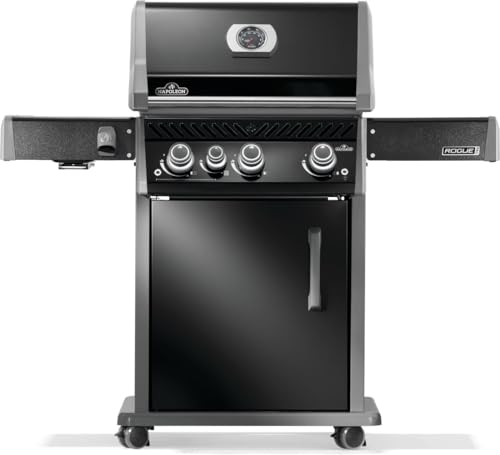
Napoleon Rogue PRO 425 Gas Grill with Infrared Side Burner — Best With a Sear Station
The Rogue PRO 425 pairs cast iron grates in the main box with Napoleon’s infrared side burner, which is arguably the ideal division of labour: the iron handles everyday grilling with its stored-heat consistency, and the infrared station handles the finishing sear at temperatures no grate can reach. It is the enthusiast’s layout in a three-burner footprint.
Strengths
- Cast iron main grates plus an infrared side burner cover both everyday grilling and extreme searing
- 56,000 BTU and 716 sq. in. are generous for a three-burner-class grill
- Backlit knobs, folding shelf and locking casters make it practical to live with and move
Trade-offs
- Premium price for its size class — you pay for the infrared hardware and Napoleon build
- Three main burners give a smaller indirect zone than four-burner rivals
- The infrared side burner is not a gentle hob; sauces belong on the main grate’s edge
| Specification | Detail |
|---|---|
| Burners | 3 main burners plus infrared side burner |
| Output | 56,000 BTU |
| Cooking area | 716 sq. in. |
| Grates | Cast iron |
| Extras | Backlit knobs, folding shelf, locking caster wheels |
| Fuel | Propane |
The workflow sells it: reverse-sear a thick ribeye gently over the cast iron, then give it ninety seconds a side on the infrared burner for a crust that looks machined. Chicken, burgers and vegetables stay on the iron, where its heat storage keeps temperatures honest when the lid opens. Few grills at this size cover both ends of the heat spectrum this convincingly.
Napoleon’s execution details — the substantial lid, the tidy cart, the folding shelf for small patios — make it easy to live with daily. Choose it if steaks and chops headline your cooking and you want cast iron’s everyday behaviour plus a specialist tool for finishing. If you never sear harder than a burger needs, the same money buys a bigger conventional grill, and the Spirit E-310 above is the smarter buy.
Best for: steak and chop enthusiasts who want cast iron daily performance plus infrared finishing power / Not suited for: hosts needing maximum grate area, or cooks who will never use the sear station
Check the current price on Amazon
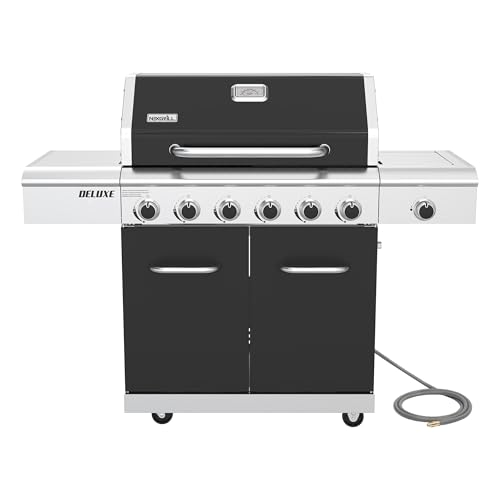
Nexgrill Deluxe 6-Burner Natural Gas Grill with Side Burner and Griddle Insert — Best Natural Gas
Plumbed-patio buyers get a full-size option here: Nexgrill’s Deluxe 6-Burner in natural gas form, with 75,000 BTU, 775 square inches of cooking space, a cast iron grate, a side burner and a griddle insert in the box. It is the big-grill, no-tank combination, and the cast iron surface keeps it honest to this guide’s brief.
Strengths
- Natural gas supply ends tank refills and mid-cook runouts permanently
- 75,000 BTU across six burners with 775 sq. in. for serious volume cooking
- Griddle insert included, expanding the grill into breakfast and smash-burger duty
Trade-offs
- Fixed to the gas line’s location — patio layout is decided by the plumbing
- Nexgrill’s long-term parts support trails Weber and Napoleon
- Cast iron grate sections at this size are heavy to lift out for deep cleans
| Specification | Detail |
|---|---|
| Burners | 6 main burners plus side burner |
| Output | 75,000 BTU |
| Cooking area | 775 sq. in. |
| Grates | Cast iron |
| Extras | Griddle insert, built-in thermometer, electronic ignition |
| Fuel | Natural gas |
Ownership is the headline: turn the knobs and cook, with fuel that costs less per session than propane and never empties during a party. The six-burner box supports true multi-zone cooking at volume, and the cast iron grate gives the stored-heat sear that big loads demand — thin grates on a grill this size would sag in temperature the moment twenty burgers landed.
The included griddle insert is more than a bonus: it turns one zone into a flat-top for smash burgers, peppers and onions, eggs and bacon for a patio breakfast. Between the griddle, the side burner and the main grate, this is the most versatile cooking station in the guide. Just be sure the gas line is where you truly want the grill forever, and have the connection made or checked by a professional.
Best for: homes with a natural gas line that cook for crowds and want cast iron plus griddle versatility / Not suited for: renters, propane-only patios, or anyone who needs the grill to move
Check the current price on Amazon
Comparison Table
All six grills put cast iron under your food; they differ in size, fuel and what surrounds the iron. Match the badge to your household first, then confirm the burner count fits your typical load.
| Pick | Badge | Key spec | Best for |
|---|---|---|---|
| Weber Spirit E-310 Gas Grill | Best Overall | 3 burners, porcelain-enameled cast-iron grates, Snap-Jet ignition | most households wanting the definitive cast-iron-grate grill with the easiest long-term ownership |
| Weber Genesis E-415 Gas Grill | Best Large Grill | 4 PureBlu burners, large area, porcelain-enameled cast-iron grates | larger families and regular hosts who want cast iron searing at full entertaining scale |
| Kendane 4-Burner Propane Gas BBQ Grill with Side Burner | Best Budget | 4 burners, enameled cast iron grates, side burner | budget buyers who refuse to give up real cast iron grates, and first-time grill owners |
| AMERLIFE 6-Burner Propane Gas Grill with Side Burner | Best Big Grill on a Budget | 6 burners, 60,000 BTU, 650 sq. in., cast iron grates | big families and party hosts who need maximum cast-iron cooking area at a budget price |
| Napoleon Rogue PRO 425 Gas Grill with Infrared Side Burner | Best With a Sear Station | Cast iron grates, infrared side burner, 56,000 BTU, 716 sq. in. | steak and chop enthusiasts who want cast iron daily performance plus infrared finishing power |
| Nexgrill Deluxe 6-Burner Natural Gas Grill with Side Burner and Griddle Insert | Best Natural Gas | Natural gas, 6 burners, 75,000 BTU, cast iron grate, griddle insert | homes with a natural gas line that cook for crowds and want cast iron plus griddle versatility |
Two decisions dominate. Size: three burners for small households, four for the middle, six for crowds — with cast iron’s heat storage making every size cook above its weight. Fuel: five picks run on movable propane tanks, one is plumbed natural gas with endless supply and a fixed address. The grates are constant; everything else is lifestyle. If you are torn between two rows, choose by the firebox and the brand’s parts support, because those decide how the grill ages, while the grate material — the reason you are reading this guide — is equally well served by every pick on the table.
Porcelain-Enameled vs Bare and Enameled Cast Iron Grates
All cast iron grates start as the same material; the finish decides how you live with them. Porcelain-enameled grates — the Weber approach — are sealed in a glassy coating. They resist rust even when your oiling routine lapses, clean up with a brass or nylon brush, and release food well. Their weakness is impact and abuse: drop one on concrete or attack it with a steel scraper and the enamel can chip, and chipped spots expose iron that will rust if ignored. Treat them like a good non-stick pan’s tougher cousin.
Enameled and matte-finish grates like the Kendane’s sit closer to skillet behaviour: a thinner enamel that wears into a working surface, improved by regular oiling and proper preheating. Bare cast iron — rare on new gas grills, common on replacements — is the most demanding and the most repairable: it must be seasoned like a skillet, but scratches and wear simply get seasoned over again.
For most buyers, porcelain-enameled cast iron is the right default: ninety percent of the sear, half the fuss. Choose the skillet-style finishes if you enjoy maintaining cookware and want the surface to improve with use. Either way, verify the finish on the listing before ordering, because product photos cannot distinguish them.
How to Choose a Cast Iron Grate Grill: Size, Burners and Heat
Cast iron changes the sizing maths slightly in your favour. Because the grate stores heat, a three-burner cast iron grill sears like a larger steel-grate grill — the surface does not crash when food lands. Buy for your typical load: three burners for two to five people, four for family-plus-friends, six only if you genuinely cook for crowds, since a big firebox wastes fuel on small dinners.
Burner quality matters as much as grate quality, because iron can only store the heat the burners deliver. Look for burners that light evenly along their length, a firebox that does not leak heat around the lid, and flavour bars or plates protecting the burners from drippings. A five-minute test after assembly — bread slices across the preheated grate — maps the hot spots honestly on any grill.
Finally, check the grate construction itself. Heavier, thicker bars store more heat and last longer; widely spaced thin rods are cast iron in name only. Listings that state cooking area and grate material together, like the picks here, are a good sign; listings that hide the grate material entirely are not.
How Cast Iron Grates Change the Way Food Cooks
The science is simple: searing is a race between the food’s surface drying and browning, and the heat flowing in to drive it. A thin grate loses that race — its temperature dives when cold food lands, the surface steams in its own juices, and you get grey meat with painted-on stripes. A cast iron grate’s stored heat keeps the surface hot through contact, so drying and browning win, and the marks are the visible receipt of real searing.
Cast iron also forgives. Its thermal mass smooths the sawtooth of burners cycling and the temperature drop when you open the lid to turn a tray of chicken, which makes timing more predictable across a whole cook. Delicate foods benefit too, paradoxically: a properly preheated, oiled cast iron grate releases fish and vegetables cleanly once the crust sets, where a cooler grate would tear them.
The one technique cast iron demands is patience at the flip. Food sticks to hot iron briefly, then releases as the crust forms. Cooks who pry early tear the crust; cooks who wait get the release and the marks. If you learn one habit with a cast iron grill, learn that one.
Cast Iron Grates in Wind, Cold and Real Backyard Conditions
Cast iron earns extra credit outside the showroom. On a windy evening, a conventional grill loses heat every time the lid lifts, and thin grates have nothing to give back; a cast iron grate is a heat battery that keeps the cooking surface honest through gusts and lid openings. Winter grillers notice the same effect doubled: the iron takes longer to preheat in January, but once hot it holds a searing temperature that thin steel cannot sustain in cold air.
There are two adjustments to make in rough conditions. First, extend the preheat — fifteen minutes instead of ten in cold or wind — and confirm with results, not the lid thermometer alone: the grate should sear a test slice of bread quickly and evenly. Second, keep the lid closed more and peek less. Every opening dumps the firebox’s hot air, and while the iron forgives, it forgives a finite number of times per cook.
Salt air deserves a final mention, because coastal owners are cast iron’s toughest audience. The seasoning-and-oil routine in the care section below matters twice as much within reach of the sea, and a cover is non-negotiable. Owners who keep that discipline grill on iron at the coast for years; the material is not delicate, it is simply honest about wanting basic care.
Cast Iron Grate Care: The Routine That Makes It Last
Seasoning is not a one-time event; it is a thin, renewing layer of polymerised oil that keeps iron non-stick and rust-free. On a new grill, wipe the grates with a high-smoke-point oil and heat until it smokes, twice, before the first cook. After that, a light oil wipe on the warm grates after cooking maintains the layer indefinitely. Porcelain-enameled grates need less of this, but the post-cook oil wipe still protects any worn spots.
Cleaning rules are simple and strict. Brush while warm, never hot-soak porcelain enamel in cold water, never use oven cleaner, and never leave the grates wet. A paste of coarse salt and oil scrubs stubborn deposits without stripping seasoning. If rust spots appear on a chipped or worn area, scrub them bright, oil, and heat — cast iron is uniquely forgiving of rescue operations.
Storage finishes the job. A cover keeps rain off the iron, and in humid climates a monthly check under the cover prevents the slow bloom of surface rust on any exposed spots. Owners who keep this light routine routinely get a decade from a set of grates; owners who do not are the ones writing reviews about rust in year two, on grills from every brand.
How to Season and Maintain Cast Iron Grill Grates
Twenty minutes of setup and two minutes after each cook — that is the whole programme. Follow it and your grates will out-sear and out-last any steel set.
- Start clean: on a new grill, wash the grates in warm soapy water to remove factory coatings, dry them completely — including an hour in a low oven or on the warming rack if your climate is humid — because seasoning over moisture traps rust underneath.
- Apply the thinnest possible coat of high-smoke-point oil (grapeseed, canola or a dedicated seasoning oil) over every surface with a paper towel. You are aiming for ‘wiped dry’, not glossy; thick coats turn sticky.
- Heat the grill to a solid medium-high with the grates in place and the lid closed for 30–45 minutes, until the oil smokes and darkens. Let the grates cool in the closed grill.
- Repeat the oil-and-heat cycle once more for a durable base. Porcelain-enameled grates need only one light cycle — their coating does most of the work — while matte enameled grates benefit from the full treatment.
- After every cook: burn off residue for five minutes, brush the warm grates, then wipe a whisper of oil across them with tongs and a folded oiled towel. Close the lid, kill the gas, and cover the grill once cool.
- Monthly in season: lift the grates, check for chips, rust blooms or flaking seasoning, scrub any problem spot to bright metal, re-oil that area, and run a short seasoning heat. Small rescues now prevent replacements later.
One warning worth repeating: never quench hot cast iron in cold water, and never leave it soaking in a sink. Thermal shock can warp or crack iron, and soaking strips seasoning and invites rust. Warm, dry and lightly oiled is the entire philosophy — everything else is detail.
Common Buying Mistakes
Scrubbing porcelain enamel like bare iron. Steel wool, aggressive wire brushes and metal scrapers chip enamel, and every chip is a future rust spot. Use brass or nylon brushes on enameled grates and save the heavy tools for the firebox.
Flipping food too early. Meat releases from hot cast iron when the crust is ready. Prying at it early tears the surface and leaves half your sear stuck to the grate. Wait for the release — it always comes.
Skipping the preheat. Cast iron’s whole advantage is stored heat, and stored heat takes time: ten minutes minimum with the lid closed. Food on a half-heated grate steams instead of searing, whatever the grate is made of.
Leaving grates wet or the grill uncovered in rain. Water is cast iron’s only real enemy. Dry grates after any washing, keep the cover on outdoors, and oil lightly after cooks in humid weather.
Judging a grill by its grates alone. Great grates on a leaky, weak-burnered firebox still cook badly. The picks here were chosen as complete grills first, with verified cast iron as the entry ticket.
Buying replacement grates by photo. Grate dimensions and shapes are model-specific. Order by the grill’s model number from the manufacturer’s parts list, not by a listing image that ‘looks the same’.
Final Recommendation
For most buyers the Weber Spirit E-310 is the answer: the definitive porcelain-enameled cast iron experience, in the size most households need, with the best ownership support in the business. Step up to the Genesis E-415 when the guest list grows, and choose the Napoleon Rogue PRO 425 when steaks deserve their own infrared finishing station alongside the iron.
Value hunters have two honest routes: the Kendane for iron at the lowest price, or the AMERLIFE when the requirement is maximum iron-covered area for party cooking. Plumbed patios should go straight to the Nexgrill Deluxe 6-Burner natural gas model and enjoy the tank-free life. Whichever you pick, verify the grate material on the listing, check price on Amazon, season the iron before the first cook — and then enjoy sear marks that thin steel grates simply cannot draw.
Start your shortlist with the Weber Spirit E-310 Gas Grill (best overall) if its strengths match the way you actually cook.
Start your shortlist with the Weber Genesis E-415 Gas Grill (best large grill) if its strengths match the way you actually cook.
Start your shortlist with the Kendane 4-Burner Propane Gas BBQ Grill with Side Burner (best budget) if its strengths match the way you actually cook.
Keep researching within this grill cluster: Best Gas Grills Under $800 Dollars Best Gas Grills With Natural Gas Best Gas Grills With High Btu Best Gas Grills With Burner And Infrared Best 4 Burner Gas Grills
Frequently Asked Questions
Are cast iron grates better than stainless steel grates?
For searing, yes: cast iron stores more heat, so it marks food deeply and recovers faster when cold food lands. Stainless grates are lighter, shrug off neglect and never rust through, which suits some owners better. Most cooks who prioritise crust and grill marks choose cast iron; most who prioritise zero-maintenance choose stainless.
Do cast iron grill grates rust?
They can if the seasoning or enamel is damaged and the iron is left wet — that is true of every cast iron product ever made. With the light routine in this guide (brush warm, oil lightly, keep covered and dry), rust stays a non-issue for years. Small rust spots are rescuable: scrub bright, oil, heat, and cook on.
How do I stop food sticking to cast iron grates?
Preheat fully, oil the food or the grate lightly, keep the surface clean between cooks, and wait for the release instead of prying. Sticking is worst on a half-hot or dirty grate. A clean, seasoned, fully preheated cast iron grate releases burgers, chicken and even fish cleanly once the crust sets.
Can I replace my steel grates with cast iron ones?
Often, yes — manufacturers and third parties sell cast iron grate sets for popular grill models. Measure your existing grates precisely and match the model number, not just the dimensions, because shapes and ledges differ. Upgrading grates is one of the most effective improvements you can make to an ageing grill.
How long do cast iron grates last?
With basic care, a quality set lasts many years — commonly the life of the grill itself. Porcelain-enameled sets from major brands are stocked as spare parts, so even an end-of-life set is a replacement order rather than a new grill. Neglect, especially leaving grates wet and uncovered, is what shortens their life.
Are porcelain-enameled cast iron grates safe to cook on?
Yes. The porcelain enamel used on grill grates is a food-contact glass coating designed for high heat. Keep it intact by avoiding metal impacts and harsh abrasives; if a chip appears, the exposed iron underneath is also food-safe — just oil it to prevent rust, exactly as you would a cast iron skillet.


