Disclosure: airfryerkitchensupply.com is reader-supported. When you buy through links on our site, we may earn an affiliate commission at no extra cost to you.
Where to buy
Every linked pick in this guide to the best electronic air cleaner for smokers is sold on Amazon by the maker or an authorised seller. Prices in this category move with seasons, pellet and chip promotions and model-year changeovers, so we never print a fixed price in the article itself. Use the links here to check the current price on Amazon on the day you buy, and judge each model on its delivered cost rather than on a number copied from an old screenshot.
- Honeywell F300E1035 Whole House Electronic Air Cleaner, 20×25, 2000 CFM — check price on Amazon
- Honeywell F300E1027 Electronic Air Cleaner, 20×20, with Post-Filter — check price on Amazon
- Honeywell F300E1001 Electronic Air Cleaner, 16-inch — check price on Amazon
- Trion HE2000 Electronic Air Cleaner with AFS — check price on Amazon
- WINIX 5510 Air Purifier — check price on Amazon
- Professionally Installed Electronic Air Cleaners via HVAC Dealers — sold direct by the maker or through dealers; see the review below for how to buy it (unlinked pick, varies tier)
The best electronic air cleaner for smokers is a different machine from the purifier most people picture, and the difference is the whole point. An electronic air cleaner — an electrostatic precipitator, in the trade’s language — sits inside your home’s ductwork and charges smoke particles as air passes, collecting them on washable plates instead of trapping them in a disposable filter. For a household that smokes indoors, or lives with someone who does, that architecture matters: smoke is not an occasional event to be filtered room by room, but a continuous load on the whole house’s air, and a whole-house machine meets it at the one place all that air eventually passes.
Why smokers, specifically, are this technology’s natural customers comes down to what smoke is. Tobacco and wood smoke particles are exceptionally fine — far below what cheap filters catch — and they carry the odorous compounds that settle into curtains, upholstery and walls. Electronic cells excel precisely at the fine end of the particle spectrum, and because the collecting plates wash clean instead of being replaced, the system’s performance does not decay the way a loading filter’s does between changes. The running cost is a sink, a hose and an hour, a few times a year.
Every linked pick in this guide was verified against its maker’s catalogue data before earning a link. The category is smaller and more professional than most we cover — the verified field is dominated by Honeywell’s F300 line and Trion — and we have written it honestly at that size: four true whole-house electronic air cleaners, one room-level alternative for households that cannot touch ductwork, and one unlinked route through professional installers, with the reasons stated rather than padded over.
In this guide
Quick Picks
If you only read one section, read this one. These are the six best electronic air cleaner for smokers we would actually buy, each with a badge that says exactly who it is for. The detailed reviews further down explain the reasoning, the trade-offs and the ownership details behind every badge.
- Best Overall — Honeywell F300E1035 Whole House Electronic Air Cleaner, 20×25, 2000 CFM: the flagship size of the category’s reference line — 20×25 inches, rated to 2000 CFM, built for the standard large residential duct.
- Best with Post-Filter — Honeywell F300E1027 Electronic Air Cleaner, 20×20, with Post-Filter: the 20×20 F300 with a performance-enhancing post-filter behind the cells — electrostatic collection plus a final polish.
- Best for Smaller Ducts — Honeywell F300E1001 Electronic Air Cleaner, 16-inch: the F300 in its 16-inch format — the same washable-cell technology fitted to smaller ductwork and compact air handlers.
- Best Alternative Brand — Trion HE2000 Electronic Air Cleaner with AFS: the other professional name in the category — a 120V electronic air cleaner with Trion’s airflow-sensing switchgear built in.
- Best Room-Level Alternative — WINIX 5510 Air Purifier: not an electronic air cleaner — a True HEPA room purifier with a high-deodorization carbon filter, for homes that cannot touch ductwork.
- Best Installer Route — Unlinked — Professionally Installed Electronic Air Cleaners via HVAC Dealers: the trade channel itself: additional EAC models and sizes sold and fitted through local HVAC dealers rather than retail listings.
How These Picks Were Chosen
Verification came first: each candidate’s brand and model were matched against the titles returned by Amazon listing data, and only exact matches carry links. That discipline bites hard in this category, because the phrase ‘electronic air cleaner’ is abused in listings for everything from ionising gadgets to ordinary HEPA boxes. A pick here had to be a genuine electrostatic whole-house unit — duct-mounted, with washable collector cells — or be labelled, in plain words, as the alternative it actually is.
Ranking then followed the physics of the application. Size and airflow come first: an electronic air cleaner must match your duct dimensions and your furnace or air handler’s airflow, measured in CFM, or it will strangle the system it was meant to clean. Collector design came next — cell construction, the presence of a post-filter for final polishing, and how the cells come out for washing — followed by the ownership picture: power supplies, indicator lights, and whether the maker supports the line with parts and documentation, as HVAC equipment must be supported for decades.
We also kept a clear line between the whole-house machines and the room-level alternative. They solve different problems — a house that smokes everywhere versus a room that smokes somewhere — and the guide’s badges say which is which, so no reader buys a portable unit expecting ductwork results, or hires an installer to solve a one-room problem. A final selection note: we did not manufacture variety the market does not contain. Where a category has two professional makers, the honest guide says so, sizes their models against real ductwork, and spends its remaining words on the decisions that actually differ — size, post-filter, channel — rather than pretending a dozen near-identical boxes were weighed and found wanting.
The 6 Best electronic air cleaner for smokers

Honeywell F300E1035 Whole House Electronic Air Cleaner, 20×25, 2000 CFM — Best Overall
The F300 line is what ‘electronic air cleaner’ means in most HVAC contractors’ mouths, and the F300E1035 is its most useful size: a 20×25 cabinet rated for airflows up to 2000 CFM, which covers the large residential systems most common in single-family homes. For a smoking household, this is the default recommendation — the machine sized for the whole house’s air, from the maker whose units have been washing smoke out of ductwork for decades.
Strengths
- 2000 CFM rating matches large residential air handlers without choking airflow
- Washable collector cells: performance renews with cleaning instead of decaying between filter purchases
- Honeywell’s HVAC support and documentation culture — this is professional equipment with a paper trail
Trade-offs
- Installation is ductwork surgery — a professional job for most households
- Cells must actually be washed on schedule; neglected cells quietly stop collecting
- It cleans the air that reaches it; a closed-off smoking room still benefits from source habits
| Specification | Detail |
|---|---|
| Size | 20 x 25 inches |
| Airflow rating | Up to 2000 CFM |
| Type | Whole-house electronic air cleaner (electrostatic) |
| Collector | Washable cells |
Whole-house cleaning changes a smoking household’s arithmetic. Instead of a purifier fighting one room’s smoke at the speed of a fan, the F300 treats the entire volume of air every time the heating or cooling runs — which, across a day, is the whole house several times over. Smoke that would have migrated, settled and stale-smelled is intercepted at the one chokepoint it cannot avoid. Owners describe the effect less as ‘clean air’ than as the absence of accumulation: curtains that stay curtains, walls that stay their colour, a house that does not announce its habit at the front door.
The washable-cell design is the economic soul of the machine. A HEPA household buys its performance again every few months in filters; an F300 household washes cells a few times a year and restores the unit to as-new collection. Over the decade-plus life of HVAC equipment, that difference is the price of the machine itself — which is why this technology, properly maintained, remains the professional answer for smoke long after trendier gadgets have been landfill for years.
Fit is the one non-negotiable: 20×25 is a duct size, not a suggestion, and the 2000 CFM ceiling must meet or exceed your air handler’s output. Measure, or have your installer measure, before ordering — the guide’s other F300 sizes exist precisely because ducts do.
Best for: most smoking households with standard large residential ductwork / Not suited for: renters or homes without forced-air ductwork
Check on Amazon to see the current price and the exact configuration on offer.
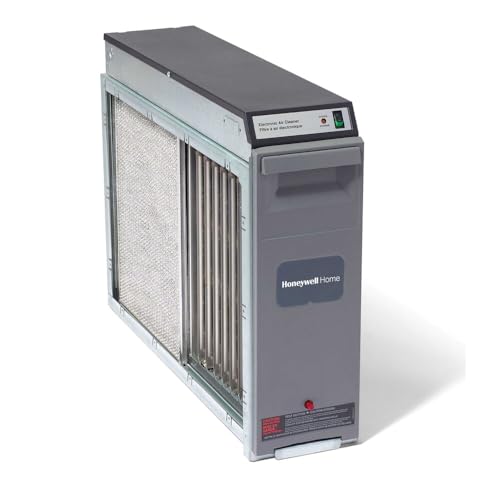
Honeywell F300E1027 Electronic Air Cleaner, 20×20, with Post-Filter — Best with Post-Filter
The F300E1027 suits the household that wants the electronic cleaner and the finishing touch: behind its washable electrostatic cells sits a post-filter that polishes the air a final time, catching what the plates missed and adding a layer of odour-side diligence. In the 20×20 size, it fits the other common duct format — and for a smoking household, the post-filter’s contribution is felt most in the fine, lingering fraction of smoke that pure electrostatics can occasionally let slip.
Strengths
- Post-filter adds a final capture stage behind the washable cells
- 20×20 size serves the other standard residential duct format
- Same F300 platform, documentation and support as the flagship
Trade-offs
- The post-filter is a consumable — the one part of the system you will periodically replace
- Slightly more resistance in the airstream than a cells-only unit; your installer should confirm static pressure
- Same professional-installation reality as the whole F300 line
| Specification | Detail |
|---|---|
| Size | 20 x 20 inches |
| Type | Whole-house electronic air cleaner (electrostatic) |
| Extra stage | Performance-enhancing post-filter |
| Collector | Washable cells |
Think of the two stages as a division of labour. The electrostatic cells do the heavy, endless work — charging and holding the great mass of smoke particles, washably, for years. The post-filter is the editor: a final pass that tidies the result. For smoke, whose particles span a wide size range and whose finest fraction carries disproportionate odour, that editorial pass is worth having, and it is why this configuration exists in the line.
The ownership compromise is honest and small: one replaceable element in an otherwise washable system, on a schedule measured in seasons rather than weeks. Households that choose this model are usually the ones who read the F300 line carefully and decided they wanted its most complete version for their duct size. It is hard to argue with them.
Best for: smoke-heavy households in 20×20 duct systems wanting the complete F300 / Not suited for: buyers determined to have zero consumable parts
Check on Amazon to see the current price and the exact configuration on offer.
Honeywell F300E1001 Electronic Air Cleaner, 16-inch — Best for Smaller Ducts
Not every house breathes through a 20-inch duct. Smaller homes, older systems and compact air handlers need the F300’s technology in the 16-inch format, and that is exactly the F300E1001’s brief. For a smoking household in a smaller property, it delivers the same whole-house electrostatic collection — every pass of the heating and cooling cycle scrubbing the air — scaled to the ductwork that actually exists rather than the ductwork in a catalogue photograph.
Strengths
- F300 washable-cell technology in the compact duct format
- Right-sizes whole-house smoke control for smaller systems
- Same professional platform and support as its larger siblings
Trade-offs
- Airflow capacity suits smaller systems; it is not a substitute for the 2000 CFM model in a large house
- Professional installation still applies — small ductwork is still ductwork
- Cell washing discipline matters exactly as much at this size
| Specification | Detail |
|---|---|
| Size | 16-inch format |
| Type | Whole-house electronic air cleaner (electrostatic) |
| Collector | Washable cells |
| Maker | Honeywell |
Sizing is destiny in air cleaning, and this model exists because the category’s commonest failure is a mismatch: a great cleaner throttling a small system, or a small cleaner lost in a large one. The 16-inch F300 lets a compact house have the correct machine — airflow the blower can push, cells sized to the load, and a smoking household’s whole air volume treated on every cycle.
Everything else about the F300 story carries over: the washable economics, the professional documentation, the decade-scale service life. If your ducts measure in the teens, this is not the consolation model. It is the correct one, and correctness in HVAC is the whole game.
Best for: smaller homes and compact forced-air systems / Not suited for: large houses with high-CFM air handlers
Check on Amazon to see the current price and the exact configuration on offer.

Trion HE2000 Electronic Air Cleaner with AFS — Best Alternative Brand
Trion is the name HVAC professionals reach for when the job is not a Honeywell, and the HE2000 is its residential electronic air cleaner: electrostatic collection with an AFS — an airflow-sensing arrangement that runs the cleaner in step with the system’s fan rather than on its own guesswork. For a smoking household whose installer favours Trion, or whose duct layout suits it better, this is the credible alternative at the professional tier.
Strengths
- Airflow-sensing operation ties the cleaner to the system’s actual running
- A genuine professional alternative — competition in a category that needs it
- Electrostatic washable-cell economics, as with the F300 line
Trade-offs
- A smaller residential footprint than Honeywell’s; your installer may know one line better than the other
- Specification detail in its catalogue listing is terser than the F300’s
- Professional installation and sizing discipline apply unchanged
| Specification | Detail |
|---|---|
| Type | Whole-house electronic air cleaner (electrostatic) |
| Power | 120V |
| Feature | AFS airflow sensing |
| Maker | Trion |
The AFS detail deserves its sentence: an electronic cleaner only works when air moves, and a unit that senses airflow and runs in true step with the blower wastes no power and misses no cycle. It is the kind of unglamorous correctness that separates professional equipment from gadgets, and it is characteristic of Trion’s approach to the category.
Choose between the HE2000 and the F300s the way professionals do: by duct fit, by your installer’s familiarity, and by local parts support. Both are real machines doing the same physical work — charging smoke particles and holding them on washable plates — and a smoking household is well served by either badge, properly sized and faithfully washed.
Best for: households whose installer or duct layout favours the Trion platform / Not suited for: buyers wanting the deepest consumer documentation and retail presence
Check on Amazon to see the current price and the exact configuration on offer.

WINIX 5510 Air Purifier — Best Room-Level Alternative
Honesty in the badge: the WINIX 5510 is not an electronic air cleaner, and it is in this guide because a large share of readers cannot install one — renters, homes without forced-air ducts, anyone solving one room’s problem. For those households, this is the strongest room-level answer we verified: True HEPA for the particles, a high-deodorization carbon filter aimed squarely at smoke odour, auto mode, and coverage rated for large rooms. It is the new generation of WINIX’s long-running 5500-2 line, with app support added.
Strengths
- High-deodorization carbon stage targets smoke odour specifically, not just particles
- True HEPA capture for the fine fraction of smoke
- No installation: it works the day it arrives, in the room that needs it
Trade-offs
- It is a room machine — it cannot treat a whole house’s air the way a ducted EAC does
- Filters are consumables on a replacement schedule; the EACs’ washable economics do not apply
- Smoke produced faster than one room’s air changes will still win locally
| Specification | Detail |
|---|---|
| Type | Room air purifier (not an electronic air cleaner) |
| Filtration | True HEPA plus high-deodorization carbon filter |
| Coverage | Large room — up to 1,881 sq ft in 1 hour (maker-rated) |
| Extras | Auto mode, app support |
Place this machine where the smoking happens and its logic is sound: it scrubs the room’s air continuously, its carbon stage works on the gaseous odour fraction that makes smoke linger in soft furnishings, and its auto mode answers rising particle levels without being asked. In a den, a bedroom or a workshop, that is a complete and respectable solution.
Its limits are geography, not quality. Smoke in the kitchen will not visit the purifier in the den, and a whole house of smokers needs the ducted answer above. Read this pick as the guide’s respect for real housing situations: not everyone can cut into ductwork, and for everyone who cannot, this is the verified machine we would put in the room.
Best for: renters and single-room smoke problems / Not suited for: whole-house smoke loads or ducted homes wanting the permanent fix
Check on Amazon to see the current price and the exact configuration on offer.
Professionally Installed Electronic Air Cleaners via HVAC Dealers — Best Installer Route — no link
A truth of this category deserves its own pick: a meaningful share of electronic air cleaners are sold the way furnaces are sold — through local HVAC dealers who size, supply and install them, with models and configurations that never appear as retail listings. For households already planning installer involvement — and every ducted pick in this guide implies it — the dealer channel is a legitimate route to the right machine, including sizes and variants beyond the verified retail field.
Strengths
- Sizing and installation handled as one professional job
- Access to the trade-only range beyond retail listings
- Local support relationship for the life of the equipment
Trade-offs
- No marketplace price transparency — get the quote in writing, itemised
- Model availability varies by region and dealer allegiance
- You are buying the dealer’s competence as much as the machine
We write this route unlinked for the same reason the direct-sale smokers elsewhere in this batch are not linked: our links are earned through catalogue verification, and a channel defined by local quotes cannot be linked honestly to a single product page. The route itself, though, is how much of this equipment has always reached homes, and a guide that pretended otherwise would be tidier and less true.
Use it well: ask the dealer which lines they install, confirm the unit is a true electrostatic cleaner with washable cells, get the duct size and CFM matching in writing, and ask who washes the cells and how often they recommend it for a smoking household. A dealer who answers those questions fluently is the product you are actually buying — the machine is the souvenir.
Best for: households already hiring an installer and wanting the trade range / Not suited for: buyers wanting a fixed retail price and one-click ordering
This pick is written unlinked: the HVAC dealer channel sells varying models by region and quote; no single ASIN can represent it, so no dp link is given.
Comparison Table
| Pick | Badge | Key spec | Best for |
|---|---|---|---|
| Honeywell F300E1035 Whole House Electronic Air Cleaner, 20×25, 2000 CFM | Best Overall | 20×25, 2000 CFM, washable cells | most smoking households with standard large residential ductwork |
| Honeywell F300E1027 Electronic Air Cleaner, 20×20, with Post-Filter | Best with Post-Filter | 20×20, post-filter, washable cells | smoke-heavy households in 20×20 duct systems wanting the complete F300 |
| Honeywell F300E1001 Electronic Air Cleaner, 16-inch | Best for Smaller Ducts | 16-inch, F300 platform, washable cells | smaller homes and compact forced-air systems |
| Trion HE2000 Electronic Air Cleaner with AFS | Best Alternative Brand | Electrostatic, AFS, 120V | households whose installer or duct layout favours the Trion platform |
| WINIX 5510 Air Purifier | Best Room-Level Alternative | True HEPA + deodorization carbon, room unit | renters and single-room smoke problems |
| Professionally Installed Electronic Air Cleaners via HVAC Dealers | Best Installer Route — no link | Trade channel, sized and installed professionally | households already hiring an installer and wanting the trade range |
Four of these picks are the same idea at different fits: electrostatic cells in your ductwork, washing your house’s entire air supply on every heating and cooling cycle. Choose among them by duct size first — 20×25, 20×20, 16-inch — then by the post-filter question, then by your installer’s allegiance between Honeywell and Trion. The WINIX plays a different sport entirely, one room at a time, for households the ducted game excludes. And the installer route reminds you that in this category, the professional channel is not a fallback; for many homes it is the front door. Read the table’s omissions as information, too: there is no bargain-bin electrostatic unit here, because the verified professional field is what it is — two makers with decades in ductwork — and a guide that padded the row count with ioniser gadgets wearing this category’s name would be lying to exactly the readers who can least afford the mistake.
How to Choose the Best Electronic Air Cleaner for Smokers
Start with your ductwork, because it chooses for you. Measure the filter slot or duct section where the cleaner will live — the F300 sizes in this guide exist because 20×25, 20×20 and 16-inch are the formats real houses have — and establish your air handler’s airflow in CFM, from its plate or your installer. The cleaner’s rating must meet that airflow; an undersized unit strangles the system, and an oversized one wastes money without cleaning better. In this category, fit is not a detail. It is the decision, and everything else is refinement.
Next, decide how much consumable you will tolerate. A cells-only electrostatic unit is a zero-consumable machine: wash, dry, reinstall, for years. Adding a post-filter, as on the F300E1027, buys a final polishing stage at the price of one periodic replacement. Neither answer is wrong; they suit different temperaments, and the guide’s badges keep the distinction visible so you choose it deliberately rather than discovering it at the first service.
Finally, be honest about the smoke load’s geography. A house where smoking happens in one room, in a home without ducts, is the WINIX’s brief. A house where smoke is a whole-home condition — or where the goal is protecting the entire interior, its fabrics and its resale self — is the ducted machines’ brief, and no fleet of room units fully substitutes. Match the architecture to the problem, and this category rewards you for a decade.
How Electronic Air Cleaning Works — and Why Smoke Suits It
The mechanism is elegant and old, in the way of good engineering. As air enters the unit, an ionizing section gives particles an electrical charge; downstream, a series of collector plates with the opposite charge draws those particles out of the airstream and holds them. What is collected is not stored in a fibrous filter that progressively chokes, but on metal surfaces that wash clean — which is why an electronic cleaner’s performance on the day after washing equals its performance when new, a claim no disposable filter can make across its life.
Smoke is this technology’s showcase application because of particle size. The particles that make smoke visible, lingering and odorous are concentrated at the fine end of the spectrum, where mechanical filters are at their weakest and electrostatic attraction is at its most effective. A technology and a pollutant matched that precisely is why electronic air cleaners became the professional standard in smoking lounges, casinos and homes long before ‘air quality’ was a consumer category.
The honest limits belong in the same section. An electronic cleaner treats the air that passes through it — it cannot help a room whose air never circulates to the duct, and it does its work across hours of system runtime rather than in minutes. Odour is partly gaseous, and while the collected particles carry much of it, the deepest odour loads benefit from the post-filter configuration or the carbon-stage room unit working alongside. Physics rewards the household that understands which fraction of its problem each stage solves.
The Decade Arithmetic: Washable Cells vs Disposable Filters
Run the two ownership models across the life of the equipment and the category’s persistence explains itself. The disposable-filter household buys performance repeatedly: media filters or purifier cartridges on a schedule, each one performing best on its first day and worst on its last, with the smoking household’s heavy load shortening every interval. The bill is modest each time and endless in total, and across a decade it quietly exceeds the price of the electronic machine that was supposed to be the expensive option.
The electronic household pays once, at installation, and then pays in water and time: cells washed back to as-new performance several times a year, a post-filter if the configuration includes one, and nothing else with a price on it. The performance curve is the mirror image of the filter’s — flat, renewable, indifferent to the calendar. For a smoking household, whose load is the heaviest a home can generate, that flat curve is not a luxury. It is the difference between a system that keeps up and a system that is always, gradually, falling behind the smoke.
There is an environmental sentence in the same arithmetic — a decade of disposable media is a decade of landfill, while a washable cell is a single object doing a decade of work — but the argument does not need it. The money and the performance already agree, which is why this older technology keeps being specified by professionals who have seen every alternative arrive, trend and clog.
Washing the Cells: The Whole Maintenance Contract
Ownership of an electronic air cleaner is one recurring act: washing the collector cells. In a smoking household the schedule matters more than in any other, because the load is continuous — cells coated in collected smoke gradually lose their grip, and a neglected unit becomes an expensive duct ornament that still hums convincingly. The makers’ guidance and professional practice agree on the rhythm for smokers: inspect often, wash when the cells show their load, and expect that to mean several times a year rather than once.
The wash itself is domestic work, not trade work: cells slide out, soak or rinse with an appropriate cleaner, dry completely — completely, because wet cells and high voltage are not friends — and slide home. Many owners keep the job pleasant by treating it as seasonal maintenance alongside the furnace’s own service. The reward is the category’s founding bargain renewed: a machine restored to as-new performance for the price of an hour and a sink of water, in a category where the rival technology’s renewal arrives by courier, in a box, at a price, forever.
How to Size and Plan an Electronic Air Cleaner Installation
Start with two measurements and write them down: the dimensions of your existing filter slot or the duct section at the air handler, and the system’s airflow. The duct size is measured with a tape in minutes. The airflow — in CFM — is on the furnace or air handler’s data plate, in its documentation, or from the installer who services it; as a rough orientation, residential systems commonly move a few hundred CFM per ton of cooling capacity, but your plate’s number, not a rule of thumb, is what the cleaner must match. The picks in this guide state their sizes and ratings plainly so this matching can be done before anyone orders anything.
Decide the configuration while you measure. Note whether your duct run has room for the cleaner’s cabinet plus the post-filter depth if you choose that model, whether there is a power source within reach of the unit’s location, and where the cells will go to be washed — a utility sink or an outdoor tap within a sane carry of the furnace makes the maintenance contract one you will actually keep. Installations fail socially before they fail mechanically: a cleaner whose cells are miserable to wash is a cleaner that stops being washed.
Get the installation quoted as a complete job: unit, duct transition work, wiring, and a walkthrough of cell removal and washing before the installer leaves. Ask specifically how the unit signals trouble — the indicator arrangements differ — and have the installer set the system’s fan behaviour so the cleaner gets the runtime it needs; many households run the fan in a circulation mode for part of each day, which multiplies the air’s passes through the cells without running heating or cooling.
After installation, build the habit that makes it all true: a calendar note for cell inspection, a first wash sooner than you think a smoking household needs it, and a walk through the house a month in — not with instruments, but with your nose and your eyes on the curtains. The absence you are buying is gradual and then obvious, and noticing it is how you will know the machine, the sizing and the washing rhythm are all correct.
One planning detail separates satisfied owners from frustrated ones: agree, before installation day, whose job the cells are. In some households the furnace’s owner washes them as part of seasonal maintenance; in others the installer’s service plan includes the washing on its visits. Either arrangement works. The arrangement that fails is the unspoken one, where the cells belong to everyone in principle and no one in practice — decide it while the installer is still there to write it into the service record.
Common Buying Mistakes
Buying by room size for a ducted machine. Electronic air cleaners are sized by duct dimensions and CFM, not by square footage of rooms. A cleaner matched to a brochure instead of a duct tape will either choke the system or underperform in it. Measure first; the model number follows the tape, not the other way round.
Confusing an electronic air cleaner with an ioniser gadget. The category’s name is borrowed by small ionising devices that charge particles and let them settle on your furniture — the opposite of collecting them. A true EAC is duct-mounted, with washable collector cells, like every linked pick here. If it sits on a shelf and plugs into a corner, it is not this technology.
Never washing the cells. A loaded cell collects nothing, silently. In a smoking household the wash schedule is the product; skip it and you own an expensive grille. Put inspections on the calendar the day the unit is installed.
Expecting it to erase smoke at the source. A whole-house cleaner treats the air that circulates to it, over hours. It will transform a home’s background air and protect its fabrics; it will not make a freshly smoked room instantly neutral, and it is not a licence to skip ventilation where ventilation is possible. Architecture and habits work together.
Ignoring the fan’s runtime. The cleaner only cleans while air moves. A system whose fan runs ten minutes an hour gives the cells ten minutes of work. Circulation settings that run the fan gently for more of the day multiply the cleaner’s effect at trivial cost — ask your installer to set them.
Installing without a power and access plan. The unit needs power, and its cells need a route to a sink that a human will actually walk several times a year. Plan both before the duct is cut; retrofitting convenience is how maintenance contracts go to die.
Final Recommendation
For most smoking households with forced-air heating and cooling, the answer is the Honeywell F300E1035 in the size your ducts dictate — its 20×20 sibling with the post-filter, or the 16-inch for compact systems — with the Trion HE2000 as the professional alternative. Households that cannot touch ductwork should take the WINIX 5510 for the room that matters, honestly labelled as the room-level solution it is.
Measure your ducts, match the CFM, plan the washing route, and this category will repay you in the currency smokers’ households actually spend: curtains, walls, upholstery, carpets, the wardrobe in the hall and mornings that do not smell of last night. It is not the most glamorous purchase in this programme — there is no bark, no sear, no dinner at the end of it — but it may be the one whose absence would be noticed first, by everyone who walks through the front door. Every linked pick was verified against its maker’s catalogue data before earning its place — check the current price on Amazon, and get the installation quoted as the professional job it is.
Keep reading within this smoker programme:
- Best Electric Smokers With Windows
- Best Electric Smokers With Bluetooth
- Best Electric Smokers With Heat Probe
- Best Electric Smokers With Stainless Steel
- Best Electric Wood Smokers
- Best Electric Smokers At Economical Prices
Frequently Asked Questions
What is the difference between an electronic air cleaner and an air purifier?
An electronic air cleaner is a duct-mounted electrostatic machine: it charges particles and collects them on washable metal plates, treating the whole house’s air as it circulates through the heating and cooling system. A room air purifier, like the WINIX in this guide, filters one room’s air through disposable media such as HEPA and carbon. The EAC is infrastructure; the purifier is an appliance. They solve the same problem at different scales, on different schedules and with different running costs.
Do electronic air cleaners really help with cigarette smoke?
They are the professional standard for it, because smoke particles are concentrated at the fine sizes electrostatic collection handles best, and because a whole-house unit treats the air continuously rather than chasing one room. What they change most visibly is accumulation: less smoke settling into curtains, upholstery and walls, and a home whose background air stays neutral. They do not make a room instantly smoke-free the moment a cigarette is lit — no machine does, whatever its box promises — and ventilation remains a partner, not a rival.
How often do the collector cells need washing?
In a smoking household, expect to inspect them often — monthly is a sane rhythm at first, until you learn your own house’s rate — and wash them several times a year, more than in a non-smoking home, because the load is continuous and unforgiving. The signal is visible: cells carrying a grey film of collected material are cells losing their grip. Washing restores them to as-new performance, every single time, which is the technology’s central economic advantage over disposable filters.
Can I install an electronic air cleaner myself?
The unit mounts into ductwork and wires into the system’s power, which puts it at the ambitious end of DIY and squarely in professional territory for most households. A competent installer also verifies the sizing, static pressure and fan settings that decide whether the machine performs. Given that the equipment is expected to serve for a decade or more — through furnace services, seasons and changes of occupancy — professional installation is the recommendation this guide stands behind, without hesitation.
Will an electronic air cleaner raise my energy bills?
The unit itself draws modest power while the system runs, and its clean cells impose little resistance on the airflow. The larger energy question is fan runtime: households that run the blower in circulation mode to give the cleaner more working hours spend a little more on fan electricity and gain a great deal of cleaning. Installers can set this balance with you, in minutes, at the thermostat; it is a dial, not a dilemma.
What if my home has no ductwork?
Then the ducted picks cannot serve you, and the honest answer is the room-level route: a purifier with True HEPA for particles and a serious activated-carbon stage for smoke odour, placed where the smoking happens — the WINIX 5510’s brief in this guide. Radiator, baseboard and mini-split homes are common enough that this is a normal, respectable solution, not a consolation, provided expectations are set by the room, not the house.


