Disclosure: airfryerkitchensupply.com is reader-supported. When you buy through links on our site, we may earn an affiliate commission at no extra cost to you.
Where to buy
Every linked pick in this guide to the best electric wood pellet smokers is sold on Amazon by the maker or an authorised seller. Prices in this category move with seasons, pellet and chip promotions and model-year changeovers, so we never print a fixed price in the article itself. Use the links here to check the current price on Amazon on the day you buy, and judge each model on its delivered cost rather than on a number copied from an old screenshot.
- recteq DualFire 1200 Pellet Smoker Grill — check price on Amazon
- Traeger Pro 22 Pellet Grill & Smoker — check price on Amazon
- Green Mountain Grills Ledge Prime 2.0 Pellet Grill — check price on Amazon
- Z GRILLS Pellet Grill, 28 lb Hopper (697 sq in) — check price on Amazon
- Pit Boss 850 Navigator Series Pellet Grill — check price on Amazon
- recteq RT-B380 Bullseye Pellet Smoker Grill — check price on Amazon
The best electric wood pellet smokers run on a beautifully simple bargain: real hardwood fire, electric discipline. Pellets of compressed hardwood are fed by an electric auger into a fire pot, a fan stokes the burn, and a controller holds the temperature you set — so the smoke flavour is genuinely wood-fired while the temperature behaviour is as steady as an oven’s. It is the combination that moved pellet grills from a regional curiosity to the default backyard smoker for a generation of cooks, and it remains the easiest route to real wood smoke ever sold.
The word ‘electric’ in the search deserves its moment, because it confuses shoppers every season. A pellet smoker is electric in its ignition, its auger, its fan and its brain — it plugs in, and without power it is a cold box of pellets. The heat and smoke, though, come from burning wood, not from an element. That hybrid nature is the whole point: wood does the cooking, electricity does the managing, and you do the eating.
Every pick in this guide was verified against its maker’s catalogue data before it earned a link — brand and model matched to the returned title, with prices and ratings used only as internal checks and printed nowhere. The six machines below divide by size, budget and temperament: a dual-chamber flagship, the classic that started it all, a WiFi mid-sizer, a value benchmark, a connected all-rounder and a compact kettle-style outlier. Between them is the right first — or next — pellet smoker for nearly any patio.
In this guide
Quick Picks
If you only read one section, read this one. These are the six best electric wood pellet smokers we would actually buy, each with a badge that says exactly who it is for. The detailed reviews further down explain the reasoning, the trade-offs and the ownership details behind every badge.
- Best Overall — recteq DualFire 1200 Pellet Smoker Grill: two chambers, two temperaments — one side for low-and-slow smoking, one for hot-and-fast grilling, under one Wi-Fi controller.
- Best Classic — Traeger Pro 22 Pellet Grill & Smoker: the original recipe — 572 sq in, an 18 lb hopper, a meat probe and 6-in-1 versatility, refined over more years than any rival.
- Best WiFi Mid-Size — Green Mountain Grills Ledge Prime 2.0 Pellet Grill: GMG’s Prime 2.0 generation brings full Wi-Fi control to a mid-size grill from the brand that championed pellet value.
- Best Value — Z GRILLS Pellet Grill, 28 lb Hopper (697 sq in): 697 sq in, PID automatic control and a 28 lb hopper, cover included — the specification-per-dollar benchmark of the guide.
- Best Connected All-Rounder — Pit Boss 850 Navigator Series Pellet Grill: 932 sq in, WiFi and Bluetooth, a 30 lb hopper and a flame broiler — the biggest all-round specification in the guide.
- Best Compact — recteq RT-B380 Bullseye Pellet Smoker Grill: a kettle-style pellet grill that sears like it means it — compact, direct and built for weeknight fire as much as weekend smoke.
How These Picks Were Chosen
Selection began with verification, then with the controller. In a pellet smoker the controller is the difference between a wood fire and a wood appliance: PID-style controllers, which measure and trim the pellet feed continuously, hold temperatures in a narrow band and produce cleaner, steadier smoke; basic controllers feed in bursts and let the temperature wander. We favoured machines whose verified listings evidence real control sophistication — named PID systems, app-connected controllers, published temperature ranges — over grills whose only specification was size.
Capacity was judged in two currencies: cooking area for the food, hopper size for the time. A pellet smoker’s promise is unattended hours, and that promise is written in hopper pounds. We also weighed temperature range at both ends — a genuine low for smoking, a genuine high for grilling — because the category’s claim to replace several appliances stands or falls on range.
Finally, we spread the badges across the market’s real fault lines: premium and value, large and compact, connected and classic. Pellet smokers inspire brand loyalty out of proportion to their differences, and this guide’s loyalty is to the match between machine and household. Read the badges as addresses, not rankings carved in stone.
One category of machine was excluded on principle: pellet grills whose listings could be verified but whose makers publish almost nothing about their controllers, hoppers or ranges. A pellet smoker is a system of knowable parts, and a maker who will not state them is asking for trust the category’s good actors earn with numbers. Every pick here publishes the figures an owner needs — which is also why the spec boxes in this guide can be written entirely from verified data, without a single borrowed claim.
The 6 Best electric wood pellet smokers

recteq DualFire 1200 Pellet Smoker Grill — Best Overall
The DualFire 1200 solves the pellet grill’s oldest compromise — one firebox asked to be both a smoker and a searing grill — by refusing it: dual chambers let one side run low and slow while the other runs hot and fast. Smoke the brisket on the left, sear the steaks on the right, at the same time, under Wi-Fi control. For households whose cooks routinely span both worlds in a single meal, no single-chamber machine in this guide can imitate that trick.
Strengths
- Dual chambers run two temperatures at once — the category’s most useful party trick
- recteq’s controller discipline applied to both fires
- Wi-Fi control keeps the two-zone juggling act observable from indoors
Trade-offs
- Premium tier, in price and in the patio space it commands
- Two chambers mean two areas to clean, season and learn
- For cooks who only ever smoke, half the machine’s talent sits idle
| Specification | Detail |
|---|---|
| Chambers | Dual — hot-and-fast plus low-and-slow |
| Connectivity | Wi-Fi |
| Fuel | 100% wood pellets |
| Maker | recteq |
Think about what dual chambers do to a Saturday. The old schedule — smoke first, rest the meat, then re-fire the grill for sides and searing — collapses into simultaneity. Ribs finish on the slow side while corn and steaks work the hot side; a reverse-sear becomes a transfer between chambers instead of a temperature negotiation with a single fire. Hosts feel this as calm. Guests just notice dinner arriving together, hot, as if it were easy.
Underneath the concept, the fundamentals are recteq’s usual: controllers that hold their numbers, construction that feels like equipment, and a Wi-Fi layer that reports both chambers without fuss. The DualFire is not the cheapest way into pellet smoking, nor the simplest. It is the most capable expression of the idea in this guide, and for the two-temperature household it earns Best Overall without needing the others to be bad at anything.
Ownership follows the premium pattern: pellets by the bag rather than the scoop, a cover that fits a substantial machine, and parts support from a maker whose business is exactly this. Buy it if your cooking has genuinely outgrown one fire. It is the rare upgrade that changes what meals are possible, not just how they taste.
Best for: hosts and enthusiasts who smoke and sear in the same meal / Not suited for: single-purpose smokers or tight budgets and patios
Check on Amazon to see the current price and the exact configuration on offer.

Traeger Pro 22 Pellet Grill & Smoker — Best Classic
Every category has a machine that defines its centre, and in pellet smoking it is the Pro 22. Its specification is the template others are compared against: 572 square inches, an 18 lb hopper sized for overnight work, a meat probe in the box, a 450°F ceiling and the 6-in-1 brief — smoke, grill, bake, roast, braise, barbecue. It suits the buyer who wants the proven thing: the grill your neighbours already own, whose every quirk is documented and whose pellets and parts are sold everywhere.
Strengths
- The most proven pellet platform in the guide — years of refinement in every detail
- 18 lb hopper covers overnight cooks without refuelling theatre
- Meat probe included; the set-and-monitor routine works out of the box
Trade-offs
- Its controller generation predates the fanciest app ecosystems
- 572 sq in is family-sized; party cooks need batches
- You pay something for the name — value rivals undercut it
| Specification | Detail |
|---|---|
| Cooking area | 572 sq in |
| Hopper | 18 lb |
| Max temperature | 450°F |
| Probe | Meat probe included |
| Modes | 6-in-1 |
The Pro 22’s virtue is the absence of surprises. Its fire management has been tuned across more cooks, in more backyards, than any competitor can claim, and it shows in the boring metrics that decide dinners: recovery after the lid opens, behaviour in wind, honesty at 225°F at hour nine. New pellet cooks succeed on it quickly because the machine’s responses are the ones every recipe, video and forum post assumes.
It is equally the safest ownership proposition here. Traeger’s dealer network, parts pipeline and sheer installed base mean a Pro 22 is never an orphan — a fact that matters in year six more than in week one. If your brief is ‘the pellet smoker, please, the one that just works’, the category’s answer has not changed, and this is it.
Best for: first-time pellet buyers wanting the proven centre of the category / Not suited for: app-maximalists or regular crowd cooks
Check on Amazon to see the current price and the exact configuration on offer.

Green Mountain Grills Ledge Prime 2.0 Pellet Grill — Best WiFi Mid-Size
Green Mountain Grills built its following by putting serious pellet technology in mid-priced grills, and the Ledge Prime 2.0 is that philosophy connected: a Wi-Fi controlled mid-size grill for households that want app oversight without entering the premium tier’s pricing or footprint. It suits the cook whose smoker must share a normal patio with normal life — big enough for family briskets, connected enough for overnight confidence.
Strengths
- Full Wi-Fi control at a mid-size, mid-tier proposition
- Prime 2.0 generation refinements across the fire and feed system
- A brand with a long pellet-only heritage and a loyal owner base
Trade-offs
- Specification detail in its catalogue listing is terser than rivals’
- Mid-size means crowd cooks still require planning
- GMG’s dealer footprint is regional in a way Traeger’s is not
| Specification | Detail |
|---|---|
| Connectivity | Wi-Fi controlled |
| Generation | Prime 2.0 |
| Format | Mid-size pellet grill |
| Maker | Green Mountain Grills |
GMG’s owners tend to be the category’s quiet evangelists, and the Ledge shows why: the money is visibly spent on the cooking system rather than the badge. Wi-Fi control on a Prime-generation grill means the overnight routine — set, probe, sleep, wake to alarms — works with the same calm as the premium ecosystems, on a machine sized and priced for ordinary patios.
Choose it over the Traeger if the app matters more than the installed base; choose it over the value picks if controller quality is your religion. It occupies the sensible middle of this guide with unusual completeness, and households that land in that middle rarely regret the address.
Best for: mid-size households wanting Wi-Fi control without premium pricing / Not suited for: maximum-capacity cooks or brand-network shoppers
Check on Amazon to see the current price and the exact configuration on offer.
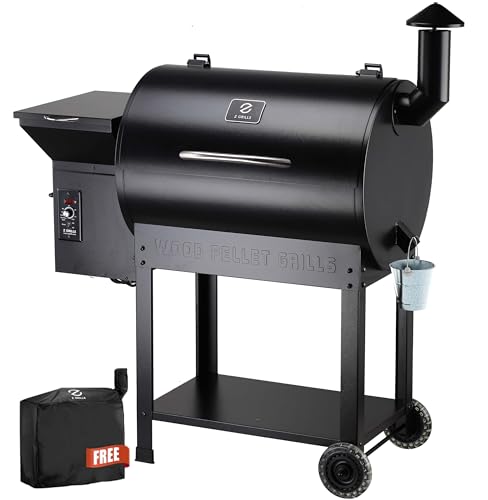
Z GRILLS Pellet Grill, 28 lb Hopper (697 sq in) — Best Value
Value picks usually ask you to forgive something. This Z GRILLS asks for remarkably little forgiveness: a proper PID controller with automatic temperature control, a 28 lb hopper that out-sizes grills costing far more, 697 square inches of 8-in-1 cooking, and a cover in the box. It suits the specification-literate buyer — the one who reads controllers and hoppers rather than badges, and would like the difference to remain in their bank account.
Strengths
- PID control at a value tier — the feature that actually decides cook quality
- 28 lb hopper is premium-sized; overnight cooks are a non-event
- Cover included and 8-in-1 range complete the no-extra-purchases package
Trade-offs
- Fit, finish and brand support trail the premium names
- App and smart features are not its argument — control is local and honest
- Resale and parts ecosystems are thinner than the big brands’
| Specification | Detail |
|---|---|
| Cooking area | 697 sq in |
| Controller | PID auto temperature control |
| Hopper | 28 lb |
| Modes | 8-in-1 |
| Included | Grill cover |
The economics of pellet grills have a tell: the expensive parts are the controller, the steel and the support network, in that order. Z GRILLS spends on the first, adequately on the second, and lightly on the third — and for a buyer who can read a specification, that is the correct order. The PID’s steady feed is what your brisket experiences; the badge is what your neighbours experience, and only one of those is dinner.
At 697 square inches with that hopper, it is also genuinely sized — not a compact grill wearing a value badge, but a family machine that happens to be priced like a compact one. As the guide’s Best Value it makes the premium picks justify themselves, which is the most useful thing a value pick can do.
Best for: specification-driven buyers wanting PID and capacity per dollar / Not suited for: buyers who value dealer networks and app polish
Check on Amazon to see the current price and the exact configuration on offer.

Pit Boss 850 Navigator Series Pellet Grill — Best Connected All-Rounder
If one grill in this guide can be described as having no obvious missing line in its specification, it is the 850 Navigator: 932 square inches of cooking space, both WiFi and Bluetooth connectivity, a meat probe, a 180°F to 500°F range, a 30 lb hopper, and Pit Boss’s flame broiler for true direct-flame searing. It suits the buyer who wants size, connection and searing in a single purchase and is tired of comparison tables that each win a different column.
Strengths
- Largest cooking area among the single-chamber picks, with the hopper to feed it
- Dual connectivity — Bluetooth beside the grill, WiFi from anywhere
- Flame broiler delivers the sear most pellet grills only approximate
Trade-offs
- Full-size footprint and appetite for pellets to match
- The app is workmanlike rather than class-leading
- Assembly and presence are two-person, full-afternoon commitments
| Specification | Detail |
|---|---|
| Cooking area | 932 sq in |
| Connectivity | WiFi & Bluetooth |
| Hopper | 30 lb |
| Temperature range | 180°F to 500°F |
| Extras | Flame broiler, meat probe |
The Navigator’s argument is completeness. Pellet shoppers usually trade columns — size against connectivity, searing against price. This grill declines the trade, and the result is the machine we would hand to a household that cooks everything: weeknight burgers over the flame broiler, Saturday ribs at 225°F, a brisket overnight on a hopper that will not need touching, all of it visible on a phone from wherever the day takes you.
Pit Boss ownership is the category’s populist version: pellets and parts everywhere, a price tier that respects the buyer, and hardware that favours function. In a guide with premium flagships and value benchmarks, the Navigator is the all-rounder that makes both explain themselves — which is why it holds a badge in a crowded field.
Best for: households wanting one big, connected, searing-capable grill / Not suited for: small patios or minimalists
Check on Amazon to see the current price and the exact configuration on offer.

recteq RT-B380 Bullseye Pellet Smoker Grill — Best Compact
The Bullseye breaks the category’s silhouette: a kettle-style pellet grill, compact and quick, that treats searing as a first-class citizen rather than a spec-sheet afterthought. Its maker lists the repertoire plainly — ribs, brisket, chicken, sear, smoke — and the format suits households whose pellet cooking is as much Tuesday steaks as Saturday shoulders. Small footprint, real wood fire, recteq controller manners.
Strengths
- Kettle format heats fast and sears genuinely — rare in pellet land
- Compact footprint suits balconies, small patios and second-grill duty
- recteq build and controller quality at the small end of their range
Trade-offs
- Compact capacity: crowd smoking is not its brief
- Smaller hopper means long cooks need a refill plan
- The kettle shape limits tall items and multi-rack arrangements
| Specification | Detail |
|---|---|
| Format | Kettle-style pellet grill |
| Fuel | 100% wood pellets |
| Repertoire | Ribs, brisket, chicken, sear, smoke (maker-listed) |
| Maker | recteq |
Most pellet grills are smokers that can grill; the Bullseye is a grill that can smoke, and the distinction reorganises a household’s week. It lights and heats with a kettle’s urgency, puts real sear marks on a steak with wood fire, and still settles down to smoke ribs when Saturday asks. For couples and small families, that ordering — weeknight first, weekend fully capable — matches actual cooking diaries better than a big smoker’s spec sheet does.
It will not host the neighbourhood, and its hopper asks for attention on the longest cooks. Within its honest brief it is the most characterful machine in this guide: the pellet smoker for people who grill four nights a week and smoke on the fifth, and want one fire for all of it.
Best for: grill-first households wanting wood fire in a compact footprint / Not suited for: volume smokers or overnight-cook specialists
Check on Amazon to see the current price and the exact configuration on offer.
Comparison Table
| Pick | Badge | Key spec | Best for |
|---|---|---|---|
| recteq DualFire 1200 Pellet Smoker Grill | Best Overall | Dual chambers, Wi-Fi, pellet | hosts and enthusiasts who smoke and sear in the same meal |
| Traeger Pro 22 Pellet Grill & Smoker | Best Classic | 572 sq in, 18 lb hopper, meat probe | first-time pellet buyers wanting the proven centre of the category |
| Green Mountain Grills Ledge Prime 2.0 Pellet Grill | Best WiFi Mid-Size | Wi-Fi, Prime 2.0, mid-size | mid-size households wanting Wi-Fi control without premium pricing |
| Z GRILLS Pellet Grill, 28 lb Hopper (697 sq in) | Best Value | 697 sq in, PID, 28 lb hopper | specification-driven buyers wanting PID and capacity per dollar |
| Pit Boss 850 Navigator Series Pellet Grill | Best Connected All-Rounder | 932 sq in, WiFi & Bluetooth, 30 lb hopper | households wanting one big, connected, searing-capable grill |
| recteq RT-B380 Bullseye Pellet Smoker Grill | Best Compact | Kettle-style, compact, sear + smoke | grill-first households wanting wood fire in a compact footprint |
Six pellet smokers, six centres of gravity. The DualFire is capability itself — two fires, one controller. The Pro 22 is the proven centre, the Ledge the connected middle, the Z GRILLS the specification-per-dollar argument, the Navigator the complete all-rounder, and the Bullseye the compact character. New buyers should start from their cooking diary, not the table: count your searing nights against your smoking days, your crowd sizes against your patio, and the right row announces itself. The wrong pellet smoker is only ever the one bought for a life you do not lead. One more reading tip: the hopper column is a clock and the temperature column is a menu. A grill whose clock runs longer than your longest cook, and whose menu covers your hottest and slowest dishes, is a grill you will not outgrow — and outgrowing, in this category, is the expensive mistake, paid for in second purchases.
How to Choose the Best Electric Wood Pellet Smokers
Begin with the controller, because it decides what kind of fire you own. PID controllers hold temperature tightly and smoke cleanly; simpler controllers swing and forgive less. For a first pellet smoker, controller quality is worth more than cooking area — a steady 550 square inches outperforms a wandering 900 on every cut that matters. The picks in this guide were filtered on exactly that priority, which is why PID and named control systems recur in their listings.
Size the hopper to your longest cook and the grates to your largest. Overnight briskets want hopper pounds in the high teens at minimum; the 28 and 30 lb hoppers here turn refuelling into a non-issue. Cooking area should be measured against your biggest realistic load — a brisket plus ribs, a spatchcocked turkey, four chickens — not against a fantasy catering contract. Buy for the cook you do monthly, and rent the solution for the one you do yearly.
Then decide your shape of life: a standard grill format for all-round duty, a dual-chamber flagship if two temperatures at once is your reality, or a compact kettle if grilling dominates your week. Connectivity follows the same logic — WiFi earns its keep on overnight and away-from-home cooks; a purely local controller serves the patio cook completely. None of these choices is a compromise when it matches the household; all of them are when it does not.
Pellets: The Fuel Is an Ingredient
A pellet smoker’s flavour is quite literally manufactured — from the wood in the pellet. Quality pellets are pure hardwood, hard and glossy, low in dust; bargain pellets may include fillers and softwood, burn dirtier and leave more ash. Since the auger meters whatever you load, pellet quality is fire quality: it decides smoke cleanliness, temperature stability and how often you vacuum the fire pot. Buy pellets like an ingredient, because they are one.
Species is seasoning. Hickory and oak are the assertive all-rounders for beef and pork; apple and cherry burn sweeter and milder for poultry, fish and cheese; mesquite is the loudest voice and best blended or used briefly. Competition blends exist to be neutral-good at everything. Because a pellet smoker holds temperature regardless of fuel, swapping species is a pure flavour decision — the cheapest experimentation in barbecue.
Storage is the pellet owner’s one commandment: dry, sealed, off the floor. Pellets are kiln-dried wood actively seeking moisture, and a humid month turns a bag into swollen, jam-prone dust. Keep a working quantity in a sealed container near the grill, the reserve indoors, and never leave pellets sitting in the hopper through a wet season — the auger you save will be your own.
What Pellet Smokers Do Better — and What They Will Never Do
Honesty about the category’s edges makes for happier owners. Pellet smokers are the best low-and-slow machines most households can buy: steady, clean, repeatable, and kind to beginners. Their smoke is real wood smoke, but it is a cleaner burn than a stick-burner’s, so the flavour is milder — a virtue for poultry and fish, a negotiation for brisket traditionalists, answerable in part by lower temperatures early in the cook and smoke-enhancing modes where fitted.
At the hot end, most pellet grills grill well and a few — flame broilers, dual chambers, the Bullseye’s kettle — sear genuinely. None of them is a charcoal grill’s equal for raw char, and none should be bought pretending otherwise. And all of them need electricity and dry pellets: a pellet smoker in a power cut is a sculpture. Know these three truths, and the category will delight you for a decade; deny them, and no badge in this guide can save the purchase.
Reading a Pellet Smoker Specification Like an Owner
Specifications are written by marketing departments and read by shoppers, but they are lived by owners — so translate them. Cooking area in square inches is a peak-load number; what you live with is grate layout: whether a brisket fits without curling, whether the second rack is usable or a warming shelf in disguise. Temperature range is a promise at both ends; check that the low end is a true smoking temperature and the high end arrives in reasonable time, because a grill that reaches its ceiling in forty minutes owns a different weeknight than one that takes ten.
Hopper capacity converts directly into sleep. Divide the pounds by your expected burn — a pound or two an hour at smoking temperatures — and the quotient is your unattended window, the single most practical number in the category. Controller language deserves the same translation: ‘PID’ means the grill predicts and trims; ‘digital’ alone may mean only that the knob became a screen. The listings in this guide were read with exactly this owner’s dictionary, and the spec boxes quote only what the makers themselves state.
Finally, weight and construction are specifications too, even when they hide in the shipping details. Heavier steel holds heat through lid openings and winter evenings; lighter steel makes a grill portable and its temperature nervous. Neither is wrong — the Trek-style traveller and the patio flagship are different animals — but a buyer who reads the whole specification, including the unglamorous lines, is a buyer whose grill matches their life on arrival rather than after a season of negotiation.
Budget Tiers for Pellet Smokers
We print no prices, but the tiers are stable. The budget tier buys a working auger and a basic controller; cooks come out well and temperatures wander politely. The mid tier — this guide’s centre of gravity — buys PID control, real hoppers, probes and, increasingly, WiFi. The premium tier buys controller refinement, thicker steel, dual chambers and support networks. The step from budget to mid is the largest in cooking quality; the step from mid to premium is the largest in ownership pleasure. Aim at mid unless your cooking diary argues otherwise, in either direction.
How to Run Your First Brisket on a Pellet Smoker
Start the night before with the machine, not the meat. Vacuum the fire pot, confirm the auger primes and turns, fill the hopper completely with pellets you trust, and check the probe against a glass of ice water if your smoker has one. A pellet smoker’s reliability is decided by these five minutes; nearly every ‘the grill failed’ story is an ash or pellet story wearing a costume.
Trim the brisket while the smoker preheats and stabilises at your smoking temperature — stability first, meat second, because a fire still hunting for its number will paint its indecision onto the bark. Season generously, insert the probe into the thick part of the flat, and set your target alarms if the controller supports them. From here the pellet smoker does what it was bought for: it holds, it feeds, it smokes, and it reports.
Manage the cook by the two witnesses, probe and appearance. Expect the stall in the 150s and 160s; watch it on the probe rather than fighting it. Wrap when the bark is set and dark — paper for bark’s sake, foil for time’s sake — and return the brisket, probe re-seated, until the finish: tender first, temperature as its witness, the probe sliding into the flat with almost no resistance.
Rest is a cooking stage, not a delay. Wrap the finished brisket and hold it insulated for at least an hour — two is better — while the smoker runs its shutdown cycle and you clean the grate while it is warm. Slice against the grain, flat first, pencil-thick; the point can return cubed for burnt ends if your crowd has earned them. Notice, as you serve, how little fire-tending the day contained. That absence is the product you bought, and the brisket is its proof.
Keep the first brisket’s numbers. Pellet smokers are repeatable in a way charcoal never was, which means your notes — temperature, wrap time, rest length, what the probe said and when — convert directly into a better second brisket. Owners who log three cooks own a system; owners who log none own a very good grill and a foggy memory. The machine’s consistency is only half the promise. Your archive is the other half, and it starts with this cook.
Common Buying Mistakes
Buying by cooking area alone. A big wandering grill loses to a smaller steady one on every long cook. Controller quality, hopper size and temperature range decide dinners; square inches decide only how many dinners fit. Read the specification in that order.
Feeding it bargain pellets. Filler-heavy pellets ash more, burn dirtier and jam augers — then the grill takes the blame. Pellets are an ingredient and a running cost; budget for good ones and store them sealed and dry.
Chasing smoke flavour with temperature chaos. Constantly opening the lid and swinging the set point makes worse smoke, not more. Pellet smoke deepens at steady low temperatures early in the cook. Set it, shut it, and let the fire be boring — boring is flavour.
Skipping the fire-pot vacuum. Ash insulates the igniter and strangles airflow until a long cook flames out at hour ten. Two minutes with a vacuum before big cooks is the whole prevention. The manual says it; experience underlines it.
Expecting charcoal char from a pellet fire. Pellet grills grill beautifully and a few sear honestly, but raw charcoal char is a different fire. Buy a pellet smoker for what it is — the steadiest wood fire in the backyard — and it will never disappoint you by failing to be something else.
Leaving pellets in the hopper all winter. A hopper is not storage. Pellets left in an outdoor grill through a damp season swell and set up the spring’s first auger jam. Empty back to sealed storage between seasons, and start each year with fresh fuel.
Judging the category by one windy day. Wind is every grill’s tax auditor, and a first cook in a gale teaches false lessons about any machine. Judge a pellet smoker across a few ordinary cooks — its steadiness is a pattern, not a performance.
Forgetting that parts support is a feature. Igniters, fans and controllers are service items across a pellet smoker’s long life. A grill whose maker sells those parts — as every brand in this guide does — is a decade appliance; a grill without a parts pipeline is a countdown. The specification sheet never lists this. Ask anyway.
Running the shutdown shortcut. Pulling the plug at the end of a cook leaves pellets smouldering in the auger tube and ash fusing in the pot. Every machine here has a shutdown cycle that burns the pot clean and parks the system safely. Use it; the next cook’s easy ignition is this cook’s patience, repaid.
Final Recommendation
If the budget stretches once, and stretches correctly, the recteq DualFire 1200 is the pellet smoker that changes, quite literally, what a meal can be — two fires, one calm, unhurried host. Most households, though, will be served for years — happily, and without a backward glance — by the proven, original Traeger Pro 22 or the connected Pit Boss 850 Navigator, and the hard specification-per-dollar crown stays with the Z GRILLS — with the Ledge holding the connected middle ground and the Bullseye the compact end, each with its own clear conviction.
Match the machine to the cooking diary — searing nights against smoking days, crowds against patios, Tuesdays against Saturdays — and any pick here will feel less like a purchase than a well-earned promotion for the person who runs it. Every single model was verified against its maker’s own catalogue data before earning a link; check the current price on Amazon for the exact configuration you choose, stock good pellets, keep them sealed and dry, and let the wood fire mind itself from the very first cook to the five-hundredth and beyond.
Keep reading within this smoker programme:
- Best Electric Smokers With Automatic Feeders
- Best Electric Smokers With Bluetooth
- Best Electric Wood Smokers
- Best Electric Smokers With Heat Probe
- Best Electric Smokers With Windows
- Best Electric Smokers At Economical Prices
Frequently Asked Questions
Are pellet smokers really electric?
Yes, in everything except the fire itself, which is the entire design. The igniter, auger, fan and controller all run on electricity, and the smoker needs mains power throughout the cook, from the first minute to the shutdown cycle. The heat and smoke come from burning hardwood pellets. That division of labour — electricity managing, wood cooking — is exactly why pellet smokers hold temperature like appliances and flavour like fires, and why a power cut, not a fuel shortage, is the one emergency their owners plan around.
Do pellet smokers give real smoke flavour?
Real wood, real smoke — with a character of its own, and an honest one. A pellet fire burns cleanly and steadily, so its smoke is milder and sweeter than a stick-burner’s heavier hand. Most people prefer it for poultry, fish and weeknight cooking; brisket traditionalists deepen it with lower temperatures early in the cook and extended time in the smoke. It is a different accent, not a lesser one — and for many households it is the accent that gets used weekly instead of admired monthly, which is its own kind of superiority.
How many pellets does a smoker use?
Plan on roughly a pound or two per hour at smoking temperatures, more in cold weather and considerably more at grilling heat. That arithmetic is why hopper size matters so much in practice: a 28 or 30 lb hopper turns an overnight brisket into a fill-and-forget exercise, while a small hopper asks for a refill plan on long cooks. Pellet cost across a season is real but modest against the meat it cooks — and it buys the fire-tending you no longer do, which most owners count as the bargain of the machine.
Can a pellet smoker replace my grill?
For most households, yes — and the picks here are chosen with that ambition in mind, deliberately. Pellet grills smoke, bake, roast and grill; models with flame broilers, dual chambers or kettle formats sear genuinely. What none of them reproduces is raw charcoal char, that particular high-heat signature of burning embers. If that specific flavour is your religion, keep a small charcoal grill beside the pellet smoker and let each do what it is best at — a two-fire patio is not an indulgence, it is a division of labour.
What maintenance does a pellet smoker need?
Three habits, none of them long: vacuum the fire pot and clear ash regularly — before long cooks, without exception; keep pellets dry and sealed, and out of the hopper between seasons; and clean the temperature probe so the controller reads the truth. Beyond that, an occasional grate scrub and grease-trap check. The machines in this guide are appliances, and they reward appliance-level care with appliance-level reliability, year after year. Skip the habits and the same machines become temperamental — the difference between the two reputations pellet grills carry is almost entirely a story about ash.
Why do pellet smokers cost more than electric cabinets?
Because there is more machine: an auger and motor, a fan, an igniter, a controller, and a firebox built to burn wood continuously, against a cabinet’s element and dial. The running costs differ too — pellets against pennies of electricity and a handful of chips. What the premium buys is the wood fire’s flavour with steadier manners and a longer attention span; whether that trade is worth it is the question this whole guide exists to help you answer for your own cooking, honestly and without a salesman’s thumb on the scale.


