Disclosure: airfryerkitchensupply.com is reader-supported. When you buy through links on our site, we may earn an affiliate commission at no extra cost to you.
Where to buy
Below are the best loose leaf teapots verified for this guide. Amazon is where teapots with real infusers can be compared honestly, and every linked pick below was verified against its maker’s own listing for this site before a link was added — capacities, materials and infuser types in the reviews come from those verified listings. Use the links to check price on Amazon, and pay attention to the infuser in each listing photo: for loose leaf, the basket matters more than the silhouette.
- HIWARE 1000ml Glass Teapot with Removable Infuser — Best Overall: Check the current price on Amazon
- Sweese Porcelain Teapot 27 oz with Removable Stainless Steel Infuser — Best Porcelain Classic: Check the current price on Amazon
- Teabloom Stovetop & Microwave Safe Glass Teapot 40 oz with Glass Infuser — Best for Blooming Teas: Check the current price on Amazon
- London Pottery Farmhouse Teapot with Infuser, 2 Cup (600 ml) — Best for One or Two Cups: Check the current price on Amazon
- Hario ChaCha Kyusu Maru Tea Pot, 700ml — Best for Japanese Green Tea: Check the current price on Amazon
- Frieling 18/8 Stainless Steel Teapot with Infuser, 34 Ounces — Best Stainless Steel Durability: Check the current price on Amazon
The best loose leaf teapots solve a problem a tea bag never has: whole leaves need room to move. Drop loose leaf into a cramped infuser ball and it steeps like a prisoner — the outside leaves over-brew and turn bitter while the leaves in the middle stay dry and give up nothing. Give those same leaves a wide basket, hot water at the right temperature and a pot that holds its heat, and the cup changes completely: sweeter, rounder, and honest about what the leaf actually tastes like.
That is why this guide judges teapots from the infuser outward. Basket size and mesh fineness come first, because they decide which teas you can brew — a fine stainless mesh handles everything from whole-leaf oolong to dusty rooibos, while a coarse glass strainer is really only suited to big leaves and blooming teas. The pot’s material comes second: glass shows you the brew and adds no flavor of its own, porcelain holds heat through a long second steeping, cast textures and clay have their devotees, and stainless steel trades a little romance for a lifetime of durability.
Every pick below was verified against its maker’s own listing for this site, and the capacities and infuser details in each review come from those verified listings. The six were chosen to cover the real ways people drink loose leaf: a glass all-rounder for daily brewing, a porcelain classic, a showcase pot for blooming teas, a small farmhouse pot for one or two cups, a Japanese kyusu-style pot for green tea brewed properly, and a steel pot that will outlast its owner.
One honest note before the picks: a teapot cannot rescue stale leaf or boiling water poured over delicate green tea. The how-to section covers temperature and timing in plain terms, because the best pot in this roundup will still make a poor cup if the water is wrong — and an ordinary pot will make a lovely one if it is right.
In this guide
Quick Picks
Six pots, three infuser philosophies and four materials. The badge on each pick names the drinker it serves, because loose leaf is a ritual and rituals are personal.
- HIWARE 1000ml Glass Teapot with Removable Infuser — Best Overall. A litre of stovetop-safe glass with a removable infuser — watch the leaves unfurl, lift the basket on time, and brew almost any tea well. Check on Amazon
- Sweese Porcelain Teapot 27 oz with Removable Stainless Steel Infuser — Best Porcelain Classic. Porcelain heat retention with a fine stainless mesh basket — the classic table teapot, upgraded where the classic was weakest. Check on Amazon
- Teabloom Stovetop & Microwave Safe Glass Teapot 40 oz with Glass Infuser — Best for Blooming Teas. The showcase pot: a 40 oz all-glass design with a glass infuser and blooming teas in the box, rated for stovetop and microwave per its listing. Check on Amazon
- London Pottery Farmhouse Teapot with Infuser, 2 Cup (600 ml) — Best for One or Two Cups. A 600 ml ceramic farmhouse pot with an infuser — small on purpose, so the pot brews full, stays hot and finishes fresh. Check on Amazon
- Hario ChaCha Kyusu Maru Tea Pot, 700ml — Best for Japanese Green Tea. A 700 ml kyusu-style pot from Japan’s Hario — built for green tea’s cooler water and repeated short infusions. Check on Amazon
- Frieling 18/8 Stainless Steel Teapot with Infuser, 34 Ounces — Best Stainless Steel Durability. A 34 oz pot in 18/8 stainless steel with an infuser — the buy-it-for-decades option for households hard on glass and porcelain. Check on Amazon
How These Picks Were Chosen
Every pick was matched by brand and model against this site’s own Amazon catalog checks, and only a product whose returned listing title confirmed the exact teapot — including its infuser — received a link. That last clause matters: a teapot and its infuser version are often separate listings, and linking the plain pot while describing the infuser model would mislead exactly the loose leaf buyer this guide serves. Capacities quoted below come from the verified listing titles and from nowhere else.
The shortlist was balanced deliberately across the three infuser materials and the rituals they serve. Glass pots were chosen for visibility and neutral flavor. Porcelain and ceramic pots were chosen for heat retention and table presence. A stainless steel pot represents the durability-first school, and a Japanese kyusu-style pot represents the small-batch, high-leaf-ratio brewing tradition. A roundup of six near-identical glass pots would have been easier to write and useless to read.
Finally, each pick had to own a distinct job — the glass all-rounder, the porcelain classic, the blooming-tea showcase, the farmhouse two-cup, the Japanese precision pot and the steel workhorse — and any pot whose infuser was an afterthought, with holes too coarse for anything finer than whole-leaf tea, was cut regardless of how pretty the silhouette was.
The 6 Best Loose Leaf Teapots
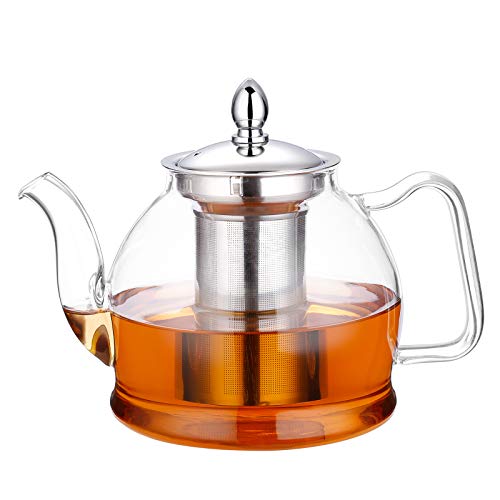
HIWARE 1000ml Glass Teapot with Removable Infuser — Best Overall
The HIWARE is the loose leaf pot most kitchens should start with, and its verified listing states the essentials plainly: 1000 ml of glass, a removable infuser, and stovetop-safe construction. A litre is the honest middle size of tea drinking — two generous mugs or a small table’s worth — and glass is the honest material for learning, because you can watch the leaves unfurl, judge the color of the liquor at a glance, and see exactly when a blooming tea has opened.
The removable infuser is the working heart of the design. Loose leaf keeps steeping as long as it sits in hot water, and the difference between a sweet second cup and a stewed one is the thirty seconds it takes to lift the basket out when the timer ends. A pot that makes that lift easy — basket accessible, lid cooperative — gets used correctly without thinking, which is the highest compliment a daily tool can earn.
Strengths
- Glass adds no flavor and shows leaf, color and bloom as you brew
- Removable infuser makes stopping the steep — the key loose leaf skill — effortless
- Stovetop-safe rating gives warming flexibility most glass pots lack
Trade-offs
- Glass sheds heat faster than porcelain; long steeps want a cozy or a warmer
- Shows scale and tea staining sooner than opaque pots
- A litre is generous for a solo drinker who brews one mug at a time
Key specs (from the verified listing)
- Capacity: 1000 ml, per the verified listing
- Material: glass, stovetop safe per the listing
- Infuser: removable infuser included
- Listed uses: blooming and loose leaf tea
Stovetop safety, confirmed in its listing, adds a flexibility the porcelain picks cannot match: the pot can warm directly on a gentle burner rather than demanding a separate kettle for every top-up, though most owners will still boil in a kettle and use the stove only for keeping warm. Treat the glass with the respect borosilicate deserves — it is tougher than it looks and still not a saucepan — and it will serve for years.
Choose the HIWARE if you want one pot that brews black tea on Monday, shows off a blooming tea on Saturday, and teaches you loose leaf technique by letting you watch it happen. It is the reference pick of this roundup for a reason.
Best for: Daily loose leaf drinkers who brew for one to three people / Not suited for: Anyone who wants a pot that holds heat through a long afternoon
Check on Amazon — check price on Amazon before ordering, and confirm the exact model name on the listing matches the name above.
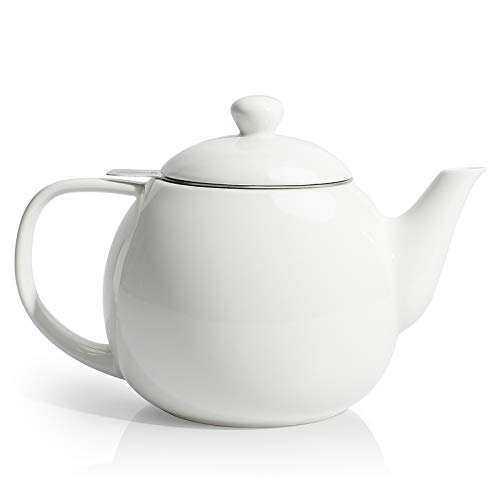
Sweese Porcelain Teapot 27 oz with Removable Stainless Steel Infuser — Best Porcelain Classic
The Sweese pairs the oldest teapot material with the most practical filter: 27 oz of porcelain with a removable stainless steel infuser, per its verified listing. Porcelain is what centuries of tea drinking settled on for good reasons — it holds heat through a leisurely second cup, it does not carry yesterday’s flavors into today’s pot, and it arrives at the table looking like it belongs there. The white finish in this listing is the versatile version of that tradition.
The stainless infuser is the modern upgrade that makes this more than a nostalgia purchase. Traditional ceramic infuser baskets have holes too large for anything but the biggest leaves; a fine steel mesh handles broken breakfast blends, flavored teas and most rooibos without leaking a sediment layer into the cup. You get porcelain’s heat and manners with a filter that matches a modern tea shelf.
Strengths
- Porcelain holds heat through a slow second cup better than glass
- Fine stainless mesh suits a wider range of teas than ceramic strainers
- A table-ready classic shape in a two-mug size that brews honestly full
Trade-offs
- Opaque — no watching leaves unfurl or judging strength by color
- Porcelain chips if it meets a granite counter at speed
- Not a stovetop pot; water must be boiled separately
Key specs (from the verified listing)
- Capacity: 27 oz, per the verified listing
- Material: porcelain
- Infuser: removable stainless steel infuser
- Listing finish: white
Twenty-seven ounces is a considered size: two honest mugs, or a pot for two people drinking from cups, without the cold dregs problem of an oversized pot brewed half-heartedly. Brew it full, lift the basket on time, and the second round is as warm as porcelain can make it — noticeably warmer than glass at the ten-minute mark, which is where porcelain earns its keep.
Choose the Sweese if your tea ritual is a table, a book and two unhurried cups, and you want the pot to be part of the calm rather than a piece of laboratory glassware. It is the classic pick, modernized exactly where the classic needed it.
Best for: Traditional tea drinkers who value heat retention and a clean table look / Not suited for: Blooming tea fans who want to watch the flower open
Check on Amazon — check price on Amazon before ordering, and confirm the exact model name on the listing matches the name above.

Teabloom Stovetop & Microwave Safe Glass Teapot 40 oz with Glass Infuser — Best for Blooming Teas
Blooming tea is theatre, and the Teabloom is built as its stage: 40 oz of glass, stovetop and microwave safe per its verified listing, with a removable glass infuser and two blooming teas included in the box. The all-glass construction is the point — a hand-tied flower opening in hot water deserves to be seen from every side, and a glass infuser keeps even the filter invisible so nothing interrupts the show.
Forty ounces makes it the gathering pot of this roundup. It brews for a table, holds a full blooming display with room to open, and its dual rating — stovetop and microwave safe, per the listing — gives it a reheating flexibility that suits the long, interrupted afternoons when guests actually stay for a second pot.
Strengths
- All-glass design is the best seat in the house for blooming teas
- The largest capacity here — a genuine table pot for guests
- Stovetop and microwave ratings make reheating a second pot simple
Trade-offs
- Glass infuser passes fines; dusty teas will leave sediment
- Large and glass — the most delicate storage proposition in this roundup
- 40 oz brewed for one person is tea wasted and heat lost
Key specs (from the verified listing)
- Capacity: 40 oz, per the verified listing
- Material: glass; stovetop and microwave safe per the listing
- Infuser: removable glass infuser
- Included: 2 blooming teas
Be clear-eyed about the glass infuser’s limits. A glass strainer’s openings are wider than fine steel mesh, so this pot is at its best with whole-leaf teas and blooming teas, and will pass sediment from broken or dusty teas. That is not a defect; it is a specialization, and the buyer who brews mostly fine-cut teas should take the HIWARE or Sweese instead and leave this pot to the households that will use it for what it does beautifully.
Choose the Teabloom if tea at your house is sometimes an occasion. It is the pick guests remember, and the included blooming teas mean the first performance happens the day the box opens.
Best for: Hosts who brew blooming teas and larger pots for guests / Not suited for: Drinkers of fine-cut or dusty teas that need fine mesh
Check on Amazon — check price on Amazon before ordering, and confirm the exact model name on the listing matches the name above.

London Pottery Farmhouse Teapot with Infuser, 2 Cup (600 ml) — Best for One or Two Cups
London Pottery’s Farmhouse is the small-pot answer, and its verified listing gives the size without apology: two cups, 600 ml, ceramic, with an infuser, in a France Blue finish. Small is a feature here, not a compromise. A 600 ml pot brewed full stays hot, steeps evenly, and is finished while it is still good — the opposite of the litre pot brewed a third full and nursed, cooling and stewing, through a morning.
The farmhouse shape is a British tea tradition rendered in ceramic: round-bellied for leaf room, made by a company whose name is a place and a craft rather than a marketing invention. For the drinker whose ritual is a proper small pot — morning tea for one at a desk, or two cups shared properly — this is the scale at which loose leaf tastes best and wastes least.
Strengths
- Brews full at a solo or two-cup scale — better heat and flavor than a big pot at quarter volume
- Ceramic body with a traditional farmhouse shape from a specialist pottery
- An infuser at a size where many small pots expect bags only
Trade-offs
- Two cups is the ceiling; guests need a second pot or a bigger pick
- Ceramic is opaque — no view of the brew
- A single-purpose size if your household’s tea count varies wildly
Key specs (from the verified listing)
- Capacity: 2 cup / 600 ml, per the verified listing
- Material: ceramic
- Infuser: included
- Listing finish: France Blue
Judge it by its intended job and it has few weaknesses: it will not serve a dinner party, and it is not meant to. Within its size it offers ceramic’s heat manners, an infuser for loose leaf rather than the bag-only design of many small pots, and a presence on the table that makes a two-cup ritual feel deliberate rather than rationed.
Choose the Farmhouse if your tea life is one or two cups at a time and you are tired of big pots brewed badly at quarter volume. Fresh, small and finished while it is hot is a legitimate philosophy of tea, and this is its pot.
Best for: Solo drinkers and couples who brew small and fresh / Not suited for: Anyone brewing for more than two people
Check on Amazon — check price on Amazon before ordering, and confirm the exact model name on the listing matches the name above.

Hario ChaCha Kyusu Maru Tea Pot, 700ml — Best for Japanese Green Tea
Hario’s ChaCha Kyusu Maru brings the Japanese kyusu tradition into this roundup: a 700 ml pot from Japan’s most respected glassmaker, shaped for the way green tea is actually brewed — smaller volumes, cooler water, and the same leaves infused several times. Where the Western pots here are built around one big steeping, the kyusu rhythm is a sequence of short ones, and the pot’s form serves that rhythm.
Hario’s glass expertise is the substance behind the name. This is a company that makes laboratory glassware and coffee brewers to professional standards, and its teapot brings the same clarity and neutrality to sencha, genmaicha and delicate whites that suffer in pots perfumed by years of black tea. Watching pale green liquor fill the pot is not decoration; for temperature-sensitive teas, color is information.
Strengths
- Designed for the multi-infusion brewing green tea rewards
- Hario glass is neutral, clear and made to a laboratory standard
- Ideal scale for solo and two-person green tea sessions
Trade-offs
- The kyusu method is a small learning curve for Western one-steep habits
- Glass heat loss matters more across repeated infusions; warm the pot first
- Less suited to a big family pot of breakfast tea
Key specs (from the verified listing)
- Capacity: 700 ml, per the verified listing
- Style: kyusu (Japanese side-handle tradition)
- Maker: Hario, Japan
Adopting the kyusu style asks a small technique adjustment: brew with less water per round, pour completely so the leaves rest damp rather than drowning between infusions, and expect three good rounds from quality leaf. The pot rewards that adjustment with a clarity of flavor that surprises drinkers raised on single big steepings — the second infusion of a good sencha is often the best cup of the day.
Choose the ChaCha if green tea is your center of gravity, or if you want to learn the multi-infusion method with a pot designed for it by the people who brew that way daily. It is the connoisseur’s pick in this group, at a thoroughly un-connoisseur tier.
Best for: Green tea drinkers who brew small, frequent infusions / Not suited for: One-big-pot black tea drinkers serving a crowd
Check on Amazon — check price on Amazon before ordering, and confirm the exact model name on the listing matches the name above.

Frieling 18/8 Stainless Steel Teapot with Infuser, 34 Ounces — Best Stainless Steel Durability
The Frieling answers the durability question in the terms its verified listing states: 18/8 stainless steel, 34 ounces, with an infuser for loose tea, and described as a tea warmer combination. 18/8 is the food-grade stainless grade worth naming — the alloy of good cutlery and cookware — and a pot built from it does not chip like porcelain, crack like glass, or stain like either. For households where teapots get knocked, stacked and dishwashed, this is the survivor’s pick.
Thirty-four ounces is the family size in this roundup, and steel suits the role: a full pot for a table, brewed once and kept at the table without the fragility anxiety that follows a big glass pot through a crowded kitchen. The infuser format keeps it a true loose leaf pot rather than a pouring kettle with pretensions.
Strengths
- 18/8 stainless does not chip, crack or hold stains and flavors
- Family-size 34 oz capacity in a pot that survives a busy kitchen
- A decades-long working life makes its tier easy to justify
Trade-offs
- Steel conducts heat — the body gets hot and the brew cools faster than porcelain
- Opaque and industrial in character; no bloom-watching
- Heavier in the hand than glass at the same capacity
Key specs (from the verified listing)
- Capacity: 34 ounces, per the verified listing
- Material: 18/8 stainless steel
- Infuser: included for loose tea
Steel’s honest costs are heat and romance. A steel wall conducts, so the pot’s exterior gets hot — handle by the handle — and the brew inside cools faster than in porcelain unless the pot is kept on its warmer. And a steel pot will never show you a blooming tea or gather the soft tannin patina of a beloved porcelain pot; it trades those pleasures for a working life measured in decades.
Choose the Frieling if your household breaks things, or if you simply want to buy a teapot once. It is the pick most likely to be brewing, unchanged, in twenty years — check price on Amazon and weigh it against replacing a glass pot twice.
Best for: Busy households that want a teapot for decades, not seasons / Not suited for: Anyone who brews for the visual ritual of glass
Check on Amazon — check price on Amazon before ordering, and confirm the exact model name on the listing matches the name above.
Comparison Table
| Pick | Badge | Key spec | Best for |
|---|---|---|---|
| HIWARE 1000ml Glass Teapot with Removable Infuser | Best Overall | 1000 ml glass, removable infuser, stovetop safe per listing | Daily loose leaf drinkers who brew for one to three people |
| Sweese Porcelain Teapot 27 oz with Removable Stainless Steel Infuser | Best Porcelain Classic | 27 oz porcelain, removable stainless steel infuser | Traditional tea drinkers who value heat retention and a clean table look |
| Teabloom Stovetop & Microwave Safe Glass Teapot 40 oz with Glass Infuser | Best for Blooming Teas | 40 oz glass, glass infuser, stovetop and microwave safe per listing, 2 blooming teas included | Hosts who brew blooming teas and larger pots for guests |
| London Pottery Farmhouse Teapot with Infuser, 2 Cup (600 ml) | Best for One or Two Cups | 2 cup / 600 ml ceramic, infuser included | Solo drinkers and couples who brew small and fresh |
| Hario ChaCha Kyusu Maru Tea Pot, 700ml | Best for Japanese Green Tea | 700 ml kyusu-style glass pot from Hario | Green tea drinkers who brew small, frequent infusions |
| Frieling 18/8 Stainless Steel Teapot with Infuser, 34 Ounces | Best Stainless Steel Durability | 18/8 stainless steel, 34 oz, infuser included | Busy households that want a teapot for decades, not seasons |
How to Choose a Loose Leaf Teapot: The Infuser Decides
Start inside the pot. Loose leaf tea is not a powder to be contained but a leaf that swells, unfurls and gives up its flavor over minutes, and the infuser’s job is to hold the leaf in the water while letting both move. A basket that reaches deep into the pot and fills much of its width lets leaves expand fully and water circulate; a small ball infuser dangling in a big pot strangles both. Rolled oolongs make the point dramatically — they can expand to several times their dry size — but every leaf tea brews better with room.
Mesh fineness is the second test, and it sorts teas into camps. Fine stainless mesh handles the broadest range, from whole-leaf whites down to broken breakfast blends and most rooibos, and it cleans easily and lasts for years. Glass infusers, like the Teabloom’s, keep the all-glass aesthetic and suit large leaves and blooming teas, but their slots pass finer particles. Ceramic infusers with drilled holes are beautiful and traditional in some porcelain pots, and the most limited of all: reserve them for big, unbroken leaves. Match the filter to the finest tea you actually drink, not the prettiest tea you might.
Material is the third decision, and it is about heat and ritual rather than correctness. Glass is flavor-neutral and shows color and bloom, but sheds heat fastest and asks for a warmer or a cozy during long steeps. Porcelain and stoneware hold heat, feel substantial, and hide the honest staining of daily use. Stainless steel is the durability champion and the heat loser is not — steel conducts, so it brews hot and cools fast, and its fans accept that in exchange for a pot that survives decades and dishwashers. There is no wrong answer here, only answers that fit or fight your habits.
- Choose basket volume before pot volume — leaves need room to unfurl
- Fine stainless mesh suits the widest range of teas, including broken grades
- Glass for visibility and blooming teas; porcelain for heat; steel for durability
- Confirm stovetop safety from the listing, never from appearance
- Size the pot to the serving: small pots brew and hold heat better
Teapot Sizes and Shapes: Brewing for One, Two or a Table
Teapot capacity is quoted in the optimistic language of teacups, so translate before you buy: a ‘cup’ in teapot listings is a small teacup, not your 350 ml mug. The London Pottery’s two-cup 600 ml size is a generous solo pot or a true two-person pot with small cups; the 27 oz Sweese serves two mug drinkers; the 40 oz Teabloom is a table pot for a group. Buying by head-count rather than by headline prevents the most common sizing disappointment in the category.
Shape follows function more than fashion. A round, low pot gives leaves maximum room to swirl and suits most teas; a tall pot suits blooming teas that need depth to open; a side-handled kyusu shape pours with a wrist flick and suits the short, repeated infusions of Japanese brewing. Spout behavior matters too, though it can only be judged in use: a good spout cuts off cleanly, and a bad one dribbles down the pot’s side onto the table for years. The established makers in this roundup have largely solved their spouts; unknown novelty pots are where dribbles live.
Finally, think about the second pot of the day. Loose leaf households rarely brew once: the same leaves often go two or three infusions, and a pot that is pleasant to handle, easy to empty without scattering wet leaves across the sink, and quick to rinse will be used for all of them. Ergonomics are not a luxury in a daily ritual — they are the ritual.
How to Brew Loose Leaf Tea in an Infuser Teapot
Brewing loose leaf well is a short discipline of temperature, dose and time, and the teapot’s role is to make all three easy to repeat. Warm the pot first with a splash of hot water, especially porcelain and glass in a cold kitchen, so the brewing water spends its heat on the leaves instead of on the pot’s walls. Add leaf to the basket — a starting point of roughly a teaspoon per cup for most teas, adjusted honestly by taste over the first week — and pour water at the temperature the tea wants: just off the boil for blacks and herbals, noticeably cooler for greens and delicate whites.
- Warm the pot with hot water and discard it, so brewing heat goes to the leaves
- Add loose leaf to the infuser basket — about a teaspoon per cup as a starting point
- Pour water at the tea’s temperature: near-boiling for black tea, cooler for greens
- Steep covered for the tea’s time — a few minutes for most blacks, less for greens
- Lift the infuser out when the time is up; leaving it in over-steeps the pot
- Re-steep the same leaves for a second or third infusion, adding a little time each round
Cleaning, Descaling and Storing a Teapot With an Infuser
Teapots ask for a gentle regime. Rinse with hot water after use, empty the infuser promptly — wet leaves left overnight stain mesh and perfume the next pot — and let everything air dry with the lid ajar. Soap is for the outside and for a weekly wash of the basket, whose fine mesh slowly clogs with leaf oils and fines; a soft brush restores it in seconds. Dishwasher claims vary by maker, and hand washing a pot you use daily takes less time than the argument about it.
Hard water adds scale, the chalky film that dulls glass and slows nothing but your pleasure. A warm soak with a spoon of citric acid or a splash of vinegar, followed by a thorough rinse, clears it from glass and steel; porcelain tolerates the same treatment. Tannin staining inside porcelain is different — cosmetic, traditional, and to some drinkers a badge of a pot that works for a living. Remove it with a baking soda paste when it bothers you, and never reach for bleach or abrasive pads on a pot you drink from.
Infuser Materials Compared: Steel Mesh, Glass and Ceramic
Stainless steel mesh is the default recommendation for a reason: it is the finest filter of the three, the easiest to clean, and effectively immortal. Its weakness is purely aesthetic — a steel basket inside a glass pot interrupts the view — and a faint sensitivity to very hard water, which shows as spotting long before it affects function. If your tea shelf includes anything broken, flavored or fine, steel mesh is the infuser that will not limit you.
Glass infusers exist for the eye. In a blooming tea pot they disappear, letting the flower own the stage, and in a plain glass pot they preserve the all-glass purity some drinkers prize. Their slots are necessarily wider than mesh, so they suit whole leaves and blooms and pass fines from broken teas. Treat a glass infuser as a specialist instrument: superb inside its range, honest about its limits outside it.
Ceramic infusers, with their drilled or pierced holes, are the traditional option inside many porcelain pots and the most restrictive of all — lovely with large unbroken leaves, frustrating with anything smaller. The modern answer, shown by the Sweese in this roundup, is a porcelain pot with a steel basket: tradition where it is visible, engineering where it counts. When a listing is vague about its infuser, that vagueness is itself information; the makers in this guide state their filter plainly.
Matching a Teapot to Your Tea Shelf
Walk your own shelf before you order. A drinker whose shelf is breakfast blends and flavored blacks needs fine mesh and heat retention — the Sweese pattern. A green-tea shelf needs the kyusu rhythm and cooler water — the Hario pattern. A shelf with a box of blooming teas bought on holiday and never opened needs the Teabloom and an occasion. The pot that fits the shelf you have will be used daily; the pot that fits the shelf you imagine will be admired monthly.
Also count your drinkers honestly, including the future. A solo drinker who hosts a tea-drinking parent every Sunday may rationally own the small pot for weekdays and borrow the big-pot role from a glass litre pot that also serves as a water jug and flower vase the rest of the week. Versatility is a fair tiebreaker between close picks — it is why the HIWARE’s stovetop rating and honest litre keep it at the top of this list — but it should never outrank the infuser, the one part of the pot that touches every single cup.
Your First Week With a Loose Leaf Teapot
Give a new pot a fair first week before judging it. Brew the same tea three ways — a little more leaf, a little less; a minute shorter, a minute longer — and notice how much control the ritual suddenly gives you compared with a bag. Most new loose leaf drinkers discover their preference is stronger and shorter than the packet suggests, and that discovery, not the pot, is the real upgrade they bought.
By the end of the week the motions become automatic: warm the pot, dose the basket, pour, time, lift, pour out completely. That automatic rhythm is the sign the pot fits your kitchen. If a step still fights you — a lid that will not sit, a basket that drips across the counter — note it honestly; teapots are kept for years, and a small daily friction is a legitimate reason to exchange a pot while you still can.
Common Buying Mistakes
Loose leaf forgives a lot, but not these habits:
- Cramming leaves into a tiny infuser ball so they cannot expand, then blaming the tea for a thin cup
- Leaving the infuser sitting in the pot after steeping, so the second cup is stewed and bitter
- Pouring boiling water over green and white teas because the kettle only has one setting in your routine
- Assuming any glass pot is stovetop safe — check the listing, because decorative glass cracks
- Buying a 50 oz pot for solo drinking and wondering why the tea is cold and flat by the second cup
- Letting wet leaves sit in the mesh overnight, staining it and flavoring tomorrow’s pot with yesterday’s
Final Recommendation
Match the pot to the ritual you actually keep. Most loose leaf drinkers should start with the HIWARE 1000ml glass teapot: neutral, visible, stovetop safe per its listing, and sized for real life. Porcelain loyalists belong with the Sweese 27 oz, small households with the London Pottery Farmhouse two-cup, and blooming-tea hosts with the Teabloom. Choose the Frieling stainless steel pot when durability outranks delicacy, and the Hario ChaCha when your tea life is Japanese greens brewed small and often.
Whichever pot you choose, give it the two things loose leaf actually demands: room in the basket and water at the right temperature. The pot is the stage, not the performance. Check price on Amazon for the pick that fits your table, confirm the infuser is included on the listing you open, and brew the first pot the day it arrives.
Keep reading in this series: Best Teapots Best Glass Teapots Best Teapots With Infusers Best Ceramic Teapots Best Japanese Teapots.
Related guides
Frequently Asked Questions
What size infuser basket do loose leaves actually need?
Room to expand to several times their dry volume. Rolled oolongs are the extreme case, unfurling dramatically as they steep; a basket that crowds them produces a thin, uneven cup no matter how good the leaf. When in doubt, choose the pot whose basket fills most of its interior, and never fill any basket more than halfway with dry leaf.
Glass or porcelain for loose leaf tea?
Glass tastes neutral and shows the brew, but loses heat faster and shows scale and staining sooner. Porcelain keeps heat longer, hides a busy pattern of use, and suits back-to-back steepings. Choose glass for blooming teas and visual drinkers, porcelain for long sessions and traditional service — the tea itself will not object to either.
Can I put a glass teapot on the stove?
Only if its own listing says it is stovetop safe, as the glass picks in this guide do. Borosilicate glass formulated for direct heat is a different material from decorative glass, and assuming stovetop safety from appearance is how teapots crack. When in doubt, boil in a kettle and pour over.
How do I stop fine leaves escaping into the cup?
Start with a finer-mesh infuser — the stainless mesh baskets in this guide handle most teas — and pour gently rather than tipping the last of the pot aggressively. For genuinely dusty teas like some rooibos, a secondary pour through a small hand strainer is the traditional and effective answer.
How often should I descale and deep-clean a teapot?
Rinse and dry after every use, wash the infuser whenever leaves begin to linger in its mesh, and descale whenever a chalky film appears — monthly in hard-water homes is typical. Brown tannin staining inside porcelain is cosmetic and traditional; remove it with a baking soda paste when guests justify the effort, not with bleach or abrasives.
Is a bigger teapot better for one person?
Rarely. Tea steeps best and stays hot in a pot sized to the serving, and a large pot brewed a third full cools quickly and dilutes the second cup. Solo drinkers are better served by a two-cup pot brewed properly, or by a small kyusu-style pot with repeated infusions, than by a family pot used at quarter capacity.


