Disclosure: airfryerkitchensupply.com is reader-supported. When you buy through links on our site, we may earn an affiliate commission at no extra cost to you.
Where to buy
Below are the best home meat grinders Chef’s Choice fans should consider first. Amazon is where home meat grinders are actually compared side by side, and every linked pick in this guide was verified against its maker’s own catalog listing for this site before a link was added. Motor figures, plate counts and included accessories in the reviews below come from those verified listings, not from roundup sites. Use the links to check price on Amazon, and read the first section carefully: the brand in this search needs an honest explanation before any alternative is recommended.
- LEM #8 Countertop Meat Grinder, 575 Watt — Best Overall Alternative: Check the current price on Amazon
- Cuisinart Electric Meat Grinder, Stainless Steel (MG-100) — Best Familiar-Brand Alternative: Check the current price on Amazon
- Sunmile SM-G50 ETL Electric Meat Grinder — Best Budget Alternative: Check the current price on Amazon
- STX International Turboforce 3000 Series Electric Meat Grinder — Best for Sausage Makers: Check the current price on Amazon
- Weston #12 Electric Meat Grinder & Sausage Stuffer (33-1301-W) — Best Heavy-Duty Home Alternative: Check the current price on Amazon
- KitchenAid KSMMGA Metal Food Grinder Attachment — Best for Stand Mixer Owners: Check the current price on Amazon
If you searched for the best home meat grinders chef’s choice, you probably trust the Chef’s Choice name — and that trust is earned. Chef’s Choice, made by EdgeCraft, built its reputation on knife sharpeners, food slicers and waffle makers that home cooks keep for years. So it is reasonable to ask what the brand offers when you want to grind your own burgers, sausage and chili meat at home instead of buying pre-ground supermarket trays.
Here is the honest situation this guide is built around. A dedicated, widely stocked Chef’s Choice-branded electric meat grinder is not a product we could verify with confidence through this site’s own Amazon catalog checks at the time of writing, and we do not invent listings. Rather than pad this page with a grinder wearing a badge it has not earned, the six picks below are the strongest verified home grinders from the brands that actually specialize in grinding — LEM, Weston, Cuisinart, Sunmile, STX International and KitchenAid — each one labeled clearly as an alternative, with the reason it earns a place next to the name you searched for.
That framing is not a consolation prize. Meat grinding is a specialist job, and the specialist brands are genuinely good at it: they publish real throughput figures, sell replacement plates and knives, and design feed tubes, gears and motors around cold meat and connective tissue rather than around a general kitchen lineup. A Chef’s Choice shopper values build quality, clear controls and a company that answers the phone; those are exactly the criteria used to choose the alternatives below.
Read the buying guide before you order anything. Grinder sizing — the #5, #8, #12 and #22 plate system — decides how fast you grind and how much counter and freezer space the machine demands, and it matters far more than the wattage number printed in large type on the box. The how-to section then walks through a first grind safely, because technique — cold meat, cut size, steady feeding — is what separates clean, springy ground meat from a smeared, warm paste.
In this guide
Quick Picks
Six verified alternatives, each with a distinct job. None of them is sold as a Chef’s Choice product, because none of them is one — the badge on each pick describes what it does best in a home kitchen.
- LEM #8 Countertop Meat Grinder, 575 Watt — Best Overall Alternative. A compact #8 electric grinder from a company that sells nothing but game and meat processing gear, sized honestly for home batches and built for sausage stuffing as well as grinding. Check on Amazon
- Cuisinart Electric Meat Grinder, Stainless Steel (MG-100) — Best Familiar-Brand Alternative. The mainstream kitchen-brand option: a stainless steel electric grinder from Cuisinart, for buyers who want a name they already own three of. Check on Amazon
- Sunmile SM-G50 ETL Electric Meat Grinder — Best Budget Alternative. The value pick with the right priorities: metal gears, a reverse function, a circuit breaker and stainless cutting parts, per its own listing. Check on Amazon
- STX International Turboforce 3000 Series Electric Meat Grinder — Best for Sausage Makers. A kit-heavy 6-in-1 machine with five grinding dies, three stainless blades, sausage and kubbe equipment and three speeds, per its verified listing. Check on Amazon
- Weston #12 Electric Meat Grinder & Sausage Stuffer (33-1301-W) — Best Heavy-Duty Home Alternative. The step-up specialist: a #12 grinder whose listing publishes a real throughput figure — 4 lbs per minute — with stainless plates and die-cast aluminum build. Check on Amazon
- KitchenAid KSMMGA Metal Food Grinder Attachment — Best for Stand Mixer Owners. The attachment alternative: a metal grinder head with tray, pusher, plates and sausage tubes that runs on the KitchenAid stand mixer you may already own. Check on Amazon
How These Picks Were Chosen
Every pick below was checked the same way: search the maker’s own catalog by brand and model, match the returned listing title word for word against the product being written about, and only then take the identifier from that verified listing. Products that could not be matched with confidence were left without a link or dropped entirely, and no specification in this article comes from anywhere except a verified listing or a plainly labeled general explanation of how grinders work.
The criteria were the ones a Chef’s Choice buyer would apply. First, honest sizing: the grinder’s plate size and a throughput figure the maker itself publishes, rather than a peak wattage claim. Second, metal where it matters — cutting blades, plates and gears described in the listing — because grinding is torque work and plastic gear trains are the classic failure point. Third, a complete kit in the box: at least two grinding plates and sausage equipment where the listing promises it, so the machine is useful on day one. Fourth, cleanup that a home cook will actually do, because a grinder that is miserable to wash does not get used twice.
Finally, each pick had to suit a recognizably different home: the weekly burger grinder, the autumn sausage maker, the hunter processing a deer with help, the stand-mixer owner who grinds twice a month, and the budget buyer who still wants metal gears. If a machine overlapped completely with a stronger pick, it was cut.
The 6 Best Home Meat Grinders Chef’s Choice Fans Should Consider

LEM #8 Countertop Meat Grinder, 575 Watt — Best Overall Alternative
LEM is the name hunters and sausage makers mention first, and this #8 countertop model is the company’s home-scale answer: an electric grinder in aluminum, rated at 575 watts in its verified listing, intended for grinding and sausage stuffing on a domestic counter. For a shopper who came looking for a trusted brand name, LEM is the closest equivalent in this category — a specialist with a reputation to protect rather than a logo licensed onto a generic machine.
The #8 size deserves emphasis because it is the size most home recipes quietly assume. It handles a few pounds of cubed beef, pork or venison in a comfortable session, produces the coarse and fine textures burgers and sausage need, and then washes up in a normal sink. Bigger grinders are faster per pound but slower per session once setup, cleaning and storage are counted honestly.
Strengths
- Specialist brand: LEM’s whole catalog is meat processing, so plates, knives and stuffing parts stay available
- #8 sizing is the honest home size — fast enough for family batches without a commercial footprint
- Countertop format stores in a cupboard instead of demanding permanent counter space
Trade-offs
- Aluminum housing is lighter than stainless and shows wear sooner under heavy use
- 575 watts is a home rating; frozen or sinewy meat must be fed slowly and well trimmed
- Too small to be the right answer for a full deer season on its own
Key specs (from the verified listing)
- Grinder size: #8 plate system
- Motor: 575 watt, per the verified listing
- Housing: aluminum
- Listed uses: grinding and sausage stuffing
In use, the discipline that makes any grinder shine applies doubly here: meat cut into strips, chilled until firm at the edges, fed steadily without forcing the pusher, and ground into a chilled bowl. The LEM rewards that discipline with an even, defined grind rather than a smeared one, and its stuffing role means a burger grinder in summer can become a sausage project in autumn without a second machine.
Choose this as the default alternative if your grinding life is weekly-to-monthly and measured in single-digit pounds. It is the pick that best matches what most Chef’s Choice shoppers actually wanted: a well-made, sensibly sized machine from a company that specializes in the job.
Best for: Most home cooks grinding a few pounds at a time / Not suited for: Anyone processing whole animals in one session
Check on Amazon — check price on Amazon before ordering, and confirm the exact model name on the listing matches the name above.

Cuisinart Electric Meat Grinder, Stainless Steel (MG-100) — Best Familiar-Brand Alternative
Some buyers searching for a Chef’s Choice grinder simply want a familiar kitchen brand rather than a specialist they have never heard of, and Cuisinart is the honest answer to that wish. Its electric meat grinder, finished in stainless steel per the verified listing, comes from the same mainstream stable as the food processors and cookware already in many kitchens, with the retail presence and warranty handling that come with that scale.
The machine’s appeal is straightforwardness. It is a dedicated countertop grinder — no attachment, no host appliance — aimed at home quantities: burger blends on a Saturday, a few pounds of pork for meatballs, ground chicken for lettuce cups. Buyers cross-shopping big kitchen brands will find its controls and footprint the least intimidating in this roundup.
Strengths
- A mainstream kitchen brand with the retail and support footprint that implies
- Stainless steel presentation suits a counter it may live on
- Dedicated machine — no stand mixer or other appliance required
Trade-offs
- The verified listing is spare on published throughput detail compared with specialist brands
- Home-scale capacity; long game sessions will test its duty cycle
- Accessory ecosystem is thinner than LEM or Weston for plates and parts
Key specs (from the verified listing)
- Construction: stainless steel, per the verified listing
- Format: dedicated countertop electric meat grinder
- Brand: Cuisinart (MG-100)
Keep expectations aligned with its class. This is a home grinder, and the listing does not promise the published pounds-per-minute figures the specialist brands advertise, so plan batches accordingly and let the motor rest between large loads. Trimmed, well-chilled meat fed at a steady pace is not optional technique here; it is how a mainstream grinder delivers a clean texture instead of warming up and smearing fat.
Pick the Cuisinart if brand familiarity and a stainless finish that matches your other appliances matter more than specialist throughput. It is the alternative most likely to feel like the purchase you originally imagined when you typed the Chef’s Choice search.
Best for: Buyers who prefer a mainstream kitchen brand / Not suited for: High-volume or game processing
Check on Amazon — check price on Amazon before ordering, and confirm the exact model name on the listing matches the name above.

Sunmile SM-G50 ETL Electric Meat Grinder — Best Budget Alternative
The Sunmile SM-G50 is the budget alternative that spends its money in the right places. Its verified listing leads with metal gears, a reverse function and a circuit breaker, and stainless steel for the cutting blade and plates — a specification list that reads like it was written by someone who knows exactly how cheap grinders die. They die by stripped plastic gears and jammed heads, and this machine is armored against both.
Treat the large wattage figure in its title the way you should treat every grinder’s headline number: as a maximum, not a promise. What matters at the counter is torque delivered through metal gearing to a sharp stainless knife, and on that measure the Sunmile is honestly equipped for home batches of burgers, sausage and pet food at a budget tier.
Strengths
- Metal gears at a budget tier — the single most important durability feature in this class
- Reverse function clears the inevitable sinew wrap without dismantling the head
- Circuit breaker protects the motor when a batch is pushed too hard
Trade-offs
- The headline figure is a maximum rating, not a continuous grinding rating — judge it by its parts, not its watts
- Budget fit and finish; expect more plastic in the housing and tray than the specialist picks
- Smaller throat and plates mean slower feeding on big batches
Key specs (from the verified listing)
- Drive: metal gears, per the verified listing
- Functions: reverse, circuit breaker protection
- Cutting parts: stainless steel blade and plates
- Listing rating: max 1.3 HP / 1000W (maker’s peak figure)
The reverse gear deserves its own paragraph because new grinders underestimate it. A wrap of silver skin around the knife is a when, not an if, and on a machine without reverse the fix is a full teardown with greasy hands mid-batch. A flick of reverse walks the obstruction back out, and grinding continues. Combined with the breaker, it makes the SM-G50 forgiving of the learning curve every new owner has.
Choose the Sunmile if the budget is firm but the grinding is real. It will not match the LEM or Weston for speed or long-session composure, but it protects its motor, cuts with stainless, and costs its tier honestly — check price on Amazon and compare it against plastic-geared rivals before assuming cheaper is better value.
Best for: Budget buyers who still want metal drive parts / Not suited for: Buyers who equate peak watt claims with real power
Check on Amazon — check price on Amazon before ordering, and confirm the exact model name on the listing matches the name above.

STX International Turboforce 3000 Series Electric Meat Grinder — Best for Sausage Makers
Where the LEM is a focused tool, the STX Turboforce 3000 is a kit. Its verified listing describes a 6-in-1 electric grinder with five grinding dies, three stainless steel blades, a sausage stuffer and a kubbe maker, driven through three speeds. For the home cook whose grinding ambitions run to linked sausage, kubbe and varied textures for different recipes, having every die and tube in the first box is a genuine advantage over buying accessories piecemeal.
Five dies is not a gimmick number. Texture is recipe: a coarse die for chili grind, a medium for burgers, a fine die for emulsified sausage and hot dogs, and spares for the textures in between. Owning the range from day one means a new recipe never waits on an accessory order, and three blades mean a dull knife — the silent cause of smeared fat — can be swapped mid-season instead of endured.
Strengths
- The most complete accessory kit in this roundup — texture options from five dies without extra purchases
- Three speeds give a low gear for controlled stuffing and higher gears for grinding
- Sausage stuffer and kubbe maker included, not sold as add-ons
Trade-offs
- The headline wattage is a maximum figure; real performance is home-class, not commercial
- More parts means more washing and more pieces to store and keep track of
- Multi-role design includes a juicer function most meat buyers will rarely use
Key specs (from the verified listing)
- Kit: 5 grinding dies and 3 stainless steel blades, per the verified listing
- Speeds: 3-speed control
- Extras: sausage stuffer and kubbe maker included
- Listing rating: 3000W max (maker’s peak figure)
Use the speeds with intent. Grind on the higher settings with cold, cubed meat; stuff on low, where control matters more than pace and a slow, steady fill prevents air pockets and burst casings. The machine’s peak wattage headline should be ignored in favor of this practical rhythm — fed steadily and kept cold, it produces clean results; forced with warm meat, like every grinder here, it will smear.
Pick the STX if your projects list is longer than burgers. It is the enthusiast’s alternative in this group, trading a little simplicity for the widest range of things a home grinder can be asked to do.
Best for: Sausage and kubbe makers who want the full kit in one box / Not suited for: Minimalists who only ever grind plain burger meat
Check on Amazon — check price on Amazon before ordering, and confirm the exact model name on the listing matches the name above.

Weston #12 Electric Meat Grinder & Sausage Stuffer (33-1301-W) — Best Heavy-Duty Home Alternative
Weston publishes the number that matters. Its verified listing for this #12 electric grinder and sausage stuffer states 750 watts, 1 HP, and a grinding rate of 4 lbs per minute, with stainless steel grinding plates in a die-cast aluminum body. That combination — a specialist brand, a bigger #12 throat and plates, and a throughput figure stated in plain language — makes it the heavy-duty alternative in this roundup.
The #12 step up is about session shape. A household that grinds twenty pounds of venison and pork in an afternoon, or makes sausage in ten-pound batches for the freezer, spends its time feeding and catching rather than waiting, and the larger plates are less prone to bridging with bigger cubes. The same machine is honestly too much for a single pound of burger meat on a Tuesday, where a #8’s quicker setup and wash-up wins.
Strengths
- A published, checkable throughput figure instead of only a peak watt claim
- #12 plates move family and game batches at a pace the #8 picks cannot match
- Weston is a processing specialist — replacement plates and stuffer parts are its home turf
Trade-offs
- Bigger, heavier machine; storage and washing are both larger jobs
- Oversized for one-pound weeknight grinding — setup time dominates small batches
- Die-cast aluminum body rather than full stainless construction
Key specs (from the verified listing)
- Grinder size: #12 plate system
- Motor: 750 watt, 1 HP, per the verified listing
- Throughput: 4 lbs per minute, per the verified listing
- Build: die-cast aluminum with stainless steel grinding plates
Weston’s catalog depth matters after the sale. Grinding plates dull, knives chip, stuffing tubes crack — and a specialist brand that sells the full processing ecosystem treats those as routine spares rather than discontinued mysteries. For a buyer whose Chef’s Choice loyalty is really about long-term supportability, Weston is the closest philosophical match in the category.
Choose the Weston if your batches are measured in tens of pounds or your autumn includes game processing with friends. Keep meat cold, cut to the throat, and let the published pace be a ceiling rather than a challenge, and it will grind the way its listing promises.
Best for: Bigger batches and hunters sharing processing days / Not suited for: Small kitchens grinding a pound at a time
Check on Amazon — check price on Amazon before ordering, and confirm the exact model name on the listing matches the name above.
KitchenAid KSMMGA Metal Food Grinder Attachment — Best for Stand Mixer Owners
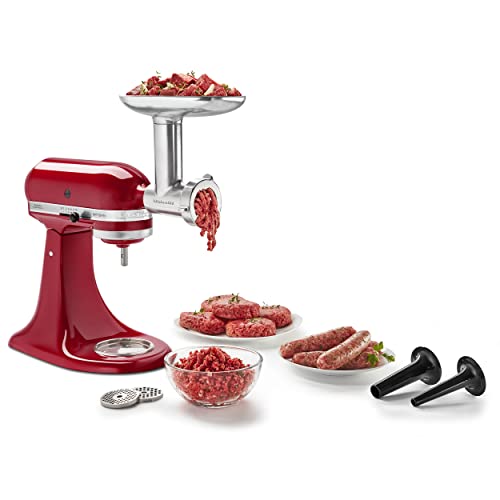
The smartest grinder purchase is sometimes not a grinder. KitchenAid’s KSMMGA is a metal food grinder attachment that fits all KitchenAid stand mixers, per its verified listing, and arrives with the food tray, pusher, grinding plates and sausage stuffer tubes and plate. If a KitchenAid already lives on your counter — as it does in a great many kitchens that also shop for brands like Chef’s Choice — the attachment converts it into a capable home grinder for the price class of an accessory.
The economics and the storage both argue for it at occasional volumes. A dedicated grinder is a bulky single-purpose box that must be stored fifty weeks a year to be used for two; the attachment lives in a drawer. For the household that grinds a few pounds for burgers once or twice a month and makes sausage a few times a year, that trade is rational, and the metal construction of this attachment — a deliberate step up from older plastic grinder attachments — addresses the durability worry head-on.
Strengths
- Uses a motor you may already own and trust — no second appliance to store
- Metal grinder attachment with the full tray, pusher, plate and stuffer kit in the box
- Stores in a fraction of the space a dedicated grinder needs
Trade-offs
- Useless without a KitchenAid stand mixer; the mixer is the real investment
- Throughput and duty cycle are limited by the host mixer’s motor and gearing
- Ties up the mixer — no grinding while the mixer is needed for anything else
Key specs (from the verified listing)
- Compatibility: all KitchenAid stand mixers, per the verified listing
- Included: food tray, pusher, grinding plates, sausage stuffer tubes and plate
- Format: attachment — requires the host stand mixer (sold separately)
Respect the host machine’s limits. A stand mixer’s motor and gearbox are designed for intermittent work, so grind in modest batches, keep meat very cold and cut small, and stop if the mixer labors or warms. Long game-processing sessions belong to the Weston or LEM; forcing a mixer through them risks an expensive repair that erases the attachment’s savings.
Pick the KSMMGA if you own the mixer and your grinding is occasional. It is the alternative that best honors the original instinct behind this search — buy once, from a brand ecosystem you trust, and buy the version that fits the kitchen you actually have.
Best for: KitchenAid owners who grind occasionally / Not suited for: Anyone without a KitchenAid mixer, or high-volume grinders
Check on Amazon — check price on Amazon before ordering, and confirm the exact model name on the listing matches the name above.
Comparison Table
| Pick | Badge | Key spec | Best for |
|---|---|---|---|
| LEM #8 Countertop Meat Grinder, 575 Watt | Best Overall Alternative | #8 size, 575 watt, aluminum housing | Most home cooks grinding a few pounds at a time |
| Cuisinart Electric Meat Grinder, Stainless Steel (MG-100) | Best Familiar-Brand Alternative | Stainless steel finish, dedicated electric grinder | Buyers who prefer a mainstream kitchen brand |
| Sunmile SM-G50 ETL Electric Meat Grinder | Best Budget Alternative | Metal gears, reverse, circuit breaker, stainless blade and plates | Budget buyers who still want metal drive parts |
| STX International Turboforce 3000 Series Electric Meat Grinder | Best for Sausage Makers | 5 grinding dies, 3 stainless blades, 3 speeds, sausage and kubbe kit | Sausage and kubbe makers who want the full kit in one box |
| Weston #12 Electric Meat Grinder & Sausage Stuffer (33-1301-W) | Best Heavy-Duty Home Alternative | #12 size, 750 watt / 1 HP, 4 lbs per minute per listing | Bigger batches and hunters sharing processing days |
| KitchenAid KSMMGA Metal Food Grinder Attachment | Best for Stand Mixer Owners | Fits all KitchenAid stand mixers; tray, pusher, plates and stuffer tubes included | KitchenAid owners who grind occasionally |
How to Choose a Home Meat Grinder When the Brand You Wanted Is a Specialist in Something Else
Start with the plate size, because it is the one specification that cannot be upgraded later. Grinders are sized by an old numbering system — #5, #8, #12, #22 and up — that describes the diameter of the grinding plate and, with it, the throat size and realistic throughput. A #8 is the classic home size: family batches, normal sink, cupboard storage. A #12 roughly doubles comfortable session volume and suits hunters and big-batch sausage makers. A #22 belongs to serious processors and small commercial work, and its weight and wash-up make it a poor fit for a pound of weeknight burgers.
Next, learn to read power claims skeptically. Many listings headline a maximum or peak wattage measured at stall, which tells you almost nothing about grinding. More useful signals are a continuous watt or horsepower rating from a specialist brand, a published pounds-per-minute figure like the Weston’s, and the materials in the drive train. Metal gears, a stainless knife and stainless plates will still be grinding in a decade; a huge peak number driving plastic gears will not survive many seasons of sinewy chuck.
Then match the machine to your meat. Burger and chili grinding is forgiving: any pick here does it well. Sausage making adds requirements — a stuffing kit, a low controlled speed or a separate stuffer for large batches, and fine plates for emulsified styles. Game processing adds volume and connective tissue, which argues for the #12 class and a reverse function or the discipline to stop and clear wraps. Raw pet food grinding, especially with bone, is a specialized demand that most home electrics are not built for; do not assume a listing promises it unless it says so.
- #8 for weekly family grinding; #12 for tens of pounds and game days
- Judge metal gears, stainless cutting parts and published throughput over peak watts
- Reverse and a circuit breaker turn beginner mistakes into pauses instead of repairs
- Confirm the box includes at least two plates and the stuffing kit your recipes need
- Plan storage before buying: measure the cupboard, not just the counter
Dedicated Grinder, Attachment or Manual: Which Format Fits Your Kitchen?
A dedicated electric grinder — five of the six picks here — is its own appliance with a motor chosen for grinding torque. It is the right format when grinding is a regular habit, when batches exceed a few pounds, or when no stand mixer exists to host an attachment. Its costs are storage space and one more machine to wash, and both are paid every session regardless of batch size.
The attachment format, represented by the KitchenAid KSMMGA, inverts the trade: minimal storage and a lower entry cost in exchange for the host mixer’s limits. It is the rational choice for occasional grinding in a mixer-owning kitchen, and the irrational one for a household that processes a deer every November. Be honest about which household yours is, because the honest answer is usually obvious from last year’s freezer.
Manual grinders still exist at the bottom of the market and in camping and off-grid niches, and a good cast-iron hand grinder is nearly indestructible. But for the shopper who arrived via a mainstream electric brand search, a manual machine is a different hobby, not a substitute: output is slow, effort is real, and sausage stuffing by hand crank is a two-person job. Choose electric unless the hand-crank ritual is itself the point.
Grind Blends Worth Owning a Grinder For
The reason to own any of these machines is the blends a supermarket cannot sell you. A burger blend of chuck with a portion of brisket or short rib, ground coarse and handled cold and loose, eats like a different food from a pre-ground tube — and it is only possible when the grinder is yours. Fat ratio is the lever: lean, dry results come from trimming too enthusiastically, while a blend built around naturally well-marbled cuts gives juicy burgers without adding separate fat at all.
Sausage is the second reason, and it is more forgiving than its reputation suggests. Pork shoulder is the classic starting point because its natural fat content suits links and patties without calculation, and a first batch — ground medium, seasoned simply, mixed cold until the meat turns tacky — teaches every skill the fancier recipes build on. Chicken and turkey grinding for meatballs and dumplings is the third quiet win: fresher, cheaper, and textured the way your recipe wants rather than the way a factory line defaults.
Keep a small grinding notebook. Record the cut, the plate, the fat impression and what you would change, because the second batch is where a grinder starts paying for itself — the blend becomes yours, repeatable on purpose instead of by luck.
How to Use a Home Meat Grinder for a Clean First Grind
Technique decides texture more than any specification in this article, and the rules are few and absolute. Cold is the first: fat smears when it warms, and smeared fat makes burgers dense and sausage greasy. Chill cubed meat until it is firm and crunchy at the edges, chill the grinder head, plates and knife in the freezer, and grind into a bowl set over ice for any batch that will take more than a few minutes.
Cut size is the second rule. Trim heavy silver skin and gristle — no home grinder enjoys them — and cut meat into strips or cubes that fall down the throat without forcing. Forcing the pusher is how jams, warm meat and strained motors happen; the pusher is a guide, not a ram. Alternate fatty and lean pieces as you feed so the mix self-distributes, and for most recipes grind once through a coarse or medium plate, or twice — coarse then medium — when a finer, more uniform texture is wanted.
- Chill cubed, trimmed meat until firm at the edges; chill the grinder head, knife and plate in the freezer
- Assemble with the knife flat side out against the plate, ring snug but not over-torqued
- Feed steadily with the pusher as a guide; alternate lean and fatty pieces
- Catch ground meat in a chilled bowl; keep the batch cold while you finish
- For sausage, mix ground meat with seasoning and ice water until tacky before stuffing on low speed
- Wash parts promptly in hot soapy water, dry completely, and oil plates and knife lightly before storage
Care, Sharpening and Storage That Make a Grinder Last
A grinder’s cutting performance lives and dies with two cheap parts: the knife and the plate. They wear as a pair, and a dull set announces itself as smearing, heat and long grinding times long before anything breaks. Wash them by hand, dry them immediately and completely — plates rust in a damp drawer — and store them with a light coat of food-safe oil. When grinding times creep up across a season, replace knife and plate together rather than nursing a worn set through another year.
The machine itself asks little: wipe the body, never immerse the motor housing, run a piece of bread through at the end of a session to push out residue before washing, and store the whole kit together so a plate or tube is never missing on processing day. Keep the manual’s parts diagram; the day you need a small replacement plate is the day a specialist brand’s catalog depth justifies everything this guide has said about buying from companies that live in this category.
What a Chef’s Choice Shopper Should Do With Sharpeners and Slicers Instead
There is a useful ending to the brand story, and it points back at what EdgeCraft actually makes. A household that grinds its own meat gets compounding value from the two things Chef’s Choice is famous for: sharp knives and a good slicer. Breaking down a chuck roast or a pork shoulder is knife work before it is grinder work, and the cleaner the cubes, the cleaner the grind; a sharpener that keeps a boning and chef’s knife honest is not an accessory to home grinding but part of its foundation.
The slicer completes the other end of the pipeline. The same household that grinds burgers and sausage tends to slice its own bacon, deli-style meats, cheese and bread, and a slicer turns a smoked pork loin or a cured slab into uniform portions a knife cannot match. None of that rescues a branded grinder that could not be verified — but it does mean the instinct that brought you here, buying proven tools from a maker that supports them, can still be spent wisely in this kitchen, on the tools that maker genuinely builds best.
Judge every future purchase in this category by the standard this guide applied: the product exists in a verifiable listing, the maker publishes the specifications that matter, replacement parts are a catalog page rather than a hope, and the badge on the box belongs to the company that built what is inside it. Any grinder — or sharpener, or slicer — that clears those four bars is a Chef’s Choice-grade purchase in spirit, whatever name is printed on it.
Common Buying Mistakes
The mistakes below ruin more home grinding than any motor ever has.
- Grinding warm meat — the single cause of smeared fat, dense burgers and greasy sausage; chill meat and parts, every time
- Believing the biggest watt number on the box — peak figures are marketing; metal gears and published throughput are evidence
- Forcing meat with the pusher until the motor strains, instead of cutting smaller and trimming silver skin
- Buying a #22 for one-pound batches, or a #5 for deer season — size the plate system to your real session volume
- Letting plates and knives air-dry in a heap, then wondering about rust and dull cutting a season later
- Skipping the brand check: assuming a trusted name from one category automatically fields the best product in another
Final Recommendation
For most homes, the LEM #8 Countertop is the best overall alternative: specialist-made, honestly sized, and complete for grinding and stuffing. Budget buyers should take the Sunmile SM-G50 and its metal gears without embarrassment, and sausage enthusiasts should take the STX Turboforce 3000 for its unmatched kit. Big-batch and game households belong with the Weston #12, brand-loyal mainstream shoppers with the Cuisinart MG-100, and KitchenAid owners who grind occasionally with the KSMMGA attachment. The recommendation depends on the kitchen, and this guide’s honesty about the brand in the search makes the rest easy to say plainly.
Whichever you choose, apply the Chef’s Choice instinct — buy the well-made version from a maker that supports it — to the brands that actually build grinders. That instinct was right; only the catalog was thinner than the search assumed. Check price on Amazon for the pick that matches your batch size, and re-read the how-to before your first grind.
Keep reading in this series: Best Home Meat Grinders Best Electric Meat Grinders Best Meat Grinders For Home Use Best Meat Grinders For Sausage Best Commercial Meat Grinders.
Frequently Asked Questions
Is there a Chef’s Choice meat grinder?
Chef’s Choice, by EdgeCraft, is best known for knife sharpeners, slicers and other kitchen electrics. A dedicated Chef’s Choice-branded electric meat grinder could not be verified with confidence through this site’s Amazon catalog checks when this guide was written, so the picks above are clearly labeled alternatives from specialist grinder brands rather than products wearing a badge they have not earned.
What size meat grinder does a home cook need?
A #8 grinder suits most homes: family-size batches of burgers and sausage with cupboard-friendly storage. Step up to a #12 if you regularly grind tens of pounds at once or process game. Smaller and larger sizes exist, but #8 and #12 cover nearly every home pattern between them.
Why does my ground meat come out mushy?
Warm fat is almost always the cause. Chill the meat until firm at the edges, freeze the grinder head, knife and plate before the session, grind into a cold bowl, and check that the knife and plate are not dull. Sharp, cold grinding cuts meat; warm, dull grinding smears it.
Do I need a separate sausage stuffer?
For small batches, a grinder with stuffing tubes — several picks here include them — is enough. For regular batches above roughly ten pounds, a dedicated vertical stuffer gives slower, more even filling with fewer air pockets and less strain on the grinder’s motor.
Can a home grinder handle chicken bones for pet food?
Do not assume so. Most home electric grinders are built for boneless meat, and bone grinding is a specialized demand that can damage gears and plates. Unless a maker’s listing explicitly rates a machine for it, keep home grinders to boneless meat and use a purpose-built option for raw bone diets.
How often should plates and knives be replaced?
Replace them as a pair when grinding slows, meat warms during a session, or texture turns smeared despite cold meat and sharp technique. With hand washing, thorough drying and light oiling, a home set typically lasts many seasons; neglect and dishwasher abuse shorten that sharply.