Disclosure: airfryerkitchensupply.com is reader-supported. When you buy through links on our site, we may earn an affiliate commission at no extra cost to you.
Where to buy
Every linked pick in this guide to the best high power microwaves was verified against Amazon’s catalog on 2026-11-21, so the model name and specification on this page are the ones on the listing you land on. Wattage is this category’s most inflated claim, so buy the verified listing whose title states the output you are paying for. Start with Panasonic NN-SN97JS 2.2 Cu.Ft Cyclonic Inverter Countertop Microwave (Silver), Panasonic NN-SN76LS 1.6 Cu.Ft Cyclonic Inverter Countertop Microwave (Stainless Steel), Toshiba 1.6 Cu.Ft Inverter Countertop Microwave (Black Stainless Steel). Check the current price on Amazon from any pick’s link, because finishes and bundle configurations rotate.
The best high power microwaves top out, in verified listings, at 1250 watts, and this guide’s first job is to make that number mean something: every wattage below is taken from Amazon listing title of the model itself, verified on 2026-11-21, because ‘high power’ is the most casually inflated phrase in the category. The six picks span 1200 to 1250 watts, and the ranking is not a wattage leaderboard: at this level, how power is delivered, inverter or pulsed, how it is distributed and how it is judged by sensors matter as much as the headline figure.
Expect honesty about what power cannot do. A 1250-watt oven does not reheat a mug of coffee meaningfully faster than a 1000-watt one; the difference appears in dense, large and frozen loads, where energy throughput is the bottleneck. High power is a batch-cooking and family-size technology, and this guide ranks it that way: flagships for big households, a compact that brings flagship pace to small ones, an extra-large banquet model and a flatbed that spends its watts on dish freedom. If your loads are small and simple, this category’s premium is not aimed at you, and the guide will say so where it matters.
In this guide
Quick Picks
Six models made the cut for this guide. Each carries its own badge, and the same badge follows it into the full review below so you can track a recommendation from summary to verdict.
- Best Overall High-Power — Panasonic NN-SN97JS 2.2 Cu.Ft Cyclonic Inverter Countertop Microwave (Silver): Maximum verified power with maximum control: 1250 inverter watts in the largest cavity here, judged by Panasonic’s Genius Sensor. Key spec: 1250W / 2.2 cu ft / Cyclonic Inverter + Genius Sensor.
- Best High-Power for Families — Panasonic NN-SN76LS 1.6 Cu.Ft Cyclonic Inverter Countertop Microwave (Stainless Steel): The family flagship: the same 1250-watt Cyclonic Inverter and Genius Sensor as the overall pick, in a 1.6 cu ft body normal counters accept. Key spec: 1250W / 1.6 cu ft / Cyclonic Inverter + Genius Sensor / stainless.
- Best High-Power Value — Toshiba 1.6 Cu.Ft Inverter Countertop Microwave (Black Stainless Steel): Flagship watts without the flagship badge tax: a genuine 1250-watt inverter with a smart sensor at a friendlier tier. Key spec: 1250W / 1.6 cu ft / inverter + smart sensor / 13.6-inch turntable.
- Best Compact High-Power — Panasonic NN-SN68KS 1.2 Cu.Ft Countertop Microwave (Stainless Steel): Small body, serious output: 1200 watts in a 1.2 cu ft compact, with sensor cooking and Turbo Defrost for impatient small households. Key spec: 1200W / 1.2 cu ft / inverter + sensor cooking / Quick 30 + Turbo Defrost.
- Best Extra-Large High-Power — Toshiba 2.2 Cu.Ft Inverter Countertop Microwave (Stainless Steel): The big-room alternative: 2.2 cu ft and 1200 inverter watts with a huge 16.5-inch turntable for the largest loads. Key spec: 1200W / 2.2 cu ft / inverter + sensor cook / 16.5-inch turntable.
- Best Flatbed High-Power — Toshiba Flatbed Microwave Oven with Inverter Technology 1.3 Cu.Ft (Black Stainless Steel): Power without the turntable: a 1200-watt flatbed whose flat floor takes square and oversized dishes turntables refuse. Key spec: 1200W / 1.3 cu ft / flatbed, no turntable / inverter + smart sensor.
How These Picks Were Chosen
We set the entry bar at 1200 verified watts, taken from the listed listing title, not from a retailer’s summary or a model’s marketing name. That single discipline removed most of the category’s noise: models whose names imply power their listings do not state, and listings whose wattage could not be confirmed, were excluded however popular they are. The six survivors all pair their output with a delivery technology, overwhelmingly inverter power supplies, because raw wattage without delivery control scorches as fast as it cooks.
Ranking then weighed power density, distribution and judgment alongside the headline figure: watts per cubic foot for pace on standard loads, inverter and cyclonic systems for evenness, and sensors for knowing when to stop. The result deliberately spans sizes, because ‘high power’ serves different households at 1.2 and at 2.2 cu ft, and a guide that crowned only the biggest boxes would mislead the compact buyer whose 1200 watts are, portion for portion, the fastest cooking on this page.
The 6 Best High Power Microwaves
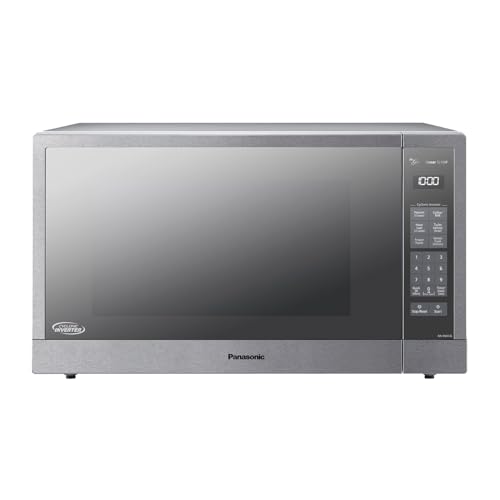
Panasonic NN-SN97JS 2.2 Cu.Ft Cyclonic Inverter Countertop Microwave (Silver) — Best Overall High-Power
The NN-SN97JS is the high-power pick for the household that cooks, not just reheats, in the microwave: batch portions, family casseroles, big bowls and meal-prep containers, all at the guide’s maximum verified output of 1250 watts. Crucially, that power arrives through Panasonic’s Cyclonic Inverter, so it is usable power, distributed evenly and deliverable at continuous low levels, rather than a pulsed blast. The 2.2 cu ft cavity and built-in capability complete the flagship brief for large kitchens.
Strengths
- 1250 watts is the joint-highest verified output in this guide, with inverter control behind it
- Cyclonic distribution keeps the big cavity’s edges and center cooking together
- 2.2 cu ft takes the largest family loads any countertop here can hold
Trade-offs
- The largest footprint in the guide; standard counters will feel every inch of depth
- Power this high is wasted on mug-and-popcorn households
- Functional styling: the performance is the luxury, not the look
| Power | 1250 watts |
| Capacity | 2.2 cu ft |
| Technology | Cyclonic Wave Inverter, Genius Sensor |
| Installation | Countertop or built-in |
| Model | NN-SN97JS |
High power exposes weak distribution mercilessly: a conventional 1250-watt oven with a single feed point scorches the near side of a big load while the far side lags, and owners learn to stir, rotate and apologize. The Cyclonic Inverter exists to solve exactly that, spreading energy through the cavity in a pattern designed for evenness and feeding it continuously, so a family casserole heats like a family casserole rather than a science experiment. This is why the guide’s most powerful pick is also its most controlled: at this output, control is not a luxury, it is the difference between fast and ruined.
The Genius Sensor completes the high-power discipline by knowing when to stop. Powerful ovens overshoot: a sensor-judged reheat ends at doneness, while a timed one ends at a guess plus 1250 watts of enthusiasm. Large households will feel the combination daily, in meal-prep containers reheated evenly, in defrosting that keeps pace with cooking, and in big fresh loads, vegetables, grains, proteins, that cook at near-stovetop speed. Give it the counter depth it demands and it is the most capable microwave in this entire batch of guides.
Best for: large households and microwave-led batch cooking / Not suited for: small counters, or light reheating-only use
Check the current price on Amazon for the Panasonic NN-SN97JS 2.2 Cu.Ft Cyclonic Inverter Countertop Microwave (Silver).

Panasonic NN-SN76LS 1.6 Cu.Ft Cyclonic Inverter Countertop Microwave (Stainless Steel) — Best High-Power for Families
The NN-SN76LS suits the family that wants the guide’s maximum power and Panasonic’s full inverter-and-sensor intelligence without surrendering the counter to a 2.2 cu ft flagship. At 1.6 cu ft it fits family plates and casseroles, at 1250 watts it reheats and cooks at the class’s fastest pace, and the Genius Sensor keeps that pace honest by judging the food rather than the clock. It is the high-power pick for real kitchens with real counters, which is most of them.
Strengths
- Full 1250-watt output with Cyclonic Inverter evenness in a standard family footprint
- Genius Sensor reheating is the fastest path to consistently hot, undried leftovers
- Stainless 1.6 cu ft format fits the counters the 2.2 cu ft flagship cannot
Trade-offs
- No convection or multi-modes: pure microwave performance, perfectly executed
- Still a substantial countertop body; compact kitchens should measure depth
- Two Panasonic flagships share this guide’s podium because the technology earns it, but brand diversity seekers should note the Toshiba pair below
| Power | 1250 watts |
| Capacity | 1.6 cu ft |
| Technology | Cyclonic Inverter, Genius Sensor cooking |
| Finish | Stainless steel |
| Model | NN-SN76LS |
Power density is the quiet number in this guide: watts divided by cavity volume decides how aggressively an oven treats a standard load. The NN-SN76LS pairs the guide’s joint-highest output with a mid-large cavity, giving it the highest power density on this page, which owners experience as pace: reheats that finish before impatience, family portions that heat through in one cycle, defrosting that keeps dinner on schedule. The inverter keeps that aggression civilized at low settings, so the same oven melts butter gently at breakfast and blasts a casserole at dinner.
For most families this is the rational flagship: the overall pick’s extra capacity serves households cooking truly large loads, while this model’s 1.6 cu ft covers the family distribution of plates, bowls and medium casseroles with counter space left over for the rest of the kitchen. Its listed dimensions, including a depth just under twenty inches, still deserve a tape measure before ordering. Families choosing between the two Panasonics should choose by dish size and counter depth, secure in the knowledge that the cooking intelligence is identical.
Best for: families wanting maximum power in a workable footprint / Not suited for: very large batch cooking, or the tightest counters
Check the current price on Amazon for the Panasonic NN-SN76LS 1.6 Cu.Ft Cyclonic Inverter Countertop Microwave (Stainless Steel).

Toshiba 1.6 Cu.Ft Inverter Countertop Microwave (Black Stainless Steel) — Best High-Power Value
This Toshiba is the high-power pick for the specification shopper: it matches the Panasonic flagships’ headline numbers, 1250 watts, 1.6 cu ft, true inverter delivery, and adds a smart sensor and auto defrost, at a noticeably friendlier tier position. It suits large households and keen cooks who buy cooking physics rather than brand prestige, and who would rather the budget difference fund the rest of the kitchen. The black stainless finish keeps it looking like the premium appliance its specification says it is.
Strengths
- True 1250-watt inverter power: the flagship cooking method without the flagship position
- Smart sensor judging covers reheats, the high-power oven’s most overshot task
- 1.6 cu ft with a 13.6-inch turntable fits family plates and dishes properly
Trade-offs
- Brand ecosystem and finish detailing sit a step below the Panasonic flagships
- No convection, air fry or other second arts: a pure high-power microwave
- Black stainless commits the kitchen corner to a darker palette
| Power | 1250 watts |
| Capacity | 1.6 cu ft |
| Technology | Inverter technology, smart sensor |
| Turntable | 13.6-inch turntable |
| Finish | Black stainless steel |
The existence of this model is the high-power market’s best news in years: inverter technology, once a single brand’s premium signature, now competes. The cooking consequences owners care about, continuous low power for delicate work, even full-power distribution, defrosting without cooked edges, are present here at 1250 watts, which means the flagship premium increasingly buys refinement, ecosystem and distribution subtleties rather than a different class of result. For reheating-led family use, the gap between this Toshiba and the guide’s Panasonics is narrower than the gap in their tier positions.
Choose it with the same honesty as the flagships: it is a pure microwave, with no convection ambitions, and its brand support story is a step behind the leaders. Within those bounds it is arguably the guide’s smartest purchase, the point where the power curve and the value curve cross. Households that arrived here wanting ‘the most powerful microwave that makes sense’ rather than ‘the most powerful microwave’ should stop at this pick and spend the difference on ingredients worthy of 1250 even watts.
Best for: spec-led families wanting flagship power at a friendlier tier / Not suited for: brand loyalists, or buyers wanting convection versatility
Check the current price on Amazon for the Toshiba 1.6 Cu.Ft Inverter Countertop Microwave (Black Stainless Steel).

Panasonic NN-SN68KS 1.2 Cu.Ft Countertop Microwave (Stainless Steel) — Best Compact High-Power
The NN-SN68KS suits the small household that refuses the compact class’s usual compromise, weak power in a small box. At 1200 watts in 1.2 cu ft it has the guide’s most aggressive power-to-size ratio, so single and couple portions reheat at flagship pace, and Panasonic’s inverter delivery, sensor cooking, Quick 30-second function and Turbo Defrost make the speed usable rather than scorching. Apartments, offices and small kitchens that cook real food are its home ground.
Strengths
- 1200 watts in a compact body: the fastest small-oven cooking in this guide
- Inverter delivery and sensor cooking keep compact speed from becoming compact scorching
- Turbo Defrost and Quick 30 serve the two impatient tasks compact ovens do most
Trade-offs
- 1.2 cu ft still limits family dishes; this is power for one to three people
- Compact footprint with flagship pace means dense loads need the sensor, not guesswork
- No convection or multi-mode versatility at this size
| Power | 1200 watts |
| Capacity | 1.2 cu ft |
| Technology | Inverter (per model line), sensor cooking |
| Features | Popcorn button, Quick 30Sec, Turbo Defrost |
| Finish | Stainless steel |
| Model | NN-SN68KS |
Compact microwaves are usually where wattage goes to die, 700 to 900 watts in ovens that make small households wait like everyone else. This Panasonic inverts the assumption: by putting near-flagship power in a 1.2 cu ft cavity, it makes small portions the fastest-cooking loads in the guide, because there is less food and more power per bite. The supporting technologies matter precisely because of that pace: sensor cooking calls time on reheats that a 1200-watt oven would otherwise overshoot in seconds, and Turbo Defrost applies the inverter’s gentleness to the week’s most rushed task.
Its honest limit is geometry, not power: a 1.2 cu ft cavity will not take the family casserole whatever the wattage, and households should not buy pace as a substitute for space. For its intended households, singles, couples, small families supplementing a range, it is close to a perfect specification, and its stainless compact body fits counters that the guide’s flagships would evict. In a guide about power, this is the pick that proves power is a ratio, not just a number.
Best for: singles, couples and small kitchens wanting flagship pace / Not suited for: family-size dish cooking
Check the current price on Amazon for the Panasonic NN-SN68KS 1.2 Cu.Ft Countertop Microwave (Stainless Steel).

Toshiba 2.2 Cu.Ft Inverter Countertop Microwave (Stainless Steel) — Best Extra-Large High-Power
This Toshiba suits the household whose loads are genuinely oversized: entertaining platters, big batch-cooking vessels, tall stockpot-adjacent bowls and the wide dishes that make standard cavities feel like puzzles. Its 2.2 cu ft cavity matches the guide’s largest, its 16.5-inch turntable is the biggest rotating platform here, and 1200 watts of inverter power with sensor cooking keeps the scale civilized. It is the extra-large pick for big families and entertainers who are tired of splitting loads.
Strengths
- 2.2 cu ft with a 16.5-inch turntable takes platters and vessels other ovens refuse
- 1200-watt inverter delivery keeps huge loads heating evenly, not just quickly
- Sensor cook and six auto menus tame the big cavity for everyday portions too
Trade-offs
- A very large countertop footprint; measure depth and door swing twice
- 1200 watts across 2.2 cu ft is gentler power density than the compact picks: big loads still take big-oven time
- Everyday single portions rattle around in a cavity built for banquets
| Power | 1200 watts |
| Capacity | 2.2 cu ft |
| Turntable | 16.5-inch turntable |
| Technology | Inverter, sensor cook |
| Features | 6 auto menus |
| Finish | Stainless steel |
Extra-large microwaves live or die on their turntable, because a cavity’s volume is a lie if the dish cannot rotate: the 16.5-inch platform here is the specification that makes the 2.2 cu ft honest, accepting the wide, shallow vessels that batch cooking and entertaining actually produce. Inverter delivery is the second honesty: spreading 1200 continuous watts through that volume heats a banquet load evenly where a pulsed oven of the same rating would ring the edges. Together they make this the guide’s true banquet appliance.
The discipline it demands is spatial and habitual. Spatially, it is a piece of counter furniture: plan its position, its door swing and its clearance as you would a range. Habitually, owners of huge cavities should resist using them as storage or as the default for a single mug, because big ovens heat small loads less efficiently and the door seals and turntable wear the same per cycle regardless. Bought for the loads it is sized for, it ends the split-batch era of a big household’s kitchen, which for the right family is worth every inch.
Best for: big families, batch cooks and entertainers with oversized dishes / Not suited for: small kitchens, or mostly single-portion use
Check the current price on Amazon for the Toshiba 2.2 Cu.Ft Inverter Countertop Microwave (Stainless Steel).

Toshiba Flatbed Microwave Oven with Inverter Technology 1.3 Cu.Ft (Black Stainless Steel) — Best Flatbed High-Power
This Toshiba flatbed suits the cook whose dishes never fit the turntable’s circle: square casserole dishes, rectangular meal-prep trays, two bowls side by side and the awkward vessels real kitchens accumulate. Removing the turntable gives a flat floor that uses the whole 1.3 cu ft footprint, while 1200 watts of inverter power and a smart sensor keep cooking even and judged. It is the high-power pick for dish-driven households, and a genuinely different answer to the evenness problem.
Strengths
- Flatbed floor accepts square, rectangular and paired dishes turntables cannot rotate
- 1200-watt inverter power with smart sensor: flatbed evenness with flagship pace
- No turntable to wash, chip or misalign: the easiest cavity in the guide to clean
Trade-offs
- Flatbed evenness depends on the inverter’s distribution; very large static loads may still want a mid-cycle turn by hand
- 1.3 cu ft is a mid-size cavity: family banquets belong to the 2.2 cu ft picks
- Mute-era conveniences aside, this is a focused design: no convection or multi-modes
| Power | 1200 watts |
| Capacity | 1.3 cu ft |
| Design | Flatbed, no turntable |
| Technology | Inverter technology, smart sensor |
| Features | Mute function |
| Finish | Black stainless steel |
The turntable is a 1970s answer to uneven energy: rotate the food through the hot spots. The flatbed is the modern answer: distribute the energy well enough that rotation is unnecessary, and claim the whole floor as usable space. Toshiba’s inverter makes the claim credible here, and the practical dividend is dish freedom, the square baker that holds the lasagna, the two soup bowls reheated together, the meal-prep trays that match the cavity’s rectangle instead of fighting its circle. Households whose cookware is rectangular will feel this as a daily liberation.
Honesty requires the caveat flatbed marketing omits: distribution has limits, and a single very large, dense, static load can still benefit from a pause and a manual turn halfway, a ten-second habit that replaces the turntable entirely. For the portion sizes this 1.3 cu ft oven is built for, the inverter handles the work unaided. Add the easiest cleaning in the guide, a flat floor wipes like a counter, and this is the pick for cooks who think in dishes rather than in specifications, powered properly at 1200 watts.
Best for: rectangular-dish households, meal preppers and easy-clean devotees / Not suited for: banquet-scale loads, or convection seekers
Check the current price on Amazon for the Toshiba Flatbed Microwave Oven with Inverter Technology 1.3 Cu.Ft (Black Stainless Steel).
Comparison Table
| Pick | Badge | Key spec | Best for |
|---|---|---|---|
| Panasonic NN-SN97JS 2.2 Cu.Ft Cyclonic Inverter Countertop Microwave (Silver) | Best Overall High-Power | 1250W / 2.2 cu ft / Cyclonic Inverter + Genius Sensor | large households and microwave-led batch cooking |
| Panasonic NN-SN76LS 1.6 Cu.Ft Cyclonic Inverter Countertop Microwave (Stainless Steel) | Best High-Power for Families | 1250W / 1.6 cu ft / Cyclonic Inverter + Genius Sensor / stainless | families wanting maximum power in a workable footprint |
| Toshiba 1.6 Cu.Ft Inverter Countertop Microwave (Black Stainless Steel) | Best High-Power Value | 1250W / 1.6 cu ft / inverter + smart sensor / 13.6-inch turntable | spec-led families wanting flagship power at a friendlier tier |
| Panasonic NN-SN68KS 1.2 Cu.Ft Countertop Microwave (Stainless Steel) | Best Compact High-Power | 1200W / 1.2 cu ft / inverter + sensor cooking / Quick 30 + Turbo Defrost | singles, couples and small kitchens wanting flagship pace |
| Toshiba 2.2 Cu.Ft Inverter Countertop Microwave (Stainless Steel) | Best Extra-Large High-Power | 1200W / 2.2 cu ft / inverter + sensor cook / 16.5-inch turntable | big families, batch cooks and entertainers with oversized dishes |
| Toshiba Flatbed Microwave Oven with Inverter Technology 1.3 Cu.Ft (Black Stainless Steel) | Best Flatbed High-Power | 1200W / 1.3 cu ft / flatbed, no turntable / inverter + smart sensor | rectangular-dish households, meal preppers and easy-clean devotees |
How to Choose a High Power Microwave
Cooking watts, input watts and other label games
Microwave wattage should mean cooking power, the microwave energy delivered to the food, and the listings behind this guide state their figures in those terms: 1200 and 1250 watts of cooking power. Be wary elsewhere of input wattage, the electricity the oven draws from the wall, which is always higher and occasionally advertised by the unscrupulous as if it were cooking power. When a listing does not state a wattage at all, as happens in this category, treat the model as unrated rather than powerful; our verification rule excluded exactly those, because a high-power guide that guesses wattages is fiction.
The practical scale to hold in mind: 700 watts is compact pace, 900 to 1000 watts is the family mainstream, 1100 is brisk, and 1200 to 1250 is the verified ceiling of the current countertop market. Each step matters less than the one before it, a law of diminishing returns that should discipline your budget: the jump from 700 to 1000 transforms daily cooking, the jump from 1100 to 1250 refines it for large and dense loads specifically.
Power density: the ratio that actually predicts pace
Divide watts by cavity volume and you get the number that predicts how a standard load behaves. The compact Panasonic here runs 1200 watts through 1.2 cu ft, the densest ratio in the guide, and reheats a single portion faster than any flagship. The banquet Toshiba runs 1200 watts through 2.2 cu ft, the gentlest ratio, and heats huge loads evenly but unhurriedly. Neither is better; they are aimed at different loads. Buyers should match the ratio to their typical portion: dense for singles and couples, balanced for families, gentle-plus-huge for batch and banquet cooking.
Power density also explains most ‘my powerful microwave is slow’ complaints: the oven is powerful, the load is enormous, and the ratio between them is ordinary. The fix is rarely a different oven; it is portioning, covering, stirring and standing time, the unglamorous techniques the how-to section covers, which multiply any oven’s effective power for free.
Inverter delivery: why high power needs a better power supply
At 1200-plus watts, the traditional pulsed power supply becomes a liability for anything delicate: its low settings are full-power bursts, and full power at this level bursts hard. An inverter delivers continuous power at the set level, so the same oven that blasts a casserole at full output can hold a gentle field for melting, softening, proofing-adjacent warmth and defrosting without cooked edges. Every pick in this guide pairs its output with inverter delivery or, in the Panasonics’ case, the cyclonic refinement of it, and that pairing, not the wattage, is the category’s real entry ticket.
Defrosting is where owners feel the pairing first. High power wants to cook; defrosting forbids cooking. An inverter threads that needle with continuous low energy, thawing a family pack of chicken evenly in a fraction of the babysitting a pulsed oven demands. Households that defrost daily should weight this section above every other in the guide: for them, the inverter is not a premium feature, it is the product.
Circuits and kitchens: feeding a high-power oven
A 1200 to 1250-watt cooking output draws substantially more from the wall, and high-power ovens deserve a circuit that is not simultaneously feeding a kettle, toaster oven or coffee maker. Nuisance breaker trips at breakfast are the classic symptom of a shared circuit, and the fix is a different outlet or staggered use, not a different oven. Older homes and offices with limited circuits should factor this into the high-power decision honestly: the compact pick is gentler on wiring than the flagships only in degree, not in kind.
Ventilation and clearance scale with power too. High-power cooking generates steam and heat at a faster rate inside the cavity, and the oven’s own vents work harder; give these models their specified clearances and resist the cubby. A flagship wedged into a tight enclosure will protect itself by aging early, which is an expensive way to learn a free lesson.
The 1250-Watt Ceiling, and Why It Exists
Shoppers sometimes ask why countertop microwaves stop at 1250 watts when commercial ovens run far higher. The ceiling is set by the household itself: standard kitchen circuits, countertop ventilation and the physics of heating household portions evenly all argue against more. Beyond this point, energy stops being the bottleneck and distribution becomes the whole problem, which is why the commercial category answers with different cavity designs and duty cycles rather than household-style wattage races, a story our industrial guide tells in full. For the home, 1250 well-delivered watts is not a limitation; it is the mature form of the technology, and the six picks here are its current state of the art.
That is also why this guide refuses to chase the occasional listing that advertises implausible household wattages without verification. In a category where the honest ceiling is known, extraordinary claims are a reason to check the listing twice, not to crown a winner. Every figure on this page survived that check.
How to Get the Most from a High-Power Microwave
High power rewards technique more than any other microwave class. This sequence turns a big specification into daily results, safely and without scorched edges.
Step 1: Place it on a circuit and a counter that can feed it
Give the oven its specified clearances and, where possible, an outlet on a circuit not shared with other heavy appliances. Confirm the counter depth with the door open, because high-power flagships are deep. Run the water test and note the time: a cup of water at this power level should steam fast, and that baseline tells you the oven is delivering as rated.
Step 2: Learn the power levels before you need them
High-power ownership is power-level literacy. Spend one session mapping the levels to your tasks: full power for liquids and dense reheats, medium for family portions and grains, low continuous levels for melting, softening and defrosting. On inverter models these low levels are genuinely continuous, which changes technique: you can hold a gentle melt without the pulse-watching a conventional oven demands.
Step 3: Use the techniques that multiply power
Cover dishes to trap steam, arrange dense items toward the edges, stir or turn large loads once midway and always observe standing time, the minute or two in which heat equalizes through the load. These habits are worth more than 100 watts of specification, they cost nothing, and they are the difference between owners who praise their high-power oven and owners who blame it.
Step 4: Keep the cavity and sensor honest
High-power cooking splatters energetically; steam-clean weekly with water and lemon, wipe the door seals and keep the sensor area clean as the manual directs, because a sensor reading through splatter judges badly. A clean high-power oven stays fast and even; a dirty one becomes an expensive ordinary oven with a misleading badge.
Mastered this way, a high-power oven stops being a faster version of your old microwave and becomes a different class of cooking tool.
Common Buying Mistakes
Mistake 1: Buying the wattage and ignoring the delivery
A pulsed 1250-watt oven and an inverter 1250-watt oven share a headline and little else. The pulsed one scorches delicates and defrosts unevenly; the inverter one does the guide’s best work. In the high-power class, the power supply is the product. Check for inverter by name before paying flagship money.
Mistake 2: Judging power without the load
Owners test a new flagship with a mug of water, conclude it feels similar to the old oven and feel cheated. Small liquids saturate at any wattage. Judge high power on its home ground: a dense family portion, a frozen pack defrosted, a batch-cooked grain. That is where the specification lives.
Mistake 3: Skipping standing time because the oven is fast
Microwave energy stops when the door opens; heat equalization does not. Dense loads need their standing minute more, not less, at high power, because the gradients the oven created are steeper. Impatience at this step manufactures the cold centers that owners then blame on distribution.
Mistake 4: Running a flagship on a shared breakfast circuit
Kettle plus toaster plus 1250-watt microwave is a breaker trip with a menu. High-power ovens belong on circuits with headroom. If your kitchen cannot offer one, stagger appliance use or choose with the constraint in mind, rather than concluding the oven is faulty.
Mistake 5: Assuming more power fixes bad technique
Uncovered dishes, un-stirred casseroles and overpacked cavities defeat any wattage. High power amplifies technique, good and bad: it makes covered, arranged, stood loads superb and makes careless loads worse faster. The how-to habits in this guide are not garnish; at this output they are half the appliance.
Mistake 6: Chasing unverified wattage claims
Listings that trumpet implausible power without stating a verifiable figure are selling a number, not an oven. This guide excluded every model whose wattage the Amazon listing did not state. Buyers elsewhere should apply the same rule, because in this category the honest ceiling is 1250 watts and everything above it deserves a raised eyebrow.
High Power vs Commercial Power: Where the Household Ceiling Ends
Households cooking at true volume sometimes eye commercial microwaves, and the boundary is worth understanding. Commercial ovens trade the household arts, sensors, turntables, presets for duty cycle: the ability to run back-to-back all day, with cavities and controls built for staff rather than families. Their wattages overlap this guide’s at the light end and exceed it at the heavy end, but the ownership experience is entirely different, and our industrial guide covers that category on its own terms. For a home, even a big, hungry one, the six picks here are the correct ceiling: commercial power in a household kitchen buys durability you will not use and surrenders judgment you would have loved daily.
The reverse mistake also exists: running a household flagship like a commercial oven, back-to-back through a party or a market stall, exceeds its duty design. High-power home ovens need pauses between heavy cycles that commercial units do not. Respect the category you bought and it will respect your schedule; cross the categories knowingly, with the right guide open.
What High Power Costs to Run
Electricity is the least interesting high-power question: even at flagship output, a microwave’s minutes-per-day duty makes its running cost a rounding error beside ovens, dryers and air conditioning. The real costs of the category are the ones this guide has priced throughout: counter depth, circuit headroom, cleaning discipline and the calibration week. Against those, the benefit, family-scale cooking at the fastest, most even pace the household format offers, compounds daily. High power is not a thirsty luxury; it is a one-time space and habit investment with a daily dividend, which is why the category keeps growing at the top of the market while the middle hollows out.
There is one more dividend worth naming, because it rarely appears in buying guides: time sovereignty at the day’s most pressured moments. The difference between a four-minute reheat and a six-minute one is trivial at noon and decisive at 7 p.m. with hungry people circling. High-power ovens buy those minutes back at exactly the moments households value them most, and they do it every day, for years, without asking anything but a clean cavity and a fair circuit in return. That compounding of small rescued minutes, more than any single specification, is why owners of this class so rarely go back to ordinary power.
Final Recommendation
Most high-power buyers should take the Panasonic NN-SN76LS: maximum verified output, inverter evenness and sensor judgment in a family footprint. Batch-cooking households with the counter for it should step up to the NN-SN97JS, and specification shoppers should pocket the Toshiba inverter’s friendlier tier for the same 1250-watt physics.
Small households are not excluded from the fast lane: the Panasonic NN-SN68KS brings 1200 watts to a compact body, while dish-driven cooks get the Toshiba flatbed and banquet households the Toshiba 2.2 cu ft. Whichever pick fits your loads, buy the delivery with the wattage, use the techniques that multiply both, and let standing time finish what the magnetron started.
The shortlist one more time, so you can jump straight to a listing: Panasonic NN-SN97JS 2.2 Cu.Ft Cyclonic Inverter Countertop Microwave (Silver) (Best Overall High-Power); Panasonic NN-SN76LS 1.6 Cu.Ft Cyclonic Inverter Countertop Microwave (Stainless Steel) (Best High-Power for Families); Toshiba 1.6 Cu.Ft Inverter Countertop Microwave (Black Stainless Steel) (Best High-Power Value); Panasonic NN-SN68KS 1.2 Cu.Ft Countertop Microwave (Stainless Steel) (Best Compact High-Power); Toshiba 2.2 Cu.Ft Inverter Countertop Microwave (Stainless Steel) (Best Extra-Large High-Power); Toshiba Flatbed Microwave Oven with Inverter Technology 1.3 Cu.Ft (Black Stainless Steel) (Best Flatbed High-Power). Whichever badge matches your kitchen, check price on Amazon before you decide, because finish and bundle pricing moves between visits.
Keep exploring this category with these related guides from the same program: Best High End Countertop Microwaves Best High End Microwaves Best High Quality Industrial Microwaves Best 1000 Watt Microwaves Best 1100 Watt Countertop Microwaves
Frequently Asked Questions
What is the highest wattage for a home countertop microwave?
In verified current listings, 1250 watts is the ceiling, represented here by the Panasonic flagships and the Toshiba inverter. Claims above that for household countertop models should be checked carefully against the listing itself, because input wattage is sometimes advertised as if it were cooking power. Every figure in this guide comes from the model’s own verified listing title.
Is 1250 watts noticeably faster than 1000 watts?
On small loads, barely: a mug of water saturates at either output. On dense, large or frozen loads, yes: the extra throughput shortens cycles and, with inverter delivery, heats more evenly while doing it. Judge high power on family portions and defrosting, not on beverages, and the difference is unmistakable.
Does high power use much more electricity?
Per minute, it draws more; per meal, the difference is small because cycles are shorter and microwaves run for minutes a day. The practical electrical question is not cost but capacity: a high-power oven deserves a circuit not shared with other heavy appliances at the same moment, to avoid nuisance breaker trips.
Why do all the picks in this guide have inverter technology?
Because at 1200 watts and above, delivery decides quality. Inverter power supplies provide continuous low power for delicate work and defrosting, and distribute full power more evenly than pulsed systems. A high-wattage pulsed oven scorches as fast as it cooks. The pairing of big output with inverter control is what makes modern high power usable.
Can a high-power microwave replace cooking on the stove?
For reheating, defrosting, vegetables, grains and many proteins, a 1250-watt inverter oven is a genuine cooking appliance, not a warmer. It will not brown or sear, which is why convection models exist in our high-end guides. Households should buy high power for speed and evenness in the microwave arts, not as a stove substitute.
Is a high-power microwave safe for everyday family use?
Yes, with the standard microwave disciplines: intact door seals, no metal unless the manual allows it, covered dishes for splatter and standing time for even temperatures. High power adds one habit: respect the pace. Foods finish faster and steam builds quicker, so vent covers carefully and give dense loads their standing minute before serving, especially to children.


