Disclosure: airfryerkitchensupply.com is reader-supported. When you buy through links on our site, we may earn an affiliate commission at no extra cost to you.
Where to buy
Every linked pick in this guide to the best high end microwaves was verified against Amazon’s catalog on 2026-11-21, so the model name and specification on this page are the ones on the listing you land on. At the premium tier, buy the verified model number from the listing itself; fitted models especially punish a mistaken variant. Start with Café 1.5 Cu.Ft Countertop Convection Microwave (Stainless Steel), Sharp SMD3070ASY 30-Inch Microwave Drawer Oven, Sharp SMD2489ES 1.2 Cu.Ft Microwave Drawer Oven (Stainless Steel). Check the current price on Amazon from any pick’s link, because finishes and bundle configurations rotate.
The best high end microwaves refuse to agree on a shape, and that is what makes this guide different from its countertop-only companion: here the premium is contested across every format, countertop convection flagships, microwave drawers that load from above, a low-profile over-the-range Profile and the largest inverter countertop Panasonic makes. High-end, judged across formats, means the best version of each position a microwave can occupy in a kitchen, so this guide crowns a champion per format and one overall, and explains exactly what each position buys and costs.
What unites the six is what the premium always buys: better cooking physics, inverter power or convection heat, better judgment, sensors instead of timers, and construction that feels like cabinetry rather than packaging. What divides them is geometry: where the appliance lives, how you load it and what your kitchen must give up for it. Every pick was verified on 2026-11-21 with specifications from the listings themselves, because at this tier a wrong model number is an expensive mistake.
In this guide
Quick Picks
Six models made the cut for this guide. Each carries its own badge, and the same badge follows it into the full review below so you can track a recommendation from summary to verdict.
- Best Overall High-End — Café 1.5 Cu.Ft Countertop Convection Microwave (Stainless Steel): The complete high-end package across all formats: convection cooking, connected convenience and design-line presence on the counter. Key spec: 1.5 cu ft / 1000W / convection + scan-to-cook + WiFi / countertop.
- Best Microwave Drawer — Sharp SMD3070ASY 30-Inch Microwave Drawer Oven: The classic high-end drawer: a 30-inch Sharp that opens toward you under the counter, with concealed controls and top-down access. Key spec: 1.2 cu ft / 950W / 30-inch drawer / concealed angled controls.
- Best Smart Drawer — Sharp SMD2489ES 1.2 Cu.Ft Microwave Drawer Oven (Stainless Steel): Sharp’s smart-generation drawer in stainless: the fitted format with the newer platform, for connected premium kitchens. Key spec: 1.2 cu ft / microwave drawer / stainless steel / smart-generation platform.
- Best High-End Over-the-Range — GE Profile UVM9125STSS 1.2 Cu.Ft Low Profile Over-the-Range Microwave: The premium hang: Profile’s slim over-the-range body with 400 CFM venting and full power, for kitchens designed around the range. Key spec: 1.2 cu ft / 1000W / 400 CFM / low-profile mounted / Profile series.
- Best Pure Performance — Panasonic NN-SN97JS 2.2 Cu.Ft Cyclonic Inverter Countertop Microwave (Silver): The engineer’s flagship: the largest cavity and the most even cooking in the guide, for buyers who measure premium in results. Key spec: 2.2 cu ft / 1250W / Cyclonic Inverter + Genius Sensor / built-in capable.
- Best Drawer with Convection — KoolMore Reserve 24-Inch Microwave Drawer with Convection: The drawer that cooks like an oven: KoolMore Reserve’s 24-inch drawer with convection bake, roast and broil plus sensor cooking. Key spec: 1.2 cu ft / drawer + bake, roast, broil / sensor cooking / electric door.
How These Picks Were Chosen
We surveyed the premium tier across all formats, countertop, drawer, over-the-range and built-in capable, and admitted only models with a flagship claim we could verify in the listing: a named technology, a format-defining design or a premium series badge with the specification to back it. Verification ran as usual, including a dedicated drawer search that returned the Sharp range and the KoolMore Reserve convection drawer. Mainstream models with premium prices but standard technology were excluded; at the high end, the specification is the entry ticket.
Badges were assigned by position, because cross-format ranking by a single score would be theatre: best overall, best drawer, best smart drawer, best over-the-range, best pure performance and best drawer with convection describe real decisions a kitchen designer actually makes. Within each position we ranked on the position’s own virtues, ergonomics for drawers, extraction and geometry for the hang, cooking results for the countertop flagships, so the guide reads the way a real premium shortlist is built: format first, champion second.
The 6 Best High End Microwaves

Café 1.5 Cu.Ft Countertop Convection Microwave (Stainless Steel) — Best Overall High-End
The Café countertop convection microwave is the high-end pick for the buyer who wants the premium to do everything at once: bake and roast by convection, reheat by microwave, set itself by scan-to-cook, and look like a designed object while doing it. In a guide spanning every format, it earns the overall badge because it asks the fewest compromises: no installation, no format geometry to satisfy, just the category’s fullest combination of cooking capability, technology and finish in a box you can place today and move tomorrow.
Strengths
- Convection plus microwave plus scan-to-cook: the broadest capability set in this guide
- Design-line build and finish that hold their own beside premium ranges
- Countertop freedom: no installation, no remodel dependency, full portability
Trade-offs
- It claims premium counter space permanently; fitted formats hide their appliances
- Convection needs ventilation clearance and a cleaning habit after dry-heat cooking
- The design premium is real: performance-led buyers can match the cooking for less theatre
| Capacity | 1.5 cu ft |
| Power | 1000 watts |
| Modes | Microwave + convection: bake, roast, broil |
| Technology | Scan-to-cook, WiFi connectivity |
| Format | Countertop |
| Finish | Stainless steel |
Overall crowns in multi-format guides usually go to the appliance with the fewest asterisks, and the Café’s asterisk list is short. Its convection system is a genuine oven, its microwave side is full-powered, its connected features solve real errors and its industrial design is the current benchmark for how a microwave can look. Against the drawer picks it wins on capability and price of entry; against the performance Panasonic it wins on versatility and presence; against the over-the-range pick it wins on installation freedom. That breadth, rather than supremacy in any single column, is what ‘best overall high-end’ should mean.
Its ownership story is equally complete. There is no installer to schedule, no opening to measure beyond counter depth and clearance, and no fixture commitment if the kitchen changes. The premium instead goes into things the owner touches daily: control feel, door action, finish quality and the quiet satisfaction of an appliance that looks intentional in a designed kitchen. Households renovating around Café’s wider appliance line will find the coordination argument decisive; everyone else can simply enjoy the best all-round premium microwave we verified.
Best for: buyers wanting one premium microwave that does everything, beautifully / Not suited for: buyers who need the appliance hidden, fitted or purely performance-led
Check the current price on Amazon for the Café 1.5 Cu.Ft Countertop Convection Microwave (Stainless Steel).

Sharp SMD3070ASY 30-Inch Microwave Drawer Oven — Best Microwave Drawer
The Sharp SMD3070ASY suits the premium kitchen designed around flow: islands, under-counter runs and households that load the microwave from above rather than reaching into a box at head or counter height. The drawer glides open toward you, you stir and season without removing the dish, and the concealed angled control panel keeps the face clean when closed. At 30 inches it matches premium range widths, and its 1.2 cu ft cavity with 950 watts covers family reheating and cooking in the format luxury kitchens standardized on.
Strengths
- Top-down drawer access is the most ergonomic loading in the category, especially for soups and heavy dishes
- Concealed controls keep a fitted kitchen’s lines clean and prevent casual button presses
- 30-inch premium format from Sharp, the maker that defined the microwave drawer
Trade-offs
- A fitted installation: cabinet work, planning and a permanent position in the kitchen
- 950 watts is a step below the countertop flagships’ pace on large loads
- Drawer format costs a premium over equivalent countertop technology, always
| Capacity | 1.2 cu ft |
| Power | 950 watts |
| Format | 30-inch built-in microwave drawer |
| Controls | Concealed angled touch control panel, digital LCD display |
| Finish | Stainless steel |
| Access | Top-down drawer loading |
The drawer’s genius is a motion: instead of lifting a hot dish out of a cavity toward your face or across a counter, you look down into it, stir it where it sits, add liquid, check doneness and close the drawer with a nudge. For soups, sauces and anything sloshy, that motion is safer and calmer, and for cooks with mobility limits it can be the difference between using the microwave independently and not. Sharp invented this format and the SMD3070ASY is its mature expression, sized for the 30-inch openings premium kitchens are drawn around.
Buy the format with its commitments understood. A drawer is cabinetry: it needs its opening built, its position chosen for a decade and its premium paid gladly, because none of it is recoverable if you move. The cooking itself is conventional microwave work at 950 watts, without inverter or convection in this model, so the premium buys ergonomics and integration rather than cooking technology. Kitchens being designed from scratch, especially with islands, should weigh it heavily; kitchens already built should measure twice before falling in love.
Best for: designed kitchens, islands and cooks who value top-down ergonomic access / Not suited for: renters, existing kitchens without a drawer opening, or technology-first buyers
Check the current price on Amazon for the Sharp SMD3070ASY 30-Inch Microwave Drawer Oven.

Sharp SMD2489ES 1.2 Cu.Ft Microwave Drawer Oven (Stainless Steel) — Best Smart Drawer
The SMD2489ES suits the buyer committed to the drawer format who wants its newer-generation platform rather than the classic model above. It keeps the format’s essentials, a 1.2 cu ft cavity in a fitted stainless drawer with top-down access, in Sharp’s smart-generation line, positioned for kitchens whose other appliances are connected and current. It is the drawer pick for a technology-refresh renovation: same beloved ergonomics, newer bones, and a face that coordinates with contemporary stainless suites.
Strengths
- Drawer ergonomics with a newer-generation platform than the classic SMD3070ASY
- 1.2 cu ft capacity matches the format’s family standard
- Stainless fitted face integrates cleanly into premium cabinetry runs
Trade-offs
- Listing detail is sparser than the classic model’s, so confirm feature specifics on the listing before ordering
- Same fitted-installation commitment and format premium as every drawer
- Cooking remains microwave-format work; convection seekers should read the KoolMore pick below
| Capacity | 1.2 cu ft |
| Format | Built-in microwave drawer |
| Finish | Stainless steel |
| Model | Sharp SMD2489ES |
Model generations inside the drawer format move quietly, and this pick exists for the buyer who notices. The SMD2489ES represents Sharp’s newer drawer platform against the long-running SMD3070ASY, and in a fitted appliance, where the purchase horizon is the kitchen’s lifetime, buying the current generation is a defensible premium in itself: parts horizons, control interfaces and ecosystem compatibility all start from a later date. The ergonomics that justify the format, the glide, the top-down access, the clean face, are fully present.
We flag honestly that this model’s verified listing title is more concise than its sibling’s, naming the capacity, format and finish without the fuller feature recitation. That is a reason to read the listing carefully before ordering, not a reason to invent specifications here, and our spec box above sticks to what the listing states. Buyers who want every feature spelled out in advance have the classic Sharp above; buyers who want the newer platform have this one, with a homework note attached in the open, which is how high-end guidance should work.
Best for: renovations wanting the drawer’s current generation / Not suited for: buyers who need exhaustive published specifications before committing
Check the current price on Amazon for the Sharp SMD2489ES 1.2 Cu.Ft Microwave Drawer Oven (Stainless Steel).

GE Profile UVM9125STSS 1.2 Cu.Ft Low Profile Over-the-Range Microwave — Best High-End Over-the-Range
The GE Profile UVM9125STSS is the high-end pick for kitchens where the microwave’s place is above the range and the range is a serious cooking station. Its low-profile body keeps tall stockpots workable underneath, its 400 CFM vent is flagship-grade extraction for a mounted microwave, and its Profile build and finish coordinate with premium suites. It suits designed kitchens that refuse to surrender counter to a microwave and cooks whose stovetop work deserves a real hood inside their microwave.
Strengths
- Low-profile premium hang restores cooktop headroom in designed kitchens
- 400 CFM venting is flagship extraction for the format
- Profile fit, finish and LED lighting complete the premium brief above the range
Trade-offs
- 1.2 cu ft and slim interior height limit tall-dish reheating
- A mounted fixture: installation and eventual replacement are projects
- If your kitchen has a dedicated pro hood, this premium is solving a problem you do not have
| Capacity | 1.2 cu ft |
| Power | 1000 watts |
| Venting | 400 CFM hood vent |
| Format | Low-profile over-the-range, 30-inch |
| Series | GE Profile |
| Lighting | LED lighting |
High-end over-the-range design used to mean a bigger box with more buttons; the Profile redefines it as better geometry. By compressing the body, GE gives the cook back the vertical working space that makes a premium range feel premium, while strengthening the vent beyond the class standard. The result is the rare mounted microwave that a kitchen designer would specify rather than tolerate, and it explains why low-profile has become the format’s premium direction across the industry.
Its limits are the format’s limits, honestly held: interior height for tall loads, a fixture’s permanence, and a cavity sized for support cooking rather than banquets. In the kitchens it is designed for, where the range does the heavy cooking and the microwave reheats, defrosts and melts in support, those limits rarely bind. GE lists the platform in black and white as well as this stainless, all verified in our research, which lets the premium hang match colored suites that stainless-only rivals cannot.
Best for: designed kitchens centered on a serious range / Not suited for: microwave-led households, or kitchens with dedicated pro ventilation
Check the current price on Amazon for the GE Profile UVM9125STSS 1.2 Cu.Ft Low Profile Over-the-Range Microwave.
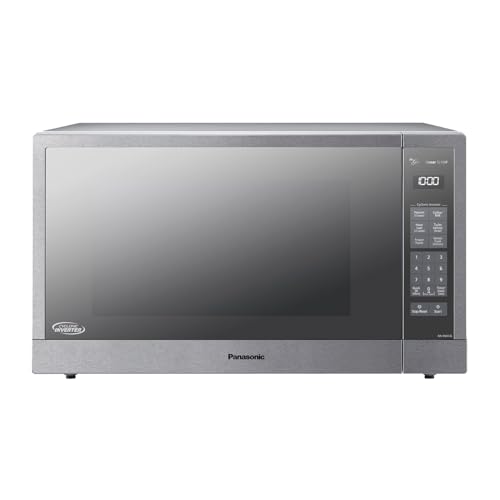
Panasonic NN-SN97JS 2.2 Cu.Ft Cyclonic Inverter Countertop Microwave (Silver) — Best Pure Performance
The Panasonic NN-SN97JS is the high-end pick for the buyer unmoved by design lines and drawer mechanisms, who wants the microwave itself to be the best microwave: Cyclonic Inverter energy distribution at 1250 watts, a Genius Sensor, and a 2.2 cu ft cavity that swallows family-scale loads, in a body that works on the counter or builds in with a kit. Large households, batch cooks and results-first buyers are its audience, and for them it is not one option among six; it is the point of the category.
Strengths
- Cyclonic Inverter cooking is the benchmark for evenness, defrosting and delicate work
- 2.2 cu ft and 1250 watts: maximum countertop scale and pace in this guide
- Built-in capability lets a countertop flagship become a fitted one at remodel time
Trade-offs
- Its footprint is the largest here; the counter must be planned around it
- Functional silver styling: the premium is invisible until the food comes out
- No convection or multi-modes: performance depth in one art, not breadth across several
| Capacity | 2.2 cu ft |
| Power | 1250 watts |
| Technology | Cyclonic Wave Inverter, Genius Sensor |
| Installation | Countertop or built-in |
| Finish | Silver |
| Model | NN-SN97JS |
Every format in this guide asks a compromise except this one, whose only compromise is space. The drawers ask you to accept conventional cooking for ergonomics; the hang asks you to accept a compact cavity for position; the convection models ask cleaning and clearance for their oven arts. The Panasonic simply cooks, with an inverter power supply delivering continuous power and a distribution pattern filling the largest countertop cavity evenly, judged by a sensor that watches the food. For households whose microwave runs all day, that purity compounds into thousands of better reheats over the appliance’s life.
It also hedges the format bet intelligently: built-in capability means the flagship can start on the counter of a rented or interim kitchen and finish fitted in the renovated one, a flexibility none of the fixed-format picks can match. Buy it if your premium is measured on the plate. Forgive its industrial presence, give it the counter it demands, and it will quietly be the best microwave most of its owners have ever used, which is the only high-end claim that survives a decade of dinners.
Best for: large households and performance absolutists / Not suited for: small counters, or buyers paying for visible design
Check the current price on Amazon for the Panasonic NN-SN97JS 2.2 Cu.Ft Cyclonic Inverter Countertop Microwave (Silver).

KoolMore Reserve 24-Inch Microwave Drawer with Convection — Best Drawer with Convection
The KoolMore Reserve drawer suits the premium buyer who loves the drawer format but refuses its usual cooking limits. It keeps the format’s ergonomics, a 24-inch fitted drawer with an electric door opening and top-down access, and adds what Sharp’s drawers do not offer: convection cooking with bake, roast and broil functions, plus sensor cooking and melt and defrost programs across 10 power levels. It is the high-end pick for designed kitchens that want their fitted microwave to be a second oven as well.
Strengths
- Convection in a drawer: bake, roast and broil join the format’s ergonomic loading
- Sensor cooking and 10 power levels give the microwave side real judgment
- Electric door opening and Reserve-series positioning aim squarely at premium kitchens
Trade-offs
- 24-inch format fits narrower runs than the 30-inch Sharp; confirm your opening class
- KoolMore’s service network is younger than Sharp’s or GE’s in the premium segment
- Convection in a drawer adds the dry-heat cleaning discipline to a fitted appliance
| Capacity | 1.2 cu ft |
| Format | 24-inch built-in microwave drawer |
| Modes | Microwave + convection: bake, roast, broil |
| Features | Electric door opening, sensor cooking, melt, defrost, 10 power levels |
| Certification | UL certified (per listing) |
| Power | 1500 watts (per listing) |
The drawer format’s one standing criticism is that you pay a fitted premium for ordinary microwave cooking, and this model is the rebuttal. Convection transforms the drawer from a reheating station into a genuine small oven that happens to load from the top: it can bake a small batch, roast vegetables and broil a finish, in an island or under-counter position that keeps the main oven free. Combined with sensor-guided microwave work, it is the most functionally complete fitted microwave in this guide, and the Reserve badge signals KoolMore aiming it at the premium tier deliberately.
The cautions are about ecosystem, not cooking. KoolMore is a younger premium name than Sharp, GE or Panasonic, and a fitted appliance is a decade-long relationship with a service network; buyers should weigh that alongside the specification, especially outside major metro areas. The 24-inch width also belongs to a different opening class than the 30-inch Sharp, so this is a design-stage choice, not a swap. Kitchens being drawn today, whose owners want the drawer to cook like an oven, should put it at the top of the fitted shortlist and do the service homework with eyes open.
Best for: designed kitchens wanting a fitted drawer that also bakes and roasts / Not suited for: 30-inch openings, or buyers prioritizing established service networks
Check the current price on Amazon for the KoolMore Reserve 24-Inch Microwave Drawer with Convection.
Comparison Table
| Pick | Badge | Key spec | Best for |
|---|---|---|---|
| Café 1.5 Cu.Ft Countertop Convection Microwave (Stainless Steel) | Best Overall High-End | 1.5 cu ft / 1000W / convection + scan-to-cook + WiFi / countertop | buyers wanting one premium microwave that does everything, beautifully |
| Sharp SMD3070ASY 30-Inch Microwave Drawer Oven | Best Microwave Drawer | 1.2 cu ft / 950W / 30-inch drawer / concealed angled controls | designed kitchens, islands and cooks who value top-down ergonomic access |
| Sharp SMD2489ES 1.2 Cu.Ft Microwave Drawer Oven (Stainless Steel) | Best Smart Drawer | 1.2 cu ft / microwave drawer / stainless steel / smart-generation platform | renovations wanting the drawer’s current generation |
| GE Profile UVM9125STSS 1.2 Cu.Ft Low Profile Over-the-Range Microwave | Best High-End Over-the-Range | 1.2 cu ft / 1000W / 400 CFM / low-profile mounted / Profile series | designed kitchens centered on a serious range |
| Panasonic NN-SN97JS 2.2 Cu.Ft Cyclonic Inverter Countertop Microwave (Silver) | Best Pure Performance | 2.2 cu ft / 1250W / Cyclonic Inverter + Genius Sensor / built-in capable | large households and performance absolutists |
| KoolMore Reserve 24-Inch Microwave Drawer with Convection | Best Drawer with Convection | 1.2 cu ft / drawer + bake, roast, broil / sensor cooking / electric door | designed kitchens wanting a fitted drawer that also bakes and roasts |
How to Choose a High End Microwave
Choose the format before the model: the high-end decision tree
Start with your kitchen’s fixed points. If the kitchen is designed or being designed, the fitted formats enter: a drawer under a counter or island for top-down loading, or an over-the-range model where the range needs a hood and the counter must stay clear. If the kitchen is finished and staying, the countertop flagships are your premium, with the Panasonic’s built-in capability as the bridge if a remodel looms. Renters and the remodel-unsure should stay countertop without apology: the best countertop models in this guide out-cook every fitted model here.
Then choose by loading motion, the daily physical fact of the appliance. Drawers load downward, best for soups, heavy dishes and seated or mobility-limited cooks. Over-the-range loads upward at head height, worst for heavy liquids, best for counter space. Countertop loads at waist height through a door, the familiar middle. Households should rehearse these motions honestly, because a premium appliance in the wrong position is a decade of small daily friction purchased at a high price.
The technologies worth paying for, by format
Inverter power is the countertop premium’s core: continuous low power for even cooking and gentle defrosting, embodied here by Panasonic’s Cyclonic system. Convection is the versatility premium: the Café countertop and the KoolMore drawer use it to become ovens. Sensors are the judgment premium, present across the guide wherever reheating quality matters. Scan-to-cook and connected features are the convenience premium, valuable in proportion to your packaged-meal habit. No format offers all of them in one verified model, which is precisely why the format decision comes first.
Notice what is not on the list: raw wattage races and preset counts. At the high end, 950 to 1250 watts all cook adequately; the differences owners taste come from power delivery, distribution and judgment. Buyers who internalize that stop paying for numbers and start paying for physics, which is the entire secret of shopping this tier well.
Design integration: suites, finishes and the fitted look
Premium kitchens are designed as compositions, and the microwave must hold its place in one. Café exists for this: a design line whose countertop flagship coordinates with its ranges and refrigeration. Profile offers the same discipline in a technology accent. Drawers disappear into cabinetry runs, showing only a stainless face, and the low-profile hang keeps the range wall’s lines clean. Against all of that, the performance Panasonic wears functional silver and asks to be judged on the plate. Neither philosophy is wrong; a designed kitchen should buy design, and a working kitchen should buy results.
Finish coordination deserves one practical rule: match the microwave to the appliance it sits nearest, not to the whole suite in the abstract. A drawer beneath a counter answers to the cabinetry; a hang answers to the range below it; a countertop flagship answers to whatever shares its counter run. Buyers who follow the nearest-neighbor rule end up with kitchens that look intentional even across brands, which is fortunate, because this guide’s champions come from four different makers.
Why Sharp Owns the Drawer, and Why That Is Changing
Sharp invented the microwave drawer and has defined it for decades, which is why two of this guide’s six picks are Sharps and why the format’s dimensions, capacities and control conventions all carry its accent. That dominance is now being contested on exactly the axis this guide’s KoolMore pick represents: cooking capability. A convection drawer answers the format’s oldest criticism, premium price for ordinary cooking, and if the idea spreads, the next generation of high-end shortlists will rank drawers by their ovens as much as their glide. For today’s buyer the practical reading is simple: Sharp for the format’s purest, most established expression, KoolMore for its most ambitious one, and the service-network homework matters more for the challenger than for the incumbent.
The same pattern, an incumbent format leader challenged on capability, is playing out more quietly on the countertop, where Panasonic’s inverter incumbency is now pressed by Toshiba’s value inverter and by multi-ovens that add dry-heat arts to the microwave base. The lesson for premium buyers is encouraging: the high end is not a closed club of legacy badges but a set of positions, each with an incumbent to trust and a challenger to consider. This guide has deliberately included both kinds, because a shortlist with only incumbents is a history lesson and a shortlist with only challengers is a gamble. Yours should be neither.
How to Commission a High-End Microwave, Any Format
Premium appliances repay a deliberate first week. This sequence works across countertop, drawer and mounted formats, because it is about habits, not hardware.
Step 1: Commission the position, not just the appliance
For fitted picks, confirm the installation is complete and true: drawer glides level and smooth, the hang level and solid on its plate, clearances as specified. For countertop picks, place with ventilation room. Every format then gets the same first test, a cup of water heated for a minute, because a premium appliance should prove its basic art before its advanced ones are trusted.
Step 2: Exercise the flagship feature deliberately
Whatever you paid the premium for, use it in the first week under controlled conditions: a sensor reheat, an inverter defrost, a small convection bake, a drawer’s top-down stir of a real soup. First-week use converts features into habits and exposes any installation or calibration issue while the paperwork is still on the counter. Premium features postponed are premium features wasted, at premium prices.
Step 3: Calibrate to your containers and your cooks
Sensors read steam through your lids; drawers change how you handle liquids; hangs change lifting. Reheat your household’s three most common dishes in the new position, with the containers you actually own, and let every regular user try the loading motion with a safe, cool dish first. A high-end microwave serves a household, not a reviewer, and calibration is a household activity.
Step 4: Set the premium care rhythm
Convection surfaces wiped after dry-heat sessions, sensor areas kept clean, drawer tracks kept crumb-free, hang filters washed monthly. Premium construction rewards this rhythm with a decade of like-new service and punishes its absence exactly as mainstream appliances do, only at higher replacement cost. Put the rhythm on the same calendar as the rest of the kitchen’s care and the premium protects itself.
Commissioned this way, a high-end microwave settles into the kitchen as infrastructure: judged by results, used without thought, and still earning its premium in year ten.
Common Buying Mistakes
Mistake 1: Choosing the format by photograph instead of by kitchen
Drawers photograph beautifully in islands their buyers do not have, and hangs look sleek over ranges their buyers barely use. The format decision belongs to your floor plan, your cooking pattern and your cooks’ bodies. Buyers who start from the photograph remodel their expectations to fit the appliance, at premium prices, for years.
Mistake 2: Paying a fitted premium in an unfitted life
Drawers and hangs are fixtures with fixture commitments. In a home you may leave, a kitchen you may remodel or a household whose cooks cannot use the position comfortably, the countertop flagships deliver more cooking for less commitment. Premium is not a synonym for fitted, and this guide’s overall crown sits on a counter to prove it.
Mistake 3: Assuming high-end means high wattage
The drawer picks cook at 950 watts and outperform 1200-watt mainstream boxes in owner satisfaction, because the premium bought position and judgment rather than pace. Shoppers who sort the high end by wattage systematically buy the wrong flagship. Sort by technology and format; let wattage confirm, never decide.
Mistake 4: Neglecting the service network on a fitted appliance
A countertop flagship can be carried to a service counter; a drawer or hang must be serviced in your cabinetry, by a network that stocks its parts. For younger premium brands especially, checking service coverage in your area is part of the purchase, not an afterthought. The specification is only half of a decade-long appliance relationship.
Mistake 5: Skipping the loading rehearsal for every cook in the house
The buyer rehearses; the household lives it. A drawer that delights a standing cook may puzzle a seated one until shown, and a hang that suits a tall buyer may endanger a shorter one’s soup. Premium positions are household infrastructure: walk every regular user through the motion before the first hot dish depends on it.
Mistake 6: Treating connected features as the premium itself
Apps and voice control are the fastest-aging layer of any appliance here. The durable premiums are power supplies, elements, sensors and construction. Buy those for a decade and enjoy the connected layer while it lasts; buyers who invert that priority own yesterday’s software in tomorrow’s kitchen, attached to a merely ordinary oven.
The High-End Ladder: What Each Step Up Actually Buys
Read as a ladder, this guide’s picks describe the premium’s structure honestly. The first step above mainstream buys technology: inverter power and sensors, the Toshiba-class lesson our countertop guide teaches. The next step buys versatility or presence: convection cooking, or Café’s design. The fitted steps buy position: the hang’s counter freedom, the drawer’s ergonomics, each with installation as part of the price. The top step buys combination, convection inside a drawer, performance inside a built-in-capable flagship, where two premiums merge. None of the steps is irrational; each prices a different good. The buyer’s task is naming which good their kitchen lacks, and this guide’s badges are labeled to make that naming easy.
One corollary deserves emphasis: steps cannot be skipped by spending. A buyer who needs position cannot substitute technology, and a buyer who needs even cooking cannot substitute a beautiful drawer. Premium budgets fail most often not by being too small but by being spent on the wrong step. Name the step first, then spend inside it with confidence.
Resale, Remodels and the Ten-Year View
Fitted premium microwaves participate in the kitchen’s value story: a designed kitchen with a drawer or a Profile hang reads as intentional to future buyers, while a countertop flagship, however excellent, leaves with you. Homeowners planning to sell within the appliance’s life can count some fitted premium as kitchen investment; owners planning to stay should count only their own daily dividends. Both calculations are legitimate, and they point different buyers to different picks in this guide, which is exactly what a high-end guide is for.
The ten-year view also disciplines technology bets. Power supplies, elements and drawer mechanisms age on mechanical time and will feel current in a decade. Connected ecosystems age on software time and will not. A ten-year buyer weights this guide’s hardware premiums accordingly, treating every app feature as a depreciating bonus on an appreciating habit: cooking well, in the right position, with an appliance built to be touched daily for years.
Finally, the ten-year view is an argument for buying the premium once rather than the mainstream twice. Two mid-tier microwaves in a decade cost more than one flagship, in money, in landfill and in the accumulated friction of re-learning controls and re-measuring openings. The high end’s real competitor is not the mainstream’s first purchase; it is the mainstream’s second and third. Judged against that honest baseline, several picks in this guide are not luxuries at all, but the economical way to own excellent microwave cooking for a long time.
Final Recommendation
Name your step and the champion follows. For the complete premium in a single portable appliance, the Café countertop convection is the overall pick. For pure cooking performance, the Panasonic NN-SN97JS stands alone. For fitted kitchens, the Sharp SMD3070ASY is the classic drawer, the SMD2489ES its newer-generation sibling and the KoolMore Reserve the drawer that also bakes. Above a serious range, the GE Profile low-profile is the premium hang.
If your kitchen is not ready for fitted commitment, do not let anyone shame you out of the countertop flagships: they are the best-cooking microwaves in this guide, and position can wait for the remodel. The high end rewards buyers who know which good they are purchasing, position, performance, versatility or presence. This guide has named the champion of each; the naming of yours is the one step only your kitchen can take.
The shortlist one more time, so you can jump straight to a listing: Café 1.5 Cu.Ft Countertop Convection Microwave (Stainless Steel) (Best Overall High-End); Sharp SMD3070ASY 30-Inch Microwave Drawer Oven (Best Microwave Drawer); Sharp SMD2489ES 1.2 Cu.Ft Microwave Drawer Oven (Stainless Steel) (Best Smart Drawer); GE Profile UVM9125STSS 1.2 Cu.Ft Low Profile Over-the-Range Microwave (Best High-End Over-the-Range); Panasonic NN-SN97JS 2.2 Cu.Ft Cyclonic Inverter Countertop Microwave (Silver) (Best Pure Performance); KoolMore Reserve 24-Inch Microwave Drawer with Convection (Best Drawer with Convection). Whichever badge matches your kitchen, check price on Amazon before you decide, because finish and bundle pricing moves between visits.
Keep exploring this category with these related guides from the same program: Best High End Countertop Microwaves Best Ge Countertop Microwaves Best Hanging Microwaves Best High Power Microwaves Best Ge Microwaves Above Stove
Frequently Asked Questions
What is the best high-end microwave overall?
Across formats, the Café 1.5 cu ft countertop convection microwave earns the overall badge for combining convection cooking, connected convenience and design-line build without installation commitment. Buyers whose premium is pure cooking performance should choose the Panasonic NN-SN97JS instead, and fitted kitchens should start from the drawer and over-the-range champions.
Are microwave drawers worth the premium?
They are worth it in kitchens designed for them, where top-down loading, island placement and clean cabinetry lines are daily dividends, and for cooks whose mobility makes drawer access genuinely enabling. In an existing kitchen without a drawer opening, the cabinet work plus the format premium is harder to justify against a countertop flagship that cooks better for less commitment.
Which high-end format cooks best?
The countertop flagships. The format imposes no geometry compromises, so it hosts the largest inverter systems and full convection ovens. Fitted formats win on position and integration, and the KoolMore drawer narrows the cooking gap with its convection system, but a buyer ranking cooking alone should start with the Café and the Panasonic.
Is 950 watts enough for a high-end microwave?
In the drawer format, yes for its intended work: reheating, cooking and support tasks at family scale, where the premium bought ergonomics rather than pace. Wattage is the least informative high-end specification; power delivery, distribution and sensors decide results. Buyers who need maximum pace alongside premium features should choose the 1250-watt Panasonic.
Should I buy a high-end microwave with WiFi and smart features?
Buy the hardware premium first, inverter, convection, sensor, construction, and treat connectivity as a bonus whose value depends on your habits. Packaged-meal households will use scan-to-cook constantly; scratch cooks will not. Connected layers also age faster than the appliance, so they should never be the main reason for a decade-long fitted purchase.
How long do high-end microwaves last compared with mainstream ones?
Premium construction and components support a long service life, and fitted models in particular are bought on a ten-year horizon. Longevity in practice follows usage intensity, cleaning discipline and, for fitted models, the maker’s parts and service network. That is why this guide weighs established networks alongside specifications for the drawer and hang picks.


