Disclosure: airfryerkitchensupply.com is reader-supported. When you buy through links on our site, we may earn an affiliate commission at no extra cost to you.
Where to buy
Low speed is where hand mixers are won and lost, so the best hand mixers at low speed below are ranked on the low-end control their verified listings actually describe, slow-start features, low gears and gentle first speeds; check price on Amazon from each link.
- Cuisinart Power Advantage Plus 9-Speed Hand Mixer HM-90S (Best True Slow Start) — Check the current price on Amazon
- KitchenAid 9 Speed Hand Mixer KHM926, Contour Silver (Best Low Gear Range) — Check the current price on Amazon
- Breville BHM800SIL Handy Mixer, Silver (Best Fine Low-End Control) — Check the current price on Amazon
- West Bend Two Sweet 2-in-1 Hand & Stand Mixer, 4.4 Qt, Red (Best Low Speed on a Stand) — Check the current price on Amazon
- Hamilton Beach 6-Speed Electric Hand Mixer 62636J with Easy Clean Beaters (Best Budget Low-Speed Manners) — Check the current price on Amazon
- KitchenAid 5 Ultra Power Speed Hand Mixer KHM512, Contour Silver (Best Simple Low-Speed Starter) — Check the current price on Amazon
Ask bakers what ruins a bake and few will say top speed. The failures happen at the bottom of the dial: flour erupting from the bowl, powdered sugar coating the kitchen, a delicate sponge knocked flat by a first gear that is not actually slow. The best hand mixers at low speed are the ones engineered for those first thirty seconds, and this guide ranks the verified field on low-end control alone. Every pick was cross-checked through the airfry site’s Amazon listing data connection, title matched before the ASIN was used.
One honesty note before the picks, because this category attracts invented numbers: none of the verified listings in this guide publishes a revolutions-per-minute figure for its lowest setting, so this guide prints none. Low-speed quality is judged instead on evidence a listing does provide: a named slow-start feature, the number of low gears in the speed range, and beater designs that move mixture gently. Any review elsewhere that quotes you a precise lowest RPM for these models is guessing, and you should shop accordingly.
What good low speed buys you is concrete. Dry ingredients incorporate instead of airborne. Egg whites can be started gently and built through their stages. Thick doughs can be engaged without the mixer leaping in the bowl. And delicate batters keep the air you folded into them. The six picks below each approach that control differently, from a dedicated SmoothStart system to a nine-gear range with a true crawl at the bottom.
In this guide
Quick Picks
If you only have a minute, start here. These six best hand mixers at low speed picks cover the main budgets and use cases in this guide, and each one gets a full review further down the page.
- Best True Slow Start: Cuisinart Power Advantage Plus 9-Speed Hand Mixer HM-90S — the only pick with a named slow-start system: SmoothStart anti-splatter technology plus 9 speeds, with a snap-on storage case. — Check on Amazon
- Best Low Gear Range: KitchenAid 9 Speed Hand Mixer KHM926, Contour Silver — 9 speeds mean more of the dial lives at the gentle end, with a pro whisk, Turbo Beater II beaters and dough hooks. — Check on Amazon
- Best Fine Low-End Control: Breville BHM800SIL Handy Mixer, Silver — 9 speed settings plus boost, sold in its listing on precise control, for bakers who modulate speed constantly. — Check on Amazon
- Best Low Speed on a Stand: West Bend Two Sweet 2-in-1 Hand & Stand Mixer, 4.4 Qt, Red — an 11 speed combo whose wide range starts gently, and whose stand mode lets low-speed mixing run hands-free in a 4.4 quart rotating bowl. — Check on Amazon
- Best Budget Low-Speed Manners: Hamilton Beach 6-Speed Electric Hand Mixer 62636J with Easy Clean Beaters — a 275 watt, 6 speed mixer whose easy clean beaters and full attachment set behave well at the bottom of the range for the tier. — Check on Amazon
- Best Simple Low-Speed Starter: KitchenAid 5 Ultra Power Speed Hand Mixer KHM512, Contour Silver — 5 speeds with a gentle first gear, Turbo Beaters and a lockable swivel cord, for bakers who want low-speed calm without a complex dial. — Check on Amazon
How These Picks Were Chosen
Picks were ranked on low-end evidence only. Each model was verified through the airfry site’s Amazon listing data connection, title matched before the ASIN was used, and then assessed on what its listing states about the bottom of its range: a named slow-start feature, the count and spread of its speeds, and any beater or stand design that changes low-speed behaviour. Models whose listings offered no low-speed story at all were left out, however good they are at full power.
No revolutions-per-minute figure appears anywhere in this guide, because no verified listing publishes one for its lowest setting; inventing one would be exactly the kind of false precision this category suffers from. Peak power figures, where a listing states them, are flagged as burst ratings and played no part in the ranking. No prices or fixed ratings appear; check price on Amazon when you shop.
The ranking method for this guide deserves one final transparency note. Because no listing publishes low-end performance data, the badges rest on a hierarchy of evidence: a named slow-start feature outranks everything, because it is a direct promise about the first seconds; a wide speed count comes next, as evidence of low-end granularity; stated motor strength follows, as evidence of low-gear authority; and beater or stand design completes the picture. Where two picks offered similar evidence, the badge went to the one whose low-speed story served the wider range of real recipes. Readers who weigh the evidence differently can re-rank the same six verified machines using the spec boxes, which is exactly what they are there for.
The 6 Best Hand Mixers at Low Speed

Cuisinart Power Advantage Plus 9-Speed Hand Mixer HM-90S — Best True Slow Start
The HM-90S takes the top badge in a low-speed guide for the most direct reason possible: its verified listing names a feature built for exactly this problem. SmoothStart is described as anti-splatter technology, a controlled ramp that brings the beaters up gently instead of launching at the dialled speed, so the first contact with flour, cocoa or powdered sugar happens at a crawl whatever you do with the control.
That automation matters because low-speed failures are usually reflex failures: a thumb pushes too far, a beginner starts at three, a tired baker forgets. SmoothStart forgives all of them. Behind it sit 9 speeds, so once the mixture is moving you still have a full range, including genuinely low gears for folding. If your baking history includes even one icing-sugar incident, this is the mixer engineered to retire the story, and in this guide’s lens that is the whole game.
Strengths
- Named slow-start system works regardless of user error
- 9 speeds include true low gears after the gentle start
- Storage case keeps the full kit together
Trade-offs
- Premium tier for a feature some bakers never need
- White finish meets a lot of flour and cocoa
- Case adds stored bulk
| Spec | Detail (from the verified listing) |
|---|---|
| Low-speed feature in listing | SmoothStart Anti-Splatter Technology |
| Speeds | 9-Speed |
| Storage in listing | Snap-On Storage Case |
| Finish | White |
Judge SmoothStart by what it replaces: the folk technique of pulsing the mixer on and off to sneak up on dry ingredients, which works but splashes anyway and stalls batters. A designed ramp does the same job smoothly and repeatably, for every cook in the household, including the ones who will never learn the pulsing trick. In a guide about low speed, the machine that guarantees a low-speed start for everyone earns first place without argument.
Live with a low-speed specialist for a month and a pattern emerges: you stop bracing yourself before you switch on. That small relaxation is the real product being sold by every pick in this guide, the confidence that the first seconds of a mix will be calm. The verified basis here, SmoothStart Anti-Splatter (from listing), 9-Speed, Snap-On Storage Case, delivers that calm by a particular route, and the route matters less than the result: flour that stays in the bowl changes how often you bake, because the cleanup tax on every recipe quietly falls to near zero. For the Cuisinart, the unlocked recipe is the celebration cake with a powdered-sugar frosting, made without the kitchen wearing white, by a baker who previously bought frosting in a tub.
Best for: bakers who work with flour and powdered sugar constantly, and households with newer cooks / Not suited for: confident bakers whose starts are already disciplined and who would rather spend on accessories
Check the current price on Amazon

KitchenAid 9 Speed Hand Mixer KHM926, Contour Silver — Best Low Gear Range
The KHM926’s low-speed case is arithmetic. Spread a mixer’s range across 9 speeds instead of 5 and the bottom gears multiply: where a basic mixer jumps from stir to splash in two steps, this KitchenAid offers a staircase of gentle speeds for incorporating flour, starting a sponge, or engaging a dough at a crawl. Its verified listing confirms the 9 speed range alongside the pro whisk, Turbo Beater II beaters and dough hooks.
Those low gears change delicate work. Egg whites can be started slowly to build a stable foam before speed is added; a chiffon batter can be folded at the bottom gear without knocking out its air; dough hooks can engage flour and water gradually instead of flinging both. There is no named slow-start system here, so the discipline is yours, but the gears to execute it exist in a way they simply do not on a 5 speed machine. For skilled hands, this is the finest low-end instrument in the guide.
Strengths
- Most low gears of any pick here for staged, gentle work
- Whisk and hooks both benefit from the slow bottom end
- Dishwasher-safe accessories simplify delicate baking cleanup
Trade-offs
- No automatic slow start; technique still required
- Premium tier
- Nine speeds are wasted on bakers who live at medium
| Spec | Detail (from the verified listing) |
|---|---|
| Speeds | 9 (from listing) |
| Attachments in listing | Pro Whisk Attachment, Turbo Beater II, Dough Hook |
| Care in listing | Dishwasher-Safe Accessories |
A practical way to feel the difference: making a sponge. On a coarse mixer the choice is a too-fast low gear that deflates, or folding entirely by hand. On this KitchenAid the bottom gears let the machine do the gentle work while you watch the texture, which is what low speed is actually for, not slowness as a virtue but control at the exact stage where batters are most fragile. Bakers who make sponges, soufflés and chiffons will understand this badge immediately.
There is a skill-transfer effect worth noting as well. A mixer chosen for skilled bakers making sponges, foams and delicate batters regularly teaches its household what gentle mixing feels like, and that feel transfers to hand folding, to stand mixers and to every future appliance. Children who learn on a forgiving low-speed machine learn that mixing is control, not force. It is an unusual thing to say about a buying guide for a small appliance, but the low end of the dial is where baking technique is actually formed, and the machine that guards that territory guards the learning too. For the KitchenAid flagship, the unlocked recipe is the chiffon: a batter whose air is its entire structure, finally entrusted to a machine because the bottom gears can be trusted with it.
Best for: skilled bakers making sponges, foams and delicate batters regularly / Not suited for: bakers who want the machine to enforce gentle starts automatically
Check the current price on Amazon

Breville BHM800SIL Handy Mixer, Silver — Best Fine Low-End Control
Breville sells the BHM800SIL on control, and its verified listing’s language, mix confidently with 9 speed settings plus boost for precise control, maps directly onto this guide’s question. Nine settings give the low end granularity, and the boost button, usually read as a power feature, has a low-speed use too: it lets you keep the dial parked at a gentle gear for most of the bowl and borrow momentary effort only where a thick patch demands it.
That dial-low, boost-briefly technique is how experienced bakers protect delicate mixtures in thickening batters, and no other pick here supports it as directly. The listing states little else, so the spec box stays honest and short. Read this as the connoisseur’s low-speed tool: less about automation than about a control layout that rewards a thoughtful hand. Beginners may get more from the Cuisinart’s enforced gentle start above; practised bakers will feel at home here.
Strengths
- Fine speed granularity across the low range
- Boost allows low dial settings with on-demand help
- Control-led design rewards experienced technique
Trade-offs
- No named slow-start feature in the listing
- Listing states few other specifications
- Premium tier positioning
| Spec | Detail (from the verified listing) |
|---|---|
| Speeds | 9 Speed Settings Plus Boost (from listing) |
| Positioning in listing | Mix Confidently With Precise Control |
| Finish | Silver |
There is a quiet low-speed benefit to boost that listings never mention: motor strain. Engaging a thickening mixture entirely at a low gear can labour a motor; a two-second boost clears the resistance, then the gentle gear resumes in a mixture that is already moving. Used that way, boost is a low-speed preservation tool as much as a power one, and it extends both the mixer’s life and the batter’s texture.
Finally, judge the low-speed purchase by the recipes it unlocks rather than the ones it merely improves. A sponge you currently avoid, a frosting you currently buy, a chiffon you have never attempted: these are the true returns on a gentle first gear. The picks above were ranked on evidence from their listings, but their value will be counted in your kitchen in attempted recipes. Choose the one whose low-speed story matches the recipe you keep putting off, and let that recipe cast the deciding vote. For the Breville, the unlocked recipe is the thick, spiced, fruit-heavy bake that used to mean ten minutes of arm-aching hand work, now handled at a calm dial with brief boosts.
Best for: experienced bakers who actively modulate speed through a mix / Not suited for: set-and-forget bakers who want automation instead of control
Check the current price on Amazon

West Bend Two Sweet 2-in-1 Hand & Stand Mixer, 4.4 Qt, Red — Best Low Speed on a Stand
The Two Sweet enters a hand-mixer guide through its stand, because low speed has a second problem nobody mentions: duration. Folding and gentle incorporating often need minutes at the bottom gear, and holding a mixer that long, at an angle, in a deep bowl, is where technique collapses. This combo’s verified listing offers 11 speeds, the widest range here, and a stand with a 4.4 quart rotating bowl, so the gentle gears can run hands-free while the bowl turns the mixture through the beaters.
Eleven speeds also mean the bottom of the range is subdivided more finely than any rival in this guide, which suits staged starts on big batters. The peak watt figure is a burst rating and irrelevant to this lens; what matters is the combination of many low gears plus a stand to hold them steady. If your low-speed work is long as well as delicate, creaming, folding and slow doughs in family volumes, this is the most comfortable tool here for it.
Strengths
- Widest speed range here at 11, with finely divided low gears
- Stand mode runs gentle mixing hands-free
- Rotating bowl helps low speeds reach the whole mixture
Trade-offs
- A combo, so stand action is not planetary
- Bulkier than any pure hand mixer here
- Peak watt headline should be ignored for this use
| Spec | Detail (from the verified listing) |
|---|---|
| Speeds | 11 with Turbo Boost (from listing) |
| Capacity | 4.4 Qt Rotating Bowl (from listing) |
| Power | 550 Peak Watts (from listing) |
| Attachments in listing | Dough Hooks, Beaters & Whisk |
Low-speed stand work has one more advantage: both of your hands are free for the additions that low speed exists for. Flour goes in gradually with one hand, the bowl gets scraped with the other, and the beaters never stop or surge. That choreography is impossible with a hand-held unit at any speed range, and it is why a combo earns a genuine badge in a low-speed guide rather than a honorary mention.
Live with a low-speed specialist for a month and a pattern emerges: you stop bracing yourself before you switch on. That small relaxation is the real product being sold by every pick in this guide, the confidence that the first seconds of a mix will be calm. The verified basis here, 11 Speeds with Turbo Boost, 4.4 Qt Rotating Bowl, 550 Peak Watts, Tilt-Head, delivers that calm by a particular route, and the route matters less than the result: flour that stays in the bowl changes how often you bake, because the cleanup tax on every recipe quietly falls to near zero. For the West Bend combo, the unlocked recipe is the big family batter folded on the stand while the cook lines tins and preheats the oven, a parallel-processing bake that hand-holding never allowed.
Best for: bakers whose gentle mixing is also long, big-batter folding and slow creaming / Not suited for: minimalists who want a drawer-sized hand mixer only
Check the current price on Amazon
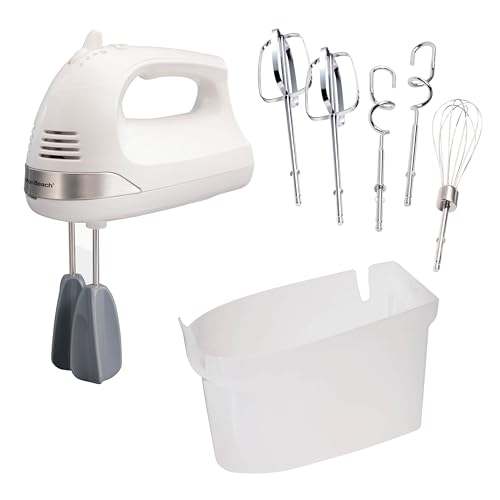
Hamilton Beach 6-Speed Electric Hand Mixer 62636J with Easy Clean Beaters — Best Budget Low-Speed Manners
Budget mixers are where low speed usually goes to die, with a first gear that is merely a slower splash. The Hamilton Beach 62636J earns its badge by being the budget pick whose low end is usable in practice: 6 speeds that start the range sensibly, a 275 watt stated motor with enough low-down torque that the bottom gear moves mixture instead of stalling in it, and easy clean beaters whose smooth profile pulls less air and splash into the first seconds.
Torque at low speed is the underrated half of this lens. A weak motor at gear one buzzes without turning thick batter, tempting you up a gear into splash territory. This Hamilton Beach’s stated wattage, the strongest in the guide, gives its low gear actual authority in cookie doughs and thick batters. Add the whisk, hooks and snap-on case from the listing and you have the most complete low-speed package at a budget-to-mid tier, without any slow-start automation, so your thumb still shares the credit.
Strengths
- Strongest stated motor gives the low gear real authority
- Easy clean beaters splash less and wash faster
- Full attachments and case at a budget-leaning tier
Trade-offs
- Only 6 speeds, so low gears are coarser than the 9 and 11 speed picks
- No slow-start system; discipline required
- White finish shows low-speed flour work honestly
| Spec | Detail (from the verified listing) |
|---|---|
| Power | 275 Watt Motor (from listing) |
| Speeds | 6 |
| Attachments in listing | Traditional Beaters, Dough Hooks, Whisk |
| Storage in listing | Snap-On Storage Case |
The honest budget technique with this mixer is the pulse start: two or three short presses at gear one until the dry ingredients darken with moisture, then continuous low speed. It is the manual version of SmoothStart, it costs nothing, and on a torquey motor like this one it works nearly as well. Budget low-speed success is mostly that habit plus this class of motor, which is why this pick, and not a weaker cheaper one, carries the badge.
There is a skill-transfer effect worth noting as well. A mixer chosen for budget buyers who still work flour and thick batters regularly teaches its household what gentle mixing feels like, and that feel transfers to hand folding, to stand mixers and to every future appliance. Children who learn on a forgiving low-speed machine learn that mixing is control, not force. It is an unusual thing to say about a buying guide for a small appliance, but the low end of the dial is where baking technique is actually formed, and the machine that guards that territory guards the learning too. For the Hamilton Beach, the unlocked recipe is the weekday cookie batch with the kids helping, low gear turning, flour staying put, and nobody’s enthusiasm extinguished by a white cloud.
Best for: budget buyers who still work flour and thick batters regularly / Not suited for: delicate-sponge specialists who need the finest low gears
Check the current price on Amazon

KitchenAid 5 Ultra Power Speed Hand Mixer KHM512, Contour Silver — Best Simple Low-Speed Starter
Five-speed mixers are usually dismissed in a low-speed guide, but the KHM512 earns a place on the quality of its first gear and the simplicity around it. With only five speeds, each one is distinct and findable without looking, and the bottom setting is a genuine stir speed for incorporating dry ingredients in everyday batters. For bakers who find nine-speed dials fiddly, that simplicity is itself a low-speed feature: the right gear, chosen confidently, every time.
The supporting details help the low-speed cause too. The lockable swivel cord stays out of the bowl during the slow, close work when you are watching the mixture most carefully, and the Turbo Beaters are dishwasher-safe for the cleanup after flour work. You give up the flagship’s gear count, whisk and hooks, and delicate patisserie is beyond its brief. For the everyday low-speed jobs, folding pancake batter, starting a cake mix, easing into frosting, this is the calmest simple tool here.
Strengths
- Distinct, easy-to-find speeds suit less technical bakers
- Genuine stir-speed first gear for everyday dry ingredients
- Swivel cord keeps focus on the mixture during slow work
Trade-offs
- Coarsest low-end granularity in this guide
- No whisk or hooks in the listing
- Delicate foams and sponges exceed its brief
| Spec | Detail (from the verified listing) |
|---|---|
| Speeds | 5 (from listing) |
| Cord in listing | Lockable Swivel Cord |
| Beaters in listing | Turbo Beaters, Dishwasher-Safe |
| Feature in listing | Easy Release Button |
There is a real argument that for most households, low speed is a binary: slow enough not to splash, and everything else. The KHM512 passes that binary test with a first gear bakers actually use, while some finer machines intimidate their owners into hand-mixing the delicate stages anyway. Judge low-speed tools by the delicate work they make you willing to attempt, and this simple KitchenAid attempts more than its spec sheet suggests.
Finally, judge the low-speed purchase by the recipes it unlocks rather than the ones it merely improves. A sponge you currently avoid, a frosting you currently buy, a chiffon you have never attempted: these are the true returns on a gentle first gear. The picks above were ranked on evidence from their listings, but their value will be counted in your kitchen in attempted recipes. Choose the one whose low-speed story matches the recipe you keep putting off, and let that recipe cast the deciding vote. For the simple KitchenAid, the unlocked recipe is the everyday sponge for two, mixed without ceremony or dread, the kind of small bake that only happens when the tool asks nothing of you.
Best for: everyday bakers who want a calm first gear without a complex speed dial / Not suited for: patisserie bakers needing staged low gears for foams and sponges
Check the current price on Amazon
Comparison Table
In a low-speed guide the key spec column is an evidence column: a named slow-start system, a speed count that subdivides the low range, or a motor figure that promises low-gear authority. Read down it and you are reading the ranking method itself, which is deliberate; if you weigh the evidence differently, this table gives you everything you need to re-rank the six honestly.
| Pick | Badge | Key spec | Best for |
|---|---|---|---|
| Cuisinart Power Advantage Plus 9-Speed Hand Mixer HM-90S — Check on Amazon | Best True Slow Start | SmoothStart Anti-Splatter (from listing), 9-Speed, Snap-On Storage Case | bakers who work with flour and powdered sugar constantly, and households with newer cooks |
| KitchenAid 9 Speed Hand Mixer KHM926, Contour Silver — Check on Amazon | Best Low Gear Range | 9 Speeds, Pro Whisk, Turbo Beater II, Dough Hook, Dishwasher-Safe Accessories | skilled bakers making sponges, foams and delicate batters regularly |
| Breville BHM800SIL Handy Mixer, Silver — Check on Amazon | Best Fine Low-End Control | 9 Speed Settings Plus Boost (from listing), Silver | experienced bakers who actively modulate speed through a mix |
| West Bend Two Sweet 2-in-1 Hand & Stand Mixer, 4.4 Qt, Red — Check on Amazon | Best Low Speed on a Stand | 11 Speeds with Turbo Boost, 4.4 Qt Rotating Bowl, 550 Peak Watts, Tilt-Head | bakers whose gentle mixing is also long, big-batter folding and slow creaming |
| Hamilton Beach 6-Speed Electric Hand Mixer 62636J with Easy Clean Beaters — Check on Amazon | Best Budget Low-Speed Manners | 275 Watt Motor, 6 Speeds, Easy Clean Beaters, Dough Hooks, Whisk, Snap-On Case | budget buyers who still work flour and thick batters regularly |
| KitchenAid 5 Ultra Power Speed Hand Mixer KHM512, Contour Silver — Check on Amazon | Best Simple Low-Speed Starter | 5 Speeds, Lockable Swivel Cord, Turbo Beaters, Easy Release Button | everyday bakers who want a calm first gear without a complex speed dial |
How to Choose the Best Hand Mixers at Low Speed
Look for a slow-start system first if your household includes beginners, children learning to bake, or anyone who has ever redecorated a kitchen with icing sugar. A named feature like the Cuisinart’s SmoothStart removes human error from the most error-prone second of mixing. Confident bakers can achieve the same with pulse technique, but a feature works for every cook, every time, including the tired and the distracted, and that reliability is worth a tier step for many homes.
Count the low gears, not the speeds. A 9 or 11 speed range matters here only because more of its steps live at the gentle end, giving you a staircase for staged work: incorporate, fold, engage, build. Ask how a mixer behaves between off and medium, because that is the territory this entire guide is about. A 5 speed mixer with a true stir gear can beat a 7 speed whose bottom three settings are all effectively medium, and listings rarely confess that, so weight named features and beater design alongside the count.
Then weigh low-speed torque. At the bottom gear a mixer must still turn a thickening batter, or you will be forced up the dial into splash and over-mixing. Stated wattage, where a listing provides it, is the only evidence available, which is why the 275 watt Hamilton Beach punches into this guide’s badges despite its coarser dial. Gentle and weak are not the same thing; the low speed you want is gentle and authoritative at once.
Why No Listing Gives You a Lowest RPM (and Why That Is Fine)
Shoppers in this category often hunt for a revolutions-per-minute figure for speed one, and manufacturers of hand mixers almost never publish one, because the number would mislead anyway: beater speed under load varies with the mixture, dropping in thick batter and spinning freely in liquid. A single RPM figure would describe the mixer in empty air, not in your bowl, which is why honest guides rank low speed by features and gear spread instead.
What you can compare truthfully is design intent. A slow-start system is a promise about the first seconds. A wide speed count is a promise about granularity. Easy-clean, smooth-profile beaters are a promise about how mixture moves at the surface. Those promises, verified from listings as this guide does, predict your flour-cloud risk far better than an invented number ever could.
Low-Speed Technique: Getting the Most From Any Mixer Here
Start with the beaters buried. Mixture should cover the beater heads before the motor turns, so the first movement happens below the surface instead of throwing it. Add dry ingredients in stages at the bottom gear, letting each addition darken and absorb before the next, and keep the bowl turning slowly with your free hand so the beaters meet fresh mixture instead of drilling one spot.
For foams and sponges, build speed like a staircase: begin low until the surface is uniformly moving, step up through the middle as volume builds, and finish at the speed the recipe needs, then step back down before stopping so the last seconds do not fling mixture up the bowl. These habits multiply the value of every pick in this guide, including the ones with automated starts, because low speed is ultimately a partnership between the dial and the hand that holds it.
Before You Buy: The Flour Test You Can Run in the Shop of Your Mind
Imagine the worst first five seconds your baking offers: a bowl of flour and cocoa for brownies, a mound of icing sugar for frosting, a dry sponge mix waiting for eggs. Walk each shortlisted mixer into that moment and ask what happens, using only the evidence in its listing: a named slow start passes automatically, a wide gear range passes with a disciplined thumb, a coarse dial with a strong motor passes with pulse technique, and a mixer with none of those stories fails, however impressive its top speed. That single imagined moment is the most predictive test in this entire category.
Then run the second test: the delicate middle. Picture folding the last flour into a sponge without losing its air, and ask whether the bottom gears are fine enough to do it by machine or whether you will fold by hand anyway. If you will fold by hand regardless, be honest that your low-speed need is splash control, not finesse, and buy accordingly; the simpler picks in this guide exist for exactly that honest answer, at a friendlier tier.
Low Speed and Motor Life: The Hidden Connection
Gentle starts are kind to motors. The hardest electrical and mechanical moment in a mixer’s life is the launch into a resistant mixture at speed, repeated hundreds of times. Slow starts, staged additions and bottom-gear engagement all reduce that shock, which is one reason bakers who mix gently also tend to own mixers that last. Choosing a low-speed specialist is therefore partly a durability decision disguised as a tidiness one, and it pays in both currencies at once.
How to Mix at Low Speed Without Splashing or Deflating
These steps turn the low-speed features above into clean counters and intact batters, whatever model you own.
- Chill your expectations, not just your bowl: choose the lowest gear before the beaters touch the mixture, every time, as a fixed habit.
- Submerge the beaters fully in the mixture before switching on, and keep them submerged until they have stopped after switching off.
- Add flour, cocoa and powdered sugar in three stages at the bottom gear, scraping the bowl between stages, rather than in one heroic dump.
- Use pulse presses for the first five seconds in very dry mixtures if your mixer has no slow-start feature, until the surface darkens with moisture.
- For egg whites and sponges, climb the speeds gradually and never jump from off to high; the foam’s structure is built in the gentle stages.
- For thick batters, let the low gear work longer instead of reaching for a higher one; time at low speed incorporates without toughening.
- Finish almost every batter with a few hand folds using a spatula, catching the bowl’s edges the beaters missed and preserving the air you built.
Master those steps and the differences between the picks in this guide become refinements rather than rescues. Low speed is where baking is decided quietly, in the first thirty seconds and the last few folds, and a mixer chosen and used for that territory will improve every recipe it touches.
Common Buying Mistakes
Trusting an invented RPM figure
If a review quotes a precise lowest RPM for a hand mixer whose listing publishes none, it is inventing precision. Shop on named features and speed spread instead, as this guide does.
Starting dry ingredients at medium to save time
It saves seconds and costs a cleaning session, plus the flour that left the bowl is flour your recipe needed. Low and staged is genuinely faster overall.
Confusing low speed with low power
A good bottom gear still turns thick batter with authority. Weak motors stall and force you up the dial; that is a power failure wearing a low-speed disguise.
Jumping straight to high for egg whites
Foams built gradually are finer and more stable. The staircase exists for a reason, and skipping it produces coarse bubbles that collapse in the oven.
Holding the mixer at the surface during slow starts
Beaters half in the mixture throw it at any speed. Submerge first, then start, then move through the bowl slowly.
Final Recommendation
For guaranteed gentle starts, the Cuisinart HM-90S and its SmoothStart system is this guide’s clearest answer. For skilled hands, the KitchenAid KHM926’s nine gears and the Breville’s boost-assisted control offer the finest low-end instruments, while the West Bend Two Sweet adds hands-free duration to the widest range here. The Hamilton Beach 62636J proves budget low speed can still have manners and torque, and the KitchenAid KHM512 keeps it simple and calm.
Whichever you choose, pair it with the technique section above and your flour stays in the bowl from the first bake. Check price on Amazon across the shortlist before deciding, because the tier distance between the automated and manual answers to this problem changes constantly.
Start your shortlist here: Cuisinart Power Advantage Plus 9-Speed Hand Mixer HM-90S (Best True Slow Start) — Check on Amazon; KitchenAid 9 Speed Hand Mixer KHM926, Contour Silver (Best Low Gear Range) — Check on Amazon; Breville BHM800SIL Handy Mixer, Silver (Best Fine Low-End Control) — Check on Amazon.
Keep exploring the cluster: Best Hand Held Electric Mixers; Best Hand Held Mixers; Best Hand Held Food Mixers; Best Hand And Stand Mixers; Best Mixers.
Frequently Asked Questions
What is the best low speed feature to look for?
A named slow-start or anti-splatter system, like the Cuisinart’s SmoothStart, because it guarantees a gentle start for every user. After that, look for a wide speed count, which subdivides the low range, and a motor strong enough to turn thick batter at the bottom gear.
How slow is speed one on these mixers, in RPM?
The verified listings for these models do not publish a revolutions-per-minute figure for their lowest setting, so this guide does not quote one. Beater speed also varies with the load in the bowl, which is why features and gear spread are the honest comparison.
Can low speed prevent flour clouds completely?
Combined with staged additions and submerged beaters, yes for practical purposes. A slow start stops the initial eruption, and adding dry ingredients in three stages at the bottom gear keeps the rest in the bowl.
Is a 5 speed mixer bad at low speed?
Not necessarily. A 5 speed model with a genuine stir-speed first gear, like the KitchenAid KHM512 here, handles everyday low-speed work well. What it lacks is granularity for delicate staged work like sponges and foams.
Why does my mixer stall at low speed in thick batter?
That is low-speed torque, not speed, failing. The motor cannot turn the load at the bottom gear, so you are forced upward. A stronger stated motor, like the 275 watt Hamilton Beach in this guide, is the fix within the hand mixer format.
Should I use low speed for dough hooks?
Yes, always. Dough work on a hand mixer belongs at the bottom gears, in small batches, with rests. Higher speeds tear dough, climb the hooks and strain the motor, which is why every guide in this cluster repeats the limit.
Does a slow start feature slow down the whole mix?
No. A slow-start system governs only the first moments, ramping the beaters gently to the speed you selected; after that the mixer runs at your chosen setting normally. It removes the splash window without taxing the rest of the job, which is precisely why it is such an elegant solution.
Can I fold with a hand mixer, or should I always fold by hand?
With a genuinely low first gear, machine folding works for many batters and saves real effort on large volumes. The most delicate sponges still reward a final hand fold, and this guide’s technique section recommends finishing by hand regardless; the machine does the incorporation, the hand does the last, gentlest strokes.


