Disclosure: airfryerkitchensupply.com is reader-supported. When you buy through links on our site, we may earn an affiliate commission at no extra cost to you.
Where to buy
If you are shopping for the best gas grills for single chef cooking, start with the verified shortlist below — every model on it was confirmed against a live Amazon listing before it earned a place here, and every one is sized for a household of one rather than a weekend crowd.
Cooking for one changes what a good grill looks like. You do not need four burners heating empty grate space, a cavernous lid that takes ten minutes to preheat, or a grease tray the size of a sheet pan to scrub after two chicken thighs. You need fast heat-up, one or two burners at most, grates that fit a steak and a vegetable skewer side by side, and cleanup that takes less time than the meal did. Every pick below was chosen against that standard, and each listing was verified before it was included.
- Weber Q 1200N Portable Propane Gas Grill (Best Overall) — Check the current price on Amazon
- Cuisinart Grillster Portable Gas Grill CGG-059A (Best Budget) — Check the current price on Amazon
- Weber Spirit E-210 Gas Grill (Best Permanent Patio Pick) — Check the current price on Amazon
- Nexgrill Tabletop 1-Burner Gas Grill (Best Tabletop Simplicity) — Check the current price on Amazon
- Char-Broil Classic 2-Burner Propane Gas Grill (Best Room to Grow) — Check the current price on Amazon
- Coleman Fold N Go Portable Propane Grill (Best Ultralight) — Check the current price on Amazon
Prices and stock on every pick in this guide move constantly, so this page never prints a fixed figure for any product. Use the links above to check price on Amazon at the moment you are ready to buy, and treat any budget language in this article as a guide to the tier a product sits in rather than a promise about a specific listing on a specific day.
The best gas grills for single chef households are not simply the smallest grills on the market — they are the ones that respect how a person cooking alone actually eats. A solo cook grills smaller loads, more often: a single ribeye on a Tuesday, two salmon fillets, a handful of asparagus, a burger that does not need a warming rack. A grill that preheats in five minutes and burns a modest amount of propane per session will get used three times a week; a big cart grill that takes fifteen minutes to come up to temperature quietly becomes a once-a-month appliance, and the takeout apps win.
There is also an honesty point worth making up front. The solo-grilling market splits into two real camps: tabletop portables that run on 1 lb canisters or a hose to a standard tank, and compact two-burner cart grills that live permanently on a patio. Both camps contain excellent options, and this guide includes the strongest verified examples of each. What you will not find here is a four- or five-burner family grill wearing a ‘great for one’ badge — heating 500 square inches of grate to cook one pork chop wastes fuel, time, and money, and no badge changes that arithmetic.
Below you will find six picks matched to different solo situations: the all-round tabletop most single cooks should buy first, a featherweight budget option, a permanent two-burner for the solo cook with a real patio, and a roomier two-burner for the single chef who still entertains a friend or two on weekends. Each review covers who the grill suits, where it compromises, and the verified specifications that matter, followed by a buying guide, a first-cook walkthrough, and the mistakes solo buyers make most often.
In this guide
Quick Picks
Short on time? These are the six best gas grills for single chef worth your attention, each matched to a different buyer. The full reviews below explain who each one suits, where it compromises, and what to check before you order.
- Weber Q 1200N Portable Propane Gas Grill — Best Overall: a single-burner tabletop with porcelain-enameled cast-iron grates and electronic ignition that preheats fast and cooks like a much larger grill.
- Cuisinart Grillster Portable Gas Grill CGG-059A — Best Budget: a 13 lb tabletop whose 8,000 BTU burner is listed as reaching 600°F over 146 square inches — the lightest full grill here.
- Weber Spirit E-210 Gas Grill — Best Permanent Patio Pick: a two-burner cart grill with porcelain-enameled cast-iron grates and Snap-Jet ignition — the smallest full-size Weber, and the right permanent home for a solo cook with patio space.
- Nexgrill Tabletop 1-Burner Gas Grill — Best Tabletop Simplicity: a cast-aluminum tabletop with 10,000 BTU over 183 square inches, a locking lid, and piezo ignition — nothing to learn, nothing to assemble.
- Char-Broil Classic 2-Burner Propane Gas Grill — Best Room to Grow: a compact cart grill with 280 square inches and 20,000 BTU across two burners — solo-sized daily, guest-capable on weekends.
- Coleman Fold N Go Portable Propane Grill — Best Ultralight: a folding 6,000 BTU grill with Instastart ignition and a dishwasher-safe grate that packs flatter than any other pick here.
How These Picks Were Chosen
Every grill in this guide was verified for the airfryerkitchensupply.com program: the listing title, burner configuration, BTU output, and cooking area quoted in the spec boxes come from the live listing itself, not from a press release or a retailer roundup. Models that could not be matched confidently to a live listing were dropped rather than guessed at, and no product appears here on the strength of a brand name alone.
The selection criteria were weighted for one-person cooking. Preheat speed and fuel economy mattered more than total cooking area. A single strong burner or two well-spaced burners outranked four mediocre ones. Grate material mattered because a solo cook sears small, high-value portions — one good steak deserves cast iron. Cleanup mattered disproportionately: dishwasher-safe grates, removable grease trays, and simple one-knob controls all scored heavily, because the cook and the dishwasher are the same person. Finally, each pick had to earn its badge for a distinct solo scenario, so the six reviews do not repeat the same grill six times.
The 6 Best Gas Grills for a Single Chef

Weber Q 1200N Portable Propane Gas Grill — Best Overall
For a single chef, the Q 1200N hits the balance almost nobody else manages: it is small enough to live on a side table or a balcony rail shelf, yet the cooking experience is unmistakably a real grill rather than a camping compromise. The single burner drives a compact firebox, which is exactly why it works for one — the whole grate comes up to searing temperature quickly instead of heating a large empty box, and the porcelain-enameled cast-iron grates hold that heat when a cold steak lands on them, producing the crust a thin stainless grate simply cannot.
Strengths
- Cast-iron grates deliver genuine sear marks on single steaks and chops
- Small firebox preheats quickly and sips propane on short solo cooks
- Runs on 1 lb canisters or a hose adapter to a 20 lb tank
Trade-offs
- Single burner means a single heat zone — no simultaneous sear-and-hold
- Cooking area suits one to two portions, not a dinner party
- Tabletop format needs a stable, heat-safe surface to sit on
| Burners | 1 |
| Output | 10,000 BTU (per listing) |
| Grates | Porcelain-enameled cast iron |
| Ignition | Electronic |
| Format | Tabletop portable, 1 lb canister or hose to bulk tank |
Day to day, the details suit solo life. Electronic ignition means one press rather than a lighter hunt. The cast-iron grates split into two halves, so a single half fits in most sinks for a soak while the other half stays on the grill. Fuel flexibility is the quiet advantage: run it on a 1 lb canister for a weeknight cook and you will get many solo sessions per bottle, or connect a hose adapter to a standard 20 lb tank and stop thinking about fuel for a season. The trade-off is real but simple — one burner means one temperature zone, so a steak and delicate vegetables cook in sequence rather than side by side, and a whole spatchcocked chicken is a squeeze rather than a plan.
Ownership costs stay solo-friendly too. There is one burner tube to keep clean, one grate set to maintain, and a drip tray system that uses small disposable pans — the consumables list is short and cheap. Parts support for the Q line is among the deepest of any portable grill, which matters when a grill this size gets used hard for years: igniters, grates, and regulators remain orderable long after cheaper tabletops have been discontinued. For a single chef buying one grill to last, that parts tail is worth as much as the sear.
Best for: the solo cook who wants one grill that handles weeknight steaks, fish, and vegetables without fuss / Not suited for: cooking two temperature zones at once or feeding more than two people regularly

Cuisinart Grillster Portable Gas Grill CGG-059A — Best Budget
The Grillster is the pick for the single chef whose grilling life is genuinely minimal: a studio balcony, a small apartment patio, or a counter-adjacent outdoor nook where the grill must be carried out, used, and put away in a closet. At 13 pounds it is the lightest complete grill in this guide, and its footprint is closer to a large shoebox than a barbecue. Yet the listing’s own figures are respectable for the class — an 8,000 BTU burner rated to reach 600°F over 146 square inches, which is honest space for one steak, two burgers, or a skewer lineup for one.
Strengths
- At 13 lbs it stores in a closet or cabinet between cooks
- Dishwasher-safe grate makes solo cleanup nearly effortless
- Push-button ignition and one-knob control keep weeknight cooks fast
Trade-offs
- 146 sq. in. fits one generous portion or two modest ones, nothing more
- Lightweight body sheds heat quickly in wind or cold weather
- Single zone only — resting food means plating it, not moving it aside
| Burners | 1 |
| Output | 8,000 BTU (per listing) |
| Cooking area | 146 sq. in. |
| Weight | 13 lbs |
| Ignition | Push-button |
| Grate | Dishwasher-safe (per listing) |
The solo-friendly detail that earns it this badge is the dishwasher-safe grate. For a household of one, cleanup is the tax on every grilled meal, and a grate that goes straight into the dishwasher removes most of that tax. Push-button ignition and a simple single control keep the routine to minutes. The compromises are the expected ones at this size and tier: the thin cooking surface loses heat when the lid opens, wind matters more than it does on a heavy cart grill, and there is no second zone for resting food. Treat it as a brilliant one-portion tool rather than a shrunken family grill and it will not disappoint.
Think about the Grillster as an appliance rather than a barbecue and its design makes complete sense. It preheats while you prep a salad, cooks a portion, and is back in the closet before the plate is cleared — a rhythm closer to a toaster oven than to a Saturday grill session. That rhythm is precisely what keeps solo cooks grilling instead of defaulting to delivery. Buy it with clear eyes about its ceiling — one portion, fair weather, modest sear — and it delivers exactly the service it promises, at the lowest tier in this guide.
Best for: apartment and studio dwellers cooking one portion at a time with minimal storage / Not suited for: windy exposed patios or anyone who wants to grill for a guest as well

Weber Spirit E-210 Gas Grill — Best Permanent Patio Pick
Some single chefs do have a patio, cook outdoors four nights a week, and are tired of tabletop compromises. The Spirit E-210 is the smallest member of Weber’s core cart-grill line and the natural answer: two burners under porcelain-enameled cast-iron grates, in a cabinet cart that stays set up and ready. For one person, two burners are the sweet spot — light one side for a steak and leave the other off as a resting zone, or run both for a full sheet-pan worth of vegetables alongside a chicken breast, without paying the fuel bill of a four-burner box.
Strengths
- Two burners give a true sear zone plus a resting zone for one
- Cast-iron grates and a heavy lid hold heat far better than tabletops
- Per-burner Snap-Jet ignition is reliable and one-handed
Trade-offs
- Permanent cart footprint — needs a dedicated patio corner
- Assembly is a real project compared with a tabletop unboxing
- Overkill if you grill less than once a week
| Burners | 2 |
| Grates | Porcelain-enameled cast iron |
| Ignition | Snap-Jet |
| Extras | Weber Works rails for prep accessories |
| Format | Cart grill, standard 20 lb propane tank |
Snap-Jet ignition lights each burner individually from its own control knob, which matters more in daily solo use than it sounds: no single igniter point of failure, and lighting only the burner you need becomes a one-handed habit. The Weber Works rails accept prep accessories that effectively add counter space, valuable when a small patio has no side table. The honest costs are footprint and commitment — this is furniture, not a portable, it assembles like furniture, and it asks for a cover and a permanent corner. If your solo cooking is a lifestyle rather than an occasional event, that trade is the right one.
The long view favors the E-210 as well. Weber’s flavorizer bars, burners, and grates for the Spirit line are stocked for years, the ignition is modular, and the firebox design sheds grease to a tray that slides out from the front — a small mercy you will appreciate weekly. For the solo cook, the E-210 also future-proofs the menu: the day you want to smoke a small brisket flat or roast a whole chicken indirectly, the two-burner layout and heavy lid are already there, no second grill required.
Best for: the committed solo griller with patio space who cooks outdoors several nights a week / Not suited for: renters who must store the grill indoors or move it frequently
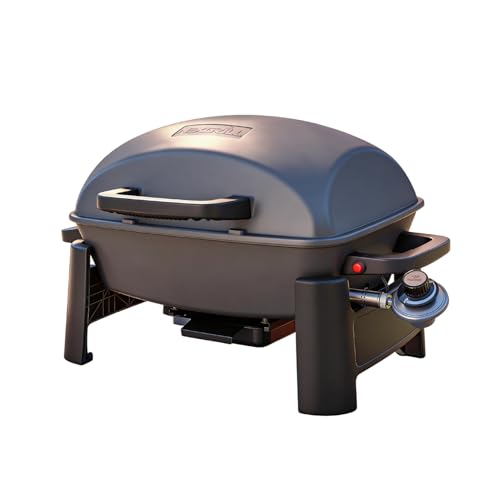
Nexgrill Tabletop 1-Burner Gas Grill — Best Tabletop Simplicity
The Nexgrill tabletop makes a different case for the single chef: absolute simplicity. One burner, one knob, a piezo igniter, and a cast-aluminum body that will not rust out in two seasons the way painted steel tabletops can. The 183 square inches of cooking space is meaningfully more than the Grillster’s — enough for a steak plus a foil packet of potatoes, or three burgers when a friend appears — while the grill itself remains a one-hand carry from shelf to table.
Strengths
- Cast aluminum body resists rust in stored-away service
- 183 sq. in. fits a steak plus a side in one session
- Locking lid makes carry-to-storage genuinely one-handed
Trade-offs
- Heat distribution is adequate rather than precise
- Piezo ignition is a step below electronic for reliability
- No accessory ecosystem or fitted cover range behind it
| Burners | 1 |
| Output | 10,000 BTU (per listing) |
| Cooking area | 183 sq. in. |
| Body | Cast aluminum frame |
| Ignition | Piezo |
| Lid | Locking lid for transport |
The locking lid is a small feature with outsized solo value: lock it, carry the whole grill by its handle to the sink or the storage shelf, and nothing rattles or spills. Cast aluminum also shrugs off the condensation cycle of a grill stored in a garage or on a covered balcony. Where it gives ground to the Weber Q is refinement — the grate and heat distribution are workmanlike rather than excellent, and there is no ecosystem of accessories behind it. For the solo cook who wants to grill tonight without a learning curve or a maintenance hobby, that is a fair and honest exchange.
One more practical note for solo households: the Nexgrill’s simplicity makes it the easiest pick here to lend, move, or repurpose. It works as a balcony grill this year, a camping grill next year, and a backup burner for a power outage in between, because nothing about it is precious. The cast-aluminum body shrugs off the knocks that lifecycle involves. Multi-role durability is an underrated virtue when one person owns exactly one of everything.
Best for: the solo cook who wants a durable, zero-learning-curve tabletop for home use / Not suited for: precision two-zone cooking or brand-ecosystem accessories

Char-Broil Classic 2-Burner Propane Gas Grill — Best Room to Grow
Plenty of single chefs live alone but do not always cook alone — a partner visits on weekends, a friend comes over for the game, a parent drops by. The Classic 2-Burner is built for that pattern. Its 280 square inches handle one person’s dinner with a burner to spare on weeknights, then stretch to four burgers and a row of corn when the household temporarily doubles. The two side shelves matter more for a small home than they would in a big yard: they are the prep surface a compact patio does not otherwise provide.
Strengths
- 280 sq. in. covers solo dinners and small guest nights alike
- Side shelves double as the prep counter a small patio lacks
- Two burners allow a hot side and a gentle finishing side
Trade-offs
- Porcelain-coated grates need gentle tools to protect the coating
- Value-tier sheet metal and hardware feel less substantial
- Cart format still needs a permanent outdoor spot
| Burners | 2 |
| Output | 20,000 BTU (per listing) |
| Cooking area | 280 sq. in. |
| Grates | Porcelain-coated |
| Extras | Side shelves |
| Format | Cart grill |
The 20,000 BTU across two burners is honest mid-range power — enough for a proper sear on the hot side with the second burner low for finishing. Porcelain-coated grates are easier to keep clean than bare cast iron, though they reward a gentler brush and will not build the same seasoned crust over years of use. This is a value-tier cart grill and feels like one in its sheet metal and hardware, but for the solo-plus-occasional-guest pattern it covers more real life per dollar of tier than anything else in this guide.
Budget the ownership honestly and the Classic still wins its badge. A cover from day one, a gentle brush for the coated grates, and an annual check of the burner tubes will carry this grill through many seasons of solo-plus-guest duty. What it asks in care it repays in versatility: it is the only value-tier pick here that a single chef can grow into rather than out of, because the guest-night capacity is already built in when life changes.
Best for: single households that host one to three guests often enough to matter / Not suited for: a purist who wants cast-iron sear performance above all else

Coleman Fold N Go Portable Propane Grill — Best Ultralight
The Fold N Go is the extremist of this guide, and for a certain single chef it is exactly right. It folds down to a slim package that slides into a kitchen cabinet, a closet shelf, or the gap beside a fridge — storage situations where even the Grillster is too bulky. The 6,000 BTU burner is modest on paper, but the cooking surface is correspondingly small, so for one burger, one chicken breast, or a pair of skewers the heat is sufficient and the preheat is quick.
Strengths
- Folds flatter than any other pick — true cabinet storage
- Dishwasher-safe grate keeps cleanup to a single cycle
- Instastart ignition and simple control suit absolute beginners
Trade-offs
- 6,000 BTU is the least power here — thick steaks sear gently
- Strictly one portion at a time
- Light construction loses heat in wind
| Burners | 1 |
| Output | 6,000 BTU (per listing) |
| Ignition | Instastart push-button |
| Grate | Dishwasher-safe (per listing) |
| Format | Folding portable, 1 lb canister |
Coleman’s Instastart ignition and an adjustable temperature control keep operation one-handed and simple, and the grate is dishwasher-safe, which again removes the solo cook’s biggest friction point. The limits are plain: this is a one-portion grill with a light build, it will not sear a thick ribeye the way cast iron does, and wind steals its heat quickly. But as a second grill, a dorm-adjacent solution, or the only grill a minimalist kitchen can hold, nothing else in this guide disappears into a home the way this one does.
The Fold N Go also deserves mention as the travel-friendly member of this lineup — the same folding package that vanishes into a kitchen cabinet rides happily in a car trunk for a picnic or a weekend rental. For the single chef, that dual life means one purchase covers home and away. Just respect its scale: it grills a portion beautifully and a feast not at all, and asking more of it is how small grills get unfair reviews.
Best for: minimalist solo cooks whose grill must vanish into a cabinet after dinner / Not suited for: thick-cut steak nights or cooking for any second person
Comparison Table
| Pick | Badge | Key spec | Best for |
|---|---|---|---|
| Weber Q 1200N Portable Propane Gas Grill | Best Overall | 1 burner, 10,000 BTU, cast-iron grates | the solo cook who wants one grill that handles weeknight steaks, fish, and vegetables without fuss |
| Cuisinart Grillster Portable Gas Grill CGG-059A | Best Budget | 8,000 BTU, 146 sq. in., 13 lbs | apartment and studio dwellers cooking one portion at a time with minimal storage |
| Weber Spirit E-210 Gas Grill | Best Permanent Patio Pick | 2 burners, cast-iron grates, Snap-Jet ignition | the committed solo griller with patio space who cooks outdoors several nights a week |
| Nexgrill Tabletop 1-Burner Gas Grill | Best Tabletop Simplicity | 1 burner, 10,000 BTU, 183 sq. in. | the solo cook who wants a durable, zero-learning-curve tabletop for home use |
| Char-Broil Classic 2-Burner Propane Gas Grill | Best Room to Grow | 2 burners, 20,000 BTU, 280 sq. in. | single households that host one to three guests often enough to matter |
| Coleman Fold N Go Portable Propane Grill | Best Ultralight | 1 burner, 6,000 BTU, folding design | minimalist solo cooks whose grill must vanish into a cabinet after dinner |
How to Choose the Best Gas Grills for Single Chef Cooking
Start with the honest question of where the grill will live. If it must be stored indoors, your shortlist is the tabletop and folding picks — measure the cabinet or shelf it will occupy before you fall in love with a model, and check the grill’s folded or lidded dimensions on the listing rather than its cooking area. If it will live outside permanently, a compact two-burner cart grill buys you a heavier lid, better heat retention, and a second zone, and it will still be there ready on the nights you least feel like cooking.
Next, think in portions, not people. A single chef typically grills one protein plus one side: roughly 100 to 200 square inches of grate is a comfortable working area, and anything beyond 300 square inches is capacity you will heat but rarely use. Burner count follows the same logic — one burner is enough for direct grilling of a single item, while two burners earn their keep the moment you want a resting zone or a gentle side for vegetables while the steak sears.
Grate material is the solo cook’s quality lever
When you grill one steak, that steak is the whole meal, so crust quality matters more than capacity. Porcelain-enameled cast iron — fitted to the Weber picks in this guide — stores heat and releases food cleanly, and it is the single feature that most separates a satisfying solo grill from a disappointing one. Porcelain-coated steel is easier to maintain but gentler in performance. If your solo menu leans toward burgers and chicken, either works; if it leans toward ribeyes and tuna steaks, prioritize cast iron.
Fuel: canisters versus a tank
Tabletop picks run on 1 lb disposable canisters, which suit solo cooking well — a single canister covers many one-portion cooks, and there is no tank to store. Most tabletops also accept a hose adapter to a standard 20 lb tank, which drops the per-cook fuel cost sharply if you grill several nights a week. Cart grills assume a 20 lb tank from the start. Decide by frequency: twice a month, canisters are simpler; three nights a week, a tank pays for its hose quickly.
Sizing a Grill for One: The Math Nobody Prints
Manufacturers size grills by total cooking area, but a solo cook should size by preheat waste. Every square inch of grate and every cubic inch of firebox must be heated before food goes on, and on a big grill you pay that cost in time and propane for every single-portion meal. A compact firebox that reaches searing temperature in five minutes will be used on weeknights; a large one that takes fifteen quietly trains you to order in. This is why the smallest grills in this guide are not compromises — for one person, they are the correctly engineered tool.
The exception is the solo cook who batch-cooks. If your pattern is to grill four chicken breasts and a tray of vegetables on Sunday and eat from them all week, you are cooking for four once a week, not for one seven times — size for the batch, which means the two-burner picks with 280 square inches or more, and treat the weekday reheat as a separate problem the grill does not need to solve.
Fuel and Running Costs for One-Person Grilling
Running costs are where solo grilling quietly wins or loses. A one-portion cook on a compact grill uses a fraction of the propane a full-size grill burns just to preheat, and over a year of weeknight cooking that difference is larger than the price gap between several picks in this guide. If you grill twice a week or more, track your canister use for the first month: most solo cooks find a 1 lb canister lasts far longer than expected, and the ones who grill nightly find the hose adapter to a bulk tank pays for itself within a season.
Maintenance costs follow the same pattern. Small grills have fewer burners to replace, smaller grates to re-season or swap, and grease systems you can actually keep ahead of. The expensive solo grill is not the one with the higher tier — it is the oversized one whose parts, covers, and fuel bills are all sized for a family of five. Buy the grill whose consumables match your household of one and the economics take care of themselves.
A note on winter solo grilling
Cold weather punishes big fireboxes and barely inconveniences small ones, which is another quiet argument for the compact picks. A tabletop stored indoors starts warm, preheats fast, and its small lid loses little heat when you flip a single steak. If you grill year-round in a cold climate, the combination of indoor storage and a compact firebox is the closest thing to a winter-proof setup a gas grill can offer.
Tabletop or Cart? A Decision Framework for One
If you are torn between the tabletop picks and the two cart grills in this guide, decide with three questions. First: where will the grill be at 2 a.m. in February? If the honest answer is a closet, garage shelf, or deck box, buy a tabletop — a cart grill that must be stored indoors is a burden you will resent by the second winter. Second: how many nights a week will you grill in June? At three or more, the cart grill’s always-ready convenience repays its footprint every single week; at one or fewer, the tabletop’s zero parked presence wins. Third: what is your guest pattern? A solo cook who hosts monthly should weight the two-burner carts heavily, because borrowing capacity on the night you need it is not possible — the grill you own is the grill that cooks.
Notice what is not in the framework: cooking quality. Both formats in this guide contain picks that sear a steak properly, because cast-iron grates and right-sized fireboxes exist in both. The tabletop-versus-cart decision is a lifestyle and logistics decision, and buyers who treat it that way end up happier than buyers who chase a specification. Pick the format that fits your home’s storage and your week’s rhythm, then pick the best grill inside that format — which is exactly the order this guide’s badges are arranged to help with.
Ten Minutes a Month: Solo Grill Care
A small grill stays pleasant to use on a tiny maintenance budget, and for a household of one that budget is the whole ballgame. Monthly: empty the grease tray before it overflows, brush the grates while warm, and wipe the exterior. Seasonally: check the burner ports for blockages, confirm the igniter clicks strongly, and inspect the hose and connections for cracks. That is the entire program. The grills in this guide were chosen partly because none of them asks for more than this — no rotisserie motors to service, no side burners to winterize, no glass to polish. When one person is the entire maintenance department, the best feature a grill can have is a short list of needs.
How to Set Up and Cook Your First Solo Meal on a Gas Grill
Whether your pick is a tabletop or a compact cart, the first-cook routine is the same, and getting it right once builds the habit that makes solo grilling effortless.
- Set the grill on a stable, level, heat-safe surface outdoors, with clearance from walls, railings, and overhangs, and check that the grease tray is in place and empty.
- Connect the fuel: screw a 1 lb canister hand-tight into the regulator on a tabletop, or attach the hose to a 20 lb tank on a cart grill and open the tank valve slowly. Sniff and listen — any hiss or gas smell means stop, disconnect, and reconnect.
- Open the lid, turn the burner to high, and ignite. Preheat with the lid closed for five to ten minutes; a small grill is ready sooner than a large one, and the grate — not the air — is what you are heating.
- Brush the hot grate and oil the food, not the grate. Season your protein while the grill preheats so nothing waits around.
- Grill with the lid down for anything thicker than a skewer, using the second zone (on two-burner picks) or a plated rest (on one-burner picks) to finish gently. A single steak typically needs only a few minutes per side — judge by touch or a thermometer, not by the clock alone.
- Turn the burner to high for two minutes after cooking to burn off residue, brush the grate, then shut off the fuel at the source first and the knob second. When the grill is cool, empty or check the grease tray — on a small grill it fills faster than you expect.
That is the whole routine, and for one person it runs about twenty minutes from cupboard to plate. The cooks who grill solo three nights a week are not more disciplined than anyone else — they just own a grill whose routine is this short.
Common Buying Mistakes
- Buying a family grill for a household of one. A four-burner grill cooking one pork chop wastes fuel on every preheat, takes longer to get hot, and dominates a small patio. Size for your actual portions.
- Ignoring cleanup until it decides for you. Solo cooks stop grilling because of the scrubbing, not the cooking. Dishwasher-safe grates, split grates that fit a sink, and accessible grease trays are features, not luxuries.
- Judging power by BTU alone. BTU only means something relative to the firebox size. A 10,000 BTU burner in a compact tabletop sears harder than a bigger number spread across a cavernous box.
- Skipping the hose adapter math. If you grill several nights a week on 1 lb canisters, fuel becomes your biggest running cost. Most tabletops accept a hose to a 20 lb tank — check the listing and do the swap.
- Grilling delicate and hearty foods in the same minute. On a one-burner grill, sequence matters: sear the steak first, rest it tented, then grill the asparagus in the residual heat. Trying to do everything at once on one zone disappoints twice.
Final Recommendation
If you buy one grill from this guide, make it the Weber Q 1200N — it is the pick that behaves like a serious grill at a size a single chef will actually use daily, and its cast-iron grates flatter the one good steak that is the whole point of cooking for yourself. Apartment dwellers with cabinet storage should look hard at the Cuisinart Grillster, and solo cooks with a permanent patio will be happiest long-term with the Weber Spirit E-210.
Whichever direction you go, keep the principle in front of you: for one person, the best grill is the one with the shortest distance between the idea of grilling and food on the grate. Small firebox, fast preheat, easy cleanup — everything else is a feature list. Round out your research with our companion guides to Best Gas Grills For Small Decks and Best Gas Grills For Small Home, which approach the same compact-grill problem from the space angle rather than the household-size angle.
Frequently Asked Questions
How many burners does a single chef actually need?
One burner is enough for direct grilling of a single portion, and most solo cooks use exactly that. Two burners earn their place when you want a resting zone or a gentler area for vegetables while a steak sears. Beyond two, a household of one is heating space it does not use.
Is a tabletop grill powerful enough to sear a steak?
Yes, when the firebox is small and the grates are cast iron. Compact tabletops concentrate their BTU output under a small grate, and cast iron holds that heat when the steak lands. Thin steel grates on any grill — large or small — are the usual reason a sear disappoints.
How long does a 1 lb propane canister last cooking for one?
Far longer than most people expect, because solo cooks are short. A single-portion grill session is often ten to fifteen minutes of burner time, so one canister covers many meals. If you grill several nights a week, a hose adapter to a 20 lb tank is the cheaper long-term setup.
Can I use a tabletop gas grill on a wooden deck table?
Only on a surface the manufacturer rates for it, and never on plastic or resin furniture. Use a stable, heat-resistant stand or a metal or stone surface, keep clearance around the grill, and never leave it unattended. When in doubt, a dedicated grill stand is the safe answer.
What is the easiest grill to clean for one person?
Look for dishwasher-safe or split grates that fit a kitchen sink, plus a grease tray you can reach without tools. The Grillster and Fold N Go in this guide have dishwasher-safe grates; the Q 1200N’s split cast-iron grates soak in a standard sink.
Should a solo cook choose a grill with a lid thermometer?
It helps for chicken and thicker cuts, but lid thermometers read air temperature, not grate temperature, and they vary in accuracy. An instant-read food thermometer is the better investment for a single cook, because doneness of one portion is the whole meal.
Can a single chef justify a cart grill over a tabletop?
Yes, if the patio space exists and grilling is a several-nights-a-week habit. The cart grill’s heavy lid, enclosed tank, and second burner make each cook easier, and ease is what sustains the habit. If any of those conditions is missing, the tabletop is the honest buy.
What accessories does a single chef actually need?
Fewer than the catalog suggests: a pair of long tongs, a wide spatula, an instant-read thermometer, a stiff brush matched to your grate material, and a cover if the grill lives outdoors. Skip the oversized tool sets — a household of one needs the four tools it uses nightly, stored within reach of the grill.
Still deciding? The budget-focused view in Best Gas Grills For Under $500 Dollars and the ultra-portable angle in Best 1lb Gas Grills cover the two directions solo cooks most often branch into next, and Best 2 Burner Gas Grills goes deeper on the two-burner format if the Spirit E-210 or the Char-Broil Classic caught your eye.


