Disclosure: airfryerkitchensupply.com is reader-supported. When you buy through links on our site, we may earn an affiliate commission at no extra cost to you.
Where to buy
If the best gas grills easy to clean designs are what you are after, start with cleaning evidence rather than burner counts. Every grill in this guide earned its place on cleaning evidence from its verified listing — porcelain-coated or porcelain-enameled grates that wipe instead of scrape, infrared systems that vaporise drips instead of letting them pool, compact formats with fewer parts to strip, and cabinet designs that keep the grease path short and reachable. If your last grill died under a crust of neglect, shop this list by cleaning system first and cooking specs second.
- Weber Spirit E-310 Gas Grill (Best Overall Easy-Clean) — Check the current price on Amazon
- Charbroil Pro Series Amplifire 2-Burner Gas Grill and Griddle Cabinet (Best Self-Cleaning Cook System) — Check the current price on Amazon
- Charbroil Classic 3-Burner Propane Gas Grill (Best Budget Easy-Clean) — Check the current price on Amazon
- Coleman RoadTrip 285 Portable Propane Grill (Best Portable Easy-Clean) — Check the current price on Amazon
- Weber Q 1200N Portable Propane Gas Grill (Best Tabletop Easy-Clean) — Check the current price on Amazon
- Charbroil Performance Series 4-Burner Gas Grill Cabinet with Side Burner (Best Full-Size Cabinet Pick) — Check the current price on Amazon
Ask owners why their last grill was scrapped and few will say the burners failed. The real killer is buildup: grease carbonised onto grates, drip trays overflowing into the cabinet, flavouriser bars buried under a season of drippings. That is why the best gas grills easy to clean designs matter more than raw BTU for most households — the best gas grills easy to clean buyers can choose are the ones whose cleaning system is fast enough that it actually happens after a Tuesday dinner, not just in a spring-cleaning fantasy.
Cleaning effort is decided by design choices you can read in a listing. Porcelain-coated and porcelain-enameled grates release food with a brush and a wipe where bare steel demands soaking and scraping. Infrared emitters vaporise drips on contact instead of letting them collect. Removable grease trays that slide out from the front turn a twenty-minute excavation into a thirty-second slide. And sheer size matters: a compact grill has less of everything to clean, which is a feature, not a compromise, for small households.
The six picks below were verified against their Amazon listings, and each review names the specific design feature that earns the pick its place. No grill is maintenance-free — anyone who promises that is selling something — but the difference between five minutes and forty-five is the difference between a grill that stays clean and one that slowly becomes a science project.
In this guide
Quick Picks
The Spirit E-310 is the best all-round balance of cooking quality and wipe-down grates. The Amplifire infrared model cleans itself hardest during cooking. The RoadTrip 285 and Q 1200N win on small-format simplicity, and the Charbroil pair cover the budget and cabinet ends of the market.
- Best Overall Easy-Clean — Weber Spirit E-310 Gas Grill. Porcelain-enameled cast-iron grates that release food with a brush, Snap-Jet ignition, and a grease path designed to be emptied rather than excavated. Check price on Amazon.
- Best Self-Cleaning Cook System — Charbroil Pro Series Amplifire 2-Burner Gas Grill and Griddle Cabinet. Amplifire infrared emitters vaporise drips before they can pool and carbonise, and the cabinet pairs a grill with a griddle — the least scrubbing per dinner in this guide. Check price on Amazon.
- Best Budget Easy-Clean — Charbroil Classic 3-Burner Propane Gas Grill. Porcelain-coated grates, 360 sq. in. and 30,000 BTU in a compact frame — the cheapest route in this guide to grates that wipe instead of scrape. Check price on Amazon.
- Best Portable Easy-Clean — Coleman RoadTrip 285 Portable Propane Grill. A 3-burner, 20,000 BTU portable whose small cooking system strips down fast — fewer parts, smaller trays, and a grill you can deep-clean at a sink. Check price on Amazon.
- Best Tabletop Easy-Clean — Weber Q 1200N Portable Propane Gas Grill. One burner, porcelain-enameled cast-iron grates and a compact body — the fewest parts of any pick here, and a two-minute routine after every cook. Check price on Amazon.
- Best Full-Size Cabinet Pick — Charbroil Performance Series 4-Burner Gas Grill Cabinet with Side Burner. Four burners and a side burner in an enclosed cabinet that keeps the grease system contained and the patio cleaner — full-size cooking with tidy ownership. Check price on Amazon.
How These Picks Were Chosen
The selection rule for this guide was evidence of a cleaning system, not a marketing claim. Each pick had to show, in its verified listing, at least one concrete easy-clean feature: porcelain-coated or porcelain-enameled grates, an infrared emitter system, a compact format that strips down for washing, or an enclosed grease path. Grills whose listings offered no cleaning-relevant feature were left out no matter how well they cook.
We then balanced the list across the ways people actually struggle: grate scrubbing (answered by enamel and coatings), firebox grease (answered by infrared), deep-clean access (answered by portable formats) and patio mess (answered by the cabinet). Cooking competence was the second filter — every pick still has the burners and output its format promises — because an easy-clean grill that cooks badly is just a clean disappointment.
Finally, a note on method: cleaning features were taken only from listing text we verified. Where a feature is common knowledge about a design (such as how infrared emitters behave), the review describes the design’s behaviour rather than inventing specifications.
The 6 Best Gas Grills Easy To Clean
Read the badges as cleaning strategies. Enamel and coating picks minimise grate work; the infrared pick minimises firebox work; the portables minimise everything by being small; the cabinet minimises the mess outside the grill. Match the strategy to the mess you personally hate most.

Weber Spirit E-310 Gas Grill — Best Overall Easy-Clean
The Spirit E-310 is the grill for people who want easy cleaning without giving up a proper 3-burner family grill. Its verified listing leads with porcelain-enameled cast-iron grates, and that enamel is the whole story: food releases from the smooth sealed surface with a hot brush-down, where uncoated grates hold onto carbon until you soak them.
Strengths
- Porcelain-enameled cast-iron grates wipe clean instead of needing soaking and scraping
- Three burners give real zone cooking in a mid-size, manageable footprint
- Snap-Jet ignition lights each burner individually, so no single point of ignition failure
Trade-offs
- Enamel must not be attacked with metal scrapers or it chips — brush, do not gouge
- Mid-size means mid-size grease tray; heavy entertaining still means frequent emptying
- Premium-mid pricing compared with the budget picks below
| Burners (listing) | 3 |
| Grates (listing) | Porcelain-enameled cast iron |
| Ignition (listing) | Snap-Jet |
| Rails (listing) | Weber Works compatible |
The cleaning routine this grill rewards takes about four minutes: brush the hot grates after cooking while residue is soft, let the grill cool, slide out the grease tray, scrape it into the bin, and wipe the enamel with a damp cloth once a month. Compare that with the bare-steel ritual of soaking, scraping and seasoning, and the Spirit explains itself. The enamel surface also resists the rust bloom that makes neglected steel grates look — and taste — tired.
As a cooker it is the balanced Weber formula: three burners for zoning, even heat across the box, and an accessory rail system for keeping tools and trays at hand, which quietly helps cleaning too — drips land on a prep tray instead of the patio. It is the pick for households that cook three or four nights a week and want the cleanup to feel like part of cooking, not a second job.
Best for: Regular weeknight grillers who want wipe-clean grates on a full-size grill / Not suited for: Owners who clean grates with aggressive metal scrapers
Check on Amazon — check price on Amazon before you decide, because grill pricing moves with the season.

Charbroil Pro Series Amplifire 2-Burner Gas Grill and Griddle Cabinet — Best Self-Cleaning Cook System
Infrared changes the cleaning equation at the source. In the Amplifire system, an emitter plate sits between burner and food, and drips that land on it vaporise instead of falling into the firebox to bake onto everything. The result is a grill whose interior stays dramatically cleaner, paired here with a griddle surface that wipes flat.
Strengths
- Infrared emitter vaporises drips, so the firebox stays cleaner by design
- Grill-plus-griddle cabinet covers searing and flat-top cooking in one unit
- Two burners means fewer burners, tents and parts to strip at deep-clean time
Trade-offs
- Emitter plates need their own periodic cleaning to keep pores open — different work, not no work
- Two burners limit zone flexibility for large mixed grills
- Infrared heat is intense and takes a short learning curve for delicate foods
| System (listing) | Amplifire infrared technology |
| Burners (listing) | 2 |
| Format (listing) | Grill and griddle cabinet |
| Model (listing) | 463676724 |
The honest description of infrared cleaning is that it moves the mess, then burns it. What would have been a greasy layer across the firebox becomes ash on an emitter plate, and ash brushes off. Owners who grill fatty foods — burgers, sausages, chicken thighs — see the biggest difference, because those are the cooks that normally leave a grill looking like a crime scene. The griddle side is even simpler: a flat surface, a scraper, a wipe, done.
Keep the emitter care in perspective: a brush and an occasional high-heat burn-off keep the system open, and that is still less total labour than degreasing a conventional firebox. If your cleaning nemesis is the greasy interior rather than the grates, this is the design philosophy aimed at you.
Best for: Fatty-food grillers whose fireboxes always end up filthy / Not suited for: Purists who want open-flame cooking and nothing between fire and food
Check on Amazon — check price on Amazon before you decide, because grill pricing moves with the season.

Charbroil Classic 3-Burner Propane Gas Grill — Best Budget Easy-Clean
Budget grills usually make cleaning worse, with thin steel grates that rust as you scrub them. The Classic 3-Burner is the exception worth naming: its verified listing specifies porcelain-coated grates across 360 square inches, with 30,000 BTU from three burners, in a compact body with side shelves. The coating is the budget buyer’s best friend.
Strengths
- Porcelain-coated grates at a budget tier — the key easy-clean feature, present where rivals omit it
- Compact body means less surface, fewer parts and a smaller tray to manage
- Three burners at 30,000 BTU is proper cooking power, not a token grill
Trade-offs
- Coating is thinner than premium enamel — treat it gently and expect a shorter cosmetic life
- Budget frame and components need a cover and basic care to stay tidy
- 360 sq. in. suits families, not parties
| Burners (listing) | 3 |
| Output (listing) | 30,000 BTU |
| Cooking area (listing) | 360 sq. in. |
| Grates (listing) | Porcelain-coated |
The cleaning case is simple and strong: porcelain coating turns the post-cook brush-down into the whole job. Food carbon sits on the coating rather than bonding to metal, so a nylon or brass brush while the grates are warm lifts it, and a wipe finishes. Owners destroy coated grates by treating them like cast iron — wire wheels, oven cleaner, metal scrapers — so the trade-off above is the whole manual: be gentle and the coating serves for years.
As a grill it is unpretentious and adequate in the best sense: three burners zone properly, the shelves hold a tray and a thermometer, and the whole thing asks little of a small patio. For a first grill or a rental property, its combination of low price tier and low cleaning friction is hard to argue with.
Best for: Budget buyers and first-time owners who still want wipe-clean grates / Not suited for: Heavy entertainers or anyone rough on equipment
Check on Amazon — check price on Amazon before you decide, because grill pricing moves with the season.
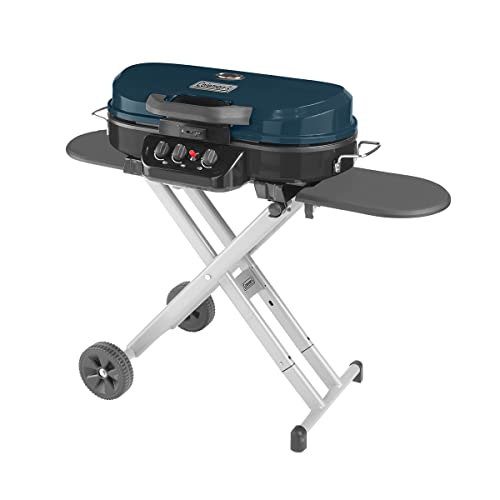
Coleman RoadTrip 285 Portable Propane Grill — Best Portable Easy-Clean
Portability is a cleaning feature nobody advertises. The RoadTrip 285 folds down, travels, and — crucially — has a compact cooking system you can break down at a utility sink instead of kneeling on a patio with a bucket. With three burners and 20,000 BTU in the listing, it cooks like a real grill rather than a camping compromise.
Strengths
- Compact system can be stripped and washed at a sink — the deepest clean in this guide
- Three burners in a portable is rare and makes zone cooking possible anywhere
- Instastart ignition and a stand format suit patios, tailgates and campsites alike
Trade-offs
- Small cooking area means batch cooking for groups
- Portable grease management is compact — empty it religiously or it overflows in transit
- Not a natural built-in look for a finished outdoor kitchen
| Burners (listing) | 3 |
| Output (listing) | 20,000 BTU |
| Ignition (listing) | Instastart |
| Format (listing) | Portable with stand |
The RoadTrip’s cleaning superpower is scale. Every component is small enough to handle, soak and inspect: grates that fit a sink, a drip system you can actually reach, burners you can see. Owners of big cart grills clean around their machines; owners of this clean the machine itself. For apartment dwellers and RVers who must store a grill indoors, that washable compactness is doubly valuable — a clean grill stores without smells.
Cooking range surprises people: three burners across a small box give a fierce hot zone and a gentle one, so the grill handles burgers and delicate fish in the same session. It will not host a neighbourhood cookout in one pass, but it will feed four to six in batches without complaint.
Best for: Campers, tailgaters and small-space owners who want sink-level cleaning / Not suited for: One-pass cooking for large gatherings
Check on Amazon — check price on Amazon before you decide, because grill pricing moves with the season.

Weber Q 1200N Portable Propane Gas Grill — Best Tabletop Easy-Clean
The Q 1200N applies the simplest cleaning logic of all: less grill, less cleaning. A single burner, a compact cast body and porcelain-enameled cast-iron grates mean the entire cooking system is a grate, a drip pan and a bowl you can wipe. Its verified listing confirms the enamel grates and electronic ignition in a travel-ready format.
Strengths
- Porcelain-enameled cast-iron grates release food with a brush and wipe
- One burner and a compact bowl — the shortest parts list in this guide
- Disposable drip pans fit the system, making grease disposal a non-event
Trade-offs
- One burner means one heat zone — no simultaneous sear-and-hold
- Cooking area is sized for one to four people
- A tabletop needs a table; the stand is a separate consideration
| Burners (listing) | 1 |
| Grates (listing) | Porcelain-enameled cast iron |
| Ignition (listing) | Electronic |
| Format (listing) | Portable tabletop |
There is a reason the Q shape has endured: the bowl funnels grease to a central pan instead of letting it coat the interior, and the grate lifts out with one hand. After cooking, the routine is brush, wipe, swap the pan when it fills. Nothing hides, nothing accumulates, and because the grill is small, a full deep clean is a ten-minute job rather than a project you postpone until it becomes archaeology.
Cooking quality per square inch is the Q’s other trick — the cast body holds heat and the single burner is strong for its size, so small meals cook properly rather than apologetically. Couples and small families who grill often and clean quickly will understand this pick immediately.
Best for: Couples, balconies and anyone who wants the two-minute clean / Not suited for: Multi-zone cooks or groups beyond four
Check on Amazon — check price on Amazon before you decide, because grill pricing moves with the season.

Charbroil Performance Series 4-Burner Gas Grill Cabinet with Side Burner — Best Full-Size Cabinet Pick
The Performance cabinet answers a different cleaning complaint: not the grates, but the mess around the grill. An enclosed cabinet contains the grease system and the tank, keeps drips off the patio, and presents a surface that wipes down like kitchen furniture. With four burners and a side burner, it does so without shrinking the cooking.
Strengths
- Enclosed cabinet contains grease management and keeps the patio cleaner
- Four burners give full zoning for family dinners and guests
- Side burner keeps saucepans off the main grates, reducing boil-over mess where it is hardest to clean
Trade-offs
- Cabinet interiors need their own wipe-down schedule or they become the hidden mess
- Full-size means full-size deep cleans when they come
- Side burner adds one more burner and grate to maintain
| Burners (listing) | 4 + side burner |
| Format (listing) | Enclosed cabinet |
| Colour (listing) | Black |
| Model (listing) | 463253925 |
Think of the cabinet as a cleaning system for the space around the grill. On open-cart grills, grease mist, drips and a swinging tank hose slowly filthy a patio corner; the enclosed design keeps the dirty half of grilling behind doors, where a periodic wipe handles it. The side burner contributes too — every pot of beans or tray of melting butter kept off the main grates is a boil-over that never carbonises onto them.
As the family-size option here, it cooks the way a 4-burner should: zones for proteins and vegetables, room for a crowd in one pass, and a side station for the rest of the menu. Pair it with the routine in the how-to section and it stays presentable with less total effort than its size suggests.
Best for: Families who want full-size cooking and a tidy patio corner / Not suited for: Minimalists who prefer the smallest possible machine
Check on Amazon — check price on Amazon before you decide, because grill pricing moves with the season.
Comparison Table
The key-spec column is deliberately cleaning-first: it names the feature that decides your Sunday scrub, with cooking format alongside.
| Pick | Badge | Key spec | Best for |
|---|---|---|---|
| Weber Spirit E-310 Gas Grill | Best Overall Easy-Clean | Porcelain-enameled cast-iron grates, 3 burners | Regular weeknight grillers who want wipe-clean grates on a full-size grill |
| Charbroil Pro Series Amplifire 2-Burner Gas Grill and Griddle Cabinet | Best Self-Cleaning Cook System | Amplifire infrared, grill + griddle cabinet | Fatty-food grillers whose fireboxes always end up filthy |
| Charbroil Classic 3-Burner Propane Gas Grill | Best Budget Easy-Clean | Porcelain-coated grates, 360 sq. in., 30,000 BTU | Budget buyers and first-time owners who still want wipe-clean grates |
| Coleman RoadTrip 285 Portable Propane Grill | Best Portable Easy-Clean | 3 burners, 20,000 BTU, sink-washable format | Campers, tailgaters and small-space owners who want sink-level cleaning |
| Weber Q 1200N Portable Propane Gas Grill | Best Tabletop Easy-Clean | 1 burner, enamel grates, drip-pan system | Couples, balconies and anyone who wants the two-minute clean |
| Charbroil Performance Series 4-Burner Gas Grill Cabinet with Side Burner | Best Full-Size Cabinet Pick | 4 burners + side burner, enclosed cabinet | Families who want full-size cooking and a tidy patio corner |
How to Choose a Gas Grill That Stays Clean
Start at the grates, because that is where you will spend most of your cleaning life. Porcelain-enameled cast iron is the premium answer: heavy, sears beautifully, and releases food from its sealed surface. Porcelain-coated steel is the budget version of the same idea — nearly as easy day to day, less forgiving of abuse. Bare stainless rod grates clean up well with heat and a brush but hold carbon in their welds. Plain cast iron cooks wonderfully and cleans worst of all unless you season and maintain it like a skillet, which most grill owners honestly will not.
Next, follow the grease. Every drip that leaves the food goes somewhere: onto an emitter or flavouriser system, into a tray, or across the firebox floor. Designs that vaporise drips (infrared) or funnel them to a single accessible tray keep the interior clean; designs that let grease sheet across the box create the black crust that takes a Saturday to remove. Ask where the grease ends up and how you reach it — from the front, without tools, is the answer you want.
Finally, count the parts. Burners, heat tents, grates, trays: each is a surface to clean and a thing to remove at deep-clean time. A grill with fewer, larger, well-finished parts cleans faster than a complex one with the same cooking area. This is why the compact picks in this guide are not compromises for small households — they are the rational cleaning choice.
The Five-Minute Routine That Prevents the Five-Hour Scrub
Easy-clean grills reward rhythm, not effort. The routine that keeps every pick in this guide presentable is: preheat and brush the grates before cooking, brush again while they are hot after cooking, let the grill run a few minutes to burn off residue, and empty the grease tray when it is half full rather than overflowing. Monthly, wipe enamel and exterior surfaces and check the tray rails. Seasonally, strip the grill, brush the burners and clear their ports, and vacuum the firebox.
What you skip matters as much as what you do. Never use oven cleaner on porcelain enamel or coatings. Never quench hot cast iron with cold water. Never let a foil-lined tray become a permanent installation — foil tears, traps grease underneath and defeats the tray’s design. The full step-by-step is in the how-to section below.
Budget Tiers for Easy-Clean Grills
Think in three tiers of cleaning investment. The budget tier buys coated grates on a simple grill — the single highest-value cleaning feature there is — and accepts gentler handling and a cover as part of the deal. The mid tier buys true porcelain enamel, better grease systems and ignition that does not fail. The premium tier buys systems that clean during cooking, like infrared emitters, plus cabinetry that keeps the whole station tidy. Notice that cleaning quality does not rise linearly with price: a small enamel-grate tabletop out-cleans a giant cheap grill at any price, which is why format choice comes before budget in this category.
How to Deep-Clean a Gas Grill in About 30 Minutes
This is the seasonal routine for any pick in this guide. Work on a cool grill, with the gas disconnected, and lay parts out in the order you remove them so reassembly is obvious.
- Disconnect the propane tank or shut off the gas supply, then remove the grates, heat tents or emitter plates, and the grease tray.
- Brush the grates while dry with a brass or nylon brush suited to their surface; soak porcelain-coated grates in warm soapy water only if residue resists, and never use a metal scraper on enamel or coating.
- Scrape the inside of the lid and firebox with a plastic scraper, working the loosened carbon down into the empty firebox, then vacuum or scoop it out.
- Brush each burner tube along its length, check that every port is open, and clear blocked ports with a soft probe — never anything that enlarges the hole.
- Wash the grease tray and drip pan in hot soapy water, dry them fully, and slide them back before you forget — a grill without its tray makes its own mess.
- Wipe exterior surfaces with a cloth suited to the finish, clean the control panel last with a barely damp cloth, and reconnect the gas.
- Run the grill on high for ten minutes to dry everything and burn off residue, then brush the warm grates once more and let it cool with the lid open.
- Replace any disposable drip pan, check the igniter clicks on every burner, and note the date — the next deep clean is due in a season, not when the grill starts smoking like a chimney.
Between deep cleans, the five-minute routine from the buying guide does the heavy lifting. The grills in this guide were chosen so that this routine stays at thirty minutes — if your current grill takes two hours, the difference is design, not your technique.
Cleaning Mistakes That Kill Easy-Clean Grills
The saddest pattern in this category is a well-designed grill destroyed by its owner’s cleaning. Porcelain enamel dies by metal scraper and by thermal shock — cold water on a hot grate. Coated grates die by wire wheel and oven cleaner. Infrared emitters die by neglect, their pores clogging until the system smokes and flares like the conventional grill it replaced. Every one of those deaths is a technique problem, and every pick in this guide will serve for years if you match the tool to the surface: brass or nylon brushes, plastic scrapers, warm water, patience.
The second killer is the grease tray treated as a storage unit. An overflowing tray is a fire risk, a pest invitation and a rancid flavour source in one. The tray is a consumable checkpoint: glance at it every few cooks, empty at half full, and the grill’s whole grease system — the thing designers actually engineered — works as intended.
What “Easy to Clean” Costs Over Five Years
There is an ownership arithmetic hiding inside this category. A grill that takes forty-five minutes to deep-clean gets deep-cleaned rarely, and the neglect compounds: carbon insulates burners, grease corrodes trays, and small problems become terminal ones. A grill that takes thirty minutes — the standard this guide’s how-to is built around — gets cleaned on schedule, and its wear parts are inspected while they are still cheap to replace. The easy-clean premium, where one exists, is repaid in the second and third years, in parts not bought and a replacement not needed.
The reverse is also true, and it flatters the budget pick here: a simple grill with coated grates, cleaned often because it is easy, will out-serve a complex grill that its owner dreads stripping. Cleaning effort is a running cost denominated in your evenings. This guide has priced it into every pick; the final exchange rate is yours to set.
A Note on Water, Covers and the Space Under the Grill
Two quiet habits protect an easy-clean grill’s finish between sessions. The first is water discipline: rain itself is harmless, but a cover fitted over a wet grill, or a patio slope that puddles beneath the cabinet, keeps the lower firebox and tray rails damp for days, and damp is where corrosion starts. Let the grill dry before covering, and if your patio pools water, a simple mat or repositioning saves the tray system you chose this category for. The second habit is underside awareness: the tray rails, the tank ring and the cabinet floor are the surfaces nobody sees and everybody’s grill needs. A torch and two minutes during each deep clean keeps them part of the routine rather than a surprise at year three.
One Last Standard: Clean Enough to Cook Tomorrow
The working definition of clean, for the grills in this guide, is not showroom shine. It is a grill you would happily cook on tomorrow without a preliminary excavation: grates brushed and free of last week’s carbon, a tray that is not a grease archive, burners that light evenly because their ports are open. Every system described in this guide — enamel, coating, infrared, compact format, contained cabinet — exists to keep you on the right side of that definition with minutes of effort rather than hours. Choose the pick whose system matches your habits, run the small routines, and “clean enough to cook tomorrow” becomes the permanent state of your grill rather than a goal you chase twice a year.
Surface Science: Why Coatings Clean Easier, and When They Do Not
The difference between a grate that wipes and a grate that fights is surface energy and texture. Porcelain enamel is glass fused to metal: smooth at the microscopic level, non-porous, and chemically uninterested in the proteins and sugars that bond to bare steel. Food carbon sits on enamel rather than marrying it, which is why a hot brush lifts in seconds what soaking cannot shift from pitted steel. Porcelain coatings on budget grates are the same idea in a thinner coat — nearly as slick in daily use, less resistant to chips and thermal abuse.
Bare stainless rod grates clean by a different contract: they tolerate aggressive brushing and high heat, and their carbon releases best when the grate is genuinely hot. Their weakness is geometry — welds and rod junctions shelter residue from the brush. Plain cast iron is the honest labourer of the group: superb to cook on, and clean only in the sense that a cast-iron skillet is clean, through heat, oil and seasoning discipline that most owners, in practice, do not sustain on a grill.
Infrared emitters sidestep the whole debate by burning the evidence. Drippings that would carbonise across a firebox vaporise on the emitter plate, leaving ash. The emitter itself becomes the surface to maintain — a fair trade, because it is one flat plate instead of a box full of corners. Whichever system you choose from this guide, the principle is the same: pick the surface whose maintenance matches the effort you will actually spend, because the best cleaning system is the one that gets used.
The Seasonal Deep Clean, Honestly Scheduled
Deep cleans fail by ambition: owners imagine a full restoration, postpone it for a free Saturday that never comes, and inherit a grill that needs archaeology. The fix is to schedule the thirty-minute version from the how-to section twice a year — season’s start and season’s end — and to let the five-minute routine carry the months between. Thirty honest minutes twice a year beats four heroic hours never.
Use the two sessions differently. The spring clean is mechanical: burners brushed and ports checked, igniters tested, tray rails cleared, everything inspected before the first cook depends on it. The autumn clean is preservative: grease fully removed so nothing rancid or corrosive winters in the box, surfaces dried, the cover fitted over a clean, dry grill. Owners in year-round grilling climates can simply pick two mild months and keep the same rhythm.
Keep the supplies together in one bucket — brushes matched to your grate surfaces, a plastic scraper, a soft probe for ports, disposable pans, gloves — stored where the grill lives. Friction is the enemy of maintenance, and a bucket at hand removes most of it. The grills in this guide were chosen to make these sessions short; the bucket makes them happen.
Designing Your Own Cleaning Standard: A Buyer’s Checklist
Before you buy any grill — in this guide or beyond it — run this five-point inspection against its listing and photographs, because cleaning quality is visible if you know where to look. One: grate surface. Enamel or coating named in the listing beats silence; silence usually means bare steel. Two: grease path. Can you see or read how drips reach a tray, and does the tray slide from the front? Three: firebox access. Do the heat tents or emitters lift out without tools, and can you reach the box floor with a scraper? Four: burner exposure. Burners you can see are burners you can brush; burners buried under fixed hardware are a promise of archaeology. Five: parts count. Count the removable pieces in the photographs; that number is your deep-clean time in disguise.
Apply the checklist to the picks above and you will see why each is here: the Spirit’s enamel and sane grease path, the Amplifire’s drip-vaporising emitter, the Classic’s coated grates at a budget tier, the portables’ sink-sized parts, the cabinet’s contained system. Apply it to any grill a salesperson presses on you and the pretenders identify themselves within a minute.
One last standard is personal: match the system to the cleaner you are, not the cleaner you intend to become. If you know a thirty-minute seasonal strip-down is your honest ceiling, choose the compact and infrared designs that thrive inside that ceiling. If you genuinely enjoy a full Saturday restoration, a bigger conventional grill will serve you happily. Easy-clean is not a property of a grill; it is a fit between a grill and a person, and this guide’s job is to help you find your fit.
Common Buying Mistakes
Scraping porcelain enamel with metal tools
Enamel and coatings chip under steel scrapers, and every chip becomes a rust point that grips food harder than the surface it replaced. Use brass or nylon brushes and plastic scrapers on any coated surface.
Letting the grease tray overflow
An overflowing tray feeds flare-ups, coats the cabinet and can ignite. Empty at half full; it takes thirty seconds and prevents the worst mess in grilling.
Pressure-washing the firebox
Water driven into burners, igniters and valves creates more problems than it solves, and soaked burner ports rust from inside. Scrape, vacuum and wipe instead.
Ignoring the underside of heat tents and emitters
The top looks clean while the underside carries the season’s grease. Flip tents and emitters during deep cleans or the first hot cook of spring will remind you.
Buying the biggest grill for a small household
Every extra square inch is a surface to clean forever. Right-size the grill and the cleaning shrinks with it — the compact picks in this guide exist precisely for this reason.
Final Recommendation
If you want one recommendation: the Weber Spirit E-310, whose enamel grates and sane grease path make it the easiest full-size grill here to live with. If your enemy is firebox grease, the Amplifire infrared system fights it during every cook. On a budget, the Charbroil Classic’s coated grates deliver the essential feature cheaply, and the RoadTrip 285 and Q 1200N prove that small is a cleaning strategy in itself.
Whichever you choose, commit to the rhythm: brush hot, empty the tray at half, deep-clean by the calendar. An easy-clean grill plus a five-minute habit will still look — and cook — like a new machine years after a neglected premium grill has become a cautionary tale.
- Weber Spirit E-310 Gas Grill — best overall easy-clean.
- Charbroil Pro Series Amplifire 2-Burner Gas Grill and Griddle Cabinet — best self-cleaning cook system.
- Charbroil Classic 3-Burner Propane Gas Grill — best budget easy-clean.
Compare the wider field before you buy: Best Gas Grills for the complete category, Best Compact Gas Grills for more small-format options, Best 3 Burner Gas Grills for the family size class, Best Affordable Gas Grills for value picks, and Best Portable Gas Grills if the sink-washable route appeals.
Frequently Asked Questions
What makes a gas grill easy to clean?
Four things: grates with a porcelain enamel or coated surface that releases food, a grease path that funnels drips to one accessible tray, a firebox you can reach and scrape, and a parts count low enough that a deep clean stays near thirty minutes. Infrared systems add a fifth advantage by vaporising drips before they collect.
Are porcelain-enameled grates really easier than stainless?
Yes for day-to-day cleaning — food releases from the sealed enamel surface with a brush and wipe, while stainless builds carbon in its welds that needs heat and effort. The trade-off is care: enamel must never meet a metal scraper or a cold-water quench on a hot grate.
How often should I deep-clean my gas grill?
For a grill used weekly, a thirty-minute deep clean at the start and end of the season, plus the five-minute after-cook routine, keeps it in shape. Heavy users and fatty-food grillers should add a mid-season session. The grease tray needs attention far more often — check it every few cooks.
Can I put grill grates in the dishwasher?
Small portable grates sometimes fit, and at least one compact design in this category is sold with a dishwasher-safe grate, but as a rule the heat-and-brush method is faster and safer for finishes. Enamel and coated grates should never meet harsh dishwasher detergents repeatedly.
Do infrared grills clean themselves?
Not literally, but they change the work. Drippings vaporise on the emitter instead of pooling in the firebox, so what remains is ash that brushes off. The emitter plates themselves need periodic brushing to keep their pores open — different work, and less of it, but not none.
What is the fastest-cleaning grill format?
A compact tabletop or portable. Fewer parts, smaller surfaces, and components you can carry to a sink beat every full-size design on total cleaning time. If your household size allows it, small is the easiest-cleaning decision you can make.


