Disclosure: airfryerkitchensupply.com is reader-supported. When you buy through links on our site, we may earn an affiliate commission at no extra cost to you.
Where to buy
The fastest way to compare finishes, hole configurations and current availability for the best futuristic tech microwaves shortlist is Amazon, where each verified pick below links straight to its listing. Prices move with finish and retailer, so this guide never prints a fixed price — use the links to check price on Amazon on the day you order. If a pick is marked as unlinked, it is discussed for fit and context but carries no purchase link, because its exact configuration could not be confirmed against a verified listing.
- Café 1.5 Cu.Ft Countertop Convection Microwave — Best Scan-to-Cook Flagship: Check on Amazon
- Samsung 1.1 Cu.Ft Smart SLIM Over-the-Range Microwave — Best Wi-Fi Voice Over-the-Range: Check on Amazon
- GE Profile PCHK11S1WBB 1.1 Cu.Ft Countertop Microwave — Best Compact Scan-to-Cook: Check on Amazon
- Panasonic HomeChef 4-in-1 Countertop Microwave — Best App-Linked Multi-Cooker: Check on Amazon
- ThermoMate 1.2 Cu.Ft Slim Over-the-Range Microwave — Best Voice Control Value: Check on Amazon
- Toshiba 4-in-1 1.5 Cu.Ft Microwave with Air Fryer Combo — Best Multi-Cooking Technology: Check on Amazon
The best futuristic tech microwaves are not the ones with the most lights — they are the ones where a named, verified technology changes what the oven can do: cook from a barcode scan, take a voice command, connect to Wi-Fi for remote control and updates, follow app-linked recipes, or combine microwave, air fry, convection and broil in a single cavity. This guide admits only technologies stated in a verified listing: Scan-to-Cook, Wi-Fi, voice control, app-linked presets. If a feature could not be verified, it is not in the badges, the spec boxes or the selling points — futuristic is a claim this guide makes technology prove.
That discipline sorts the field fast. The genuine frontier, as verified here, is led by Café’s Scan-to-Cook countertop oven and GE Profile’s scan-equipped compact, Samsung’s Wi-Fi Smart SLIM over-the-range model with voice control, Panasonic’s app-linked HomeChef combo, ThermoMate’s voice-control slim oven, and Toshiba’s 4-in-1 sensor combo as the multi-cooking technology pick. Each represents a different bet on the kitchen’s future: packaged-food automation, voice-first control, connected ecosystems, or one appliance replacing four.
A word of honest framing before the badges: smart features age differently from steel and magnetrons. Apps change, ecosystems evolve, and a Wi-Fi oven’s cleverest trick depends on services outside the box. The reviews below therefore judge each pick on two axes — the verified futuristic feature, and the underlying oven you will still own if the app era moves on. Buy the future, by all means; this guide just insists the present underneath it is solid too.
In this guide
Quick Picks: The Shortlist for Best futuristic tech microwaves
Fast answer: Café’s Scan-to-Cook is the flagship future, Samsung’s Smart SLIM owns Wi-Fi plus voice over the range, and GE Profile miniaturises scan cooking. Panasonic HomeChef brings app-linked recipes, ThermoMate adds voice in a slim profile, and Toshiba’s 4-in-1 bets on multi-cooking instead of connectivity.
Café 1.5 Cu.Ft Countertop Convection Microwave — Best Scan-to-Cook Flagship. A 1000W convection countertop oven whose verified listing names Scan-to-Cook Technology and Wi-Fi connection — scan a package, and the oven sets itself. Check on Amazon.
Samsung 1.1 Cu.Ft Smart SLIM Over-the-Range Microwave — Best Wi-Fi Voice Over-the-Range. A slim over-the-range oven whose verified listing names Wi-Fi, voice control, a 550 CFM hood vent, LED light bar and sensor cook — the connected flagship above the stove. Check on Amazon.
GE Profile PCHK11S1WBB 1.1 Cu.Ft Countertop Microwave — Best Compact Scan-to-Cook. GE Profile’s 800W, 1.1 cu ft black countertop oven whose verified listing names Scan-to-Cook Technology and sensor cooking — flagship tricks at compact scale. Check on Amazon.
Panasonic HomeChef 4-in-1 Countertop Microwave — Best App-Linked Multi-Cooker. A 1000W, 1.2 cu ft inverter HomeChef whose verified listing names 20 presets plus app-linked recipes across microwave, air fry and more. Check on Amazon.
ThermoMate 1.2 Cu.Ft Slim Over-the-Range Microwave — Best Voice Control Value. A slim low-profile over-the-range oven whose verified listing names voice control and sensor cooking at 1000W — hands-free above the stove at a value tier. Check on Amazon.
Toshiba 4-in-1 1.5 Cu.Ft Microwave with Air Fryer Combo — Best Multi-Cooking Technology. A 1000W, 1.5 cu ft countertop combo whose verified listing names smart sensor, convection, mute and position-memory turntable across its 4-in-1 modes. Check on Amazon.
How These Picks Were Chosen
Admission required a futuristic feature stated in the verified listing itself: Scan-to-Cook, Wi-Fi, voice control, app-linked recipes, or a genuine multi-mode platform. Listings were retrieved through the site’s product data channel. Ovens with smart-sounding names but no verifiable connected or automated feature were excluded, as were standard ovens in futuristic finishes — a black glass door is a colour, not a technology.
The six were balanced across the four real futures the verified market offers: packaged-food automation (Café, GE Profile), connected over-the-range control (Samsung, ThermoMate), guided ingredient cooking (Panasonic HomeChef), and appliance consolidation (Toshiba 4-in-1). Each review also weighs the underlying oven — capacity, power, cooking modes — because connected features ride on services that evolve, while the cavity and magnetron are yours for the appliance’s whole life.
One exclusion deserves naming: voice-assistant compatibility claims that appear only in marketing copy, not in the verified listing data, were not credited to any pick. Where voice control is badged in this guide, the listing itself states it. Readers integrating with a specific smart-home ecosystem should confirm current compatibility on the maker’s page before purchase, since integrations change faster than ovens do.
The 6 Best Futuristic Tech Microwaves, Reviewed
Each review below follows the same order: who the pick suits, its verified strengths and trade-offs, the specifications that could be verified, and a plain verdict. Badges match the Quick Picks exactly, so you can move between the shortlist and the deep reviews without losing your place.

Café 1.5 Cu.Ft Countertop Convection Microwave — Best Scan-to-Cook Flagship
Scan-to-Cook is the rare futuristic feature that survives contact with a Tuesday: point the oven (via its connected app flow) at a frozen meal’s barcode and the cooking programme arrives pre-set — power, time, stages — instead of you squinting at box instructions written for a different wattage. The Café’s verified listing names Scan-to-Cook Technology and Wi-Fi connectivity on a 1.5 cubic foot convection platform that also bakes, roasts and broils, so the flagship future sits on a genuinely multi-talented oven.
Strengths
- Scan-to-Cook named in the verified listing — packaged food cooks as its maker intended
- Wi-Fi connectivity enables the scan flow and remote features
- Convection bake, roast and broil make it a second oven, not just a smarter microwave
Trade-offs
- Scan databases cover packaged brands unevenly — scratch cooking gains less
- Connected features depend on the maker’s app and services continuing
- Flagship tier pricing and a substantial counter footprint
| Specification | Detail (verified) |
|---|---|
| Capacity | 1.5 cu ft (verified) |
| Power | 1000W (verified) |
| Verified features | Scan-to-Cook Technology, Wi-Fi connected, convection bake/roast/broil |
The Café’s bet is that the microwave’s future is removing translation: boxes speak in wattage-adjusted instructions, ovens speak in programmes, and scanning lets them talk directly. For households that live partly on packaged convenience foods — and are honest about it — that translation layer is worth more than another sensor. The convection platform matters as insurance: if the connected era shifts, you still own a capable second oven. That dual value is what a flagship should mean, and it is why the Café leads this guide.
Best for: Packaged-food households wanting scan automation plus a real convection oven / Not suited for: Scratch-only cooks who will never scan a barcode
Check the current price on Amazon to confirm the exact finish and configuration before ordering.

Samsung 1.1 Cu.Ft Smart SLIM Over-the-Range Microwave — Best Wi-Fi Voice Over-the-Range
Samsung’s Smart SLIM packs the connected brief into the space above the range: Wi-Fi and voice control in the verified listing, sensor cooking for the food itself, and a serious 550 CFM ventilation system with an LED light bar for the cooking below. The slim profile preserves headroom and sightlines that full-size over-the-range ovens eat, which makes this the futuristic pick for kitchens where the microwave must multitask as hood, light and connected appliance at once.
Strengths
- Wi-Fi and voice control both verified in the listing
- 550 CFM venting is flagship-grade for an over-the-range unit
- Sensor cook keeps the food side as smart as the connectivity
Trade-offs
- 1.1 cu ft slim cavity limits the largest dishes
- Over-the-range installation is a bigger commitment than countertop
- Connected features live inside Samsung’s ecosystem choices
| Specification | Detail (verified) |
|---|---|
| Capacity | 1.1 cu ft (verified) |
| Format | Over-the-range, slim low profile (verified) |
| Verified features | Wi-Fi, voice control, 550 CFM hood vent, LED light bar, sensor cook |
Voice control earns its keep above a range more than anywhere else in the kitchen: hands are greasy, pans are hot, and ‘stop’ said aloud beats a button hunt. The Samsung pairs that with ventilation strong enough for real searing below — the unglamorous specification that decides whether an over-the-range unit satisfies after the novelty fades. Choose it when your remodel wants one connected appliance doing three jobs over the stove, and accept the slim cavity as the deliberate price of the profile.
Best for: Remodels wanting Wi-Fi, voice and serious venting in one slim unit / Not suited for: Households needing a large over-the-range cavity
Check the current price on Amazon to confirm the exact finish and configuration before ordering.

GE Profile PCHK11S1WBB 1.1 Cu.Ft Countertop Microwave — Best Compact Scan-to-Cook
Futuristic features usually debut at flagship sizes; the GE Profile inverts that, bringing Scan-to-Cook — named in its verified listing — and sensor cooking to a 1.1 cubic foot, 800-watt black countertop oven. For smaller kitchens and premium dorms or offices, that is the scan-automation experience without surrendering the counter to a convection flagship. Child lock technology in the listing rounds out a spec aimed at design-conscious, space-conscious buyers.
Strengths
- Scan-to-Cook verified at a compact, counter-friendly size
- Sensor cooking handles the non-packaged half of life
- GE Profile design language suits premium small kitchens
Trade-offs
- 800W is gentler pace than the 1000W+ flagships
- No convection — the future here is automation, not multi-cooking
- Compact cavity caps family-sized dishes
| Specification | Detail (verified) |
|---|---|
| Capacity | 1.1 cu ft (verified) |
| Power | 800W (verified) |
| Verified features | Scan-to-Cook Technology, sensor cooking, child lock technology |
The GE Profile’s insight is demographic: the households most fluent in app-driven cooking often live in the smallest kitchens. Giving them scan automation at 1.1 cubic feet — rather than forcing a size upgrade to earn the feature — respects how they actually live. The 800-watt pace is the honest trade: scans adjust programmes to the oven, so packaged results stay true, while raw speed merchants should look at the wattage leaders in this guide’s sibling roundups. For the connected compact brief, this is the verified benchmark.
Best for: Small premium kitchens wanting scan automation without the bulk / Not suited for: Families needing capacity or convection
Check the current price on Amazon to confirm the exact finish and configuration before ordering.
Panasonic HomeChef 4-in-1 Countertop Microwave — Best App-Linked Multi-Cooker
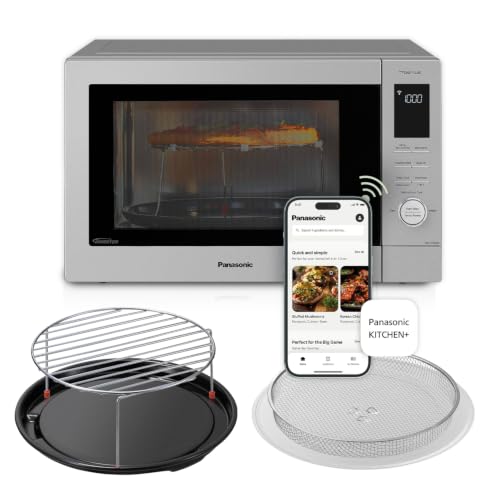
Panasonic’s HomeChef bets the future is guidance: its verified listing pairs app-linked recipes with twenty presets on a 4-in-1 platform — microwave with inverter delivery, air fryer and companion modes — at 1.2 cubic feet. Instead of automating packaged food like the scan models, it coaches fresh cooking: the app supplies the programme, the inverter executes it evenly, and the air-fry mode finishes what microwaves alone cannot crisp.
Strengths
- App-linked recipes verified — guided cooking beyond presets
- Inverter delivery gives the multi-modes an even foundation
- 4-in-1 platform replaces separate air fryer for many households
Trade-offs
- App value depends on your willingness to cook from a phone
- 1.2 cu ft air-fry batches are modest for large families
- Feature depth means a learning curve the simple ovens skip
| Specification | Detail (verified) |
|---|---|
| Capacity | 1.2 cu ft (verified) |
| Power | 1000W (verified) |
| Verified features | App-linked recipes, 20 presets, inverter, 4-in-1 with air fryer |
Every futuristic oven in this guide picks a user story, and the HomeChef’s is the cook who wants range without a recipe file: the app proposes, the presets execute, the inverter evens, the air fryer crisps. That is a coherent product philosophy, and its verified pieces fit together — which cannot be said of every feature-stuffed rival. If your household’s future is connected cooking from ingredients rather than barcodes, this Panasonic, not the scan flagships, is your pick.
Best for: Ingredient cooks who want app guidance plus air-fry versatility / Not suited for: Barcode-driven packaged-food households (choose Café or GE)
Check the current price on Amazon to confirm the exact finish and configuration before ordering.
ThermoMate 1.2 Cu.Ft Slim Over-the-Range Microwave — Best Voice Control Value
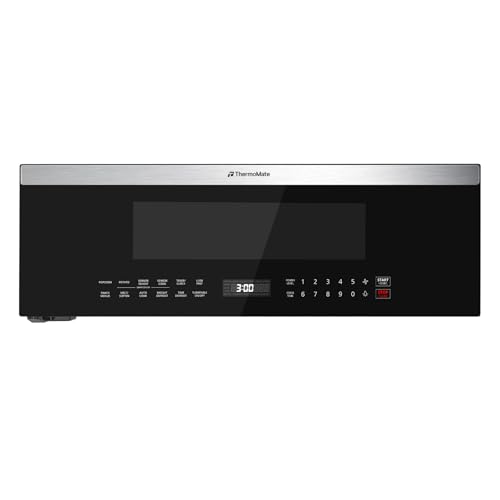
ThermoMate brings the voice headline down from flagship pricing: its verified listing names voice control on a slim, low-profile 1.2 cubic foot over-the-range oven with sensor cooking and 1000 watts. The slim format preserves the modern open sightline above the range, and voice handles the messy-hands moments that define range-top cooking. It is the accessible route into the connected above-stove brief.
Strengths
- Voice control verified at a value tier
- Slim profile keeps headroom and sightlines open
- Sensor cooking covers the food side competently
Trade-offs
- Smaller brand ecosystem than Samsung or GE for connected support
- Slim cavity limits tall and very large dishes
- Voice feature set is narrower than the flagship ecosystems
| Specification | Detail (verified) |
|---|---|
| Capacity | 1.2 cu ft (verified) |
| Power | 1000W (verified) |
| Verified features | Voice control, sensor cooking, slim low-profile over-the-range format |
Value futuristic picks live or die on whether the headline feature truly works, and voice control here is verified in the listing rather than implied by a smart-sounding name — the distinction this guide exists to enforce. Around it sits a sensibly specified slim oven: sensor cooking, full microwave power, a profile modern kitchens want. If the Samsung’s ecosystem premium does not fit your budget but voice above the stove does fit your cooking, the ThermoMate is the honest alternative.
Best for: Budget-conscious remodels wanting voice control over the range / Not suited for: Ecosystem loyalists who want the deepest smart-home integration
Check the current price on Amazon to confirm the exact finish and configuration before ordering.
Toshiba 4-in-1 1.5 Cu.Ft Microwave with Air Fryer Combo — Best Multi-Cooking Technology
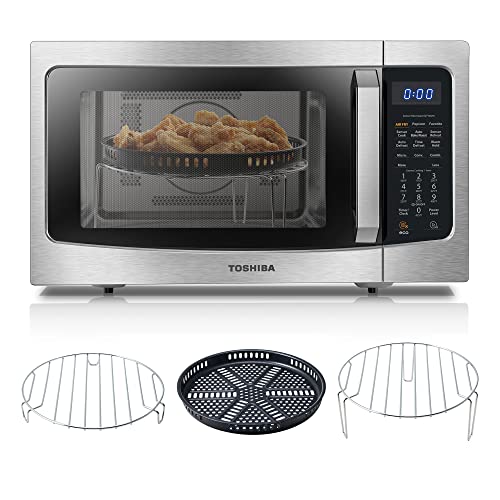
Not every futuristic bet is connectivity. Toshiba’s 4-in-1 wagers that the future oven is a consolidation: microwave, air fryer, convection and companion modes in one 1.5 cubic foot cavity, run by a smart sensor, with thoughtful touches like a mute function and a position-memory turntable that returns your mug handle to where you left it. Its verified listing supports every one of those claims, making it the technology pick for households that want capability futures rather than connected ones.
Strengths
- Four cooking modes in one cavity — genuine appliance consolidation
- Smart sensor automates done-ness across modes
- Position-memory turntable and mute are small, daily, human touches
Trade-offs
- No Wi-Fi, scan or voice — its future is capability, not connectivity
- Air-fry capacity suits couples and small families, not crowds
- Mode-rich interface takes longer to master
| Specification | Detail (verified) |
|---|---|
| Capacity | 1.5 cu ft (verified) |
| Power | 1000W (verified) |
| Verified features | 4-in-1 with air fryer combo, smart sensor, convection, mute function, position memory turntable |
Include this Toshiba in a futuristic guide and a useful argument starts: is a microwave that replaces three appliances less futuristic than one that talks to your phone? For small kitchens, consolidation is the future that pays rent — literally, in counter space returned. The sensor and memory details show the same design intelligence as the connected flagships, aimed at the food instead of the network. Choose it if your household’s bottleneck is appliance sprawl; choose the Café or Samsung if it is automation. Both are futures; only one is yours.
Best for: Small kitchens wanting one oven that air-fries and convects too / Not suited for: Smart-home integrators who want Wi-Fi and voice above all
Check the current price on Amazon to confirm the exact finish and configuration before ordering.
Comparison Table
Compare by future, not by chrome: which verified technology each pick actually delivers, and the oven underneath it.
| Pick | Badge | Key spec | Best for |
|---|---|---|---|
| Café 1.5 Cu.Ft Countertop Convection Microwave | Best Scan-to-Cook Flagship | Scan-to-Cook + Wi-Fi, convection | Packaged-food households wanting scan automation plus a real convection oven |
| Samsung 1.1 Cu.Ft Smart SLIM Over-the-Range Microwave | Best Wi-Fi Voice Over-the-Range | Wi-Fi + voice, 550 CFM, slim | Remodels wanting Wi-Fi, voice and serious venting in one slim unit |
| GE Profile PCHK11S1WBB 1.1 Cu.Ft Countertop Microwave | Best Compact Scan-to-Cook | Scan-to-Cook, 1.1 cu ft, 800W | Small premium kitchens wanting scan automation without the bulk |
| Panasonic HomeChef 4-in-1 Countertop Microwave | Best App-Linked Multi-Cooker | App recipes, inverter, 4-in-1 | Ingredient cooks who want app guidance plus air-fry versatility |
| ThermoMate 1.2 Cu.Ft Slim Over-the-Range Microwave | Best Voice Control Value | Voice control, slim OTR, 1000W | Budget-conscious remodels wanting voice control over the range |
| Toshiba 4-in-1 1.5 Cu.Ft Microwave with Air Fryer Combo | Best Multi-Cooking Technology | 4-in-1 combo, smart sensor | Small kitchens wanting one oven that air-fries and convects too |
How to Choose a Futuristic Tech Microwave
Pick your future: automation, voice, guidance or consolidation
The verified frontier splits four ways, and households rarely need all four. Automation (Scan-to-Cook) serves packaged-food fluency: the oven reads the box so you do not have to. Voice serves the range-top moment: hands occupied, water or heat needed now. Guidance (app-linked recipes and rich presets) serves ingredient cooks who want the oven to propose and execute programmes. Consolidation (4-in-1 platforms) serves space: one cavity doing microwave, air fry and convection work. Rank these by your real week before comparing models — the Café and the Toshiba are both excellent and almost perfectly non-interchangeable.
Be equally clear about what you will not use. An app you will never open is not a feature; a scanner in a scratch kitchen is décor. Futuristic premiums are the easiest money in appliances to waste, and the most satisfying to spend correctly, because a matched smart feature is used daily while a mismatched one is used at the unboxing.
The service question: apps, ecosystems and longevity
Connected features depend on things outside the box: the maker’s app, its servers, your Wi-Fi, and the smart-home ecosystem’s current integrations. Before buying any connected pick, check three things on the maker’s current pages: that the app supports your phone platform, that the voice ecosystem named matches your home’s, and that the core cooking functions work fully without the connection — every pick in this guide cooks as a normal oven offline, which is the non-negotiable baseline. A future-proof purchase is one whose future is a bonus, not a dependency.
Wi-Fi setup itself is a small project: these ovens join home networks like other smart appliances, and a weak signal at the kitchen’s far wall can make connected features flaky while the oven itself cooks perfectly. If your router struggles to reach the kitchen, solve that first or weight the non-connected Toshiba more heavily — matching the feature to the infrastructure is part of matching it to the household.
Judge the oven under the technology
Strip the smart layer mentally and spec what remains: capacity against your dishes, wattage against your patience, modes against your cooking. The Café remains a convection oven if its app vanished; the Samsung remains a 550 CFM hood; the HomeChef remains an inverter multi-cooker. That residual value is the floor of your purchase, and in this guide it is deliberately high for every pick. Conversely, be wary in the wider market of thin ovens wearing thick technology — a weak cavity with a great app is a subscription to disappointment.
Physical interfaces matter too: futuristic ovens still need legible controls for the unconnected moments and the unconnected guests. Touch panels that vanish when off look stunning and confuse grandparents; presets that require an app for basic popcorn are a design failure. The picks here keep their core cooking on the oven itself — hold any rival to the same standard.
Sizes and formats in the smart era
Connected flagships cluster at two poles: large countertop convection platforms (Café, Toshiba at 1.5) and slim over-the-range units (Samsung, ThermoMate) that trade cavity for profile. The GE Profile’s compact scan model is the exception that proves small kitchens are not excluded from the future. Choose format by kitchen first — counter versus over-range is an installation decision with venting and cabinet consequences — and technology second; a voice oven in the wrong format is a remodel regret with good diction.
For over-the-range picks, verify venting configuration (ducted versus recirculating) and cabinet dimensions against the slim profiles before ordering; for countertop flagships, measure depth with the door open. Futuristic features do not exempt an oven from the tape measure — they make skipping it more expensive.
What ‘Futuristic’ Should Mean in a Kitchen Appliance
The kitchen’s real future is not a refrigerator that video-calls; it is the removal of translation and friction from cooking. Scan-to-Cook removes the translation between a box’s instructions and an oven’s programme. Voice removes the friction of occupied hands. Sensors remove the guesswork tax on every reheat. Multi-mode cavities remove the appliance sprawl that eats small kitchens. Judged by that standard, the six picks here are genuinely futuristic — each deletes a real friction — while a hundred glossy ovens with ambient lighting delete nothing but counter space.
The corollary is a buying discipline: pay for deleted friction you actually experience weekly. If your friction is packaged-food guesswork, the scanner is worth a flagship price. If it is counter sprawl, the 4-in-1 is. If it is none of these — if your friction is uneven reheats — then your futuristic oven is an inverter from this site’s efficiency guides, and it will feel more like the future than any connected model in this one. Technology earns its name by serving the cook, never the reverse.
Privacy and Data: The Connected Oven’s Quiet Print
A connected microwave participates in your home network and, through its app, in the maker’s data ecosystem: usage patterns, feature telemetry, account details. This guide takes no alarmist position — the data involved in reheating soup is among the least sensitive in the smart home — but it does insist the exchange be conscious. Before connecting any pick here, read the app’s permission requests and the maker’s privacy summary with the same care you gave the spec sheet. An oven whose connected features you love is worth an account; an oven you bought for its cavity alone can live a perfectly full life offline, and every pick in this guide was required to prove exactly that.
Network hygiene is the practical half: keep the oven on your main or guest network per your household’s smart-device policy, let firmware updates install (they carry security fixes as well as features), and use a strong, unique password on the appliance account. These are five-minute disciplines with decade-long payoffs, and they apply to the whole connected kitchen this microwave may be pioneering in your home.
There is also a household-politics point worth making plainly: connected features should serve everyone who cooks, not only the account holder. Set up shared access where the platform offers it, keep the panel controls primary for guests, and never let a partner’s dinner depend on your phone’s battery. The future that excludes the household is not the future this guide is selling — it is a demo with a power cord.
Resale, Longevity and the Smart Appliance Decade
Microwaves live a long time, and connected models raise a fair question: what is a smart oven worth in year eight, when its app has changed twice and its ecosystem has moved on? This guide’s answer is built into its selection rule — every pick had to justify itself as an offline oven first. Judged that way, longevity risk concentrates in the bonus layer, not the appliance: the Café remains a convection oven, the Samsung a strong hood, the HomeChef an inverter multi-cooker, whatever the services do. Buy with that floor in mind and the smart premium becomes a calculated, bounded bet instead of an open-ended one.
Care extends the floor’s life in unglamorous ways that matter more for smart ovens than dumb ones: electronics dislike steam, heat and grease, all of which kitchens produce at the exact altitude these ovens occupy. Keep vents clear, wipe the cavity and door frame weekly, and let over-the-range units’ filters be cleaned on schedule so the hood’s airflow keeps carrying cooking effluent away from the control panel. A smart oven coddled this way will likely outlive its own app — at which point it graduates, gracefully, into a very good ordinary oven, and your six-month feature audit from the setup section will tell you whether its successor needs to be smart at all.
The Guest Test: Futuristic Features in a Shared Kitchen
Every futuristic feature should be subjected to one brutal evaluation before purchase: hand it to a guest. The guest — a grandparent, a babysitter, a friend reheating coffee at midnight — arrives with no app, no account and no patience for a tutorial. Can they heat the soup? On every pick in this guide, yes: the panels cook, the handles and buttons behave, and the smart layer waits politely for its owner. That is not an accident of these six models; it was an admission condition. The wider market contains ovens whose basic functions hide behind touch menus and app pairings, and the guest test exposes them instantly.
Design your own household’s usage with the guest in mind even after purchase: leave the two or three core programmes discoverable on the panel, resist burying daily functions in app-only flows, and keep a one-line note on the fridge for the headline feature (‘wave over the top to start’) rather than a manual nobody reads. Technology that survives the guest test becomes household infrastructure; technology that fails it becomes the owner’s private gadget sitting in everyone’s way. The future, in a shared kitchen, must be hospitable or it is merely expensive.
Smart Features Ranked by Daily Usefulness: A Field Guide
After the unboxing glow fades, futuristic features sort themselves by a ruthless metric: uses per week. Field experience across connected kitchens suggests a consistent ordering. Sensor cooking — present across this guide’s picks — is used at nearly every cook and therefore out-earns flashier features within a month. Voice control at the range is used daily by households that cook with occupied hands. Scan-to-Cook is used exactly as often as packaged meals appear, which for its target households is several times a week and for scratch kitchens is never. App-linked recipes are used in enthusiastic bursts — heavily in month one, then settling into a loyal minority’s weekly rhythm. Remote start and monitoring, the features demos love most, are used least of all in real kitchens, because food still has to be physically placed in the cavity by a person standing in front of it.
Use that ordering as a pricing instrument. Pay flagship money only for features in your household’s top two; treat the rest as worth approximately nothing to you, whatever they cost to include. The Café buyer whose week runs on packaged meals is making a rational flagship purchase; the identical oven in a scratch kitchen is an expensive sensor microwave. Futuristic value is not a property of the oven — it is a property of the match, and this guide’s per-pick verdicts were written to make that match explicit before your money makes it permanent.
Buying Futuristic on a Budget: Where the Premium Is Worth It
Not every household needs the flagship expression of its chosen future, and this guide’s sequencing quietly encodes the value map. Voice control exists at the ThermoMate’s tier as well as Samsung’s; multi-mode consolidation exists without Café’s scan premium; sensor intelligence — the feature with the highest uses-per-week in the field ranking — is available across almost every tier in this programme’s wider microwave coverage. The disciplined budget move is to identify your one future — automation, voice, guidance or consolidation — and buy its most affordable verified expression, banking the difference rather than scattering it across features ranked third and fourth in your own usage.
The one place not to economise is the underlying oven: capacity that fits your dishes, wattage that fits your patience, a cavity you would happily own offline. A budget smart oven that fails the offline test is not a saving; it is a subscription to a lesser appliance with a brighter launch video. Hold that line, spend the smart premium only on your top-ranked future, and the futuristic kitchen becomes attainable at almost any budget — which, when you think about it, is the most futuristic outcome of all.
Matching the Shortlist to Four Real Households
Concretely, then. The packaged-meal household in a full-size kitchen: the Café, whose scanner will earn its premium weekly. The same household in a compact kitchen: the GE Profile, the scanner at honest scale. The range-led remodel: Samsung’s Smart SLIM when the budget allows the deepest verified package, ThermoMate when voice is the requirement and value is the constraint. The ingredient cook who wants a guide, not a scanner: the Panasonic HomeChef. The small kitchen drowning in single-purpose boxes: the Toshiba 4-in-1, whose future is floor space. Five households, five futures, zero features bought on a demo’s say-so — that is the shape of a futuristic purchase made properly, and it is the standard this guide set in its first paragraph and kept in every badge.
A Final Calibration Before You Order
Before ordering, complete the guide’s three sentences for your chosen pick: ‘Its verified futuristic feature is…’, ‘I will use that feature when…’, and ‘Stripped of it, the oven underneath is still right for us because…’. A purchase that completes all three crisply is a future bought properly. A purchase that stalls on the second sentence is a demo looking for a home — put it back, however beautiful the launch video was, and let the household ranking in this guide choose again.
How to Set Up a Smart Microwave for First-Day Success
Connected ovens reward a deliberate first hour. This sequence gets the technology working, verifies the oven underneath it, and sets the household up to actually use the features paid for.
- Place and power it as an oven first. Confirm clearances, counter depth with the door open, and — for over-the-range models — venting configuration before touching any app. The appliance must fit before it can be smart.
- Run a manual baseline cook. Heat a mug of water and reheat a familiar leftover on manual settings. This verifies the cavity, turntable and power while proving the oven works fully offline.
- Connect Wi-Fi in a quiet moment. Join the oven to your home network per the maker’s app, close to the router if the signal allows, and complete any firmware update before judging responsiveness.
- Test the headline feature on its home turf. Scan a packaged item the database knows, or run the voice command set, or open an app-linked recipe. Judge the feature on a fair first case, not an edge case.
- Teach the household the offline truth. Show everyone that every core function works from the panel without the app. Guests and grandparents are part of the user base.
- Set the sensible defaults. Configure clock, sound (mute where offered), child lock and favourite presets now, while motivation is high — defaults set on day one are the ones that survive.
- Calendar a six-month feature audit. Note which smart features you actually used. That audit — not the launch marketing — should drive your next connected-appliance decision.
If a connected feature misbehaves in week one, suspect signal and setup before the oven: re-check Wi-Fi strength at the cavity, the app’s permissions, and firmware status. Verified platforms from Café, GE, Samsung and Panasonic carry real support — use it while the return window is open.
Common Buying Mistakes
Futuristic purchases fail by buying the demo instead of the life. These are the traps — each with its counter.
- Paying for a future you will not use. A scanner in a scratch kitchen, an app for a phone-averse cook. Rank the four futures by your real week first.
- Letting technology outrank the oven. Capacity, wattage and modes are forever; apps evolve. Strip the smart layer mentally and spec what remains before paying the premium.
- Assuming ecosystem compatibility. Voice and app integrations are specific and changeable. Confirm your exact ecosystem on the maker’s current page before ordering.
- Ignoring Wi-Fi reality at the cavity. A weak kitchen signal makes connected features flaky. Check coverage where the oven will live, or weight offline-capable picks.
- Skipping the offline test. If basic cooking needs the app, the design has failed you. Every pick here cooks fully from its own panel — verify yours does on day one.
- Forgetting installation physics. Slim over-the-range and flagship countertop ovens still obey tape measures, venting and clearance rules. Measure like it is a normal oven, because it is one.
Final Recommendation
Choose your future first. Packaged-food automation: the Café flagship for the full convection platform, the GE Profile when the kitchen is compact. Connected control above the range: the Samsung Smart SLIM for the deepest verified package, the ThermoMate for voice at a value tier. Guided ingredient cooking: the Panasonic HomeChef. Consolidation over connectivity: the Toshiba 4-in-1. Every one of those sentences names a verified feature on a solid underlying oven — which is the whole standard of this guide.
Set it up deliberately, teach the household the offline truth, and audit your feature use in six months. The future, properly bought, is not a demo in your kitchen. It is Tuesday dinner, made easier, by nameable technology you can point to.
The verified shortlist, linked for convenience: Café 1.5 Cu.Ft Countertop Convection Microwave; Samsung 1.1 Cu.Ft Smart SLIM Over-the-Range Microwave; GE Profile PCHK11S1WBB 1.1 Cu.Ft Countertop Microwave; Panasonic HomeChef 4-in-1 Countertop Microwave; ThermoMate 1.2 Cu.Ft Slim Over-the-Range Microwave; Toshiba 4-in-1 1.5 Cu.Ft Microwave with Air Fryer Combo.
Keep exploring the cluster: Best Microwaves Best Smart Microwaves Best Ge 1.7 Cubic Foot Microwaves Black Best Countertop Microwaves Best Air Fryer Microwaves
Frequently Asked Questions
What is Scan-to-Cook and which picks have it?
Scan-to-Cook lets the oven receive a packaged food’s cooking programme from its barcode via the connected app, instead of you translating box instructions. It is verified in this guide for the Café 1.5 convection oven and the GE Profile 1.1 compact.
Do smart microwaves work without Wi-Fi?
The picks here cook fully from their own panels offline; Wi-Fi enables the connected layer — scanning flows, app recipes, remote features. Treat connectivity as a bonus on top of a complete oven, never as the oven itself.
Which voice assistants do these ovens use?
Voice implementations vary by maker and change over time, so this guide badges voice control only where the listing states it (Samsung Smart SLIM, ThermoMate) and advises confirming your exact ecosystem on the maker’s current page before purchase.
Is a 4-in-1 microwave really futuristic without Wi-Fi?
This guide says yes: consolidating microwave, air fry and convection into one sensor-run cavity deletes real friction — appliance sprawl — which is the standard ‘futuristic’ should meet. Connectivity is one future; consolidation is another.
Will the apps for these ovens be supported forever?
No honest guide can promise that, which is why every pick was also judged as an offline oven. Buy connected features for their present value and treat longevity as upside, not as the foundation of the purchase.
Are futuristic microwaves harder to install?
Countertop models install like any countertop oven, plus a Wi-Fi setup. Over-the-range models (Samsung, ThermoMate) are full installations with venting decisions — plan them as remodel work, not as unboxing.


