Disclosure: airfryerkitchensupply.com is reader-supported. When you buy through links on our site, we may earn an affiliate commission at no extra cost to you.
Where to buy
Every linked pick in this guide to the best french range cookers was checked against a live Amazon listing before publication, and only models with a confirmed listing carry a buy link. Prices on appliances move constantly, so we never print a fixed price here — use the links to check the current price on Amazon and confirm the exact configuration before you order. Picks marked as unlinked are real, relevant products that did not have a confidently matched Amazon listing at review time; we explain where they are normally sold instead of inventing a link.
La Cornue Château Series — unlinked pick: sold through authorised dealers and specialist importers rather than Amazon — expect a consultation-led purchase with delivery and installation arranged by the dealer.
Lacanche Classic Ranges (Cluny and Sully Families) — unlinked pick: sold through authorised dealers and specialist importers rather than Amazon — expect a consultation-led purchase with delivery and installation arranged by the dealer.
La Cornue CornuFé Series — unlinked pick: sold through premium appliance retailers and La Cornue dealers rather than standard Amazon listings — confirm the exact configuration and delivery terms with the retailer.
Lacanche Modern and Compact Formats — unlinked pick: sold through authorised dealers and specialist importers rather than Amazon — expect a consultation-led purchase with delivery and installation arranged by the dealer.
Capriasca 30-Inch French Door Dual Fuel Range (4.32 Cu. Ft.) — Check the current price on Amazon
Forno Torino French Door 36-Inch Induction Range — Check the current price on Amazon
The best french range cookers are the most misunderstood appliances in the kitchen, so this guide begins by splitting the phrase in two — because it means two entirely different things. A true French range cooker is a hand-built cooking range made in France by houses like La Cornue and Lacanche: enamelled, brass-trimmed, built to order, and sold through dealers the way grand pianos are sold. A ‘French door’ range is something else completely: a mainstream range, usually North American or Italian-styled, whose oven opens with two side-hinged doors. Both appear in this guide, clearly labelled, because buyers search for both — but nobody should pay for one believing they bought the other.
Here is the market reality for the true French article. La Cornue and Lacanche ranges are not Amazon products. They are configured with a dealer — fuel type, width, colours, trims, oven formats — built in France, shipped, and installed by specialists. There is no standard listing, no universal price and no checkout button, which is why the French-made picks in this guide are not linked: we describe the ranges, the formats and the buying route honestly instead of inventing a link. Anyone who finds a suspiciously simple ‘buy now’ offer on a bespoke French range should treat it with great care.
What this guide can verify, it does: the two French-door ranges at the end of the picks were confirmed against live Amazon listings, and they are good appliances on their own terms — family-sized, modern, and dramatically easier to buy and service. Read the six picks as a map of one keyword’s two meanings: four entries on the genuine French article and how to buy it, then the two verified French-door alternatives for buyers whose real need is a range this month, in a normal kitchen, at a mainstream tier.
In this guide
Quick Picks
If you only read one section, read this one. These are the six best french range cookers we would shortlist first, each with a clear job. The detailed reviews below explain who each one suits, where it compromises, and which buyers should walk past it.
- Best True French Luxury: La Cornue Château Series — the summit of the category — hand-built in France to individual order, configured with a dealer, installed by specialists. — unlinked (see the review for where to buy it)
- Best Traditional French: Lacanche Classic Ranges (Cluny and Sully Families) — the Burgundy-built classics — serious hob power and oven choice in enamelled colours, configured through dealers. — unlinked (see the review for where to buy it)
- Best Accessible French Brand: La Cornue CornuFé Series — La Cornue’s more standardised line — the house style and enamel colours in set formats, through premium retailers and dealers. — unlinked (see the review for where to buy it)
- Best French for Smaller Kitchens: Lacanche Modern and Compact Formats — the smaller Lacanche formats — proof that a true French range does not have to dominate a country kitchen to be one. — unlinked (see the review for where to buy it)
- Best French-Door Dual Fuel (Verified): Capriasca 30-Inch French Door Dual Fuel Range (4.32 Cu. Ft.) — a verified Amazon-listed range with French-door oven access and dual fuel — gas hob, true convection electric oven. — Check the current price on Amazon
- Best French-Door Induction (Verified): Forno Torino French Door 36-Inch Induction Range — 36 inches of induction with French doors, air fry, air sous vide and true convection — the modern end of the door style. — Check the current price on Amazon
How These Picks Were Chosen
The selection method for this search had to be honesty before everything. For the French-made houses, we included only the model families that define the category — La Cornue’s Château and CornuFé lines and Lacanche’s classic ranges — and we describe them at the level of verifiable fact: who makes them, how they are configured and sold, what formats exist, and what ownership involves. No specifications are printed for them beyond the general characteristics of the lines, because a bespoke appliance’s specification is the one the buyer configures, and printing invented numbers would betray the entire point of the guide.
For the French-door picks, the normal program gates applied in full: each model needed a confident Amazon listing data match for this site, which is where their ASINs and product titles come from, and each had to earn its slot — one as the dual-fuel representative, one as the induction representative — so the comparison between door style and cooking technology stays useful.
We also set a language rule for the whole article, and kept it: ‘French’ describes origin only for the houses that build in France. The French-door models are described as exactly what they are — ranges with a French-door oven design — every single time they are mentioned. If you finish this guide clearer about the difference than when you started, it has done its most important job.
The 6 Best French Range Cookers
La Cornue Château Series — Best True French Luxury
The Château series is the reference point for the entire category: La Cornue’s flagship line of ranges, hand-built in France to each buyer’s configuration. The concept is closer to commissioning furniture than buying an appliance. Width, fuel configuration, oven formats, colours and metal trims are chosen with a dealer, the range is built around those choices, and the finished piece — enamel, brass or other specified trim, and the line’s signature vaulted-oven heritage — is installed as the permanent centrepiece of a kitchen designed around it.
Who is it for? Honestly, a narrow audience: buyers undertaking a serious kitchen project, with a serious project budget, who cook often and value the object itself — its craft, its presence, its decades-long service life — as part of the purchase. The Château is not a rational cost-per-meal calculation and does not pretend to be. It is the category’s equivalent of a mechanical watch: the function is real, and so is everything beyond the function.
Strengths
- The genuine article: hand-built in France to order
- Configuration freedom across size, fuel, colour and trim
- Built as a decades-long, serviceable heirloom appliance
Trade-offs
- Dealer-led purchase with project-level pricing and lead times
- No Amazon route, no standard listing, no quick delivery
- Ownership assumes access to specialist service
The buying route is the content here, because it is the part buyers get wrong. You start with a La Cornue dealer, not a website: discuss the kitchen, the fuel available, the formats you cook with, and the finish. Expect the conversation to include site requirements — gas supply, electrical, ventilation, floor loading and access — because a range of this class is installed, not delivered to the doorstep. Timelines run to months, and the kitchen design usually proceeds around the confirmed specification.
If that process sounds wonderful, the Château is your pick and no Amazon listing could improve it. If it sounds exhausting, that is useful information too — the CornuFé line below exists precisely for buyers who want La Cornue’s world in a more standardised form.
Best for: major kitchen projects where the range is the heirloom centrepiece and budget is secondary / Not suited for: anyone who needs a range soon, online, or at a mainstream tier
Unlinked pick — no verified Amazon link for this model at review time. sold through authorised dealers and specialist importers rather than Amazon — expect a consultation-led purchase with delivery and installation arranged by the dealer.
Lacanche Classic Ranges (Cluny and Sully Families) — Best Traditional French
Lacanche builds its ranges in the Burgundy village whose name the company carries, and the classic families — the Cluny and Sully among them — are the working cook’s French ranges: heavy enamelled bodies in a palette of colours, substantial hobs in gas, induction or mixed configurations, and oven combinations that can include gas, electric and convection formats in one body. Where La Cornue leads with ceremony, Lacanche leads with specification — chefs who specify a range for serious home cooking often land here.
The model-family logic is width and layout. The families step up in size and in the number of ovens and hob elements they carry, so the buying conversation is really about your cooking: how many burners you run at once, whether you want a dedicated simmer or a plancha-style plate, whether a second smaller oven earns its place for weeknight cooking while the main oven rests.
Strengths
- Serious, chef-grade hob and oven configurations
- Colour and trim choices in the classic French enamel tradition
- A working cook’s specification depth across the families
Trade-offs
- Dealer configuration and import logistics are the only route
- Project pricing and lead times, as with all bespoke French ranges
- US service depends on the importing dealer’s network — ask before you buy
The question to put to a Lacanche dealer first is not about the range but about the support: who installs it, who services it in your state, and how parts flow from France when something wears in year nine. The good dealers answer these questions fluently, because they are the business. A vague answer is a reason to choose a different dealer, not necessarily a different range.
Choose Lacanche if your French-range dream is primarily about cooking power in the classic format. Choose La Cornue if it is primarily about the object and the ceremony. Both are the genuine article; they simply wear it differently.
Best for: serious cooks who want a true French range specified around their cooking / Not suited for: buyers without a dealer relationship available, or anyone on a deadline
Unlinked pick — no verified Amazon link for this model at review time. sold through authorised dealers and specialist importers rather than Amazon — expect a consultation-led purchase with delivery and installation arranged by the dealer.
La Cornue CornuFé Series — Best Accessible French Brand
The CornuFé series is La Cornue’s bridge between the bespoke Château world and the ordinary premium appliance market. The formula: the house’s enamel colours, trim character and design language, applied to standardised range formats at set sizes, sold through premium retailers and dealers in a process much closer to buying any high-end range. For many buyers this is the sweet spot of the entire French category — the badge and the beauty are real, and the purchase is recognisable.
Standardisation is the honest trade. You choose among the line’s defined configurations rather than commissioning your own, and in return the price is knowable, the timeline is shorter, and the retailer’s normal delivery and installation machinery applies. What you do not give up is the essential identity: this is a La Cornue, with the finish and presence that name carries in a kitchen.
Strengths
- Real La Cornue identity in standard, purchasable formats
- A retail buying process instead of a bespoke commission
- The most attainable route into the French houses in this guide
Trade-offs
- Still a premium-tier purchase by any mainstream measure
- Configuration choice is limited to the line’s set formats
- Sold through specialist retail, not Amazon — no verified link here
CornuFé buyers should shop the retailer as carefully as the range: confirm who installs, who services, and what the warranty route looks like locally, because at this tier the dealer relationship is half the product. Get the full delivered-and-installed figure in writing, including any fuel conversion and ventilation work, before comparing it against the mainstream alternatives.
If the French houses are the dream and the Château process is a bridge too far, CornuFé is where the dream becomes a purchase. If even that tier is beyond the project, the verified French-door ranges below deliver the door theatre and modern cooking at a completely different level of commitment.
Best for: buyers who want genuine La Cornue character through a normal premium retail purchase / Not suited for: buyers wanting full bespoke configuration, or mainstream budgets
Unlinked pick — no verified Amazon link for this model at review time. sold through premium appliance retailers and La Cornue dealers rather than standard Amazon listings — confirm the exact configuration and delivery terms with the retailer.
Lacanche Modern and Compact Formats — Best French for Smaller Kitchens
A persistent myth says French ranges are all vast country-house machines. Lacanche’s range of formats includes more compact widths intended for ordinary — even urban — kitchens, carrying the same enamel, hob quality and oven engineering in a body that fits a normal range gap. For the buyer whose kitchen is a city apartment or a modest cottage, these formats are the difference between the French route being a fantasy and being a plan.
Compact French ranges make a particular kind of sense: the cooking hardware is the point of these appliances, and it scales down more gracefully than the ceremony does. A smaller Lacanche still gives you the hob control and oven quality the house is known for, in a format whose installation requirements — fuel, ventilation, access — are correspondingly easier to satisfy in a smaller home.
Strengths
- Genuine French build in widths for ordinary kitchens
- The house’s hob and oven quality without the vast footprint
- Easier installation logistics than the flagship formats
Trade-offs
- Still dealer-sold, still project-priced for their size
- Smaller formats mean real compromises in oven and hob count
- The value-per-inch calculation only works if the French identity matters to you
The honest comparison for a compact-format buyer is against the premium mainstream: a high-end 30-inch range from a major brand will offer more automation and easier service for similar commitment. The Lacanche answers with material, craft and character. Neither answer is wrong; the guide’s job is to make sure the choice is made with both clearly in view.
If you go this route, bring exact measurements and fuel details to the first dealer conversation — in compact kitchens, the installation survey decides feasibility faster than any catalogue does.
Best for: smaller kitchens whose owners want a genuine French range without the flagship scale / Not suited for: buyers who need maximum oven capacity or mainstream service convenience
Unlinked pick — no verified Amazon link for this model at review time. sold through authorised dealers and specialist importers rather than Amazon — expect a consultation-led purchase with delivery and installation arranged by the dealer.
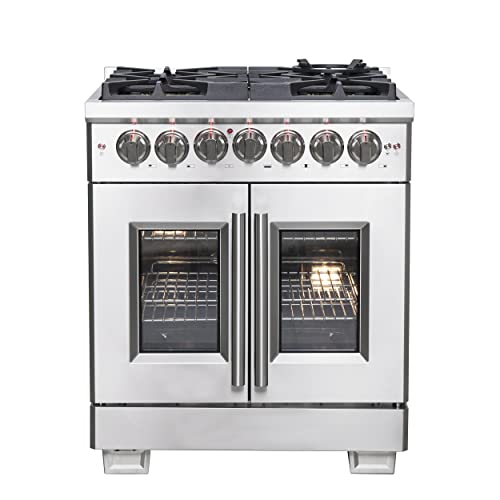
Capriasca 30-Inch French Door Dual Fuel Range (4.32 Cu. Ft.) — Best French-Door Dual Fuel (Verified)
Now the other meaning of the keyword, with the label in lights: this Capriasca is a French-door range, which describes how its oven opens — two doors hinged at the sides, parting in the middle — and not where it was made. What it offers is genuinely useful. French doors let you open the oven with one hand and stand closer to the cavity, without a drop-down door between you and the food, which cooks with limited mobility or a narrow galley kitchen feel immediately.
The cooking specification is the classic dual-fuel argument in a 30-inch body: a gas cooktop for flame control, and a 4.32 cu. ft. true-convection electric oven for even baking. It is the format professional-style home ranges made popular, here in a verified listing you can actually buy online — the practical counterpoint to everything above it in this guide.
Strengths
- French-door access is one-handed and galley-friendly
- Dual fuel pairs gas hob control with an even electric oven
- Verified Amazon listing — a normal purchase with normal delivery
Trade-offs
- French-door is a door style, not French manufacture — buy it for the right reason
- Two doors mean two seals and handles to keep aligned and clean
- Smaller brand than the mainstream giants; check service arrangements
| Format | 30-inch range with French-door oven design |
| Oven capacity | 4.32 cu. ft., true convection |
| Fuel | Dual fuel — gas cooktop with electric oven |
Judge this range as what it is and it judges well: a well-specified, good-looking dual-fuel range whose door design solves real ergonomic problems. The one-hand opening is the feature owners mention years later, especially when carrying a tray with the other hand.
Choose it if the French-door function — not French origin — is what your search actually meant, and you want it verified and buyable today. The induction model below is the same door idea on a different fuel logic.
Best for: buyers who want French-door oven access and dual-fuel cooking in a standard 30-inch range / Not suited for: buyers seeking a French-made range — this is a door style, honestly labelled
Check the current price on Amazon

Forno Torino French Door 36-Inch Induction Range — Best French-Door Induction (Verified)
The Forno Torino takes the French-door format to its modern conclusion: a wide 36-inch body, an induction cooktop, and a true-convection oven whose verified listing adds air fry and air sous vide modes. Again, the label discipline: Forno is an Italian-styled brand, ‘French door’ describes the oven doors, and nothing about this range was made in France. What was made, on the evidence of the listing, is a thoroughly contemporary large range.
Induction plus French doors is a thoughtful pairing. Induction keeps the kitchen cooler and the cooktop surface comparatively safe to brush against while reaching into an oven you can stand close to — the doors’ whole point. The air sous vide mode reflects how these wide ranges are actually used now: long, gentle, sealed-bag cooking alongside the roasts and trays.
Strengths
- Induction speed and control in a wide 36-inch format
- French doors plus true convection, air fry and air sous vide
- Verified listing — buyable through normal online channels
Trade-offs
- 36 inches needs a 36-inch gap — measure before falling in love
- Induction requires magnetic cookware
- French-door, not French-made — the guide’s standing distinction applies
| Format | 36-inch range with French-door oven design |
| Cooktop | Induction |
| Oven features | True convection, air fry, air sous vide (per verified listing) |
This is the pick for the buyer whose ‘French range’ search really meant ‘a range with presence and those doors, please, and modern cooking’. It delivers theatre and technology together, with a purchase process measured in days rather than a dealer’s months.
Between the two verified picks: choose the Capriasca for gas-flame cooking in a 30-inch gap; choose the Torino for induction, width and the fuller modern feature set.
Best for: buyers who want the French-door format with induction and a wide, modern feature set / Not suited for: 30-inch gaps, gas loyalists, or anyone seeking French manufacture
Check the current price on Amazon
Comparison Table
| Pick | Badge | Key spec | Best for |
|---|---|---|---|
| La Cornue Château Series | Best True French Luxury | Bespoke, built to order in France; dealer-sold | major kitchen projects where the range is the heirloom centrepiece and budget is secondary |
| Lacanche Classic Ranges (Cluny and Sully Families) | Best Traditional French | Built in France; configured by width, hob and ovens via dealer | serious cooks who want a true French range specified around their cooking |
| La Cornue CornuFé Series | Best Accessible French Brand | Standardised La Cornue line; set sizes and formats | buyers who want genuine La Cornue character through a normal premium retail purchase |
| Lacanche Modern and Compact Formats | Best French for Smaller Kitchens | Compact widths within the Lacanche dealer range | smaller kitchens whose owners want a genuine French range without the flagship scale |
| Capriasca 30-Inch French Door Dual Fuel Range (4.32 Cu. Ft.) | Best French-Door Dual Fuel (Verified) | 30-inch, 4.32 cu. ft. true convection, dual fuel, French-door oven | buyers who want French-door oven access and dual-fuel cooking in a standard 30-inch range |
| Forno Torino French Door 36-Inch Induction Range | Best French-Door Induction (Verified) | 36-inch, induction, French-door oven, true convection, air fry | buyers who want the French-door format with induction and a wide, modern feature set |
How to Choose the Best French Range Cookers: First, Decide Which ‘French’ You Mean
Every decision in this category flows from one question, so ask it before all others: do you want a range made in France, or a range with French doors? The first is a bespoke appliance bought through a dealer as part of a kitchen project, at a project tier, on a project timeline. The second is a mainstream appliance bought online this week. Confusing the two — in either direction — is the category’s only truly expensive mistake, and it happens because listings and search results use ‘French’ loosely. This guide never does, and neither should your shortlist.
If the answer is French-made, the next questions are about the project, not the product: Is a dealer for the house within reach, and have you spoken to them about installation and service in your area? Does your kitchen project budget honestly include the range, its delivery and installation, and any fuel or ventilation work it requires? Is your timeline measured in seasons rather than weeks? Three yeses make you a French-range buyer. Any no makes the mainstream alternatives below the wiser conversation.
If the answer is French-door, shop it like any range: width first, fuel second — gas, dual fuel or induction — then oven capacity and the door mechanics themselves. Open and close display models if you can; French doors vary in how their handles meet and how the two sides synchronise, and the good ones feel like one motion, not two.
Inside a True French Range: What the Money Actually Buys
It is fair to ask what a bespoke French range offers that a premium mainstream range does not, because the honest answer has several parts. Materials and mass: heavy enamelled steel bodies, substantial cast iron and brass, built to be serviced and re-enamelled rather than replaced. Configuration: ovens and hobs combined to your cooking — a gas oven beside an electric one, a plancha beside burners, a dedicated low-temperature or simmer capability — in a single body. Longevity: these houses support their ranges for decades, and a French range is one of the few appliances that can anchor a kitchen for a generation.
What the money does not buy is automation. A French range is a manual instrument: fewer programs, fewer sensors, no app. Its philosophy is that heat, mass and control belong to the cook. Buyers who love that philosophy find the ranges endlessly satisfying; buyers who want the oven to run a program while they do something else are better served by the premium mainstream, and there is no shame in either preference — only in discovering yours after the purchase.
There is also a quieter, practical pleasure in these ranges that owners mention and brochures underplay: they are unusually repairable. Burners, igniters, thermostats and enamel panels are individual, replaceable components rather than sealed modules, and the houses’ long production runs mean those components stay available. In a decade when most appliances are designed as disposable assemblies, a range designed as a maintainable machine is a genuinely different ownership proposition — and for many buyers it, rather than the enamel, is what finally justifies the tier.
Resale and renovation logic deserve one cool sentence: in a high-end kitchen renovation, a genuine French range is one of the few appliances that functions as a design asset in its own right, named in listings the way a fireplace is. That is not a cooking argument, but for project buyers it is a real part of the calculation.
The French-Door Design: Ergonomics, Seals and Daily Life
French doors earn their place on ranges for one ergonomic reason: access. A conventional drop-down oven door puts a hot horizontal surface between you and the food; you lean over it, trays travel further, and in a narrow galley the open door eats the walkway. Side-hinged doors part in the middle, open with one hand — often with both doors linked to a single handle motion — and let you stand close, which matters most to cooks with limited reach or strength and to anyone loading heavy roasting pans.
The design’s costs are mechanical. Two doors mean two hinges, two seals and a meeting point in the middle that must align to keep heat in; over years, that is more hardware to keep clean and adjusted than one door. The doors also swing sideways, so check clearance against adjacent cabinet handles and island edges — a French-door range in a tight corner can trade one access problem for another.
Daily life adds small verdicts: the doors are easier to wipe than a drop-down door’s inner glass jungle, children find the handles interesting (check for a control lock if that matters), and the theatrical pleasure of the parting doors is real and, owners report, does not wear off. It is a legitimate reason to choose the style — kitchens are allowed to be enjoyed.
Fuel Choices on French and French-Door Ranges
True French ranges are traditionally dual-fuel in the original sense and often beyond it: gas hobs with electric ovens is the classic configuration, but the bespoke houses will build combinations — all-gas, induction hobs, mixed oven formats — that mainstream catalogues never offer. That configurability is a core part of what you are buying, and the dealer conversation should start from how you cook: the sauces that want a true simmer, the breads that want a particular oven character, the plancha cooking that wants a dedicated plate.
On the verified French-door side, the fuel choice is the familiar modern triangle. Gas gives flame and familiarity; dual fuel — the Capriasca’s formula — pairs a gas hob with an electric oven’s evenness; induction — the Torino’s — gives speed, control and a cooler kitchen, at the price of magnetic cookware. None of these is the ‘French’ choice in any cultural sense; they are engineering choices, and the guide’s picks are arranged so you can make yours cleanly.
One infrastructure note applies to both worlds: serious ranges of any origin want serious ventilation. A wide, powerful hob under a weak hood fills a kitchen with heat and grease regardless of the badge, so budget the extraction alongside the range, and on bespoke purchases let the dealer’s site survey confirm it.
Buying a Bespoke Range: The Dealer Process, Step by Step
Because the French-made route has no checkout button, first-time buyers benefit from the map. Step one is the dealer conversation: your kitchen, your cooking, your fuel supply, your timeline. Step two is configuration — the house’s formats narrowed to a specification with colours and trims chosen, ideally seen in person, because enamel colours in a showroom and enamel colours in a photograph are cousins, not twins. Step three is the site survey and the written, complete figure: range, delivery, installation, any fuel or ventilation work, in one number you can compare honestly against alternatives.
Step four is patience, structured: a build and shipping timeline measured in months, during which the kitchen work proceeds around the confirmed specification. Step five is installation day and commissioning — the dealer verifies the installation, levels and tests the range, and walks you through its operation and care. Keep every document; with an appliance designed to serve for decades, the paperwork is part of the asset.
Throughout, the service question stays on the table: who, specifically, services this range in your area in year ten, and how do parts travel? The houses and their importers have real answers. A buyer who hears them clearly can purchase with confidence; a buyer who cannot get them should pause, whatever the enamel looks like.
Budget Tiers: From Verified Mainstream to Bespoke
We print no prices in this program — they change too often to print honestly, and for bespoke ranges a single price barely exists. The tiers, though, are stable and worth stating in words. The verified French-door ranges sit at the mainstream premium tier: real money, but recognisable appliance money, with online purchase and standard delivery logic. The CornuFé line sits a clear step above, in specialist-retail territory. The bespoke houses — Lacanche’s configured ranges and La Cornue’s Château above all — occupy the project tier, where the range is budgeted like the kitchen cabinetry, not like an appliance.
The useful discipline is to compare complete figures within a tier: delivered, installed, ventilated, warranted. A bespoke range’s headline figure and a mainstream range’s headline figure exclude different things, and the gap between the tiers is large enough that cross-tier comparisons mostly serve to clarify which buyer you are — which, as the first guide section said, is the decision everything else follows from.
How to Plan a Kitchen Around a French Range (or a French-Door Range)
Start with the tape and the truth about your space. Measure the range gap, the doorways and turns on the delivery path, and the swing clearance on both sides — bespoke ranges are heavy and wide, and French doors need their lateral room. Photograph and measure the existing fuel and electrical supplies; a dealer or installer can tell you more from those photographs than from a dozen descriptions.
Decide the range before the cabinetry is finalised. In a French-range project the appliance is the anchor: its width, colour and configuration drive cabinet runs, worktop heights and the ventilation design. Even in a mainstream French-door purchase, confirming the exact model early lets the kitchen plan absorb its door swings and clearances instead of discovering them.
Plan ventilation as part of the range, not after it. Agree the hood’s size, power and duct route with the same people supplying the range, and if the kitchen is small or open-plan, discuss make-up air — powerful extraction in a sealed modern home needs air to replace what it removes.
Finally, plan the first month of ownership. Bespoke ranges come with a dealer’s commissioning and a learning curve: new oven characters, new hob behaviours, enamel care that differs from stainless habits. Cook your familiar dishes first, note how the new instrument differs, and let the range teach you its ways before the first dinner party depends on them.
Common Buying Mistakes
Searching ‘French range’ and buying a French-door range by accident — or the reverse. The two products share two words and nothing else. Decide which you mean before you look at a single listing, and check origin claims against the manufacturer, not the marketplace title.
Assuming a bespoke French range can be ordered like an appliance. It is configured, surveyed, built and installed. Starting that process on an appliance timeline is how kitchen projects stall.
Skipping the service question. On a decades-long appliance bought through importers, ‘who services this near me, and how do parts arrive?’ is a first-conversation question, not an afterthought.
Judging French-door ranges by the doors alone. The doors are the access story; the fuel, oven and build still decide the cooking. Shop the whole range, then enjoy the doors.
Forgetting door-swing clearance. French doors open sideways into your cabinet runs. Measure the swing against handles, islands and corners before the range arrives.
Under-speccing ventilation for a powerful range. Great hobs under weak hoods make smoky, greasy kitchens. Budget extraction with the range, in both the bespoke and mainstream worlds.
Final Recommendation
If your heart and project are set on the genuine article, the map is clear: La Cornue’s Château for the full bespoke ceremony, Lacanche for a serious cook’s configured French range, the CornuFé for La Cornue character through a normal premium purchase, and Lacanche’s smaller formats where space is tight. All four routes run through dealers, all four reward patience, and none of them involves a checkout button — which is precisely what makes them what they are.
If your search meant the doors, buy with confidence from the verified pair: the Capriasca for dual fuel in 30 inches, the Forno Torino for induction and width at 36. They are good ranges, honestly labelled, and they will be cooking this month. Check the current price on Amazon for either before you decide — and for the French houses, let your first step be a dealer’s phone call, not a search result.
Capriasca 30-Inch French Door Dual Fuel Range (4.32 Cu. Ft.) — Check the current price on Amazon
Forno Torino French Door 36-Inch Induction Range — Check the current price on Amazon
Best Freestanding Electric Cookers Best Dual Fuel Cookers 60cm Best Electric Range Cookers Best Freestanding Cookers Best Griddle Cookers
Frequently Asked Questions
What is a French range cooker?
A range cooker made in France by houses such as La Cornue and Lacanche — typically enamelled, heavily built, configured to order and sold through dealers. The term describes origin and construction. It is not the same as a ‘French door’ range, which describes an oven door style on a mainstream appliance made anywhere.
Why can’t I buy a La Cornue or Lacanche on Amazon?
Because that is not how these appliances are sold. They are configured with a dealer for fuel, size, colour and trim, built in France, and delivered and installed through the dealer network. A standard marketplace listing cannot represent a bespoke configuration, so this guide describes them as a pick without a link and points you to the dealer route.
Are French-door ranges made in France?
Generally, no. ‘French door’ names the pair of side-hinged oven doors, borrowed from the doors of French country houses. The ranges themselves come from mainstream and Italian-styled brands — the two verified picks in this guide are examples — and should be bought for their door ergonomics and cooking specification, not for any French origin.
Is a bespoke French range worth it compared with a premium mainstream range?
It depends what you are buying. For cooking automation and service convenience, premium mainstream ranges are excellent and simpler to own. The French houses sell materials, configuration freedom, craft and longevity — an appliance as a generational object. Buyers who value those things find them worth it; buyers who do not should not be talked into them.
What should I ask a French range dealer first?
Three things: who installs and services the range in your area, and how parts are supplied over the long term; what the complete delivered-and-installed figure includes; and what the realistic timeline is from configuration to first cook. A good dealer answers all three precisely — that precision is part of what the tier buys.
Can a French-door range go in a small kitchen?
The doors themselves suit small, narrow kitchens well — they open without claiming the walkway a drop-down door takes. The checks are lateral: door swing against neighbouring cabinets, and the range’s width against your gap. The 30-inch Capriasca in this guide is the size most small kitchens will be shopping.


