Disclosure: airfryerkitchensupply.com is reader-supported. When you buy through links on our site, we may earn an affiliate commission at no extra cost to you.
Where to buy
Shopping for the best four slice toasters? Every model linked below had its ASIN verified against Amazon’s own catalogue data before this guide was written, so each link lands on the exact model described — not a two-slice sibling or a lookalike variant. Prices on countertop appliances move with promotions and colour choices, so this guide never prints a fixed figure; use the links to see the live price and finish options for each toaster.
- Cuisinart 4-Slice Stainless Steel Toaster, CPT-180P1 — check price on Amazon
- BLACK+DECKER 4-Slice Toaster with Extra-Wide Slots — check price on Amazon
- Dualit Classic 4 Slice NewGen Toaster — check price on Amazon
- SMEG TSF02 4 Slice Long Slot Toaster — check price on Amazon
- Hamilton Beach 4 Slice Toaster (24796) — check price on Amazon
- KitchenAid 4-Slice Manual Lift Toaster, KMT4115 — check price on Amazon
The best four slice toasters solve a very specific morning problem: two people, or one person and a bagel habit, who do not want to queue for breakfast. A four-slice machine toasts a full round for a couple, a pair of bagels, or four slices for a family in one cycle, and the good ones do it with two independently controlled halves so nobody has to compromise on shade. This guide compares six verified four-slice models across the real decision points — slot layout, browning consistency, lift height, footprint and how honestly each machine handles thick artisan bread.
Four-slice toasters come in two layouts, and choosing between them matters more than any single feature. Standard four-slot models carry four short slots in a wide body; long-slot models carry two long slots that each fit two slices side by side or one long slice of sourdough. Both layouts appear below, labelled clearly, because a household that bakes wide farmhouse loaves and a household that toasts sandwich bread need different machines even though both are shopping the same keyword.
In this guide
Quick Picks — the best four slice toasters
Best Overall: Cuisinart 4-Slice Stainless Steel Toaster, CPT-180P1 — The balanced default for most kitchens: dual independent controls, six shade settings per side and extra-wide slots in a brushed stainless body that suits couples who toast differently. Check price on Amazon.
Best Budget: BLACK+DECKER 4-Slice Toaster with Extra-Wide Slots — The honest budget route into four slices: seven shade settings, a bagel mode and extra-wide slots, in a simple body that costs out at the value tier without feeling flimsy. Check price on Amazon.
Best Premium and Repairable: Dualit Classic 4 Slice NewGen Toaster — The buy-it-for-decades option: hand-built in the UK with replaceable ProHeat elements and a mechanical timer, so a failed element is a repair, not a replacement toaster. Check price on Amazon.
Best for Artisan Bread: SMEG TSF02 4 Slice Long Slot Toaster — The long-slot answer: two long slots take four standard slices or two wide artisan slices, with six browning levels and SMEG’s retro steel body in cream. Check price on Amazon.
Best Digital Controls: Hamilton Beach 4 Slice Toaster (24796) — The digital pick: a display-led control panel with defrost, a bagel setting, Toast Boost lift and auto-shutoff, for households that like their shade setting as a number. Check price on Amazon.
Best for Bagels: KitchenAid 4-Slice Manual Lift Toaster, KMT4115 — The bagel specialist: extra-wide slots, dual independent controls and a manual high-lift lever in KitchenAid’s Empire Red, tuned for thick halves and small items alike. Check price on Amazon.
How These Picks Were Chosen
Every pick below was verified the same way: the brand and model were searched through the airfry site’s Amazon listing data connection, the returned Amazon title was matched word-for-word against the model we intended to write about, and only then was the ASIN used for links. Models whose listings could not be matched with certainty were left out rather than guessed at, and no price, star rating or review count appears anywhere in this guide because all three change too often to print honestly.
The six picks were then spread deliberately across the ways people actually buy a four-slice toaster: one balanced all-rounder, one budget workhorse, one premium repairable machine, one long-slot specialist for artisan bread, one digital model for households that want a display and presets, and one manual-lift model chosen for bagels and thick slices. If two picks look similar on paper, the review text explains the ownership difference — crumb tray access, lever feel, counter footprint — that decides between them in a real kitchen.
The 6 Best Four Slice Toasters, Reviewed
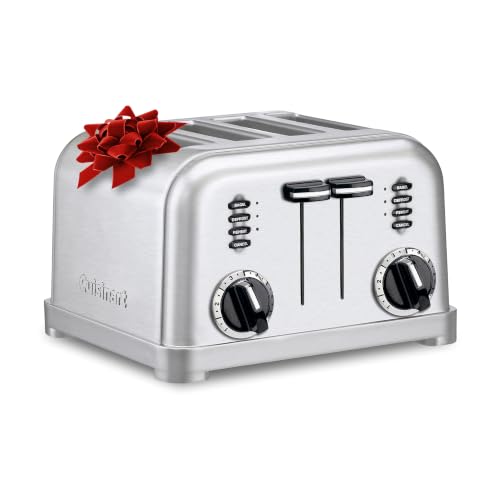
Cuisinart 4-Slice Stainless Steel Toaster, CPT-180P1 — Best Overall
This is the four-slice toaster to buy when nobody in the house has a strong special requirement. The CPT-180P1 runs two completely independent toasting halves, each with its own six-setting browning dial, so one side can produce pale, soft toast for a child while the other side darkens a bagel for an adult. The extra-wide slots take bagels, muffins and reasonably thick sliced bread without forcing, and the brushed stainless housing wipes clean and does not date the way coloured plastic does. It suits couples and small families who toast mixed loads daily; it is less ideal for bakers of very wide artisan loaves, who should look at the long-slot SMEG further down.
Strengths
- Dual independent controls — each pair of slots has its own browning dial and function buttons
- Extra-wide slots handle bagels and thick-cut bread without trimming
- Brushed stainless steel body resists fingerprints better than polished finishes
Trade-offs
- Four short slots cannot take one long slice of sourdough or panettone
- Dial-based shade control is less repeatable than a digital countdown
- Wide body claims real counter depth in a small kitchen
| Format | 4-slice, four short slots |
| Controls | Dual independent, 6-setting browning dials |
| Finish | Brushed stainless steel |
| Slot style | Extra-wide |
What makes this model the overall pick is not any headline feature but the absence of a weak point. Browning across the four slots is even enough that you do not develop a house rule about which slot is ‘the good one’, the high-lift lever raises small items like crumpets and English muffin halves clear of the slots so fingers stay away from hot elements, and the cancel, bagel and defrost functions are separate physical buttons rather than a menu you have to cycle through half asleep. In a household where the toaster runs three or four times before 8 a.m., that directness is the feature.
Ownership details are equally sensible. The crumb trays slide out from the back, which is worth knowing before you push the toaster against a backsplash — leave a few centimetres behind it. The cord is long enough for a normal counter run, and the stainless body stays presentable with a weekly wipe. Buyers who want a visible countdown or a motorised lift should step to the digital or premium picks below; buyers who want the dependable centre of the category should stop here.
Best for: Couples and small families who toast mixed loads and want independent shade control per side / Not suited for: Bakers of wide artisan loaves, or anyone who needs a countdown display
Check the current price on Amazon

BLACK+DECKER 4-Slice Toaster with Extra-Wide Slots — Best Budget
Budget four-slice toasters often cut the wrong corners — narrow slots, a single control for all four slots, or a crumb tray that barely opens. This BLACK+DECKER avoids the worst of those compromises: the slots are genuinely extra-wide, the shade dial runs to seven settings, and there is a dedicated bagel mode that toasts the cut side harder than the crust side. It suits first flats, student houses, holiday lets and anyone replacing a dead toaster without wanting a countertop statement piece. It will not satisfy buyers who want metal construction throughout or laboratory-even browning edge to edge.
Strengths
- Seven shade settings give finer control than most budget dials
- Bagel mode and frozen function included at a value-tier price point
- Removable crumb tray makes the weekly empty a ten-second job
Trade-offs
- Lighter construction than the metal-bodied picks in this guide
- Browning can vary slightly between the inner and outer slots on back-to-back cycles
- No countdown or end-of-cycle display — you judge by the pop and the lever
| Format | 4-slice, four short slots |
| Shade settings | 7 |
| Functions | Bagel mode, removable crumb tray |
| Slot style | Extra-wide |
The sensible way to judge a budget toaster is by what a year of breakfasts feels like, and here the BLACK+DECKER holds up well. The lever action is positive, the toast boost-style lift keeps small slices reachable, and the shade dial’s seven stops mean the difference between ‘warm bread’ and ‘properly crisp’ is findable rather than a coin toss between two dial positions. Bagel mode is the pleasant surprise at this tier: many cheap toasters simply toast both sides equally and scorch the crust, while this one biases heat to the cut side as a bagel setting should.
Where the budget shows is in materials and in repeat-cycle consistency. Run four consecutive full loads — a brunch for guests — and later loads may come out a touch darker at the same setting, a common trait of simpler thermostats; dropping the dial half a step for the second batch is an easy habit. The body is lighter and more plastic-forward than the Cuisinart or Dualit. None of that stops it being the right answer for a household that toasts daily but would rather spend the difference on the bread itself.
Best for: Budget-conscious households, first kitchens and rentals that still want true four-slice capacity / Not suited for: Buyers wanting all-metal construction or perfect batch-to-batch shade repeatability
Check the current price on Amazon
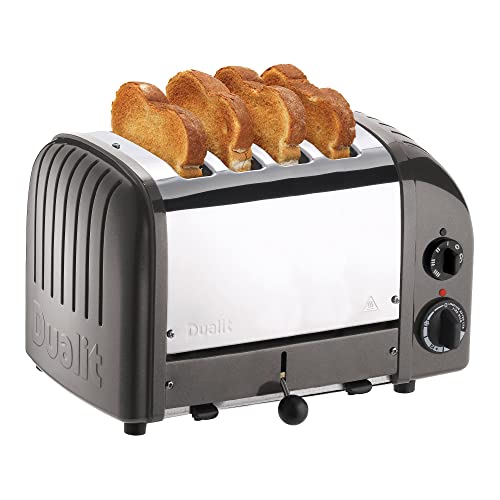
Dualit Classic 4 Slice NewGen Toaster — Best Premium and Repairable
The Dualit Classic is a different species of appliance. Where most toasters are sealed consumables, this one is hand-built in the UK around replaceable ProHeat elements: when an element eventually fails, it can be swapped rather than sending the whole machine to landfill. The mechanical timer gives a tactile, click-set control with an audible end to the cycle, and the selector lets you energise one, two, three or four slots so a solo breakfast does not heat empty slots. It suits buyers who keep appliances for a decade or more and cooks who like mechanical controls; it is the wrong pick for anyone who wants push-button presets or a budget price.
Strengths
- Replaceable ProHeat elements make the toaster repairable for the long term
- Slot selector heats only the slots in use — 1, 2, 3 or 4 slices
- Mechanical timer is simple, tactile and free of electronics to fail
Trade-offs
- Premium-tier pricing, well above the mainstream picks here
- Manual timer demands a little attention — it will not think for you
- Traditional styling and weight will not suit every kitchen
| Format | 4-slice, four short slots |
| Elements | Replaceable ProHeat |
| Control | Mechanical timer with slot selector |
| Build | Hand-built in the UK, stainless steel |
Living with the Dualit recalibrates what you expect from a toaster. The cast ends and steel body feel like workshop equipment, the timer’s ticking is oddly reassuring, and because you choose how many slots to energise, the machine is as happy making one slice as four. The defrost setting handles bread straight from the freezer — the sensible way to keep a good loaf — and the browning, once you learn your timer positions for your breads, is remarkably repeatable because a mechanical timer does not drift with the machine’s temperature the way cheap thermostats do.
The honest costs are money and involvement. This is the premium tier, several times the budget pick, and the manual control loop means a distracted cook can over-toast in a way a sensor-driven machine would prevent. Crumb removal and element replacement are straightforward but hands-on. For the right buyer none of that is a drawback: this is the toaster people buy after their third cheap one dies, and it is priced and built accordingly. Colour variants of the same NewGen model exist; the listing linked here is the charcoal-finish version of the same verified model line.
Best for: Long-term owners who value repairability, mechanical controls and slot-by-slot energy use / Not suited for: Budget buyers or anyone who wants set-and-forget electronic presets
Check the current price on Amazon

SMEG TSF02 4 Slice Long Slot Toaster — Best for Artisan Bread
If your bread comes from a bakery rather than a plastic bag, the TSF02 is the four-slice format you actually need. Its two long slots each accept two standard slices side by side — that is where the four-slice rating comes from — or a single long, wide slice of sourdough, farmhouse or panettone that would have to be cut down or turned halfway in a short-slot machine. Six browning levels plus defrost, reheat and bagel functions cover the normal repertoire, and the retro stainless body is a genuine design object. It suits artisan-bread households and style-led kitchens; high-volume families who want four independent short slots should choose the Cuisinart layout instead.
Strengths
- Long slots fit wide artisan slices whole — no trimming or mid-cycle turning
- Still toasts four standard slices per cycle, two per long slot
- Six browning levels with defrost, reheat and bagel functions
Trade-offs
- Two slots means two heating zones, not four independent ones
- Retro styling is a commitment — it dominates a counter visually
- Premium-tier price for what is mechanically a simpler layout
| Format | 4-slice via 2 long slots |
| Browning levels | 6 |
| Power | 1400W (per listing) |
| Functions | Defrost, reheat, bagel |
The long-slot layout changes breakfast in one specific, delightful way: a thick slice of yesterday’s sourdough goes in whole, and comes out evenly bronzed with the crust intact, instead of emerging as two half-toasted fragments. The self-centring racks grip slices of different thicknesses so a thin crispbread and a fat bagel half both sit centred over the elements. The ball-ended lever and chunky browning knob suit the retro brief, and the automatic pop-up is reliable. For standard sandwich bread, two slices per slot toast side by side with no meaningful penalty versus a four-short-slot machine.
Be honest about the compromises before spending at this tier. Two zones mean you cannot run three different shades at once the way a dual-control four-slot can; a couple with very different tastes toasts in sequence. The cream finish of the verified listing is beautiful and shows crumbs and butter smears more than brushed steel, so it asks for a wipe-down habit. And the footprint runs long rather than wide — measure front-to-back counter space. Bakers will forgive all of it; mixed-shade families should not buy it by mistake.
Best for: Artisan and sourdough bakers who want whole wide slices toasted in one pass / Not suited for: Households needing three or four independently shaded slots at once
Check the current price on Amazon
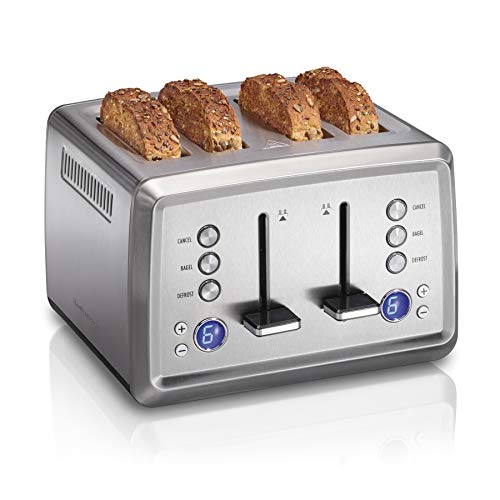
Hamilton Beach 4 Slice Toaster (24796) — Best Digital Controls
Some households run on repeatable settings — ‘my setting is 4’ — and the Hamilton Beach 24796 is built for them. The digital controls make your shade choice explicit and repeatable, the defrost function is a button rather than a guess, and Toast Boost lifts small items higher so muffins and crumpet tops clear the slots. Auto-shutoff adds a layer of reassurance in busy family kitchens. It suits families with children old enough to make their own toast, and anyone who found dial toasters maddeningly vague. Buyers who prefer purely mechanical controls or a long-slot format should look at the Dualit or the SMEG.
Strengths
- Digital controls make shade settings repeatable day to day
- Toast Boost raises small items clear of the slots
- Auto-shutoff and a proper cancel button suit family kitchens
Trade-offs
- Electronics are one more thing to fail than a mechanical timer
- Slide-out crumb tray is shallower than the trays on premium models
- Digital panel styling is more appliance-like than design-led
| Format | 4-slice, extra-wide slots |
| Controls | Digital with defrost function |
| Lift | Toast Boost high lift |
| Safety | Auto-shutoff, cancel button |
The 24796’s party trick is consistency of a particular kind: because the shade is a stored digital value rather than a dial position you nudge by eye, Tuesday’s toast matches Monday’s. That matters in households where several people use the machine and reset each other’s dials. The bagel setting behaves properly, biasing heat toward the cut side, and the extra-wide slots with self-centring guides take thick bagel halves without a squeeze. Defrost adds a gentle first phase for frozen bread instead of blasting it, which keeps the crumb soft inside a crisped crust.
In daily use the slide-out crumb tray is easy enough to keep on top of, and the stainless front panel wipes clean. The trade-offs are the usual digital ones: a control board is a potential failure point a mechanical toaster does not have, and the display is information you may simply not need. Judge it against the Cuisinart above on that basis — dial simplicity versus digital repeatability — because on slots, lift and everyday browning the two are close, and the right answer is about how your household thinks, not which toasts better in a lab.
Best for: Families who want a repeatable numbered shade setting and child-friendly auto-shutoff / Not suited for: Minimalists who prefer mechanical controls with no electronics
Check the current price on Amazon

KitchenAid 4-Slice Manual Lift Toaster, KMT4115 — Best for Bagels
The KMT4115 is the pick for households where bagels, thick muffins and hand-cut bread are the default rather than the exception. The slots are properly extra-wide, the manual lift lever lets you raise the rack to peek and to retrieve small items without tongs or a fork anywhere near the elements, and dual independent controls mean a bagel cycle on one side never dictates the shade of plain toast on the other. The Empire Red finish of the verified listing matches KitchenAid’s other countertop kit. It suits bagel-first breakfast households; buyers wanting a countdown display or long slots should take the Hamilton Beach or SMEG instead.
Strengths
- Extra-wide slots genuinely fit halved bagels and thick hand-cut slices
- Manual high-lift lever doubles as a safe peek-and-retrieve control
- Dual independent controls for the two slot pairs
Trade-offs
- Manual lift means no automatic pop-up drama — you raise it yourself
- Coloured enamel shows toast crumbs and needs regular wiping
- No digital countdown or preset bread-type programmes
| Format | 4-slice, 4 extra-wide slots |
| Controls | Dual independent, adjustable shade |
| Lift | Manual high-lift lever |
| Finish | Empire Red (verified listing) |
Bagels expose weak toasters quickly: a slot that is a few millimetres too narrow shaves the crust, and an under-powered element steams the cut side instead of toasting it. The KMT4115 avoids both failures — halves drop in cleanly, the shade control has enough range to take a bagel from golden to properly dark without burning the crust side, and the manual lever’s high lift means the small, hot halves come up to a height where fingers can take them safely. That lever also becomes a mid-cycle checking tool: lift, look, lower again, with no cancel-and-restart dance.
As an ownership proposition it is a mainstream metal-bodied machine with KitchenAid’s usual fit and finish — tidy cord storage, a crumb tray that slides out for emptying, and a body that feels a class above the budget tier. The red finish is the one on the verified listing; it is a commitment in a neutral kitchen, and it will show every crumb against the enamel, so buy it because you like the colour, not despite it. For bagel households that also toast bread for sandwiches and children, it is arguably the most likeable all-rounder here after the Cuisinart.
Best for: Bagel and thick-slice households that want manual lift control and dual shade zones / Not suited for: Buyers who want automatic pop-up with a digital countdown
Check the current price on Amazon
Comparison Table
Read the layout column first: four short slots and two long slots are both sold as ‘four slice’, but they suit different bread. Then compare controls — dial, digital or mechanical timer — because that is the difference you will feel every single morning.
| Pick | Badge | Key spec | Best for |
|---|---|---|---|
| Cuisinart 4-Slice Stainless Steel Toaster, CPT-180P1 | Best Overall | Dual independent controls, 6 shade settings | Couples and small families who toast mixed loads and want independent shade control per side |
| BLACK+DECKER 4-Slice Toaster with Extra-Wide Slots | Best Budget | 7 shade settings, bagel mode | Budget-conscious households, first kitchens and rentals that still want true four-slice capacity |
| Dualit Classic 4 Slice NewGen Toaster | Best Premium and Repairable | Replaceable ProHeat elements, mechanical timer | Long-term owners who value repairability, mechanical controls and slot-by-slot energy use |
| SMEG TSF02 4 Slice Long Slot Toaster | Best for Artisan Bread | Two long slots, 6 browning levels, 1400W | Artisan and sourdough bakers who want whole wide slices toasted in one pass |
| Hamilton Beach 4 Slice Toaster (24796) | Best Digital Controls | Digital controls, Toast Boost, auto-shutoff | Families who want a repeatable numbered shade setting and child-friendly auto-shutoff |
| KitchenAid 4-Slice Manual Lift Toaster, KMT4115 | Best for Bagels | Extra-wide slots, manual lift, dual controls | Bagel and thick-slice households that want manual lift control and dual shade zones |
How to Choose the Best Four Slice Toasters for Your Kitchen
Start with the bread, not the toaster. Write down what your household actually toasts in a normal week. If it is standard sliced bread, bagels and frozen waffles, a four-short-slot machine with extra-wide slots covers everything and gives you the most flexible shade control. If wide sourdough, farmhouse or bakery loaves feature even twice a week, a long-slot model stops being a luxury and becomes the correct tool, because trimming a slice to fit a short slot wastes bread and toasting in two rotated passes never browns evenly.
Next, count the shade opinions in the house. Dual independent controls — two separately controlled slot pairs — are the single most valuable feature for couples and families, because they end the negotiation over one shared dial. A single-control four-slice toaster is only a good buy for a one-person household or a family that genuinely all eats toast the same colour. Digital controls add repeatability: a numbered setting survives other people using the machine, while a dial gets nudged. Mechanical timers, as on the Dualit, are the connoisseur’s choice — precise once learned, and repairable.
Finally, measure the counter, including the space behind the toaster. Four-slice bodies are wide or long depending on layout, crumb trays usually slide from the rear, and a toaster pushed flush against a backsplash will slowly fill with crumbs you cannot easily empty. Leave clearance, check the cord run to your socket, and decide honestly whether a coloured or retro body will still please you in three years — stainless finishes age the most gracefully.
- Match layout to bread: short slots for sliced loaves, long slots for artisan bread
- Dual independent controls if more than one shade preference lives in the house
- High lift matters if you toast muffins, crumpets or small slices
- Check rear crumb-tray access before choosing the toaster’s parking spot
- Repairable elements (Dualit) change the long-term cost calculation entirely
Slot Width, Lift and Browning: The Specs That Actually Matter
Slot width decides what fits; slot length decides the layout. ‘Extra-wide’ is not a regulated term, so treat it as a direction rather than a guarantee, and favour models whose listings and reviews consistently show bagel halves dropping in without force. Self-centring racks are the quiet heroes here: they grip a thin slice and a thick slice with equal centring, and centred bread browns evenly because both faces sit the same distance from the elements.
Browning consistency has two halves — across the slice, and across the morning. Across the slice, look for even colour corner to corner, which comes from element design and centring. Across the morning, later cycles often toast darker at the same setting as the machine warms up; better thermostats and digital controls compensate, simpler dials do not, and the fix is a small shade reduction for batch two. High lift — manual or boost-assisted — is a safety feature disguised as convenience: anything that keeps fingers and utensils out of a live slot is worth having, especially with children making their own breakfast.
Four Short Slots vs Two Long Slots: Choosing a Layout
The four-short-slot layout is the multitasker: up to four slices, two independent shade zones on dual-control models, and a natural fit for mixed loads — toast on the left, bagel on the right. Its weakness is geometry: nothing longer than a standard slice fits, full stop. The two-long-slot layout trades zones for freedom: two slices of anything, however long, or four standard slices at one shared setting per slot. Households split roughly by bread buying — supermarket sliced points one way, bakery loaves the other.
There is also a footprint difference worth measuring. Short-slot fours are wide and shallow; long-slot fours are narrower but deeper front-to-back, which can matter under low wall cabinets where the toaster’s steam and heat need somewhere to go. Neither layout is superior in the abstract, and this guide deliberately includes both, labelled, so the choice is made on your bread and your counter rather than on a headline.
Living With a Four-Slice Toaster: The First Month, Honestly
Week one with any four-slice toaster is calibration. Every model in this guide will produce one slice that is too pale and one that is too dark while you learn its dialect, because browning settings are not standardised across brands — a 4 on the Cuisinart is not a 4 on the Hamilton Beach, and both differ again between a cold first cycle and a warm third. The households that end up loving their machine are the ones that treat the first week as measurement: same bread, same setting, every slot, results noted. The households that end up returning theirs are usually the ones that judged it on a single slice of an unfamiliar loaf on the morning it arrived.
By week two, patterns emerge that no specification sheet mentions. You will discover which slot pair your household fights over, whether the crumb tray’s rear exit actually clears your backsplash, and whether the lever height suits the shortest cook in the house. Four-slice machines also change shopping: a full loaf suddenly lasts a predictable number of breakfasts, freezing bread in slices becomes worthwhile because defrost settings genuinely work, and the second breakfast shift — teenagers, guests, the second coffee round — stops requiring a negotiation about whose toast goes first.
By the end of the first month, the right toaster disappears. That is the honest test of every pick in this guide: not whether it impresses on day one, but whether by day thirty it has become invisible infrastructure, producing your household’s exact toast with no thought at all. The Dualit owner will have memorised two timer positions; the digital household will argue about whose numbered setting is correct with the confidence of people discussing thermostat wars. Both outcomes are success. The only failure mode is a machine still being discussed at the end of the month — which is why the layout and controls decisions in the buying guide matter more than any feature list.
Four-Slice Toasters and Energy, Noise and Countertop Reality
A four-slice toaster draws serious power for a short time — the models in this programme state figures from 1300W to 1800W — and on a shared kitchen circuit with a kettle and a microwave, simultaneous use can trip a breaker in older homes. The practical habit is sequencing: kettle first, toaster second, microwave whenever, rather than all three at the same moment. Slot selection, where a model offers it as the Dualit does, is the other energy lever: heating two slots for one slice wastes a third of the cycle’s energy for the machine’s whole life, which compounds across thousands of breakfasts into a real, if modest, saving.
Noise is the unreviewed specification. Pop-up springs, timer bells, electronic beeps and the clatter of a manual lever all land differently in an open-plan flat at 6 a.m. Mechanical timers tick — some sleepers hear it through a wall, most cooks find it companionable. Digital models beep; check whether the beep can be muted if your household includes shift workers. None of this appears on a box, and all of it is lived with daily, which is why this guide names the control type of every pick as a first-class fact rather than a footnote.
Countertop reality finishes the picture. A four-slice body is a permanent resident, not a cupboard appliance, in most kitchens — it is used too often to store. That permanence is an argument for the finishes that age well (brushed stainless first among them), for cord management that does not leave a tail across the worktop, and for honest measurement of the parking spot including the steam path upward. Toasters vent heat and moisture through their slots; a low wall cabinet directly above will collect condensation and, over years, suffer for it. Give the machine air, and it will give you a decade.
- Sequence high-draw appliances on older circuits — kettle, then toaster
- Use slot selection where offered; heating empty slots is a lifetime waste
- Check digital beep behaviour if the household includes light sleepers
- Leave headroom above the slots for steam and heat to escape
Cleaning and Care: Keeping a Four-Slice Toaster Browning Evenly for Years
Most ‘my toaster toasts unevenly now’ complaints are crumb complaints in disguise. Crumbs accumulate on the floor of the slots and around the elements, where they insulate patches of the element and scorch into dark spots that shadow the bread. The weekly crumb-tray empty in the how-to section prevents most of it; the monthly habit that completes the job is unplugging the cooled machine, turning it gently over a bin and tapping the base — never shaking it hard, which bends elements — then wiping the top plate where butter and jam migrate. A toaster cleaned this way browns in year three the way it browned in week one.
The exterior deserves the same realism. Brushed stainless wants a microfibre cloth along the grain and nothing abrasive; coloured enamel wants crumbs wiped before they bake onto a warm surface; polished finishes want fingerprints accepted as a lifestyle or a cloth kept nearby. What no toaster wants is water inside it — a damp cloth on the exterior only, ever, and the machine fully dry and cool before it is plugged back in. Treat the appliance like the small electric fire it technically is, and it will repay the respect with a decade of identical breakfasts.
How to Set Up and Use a Four-Slice Toaster Well
A few habits separate people who love their toaster from people who tolerate it. Work through the setup once, and the machine will reward you every morning after.
- Run two empty cycles on a medium setting in a ventilated space before first use — new elements carry manufacturing residues that should burn off away from your breakfast.
- Find your shade numbers bread by bread: toast one slice of each regular bread at a mid setting, note the result, and write the winning settings on a card kept near the machine.
- Use the bagel function for bagels and muffins — it biases heat to the cut side so the crust stays chewy instead of crisping into a shell.
- Use defrost for frozen bread rather than a higher shade; the gentle first phase thaws the crumb so the surface does not scorch while the centre is still icy.
- Drop the shade half a step for second and third consecutive batches — a warm toaster toasts faster at the same setting.
- Empty the crumb tray weekly, and never shake the toaster over the counter; crumbs in the base are the main cause of stale smells and uneven browning over time.
Store the toaster with the lever up and the cord loosely coiled, and keep the top clear — slots vent heat upward, so a tea towel draped over a warm toaster is both a browning problem next time and a safety problem now. If a slice ever jams, unplug first, let the machine cool, and free it with a wooden utensil; metal near elements is never worth the risk.
Common Buying Mistakes
Buying four slots when you needed two long ones. The most common regret in this category is a baker forcing wide loaves into short slots. Decide by bread first; capacity second.
Sharing one dial between two shade opinions. Single-control four-slice toasters save a little money and cost a small argument every morning. Dual controls are worth it for couples.
Judging shade by the first slice of the day. A cold toaster toasts paler than a warm one. Set your expectations — and your dial — by the second cycle, and ease off for batches.
Ignoring crumb tray access. A tray that slides from the rear is useless if the toaster lives against the wall. Check where the tray exits before you park the machine.
Using metal utensils to fish out toast. Forks and elements do not mix. High-lift levers, wooden tongs or simply unplugging and upending the cooled toaster are the safe retrievals.
Final Recommendation
For most kitchens the Cuisinart CPT-180P1 is the answer: dual controls, wide slots, honest stainless construction and no learning curve. Households counting cost should take the BLACK+DECKER and spend the savings on better bread, while buyers settling in for a decade should take the Dualit and its replaceable elements seriously. Bakers: the SMEG TSF02’s long slots will change your mornings. Families who run on numbered settings should choose the Hamilton Beach 24796, and bagel households will be happiest with the KitchenAid KMT4115’s wide slots and manual lift.
Whichever model you choose, buy the layout that matches your bread and the controls that match your household — those two decisions matter more than any single specification, and every pick above was verified so the link you follow is the machine you just read about.
Start with the headline picks: Cuisinart 4-Slice Stainless Steel Toaster, CPT-180P1, Dualit Classic 4 Slice NewGen Toaster, SMEG TSF02 4 Slice Long Slot Toaster.
Keep exploring: Best Four Slice Toasters Models Best Toasters Best 2 Slice Toasters Best Long Slot Toasters Best Toaster Ovens
Frequently Asked Questions
Is a four-slice toaster worth it for a two-person household?
Usually, yes — not for volume but for simultaneity. Two people can toast different items at different shades at the same time, which a two-slice machine cannot do. If you always eat the same thing at the same shade, a good two-slice is enough and saves counter space.
What is the difference between four short slots and two long slots?
Four short slots toast up to four standard slices, often with two independent shade zones. Two long slots toast two slices of any length — including wide artisan bread — or four standard slices side by side in pairs. Choose by the bread you buy, not by the headline capacity.
Why does the second batch of toast come out darker?
The elements and cavity are already hot, so the same setting delivers more browning. Better machines compensate electronically; on simpler models, drop the shade half a step for consecutive batches and the results even out.
Can a four-slice toaster handle bagels properly?
Yes, if the slots are genuinely extra-wide and it has a bagel function that biases heat to the cut side. Every pick in this guide has wide slots; the KitchenAid and Cuisinart are the strongest bagel performers of the six.
How long should a four-slice toaster last?
A mainstream metal-bodied model should give many years of daily service with weekly crumb-tray emptying. The Dualit is the exception that proves the rule: its elements are replaceable, so its working life is measured in decades rather than product cycles.
Do I need a defrost function?
If you freeze bread — the best way to keep good bread — yes. Defrost runs a gentle thaw phase before toasting, so the centre is soft and the surface crisp. Without it, frozen slices scorch outside while staying cold in the middle unless you toast twice at low settings.


