Disclosure: airfryerkitchensupply.com is reader-supported. When you buy through links on our site, we may earn an affiliate commission at no extra cost to you.
Where to buy
This shortlist of the best flushing toilets for residential use answers a narrower question than a general best-toilet list: which strong-flushing toilets drop into a typical home with the least friction — standard rough-ins, honest dimensions, and configurations that solve the common replacement problems, from sweating tanks to odd rough-in distances. Every linked model was verified as a complete toilet through the airfry site’s Amazon record. Check the current price on Amazon for the configuration you need, and measure your rough-in before you order anything.
- Kohler Wellworth Round-Front 1.28 GPF Toilet with Insuliner (K-3997-U-0) (Best for Homes With Sweating Tanks) — Check the current price on Amazon
- Kohler Wellworth Round-Front Dual-Flush Toilet (K-3987-RA-0) (Best Everyday Dual-Flush Replacement) — Check the current price on Amazon
- Kohler Wellworth Round-Front 1.28 GPF Toilet, 14-Inch Rough-In (K-3947-RA-0) (Best for 14-Inch Rough-In Homes) — Check the current price on Amazon
- American Standard Cadet PRO Right Height Elongated 1.6 GPF Toilet (Best Straightforward Full-Flush Replacement) — Check the current price on Amazon
- Los Flexi 17.9-Inch ADA Two-Piece Elongated Toilet, 1.28 GPF (Best Comfort-Height Replacement for Family Homes) — Check the current price on Amazon
- SierraSquad 15-Inch Round Front Two-Piece Toilet, 1.28 GPF (Best for Small Residential Bathrooms) — Check the current price on Amazon
Most people shopping for the best flushing toilets for residential use are not building a dream bathroom. They are replacing a toilet that double-flushes, rocks, sweats, or simply embarrasses them when guests visit — and they want the swap done in an afternoon with no surprises. That replacement lens changes what ‘best’ means: fit and forgiveness matter as much as flush engineering, because the best-performing toilet in the world is a bad purchase if its rough-in is wrong for your flange.
So this guide is organised around the situations real replacements fall into. A standard 12-inch rough-in with a sound flange is the easy case, and two picks serve it directly. Older homes add wrinkles: tanks that sweat in humid summers, rough-ins that measure 14 inches instead of 12, and small bathrooms where the original round bowl was chosen for a reason. There is a verified pick for each of those cases below, plus a comfort-height option for the household whose users have changed since the last toilet went in.
A note on scope: this article deliberately overlaps as little as possible with the long-term-ownership residential guide in the same cluster. That guide weighs quietness and decades of service; this one weighs the purchase-and-install experience in an ordinary home. If you are mid-renovation with walls open, the wall-hung guide in this cluster is the more relevant read.
In this guide
Quick Picks
- Kohler Wellworth Round-Front 1.28 GPF Toilet with Insuliner (K-3997-U-0) — Best for Homes With Sweating Tanks: The classic Wellworth round-front with Kohler’s Insuliner tank insulation — the replacement for bathrooms where summer humidity leaves puddles under the tank. — Check the current price on Amazon
- Kohler Wellworth Round-Front Dual-Flush Toilet (K-3987-RA-0) — Best Everyday Dual-Flush Replacement: The Wellworth platform with a dual-flush valve and Class Five flush technology — the default replacement for a typical home that wants lower water use without changing anything else. — Check the current price on Amazon
- Kohler Wellworth Round-Front 1.28 GPF Toilet, 14-Inch Rough-In (K-3947-RA-0) — Best for 14-Inch Rough-In Homes: A genuine 14-inch rough-in configuration of the Wellworth — the pick for older homes where the flange sits too far from the wall for a standard toilet. — Check the current price on Amazon
- American Standard Cadet PRO Right Height Elongated 1.6 GPF Toilet — Best Straightforward Full-Flush Replacement: A Right Height elongated Cadet PRO at the full 1.6 GPF volume — the no-drama replacement for homes whose old toilet was a full-flush model and whose drains liked it that way. — Check the current price on Amazon
- Los Flexi 17.9-Inch ADA Two-Piece Elongated Toilet, 1.28 GPF — Best Comfort-Height Replacement for Family Homes: A tall 17.9-inch comfort-height two-piece with a siphon jet flush on a standard 12-inch rough-in — the replacement for households that have outgrown a low, old toilet. — Check the current price on Amazon
- SierraSquad 15-Inch Round Front Two-Piece Toilet, 1.28 GPF — Best for Small Residential Bathrooms: A compact 15-inch round-front two-piece with a side flush and soft-close seat, built for the small bathrooms where a standard toilet crowds the room. — Check the current price on Amazon
How These Picks Were Chosen
Verification followed the same rule as every guide in this programme: Amazon record had to describe a complete toilet — tank and bowl, or one-piece — in the exact configuration reviewed. Tank-only listings, bowl-only listings, and parts were excluded. Where a listing states a rough-in, a flush volume, or a feature such as an insulated tank liner, that detail is used; where it does not, nothing has been assumed.
Within the verified shortlist, picks were mapped to replacement scenarios rather than ranked in a single line. A toilet earned its place by being the strongest answer to one common residential situation: the sweating tank, the 14-inch rough-in, the small bathroom, the tall household, the straightforward like-for-like swap. Flush strength remained the entry ticket — every pick clears with a modern siphon or dual-flush design — but no pick is here on flush claims alone.
Prices are not printed, per programme policy, because they move. Each pick is positioned by tier in words, and the links let you check price on Amazon at the moment of purchase, which is the only price that matters for a replacement you intend to install this month.
The 6 Best Flushing Toilets for Residential Use: Easy Replacements for Typical Homes

Kohler Wellworth Round-Front 1.28 GPF Toilet with Insuliner (K-3997-U-0) — Best for Homes With Sweating Tanks
Tank sweat sounds trivial until it rots a bathroom floor. Cold fill water chills the tank porcelain, humid air condenses on the outside, and the drip runs quietly for years. The verified listing for this Wellworth names the fix directly: an Insuliner insulated tank, which lines the tank interior so the outer surface stays closer to room temperature. If your old toilet’s tank rains every summer, this is the replacement that solves the actual problem instead of mopping around it.
Underneath the insulation sits the Wellworth platform — one of the longest-running residential toilet designs in North America, in a water-saving 1.28 GPF round-front configuration. That ordinariness is the virtue for residential use: any plumber knows it, every wear part is on a shelf, and the round bowl keeps the same footprint as the toilet it replaces in older, smaller bathrooms.
The limits are the platform’s age. The styling is unmistakably traditional, the round bowl suits smaller users and smaller rooms better than tall adults, and there is no chair-height seating here. As a like-for-like replacement in a humid climate, though, it is the most precisely aimed pick in this guide.
Strengths
- Insulated tank directly addresses condensation and floor damage
- Proven Wellworth platform with universal parts availability
- Round front matches the footprint of older toilets being replaced
Trade-offs
- Traditional styling that shows its design age
- Round bowl is compact for taller adults
- Standard height only in this configuration
| Specification | Detail |
|---|---|
| Configuration | Two-piece, round front |
| Flush volume | 1.28 GPF (per verified listing) |
| Tank | Insuliner insulated tank (per verified listing) |
| Finish | White (per verified listing) |
Best for: humid-climate homes replacing a toilet with a sweating tank / Not suited for: tall households wanting chair height and an elongated bowl
Check the current price on Amazon

Kohler Wellworth Round-Front Dual-Flush Toilet (K-3987-RA-0) — Best Everyday Dual-Flush Replacement
If the Insuliner model solves the sweating-tank case, this dual-flush Wellworth is the generalist replacement: the same familiar platform, updated with a two-volume flush. The verified listing confirms Class Five Flush Technology and a right-hand trip lever in a two-piece round-front body. In residential use the dual flush maps neatly onto reality — most flushes are liquid-only and can take the reduced volume, while the full flush is there when the bowl needs it.
The replacement experience is the selling point. Dimensions and footprint follow the pattern of millions of installed Wellworths, the tank hardware is conventional, and a future owner or plumber will recognise everything inside the tank. For a home that may be sold within the decade, that familiarity is worth more than an exotic flush engine: nothing about this toilet will ever be a question on a buyer’s inspection.
Dual-flush valves ask slightly more of the user — guests occasionally need the two options explained — and the round-front standard-height format repeats the platform’s usual limits for tall users. Within the brief of an easy, water-trimming replacement for a typical home, those are small prices.
Strengths
- Dual flush cuts water on the majority liquid-only flushes
- Class Five flush platform is proven and familiar
- Like-for-like footprint for millions of existing bathrooms
Trade-offs
- Dual-flush controls can confuse guests briefly
- Round front and standard height limit tall-user comfort
- Styling is safe rather than distinctive
| Specification | Detail |
|---|---|
| Configuration | Two-piece, round front |
| Flush system | Dual flush with Class Five Flush Technology (per verified listing) |
| Trip lever | Right-hand (per verified listing) |
| Finish | White (per verified listing) |
Best for: typical homes wanting a painless, water-saving like-for-like swap / Not suited for: households wanting chair height or an elongated bowl
Check the current price on Amazon
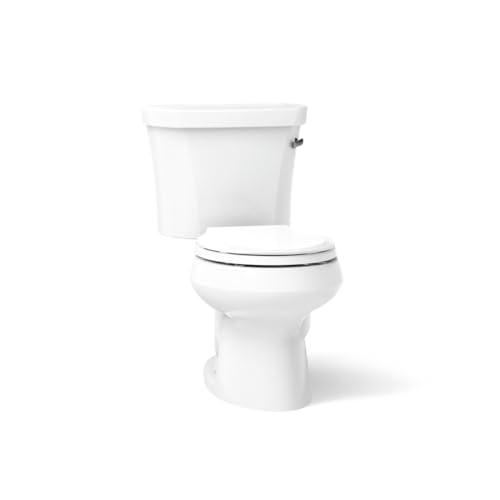
Kohler Wellworth Round-Front 1.28 GPF Toilet, 14-Inch Rough-In (K-3947-RA-0) — Best for 14-Inch Rough-In Homes
Measure from the wall to the centre of the floor bolts before you buy anything: most toilets assume 12 inches, but a meaningful minority of older homes measure 14. Fit a 12-inch toilet on a 14-inch flange and the tank lands inches off the wall, straining the supply line and looking wrong forever. The verified listing for this Wellworth states the answer plainly — a factory 14-inch rough-in configuration of a mainstream platform, at 1.28 GPF, with a right-hand trip lever.
That factory configuration matters more than it sounds. The alternatives are offset flanges, which disturb the drain geometry and are restricted in some jurisdictions, or moving the flange, which is a plumbing project. A toilet built for the rough-in keeps the swap at the difficulty of any other replacement while preserving proper tank support against the wall.
Everything else about the pick is deliberately ordinary Wellworth: round front, two-piece, universal parts. The 14-inch configuration is also less widely stocked than the 12-inch, so order with a little lead time rather than on the morning of installation day.
Strengths
- Factory 14-inch rough-in avoids offset flanges and plumbing work
- Mainstream platform keeps parts and service simple
- 1.28 GPF meets the modern water-saving baseline
Trade-offs
- Less widely stocked than 12-inch configurations
- Round front and standard height only
- Solves one specific problem rather than upgrading everything
| Specification | Detail |
|---|---|
| Configuration | Two-piece, round front |
| Flush volume | 1.28 GPF (per verified listing) |
| Rough-in | 14-inch (per verified listing) |
| Trip lever | Right-hand (per verified listing) |
Best for: older homes whose flange measures 14 inches from the wall / Not suited for: standard 12-inch rough-ins, which have far more choice
Check the current price on Amazon

American Standard Cadet PRO Right Height Elongated 1.6 GPF Toilet — Best Straightforward Full-Flush Replacement
Some replacements should change as little as possible. If the outgoing toilet was a full-flush 1.6 GPF model and the household was happy with how the drains behaved, this Cadet PRO reproduces that experience in a current Right Height elongated body. The verified listing confirms the format: two-piece, elongated front, Right Height seating, 1.6 GPF. The Cadet PRO line is American Standard’s professional channel range, built for installers who cannot afford callbacks.
The upgrade hiding inside the like-for-like brief is the seating. Right Height plus an elongated bowl is the combination most adults now expect, and moving from an old standard-height round toilet to this format is the single most noticeable daily improvement a replacement can make — more noticeable, honestly, than any flush specification.
The full-volume flush is the deliberate trade. It will not win a water-efficiency comparison, and in a drought-priced water district the 1.28 GPF picks in this guide make more sense. Where drains are old and water is not metered punitively, it remains the conservative, proven choice.
Strengths
- Replicates the full-flush behaviour older drains were built around
- Right Height elongated format is a real comfort upgrade
- Professional-line platform chosen by installers for reliability
Trade-offs
- 1.6 GPF is the highest water use in this guide
- Two-piece format with the usual exposed joint
- No water-saving or dual-flush option in this configuration
| Specification | Detail |
|---|---|
| Configuration | Two-piece, elongated bowl |
| Flush volume | 1.6 GPF (per verified listing) |
| Height class | Right Height (per verified listing) |
| Line | Cadet PRO (per verified listing) |
Best for: homes replacing a full-flush toilet on older drain lines / Not suited for: water-conscious households on modern plumbing
Check the current price on Amazon

Los Flexi 17.9-Inch ADA Two-Piece Elongated Toilet, 1.28 GPF — Best Comfort-Height Replacement for Family Homes
Households change faster than toilets. The standard-height toilet installed twenty years ago may now serve taller teenagers, ageing knees, or a parent moving in — and height becomes the reason for replacement all by itself. The verified listing for this Los Flexi states a 17.9-inch comfort height in an ADA-format elongated two-piece, with a 1.28 GPF siphon jet flush and a standard 12-inch rough-in, which means the comfort upgrade does not demand any plumbing change.
The siphon jet design is a sensible residential flush: a jet at the front of the trapway starts the siphon decisively, which is what one-flush clearing actually depends on. At 1.28 GPF it also lands on the modern water baseline, so the height upgrade does not come with a water penalty.
Los Flexi is a value brand rather than a heritage sanitaryware name, so long-term parts support rests on the design’s conventional internals rather than a dealer network — check that the listing’s configuration includes the seat and hardware you expect. The height that helps most adults can also be tall for children, who may need a step in a shared family bathroom.
Strengths
- Tall comfort height transforms daily use for most adults
- Standard rough-in keeps the swap plumbing-free
- Siphon jet flush at the 1.28 GPF water baseline
Trade-offs
- Value brand without a heritage parts network
- Tall bowl can be high for young children
- Confirm included seat and hardware on the listing
| Specification | Detail |
|---|---|
| Configuration | Two-piece, elongated bowl |
| Seat height | 17.9-inch comfort height (per verified listing) |
| Flush volume | 1.28 GPF siphon jet (per verified listing) |
| Rough-in | Standard 12-inch, S-trap (per verified listing) |
Best for: family homes replacing a low toilet for taller or ageing users / Not suited for: households with only small children using the bathroom
Check the current price on Amazon

SierraSquad 15-Inch Round Front Two-Piece Toilet, 1.28 GPF — Best for Small Residential Bathrooms
Small bathrooms punish standard choices. An elongated bowl can steal the inches a door needs to swing or a knee needs in front of the bowl, and the original builder usually fitted a round toilet for exactly that reason. This SierraSquad replacement respects the constraint: the verified listing describes a 15-inch round-front two-piece in ceramic, with a 1.28 GPF siphonic flush, a soft-close seat included, cUPC certification, and a standard 12-inch rough-in.
The side-flush handle placement is a small, real detail in tight rooms, keeping the flush control clear of a tank-top storage shelf or a close side wall. The included soft-close seat also matters disproportionately in small homes, where a slamming lid in a tiled box of a bathroom is loud enough to matter at night.
Compact is a compromise by definition: the round bowl and lower seat will not flatter tall adults, and SierraSquad is a smaller brand whose support runs through the seller rather than a national network. For the second bathroom, the rental unit, or the tight ensuite, the fit is the feature — and this pick fits where the others in this guide cannot.
Strengths
- Compact footprint suits genuinely small bathrooms
- Soft-close seat and certification included in the listing
- Standard rough-in keeps installation conventional
Trade-offs
- Round, lower format is compact for tall adults
- Smaller brand with seller-based support
- Side-flush layout is less standard than top or front levers
| Specification | Detail |
|---|---|
| Configuration | Two-piece, round front, compact |
| Seat height class | 15-inch (per verified listing) |
| Flush volume | 1.28 GPF siphonic flush (per verified listing) |
| Seat | Soft-close seat included (per verified listing) |
| Rough-in | 12-inch (per verified listing) |
Best for: small bathrooms, ensuites, and rentals needing a compact swap / Not suited for: main bathrooms serving tall adults daily
Check the current price on Amazon
Comparison Table
| Pick | Badge | Key spec | Best for |
|---|---|---|---|
| Kohler Wellworth Round-Front 1.28 GPF Toilet with Insuliner (K-3997-U-0) | Best for Homes With Sweating Tanks | 1.28 GPF round-front with insulated tank liner | humid-climate homes replacing a toilet with a sweating tank |
| Kohler Wellworth Round-Front Dual-Flush Toilet (K-3987-RA-0) | Best Everyday Dual-Flush Replacement | Dual-flush two-piece with Class Five flush technology | typical homes wanting a painless, water-saving like-for-like swap |
| Kohler Wellworth Round-Front 1.28 GPF Toilet, 14-Inch Rough-In (K-3947-RA-0) | Best for 14-Inch Rough-In Homes | 1.28 GPF two-piece built for a 14-inch rough-in | older homes whose flange measures 14 inches from the wall |
| American Standard Cadet PRO Right Height Elongated 1.6 GPF Toilet | Best Straightforward Full-Flush Replacement | 1.6 GPF Right Height elongated two-piece | homes replacing a full-flush toilet on older drain lines |
| Los Flexi 17.9-Inch ADA Two-Piece Elongated Toilet, 1.28 GPF | Best Comfort-Height Replacement for Family Homes | 17.9-inch ADA comfort height, 1.28 GPF, standard rough-in | family homes replacing a low toilet for taller or ageing users |
| SierraSquad 15-Inch Round Front Two-Piece Toilet, 1.28 GPF | Best for Small Residential Bathrooms | Compact round-front 1.28 GPF with soft-close seat | small bathrooms, ensuites, and rentals needing a compact swap |
How to Choose the Best Flushing Toilets for Residential Use: Measure First, Buy Second
Every successful replacement starts with three measurements taken before any shopping: the rough-in (finished wall to the centre of the floor bolts — 12 inches standard, 10 and 14 inches the common exceptions), the space in front of the bowl the room can spare, and the footprint the old toilet leaves on the floor, since a new base narrower than the old one’s outline can expose unfinished flooring. The picks in this guide map onto those measurements: standard swaps, a factory 14-inch rough-in, and a compact round-front for tight rooms.
Next, diagnose why the old toilet is going. If the complaint is weak flushing on a sound drain line, any modern pick here fixes it. If the complaint is a sweating tank, the insulated-tank pick is the actual cure. If the complaint is comfort, height and bowl shape are the purchase, and the flush specification is secondary. Replacements fail when they solve the wrong problem beautifully.
Finally, inventory what the box contains. Seat included or less seat, install kit or bare porcelain, lever side — the verified listings state these details, and they decide whether the job finishes in one afternoon or two trips.
- Measure rough-in from the wall, not the baseboard
- Match the pick to the diagnosis: sweat, fit, comfort, or flush
- Confirm seat and install-kit inclusion on the listing
- Photograph the old supply line and angle stop before shopping for parts
- Keep the old toilet until the new one flushes — returns are easier than reinstalls
Rough-Ins, Footprints, and Other Fit Traps in Older Homes
The rough-in is the dimension that cannot be fudged. A toilet built for 12 inches on a 14-inch flange leaves the tank floating off the wall; on a 10-inch flange it may not fit at all. Ten-inch and 14-inch configurations exist across mainstream brands but in fewer styles, which is why this guide carries a dedicated 14-inch pick rather than pretending the standard size fits all.
Footprint surprises run the other way: a new toilet with a smaller base can reveal a ring of unfinished floor or old adhesive where the previous, larger base sat. One-piece and skirted designs usually cover generously; compact two-piece designs cover least. If the floor finish matters, compare base dimensions before ordering, not during installation.
Water supply position is the third trap. A replacement whose fill valve sits where a shelf, cabinet, or the old supply stub conflicts will turn a simple swap into a plumbing visit. A quick photo of the existing installation, checked against the new model’s rear view, prevents nearly all of it.
The Replacement Day Checklist: Parts and Tools That Prevent the Second Trip
Every failed one-afternoon replacement fails the same way: a small, cheap part that nobody bought. The toilet itself is never the problem. Before the old toilet comes out, the complete kit should be on the floor beside you: a new wax ring (the kit included with several picks here covers it), new closet bolts if the old ones are corroded, a new braided supply line, shims, a sponge and bucket for the residual water, and — for the configurations sold less seat — the seat itself. That inventory, checked against the listing’s stated contents, is the difference between a swap and a saga.
Tools are equally unglamorous: an adjustable wrench, a putty knife for the old wax, a hacksaw blade for a seized bolt, and a level. Nothing on that list is specialised, which is precisely the point of the mainstream platforms in this guide — they were designed by companies that expect homeowners and generalist plumbers, not factory technicians, to install and service them.
Stage the job in the order the how-to section sets out, and resist the one temptation that ruins replacements: setting the new toilet ‘temporarily’ on the old wax ring to check the fit. Wax seals once. A dry fit is done without the ring, the ring goes on for the real set, and a toilet that has been lifted off a compressed ring gets a fresh ring before it goes back down.
When a Replacement Reveals a Bigger Problem: Flanges, Floors, and Drain Lines
Removing an old toilet is an inspection you cannot perform any other way, and sometimes it returns bad news. A flange cracked at the bolt slots, a flange sitting well below the finished floor, subfloor that flexes or shows dark water staining, a drain line that reveals roots or scale at the opening — each of these converts a replacement into a small repair project. The correct response is to do the repair. A new toilet set over any of them will rock, leak, or flush into a compromised line, and the toilet will be blamed for all of it.
The flange cases are the most common and the most tractable: repair rings and flange extenders exist precisely because floors get built up over decades of re-tiling, raising the finished surface above the flange the toilet was designed to meet. What does not work is stacking wax rings to bridge the gap — the shortcut most likely to produce the slow, silent leak that rots the floor the new toilet was meant to refresh.
Floor damage is the case for professional help, and there is no shame in the sequencing: toilet out, floor repaired properly, toilet in. The picks in this guide will wait patiently in their boxes. A replacement done in the right order happens once; a replacement done over a bad floor happens twice.
Rentals and Family Homes: How the Replacement Calculus Changes
A toilet replaced in a rental or a home that will be sold within a few years is judged by different mathematics than a forever-home fixture. Durability still matters — a landlord pays for every callback personally — but so do neutrality and familiarity: standard configurations, mainstream platforms, parts any local plumber stocks. That is why the Wellworth and Cadet PRO picks anchor this guide. An exotic flush engine in a rental is a liability wearing a feature list.
In a family home the calculus tilts toward the users in the house: the comfort-height pick for the household that has outgrown a low toilet, the compact pick for the bathroom that never had room. The replacement is the one moment per decade when the bathroom adapts to the family instead of the reverse, and spending the choice on fit rather than novelty is what this guide’s scenario-based picks are for.
Reading a Listing Like an Installer: The Five Lines That Decide the Job
Installers read listings differently from shoppers: they skip the adjectives and hunt five lines. Rough-in first, because it is binary — the toilet fits the flange or the job stops. Bowl shape and height second, because they decide whether the household’s comfort complaint is actually solved. Seat inclusion third, because it decides whether the job finishes today. Lever or button position fourth, because a side wall or a shelf can make a top button the only workable control. And the flush volume fifth — not for performance romance, but because it must suit the drain line the installer can see and the household’s water reality.
Every pick in this guide was documented against those five lines from its verified listing, and the reviews state them in the specs box precisely so a buyer can run the same read in seconds. A listing that will not state one of the five is telling you something about the purchase, and in a replacement — where the old toilet may already be on the lawn — ‘telling you something’ usually means a delay.
The First Week With a New Toilet: What Normal Looks Like
New toilets generate a predictable week of questions, and knowing the normal answers prevents both complacency and panic. A faint tank-refill sound slightly longer than the old toilet’s is a fill-valve characteristic, not a fault — but a refill that repeats on its own, minutes later, is ghost flushing and wants the flapper checked. A flush that swirls more than it surges usually means the waterline sits below its mark. A base that feels solid but shows a hair of movement at the tank on a two-piece is tank-bolt evenness, corrected with alternating quarter-turns, never with force.
The two findings that are never normal are moisture and smell: a damp base perimeter, a wet supply connection, or a sewer-gas note around the bowl all mean the installation needs revisiting now, while the fix is a wax ring and an hour rather than a floor. Check with a dry paper towel daily for the first week — the cheapest inspection in home ownership — and a correct installation will bore you, which is the entire ambition of a residential replacement.
Matching the Replacement to the Decade Ahead of the Household
A replacement toilet will serve the household that exists in ten years, not only the one measuring the rough-in today, and the wisest replacements in this guide are the ones chosen with that household in mind. Young children argue for the standard heights and round bowls that fit them now — but children grow at a rate that makes a decade-long fixture decision based on a five-year-old’s knees a poor trade; the comfort-height picks serve the family’s adults for the whole period and the children, with a step stool’s brief assistance, for a fraction of it. The arrow of time in a family home points toward taller users and older knees, and replacements chosen along the arrow rarely need regretting.
The arrow points the same way for ageing in place. A household expecting a parent to join it, or simply expecting its own knees to age, should read the Los Flexi’s comfort height not as a luxury but as the cheapest accessibility decision it will ever make — taken at the one moment when changing the toilet costs nothing extra. Grab bars can be added any weekend; bowl height can only be chosen on replacement day.
Even the household expecting to move benefits from thinking a decade out, because the buyer who inherits the toilet reads it as the house’s maintenance signature. A mainstream platform, conventionally installed, in a neutral configuration — the Wellworth and Cadet PRO pattern — is the replacement that never becomes a negotiation point. Fit the household you have, lean toward the household you are becoming, and let the toilet disappear into the background of both.
A Note on Timing: When to Replace Before You Must
The best replacement is the one scheduled rather than forced. A toilet announces its retirement in stages — a flush that weakens across a season, a tank that refills uninvited, a hairline of moisture at the base that returns after wiping — and each stage is an invitation to shop calmly: measure the rough-in, read the five installer lines, choose the scenario pick from this guide, and order with delivery slack. The same toilet replaced under emergency conditions costs the household its choice, because the available model that day replaces the right model entirely.
There is also a seasonal rhythm worth exploiting. Bathroom work is pleasanter and plumbers are less besieged outside the holiday-guest season, and a replacement done in a quiet month can be staged over two unhurried sessions — toilet out and flange inspected one day, new toilet in the next — which is the pace at which first-timers make no mistakes. The picks in this guide are stocked, mainstream, and patient. Let the replacement happen on the household’s schedule, and it will feel like the upgrade it is rather than the rescue it nearly became.
How to Replace a Residential Toilet in One Afternoon
A like-for-like residential replacement is one of the most achievable plumbing jobs in a home, provided the flange is sound. Budget an unhurried afternoon for a first attempt, keep towels and a sponge ready, and stop to reassess if the flange turns out to be cracked or below floor level — that discovery changes the job.
- Turn off the angle stop, flush, hold the handle to drain the tank, then sponge the tank and bowl dry into a bucket.
- Disconnect the supply line, unbolt the tank (two-piece) and the base, then rock the old toilet gently to break the wax seal and lift it straight up; plug the open flange with a rag immediately.
- Scrape all old wax from the flange, inspect it for cracks, and test-fit the new bowl dry to confirm rough-in and a rock-free sit.
- Fit new closet bolts, set a fresh wax ring on the flange or bowl horn as the instructions direct, and lower the bowl in one straight motion; sit on it gently to seat the wax before snugging the nuts alternately.
- Mount the tank if two-piece, connect a new braided supply line, open the water slowly, and set the fill level to the tank’s waterline mark.
- Flush repeatedly, checking the base, tank bolts, and supply connections with a dry paper towel; then fit the seat and test the flush with a normal load of toilet paper before calling it done.
Dispose of the old toilet through your local bulky-waste or recycling route — many municipalities take porcelain. Keep the new model’s paperwork with your home records; the next parts purchase, years from now, starts with that model number.
Common Buying Mistakes
Ordering before measuring the rough-in. It is the single most common replacement failure, and it is entirely preventable with a tape measure and thirty seconds. Measure wall to bolt centre, every time.
Assuming the new toilet covers the old footprint. A smaller base can expose unfinished floor. Compare base dimensions when the flooring matters to you.
Reusing the wax ring or the old supply line to save a few minutes. Both are wear items whose failure floods floors. New ring, new line, every replacement.
Overtightening bolts to stop a rock. Porcelain cracks under uneven load. Shim the base level first, then snug the hardware — never use bolt torque as a levelling tool.
Ignoring a damaged flange because the schedule is tight. A toilet set on a broken flange will leak and rock no matter how good it is. Repair the flange first; it is a small job compared with a rotted floor.
Final Recommendation
For the typical home, the dual-flush Wellworth is the default replacement: familiar, water-trimming, and painless to install. Sweating tanks point to the Insuliner Wellworth, a 14-inch rough-in to its dedicated sibling, and older full-flush drains to the Cadet PRO. Households replacing for comfort should take the Los Flexi’s height, and small bathrooms should take the SierraSquad’s compact fit.
Measure first, match the pick to the diagnosis, and check price on Amazon for the exact configuration when you are ready to order. A replacement chosen that way installs in an afternoon and then disappears from your attention for years — which is the whole point.
- Kohler Wellworth Round-Front 1.28 GPF Toilet with Insuliner (K-3997-U-0) (Best for Homes With Sweating Tanks) — Check the current price on Amazon
- Kohler Wellworth Round-Front Dual-Flush Toilet (K-3987-RA-0) (Best Everyday Dual-Flush Replacement) — Check the current price on Amazon
- Kohler Wellworth Round-Front 1.28 GPF Toilet, 14-Inch Rough-In (K-3947-RA-0) (Best for 14-Inch Rough-In Homes) — Check the current price on Amazon
- American Standard Cadet PRO Right Height Elongated 1.6 GPF Toilet (Best Straightforward Full-Flush Replacement) — Check the current price on Amazon
- Los Flexi 17.9-Inch ADA Two-Piece Elongated Toilet, 1.28 GPF (Best Comfort-Height Replacement for Family Homes) — Check the current price on Amazon
- SierraSquad 15-Inch Round Front Two-Piece Toilet, 1.28 GPF (Best for Small Residential Bathrooms) — Check the current price on Amazon
Keep researching within this cluster: Best Flushing Toilets Best Flushing Toilets For Residential Best Flushing Residential Toilets Best Flushing Toilets For Home Best Flushing Toilets Under $400 Best Flushing Wall Hung Toilets
Frequently Asked Questions
How do I measure my toilet’s rough-in?
Measure from the finished wall (not the baseboard) to the centre of the floor bolts holding the toilet down. Twelve inches is standard; 10 and 14 inches are the common exceptions and need toilets built for those dimensions.
Can I replace a round toilet with an elongated one?
Usually, if the room has the extra projection space and the door swing clears it. The rough-in is the same; the bowl simply extends further forward. Measure the available depth before choosing.
What does ‘less seat’ mean in a listing?
The toilet is sold without a seat. Several quality configurations are listed that way, so add a matching seat — round or elongated, soft-close ideally — to the same order.
Should a replacement toilet be 1.28 or 1.6 GPF?
On modern drains, 1.28 GPF is the sensible default. If the outgoing full-flush toilet served old drain lines well and water costs are modest, a 1.6 GPF replacement keeps the behaviour the house was built around.
How long does a residential toilet replacement take?
A like-for-like swap on a sound flange typically takes one to two hours for an experienced DIYer and an afternoon for a first-timer. A damaged flange or an odd rough-in adds time or calls for a plumber.
Is an insulated tank worth it?
In humid homes where the current tank drips condensation onto the floor, yes — it addresses the cause directly. In dry climates it adds nothing, and a standard tank is fine.
Can I replace a toilet myself if I have never done plumbing?
A like-for-like swap on a sound flange is one of the most achievable first plumbing jobs: shut-off, drainage, two to four bolts, a wax ring, and a supply line. Work slowly, follow the sequence in this guide, and stop for help if the flange or floor turns out to be damaged.
Should I replace the angle stop valve while the toilet is out?
If the existing stop is old, stiff, or shows corrosion, yes — it is the cheapest moment in the toilet’s life to renew it, and a stop that will not fully close turns every future repair into a whole-house shut-off.
My new toilet rocks slightly — can I just tighten the bolts?
No. Rocking is a levelling problem, not a tightness problem, and bolt force on porcelain risks a cracked base. Shim the base level, then snug the hardware. If the rock comes from a damaged flange or floor, repair that first.


