Disclosure: airfryerkitchensupply.com is reader-supported. When you buy through links on our site, we may earn an affiliate commission at no extra cost to you.
Where to buy
Shoppers comparing the best family toasters will find every pick in this guide on Amazon, sold by the makers or their authorised sellers.
All six family toasters are sold on Amazon. Family models are frequently bundled in different finishes, so confirm the exact model and control layout on the current listing, and check price on Amazon before ordering.
- Cuisinart CPT-180P1 4-Slice Toaster — check price on Amazon
- Hamilton Beach 4-Slice Digital Toaster 24796 — check price on Amazon
- Mueller UltraToast 4-Slice Toaster — check price on Amazon
- BLACK+DECKER 4-Slice Toaster with Extra-Wide Slots — check price on Amazon
- Cuisinart CPT-640P1 4-Slice Custom Select Toaster — check price on Amazon
- Mecity 4-Slice Long Slot Toaster — check price on Amazon
The best family toasters solve a logistics problem disguised as breakfast. Four or more people, four different ideas of perfect toast, one school-run deadline — the machine in the middle needs capacity, speed and controls that end arguments rather than start them. Every pick here toasts four slices per cycle, because below that threshold a family toaster is just a queue with a heating element. Within that class, the differences are real: dual controls for divided households, digital repeatability for precise children, extra-wide and long slots for bakery families, and warming racks for pastry weekends.
Family duty is also hard duty. These machines run back-to-back cycles, catch crumbs by the handful, get operated by everyone from grandparents to a determined seven-year-old, and are expected to survive it all with a wipe. We weighted removable crumb trays, auto-shutoff, high-lift levers that keep small fingers safe, and builds from makers with long family-kitchen track records. Every model was verified against Amazon’s catalogue data and its specifications quoted from the listing only.
A word on safety, since families ask: look for auto-shutoff, cool-running placement, stable bodies and levers that lift toast clear of hot slots — several picks state these features explicitly. Supervise young children with any toaster, teach the wooden-tongs rule early, and place the machine where small hands cannot reach across it. The right model plus those habits makes the breakfast rush calmer for everyone.
In this guide
Quick Picks
Six four-slice machines that can run a family breakfast without a queue, a quarrel or a casualty.
- Cuisinart CPT-180P1 4-Slice Toaster — Best Overall Family Toaster. Cuisinart’s 4-slice classic runs dual independent controls — two shades at once — in brushed stainless with extra-wide slots. Check on Amazon
- Hamilton Beach 4-Slice Digital Toaster 24796 — Best Digital Family Toaster. Hamilton Beach’s digital four-slice adds Toast Boost, auto-shutoff and defrost, so each person’s number is repeatable. Check on Amazon
- Mueller UltraToast 4-Slice Toaster — Best for Artisan Bread Families. Mueller’s UltraToast fits the bakery family: stated 1.6 in slots, LED display and reheat for artisan loaves and waffles. Check on Amazon
- BLACK+DECKER 4-Slice Toaster with Extra-Wide Slots — Best Value Family Toaster. BLACK+DECKER’s four-slice is the value workhorse: wide slots, seven shades, bagel mode and a removable tray. Check on Amazon
- Cuisinart CPT-640P1 4-Slice Custom Select Toaster — Best for Mixed Bread Households. Cuisinart’s Custom Select adapts its cycles to different bread types — built for households that rotate breads daily. Check on Amazon
- Mecity 4-Slice Long Slot Toaster — Best Long-Slot Family Toaster. Mecity’s long slots swallow sourdough whole, with a countdown timer and a warming rack for pastry mornings. Check on Amazon
How These Picks Were Chosen
Capacity was the entry ticket: four slices per cycle, in either a square four-slot or long-slot format. Beyond that, we scored family-specific virtues — dual or digital controls that let different preferences coexist, slot widths for the breads families actually buy, high-lift and auto-shutoff features that protect small users, and crumb management that survives heavy daily service.
Every pick was verified against Amazon’s catalogue data for this site, with slot widths, functions and control types quoted only from listings. Where a listing is concise — the Cuisinart Custom Select, for example — the review says so and leans on the model’s established line rather than invented detail. No prices or ratings are printed; check price on Amazon when you buy, and remember that a family toaster is a five-year appliance, so cost per breakfast is the honest metric.
We deliberately mixed control philosophies. Some families thrive on dual dials, some on digital numbers each child can memorise, and some on bread-type selection that removes thinking entirely. The ranking reflects overall family usefulness, but your household’s habits — who toasts, what bread, how chaotic mornings are — should make the final call between these six.
The 6 Best Family Toasters
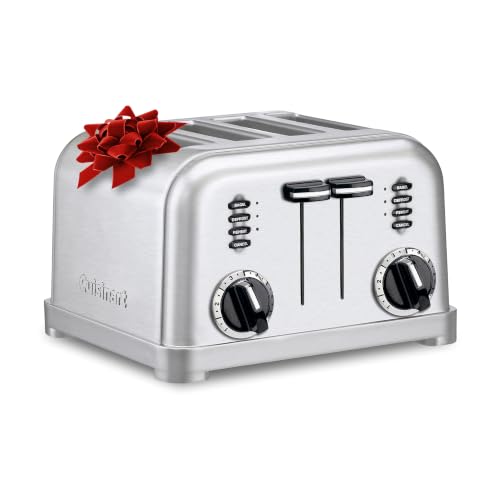
Cuisinart CPT-180P1 4-Slice Toaster — Best Overall Family Toaster
The CPT-180P1 is the family classic in this roundup: four slices, extra-wide slots, and dual independent controls with six-setting dials, so one side can run light for a child while the other runs dark for a parent. The brushed stainless body is sized for daily family service and built to be wiped down and used again tomorrow.
The CPT-180P1 is the family toaster perfected by long practice. Dual independent controls are its genius: the left side runs pale for the child who fears colour, the right runs dark for the parent who wants crunch, simultaneously, without compromise or sequencing. Extra-wide slots take the bagels and bakery slices family weekends produce, six-setting dials are operable by every generation, and the brushed stainless body is built for the wipe-down-and-go-again rhythm of family service. If one toaster must serve a whole household for years, this is the safest pair of hands in the category.
Strengths
- Dual controls let two shade preferences run at once
- Four extra-wide slots cover bagels and family breakfast in one cycle
- Proven, simple dial interface every age can manage
Trade-offs
- Larger footprint than 2-slice models
- No digital countdown or specialty bread modes
- Brushed finish shows crumbs until wiped
| Specification | Detail (from listing) |
|---|---|
| Capacity | 4 slices |
| Controls | Dual independent controls, 6-setting dials (per listing) |
| Body | Brushed stainless steel |
Exploit the dual controls deliberately: assign sides by shade camp and breakfast becomes parallel instead of serial. The dials’ simplicity makes this the toaster grandparents and grandchildren operate identically, which in a family machine is a safety feature as much as a convenience. Keep both crumb zones emptied weekly — four-slice family service generates crumbs at industrial rates.
Best for: families split between light and dark toast who want both at once / Not suited for: tiny counters where a four-slice footprint will not fit
Check on Amazon — check the current price on Amazon before you decide.
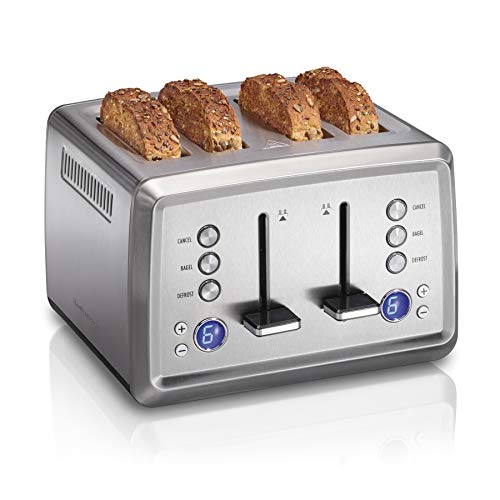
Hamilton Beach 4-Slice Digital Toaster 24796 — Best Digital Family Toaster
The 24796 gives a family of mixed preferences the Hamilton Beach toolkit at four-slice scale: digital controls with defrost, a bagel setting, Toast Boost for small slices, auto-shutoff and a slide-out crumb tray, all in stainless. Digital shade selection is repeatable in a way dials are not — note the number each family member likes and breakfast arguments end.
Hamilton Beach’s digital four-slice turns shade preference into data. Each family member gets a number; the digital controls reproduce it exactly; the morning negotiation ends. Around that core sit the brand’s family-minded extras — Toast Boost lifting small slices clear of hot slots, auto-shutoff standing guard over the school-run exit, defrost handling the frozen waffles that appear whenever plans change. For households whose conflict is precision rather than capacity, this is the peacemaker, in stainless that survives the peace.
Strengths
- Digital controls make each person’s shade repeatable
- Toast Boost protects small fingers from hot slots
- Auto-shutoff and slide-out tray suit busy family kitchens
Trade-offs
- Digital panel is one more thing to keep clean and dry
- Four-slice footprint needs counter commitment
- Stainless body warms during long breakfast runs
| Specification | Detail (from listing) |
|---|---|
| Capacity | 4 slices |
| Controls | Digital controls with defrost (per listing) |
| Functions | Bagel setting, Toast Boost, auto-shutoff, cancel (per listing) |
| Cleaning | Slide-out crumb tray |
Write each person’s number on a card by the toaster for the first month; after that it is muscle memory and the arguments are over. Toast Boost deserves a family demonstration — small slices rising clear changes how confidently children can serve themselves. Auto-shutoff is not a licence to leave mid-cycle chaos unwatched, but it forgives the inevitable distracted exit.
Best for: families who want each member’s shade repeatable by number / Not suited for: households that prefer the simplest possible dial-only controls
Check on Amazon — check the current price on Amazon before you decide.

Mueller UltraToast 4-Slice Toaster — Best for Artisan Bread Families
The Mueller UltraToast leads with the widest slots in this family roundup — a stated 1.6 inches — aimed squarely at artisan bread, bagels and frozen waffles. Six browning levels with an LED display, plus cancel, defrost and reheat functions and a removable crumb tray, make it the pick for families whose bread comes from a bakery rather than a sliced loaf.
The Mueller UltraToast serves the family that buys bread from a bakery and waffles from the freezer. Its stated 1.6-inch slots are the widest here — thick artisan slices fit whole instead of being trimmed or turned — and the LED display makes the six browning levels legible to everyone. Reheat is the sleeper feature: toast that popped while the eggs finished goes back for warmth without re-browning. If your family’s bread is wide, varied and precious, this is the machine that respects it.
Strengths
- 1.6 in slots are the widest here; artisan loaves fit properly
- LED display makes browning level easy to read and repeat
- Reheat function rescues toast that sat while eggs cooked
Trade-offs
- Wide-slot focus is wasted on households using only sliced bread
- Four-slice footprint is substantial
- LED and functions add complexity for the youngest users
| Specification | Detail (from listing) |
|---|---|
| Slots | 1.6 in extra-wide slots (per listing) |
| Browning | 6 levels, LED display (per listing) |
| Functions | Cancel, defrost, reheat (per listing) |
The Mueller rewards batching by bread type: artisan slices at their level, waffles from frozen with defrost, and the reheat function rescuing anything that waited. Its wide slots centre thick slices well; very thin slices may lean, so pair them in adjacent slots for support. The LED display is genuinely useful in dim early kitchens — a small mercy parents will feel daily.
Best for: bakery-bread families needing the widest slots and a reheat function / Not suited for: families who only ever toast standard sliced loaves
Check on Amazon — check the current price on Amazon before you decide.

BLACK+DECKER 4-Slice Toaster with Extra-Wide Slots — Best Value Family Toaster
BLACK+DECKER’s 4-slice doubles family throughput with extra-wide slots, seven shade settings and a bagel mode, plus the removable crumb tray that keeps a hard-working family toaster hygienic. It is the value route to four-slice mornings: familiar controls, generous slots, and no premium surcharge for features families rarely touch.
BLACK+DECKER’s four-slice is the family value play, and it does not apologise for it. Extra-wide slots, seven shades, a bagel mode and a removable crumb tray cover the family checklist at a tier that leaves budget for the rest of the kitchen. The single control set means one shade per cycle — the one honest compromise — which many families solve by batching: dark cycle first, light cycle second, everyone fed within minutes. For a first family toaster or a holiday-home workhorse, its arithmetic is hard to beat.
Strengths
- Four slices per cycle halves breakfast queueing
- Bagel mode and seven shades cover family preferences
- Removable crumb tray suits heavy daily use
Trade-offs
- Single control set means one shade choice per cycle
- Takes meaningful counter space
- Plainer finish than stainless design models
| Specification | Detail (from listing) |
|---|---|
| Capacity | 4 slices |
| Shade | 7 shade settings (per listing) |
| Functions | Bagel mode; removable crumb tray (per listing) |
Run the BLACK+DECKER by shade batches and the single control stops mattering: darkest eaters first, lightest last, four slices at a time. The removable tray is the family’s best friend — shake it twice a week at family volumes. Bagel mode handles the weekend run properly, crisping cut sides while keeping crusts chewy, which is more than many pricier machines manage.
Best for: value-focused families wanting four slices and the full basic checklist / Not suited for: households needing two shades in the same cycle
Check on Amazon — check the current price on Amazon before you decide.

Cuisinart CPT-640P1 4-Slice Custom Select Toaster — Best for Mixed Bread Households
The CPT-640P1 Custom Select brings Cuisinart’s bread-type approach to a four-slice stainless body: instead of one generic cycle, the Custom Select concept adjusts the toasting logic to what you are actually browning. For families rotating between sandwich bread, bagels, waffles and pastries across a single morning, that flexibility earns its counter space.
The Custom Select CPT-640P1 is built for the household whose bread changes daily — sandwich loaf on Monday, bagels on Wednesday, waffles and pastries at the weekend. Its Custom Select concept adjusts the toasting logic to the food type rather than forcing one generic cycle onto everything, which suits confident families who will actually use the selection. The listing is concise on dimensions, so confirm your largest loaf’s fit, but as a four-slice stainless Cuisinart aimed at variety, it occupies a niche none of the other five quite touches.
Strengths
- Custom Select concept adapts cycles to different bread types
- Four-slice capacity suits family breakfast throughput
- Stainless Cuisinart build for daily service
Trade-offs
- Bread-type selection adds a step some users will skip
- Listing detail is concise; confirm slot dimensions for huge loaves
- Premium tier positioning within the family category
| Specification | Detail (from listing) |
|---|---|
| Capacity | 4 slices |
| Body | Stainless steel |
| Line | Custom Select (per listing) |
Use the bread-type selection as intended rather than defaulting to one setting — the model’s value lives in matching cycle to food, especially across a mixed weekend. Because listing detail is brief, keep the manual: Custom Select’s logic is easiest to exploit with the maker’s own guidance in the kitchen drawer. Stainless care is the usual thirty-second wipe.
Best for: households rotating bread types daily who will use bread-type selection / Not suited for: buyers who want every dimension published before ordering
Check on Amazon — check the current price on Amazon before you decide.

Mecity 4-Slice Long Slot Toaster — Best Long-Slot Family Toaster
The Mecity takes the other route to four slices: long slots instead of a wide square body. Long slots swallow artisan and sourdough slices that square toasters reject, the countdown timer ends guessing, and the built-in warming rack keeps croissants and rolls warm above the slots. Bagel, defrost and reheat functions and six browning settings complete a family specification with a baker’s accent.
Mecity’s long-slot design rethinks the family toaster’s shape. Two long slots take four standard slices or the long, wide sourdough and artisan pieces that square toasters reject outright, the countdown timer shows children exactly how long patience must last, and the warming rack above keeps croissants and rolls at serving temperature while eggs cook. Bagel, defrost and reheat functions and six browning settings complete a specification aimed at families whose breakfast is an event, not a refuel. Check your counter’s length rather than its depth for this one.
Strengths
- Long slots fit artisan and sourdough slices other toasters reject
- Countdown timer makes timing transparent for kids learning breakfast
- Warming rack is genuinely useful for pastries and rolls
Trade-offs
- Long body needs a different counter footprint than square models
- 1300W shared across long slots is moderate power
- Feature set may exceed what simple toast households need
| Specification | Detail (from listing) |
|---|---|
| Format | Long-slot, 4 slices (per listing) |
| Functions | Countdown timer; bagel, defrost, reheat, cancel (per listing) |
| Extras | Warming rack; 6 browning settings; 1300W (per listing) |
The countdown timer quietly teaches children breakfast timing — a developmental bonus nobody advertises. Use the warming rack for pastries while slots handle toast, and the Mecity becomes a small breakfast station. Long slots also fit halved baguettes and panini-style slices other family toasters refuse, expanding what ‘toast’ can mean on a Sunday.
Best for: sourdough and artisan families plus pastry-weekend households / Not suited for: kitchens short on counter length rather than depth
Check on Amazon — check the current price on Amazon before you decide.
Comparison Table
| Pick | Badge | Key spec | Best for |
|---|---|---|---|
| Cuisinart CPT-180P1 4-Slice Toaster | Best Overall Family Toaster | 4 slices | families split between light and dark toast who want both at once |
| Hamilton Beach 4-Slice Digital Toaster 24796 | Best Digital Family Toaster | 4 slices | families who want each member’s shade repeatable by number |
| Mueller UltraToast 4-Slice Toaster | Best for Artisan Bread Families | 1.6 in extra-wide slots (per listing) | bakery-bread families needing the widest slots and a reheat function |
| BLACK+DECKER 4-Slice Toaster with Extra-Wide Slots | Best Value Family Toaster | 4 slices | value-focused families wanting four slices and the full basic checklist |
| Cuisinart CPT-640P1 4-Slice Custom Select Toaster | Best for Mixed Bread Households | 4 slices | households rotating bread types daily who will use bread-type selection |
| Mecity 4-Slice Long Slot Toaster | Best Long-Slot Family Toaster | Long-slot, 4 slices (per listing) | sourdough and artisan families plus pastry-weekend households |
How to Choose a Family Toaster
Start with throughput honesty. Count the slices your household eats in the peak twenty minutes of a weekday morning; if the answer is six or more, four-slice capacity is not a luxury but the difference between a system and a queue. All six picks clear that bar — the choice between them is about controls and slots, not about whether the family gets fed.
Controls decide household harmony. Dual independent dials, as on the Cuisinart classic, let two camps toast simultaneously. Digital controls, as on the Hamilton Beach, make each person’s shade a repeatable number. Bread-type selection, as on the Custom Select, removes judgment calls for mixed loads. Watch your family for one morning and you will know which philosophy fits: arguers need dual controls, precisionists need numbers, variety households need selection.
Then check the bread. Measure the thickest and longest slices your household regularly buys and compare them with stated slot dimensions — 1.6 inches wide on the Mueller, long slots on the Mecity, extra-wide slots across most of the list. A family toaster that fits the family’s actual bread ends the trimming, turning and tearing that quietly ruin breakfasts.
Family Safety and Sanity: Features That Earn Their Keep
High-lift levers and Toast Boost-style features are safety equipment in a family kitchen: they raise small slices clear of hot elements so small fingers never go fishing. Auto-shutoff, stated on the Hamilton Beach, forgives the distracted exit every family eventually makes. Stable, well-weighted bodies resist the knocks of a busy counter, and crumb trays that actually remove keep the machine hygienic under industrial crumb production.
Teach the household rules once, together: wooden tongs only, never metal; the toaster is watched while it runs; crumbs get emptied by whoever is on kitchen duty. Place the machine away from the sink’s splash zone and the kettle’s steam, with clearance above — under-cabinet heat traps are the family toaster’s quiet enemy. The right model plus these habits is the complete safety system; neither half works as well alone.
Sanity features deserve equal billing. Countdown displays end the ‘is it done yet’ chorus. Reheat functions rescue toast orphaned by slow eggs. Warming racks keep pastries at temperature without a second appliance. None of these appears on a specification-first shopping list, and all of them are felt every single week — weight them accordingly.
Running a Four-Slice Toaster Like a Breakfast System
Batch by shade, not by person. Run the darkest cycle first while eggs cook, hold finished toast briefly on a rack, and follow with lighter cycles; four-slice capacity makes two cycles feed most households completely. Keep everyday breads near the toaster with their winning settings noted — a small card in the bread bin ends recalibration forever.
Maintain at family tempo: crumb trays twice a week, a body wipe whenever it cools, and a monthly gentle shake-out over the bin. Family toasters fail from neglect more than from defects, and the maintenance here is measured in seconds. Assign it, rotate it, and the machine that feeds everyone will keep doing so for years.
Planning for Growth: The Toaster a Family Keeps
Families change faster than appliances. The toaster bought for two adults and a toddler will, within a few years, be serving teenagers who eat four slices as a snack and regard the kitchen as a 24-hour facility. That trajectory argues for buying the family class properly once: four-slice capacity, controls that several generations can share, and a build from a maker whose designs stay in production for years. Every pick in this roundup was chosen with that five-to-ten-year horizon in mind, because the cheapest family toaster is the one bought a single time.
Growth also means variety. Children’s bread gives way to bagels, waffles, bakery loaves and the occasional pastry emergency, which is why slot generosity — the Mueller’s stated 1.6 inches, the Mecity’s long slots, extra-wide slots across the list — matters more with each passing year. A machine that fits the family’s future bread prevents the slow accumulation of workarounds: trimming, turning, tearing and eventually replacing.
Think, finally, about where the toaster will live when the kitchen gets busier. Four-slice machines earn a permanent counter position; fighting one in and out of a cupboard twice a day is how good appliances become resented ones. Measure the permanent spot — with clearance, not just footprint — before ordering, and the toaster you choose will still be the right answer when the toddler is taller than you.
The Family Breakfast Audit: Finding Your Real Requirements
Before choosing between these six, run one honest audit of a weekday morning. Count the slices, note who eats what, and watch where the friction lives. If the friction is waiting, capacity and batching are your answers and any pick here works. If it is disagreement about doneness, the Cuisinart’s dual controls or the Hamilton Beach’s digital numbers are the specific cures. If it is the bread itself — torn sourdough, rejected bagels — slot shape is your cure, and the Mueller or Mecity should lead your shortlist.
Audit the operators too. A household where a grandparent toasts daily needs dial clarity above digital cleverness. A household of teenagers will exploit countdown timers and reheat buttons with delight and total competence. A household with a pastry habit will use the Mecity’s warming rack weekly and wonder how it lived without it. The audit takes one morning and prevents the most common family-appliance mistake: buying for an imagined household instead of the real one.
Close the audit with the boring numbers: counter length and depth at the intended spot, distance to the socket, and headroom to the cabinet above. Family toasters run long and hot at peak times, and the machine that fits its space properly will be safer, cleaner and longer-lived than a technically better model wedged into a space that resents it. Then buy once, set the household’s settings card, and let breakfast become the calmest part of the school run.
Weekend Mode: Bagels, Waffles and the Full Family Spread
Weekday family toasting is logistics; weekend toasting is theatre, and a good family machine handles both. Bagels want their mode and a little patience — the cut side crisping while the crust stays chewy is the whole art — and the extra-wide slots across this roundup exist for exactly that Saturday moment. Frozen waffles want defrost logic rather than raw power, so they emerge crisp at the edges and tender in the middle instead of scorched and raw in patches.
Pastries and croissants should never enter the slots at all — butter and elements are enemies — which is where the Mecity’s warming rack stops being a curiosity and becomes the weekend hero: pastries warming above the slots while toast browns below is a small breakfast production line. Reheat functions, like the Mueller’s, play the supporting role for anything that popped early and waited while the table was set.
Build the weekend spread as a sequence rather than a scramble: waffles or bagels first, since they hold best; toast last, since it holds worst; eggs timed to the final cycle. A four-slice machine run this way feeds a table of six in two cycles with everything hot at once — the quiet miracle that family toasters, chosen well, perform every weekend for years.
Cleaning and Care at Family Scale
Family toasters live harder lives than any other small appliance: multiple daily sessions, crumbs in industrial quantities, small sticky hands on every surface. The care routine must therefore be shorter than the problem. Crumb trays out twice a week — every pick here has a removable or slide-out tray — a wipe of the body whenever the last user leaves the kitchen, and a monthly shake-out over the bin. Total investment: perhaps three minutes a week, which is the entire maintenance contract for years of service.
Teach the routine as part of the privilege of using the machine. Children who toast their own breakfast can empty a tray; partners who benefit from the settings card can wipe a fingerprint. Shared care is not chore-spreading so much as insurance — a toaster everyone maintains is a toaster nobody lets fail, and its browning stays even because crumbs never accumulate into insulation.
Watch for the two honest end-of-life signals beneath the neglect: elements that brown in permanent stripes on every bread, and carriages that will not latch or lift reliably. Until those appear, a family toaster from the makers in this roundup is not old — it is just experienced, and it has many breakfasts left in it.
Stocking the Family Bread Station
A family toaster performs best as part of a small, deliberate station rather than as a lone appliance in a cluttered corner. Keep the everyday breads within arm’s reach in a bin or box that actually seals, the wooden tongs on a hook beside the machine, and the settings card — each person’s shade, the bagel setting, the waffle routine — taped inside the nearest cupboard door. That five-minute organisation, done once, removes the daily friction of hunting, guessing and arguing that makes family breakfasts feel harder than the cooking itself.
Stock for the week’s reality: the weekday loaf portioned for the toaster’s slots, weekend bagels bought fresh or frozen in halves, a freezer reserve of waffles for plan-B mornings. The defrost functions across this roundup exist for that reserve, and the wide and long slots exist for the weekend bread — the station and the machine are one system, and choosing them together is what separates households that ‘have a toaster’ from households that have breakfast handled.
Rotate the station’s invisible duties with the visible ones. Whoever empties the crumb trays checks the bread supply; whoever wipes the body updates the settings card when a new loaf enters the rotation. Small, shared, boring systems are the entire secret — and they are why a family toaster, chosen from this list and stationed properly, quietly becomes the most reliable part of the school morning.
When the Family Outgrows Four Slices
Some households eventually outgrow even a four-slice machine — teenagers with friends, multigenerational homes, the breakfast-for-dinner crowd. The honest options are three. Batch smarter first: darkest-to-lightest cycles, toast held upright on a rack, eggs timed to the final run — most ‘we need a bigger toaster’ moments dissolve under that system, because four slices every three minutes is a formidable rate of production. Add a second machine second, ideally the household’s retired two-slice in a new station by the kettle, splitting the queue by shade camp or by bread type.
Replace last, and replace within the logic of this guide: the same slot honesty, the same control philosophy your household already speaks, from a maker whose machines have survived your family’s service. What not to do is solve a throughput problem with a toaster oven, which toasts more slices more slowly and less evenly, or with a commercial unit whose speed assumes a café’s power and workflow. Families do not need more toaster; they need the right toaster, run as a system — which is the argument this entire roundup has been making.
One Last Check Before You Buy
Before ordering, run the final family test on your shortlist. Count tomorrow morning’s slices and confirm the four-slice maths still holds with guests included. Stand at the counter spot and check the headroom, the socket and the route small hands will take past the machine. Then ask the household’s other toast-makers — the grandparent, the teenager, the partner who burns everything — to look at the controls you are about to choose, because a family toaster is bought by one person and judged by everyone.
If the vote splits, let the control philosophy decide it: dual dials for divided tastes, digital numbers for precision households, bread-type selection for variety, long or extra-wide slots where the bread demands them. Order with the wooden tongs and, if your mornings need it, the second crumb-tray rhythm already planned. Set the settings card up on day one, and the machine you chose from this page will pay for itself in calm school mornings for years.
A Note on Breakfast Itself
End with the bread, because family toasting is finally about feeding people well rather than operating machinery. The machine that fits your loaves, your counters and your household’s control philosophy will disappear into the morning routine within a month, and what remains is the thing itself: hot toast, eaten together, at the start of ordinary days that turn out, in retrospect, to have been the good ones. Buy the toaster once, set it up as a system, keep its trays clean and its settings card current — and let it do the quiet, daily work that family kitchens actually run on.
In One Sentence
If this guide leaves you with a single rule, let it be this: buy for the household you actually feed — its bread, its shade arguments, its chaotic school mornings — and the family toaster you choose will stop being an appliance you bought and become part of how the house runs, quietly feeding everyone for years.
How to Run Family Breakfast With a Four-Slice Toaster
A four-slice toaster becomes a system with ten minutes of setup thinking. Organise once, and weekday breakfasts run themselves.
- Assign controls: dual sides by shade camp, or a written number per person for digital models, kept on a card by the machine.
- Stage bread the night before where possible — freezer bread portioned, bagels sliced — so morning is loading, not preparing.
- Run darkest shades first, holding finished toast upright on a rack so it stays crisp while lighter cycles run.
- Use bagel and defrost modes as designed; they exist precisely for the mixed loads families produce.
- Keep wooden tongs at the toaster permanently, and make ‘tongs, not fingers’ the house rule from the first day.
- Empty crumb trays on a fixed twice-weekly rhythm tied to another chore, so it never becomes a project.
- Wipe the body while it is the last person’s job to leave the kitchen — thirty seconds, done daily, invisible by Friday.
Breakfast stops being a negotiation when the machine, the settings and the routine are all settled. That calm — repeated every school morning for years — is what a family toaster is actually for.
Common Buying Mistakes
- Buying a two-slice toaster for a four-person household. The queue becomes the morning. Four-slice capacity is the entry ticket for family duty.
- Ignoring dual controls in a divided household. If your family splits light and dark, dual controls end the daily compromise. Single-control models mean batching by shade.
- Forgetting to measure the family’s bread. Artisan and sourdough slices defeat standard slots. Check stated widths and consider long-slot designs.
- Letting children fish with forks or fingers. Hot slots and metal utensils are a dangerous mix. High-lift features plus wooden tongs, taught early, are the system.
- Running the toaster trapped under cabinets. Family volumes mean long, hot sessions. Give the machine air above and around it every time.
- Neglecting crumbs at family scale. Four-slice households produce crumbs industrially. Twice-weekly tray emptying keeps browning even and smells sweet.
Final Recommendation
For most families, the Cuisinart CPT-180P1’s dual controls make it the enduring first choice, with the Hamilton Beach digital the pick where repeatable numbers end arguments. Bakery families should look hard at the Mueller’s wide slots or the Mecity’s long ones, value buyers at the BLACK+DECKER, and variety households at the Custom Select. Every one of the six will feed a family properly for years.
Measure your bread, count your morning slices, check the current price on Amazon, and buy the control philosophy your household will actually enjoy using at 7 a.m.
Our shortlist, if you are deciding today:
- Cuisinart CPT-180P1 4-Slice Toaster (Best Overall Family Toaster) — check price on Amazon
- Hamilton Beach 4-Slice Digital Toaster 24796 (Best Digital Family Toaster) — check price on Amazon
- Mueller UltraToast 4-Slice Toaster (Best for Artisan Bread Families) — check price on Amazon
Keep exploring related guides: Best Electric Toasters Best Economy Toasters Best Toasters Best Toaster Ovens Best 4 Slice Toasters Best 2 Slice Toasters
Frequently Asked Questions
Is a four-slice toaster worth it for a family of three?
Usually yes. Three people eating two slices each is six slices — two full cycles in a four-slice, three in a two-slice — and the second cycle is exactly where school mornings unravel. The footprint difference is modest, the time saving is daily, and guests push the maths further. Only genuinely small households that rarely toast together are better served by the two-slice models in our electric and economy toaster guides.
Dual controls or digital controls for a family?
Dual controls, like the Cuisinart classic’s, let two shade camps toast simultaneously — the fastest route to harmony in a divided household. Digital controls, like the Hamilton Beach’s, make one shade perfectly repeatable per person, which suits precision-minded families and children who know their number. Watch your household: if the argument is ‘mine is too dark’, buy dual; if it is ‘it was different yesterday’, buy digital.
Are four-slice toasters safe for children to use?
With supervision, teaching and the right features, older children can toast safely: look for high-lift levers or Toast Boost that keep fingers out of slots, auto-shutoff, and a stable body placed away from edges and water. The non-negotiables are wooden tongs only, no metal ever, and an adult’s rules set before the first use. No toaster is a toy, but a well-chosen family model is designed for a household that includes learners.
What if my family eats artisan or sourdough bread?
Measure it, then choose by slot: the Mueller states 1.6-inch slots, the widest here, and the Mecity’s long slots accept the length that defeats square machines. Standard extra-wide slots across the rest of the list handle most bakery loaves and bagels. The daily frustration of trimming or tearing a favourite loaf costs more, over years, than choosing the right slot shape now.
How much counter space does a family toaster need?
A square four-slice occupies roughly a dinner-plate-and-a-half of counter; long-slot models trade depth for length. All need clearance above while running and should sit out from under low cabinets during use. Measure your intended spot with those clearances, not just the footprint — in most kitchens one of the six formats here will fit comfortably, and the Mecity exists precisely for counters that are long rather than deep.
How long should a family toaster last?
A branded four-slice in daily family service should give years of breakfasts; the Cuisinart and BLACK+DECKER designs here have long production histories behind them. Life is set mostly by care: crumb trays emptied at family tempo, no metal inside the slots, sane placement away from steam and splashes. Treat it as the daily appliance it is, and replacement becomes a choice about features, not a rescue from failure.


