Disclosure: airfryerkitchensupply.com is reader-supported. When you buy through links on our site, we may earn an affiliate commission at no extra cost to you.
Where to buy
A true espresso drip combo machine brews a carafe of drip coffee on one side and pulls pump espresso on the other — and it is a much smaller category than search results suggest, because many ‘combos’ are actually pod stations or drip machines with a pressurised novelty spout. Every pick below was confirmed through the site’s Amazon verification step, and the genuine article is led by the De’Longhi COM530M All-In-One and the De’Longhi BCO430 Combi, with two clearly-labelled capsule and pod hybrids at the end for households that prefer that route.
Check the current price on Amazon through the links in this guide, and check which side of any combo does what before ordering: in the true combos, the drip side brews a full pot and the espresso side uses ground coffee in a portafilter; in the hybrids, espresso comes from a capsule or pod. The reviews state which is which, in the first paragraph, every time.
Introduction
The best espresso drip combo machines exist for divided households: one drinker wants a pot of drip coffee that lasts all morning, the other wants a cappuccino, and the counter has room for exactly one machine. A combo answers with two brewing systems in one footprint — a drip brewer with a carafe on one side, a pump espresso maker with a steam wand on the other — sharing a counter slot, a plug and a water routine.
Honesty matters in this category more than most. De’Longhi makes nearly all the true pump-and-drip combos sold today, so four of the six picks wear the same badge — that is the market as it is, not a lack of research. The remaining two picks are hybrids whose espresso side runs on capsules or pods; they are included because many households genuinely prefer that trade, and they are labelled as hybrids wherever they appear.
Every machine was verified against its Amazon listing through a listing check. Carafe sizes, heating systems and milk features below come only from those verified listings. If you want one machine that keeps both camps in a household happy, this is the complete, truthful field.
A note on naming, because it decides whether you buy the right machine: manufacturers use ‘combo’, ‘all-in-one’, ‘combination’ and ‘coffee center’ loosely, and the words guarantee nothing about what is inside. The only reliable test is the two questions this guide applied — does it brew drip coffee into a carafe, and does it make espresso from ground coffee with a pump? Ask both of any machine you meet outside this list, including the ones in the list, and the category becomes impossible to be fooled by.
In this guide
Quick Picks
Four true pump-and-drip combos, then two labelled hybrids — know which kind you are buying:
- Best Overall True Combo: De’Longhi COM530M All-In-One Combination Coffee and Espresso Machine — the modern true combo — full drip side, pump espresso side, one footprint.
- Best for Big Drip Batches: De’Longhi Combi BCO430 Coffee and Espresso Machine — a 10-cup drip side with a pump espresso side and frothing wand.
- Best Dual Heating: De’Longhi All-in-One Espresso & Coffee Maker with Dual Heating (10-Cup) — a dual heating system lets both sides work without waiting on one boiler.
- Best Premium Combo: De’Longhi COM630BK All-In-One Combination Coffee and Espresso Machine — the premium combo, with an Advanced Cappuccino System for easier milk drinks.
- Best Capsule Hybrid: Ninja Espresso & Coffee Barista System (CFN601) — HYBRID: capsule espresso in three styles plus single-serve coffee from grounds.
- Best Pod Hybrid: Cuisinart Coffee Center Barista Bar 4-in-1 (SS-4N1NAS) — HYBRID: a 4-in-1 station built around single-serve pods in three brewing sizes.
How These Picks Were Chosen
Verification ran on the airfry storefront: each combo’s model had to match a confirmed listing before it earned a link, and claims like carafe size and dual heating are quoted only where the verified listing states them.
The first selection test was definitional: does the machine brew real drip coffee into a carafe AND make espresso from ground coffee with a pump? Machines passing both halves rank as true combos. Two machines that substitute capsules or pods for the espresso half were admitted as a separate, clearly labelled class, because their convenience is a legitimate reason to buy — but they were not allowed to borrow the true combos’ credibility.
Ranking within the true combos weighed drip capacity, whether both sides can work at once, milk performance, and how much counter the two-in-one actually saves versus two separate machines. A combo that saves no space and brews worse on both sides would not have been listed at all.
Selection also weighed a factor specific to combos: the quality of the compromise on the side you care about less. Every combo buyer has a primary drink and a secondary one, and a good combo keeps the secondary drink genuinely enjoyable rather than vestigial. The true combos ranked here were chosen because their ‘other side’ — drip for the espresso household, espresso for the drip household — still clears the bar of a drink you would serve a guest without apology.
The 6 Best Espresso Drip Combo Machines

De’Longhi COM530M All-In-One Combination Coffee and Espresso Machine — Best Overall True Combo
De’Longhi COM530M All-In-One Combination Coffee and Espresso Machine — check price on Amazon.
The COM530M is the current benchmark for a true espresso drip combo: a proper drip brewer for the morning pot on one side, and a pump espresso side with a portafilter and frothing for cappuccinos and lattes on the other. It is the machine that lets a divided household retire two appliances without either drinker feeling demoted.
For home use, its appeal is the shared routine — one machine to fill, descale and wipe down — and a footprint meaningfully smaller than a separate drip brewer plus espresso machine standing side by side. That space saving is the entire reason the category exists, and the COM530M delivers it without obvious compromises on either side.
One more household pattern suits the COM530M: the work-from-home day, where the drip pot serves the morning’s steady cups and the espresso side provides the afternoon’s single deliberate cappuccino. Machines earn their counter in different ways across a day, and a combo that covers both rhythms is used more hours per day than either single-purpose rival would be.
Strengths
- True drip and true pump espresso in one body
- Saves real counter space versus two machines
- One maintenance routine for both brewing styles
Trade-offs
- Espresso side is good, not enthusiast-grade
- If one side fails, both drinks are affected
- De’Longhi’s near-monopoly means few design alternatives
| Specification | Detail |
|---|---|
| Type | Combination coffee and espresso machine (true combo) |
| Model | COM530M |
| Class | 47 ounces per listing |
Judge a combo by its weaker side, and the COM530M’s weaker side — the espresso — is still a legitimate pump machine with a wand, not a toy attachment. Households whose espresso drinker wants lattes rather than a new hobby will be fully served; households with a budding barista should buy separates.
As the household’s single coffee appliance it also simplifies consumables: one descaler schedule, one filter routine, one spot on the counter to keep clean. In busy kitchens, that administrative simplicity is a feature people feel weekly.
A usage pattern worth adopting from long-term combo owners: assign each side its own coffee and keep both stocked properly — a drip blend in the cupboard, a fresh espresso bag beside the portafilter. The households that report mediocre combo espresso almost always trace it to feeding the espresso side the drip coffee, ground for drip, weeks old. The machine was never the problem; the input was.
Best for: divided households wanting one machine for drip and espresso / Not suited for: espresso enthusiasts who will outgrow a combo’s espresso side
Check on Amazon — check the current price on Amazon before you decide.

De’Longhi Combi BCO430 Coffee and Espresso Machine — Best for Big Drip Batches
De’Longhi Combi BCO430 Coffee and Espresso Machine — check price on Amazon.
The BCO430 is the long-running workhorse of the combo category, and its headline is the drip side: a full 10-cup carafe, the size a household that hosts brunch or fuels a home office actually needs, paired with a pump espresso side and frothing wand for the espresso drinker at the same table.
It has been on the market for years, which in this niche is a virtue: parts, carafes and owner knowledge are easy to find, and its foibles are documented rather than discovered. If your household’s centre of gravity is the drip pot, with espresso as the second act, this is the combo tuned for you.
The BCO430’s frothing wand is the simple, vigorous kind — it makes abundant cappuccino foam without latte-art pretensions, which matches its household: people who want a foamy cappuccino with Sunday pancakes, not a rosetta. Judged on that job it is entirely fit for purpose, and this guide scores milk systems against their intended drink, not against café art.
Strengths
- Full 10-cup drip capacity for households and guests
- Long production run — parts and knowledge are plentiful
- Frothing wand covers cappuccino duties
Trade-offs
- Older design language and controls
- Espresso side is the junior partner in size and focus
- Large footprint for a combo — measure your counter
| Specification | Detail |
|---|---|
| Type | Combination pump espresso and drip machine |
| Drip capacity | 10-cup drip coffee per listing |
| Milk | Frothing wand per listing |
| Model | BCO430 |
The BCO430’s honest positioning is ‘a serious drip machine that also does espresso properly’. Households that reverse that priority should look at the COM530M first. Knowing which drink leads in your house is the whole decision between the top two picks.
For a family kitchen or a small office corner, its combination of a big pot, a real espresso option and a proven track record makes it the lowest-risk purchase in this category.
Because the BCO430 has been sold for years, its second-hand and parts ecosystem is unusually deep for this category — replacement carafes, filters and seals are easy to source, and any appliance repair shop has seen one. For a category defined by single-appliance risk, that boring practical fact materially de-risks the purchase, and it is part of why this older design still ranks second in a 2026 guide.
Best for: drip-first households that also want real espresso / Not suited for: espresso-first drinkers or very small counters
Check on Amazon — check the current price on Amazon before you decide.
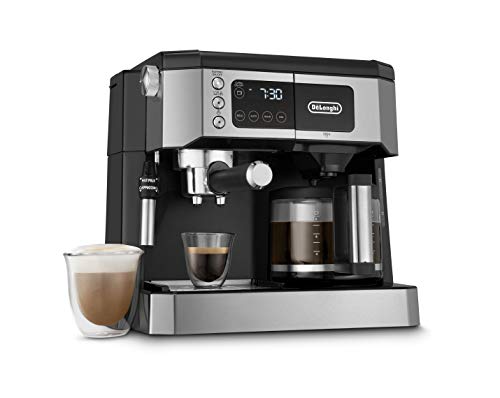
De’Longhi All-in-One Espresso & Coffee Maker with Dual Heating (10-Cup) — Best Dual Heating
De’Longhi All-in-One Espresso & Coffee Maker with Dual Heating (10-Cup) — check price on Amazon.
The detail that earns this All-in-One its badge is in the verified listing: a dual heating system. Most combos share heating resources, so brewing drip while someone pulls espresso involves compromise or waiting; dual heating lets the two sides work independently, which is exactly the scenario combos are bought for — two different drinks wanted at the same moment.
It pairs that with a 10-cup pot for the drip side, a milk frother for the espresso side, and a stainless, comparatively compact body. For households whose mornings genuinely collide — pot drinker and latte drinker on the same schedule — this is the combo engineered for the collision.
Consider the school-morning stress test: lunches being made, a pot needed for two travel mugs, and one person wanting a latte before the door. The dual-heating All-in-One is the only true combo here that runs that scene without sequencing or negotiation, and households living that scene daily should treat its badge as the headline of the whole guide.
Strengths
- Dual heating — both sides can work at once
- 10-cup drip capacity matches family mornings
- Stainless, compact body for a full combo
Trade-offs
- Frother rather than a full latte-art wand
- Premium positioning within the combo field
- Still one appliance — a failure affects both drinks
| Specification | Detail |
|---|---|
| Type | All-in-one espresso & coffee maker (true combo) |
| Heating | Dual heating system per listing |
| Drip capacity | 10-cup pot per listing |
| Milk | Milk frother per listing |
| Body | Stainless steel, compact per listing |
Think of this model as the combo for households that rejected combos because of the queue. If two people make different drinks at the same time every day, the dual-heating design removes the category’s most practical objection.
It is also the easiest true combo to recommend to mixed households upgrading from a drip machine alone: the drip side they know is fully present, and the espresso side arrives as a bonus rather than a replacement they must learn to love.
The dual-heating design has one more subtle benefit: temperature behaviour on each side is independent, so a long drip brew does not leave the espresso side heat-soaked or starved when its turn comes immediately after. On shared systems, back-to-back different drinks are where compromises taste most obvious; this model was engineered specifically to erase that sequence, and regular two-drink households notice it within the first week.
Best for: households where drip and espresso are wanted simultaneously / Not suited for: solo drinkers who never run both sides at once
Check on Amazon — check the current price on Amazon before you decide.

De’Longhi COM630BK All-In-One Combination Coffee and Espresso Machine — Best Premium Combo
De’Longhi COM630BK All-In-One Combination Coffee and Espresso Machine — check price on Amazon.
The COM630BK is the top of De’Longhi’s combo line, and its distinguishing feature per the verified listing is the Advanced Cappuccino System — the milk side upgraded so cappuccinos and lattes come together with less wand skill than the basic frothers on the cheaper combos. For a combo buyer, whose espresso drinker is often a casual one, that assistance is well aimed.
The rest of the formula is the proven one: a full drip side for the pot drinkers, a pump espresso side for the milk drinks, one footprint and one routine. This is the version for households that want the combo idea executed at its most polished rather than its most affordable.
The COM630BK also presents best on the counter — the black finish and the line’s flagship detailing suit kitchens where the coffee station is on show. Appearance is a legitimate criterion for an appliance that occupies prime counter permanently, and among the true combos this is the one chosen to be looked at.
Strengths
- Advanced Cappuccino System eases milk drinks
- Most polished execution of the true-combo formula
- Full drip side plus real pump espresso
Trade-offs
- Highest tier among the true combos
- Milk system parts need the usual same-day rinsing
- Same single-appliance risk as every combo
| Specification | Detail |
|---|---|
| Type | All-in-one combination coffee and espresso machine (true combo) |
| Milk | Advanced Cappuccino System per listing |
| Model | COM630BK |
Combos are compromise machines by definition; the COM630BK’s pitch is that the compromise is smallest here, particularly for milk drinks, which are where casual espresso drinkers judge the whole appliance. If the latte drinker in your house is the hardest to please, start at this end of the range.
It also suits households buying once for a long tenure — a family kitchen being equipped properly — where the cheaper combos’ rougher edges would be felt for years.
Position the COM630BK against its siblings honestly: you are paying for milk-drink polish and finish, not for a different class of drip or espresso. If your household’s espresso drinker takes it black, the COM530M delivers your actual drinks for less. If they take it with milk — and judge the machine by the milk — the Advanced Cappuccino System is the feature your money should follow.
Best for: households wanting the most polished true combo, milk drinks included / Not suited for: buyers who mainly drink drip and want espresso as a cheap bonus
Check on Amazon — check the current price on Amazon before you decide.
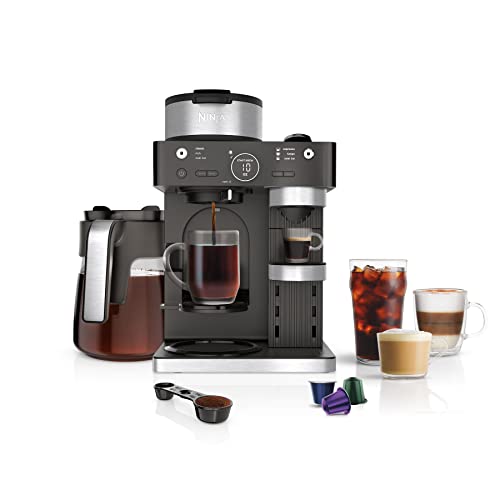
Ninja Espresso & Coffee Barista System (CFN601) — Best Capsule Hybrid
Ninja Espresso & Coffee Barista System (CFN601) — check price on Amazon.
Label first, because it matters: the Ninja CFN601 is not a drip-carafe combo. Its espresso side uses Nespresso-compatible capsules in three brew styles, and its coffee side brews single-serve coffee from grounds. There is no 10-cup pot here. What it offers instead is speed and zero mess on the espresso side, in a system built for households that drink one cup at a time.
For the right home, that trade is genuinely better: no portafilter, no puck, no tamping — capsule in, espresso out — while the coffee side still uses real ground coffee rather than pods. It is included in this guide because many ‘combo’ shoppers actually want this, and deserve to choose it knowingly rather than by a misleading product title.
The Ninja’s three espresso styles deserve clarification for capsule newcomers: they vary the water volume and intensity through the same capsule, giving a ristretto-like short drink, a standard espresso and a longer, milder cup. It is a genuinely useful range for households whose ‘espresso drinker’ actually alternates between a short morning shot and a longer afternoon drink.
Strengths
- Capsule espresso is instant and mess-free
- Coffee side uses real grounds, not pods
- Three espresso styles from one capsule system
Trade-offs
- No drip carafe — not a true drip combo
- Capsule cost per drink exceeds ground coffee
- Capsule espresso has a lower ceiling than fresh-ground pump espresso
| Specification | Detail |
|---|---|
| Type | Hybrid — capsule espresso and single-serve coffee |
| Espresso side | Nespresso capsule compatible per listing |
| Styles | 3 espresso brew styles per listing |
| Coffee side | Single-serve coffee from grounds per listing |
Choose the Ninja if your household’s pattern is individual drinks at scattered times rather than a shared morning pot. It serves that pattern better than any true combo here, because a carafe machine’s strengths are wasted on one-cup-at-a-time drinking.
Just buy it as what it is — a capsule-and-grounds hybrid of high quality — and it will not disappoint. Buy it expecting a drip pot and it will, which is why this guide insists on the label.
Capsule economics deserve one honest paragraph: the CFN601’s espresso side trades money for time on every drink — capsules cost more per shot than ground coffee, forever. Households drinking one or two espresso drinks a day usually judge that a fair trade for zero mess and zero skill. Households drinking six should do the arithmetic against the true combos before choosing, because at volume the capsule premium buys a lot of beans.
Best for: one-cup-at-a-time households wanting mess-free espresso / Not suited for: households that brew a shared pot of drip coffee
Check on Amazon — check the current price on Amazon before you decide.

Cuisinart Coffee Center Barista Bar 4-in-1 (SS-4N1NAS) — Best Pod Hybrid
Cuisinart Coffee Center Barista Bar 4-in-1 (SS-4N1NAS) — check price on Amazon.
The Cuisinart Barista Bar is the other honest hybrid in this guide: a 4-in-1 station centred on single-serve pods, with three brewing sizes and espresso-style drinks made the pod way. Like the Ninja, it does not brew a ground-coffee carafe on one side and pump espresso on the other — it trades that formula for pod convenience across the whole menu.
Its home is the household already committed to pods that wants a broader, better station: espresso-style drinks, regular cups in several sizes, and one appliance on the counter instead of a pod brewer plus extras. Within the pod world, it is a well-conceived hub.
For clarity about the Barista Bar’s espresso-style drinks: they are brewed from pods at pod-system pressures and taste like good pod espresso — consistent, crema-topped and mild. Placed beside a true combo’s fresh-ground shot, the difference is real but not embarrassing, and for the pod household this station replaces, it is an upgrade in range rather than a downgrade in kind.
Strengths
- One station for the whole pod household’s menu
- Three brewing sizes cover cups to travel mugs
- No grounds, no portafilter, minimal cleanup
Trade-offs
- Not a true drip-and-pump combo — pod-based throughout
- Pod cost and waste exceed ground coffee
- Espresso-style drinks are not pump espresso
| Specification | Detail |
|---|---|
| Type | Hybrid — 4-in-1 coffee maker station |
| Brewing | Single-serve pods compatible per listing |
| Sizes | Three brewing sizes per listing |
| Model | SS-4N1NAS |
Pod households are often lectured by guides like this one; the fairer view is that convenience is a real value and this station delivers it competently. If your kitchen already runs on pods and counter space is the problem, the Barista Bar consolidates that life into one footprint.
If, however, you arrived here wanting an actual pot of drip coffee and actual espresso, scroll back to the four De’Longhi machines — they are the only true answers to the keyword, and this guide would rather lose the sale than blur that line.
The Barista Bar also consolidates the small things pod households accumulate: the pod carousel, the spare brewer for guests who drink tea, the travel-mug workaround. A single station with three brewing sizes absorbs those odds and ends into one footprint, and in small kitchens that tidiness is a daily pleasure out of proportion to its place in a specification list.
Best for: pod-committed households wanting one consolidated station / Not suited for: anyone seeking real drip carafes and pump espresso
Check on Amazon — check the current price on Amazon before you decide.
Comparison Table
| Pick | Badge | Key spec | Best for |
|---|---|---|---|
| De’Longhi COM530M All-In-One Combination Coffee and Espresso Machine | Best Overall True Combo | True combo: drip + pump espresso, 47oz class | divided households wanting one machine for drip and espresso |
| De’Longhi Combi BCO430 Coffee and Espresso Machine | Best for Big Drip Batches | True combo, 10-cup drip carafe, frothing wand | drip-first households that also want real espresso |
| De’Longhi All-in-One Espresso & Coffee Maker with Dual Heating (10-Cup) | Best Dual Heating | True combo, dual heating system, 10-cup pot | households where drip and espresso are wanted simultaneously |
| De’Longhi COM630BK All-In-One Combination Coffee and Espresso Machine | Best Premium Combo | True combo, Advanced Cappuccino System | households wanting the most polished true combo, milk drinks included |
| Ninja Espresso & Coffee Barista System (CFN601) | Best Capsule Hybrid | Hybrid: Nespresso-compatible capsule espresso + grounds coffee | one-cup-at-a-time households wanting mess-free espresso |
| Cuisinart Coffee Center Barista Bar 4-in-1 (SS-4N1NAS) | Best Pod Hybrid | Hybrid: 4-in-1 single-serve pod station | pod-committed households wanting one consolidated station |
The decisive column is ‘Type’: four true combos brew drip into a carafe and pull ground-coffee espresso; two hybrids substitute capsules or pods on the espresso side (and, in the Cuisinart’s case, everywhere). Neither class is ‘better’ — but they are different purchases, and the table keeps them visibly separate so you choose the class first and the model second.
How to Choose the Best Espresso Drip Combo Machines
Decide the class first. True combo (De’Longhi’s four machines here): a carafe of drip plus pump espresso from ground coffee — the right answer when a pot gets brewed daily and someone wants real lattes. Capsule hybrid (Ninja): one-cup drinking, espresso from capsules, coffee from grounds. Pod station (Cuisinart): full pod convenience. Households routinely buy across these classes by accident because product titles blur them; the class decision is the one that determines satisfaction.
Within the true combos, the differentiators are drip capacity, whether both sides can run at once (the dual-heating model), and how assisted the milk side is (basic frother, wand, or the Advanced Cappuccino System). Rank those by your household’s actual morning: who drinks what, at the same time or in sequence, and who is making it.
- True combo, best all-round: COM530M
- Drip pot leads: BCO430 (10-cup)
- Both drinks at once: All-in-One with dual heating
- Easiest milk drinks: COM630BK
- Capsule convenience: Ninja CFN601; pod station: Cuisinart Barista Bar
Finally, measure the counter honestly. A combo is smaller than two machines but larger than one; check width and cabinet height, and remember the carafe and portafilter both need working room in front of the machine, not just the machine’s own footprint.
The Honest Limits of Combo Machines
A combo’s espresso side will not match a dedicated semi-automatic: baskets are simpler, temperature control is coarser, and there is no upgrade path short of replacing the whole appliance. Its drip side, likewise, is a good drip brewer rather than a precision showcase brewer. What you buy with a combo is adequacy on both sides plus a genuine space saving — for most divided households, that trade is correct, but enthusiasts on either side should buy separates.
The second limit is shared fate: one appliance means one failure stops both drinks, and one descale schedule serves two systems. Keep the maintenance up — combos concentrate a household’s coffee life, so their upkeep matters more, not less, than a single-purpose machine’s.
Running Both Sides Well: Beans, Grounds and Water
A combo asks you to stock two coffees well: a drip coffee your household loves by the pot, and an espresso coffee fresh enough for the portafilter. Buying one bag for both is possible — a versatile medium roast — but most households are happier with two, since drip and espresso reward different roasts and grind sizes. The espresso side, fed stale supermarket grounds, is where combos get their mediocre reputation; feed it fresh and it performs respectably.
Water is shared too, so one filter and descale routine protects both systems. In hard-water homes that routine is the difference between a combo that lasts and one that clogs on both sides simultaneously — set the reminder when you unbox, not when the first warning light appears.
True Combo vs Two Separate Machines: The Space and Cost Logic
The honest comparison for a combo is not against one machine but against two: a decent drip brewer plus a decent entry espresso machine. On counter space, the combo wins clearly — one footprint, one cord, one spot to clean. On purchase cost, the combo usually wins modestly against two mid-range separates. On drink quality, separates win at the margins: each dedicated machine does its one job slightly better, and either can be upgraded or replaced independently when tastes or budgets change.
So the combo decision is really a space-and-simplicity decision. If your counter can hold two machines and your household contains an enthusiast on either side, buy separates and enjoy the upgrade paths. If the counter holds one machine — the situation in most real kitchens — the combo is not a compromise but the only way both drinks exist in your home at all, and the four true combos here execute that brief well.
Drip Side Quality: Getting a Good Pot From a Combo
Combo drip sides are often judged by their worst pot, which is usually a technique problem: stale pre-ground coffee, the wrong ratio, and a carafe left on the warming plate for three hours. Use fresh coffee ground for drip, a ratio near one part coffee to sixteen parts water by weight as a starting point, and serve within the first hour — or decant into a thermal carafe — and a combo’s drip side tastes like what it is: a competent modern drip brewer.
Paper filters versus permanent mesh also matters more on combos, whose drip baskets are sized for standard filters: paper gives a cleaner cup and easier cleanup; mesh gives a fuller cup and one less thing to buy. Neither is wrong, but switching mid-household without telling the other drinker has started more ‘the machine tastes different’ mysteries than any mechanical fault.
Who Should Not Buy a Combo Machine
Three households should skip this category entirely. The espresso enthusiast household: a combo’s espresso side has no upgrade path and a modest ceiling, and it will be resented within a year — buy a dedicated semi-automatic and a simple drip brewer or pour-over setup. The drip perfectionist household: precision brewers with exact temperature control exist for the pot itself, and a combo’s drip side is not one. And the single-drinker household that only thinks it wants both: one person rarely keeps two coffee routines alive, and the unused side becomes counter clutter with a plug.
Everyone else — the genuinely divided household on a real counter — is who combos were invented for, and for them the category is not a compromise at all. It is the difference between both drinks happening at home and one drinker quietly defecting to a café.
Combo Machines in Small Kitchens and Offices
Combos earn a second audience beyond divided households: the small office and the studio flat, where one appliance serving several tastes replaces a kettle-side negotiation. In an office of four to eight people, a true combo covers the pot drinkers and the cappuccino maker without a second purchase order, and its single descale routine can be owned by one named person — the detail that decides whether shared machines live or die. The BCO430’s big carafe and proven design make it the natural office pick of this list.
In a studio flat, the calculus is footprint purity: one machine where two cannot fit at all. There the COM530M’s balance is the draw, and the hybrids deserve a fair hearing too, since a single occupant drinking one cup at a time is exactly the Ninja’s design centre. The category’s through-line is respect for limited counters, and every pick here honours it in a different dialect.
Combo Machines and Coffee Freshness: Running Two Coffees Well
A combo quietly doubles a household’s coffee inventory problem: two brewing methods, two ideal grinds, and two staleness clocks. The households that manage it well keep the system almost embarrassingly simple — one bag labelled for the pot, bought in the size the pot drinks in two weeks, and one smaller bag of espresso coffee bought more often, stored sealed beside the portafilter. They also accept a small heresy this guide endorses: a versatile medium roast can serve both sides acceptably when life is busy, and a combo fed one fresh coffee beats a combo fed two stale ones every time. Freshness outranks specialisation in real kitchens, and combo ownership is where that hierarchy is tested weekly.
How to Use an Espresso Drip Combo Machine on a Real Morning
The combo’s promise is two drinks from one station. This sequence runs a typical divided-household morning — pot for one drinker, cappuccino for the other — without either side getting in the other’s way.
- Start the drip side first: it is the slow, unattended brew. Fill the carafe side, add grounds and filter, and set it going before touching the espresso side.
- While the pot brews, prep the espresso side: check its water, dose the portafilter, and set out the milk jug — on dual-heating models you can pull the shot during the drip brew; on shared-heating models, wait until the pot finishes.
- Pull the espresso shot, then froth or steam the milk immediately after, while the drip coffee rests — resting drip coffee for a few minutes costs it nothing.
- Serve both drinks together, then do the sixty-second reset: knock out the puck, rinse the portafilter, wipe the wand or frother, and dump the drip grounds while the filter is still easy to handle.
- Leave the carafe on its warming plate only as long as people are drinking; drip coffee held hot for hours stales, and tomorrow’s pot deserves a clean carafe, rinsed tonight.
- Weekly, descale or check the descale prompt for the whole machine — both sides share the schedule — and wash the carafe with a proper coffee-oil cleaner if a film has built up.
- Keep two coffees clearly labelled at the station — DRIP and ESPRESSO — because the fastest way to a bad morning is espresso grounds in the drip basket or drip-grind in the portafilter, and it happens in every combo household exactly once.
- Run the espresso side’s rinse right after the drip side is set going each morning; overlapping the two routines keeps the whole station clean in the time the pot takes to brew.
Run that rhythm and a combo stops feeling like a compromise and starts feeling like the household’s coffee station — which is precisely what the category promises at its best.
Common Buying Mistakes
Buying a hybrid expecting a true combo. Capsule and pod stations do not brew a drip carafe or pull ground-coffee espresso. Read the type before the title.
Assuming all combos can brew both sides at once. Only dual-heating designs truly can. On shared-heating models, sequence the drinks as the how-to above describes.
Feeding the espresso side stale grounds. The espresso half of a combo lives or dies on coffee freshness, exactly like a standalone machine.
Ignoring the shared-fate risk. One machine, both drinks. Keep up descaling and know where the service network is before you need it.
Under-measuring the counter. Combos are wide. Measure width, cabinet height and the working space in front for carafe and portafilter.
Leaving the carafe on the hot plate all day. Drip coffee stewing on a warmer for hours is how combo drip sides earn bad reputations. Serve what you brew within the hour, or decant into a thermal carafe.
Final Recommendation
For the household this category was invented for, the De’Longhi COM530M is the best espresso drip combo machine: a real drip side, a real pump espresso side, one footprint and one routine. Choose the BCO430 if the 10-cup pot is the household’s centre of gravity, the dual-heating All-in-One if both drinks are wanted at the same moment every morning, and the COM630BK if milk drinks should be as easy as the category allows.
And if your household actually drinks one cup at a time, buy the Ninja CFN601 or the Cuisinart Barista Bar with clear eyes — hybrids chosen knowingly serve their households better than true combos bought by mistake. The only wrong purchase in this category is the one made under a misunderstanding, and this guide has done its best to make that impossible.
Buy the class first and the model second, feed both sides fresh coffee, and keep the one shared maintenance routine — a combo will then do something no single-purpose machine can: end the household’s coffee argument permanently, in one footprint, for years.
Keep researching with these related guides from the same program: Best Espresso Machines Best Espresso Coffee Machines Best Espresso Coffee Machines For Home Best Coffee And Espresso Combo Machines Best Coffee Espresso Combo Machines Best Coffee Makers
Frequently Asked Questions
What is an espresso drip combo machine?
A single appliance with two brewing systems: a drip brewer that makes a carafe of coffee, and a pump espresso maker that uses ground coffee in a portafilter, usually with a milk frother or wand. Machines that use capsules or pods for espresso are hybrids, not true combos.
Are combo machines as good as separate machines?
Each side is good rather than great: the espresso side trails a dedicated semi-automatic, and the drip side trails a precision brewer. The combo wins on counter space, cost versus two machines, and one shared routine — the reasons households buy them.
Can a combo machine brew drip and espresso at the same time?
Only models with dual heating systems, like the De’Longhi All-in-One in this guide. Shared-heating combos need the two drinks made in sequence, drip first.
Why are most true combos made by De’Longhi?
Because the category is small and De’Longhi has served it consistently for years while rivals focused on pods and automatics. The four true combos here are all De’Longhi because, at verification time, they were the confirmed true combos on the market.
Should I buy a capsule hybrid instead of a true combo?
If your household drinks one cup at a time and values zero-mess espresso, yes — the Ninja CFN601 is excellent at that job. If a shared pot of drip is a daily ritual, only a true combo replaces your drip machine.
How do I maintain a combo machine?
One routine covers both sides: daily puck and grounds disposal, wand wiping, carafe rinsing, and descaling the whole appliance on its prompt schedule, since the systems share water and heating components.
Can one person use a combo machine, or are they only for couples?
One person absolutely can — many owners are single drinkers who want a pot on workdays and espresso on weekends. The combo simply means both drinks live in one footprint; nothing about it requires two people, though divided households feel the benefit most.
Do combo machines make good drip coffee?
Yes — the drip sides of the true combos here are competent modern drip brewers, and with fresh coffee at a sensible ratio they produce a pot most households are happy to serve guests. They trail dedicated precision brewers, not ordinary drip machines.


