Disclosure: airfryerkitchensupply.com is reader-supported. When you buy through links on our site, we may earn an affiliate commission at no extra cost to you.
Where to buy
Shoppers comparing the best electric toasters will find every pick in this guide on Amazon, sold by the makers or their authorised sellers.
Every model below is sold on Amazon. Electric toaster line-ups change finishes and bundles often, so confirm the exact model code on the current listing, and check price on Amazon before you buy rather than trusting any older screenshot.
- Cuisinart CPT-160P1 2-Slice Metal Classic Toaster — check price on Amazon
- Breville BTA720XL Bit More Toaster, 2 Slice — check price on Amazon
- GE 2-Slice Stainless Steel Toaster — check price on Amazon
- Hamilton Beach 2-Slice Toaster 22794 — check price on Amazon
- Cuisinart CPT-320P1 Compact 2-Slice Toaster — check price on Amazon
- BLACK+DECKER 2-Slice Toaster, Stainless Steel — check price on Amazon
An electric toaster is the simplest powered appliance in the kitchen — resistance elements, a carriage, a timer — and the best electric toasters are the ones that execute that simplicity flawlessly. This guide is about slot toasters specifically: the pop-up kind that browns bread, bagels and waffles. It is not about toaster ovens, which are small countertop ovens with a different job, different strengths and their own guide on this site. If what you want is perfect slices at breakfast, read on; the six models below span the sensible market from proven classic to feature-led premium.
The differences that matter are narrower than marketing suggests. Slot width decides which breads fit; element quality and sensing decide evenness; controls decide whether your shade is repeatable on a sleepy Tuesday. Everything else — finishes, displays, novelty modes — is preference, and we treat it that way in the rankings. Each pick was verified against Amazon’s catalogue data, and specifications are quoted only from listings.
We also kept this list honest about capacity. All six are two-slice models, because the two-slice slot toaster is the canonical electric toaster; households needing four slices per cycle will find that class covered in our family toasters guide. Within the two-slice world, though, there is real variety here — from a 1,500-watt powerhouse to a compact built for small counters — and the right choice depends on your bread, your space and your patience for features.
In this guide
Quick Picks
Six two-slice slot toasters that define the category, from the classic all-rounder to the feature-rich flagship.
- Cuisinart CPT-160P1 2-Slice Metal Classic Toaster — Best Overall Electric Toaster. Cuisinart’s CPT-160P1 is the classic: 1.5 in slots, a six-setting dial and brushed stainless that has satisfied breakfasts for years. Check on Amazon
- Breville BTA720XL Bit More Toaster, 2 Slice — Best Premium Features. Breville’s Bit More adds Lift & Look and A Bit More — the two smartest features in toasting — in brushed stainless. Check on Amazon
- GE 2-Slice Stainless Steel Toaster — Best Power and Even Toasting. GE’s 2-slice publishes real numbers: 1,500W, slots at 1.38 x 5.50 in, seven shades and defrost. Check on Amazon
- Hamilton Beach 2-Slice Toaster 22794 — Best Everyday Electric Toaster. Hamilton Beach’s 22794 layers Toast Boost, auto-shutoff and bagel and defrost settings into the everyday sweet spot. Check on Amazon
- Cuisinart CPT-320P1 Compact 2-Slice Toaster — Best Compact Electric Toaster. Cuisinart’s CPT-320P1 compacts the brand’s browning reputation for small kitchens and second homes. Check on Amazon
- BLACK+DECKER 2-Slice Toaster, Stainless Steel — Best Wide-Slot Value. BLACK+DECKER’s stainless 2-slice brings extra-wide slots and seven shades at a value position. Check on Amazon
How These Picks Were Chosen
Selection began with the fundamentals: slot dimensions that accept real bread, browning controls with a usable range, and the everyday functions — bagel, defrost, cancel — that modern breakfasts assume. Models earned their places by excelling at one clear job, whether that is Breville’s progress-checking features, GE’s stated power and slot measurements, or Cuisinart’s compact footprint.
We separated slot toasters from toaster ovens rigorously. Several excellent countertop ovens toast bread as a side job, but they heat a cavity rather than hugging the slice, and they belong in a different comparison. Everything here is a pop-up slot toaster, verified as such against its listing. Specifications are quoted from listings only, and no prices or ratings are printed — check price on Amazon when you decide.
Evenness claims were treated with suspicion, including our own. No listing can prove browning quality, so we weighted design signals — element style, slot fit, sensing features like Breville’s check-without-cancelling — and maker track record, and we say plainly in each review what the model is for rather than crowning laboratory winners we cannot verify.
The 6 Best Electric Toasters

Cuisinart CPT-160P1 2-Slice Metal Classic Toaster — Best Overall Electric Toaster
The Cuisinart CPT-160P1 is the classic metal 2-slice: brushed stainless body, a six-setting browning dial, and 1.5-inch slots that swallow bagels and thick bakery slices. Its retro lines have sold for years because the formula works — even, repeatable browning, controls with no learning curve, and a body that wipes clean and still looks right a decade in.
The CPT-160P1 is the electric toaster as a solved problem. Its 1.5-inch slots accept the full modern bread spectrum, the six-setting dial lands exactly where muscle memory expects, and the brushed stainless body looks correct in almost every kitchen ever built. It leads this list because most households asking ‘which toaster’ are really asking ‘which one will just work, beautifully, for years’ — and this model’s long production life is the strongest evidence available that the answer is this one. Buy it once, learn its dial, and breakfast becomes infrastructure.
Strengths
- 1.5 in slots handle bagels and thick artisan slices easily
- Simple dial control is precise enough and instantly familiar
- Brushed stainless body ages gracefully on the counter
Trade-offs
- Two-slice capacity only
- Dial control lacks the countdown feedback of digital rivals
- Retro styling is a taste choice, not a universal fit
| Specification | Detail (from listing) |
|---|---|
| Slots | 1.5 in slots (per listing) |
| Browning | 6 settings, dial control (per listing) |
| Body | Brushed stainless steel, retro design |
Learn the dial in halves: most breads land between the middle settings, and the CPT-160P1’s consistency means a number, once found, stays found. The wide slots self-centre thinner slices well enough for even results, and the retro lever action is satisfying in a way touch panels never manage. Wipe the brushed finish along its grain and it will look new at year five.
Best for: most households wanting the proven classic two-slice in stainless / Not suited for: households needing four slices per cycle
Check on Amazon — check the current price on Amazon before you decide.

Breville BTA720XL Bit More Toaster, 2 Slice — Best Premium Features
Breville’s Bit More is built around the two moments other toasters fumble: checking progress and fixing underdone toast. Lift & Look raises the carriage without cancelling the cycle, and A Bit More adds a short extra burst instead of restarting from zero. Wide slots take thick artisanal bread, and the brushed stainless body matches Breville’s wider countertop range.
Breville’s Bit More exists for people who care about the last ten percent of toasting. Lift & Look is a genuinely better interface: raise, inspect, lower, continue — no cancelled cycles, no guesswork. A Bit More then fixes the universal pale-toast problem with a calibrated extra burst instead of a full restart that incinerates the edges. The wide slots take the thick, irregular slices that artisan loaves produce. If toast is a small daily pleasure you take seriously, this is the connoisseur’s two-slice, and its features are the rare kind you will use every single day.
Strengths
- Lift & Look checks progress without cancelling the cycle
- A Bit More fixes pale toast with one short extra burst
- Wide slots suit thick, artisanal and bakery loaves
Trade-offs
- Premium positioning among 2-slice toasters
- Two slices at a time despite the feature list
- Feature buttons add a small learning curve for guests
| Specification | Detail (from listing) |
|---|---|
| Slots | Wide slots for thick, artisanal bread (per listing) |
| Functions | ‘A Bit More’, ‘Lift & Look’, defrost (per listing) |
| Body | Brushed stainless steel |
Build your routine around Lift & Look for the first week — check at the point you think is nearly done, then calibrate your setting from evidence instead of hope. A Bit More is calibrated conservatively, so use it once and reassess rather than double-tapping. The Breville rewards this small engagement with the most consistent artisan-bread results in this roundup.
Best for: toast enthusiasts who will use Lift & Look and A Bit More daily / Not suited for: buyers who want the simplest possible controls
Check on Amazon — check the current price on Amazon before you decide.
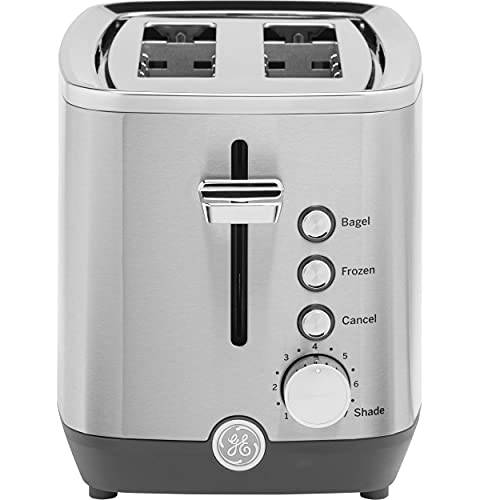
GE 2-Slice Stainless Steel Toaster — Best Power and Even Toasting
GE’s 2-slice brings unusually specific numbers to a simple appliance: 1,500 watts for even toasting, slots measured at 1.38 x 5.50 inches, seven shade settings and a defrost function, with a removable crumb tray underneath. That wattage is high for a 2-slice, which shows up as faster cycles and confident browning on frozen waffles and bagels.
GE’s entry is the engineer’s toaster: it publishes its wattage, its slot dimensions and its shade count, and those numbers are good. Fifteen hundred watts in a two-slice body means fast cycles and confident work on frozen waffles; slots measured at 1.38 by 5.50 inches tell you exactly which loaves fit before you order. Seven shades give the dial real granularity. For buyers who comparison-shop appliances the way they shop for tools — by specification — this is the most satisfying model on the page.
Strengths
- 1,500W is strong power for a 2-slice toaster
- Published slot dimensions make fit-checking easy
- Seven shades plus defrost cover frozen and fresh routines
Trade-offs
- Higher wattage rewards a circuit that is not already loaded
- Two-slice capacity only
- Utilitarian styling rather than a design statement
| Specification | Detail (from listing) |
|---|---|
| Power | 1,500 watts (per listing) |
| Slots | 1.38 x 5.50 in extra-wide slots (per listing) |
| Shade | 7 shades (per listing) |
| Functions | Defrost; removable crumb tray |
The GE’s power shows most on frozen goods: waffles and freezer bread brown through without the pallid centre lesser elements leave. Use the published slot dimensions honestly — a loaf that fits on paper fits in the machine — and start frozen items on defrost at your normal shade. On a busy kitchen circuit, avoid running it simultaneously with a kettle on the same outlet run.
Best for: specification-led buyers wanting stated power and slot dimensions / Not suited for: kitchens whose circuits are already heavily loaded
Check on Amazon — check the current price on Amazon before you decide.

Hamilton Beach 2-Slice Toaster 22794 — Best Everyday Electric Toaster
Hamilton Beach’s 22794 combines the practical extras this brand is known for: Toast Boost for small slices, auto-shutoff, a slide-out crumb tray, and bagel and defrost settings around extra-wide slots in a stainless body. It is the everyday-driver pick — nothing flashy, everything present, and priced in the sensible middle of the market’s tiers.
Hamilton Beach builds toasters for real mornings, and the 22794 shows it. Toast Boost lifts the small slices children and crumpets produce; auto-shutoff forgives the distracted rush out of the door; bagel and defrost settings handle the freezer-based reality of weekday breakfast. None of this is glamorous, and all of it is used daily. Positioned in the sensible middle of the market, it is the electric toaster we would hand to a household that asked for ‘a good one’ without further specification.
Strengths
- Toast Boost and auto-shutoff are genuinely useful daily features
- Bagel and defrost settings cover the full breakfast routine
- Slide-out crumb tray keeps cleanup quick
Trade-offs
- Two-slice capacity limits bigger households
- Stainless finish needs wiping to stay mark-free
- Mid-tier positioning means fewer premium touches
| Specification | Detail (from listing) |
|---|---|
| Slots | Extra-wide slots (per listing) |
| Functions | Bagel, defrost, cancel; auto-shutoff (per listing) |
| Extras | Toast Boost, slide-out crumb tray (per listing) |
Make the 22794 the household’s default and teach everyone Toast Boost on day one; it prevents the fork-fishing that damages elements and tempers. The slide-out tray suits a quick weekly shake over the bin, and auto-shutoff means the school-run rush cannot leave it cooking air. Stainless wipes clean best while slightly warm after use.
Best for: busy families wanting Toast Boost, auto-shutoff and full everyday functions / Not suited for: design purists chasing a minimalist statement piece
Check on Amazon — check the current price on Amazon before you decide.
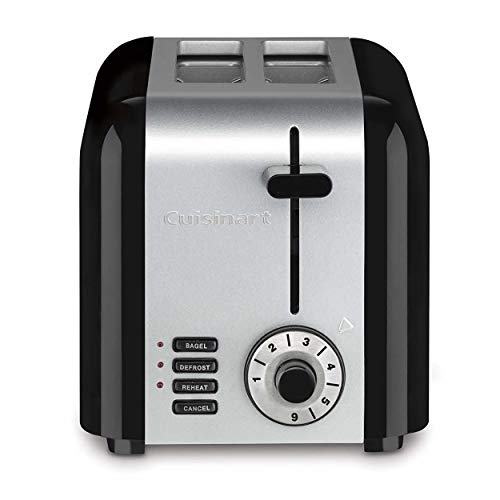
Cuisinart CPT-320P1 Compact 2-Slice Toaster — Best Compact Electric Toaster
The CPT-320P1 is Cuisinart’s compact answer for small kitchens: a brushed stainless 2-slice that keeps the brand’s even-browning reputation while taking up less of a tight counter. It suits single households, small flats and second-home kitchens where a full-size toaster would crowd out the kettle and the chopping board.
The CPT-320P1 answers the small-kitchen problem without surrendering the Cuisinart name or its browning manners. Compact two-slice toasters often feel like toys; this one is a scaled appliance, brushed stainless and properly weighted for its size. It suits the flat where counter space is negotiated, the studio where the toaster stores in a cupboard, and the second home where breakfast should be as good as at home but the kitchen is half the size. Measure your largest loaf, as compact slots have honest limits, then enjoy the space it gives back.
Strengths
- Compact footprint designed for small counters
- Cuisinart build and browning consistency in a smaller box
- Brushed stainless finish matches most kitchen schemes
Trade-offs
- Compact size can limit very large artisan slices
- Two-slice capacity only
- Fewer listed extras than larger siblings
| Specification | Detail (from listing) |
|---|---|
| Format | Compact 2-slice (per listing) |
| Body | Brushed stainless steel |
The compact Cuisinart is happiest with standard and moderately sized loaves; very tall sourdough may need a turn halfway, which small households usually accept happily in exchange for the counter space. Store it where you use it if you can — appliances that live in cupboards get used less — its footprint is small enough to earn a permanent spot in most kitchens.
Best for: small kitchens, studios and second homes / Not suited for: regular bakers of very tall artisan loaves
Check on Amazon — check the current price on Amazon before you decide.
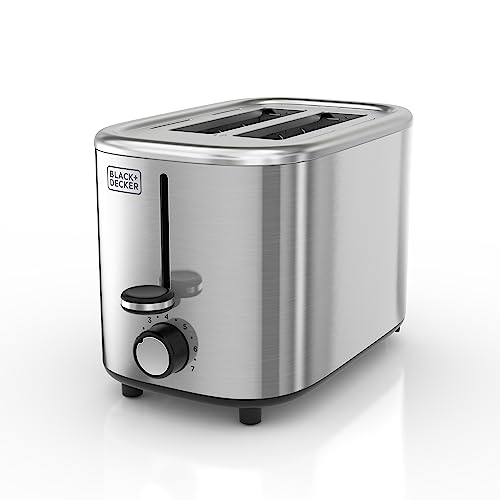
BLACK+DECKER 2-Slice Toaster, Stainless Steel — Best Wide-Slot Value
This stainless BLACK+DECKER 2-slice adds a metal body and seven shade settings to the brand’s extra-wide-slot formula. It is aimed at buyers who found the basic plastic models a little plain but want the same everyday simplicity — wide slots, clear shade control, a crumb tray that comes out for a shake over the bin.
BLACK+DECKER’s stainless two-slice closes the list as the value route into a metal-bodied, wide-slot machine. Seven shade settings give it finer control than the brand’s basic models, the extra-wide slots cover bagels and bakery slices, and the crumb tray keeps ownership simple. It lacks the Breville’s cleverness and the Cuisinart’s heritage, but as a straightforward electric toaster bought with clear eyes, it delivers the category’s essentials in a body that elevates the counter it sits on.
Strengths
- Stainless body upgrades the look over basic plastic models
- Seven shade settings give finer browning control
- Extra-wide slots fit bagels and thick slices
Trade-offs
- Two-slice capacity only
- Metal body gets warm during back-to-back cycles
- Core feature set without digital extras
| Specification | Detail (from listing) |
|---|---|
| Slots | Extra-wide slots (per listing) |
| Shade | 7 shade settings (per listing) |
| Body | Stainless steel; crumb tray included |
Seven shades reward a week’s calibration: run your regular bread at the middle, adjust one step, and settle. The metal body warms during long sessions, so position it where hands do not brush past mid-breakfast-rush. As with all stainless here, a microfibre wipe keeps it looking like the upgrade it is.
Best for: value buyers wanting a stainless wide-slot two-slice / Not suited for: feature hunters wanting countdowns or specialty modes
Check on Amazon — check the current price on Amazon before you decide.
Comparison Table
| Pick | Badge | Key spec | Best for |
|---|---|---|---|
| Cuisinart CPT-160P1 2-Slice Metal Classic Toaster | Best Overall Electric Toaster | 1.5 in slots (per listing) | most households wanting the proven classic two-slice in stainless |
| Breville BTA720XL Bit More Toaster, 2 Slice | Best Premium Features | Wide slots for thick, artisanal bread (per listing) | toast enthusiasts who will use Lift & Look and A Bit More daily |
| GE 2-Slice Stainless Steel Toaster | Best Power and Even Toasting | 1,500 watts (per listing) | specification-led buyers wanting stated power and slot dimensions |
| Hamilton Beach 2-Slice Toaster 22794 | Best Everyday Electric Toaster | Extra-wide slots (per listing) | busy families wanting Toast Boost, auto-shutoff and full everyday functions |
| Cuisinart CPT-320P1 Compact 2-Slice Toaster | Best Compact Electric Toaster | Compact 2-slice (per listing) | small kitchens, studios and second homes |
| BLACK+DECKER 2-Slice Toaster, Stainless Steel | Best Wide-Slot Value | Extra-wide slots (per listing) | value buyers wanting a stainless wide-slot two-slice |
Electric Toaster vs Toaster Oven: Which Do You Actually Need?
This is the most common confusion in the category, so let us settle it. A slot toaster — everything in this guide — browns bread with elements close on both sides: fast, even, energy-sipping, and brilliant at exactly one job. A toaster oven is a miniature oven: it reheats pizza, bakes small dishes, melts cheese and also makes toast, more slowly and usually less evenly, in exchange for that versatility. Kitchens with oven space and toast ambitions need the slot toaster; kitchens needing a second small oven should read our toaster oven coverage instead.
The energy and speed gap is real. A slot toaster finishes in two to three minutes using a fraction of the power a cavity oven spends preheating. If your household toasts daily and rarely reheats, the slot machine wins on every axis that matters at 7 a.m. Many well-equipped kitchens own both and use each for its strength; nobody who owns both toasts in the oven by choice.
Capacity language differs too, and trips buyers up. A ‘four-slice’ toaster oven may fit four slices laid flat but toast them less evenly than a two-slice slot toaster handles its pair. Compare like with like: this guide’s six are all two-slice slot machines, judged on browning, fit and controls — the honest axes of their category.
How to Choose the Right Electric Toaster
Measure your bread before your counter. Slot width and length decide which loaves your household can toast whole; the listings here state up to 1.5 inches wide and, in GE’s case, full dimensions — use them. Artisan and sourdough households should weight wide slots and Breville-style progress checking heavily; sandwich-loaf households can prioritise compactness and simplicity instead.
Decide how much interface you want. A dial, like Cuisinart’s, is timeless and instantly learnable. Breville’s button features solve real problems — checking and correcting — that dials cannot. Digital feedback suits households where several people each have a precise shade. There is no wrong answer, only mismatches: buy the interface that matches the most impatient person who will use it at 7 a.m.
Finally, plan the toaster’s home. It needs clearance above and around while running, a spot away from the kettle’s steam, and a cable route that does not cross the sink. Compact models exist precisely because this planning fails in small kitchens; choosing one deliberately, like the CPT-320P1, beats wedging a full-size machine into a space that resents it.
Getting Even Browning From Any Slot Toaster
Evenness begins with fit: a slice centred in a slot sized for it browns most uniformly, which is why wide slots with self-centring behaviour help thin bread as much as thick. Preheat on the first cycle of a cold morning, keep the crumb tray empty so heat circulates as designed, and use consistent settings per bread — most ‘uneven toaster’ complaints are actually ‘different bread every day’ discoveries.
Frozen bread needs the defrost logic, not a higher shade: the gentle first phase thaws the crumb so the browning phase works on bread, not ice. Bagels need their mode for the opposite reason — intensity on the cut face, gentleness on the crust. Use the functions your model provides as designed, and the gap between a good electric toaster and a great one narrows to almost nothing.
How Electric Toasters Actually Brown: Elements, Sensors and Fit
Inside every slot toaster, elements glow on both sides of each slot and radiate heat at the bread’s surfaces while the crumb dries and sugars brown. The carriage timer — mechanical in classic dial models like the Cuisinart, electronic in feature models like the Breville — decides how long that radiation lasts. Everything a buyer experiences as ‘evenness’ is really three variables: how uniformly the elements radiate, how centrally the slice sits between them, and how intelligently the cycle adapts to a hot second round versus a cold first one.
That second variable explains why slot fit matters so much. A thick slice centred in a wide slot receives balanced radiation; a thin slice rattling in the same slot leans toward one element and browns in stripes. Self-centring guides, common on better wide-slot models, exist precisely to solve this. It also explains why the first slice of the day differs from the third: elements and cavity start cold, then stabilise — the small preheat habit recommended in this guide is physics, not fussiness.
Feature models add sensing and interface intelligence on top of the same physics. Breville’s Lift & Look is a mechanical answer — inspect without cancelling — while A Bit More is a timing answer, a short calibrated extension rather than a fresh full cycle. Neither changes the elements; both change the information available to the cook. Understanding that distinction helps you shop calmly: buy fit and elements first, then buy exactly as much interface intelligence as your household will genuinely use.
Two-Slice Topographies: Matching the Machine to Your Kitchen
The two-slice class divides by shape as much as by specification. Standard rectangles like the Cuisinart classics sit happily in a row of countertop appliances. Compact models like the CPT-320P1 trade a little slot generosity for a footprint that suits studios, caravans and second homes. Long-slot designs — represented in our family guide by the Mecity — accept artisan loaves lengthwise, while the classic two-slice here assumes the more common pattern of two upright slices side by side.
Placement shapes satisfaction more than buyers expect. A toaster needs headroom: run beneath a low wall cabinet and steam and heat attack both the appliance’s finish and the cabinet above it. It needs distance from the kettle, whose steam finds every seam, and from the sink, whose splashes find the rest. Give any model in this roundup a foot of breathing room and a wipe-down habit, and its finish — brushed stainless especially — will look deliberate for years rather than apologetic in months.
Finally, consider who else uses the machine. A guest room, a rental or a multigenerational kitchen all argue for the dial-and-lever clarity of the Cuisinart or Hamilton Beach over feature interfaces that need explaining. The best electric toaster is not the cleverest one on the page; it is the one whose results your whole household can reproduce at 7 a.m. without a briefing.
Care, Descaling Myths and Real Maintenance
Toasters need almost no maintenance, which makes the little they need easy to forget. The complete programme is: empty the crumb tray weekly, shake the body gently over a bin monthly, wipe the exterior with a damp cloth when cool, and keep the slots free of the butter and jam archaeology that family life deposits. There is no descaling — that is kettles — no element cleaning, and no lubrication. Anything inside the slots is addressed by gravity and the tray, never by tools, water or sprays.
Two habits protect the finish on the stainless models that dominate this roundup. Wipe with the grain, using a microfibre cloth, and dry afterwards to prevent water marks; and keep the toaster out of the kettle’s steam path, because daily steam is the one household force that genuinely ages finishes and electronics. Do those things and a brushed stainless Cuisinart or Breville will look intentional for a decade.
Know the signs of genuine old age versus neglect. Browning that drifts uneven after years of service, a lever that tires, a tray that warps — these are end-of-life conversations with a maker, not cleaning failures. The models here come from brands with real support channels, which at replacement time is worth as much as it was on the day of purchase.
A Brief History of the Pop-Up, and Why It Endures
The automatic pop-up toaster is over a century old, and its survival is a lesson in fit between tool and task. Bread wants intense, close, two-sided heat for a short time; the slot toaster is precisely that, miniaturised to a countertop box with a spring. Every attempt to replace it — oven toasting, grill toasting, smart appliances with cameras — has foundered on the same rocks: slower, less even, or absurdly complicated for a three-minute job. The six models in this guide are the current form of a settled idea.
What changes across the decades is the interface and the fit. Slots widened as bread diversified beyond the sliced loaf; bagel and defrost logic arrived with freezer-based households; features like Breville’s Lift & Look answered the one frustration the original design never solved, which is not being able to see. Shopping well in this category means honouring that history: buy the settled fundamentals without nostalgia, and buy the modern answers only where they answer a frustration you actually have.
Slot Toasters for Special Diets and Real Bread
Modern bread is not one thing, and the electric toaster’s recent evolution — wider slots, longer slots, gentler defrost logic — is largely a response to that diversity. Gluten-free loaves are often denser and smaller, browning faster at the edges while the centre lags; they reward the check-without-cancelling approach of the Breville or the patience of a lower setting and a second short cycle. Sourdough and artisan loaves are larger, wetter and more irregular, rewarding the wide slots of the Cuisinart classic and the GE’s published dimensions, which let you verify fit before the loaf meets the machine.
Frozen specialty breads — the freezer is where dietary households store their loaves — make the defrost function a daily necessity rather than a bullet point. Every pick here that states defrost logic earns it honestly: the gentle first phase is the difference between toast and a scorched shell around a cold centre. Rye and seeded breads, at the other extreme, brown quickly from their sugars and malts; start them a setting lower than white bread and let the notebook, not optimism, set the household standard.
The practical conclusion is liberating: there is no ‘best setting’ in this category, only a best fit between a machine’s slots and sensing and a household’s actual bread basket. Audit the basket first — the family guide in this series describes how — and the right model from this page usually selects itself.
What Premium Money Buys, and When to Spend It
Above this roundup’s sensible middle sits a premium tier of motorised carriages, touchscreens and designer collaborations. Honesty about what that money buys helps you decline or accept it with clear eyes. It buys quieter, gentler handling of the bread; it buys countdown certainty and sometimes genuine browning sensors; it buys objects that look like sculpture on a design-led counter. It does not buy a different category of toast — the physics of elements and fit, covered in this guide, still govern the result, and a well-chosen Cuisinart or Breville sits within a whisker of any flagship on the plate.
Spend premium money when the toaster is a daily pleasure object in a kitchen you have designed around pleasure — a legitimate reason, openly held. Spend it when a specific feature solves a specific household problem that the models here cannot. Decline it when the argument is vague superiority, because vague superiority is the most expensive thing in any appliance category. The six electric toasters in this guide were chosen to make the sensible decision an excellent one, so that premium spending becomes a choice about joy rather than a tax on quality.
One Last Check Before You Buy
Before ordering, hold your household’s most-used loaf in mind and walk it through the shortlist one final time. Does it fit the Cuisinart’s 1.5-inch slots or the GE’s published dimensions without trimming? Would the Breville’s Lift & Look end a daily frustration in your kitchen, or would its buttons go unused while a simple dial served you better? Is the counter spot a compact’s natural home, or a full-size machine’s? Those three answers, honestly given, select among these six more reliably than any ranking — including ours.
Confirm the exact model code on the listing, since this category’s line-ups shift finishes and bundles between seasons, and put a microfibre cloth in the same order if you chose stainless. Then give the machine its shakedown week: one bread, one setting, small adjustments, notes kept. An electric toaster chosen this way stops being an appliance purchase and becomes what it should be — a small, settled pleasure at the start of every day.
A Note on Breakfast Itself
End, as every toaster discussion should, with the bread. The finest slot machine ever built can only brown what it is given, and the quiet truth of this category is that bread quality moves the result further than any feature in this guide. A household that buys one good loaf a week, freezes it sliced, and toasts it from frozen with the defrost logic these machines provide will eat better toast than a household with a flagship appliance and a bargain loaf. Choose the electric toaster that fits your bread and your counter — then spend your ongoing attention, and a little of the money this roundup saved you, on what goes into it.
In One Sentence
If this guide leaves you with a single rule, let it be this: fit first, features second, finish last — a toaster whose slots fit your bread, whose controls fit your household, and whose size fits your counter will still be making you glad at breakfast long after the excitement of any particular specification has faded into the ordinary, reliable pleasure of toast done properly, every single morning.
How to Use a Slot Toaster for Perfect Results
Six small habits separate good toast from great toast on any machine in this roundup. None costs money; all are worth learning in the first week.
- Start at the middle setting with a new bread and adjust one step at a time; keep a note of the winning number per loaf.
- Centre slices in their slots, and for a single slice use the slot your maker recommends if the manual specifies one.
- Use defrost for anything frozen and bagel mode for bagels, rather than improvising with shade changes.
- Check progress without cancelling where your model allows it — Lift & Look on the Breville, a gentle lever lift elsewhere only if the maker permits.
- Retrieve with the high-lift lever or wooden tongs; never metal utensils, never fingers in hot slots.
- Rest toast on a rack or stood upright for thirty seconds so steam escapes and the crumb stays crisp.
- Empty the crumb tray weekly and wipe the body cool; cleanliness is a browning feature.
Within a fortnight these steps become reflex, and your toaster — whichever of the six you chose — will produce the breakfast your household actually wanted when it went shopping.
Common Buying Mistakes
- Buying a toaster oven to make toast. Countertop ovens toast slowly and less evenly than slot machines. If toast is the primary job, buy the slot toaster.
- Ignoring slot dimensions. A toaster your favourite loaf does not fit is a daily annoyance. Check stated widths and lengths against your bread.
- Cranking the shade for frozen bread. Frozen slices need the defrost phase, not more intensity. Use the mode and keep your normal shade.
- Judging a toaster on its first-ever slice. Elements and kitchens start cold. Assess over a week of real breakfasts before concluding anything.
- Leaving crumbs to accumulate. Crumbs burn, smoke and insulate. Weekly tray emptying is the whole maintenance contract — honour it.
- Storing the toaster in a cupboard and the bread by the kettle. Appliances in cupboards get skipped, and steam ages finishes. Give the toaster a counter home with clearance.
Final Recommendation
The Cuisinart CPT-160P1 remains the default electric toaster: proven, capacious for its class and timeless. The Breville Bit More is the enthusiast’s upgrade whose features genuinely get used, the GE is the specification-lover’s choice, and the Hamilton Beach is the everyday family workhorse. Small kitchens should take the compact Cuisinart seriously, and value buyers will be well served by the stainless BLACK+DECKER.
Confirm the model code on the listing, check the current price on Amazon, and match the machine to your bread and your counter — in this category, fit is destiny.
Our shortlist, if you are deciding today:
- Cuisinart CPT-160P1 2-Slice Metal Classic Toaster (Best Overall Electric Toaster) — check price on Amazon
- Breville BTA720XL Bit More Toaster, 2 Slice (Best Premium Features) — check price on Amazon
- GE 2-Slice Stainless Steel Toaster (Best Power and Even Toasting) — check price on Amazon
Keep exploring related guides: Best Economy Toasters Best Family Toasters Best Toasters Best Toaster Ovens Best 2 Slice Toasters Best 4 Slice Toasters
Frequently Asked Questions
What is the difference between an electric toaster and a toaster oven?
An electric slot toaster browns bread between close elements — fast, even and specialised. A toaster oven is a small cavity oven that bakes, reheats and melts as well as toasting, more slowly and usually less evenly. Choose the slot toaster for breakfast excellence, the oven for versatility, and see our toaster oven guides if reheating and small bakes matter as much as toast in your kitchen.
How wide should toaster slots be?
For sandwich loaves, standard slots suffice. For bagels, crumpets and bakery bread, look for extra-wide slots — the picks here state up to 1.5 inches, and GE publishes full slot dimensions of 1.38 x 5.50 inches. Measure your regular loaf’s thickness and length before ordering; a toaster that fits your bread whole, without trimming or turning, is the single biggest daily satisfaction in this category.
Does higher wattage mean better toast?
Not automatically. Wattage buys speed and helps frozen items brown through — GE’s stated 1,500W is strong for a two-slice — but evenness depends on elements, fit and sensing. A well-designed lower-wattage toaster with centred slots will out-toast a powerful one your bread rattles around in. Use wattage as a secondary signal, behind slot fit and maker reputation.
Why is my toast uneven on one side?
Common causes are a slice too thin or off-centre for its slot, a cold first cycle, crumb buildup insulating one element, or frozen patches in the bread. Centre the slice, preheat on the first round, empty the tray, and use defrost for frozen loaves. Persistent one-sided results on every bread, after those fixes, suggest an element issue — contact the maker rather than compensating forever with mid-toast turning.
Are dial or digital controls better?
Both work; they suit different households. Dials like Cuisinart’s are instantly learnable and effectively timeless. Feature buttons like Breville’s Lift & Look and A Bit More solve checking and correcting, which dials cannot do at all. Choose by the user, not the brochure: the best control is the one your household’s sleepiest member operates correctly without thinking.
How do I clean an electric toaster safely?
Unplug it and let it cool completely. Remove and empty the crumb tray — every pick here has one — shake the body gently upside down over a bin, and wipe the exterior with a slightly damp cloth. Never immerse a toaster, never spray cleaner inside the slots, and never fish for stuck items with metal. That weekly two-minute routine is the entire maintenance programme.


