Disclosure: airfryerkitchensupply.com is reader-supported. When you buy through links on our site, we may earn an affiliate commission at no extra cost to you.
Where to buy
Home chefs buy cookware differently from first-apartment shoppers: the set has to sear hard, simmer gently, survive the oven and still be pleasant to wash up on a weeknight. Every set below was confirmed through the site’s Amazon verification step, and the shortlist is led by fully clad stainless — start with the Tramontina Signature Tri-Ply Clad 12-Piece if you want one set that does almost everything, or the All-Clad D3 Stainless 10-Piece if you want the benchmark American-made clad line.
Check the current price on Amazon through the links in this guide, and count pieces the way manufacturers do before you compare sets: lids count as pieces, so a “13-piece” set may hold fewer actual pans than a generous 10-piece. The reviews below call out what each set really contains and how it behaves at the stove.
Introduction
The best cookware sets for home chefs are not the biggest boxes on the shelf — they are the sets whose pans heat evenly edge to edge, whose handles stay put under a full load, and whose mix of pieces matches how an enthusiastic home cook actually cooks: a wide skillet for searing, a sauté pan with a lid for braises, two saucepans that get used daily, and a stockpot big enough for a real batch of soup or pasta water.
A home chef also asks more of a set than gentle weeknight reheating. You are reducing sauces until they coat a spoon, finishing chicken thighs under the broiler, deglazing with wine and scraping with a metal spoon. That workload points to clad stainless steel as the default recommendation, with one hard-anodized nonstick set and one ceramic set included for cooks who know exactly which jobs they want those surfaces for.
This guide ranks six verified sets by cooking performance first and convenience second. Piece counts, oven limits and construction details below come only from the verified listings, and where a set’s marketing runs ahead of its contents, the review says so plainly.
One more framing note before the picks: a ‘set’ is a bundle decision, not a law. Every set below can be the whole purchase, but the reviews also flag where a set’s mix leans — more saucepans, fewer skillets, a stockpot sized for a crowd — so you can judge the bundle against your shelf of existing pans. The best set for a home chef with a beloved cast iron skillet already in the kitchen is not the same as the best set for an empty kitchen, and the guide tries to serve both readers honestly.
In this guide
Quick Picks
Six sets, six different answers to what a serious home kitchen needs most:
- Best Overall: Tramontina Signature Tri-Ply Clad 12-Piece Set — fully clad tri-ply stainless with the most useful 12-piece mix in this guide.
- Best Premium: All-Clad D3 Stainless 10-Piece Set — the original bonded clad line, oven safe to 600F and made in the USA.
- Best for Entertaining: Calphalon 3-Ply Stainless Steel 13-Piece Set — a broad 13-piece clad spread, metal-utensil safe and oven safe to 500F.
- Best Nonstick: Ninja Foodi NeverStick Premium 13-Piece Set (C39600) — hard-anodized nonstick rated oven safe to 500°F for sear-to-oven cooking.
- Best Value Clad: Cuisinart MultiClad Pro 12-Piece Set (MCP-12N) — tri-ply clad construction and a chef-friendly 12-piece mix at a mid tier.
- Best Ceramic Nonstick: GreenPan Reserve 10-Piece Set — PFAS-free ceramic nonstick on hard-anodized bodies, oven and broiler safe.
How These Picks Were Chosen
Each set was checked against the manufacturer’s listing verification used across this site, and only sets with a confirmed listing carry a buying link. Construction claims — tri-ply clad, impact-bonded base, hard-anodized body — were taken from the verified listing text, not from roundup sites.
The ranking weighs four things home chefs feel every day: evenness of heat across the cooking surface, responsiveness when you lift a pan off the flame or drop the heat, oven and broiler headroom for finishing dishes, and how the set’s piece mix maps onto real cooking rather than padding a count with utensils and lids.
Two honest filters were applied. Sets built around thin disc bases were ranked below fully clad sets for searing work, because the sidewalls are where sauces scorch. And every set here had to include at least one wide skillet and one lidded sauté or Dutch-oven-style piece — the two pans a home chef reaches for most.
A final methodological note: cookware marketing counts and materials were cross-checked between the verified listing and the set’s piece list, and where a listing’s language was vague — ‘premium construction’ and its cousins — the review describes observable behaviour (heat response, oven rating, utensil tolerance) instead of repeating the adjective. Home chefs deserve nouns and numbers, not adjectives.
The 6 Best Cookware Sets for Home Chefs

Tramontina Signature Tri-Ply Clad 12-Piece Set — Best Overall
Tramontina Signature Tri-Ply Clad 12-Piece Set — check price on Amazon.
The Tramontina Signature set earns the top spot because it gives a home chef the construction that matters — aluminum core sandwiched in stainless, running up the sidewalls, not just across the base — at the tier where most serious home cooks actually shop. Searing scallops, the pan holds heat when cold food lands; simmering a tomato sauce, the clad walls stop the ring of scorch that disc-base pans leave.
The 12-piece mix is the other half of the appeal. You get the skillets, saucepans, sauté pan and stockpot a home chef rotates through weekly, in sizes that suit cooking for two to six people. It is the rare set where nothing feels like filler.
Who should skip it: cooks whose repertoire is mostly delicate egg dishes and who do not want to learn stainless technique — the GreenPan or Ninja below will make their mornings happier. Everyone else gets, in this set, the closest thing the category offers to a permanent answer.
Strengths
- Fully clad sidewalls heat evenly and resist scorching sauces
- Induction-ready, so it survives a future hob change
- Dishwasher-safe and NSF-certified for cooks who value easy cleanup
Trade-offs
- Stainless demands a little technique — preheat and oil timing matter for eggs
- Heavier than disc-base sets when a stockpot is full
- Polished exterior shows water spots unless dried after washing
| Specification | Detail |
|---|---|
| Construction | Tri-ply clad stainless steel |
| Compatibility | Induction-ready |
| Care | Dishwasher-safe |
| Certification | NSF-certified |
| Origin | Made in Brazil |
In daily use the detail that stands out is responsiveness. Drop the heat under a beurre blanc and the pan listens immediately; crank it for a hard sear and there is no lag while a thick base catches up. That is the practical difference clad construction makes, and it is why this set, rather than a cheaper lookalike, leads the guide.
Long-term, stainless is the surface that does not wear out. There is no coating to baby, no seasoning to maintain, and a paste cleaner restores the finish when rainbow discolouration appears from high heat. For a home chef buying a decade-long set, that durability argument is decisive.
One more practical note: because the whole set is induction-ready and dishwasher-safe, it survives the two most common mid-ownership changes — a new hob and a busier life — without any piece becoming obsolete. Home chefs rarely replace sets because pans wear out; they replace them because the kitchen changed around the pans. This set is unusually resistant to that fate, which quietly strengthens its best-overall case.
Best for: home chefs who want one clad set for nearly every job / Not suited for: cooks who want food to release with zero technique or fat
Check on Amazon — check the current price on Amazon before you decide.
All-Clad D3 Stainless 10-Piece Set — Best Premium
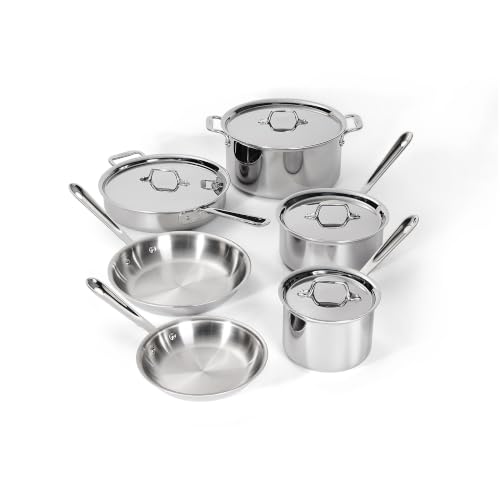
All-Clad D3 Stainless 10-Piece Set — check price on Amazon.
All-Clad’s D3 line is the cookware other clad sets are measured against, and for a home chef who finishes dishes in a hot oven or under the broiler, its verified 600F oven rating is the headline: that headroom covers everything from frittatas to a final blast of heat on gratins without checking the manual first.
The 10-piece count is honest rather than padded — fry pans, saucepans with lids, a sauté pan and a stockpot — and the handles, rivets and rolled rims feel a notch more finished than value clad rivals. This is the set for the cook who notices those things every single day.
A note on value framing: the D3’s tier buys finishing and headroom, not magic. Dinner from the D3 and dinner from the Tramontina will taste the same on most nights; the difference appears at the extremes — the broiler finish, the violent sear, the fifteenth year of service — and home chefs who cook at those extremes are the ones who should pay for them.
Strengths
- 600F oven rating gives real broiler and finishing headroom
- Bonded construction heats evenly with excellent control
- Made in the USA with a long track record in home kitchens
Trade-offs
- Premium tier — the most expensive route to clad in this guide
- 10 pieces means no dedicated second large skillet
- Handles are slim and can feel sharp under a very full, heavy pan
| Specification | Detail |
|---|---|
| Construction | Bonded stainless (D3 tri-ply) |
| Oven limit | Oven safe up to 600F per listing |
| Compatibility | Induction compatible |
| Origin | Made in the USA |
Where the D3 justifies its tier is consistency across the set: the small saucepan behaves like the big sauté pan, just smaller. Sauces reduce at the same predictable rate, and once you learn one pan’s hot spots you have learned them all, which quietly makes you a better cook over a year of dinners.
If your cooking leans French — pan sauces, gentle egg work in the omelette pan the listing calls out, oven-finished proteins — this is the set that rewards that style most. Buy it once, and the upgrade itch that plagues home chefs largely goes away.
Consider also what the D3 does to your other purchases: because the set covers searing, saucing and oven work at the highest level, the pans you add later can be specialists — a carbon steel crêpe pan, a big Dutch oven — rather than replacements for pieces that underperform. A core set this complete changes the rest of the kitchen’s shopping list, which is a form of value rarely counted in per-piece comparisons.
Best for: home chefs who finish dishes in the oven and want the benchmark clad set / Not suited for: shoppers who need the lowest cost per piece
Check on Amazon — check the current price on Amazon before you decide.
Calphalon 3-Ply Stainless Steel 13-Piece Set — Best for Entertaining
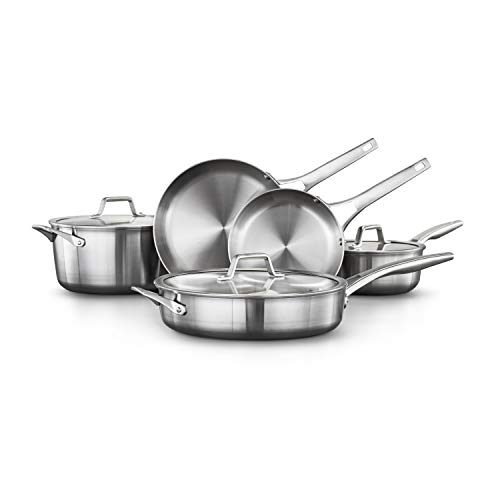
Calphalon 3-Ply Stainless Steel 13-Piece Set — check price on Amazon.
Entertaining is a capacity problem as much as a cooking problem: you need the big pot for pasta, a second pan for the sauce, a skillet for the protein and somewhere for the vegetables — all at once. Calphalon’s 13-piece 3-ply set is the broadest stainless spread in this guide, and its verified induction compatibility and 500F oven rating mean none of those pans is the weak link.
The listing’s metal-utensil-safe note matters more than it sounds. When guests are helping in the kitchen, nobody is hunting for the wooden spoon drawer, and a surface that shrugs off a metal spatula removes a whole category of dinner-party stress.
Storage tip for this set specifically: its breadth rewards a pot rail or a deep drawer with a rack more than stacked cabinets, because nested stainless is heavy to unstack one-handed mid-recipe. Plan the home for it and the set’s size becomes pure advantage; improvise the storage and even fans of the set start leaving pieces in the dishwasher.
Strengths
- Widest piece spread here for cooking several dishes at once
- Metal utensil safe — forgiving when helpers grab the wrong tool
- Induction compatible and oven safe to 500F
Trade-offs
- 13 pieces need real cabinet or hanging space
- 3-ply walls are a step behind the very best clad for delicate sauces
- Big set means more washing up after big meals
| Specification | Detail |
|---|---|
| Construction | 3-ply stainless steel |
| Oven limit | Oven safe 500F per listing |
| Compatibility | Induction |
| Utensils | Metal utensil safe per listing |
For the home chef who cooks for eight on weekends, this set’s value is in duplication: two frying pans and multiple saucepans mean you are never washing a pan mid-service to reuse it. Holiday cooking, where timing everything to land together is the whole game, is exactly where that depth pays off.
It also works as a household’s only set more comfortably than the 10-piece rivals, because the piece you need is simply more likely to be in the box. If your kitchen has the storage, breadth beats minimalism.
A word on the count itself: thirteen pieces here includes lids, as every brand counts, but the vessel count underneath is genuinely broad — and for entertaining, vessels are what run out. When the menu has a sauce, a side, a main and a vegetable all moving at once, this is the set in the guide least likely to send you to the sink mid-cook to wash and reuse a pan.
Best for: home chefs who regularly cook for a crowd / Not suited for: small kitchens with one shallow cabinet for pans
Check on Amazon — check the current price on Amazon before you decide.

Ninja Foodi NeverStick Premium 13-Piece Set (C39600) — Best Nonstick
Ninja Foodi NeverStick Premium 13-Piece Set (C39600) — check price on Amazon.
Most nonstick sets ask home chefs to accept low oven limits and no real searing. The Ninja NeverStick Premium line is the exception worth ranking: its verified listing rates the set oven safe to 500°F, which covers the sear-on-the-hob, finish-in-the-oven routine that defines a lot of serious home cooking, on a surface that releases fish and eggs without a fight.
The hard-anodized body gives the pans more heft and heat tolerance than bargain nonstick, and the 13-piece spread mirrors the stainless sets above rather than trimming to a token saucepan or two.
One more use case where this set quietly excels: rental and shared kitchens. Its surface forgives other people’s metal utensils and variable technique better than the alternatives, and its oven rating covers the dishes housemates actually cook. A set that survives communal life is a rarer thing than a set that survives a careful owner.
Strengths
- 500°F oven rating is unusually high for nonstick
- Hard-anodized bodies feel sturdier than budget nonstick
- Forgiving release for eggs, fish and sticky glazes
Trade-offs
- Any nonstick coating is a consumable — it will not outlive stainless
- High-heat dry searing is still better in clad or cast iron
- Textured surface needs a soft sponge, not the scourer
| Specification | Detail |
|---|---|
| Construction | Hard-anodized nonstick |
| Oven limit | Oven safe to 500°F per listing |
| Pieces | 13-piece set |
The honest way to use this set is as the high-release half of a kitchen: weeknight eggs, delicate fish, reheated rice dishes that weld themselves to stainless. Keep one stainless skillet for screaming-hot steak work and the Ninja handles everything that punishes other pans.
Home chefs who cook a lot of saucy, sticky, low-fat food — glazes, curries with coconut milk, caramelised onions in quantity — will feel the cleanup difference nightly. Just budget for eventual replacement in a way stainless never asks you to.
Technique note for owners: the NeverStick surface sears best when the pan is preheated to medium-high rather than maximum, with food dried on a towel first. That routine gets you a respectable crust and keeps the coating in its comfort zone — the difference between a nonstick set that thrives for years and one that fades in eighteen months is almost always heat discipline, not the brand.
Best for: home chefs who want nonstick release without giving up oven finishing / Not suited for: buyers who want a single set to last decades untouched
Check on Amazon — check the current price on Amazon before you decide.

Cuisinart MultiClad Pro 12-Piece Set (MCP-12N) — Best Value Clad
Cuisinart MultiClad Pro 12-Piece Set (MCP-12N) — check price on Amazon.
The MultiClad Pro is the set experienced cooks recommend when a friend asks for clad performance without the flagship tier. Its tri-ply construction puts the aluminum core where it counts, the rims are designed to pour without dribbling down the side of the pan, and the 12-piece mix includes the covered sauté and steamer-style versatility a home chef actually uses.
It has been a staple recommendation for years for a simple reason: on the stove, blindfolded, most cooks cannot tell its results from sets in a higher tier. The differences show in finishing details, not in how dinner turns out.
For cooks choosing between this and the Tramontina at the top: the honest differences are lids, handles and small finishing preferences, not cooking outcomes. Pick by which handle shape your hand prefers and whether the piece mix matches your shelf — at this level of clad, ergonomics is a legitimate deciding vote.
Strengths
- Clad performance at a mid-range tier
- Drip-free pouring rims and comfortable handles
- 12 useful pieces with no obvious filler
Trade-offs
- Exterior finish is plainer than the premium pick
- Lids are stainless, so you cannot watch a simmer without lifting
- Slightly less oven headroom on paper than the 600F pick
| Specification | Detail |
|---|---|
| Construction | MultiClad Pro tri-ply stainless steel |
| Pieces | 12-piece set |
| Model | MCP-12N |
For a home chef building skill, this set removes equipment as an excuse. Sauces behave, sears are even, and the pans respond quickly enough to teach heat control — the core skill that separates good home cooking from great home cooking.
Pair it with one nonstick skillet for eggs and you have covered essentially every task in a home kitchen for years. That two-part strategy is what many professionals quietly run at home themselves.
Owners upgrading from disc-base pans notice one more thing: the MultiClad Pro’s pans sit flatter and steadier on electric and induction hobs, because the clad base is machined as one piece rather than a disc bonded on. On glass hobs especially, that stability — no spinning saucepan when you stir — is a daily quality-of-life detail that never appears in specifications.
Best for: home chefs who want clad results and value in the same box / Not suited for: cooks who want glass lids to monitor food hands-off
Check on Amazon — check the current price on Amazon before you decide.

GreenPan Reserve 10-Piece Set — Best Ceramic Nonstick
GreenPan Reserve 10-Piece Set — check price on Amazon.
Some home chefs want a nonstick surface without fluoropolymer coatings, and the GreenPan Reserve is the ceramic set that takes that brief seriously: a hard-anodized body for even heat, a PFAS-free ceramic surface per the verified listing, glass lids for watching a simmer, and an oven-and-broiler-safe rating that most ceramic sets do not offer.
The gold-tone stainless handles and taupe finish also make it the best-looking set in this guide — not a cooking metric, but home chefs who store pans on open shelves or a hanging rail are allowed to care.
The Reserve also earns a mention as the gift pick of the guide: for a home chef setting up a first serious kitchen who cares about coatings, it arrives beautiful, complete and easy to succeed with from the first omelette. Gifts should be usable on day one, and no set here is kinder on day one.
Strengths
- PFAS-free ceramic surface for coating-conscious cooks
- Oven and broiler safe, unusual among ceramic sets
- Glass lids and dishwasher-safe care keep it easy to live with
Trade-offs
- Ceramic release fades faster than conventional nonstick
- Needs lower heat habits — ceramic hates being preheated empty on high
- Colour finishes show scratches more than plain stainless
| Specification | Detail |
|---|---|
| Coating | Ceramic nonstick, PFAS-free per listing |
| Construction | Hard anodized body |
| Lids | Glass lids |
| Care | Dishwasher safe |
| Oven use | Oven & broiler safe per listing |
Treat ceramic as a medium-heat specialist and it rewards you: eggs, pancakes, reheats and gentle sautés slide around happily, and the hard-anodized base keeps heat even at those settings. Push it into daily high-heat searing and you will shorten its life — that trade-off is stated here so you can choose with eyes open.
For the home chef whose cooking is mostly weeknight, vegetable-forward and sauce-based, this set covers the workload with the easiest cleanup in the guide. It is a lifestyle pick as much as a performance pick, and a legitimate one.
A care detail worth the space: ceramic surfaces dislike aerosol sprays and sudden cold water on a hot pan, both of which shorten the release life. Use oil or butter applied with a brush, let the pan cool before washing, and the Reserve’s coating lasts noticeably longer. Ceramic ownership is a habits game, and this set rewards the gentle player with the easiest cleanup in this guide.
Best for: home chefs who prioritise a PFAS-free surface and easy cleanup / Not suited for: high-heat searing devotees who preheat pans hard and dry
Check on Amazon — check the current price on Amazon before you decide.
Comparison Table
| Pick | Badge | Key spec | Best for |
|---|---|---|---|
| Tramontina Signature Tri-Ply Clad 12-Piece Set | Best Overall | Tri-ply clad stainless, induction-ready | home chefs who want one clad set for nearly every job |
| All-Clad D3 Stainless 10-Piece Set | Best Premium | Bonded tri-ply, oven safe up to 600F | home chefs who finish dishes in the oven and want the benchmark clad set |
| Calphalon 3-Ply Stainless Steel 13-Piece Set | Best for Entertaining | 3-ply stainless, oven safe 500F, 13 pieces | home chefs who regularly cook for a crowd |
| Ninja Foodi NeverStick Premium 13-Piece Set (C39600) | Best Nonstick | Hard-anodized nonstick, oven safe to 500°F | home chefs who want nonstick release without giving up oven finishing |
| Cuisinart MultiClad Pro 12-Piece Set (MCP-12N) | Best Value Clad | MultiClad tri-ply stainless, 12 pieces | home chefs who want clad results and value in the same box |
| GreenPan Reserve 10-Piece Set | Best Ceramic Nonstick | PFAS-free ceramic nonstick, glass lids | home chefs who prioritise a PFAS-free surface and easy cleanup |
Read the table as a construction map: the three clad stainless sets differ mainly in piece count, oven headroom and tier, while the two nonstick sets trade ultimate lifespan for release. If you cook everything, start at the top; if you cook sticky food nightly, weight the Ninja and GreenPan rows more heavily than their rank suggests.
How to Choose the Best Cookware Sets for Home Chefs
Start with construction, because it decides almost everything else. Fully clad stainless — layers bonded through the base and walls — heats the most evenly and responds fastest, which is why three of the six picks use it. Disc-base pans put the aluminum only in the bottom; they boil water fine but scorch sauces at the edges. Nonstick, whether conventional or ceramic, is a surface decision layered on top of a body decision, so check what is under the coating before you fall for the coating itself.
Next, audit the piece mix against your actual week. List the pans you used in the last seven days. Most home chefs find two skillets, two saucepans, one lidded sauté pan and one stockpot cover 95 percent of cooking — which is why bloated counts padded with utensils, steamers you will never use and three lids for two pots should not sway you.
- Clad stainless for searing, sauces and longevity
- Hard-anodized nonstick if oven finishing plus release both matter
- Ceramic nonstick for medium-heat, coating-conscious cooking
- Induction-ready bases if your next hob might be induction
- Oven rating of 500F or higher for finish-in-the-oven cooking
Finally, handle the pans mentally before buying: a helper handle on the big sauté pan, handles that stay cool on the hob, and a stockpot you can lift full of water from sink to stove. Weight is a feature until it is a wrist problem, and home chefs cook too often to fight their pans.
Clad, Disc-Base and Nonstick: What Actually Changes at the Stove
The difference you can taste is in sauces and sears. A clad pan’s walls carry heat, so a fond forms evenly and a sauce reduces without a scorched ring; a disc-base pan concentrates heat at the bottom, which is fine for boiling but shows up as hot spots when you are browning meat in batches. Nonstick changes technique the other way: less fond, easier release, and browning that is good rather than great, in exchange for cleanup that takes seconds.
Longevity runs in the opposite order to convenience. Clad stainless is effectively permanent. Conventional nonstick is a multi-year consumable. Ceramic nonstick usually fades fastest of the three. A home chef’s rational setup is often a clad core set plus one nonstick skillet — which is why this guide ranks complete clad sets first but refuses to pretend nonstick has no place in a serious kitchen.
Sizing a Set for How You Really Cook
Household size is a weak guide; cooking style is a strong one. A two-person household that batch-cooks Sunday sauce needs the big stockpot more than a family of five that eats simply. Skillet diameter matters most: too small and meat steams instead of searing because the pan is crowded; the wide skillet in a set is the pan whose size you should check first.
Also check your oven and your storage before the set arrives. A 13-piece set needs a home — a deep drawer, a rail, or a cabinet with a rack — and the largest pan should fit your oven if you plan to finish braises in it. Measuring two spaces (cabinet depth, oven width) before ordering prevents the most common return in this category.
Stainless Steel Grades and What 18/10 Actually Means
Home chefs shopping clad sets meet the numbers 18/10 and 18/8 constantly. They describe the chromium and nickel content of the stainless steel: chromium provides corrosion resistance, nickel adds lustre and further rust protection, and 18/10 is the grade traditionally used for the cooking surface of quality pans. It is a materials detail, not a performance guarantee — a well-made 18/8 pan with a proper clad core will outcook a thin 18/10 pan every time — but on the interior surface that touches acidic tomato sauces for hours, the higher nickel grade is the one that resists pitting best over years of use.
The practical takeaway is ordering: construction first (clad or disc), thickness and weight second, grade third. The sets in this guide were ranked in exactly that order, which is why the grade appears in this section rather than in any badge. If a listing shouts the grade and whispers the construction, read that as marketing choosing its favourite child.
Building Around a Set: The Three Add-Ons Home Chefs Actually Buy
No set, however good, covers three jobs home chefs meet constantly. The first is a large Dutch oven for braises and bread — most sets include a stockpot that boils well but lacks the heavy lid and low, wide shape braising wants. The second is a carbon steel or cast iron skillet for the highest-heat searing, where even clad stainless is second best. The third is one small nonstick pan dedicated to eggs, whatever your main set is made of, because eggs are the one daily food that punishes every other surface.
Bought in that order, those three additions turn any set in this guide into a complete professional-grade home kitchen. Bought randomly — another saucepan here, a gadget pan there — they become the clutter that makes cooking feel crowded. The set is the foundation; build on it deliberately.
How Long Should a Cookware Set Last? An Honest Lifespan Guide
Clad stainless, treated normally, has no practical expiry date: the sets at the top of this guide can reasonably be measured in decades, with handles and rivets the only parts that ever need attention. That is why their higher tiers amortise so well — the cost per year of a clad set kept for fifteen years undercuts a budget set replaced every four, before you count the cooking difference at all.
Nonstick lifespans are shorter and should be budgeted as such: conventional hard-anodized surfaces typically serve several years of daily use before release fades, and ceramic surfaces fade sooner still. Neither is a defect — it is the physics of coatings — but a home chef choosing nonstick should choose it for what it does during those years (release, easy cleaning, gentle cooking) rather than pretending the timeline matches stainless. This guide ranks with that honesty in both directions.
Gas, Induction, Electric: Matching a Set to Your Hob
Every set in this guide works on gas and electric, but induction is the filter that future-proofs a purchase: the clad stainless picks and the Calphalon are verified induction-compatible, which matters because induction is where new kitchens are heading and a set bought today should survive the hob bought in five years. A magnet test tells the truth about any pan — if a fridge magnet sticks firmly to the base, induction will drive it — and it is worth applying to pans you already own before assuming a new set must replace them all.
Gas rewards responsive pans, because flame changes are instant and a clad pan’s quick answer to the dial is felt immediately in sauce work. Glass-ceramic electric rewards flat, stable bases — another quiet strength of the clad sets here, whose machined bases sit dead flat. Coil electric is the most forgiving hob of all. In short: the hob you have should not change your pick among the top sets, but the hob you might get next argues for induction-ready construction, and this guide has weighted it accordingly.
A Quick Word on Lids, Handles and the Details That Decide Daily Happiness
Two details decide whether a set delights or nags daily, and neither photographs well. Lids: stainless lids seal tightly and survive any oven temperature the pan does, while glass lids let you watch a simmer but carry lower heat limits and one more thing to wash carefully — the GreenPan’s glass and the clad sets’ steel in this guide represent both philosophies fairly. Handles: look for a shape your hand can grip with a towel, a length that balances a full pan, and — on the big pieces — a helper handle opposite the main one. You will lift a full stockpot hundreds of times; the handle is the interface, and it deserves the same scrutiny as the cooking surface it is attached to.
How to Season, Preheat and Care for a New Cookware Set
Stainless and nonstick ask for different habits, and the first week with a new set is when those habits form. This routine covers the preheating method that makes stainless behave almost like nonstick, plus the care rules that keep every surface in this guide performing.
- Unpack and wash every piece in warm soapy water to remove manufacturing residue, then dry fully — water spots on stainless are cosmetic but easier to prevent than polish out.
- For stainless, preheat the empty pan over medium heat for one to two minutes, then flick in a few drops of water: when they bead and glide like mercury, the pan is at searing temperature.
- Add oil after preheating, let it shimmer for a few seconds, then add food and leave it alone — protein releases naturally once the crust forms, which is the moment most cooks ruin by prying early.
- For nonstick and ceramic, skip the empty high-heat preheat entirely; warm the pan with a little oil or butter over medium heat and cook at medium to medium-high.
- Deglaze stainless while it is still warm — a splash of water or wine lifts the fond for a pan sauce and does most of the cleaning for you.
- Wash nonstick with a soft sponge only, avoid aerosol cooking sprays that build up on coatings, and store pans with a cloth or protector between stacked surfaces.
- Remove stainless discolouration with a paste of baking soda or a stainless cleaner, and dry pans before storing to keep the finish bright.
- Store the set so the pans you use daily are reachable without unstacking: a rail, a rack or the two most-used pans living on the hob beats a perfect set buried in a cabinet.
- After the first month, note which two pieces you have not touched — that observation, not any guide, tells you what your next purchase should and should not be.
Follow that split routine — patience and preheat for stainless, gentleness for coatings — and a set bought this year will still be cooking well when recipes you have not discovered yet become house favourites.
Common Buying Mistakes
Counting pieces instead of pans. Lids, utensils and protectors inflate the number on the box. Count actual vessels, then compare sets.
Buying nonstick for high-heat searing. Coatings degrade fastest under dry, screaming-hot use. Keep one stainless or cast iron pan for that job.
Preheating nonstick empty on high. It shortens coating life dramatically. Warm coatings gently with fat in the pan.
Ignoring the oven rating. Home chefs finish dishes in the oven constantly; a low limit quietly rules out whole techniques.
Skipping the storage plan. A 13-piece set in a small kitchen becomes a daily frustration. Measure first, then choose the count.
Judging a set by its heaviest pan. Weight signals clad quality up to a point, then it just signals weight. A set you can lift confidently, full, with one hand and a towel is better than a marginally thicker set you dread moving.
Final Recommendation
For most home chefs the decision is simple: the Tramontina Signature Tri-Ply Clad 12-Piece is the best cookware set for home chefs who want one purchase to cover searing, sauces and Sunday batch cooking, and it does so without the flagship tier. Choose the All-Clad D3 if oven headroom and the benchmark name matter most, and the Cuisinart MultiClad Pro if you want the same clad idea with money left over for a great knife.
If your cooking is sticky, saucy and weeknight-paced, there is no shame in the nonstick route: the Ninja NeverStick Premium keeps an oven rating serious cooks can use, and the GreenPan Reserve is the pick when a PFAS-free surface is the priority. Entertainers cooking several dishes at once should look at the Calphalon 13-piece first.
One last piece of advice for the home chef still torn between two sets on this list: cook your most-cooked meal in your head, pan by pan, through each set’s piece list. The set that never makes you improvise mid-recipe — the right pan, clean and ready, at every step — is your set, whatever its rank here. Rankings serve readers in general; that mental rehearsal serves the one reader who matters.
Keep researching with these related guides from the same program: Best 10 Pc Cookware Sets Best 13 Piece Cookware Sets Best Affordable Cookware Sets Best 18 10 Stainless Cookware Sets Best 8 Ceramic Cookware Sets
Frequently Asked Questions
What cookware material is best for home chefs?
Clad stainless steel is the best all-round answer: it sears, simmers, deglazes and goes in the oven without a coating to wear out. Most serious home kitchens pair a clad core set with one nonstick skillet for eggs and delicate fish.
How many pieces does a home chef really need?
Six vessels cover nearly everything: two skillets, two saucepans, a lidded sauté pan and a stockpot. Sets are counted with lids included, so a 10- to 13-piece set typically contains exactly that working core.
Is tri-ply worth it over a disc-base set?
For sauces and searing, yes. Clad walls heat evenly and stop scorch rings; disc bases only improve the bottom of the pan. For boiling water and simple reheating, the difference mostly disappears.
Can nonstick pans really go in the oven?
Some can — the Ninja set in this guide is rated to 500°F per its listing. Always check the specific set’s verified oven rating, and remember handles and lids can have lower limits than the pan body.
How do I stop food sticking to stainless steel?
Preheat the pan until water drops bead and glide, add oil, let it heat briefly, then add food and resist moving it until a crust forms and it releases on its own. Temperature control, not more oil, is the fix.
Should a home chef buy ceramic or conventional nonstick?
Choose ceramic if avoiding fluoropolymer coatings is the priority and your cooking is mostly medium heat. Choose conventional hard-anodized nonstick if you want stronger release, higher oven tolerance and a longer-lasting surface.
Are expensive cookware sets worth it for home chefs?
The clad sets here justify their tiers through lifespan and heat control rather than luxury: a clad set kept for fifteen years costs less per year than budget sets replaced repeatedly, and it cooks measurably more evenly in the meantime. Nonstick sets should be judged on their working years, not compared on lifespan.
Can I put stainless cookware in the dishwasher?
The Tramontina and GreenPan sets here are listed as dishwasher-safe, and stainless generally tolerates it well. Hand washing keeps polished finishes brighter for longer, but for home chefs the honest answer is that dishwasher use is a cosmetic trade-off, not a functional one, on stainless.

