Disclosure: airfryerkitchensupply.com is reader-supported. When you buy through links on our site, we may earn an affiliate commission at no extra cost to you.
Where to buy
Shopping for the best cookware sets for college students starts with verified listings, not guesswork. All six sets below were verified against live Amazon listing data before being included, so the piece counts, materials and configurations described are the ones actually on sale. Buy through the linked Amazon listings to get the exact set reviewed — cookware sets are notorious for near-identical names covering different piece counts, and the link removes the guesswork.
Shop the verified picks on Amazon: CAROTE 21pcs Pots and Pans Set Non Stick, Detachable Handle Cookware; GreenLife 16 Piece Ceramic Nonstick Pots & Pans Cookware Set; T-fal Initiatives Ceramic 14-Piece Cookware Set; GreenLife 8-Piece Ceramic Nonstick, Turquoise; T-Fal Ultimate Hard Anodized Nonstick Pots and Pans Set 17 Piece; Farberware EcoAdvantage 13-Piece Cookware Set. Use the links to check price on Amazon for each model, because listings, included accessories and availability change over time.
Finding the best cookware sets for college students starts with a reality check about where the cooking happens. Some students are in dorms where hot plates are banned, wattage is capped and the only legal appliance is a microwave; others are in off-campus apartments or house shares with a real stove, three hungry flatmates and a sink that is always full. This guide is written for the second group — students with actual stove access — and for dorm residents whose housing allows a small electric setup elsewhere in the building’s shared kitchen.
Within that reality, student cookware has a brutal job description. It must be cheap enough to survive being abandoned in a move, tough enough to survive flatmates who treat nonstick like cast iron, small enough to fit one cupboard shelf, and simple enough that a person cooking their fortieth-ever meal can succeed with it. Every set below was verified against live listing data, and each was judged on storage footprint, durability under careless use, and how few pieces a student genuinely needs.
The short version: most students need far fewer pieces than sets contain. One good frying pan, one saucepan, one medium pot and lids that interchange will cook ninety percent of student food — pasta, eggs, rice, stir-fries, soups and the occasional ambitious curry. The six picks below range from a detachable-handle set that stacks into a single pile, to a 17-piece hard-anodized set for a shared house that cooks like a small restaurant.
A word about who pays and who cooks, because student cookware decisions are rarely solo. If you are a parent equipping a first kitchen, the sets below are ordered by student reality, not by impressiveness: the set that gets used, stored and survived beats the beautiful set that intimidates. If you are the student, buy for the kitchen you have this year — its cupboard, its rules, its cast of flatmates — and let graduation-you upgrade with a salary.
In this guide
Quick Picks
Best Overall — CAROTE 21pcs Pots and Pans Set Non Stick, Detachable Handle Cookware
The student winner: a 21-piece nonstick set whose handles detach, so the whole kit stacks into one flat pile in a cupboard, goes from stove to table to fridge without a handle in the way, and survives the dishwasher — exactly the compromises student life demands. Check price on Amazon
Best Budget — GreenLife 16 Piece Ceramic Nonstick Pots & Pans Cookware Set
The budget benchmark: a 16-piece ceramic nonstick set that covers every student staple — fry pans, saucepans, a stock pot and utensils — at the tier students actually shop in, with easy-release surfaces that forgive beginner technique. Check price on Amazon
Best Ceramic Alternative — T-fal Initiatives Ceramic 14-Piece Cookware Set
A 14-piece ceramic set from one of the biggest names in nonstick: even-heating bases, an easy-clean ceramic interior and the sensible, student-sized piece selection that T-fal has refined over decades of starter kitchens. Check price on Amazon
Best Compact Set — GreenLife 8-Piece Ceramic Nonstick, Turquoise
The minimal kit: an 8-piece ceramic nonstick set for the student whose kitchen is one cupboard and whose cooking is eggs, pasta and reheats — the smallest honest set in this guide, in a colour that at least makes the cupboard cheerful. Check price on Amazon
Best for Shared Houses — T-Fal Ultimate Hard Anodized Nonstick Pots and Pans Set 17 Piece
The house-share heavyweight: a 17-piece hard-anodized nonstick set with the durability to survive multiple cooks, metal-adjacent carelessness and industrial quantities of pasta — the set a shared student house can buy once and argue about fairly. Check price on Amazon
Best Mid-Range All-Rounder — Farberware EcoAdvantage 13-Piece Cookware Set
The middle path: a 13-piece set from a heritage American cookware name, sized between the minimal kits and the house-share sets, for the student who wants one sensible box that handles a normal cooking life without drama. Check price on Amazon
How These Picks Were Chosen
Candidates were verified through Amazon product listings: brand, piece count, material and configuration had to match the listing exactly, and any set that could not be confirmed was dropped rather than described from memory. No prices, star ratings or review counts appear in this guide, because all three change constantly and students budgeting on them would be misled within a semester.
The judging criteria were student-specific. Storage: does the set nest, stack or hang in the footprint of a single cupboard shelf? Abuse tolerance: will the coating or material survive metal utensils, thermal shock and being left to soak for two days? Cleaning: is it dishwasher safe, honestly, because students will dishwash it regardless of what the box says? And value logic: a set is only cheap if it is still cooking in year three, so flimsy sets that warp in a term were excluded even when their sticker looked friendly.
One further filter deserves naming: every set here had to make sense at the end of the year as well as the start. Cookware that only suits September — too small by the time friends visit, too fragile by the time exams end — was marked down, because students move too often to own single-semester equipment. The survivors are sets a student can grow into as a cook without outgrowing as a tenant: sized for real meals, priced for real budgets, and sturdy enough that the final-year version of you is not shopping again with money that should be funding summer.
The 6 Best Cookware Sets for College Students, Reviewed

CAROTE 21pcs Pots and Pans Set Non Stick, Detachable Handle Cookware — Best Overall
This is the set for the student in a small apartment, studio or house share where cupboard space is the scarcest resource in the kitchen. The detachable handle turns every pan into a serving dish and a storage container, which quietly eliminates half the washing up. It is less ideal for a student who sears steaks at maximum heat nightly — nonstick coatings prefer moderate heat — but for the real student menu it is close to perfect.
Strengths
- Detachable handles make the set stack into a fraction of the space of handled pans
- Pans double as serving and storage vessels, cutting dishes and fridge Tetris
- Dishwasher and oven safe per the listing, matching how students actually treat cookware
Trade-offs
- The handle mechanism is one more thing to keep track of in a shared kitchen — lose it and every pan is compromised
- Nonstick coating will not tolerate years of maximum-heat searing or metal utensil abuse
- A 21-piece count includes lids and accessories; the core cooking vessels are fewer than the number suggests
| Configuration | 21-piece set with detachable handle (per listing) |
| Compatibility | Induction compatible, dishwasher and oven safe (per listing) |
| Storage | Handles detach so pans stack flat (per listing design) |
Space is the argument that wins. A conventional set of handled pans, nested badly in a student cupboard, becomes a clattering landslide every time someone wants the middle one. The CAROTE design removes the handles entirely: click one on to cook, click it off to stack, serve or store. The whole set occupies roughly the footprint of its largest pot, which in a shared kitchen is the difference between owning cookware and storing it on the counter forever.
In use, the detachable system has a second, quieter benefit: leftovers go straight into the fridge in the pan, with a lid on, no decanting into a container you do not own. Reheating is the reverse journey. For a student cooking one-pot meals three nights a week, that loop — cook, serve, store, reheat, one vessel — is worth more than any exotic material.
The honest limits are the coating’s limits. Keep the heat at medium for everyday cooking, reserve high heat for brief moments, and the surface will last the degree. Treat it as disposable fast-fashion cookware and it will behave that way. Judged as a system for small-space student life, though, nothing else in this guide is as well thought through.
A practical note on the handle: buy the set, then immediately decide the handle’s home — one specific drawer or hook — and tell every flatmate. The system’s one vulnerability is social, and a fixed home for the handle removes nearly all of it.
One more CAROTE virtue for students: the pans go under the broiler and into the oven without their handle, which makes the one-pan pasta bake — the shared house’s highest-value recipe — a single-vessel operation.
Best for: students in small apartments and studios where storage space decides everything / Not suited for: high-heat searing devotees or chaotic shares likely to lose the handle
Check on Amazon — check the current price on Amazon before you decide.

GreenLife 16 Piece Ceramic Nonstick Pots & Pans Cookware Set — Best Budget
Buy the GreenLife if the budget is firm and the cooking is honest weeknight food: pasta, eggs, quesadillas, soups, rice. Ceramic nonstick is forgiving for beginners because food releases even when the heat management is imperfect. It is not the set for a four-year degree of daily abuse without some care — ceramic coatings are the sprinters of the cookware world, brilliant early, fading sooner than hard-anodized rivals.
Strengths
- Full 16-piece coverage including utensils — a genuine one-box kitchen start
- Ceramic surface releases eggs and sauces with beginner-proof ease
- Sits in the budget tier students actually buy in, without feeling like a toy set
Trade-offs
- Ceramic nonstick typically loses its slickness faster than hard-anodized coatings under heavy use
- Lightweight construction is easy to handle but less forgiving of being dropped or warped on high heat
- Not the set to hand down after graduation — plan on it serving the degree, not the decade
| Configuration | 16-piece set (per listing) |
| Coating | Ceramic nonstick (per listing) |
| Finish | Black (per listing) |
There is a specific student moment this set is built for: the first September in a real kitchen, with a trolley of pasta, eggs and frozen vegetables and no idea what a fond is. Ceramic nonstick forgives all of it. Eggs slide, cheese sauce rinses out, and the student learns to cook instead of learning to scrub, which is the correct order of lessons.
Sixteen pieces sounds like marketing inflation, and partly is — but here the count includes the utensils a new kitchen genuinely lacks, so the box really does start a kitchen rather than supplement one. The pots are sized for student cooking: a stock pot that handles a family-pack of pasta for flatmates, saucepans that manage rice and sauces without drama.
Set expectations correctly and it will not disappoint. Use wooden or silicone tools, keep heat moderate, and accept that by the final year the fry pan may be on its second wind. At this tier, that is a fair trade — the set costs less than a month of takeaway mistakes and teaches real cooking on the way.
Ceramic care that pays: let the pans cool a few minutes before washing rather than running cold water into a hot pan. Thermal shock is the silent ceramic killer, and students — rushing — are its favourite victims. A two-minute pause doubles the coating’s useful life.
GreenLife’s included utensils deserve a footnote: they are the right softness for the coating, which quietly solves the metal-fork problem for the first semester, before habits form.
Best for: first kitchens on a firm budget that need everything in one box / Not suited for: students wanting one set to last well beyond graduation
Check on Amazon — check the current price on Amazon before you decide.
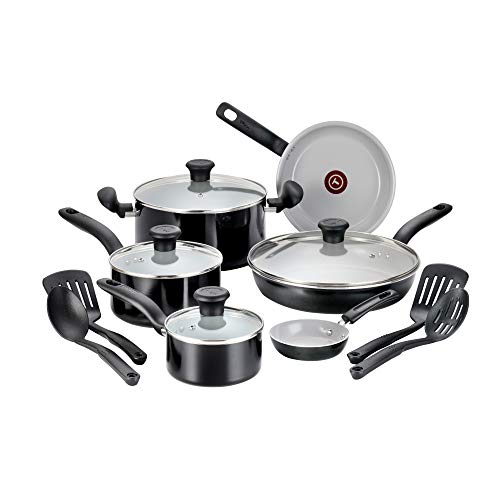
T-fal Initiatives Ceramic 14-Piece Cookware Set — Best Ceramic Alternative
The T-fal Initiatives suits a student who wants ceramic’s easy release with a mainstream brand’s consistency behind it — replacement lids and matching pieces are easy to find years later. It fits a single student or a couple cooking simply. A house of five competitive cooks will outgrow the piece sizes; look at the 17-piece T-Fal further down instead.
Strengths
- Big-brand consistency: even heating and predictable behaviour across the set
- Ceramic interior wipes clean after the saucy, cheesy food students actually cook
- Piece selection is student-sensible — no ornamental vessels nobody uses
Trade-offs
- Ceramic coating shares the category’s lifespan limits under high heat and metal tools
- Sizes are tuned for one to three people, not for feeding a whole house share
- No detachable-handle storage trick — it needs a normal cupboard’s worth of space
| Configuration | 14-piece set (per listing) |
| Coating | Ceramic interior (per listing) |
T-fal’s entire reputation rests on nonstick that behaves, and the Initiatives line applies that to ceramic. The bases heat evenly enough that a beginner’s pasta sauce does not scorch in a ring while the middle stays cool, and the ceramic surface keeps the cleanup to a rinse on most nights — a feature whose value compounds across a semester of 11 p.m. dinners.
The piece mix deserves credit for restraint. Fourteen pieces here means the core vessels plus lids and basics, not a parade of novelty pans. A student can cook the full rotation — breakfast eggs, lunchtime noodles, a proper evening curry — without once wishing for a vessel that is not in the box, and without storing vessels that never leave the cupboard.
As with every ceramic set, the contract is care in exchange for convenience: moderate heat, soft utensils, no thermal shock from tap to hot pan. Keep that contract and the Initiatives is the steady, unglamorous, correct choice for a student who wants cooking to simply work.
T-fal’s sizing has a hidden student virtue: the saucepans are the sizes that cook single packets of noodles and double portions of rice without waste, which sounds trivial until you have washed a stockpot used to boil one egg.
If the Initiatives has a sleeper feature, it is the lids: they fit the set’s vessels sensibly across sizes, so the saucepan lid moonlights on the fry pan for steaming eggs — small fleet logic students rely on.
Best for: students wanting easy-clean ceramic from a mainstream, consistent brand / Not suited for: large house shares or anyone who cooks everything at maximum heat
Check on Amazon — check the current price on Amazon before you decide.

GreenLife 8-Piece Ceramic Nonstick, Turquoise — Best Compact Set
This set is for the truly space-poor: a studio corner kitchen, a shared house where your shelf is your shelf, or a student who cooks three things and cooks them often. Eight pieces is the floor of a functional kitchen — fry pan, saucepans, a pot, lids — and nothing else. If you regularly cook for friends, this is not your set; if you cook for one, it is exactly your set.
Strengths
- Smallest footprint in the guide — fits a single shelf with room to spare
- Ceramic nonstick keeps the tiny rotation of student staples effortless to clean
- Fewer pieces means fewer things to wash, lose or have borrowed by flatmates
Trade-offs
- No capacity for entertaining: batch cooking and dinner guests overwhelm it
- Ceramic lifespan caveats apply — moderate heat and soft tools required
- The bright finish shows wear and scorch marks more honestly than black sets
| Configuration | 8-piece set (per listing) |
| Coating | Ceramic nonstick (per listing) |
| Finish | Turquoise (per listing) |
Minimalism in a student kitchen is not an aesthetic, it is a survival strategy. Every piece you own must be washed, stored and defended from flatmates. An 8-piece set is the smallest configuration that still cooks a real rotation: a fry pan for eggs and stir-fries, saucepans for rice and sauces, a pot for pasta and soup. The GreenLife version wraps that minimum in ceramic nonstick, so the rotation cleans up in minutes.
The turquoise finish sounds trivial until you live in a beige rental kitchen: a set you like looking at is a set you cook with, and cooking at home is the entire financial point. It also makes your pans identifiable at a glance in a shared cupboard, which anyone who has lost a good pan to a flatmate’s ‘borrowing’ will appreciate.
Buy it with clear eyes about its ceiling. The day you start cooking Sunday roasts for six, you will add pieces — and that is fine. As the starter kit for one person’s first kitchen, sized to the space that actually exists, it is the most honest set here.
In a shared cupboard, the turquoise finish does real work: your pans are identifiable across a kitchen, which ends both accidental borrowing and the mystery of whose pan is in the sink. Visibility is a feature in communal living.
The 8-piece’s fry pan is sized for the two-egg, one-person breakfast that is ninety percent of solo student frying — no wasted surface, no sad single egg in a giant pan.
Best for: solo students with one shelf of storage and a tight, simple rotation / Not suited for: social cooks who regularly feed groups
Check on Amazon — check the current price on Amazon before you decide.

T-Fal Ultimate Hard Anodized Nonstick Pots and Pans Set 17 Piece — Best for Shared Houses
Choose this for a house of three to five students who cook seriously and share equipment. Hard-anodized nonstick is the toughest coating class in this guide, the piece count covers simultaneous cooking — one pan for the sauce, one for the protein, a pot for pasta — and the build tolerates the sink-soaking, dishwasher-blasting reality of shared living better than ceramic. Solo students should save their money; this is capacity you will not use.
Strengths
- Hard-anodized coating is the most abuse-tolerant nonstick in this roundup
- 17 pieces support parallel cooking by several people at once
- Built for volume: big pasta nights and full-house curries are its home territory
Trade-offs
- Overkill for one or two people — you pay for capacity that sits idle
- Takes real cupboard space; a small kitchen will resent it
- Even hard-anodized coating eventually wears under years of maximum heat and metal tools
| Configuration | 17-piece set (per listing) |
| Construction | Hard-anodized nonstick (per listing) |
Shared houses destroy delicate cookware. Someone will use a fork in the pan, someone will crank the burner and walk away, someone will leave the sauce to fossilise until morning. The Ultimate Hard Anodized is the set in this guide engineered for that environment: hard-anodized aluminum shrugs off knocks, the coating tolerates more heat and rougher handling than ceramic, and the whole set feels like equipment rather than a starter kit.
The piece count earns its keep in a house context. Seventeen pieces means two cooks can work at once without negotiating for the one good pan, and the stockpot capacity handles the economics of student group cooking — one enormous pot of chilli feeding five people for the price of two takeaways.
It is also, frankly, the set most likely to still be cooking at graduation and to be worth fighting over in the final-week division of property. If your student kitchen is a communal operation, buy the durable thing once. The cheap-set-replaced-yearly path costs more by year three.
House economics: split five ways, this set costs each person less than a single group takeaway, and it will still be the house’s kitchen in the final year. It is the rare shared purchase whose value rises with the number of cooks.
For the T-Fal 17-piece, designate one pan as the house pan and keep the rest as the cooks’ fleet if your share is chaotic: a sacrificial layer is a legitimate strategy for shared equipment.
Best for: houses of three to five students sharing one hard-working kitchen / Not suited for: solo students or anyone with minimal storage
Check on Amazon — check the current price on Amazon before you decide.

Farberware EcoAdvantage 13-Piece Cookware Set — Best Mid-Range All-Rounder
The Farberware suits the average case the other picks bracket: a student in a one- or two-bedroom apartment, cooking for one to three, who wants neither a stripped 8-piece kit nor a 17-piece arsenal. It is the set to buy when you do not have a special constraint — no tiny cupboard, no huge household — and just want balanced, unremarkable competence.
Strengths
- Balanced 13-piece mix covers the full student rotation without surplus
- Heritage brand with widely available matching pieces and replacement lids
- Sized for real apartments: neither toy-small nor house-share huge
Trade-offs
- No standout trick — it wins on balance, not on any single feature
- Mid-tier construction means mid-tier lifespan under heavy daily abuse
- Less exciting for storage than the detachable-handle CAROTE in tight kitchens
| Configuration | 13-piece set (per listing) |
| Line | EcoAdvantage (per listing) |
Most buying guides underrate the balanced option because balance is hard to dramatise. The EcoAdvantage set is the balanced option here: thirteen pieces that map onto a normal cooking week, from a brand that has equipped starter kitchens for generations and whose lids, handles and matching pieces remain findable years later — an underrated virtue when a flatmate inevitably breaks one lid.
In the kitchen it behaves like the sensible middle it is. The vessels are big enough for a couple-plus-guests dinner, small enough to store in an ordinary apartment cupboard, and the set covers sautéing, boiling, saucing and frying without forcing a saucepan to impersonate a stockpot.
If your situation has a sharp edge — minimal space, maximum household, minimum budget — the specialist picks above serve you better. If your situation is the ordinary middle, this is the set that quietly fits it, and there is real value in cookware you never have to think about again.
The Farberware’s quiet strength is replaceability: when — not if — a shared kitchen loses a lid or a pan to a house move, matching pieces from a heritage line are findable in days, and the set heals instead of being replaced wholesale.
Farberware’s mid-weight build has a student-specific benefit: it survives being knocked off a counter onto a hard floor better than the lightest sets, and student kitchens drop things at a rate kitchens elsewhere do not.
Best for: the average student apartment needing one balanced, do-everything set / Not suited for: extreme space, budget or household-size situations with a specialist pick above
Check on Amazon — check the current price on Amazon before you decide.
Comparison Table
| Pick | Badge | Key spec | Best for |
|---|---|---|---|
| CAROTE 21pcs Pots and Pans Set Non Stick, Detachable Handle Cookware | Best Overall | 21-piece nonstick set, detachable handle, induction compatible (per listing) | students in small apartments and studios where storage space decides everything |
| GreenLife 16 Piece Ceramic Nonstick Pots & Pans Cookware Set | Best Budget | 16-piece ceramic nonstick set, black (per listing) | first kitchens on a firm budget that need everything in one box |
| T-fal Initiatives Ceramic 14-Piece Cookware Set | Best Ceramic Alternative | 14-piece ceramic cookware set (per listing) | students wanting easy-clean ceramic from a mainstream, consistent brand |
| GreenLife 8-Piece Ceramic Nonstick, Turquoise | Best Compact Set | 8-piece ceramic nonstick set, turquoise (per listing) | solo students with one shelf of storage and a tight, simple rotation |
| T-Fal Ultimate Hard Anodized Nonstick Pots and Pans Set 17 Piece | Best for Shared Houses | 17-piece hard-anodized nonstick set (per listing) | houses of three to five students sharing one hard-working kitchen |
| Farberware EcoAdvantage 13-Piece Cookware Set | Best Mid-Range All-Rounder | 13-piece cookware set (per listing) | the average student apartment needing one balanced, do-everything set |
How to Choose the Best Cookware Sets for College Students
Start with where you will actually cook. If your dorm bans cooking appliances, no set on this page belongs in your room — the purchase to make is a shared-kitchen arrangement or nothing. If you have a stove, the deciding factors are storage, household size and abuse level, in that order. Measure your cupboard shelf before ordering; a set that does not fit gets stored on the stove, then in the way, then resented.
Material choice is the second decision. Ceramic nonstick (GreenLife, T-fal Initiatives) is the easiest to cook and clean on, and the friendliest for beginners, but its slickness fades fastest under high heat. Hard-anodized nonstick (the big T-Fal) is the durability champion for shared houses. Detachable-handle sets (the CAROTE) trade a mechanism to keep track of for a storage miracle. There is no wrong answer — only answers mismatched to your kitchen.
Count vessels, not pieces. Marketing counts lids and utensils as pieces, so a ’21-piece’ set may hold eight actual cooking vessels. List what you cook weekly — eggs, pasta, rice, stir-fry, soup — and check the set has a right-sized vessel for each. Everything beyond that list is cupboard decoration.
- Measure the cupboard before you buy; storage decides student cookware happiness
- Ceramic for easy release, hard-anodized for shared-house durability, detachable handles for tiny spaces
- Count actual pots and pans, not the headline piece number
- Buy for your household size this year, not an imagined future dinner party
- Dishwasher-safe matters because students will use the dishwasher regardless
Dorm Rules, Wattage and Shared-Kitchen Survival
Dormitories restrict cooking equipment for fire-safety reasons, and the rules are enforced unevenly but expensively when they are enforced. Typical restrictions ban open-coil hot plates and high-wattage appliances, cap the wattage allowed per room, and confine cooking to shared kitchens. Before any cookware purchase, read your housing agreement: a set bought for a stove you are not allowed to use is a donation to the charity shop.
In shared kitchens — dorm or house — the survival skills are social as much as culinary. Label your pans if the house is large. Agree a washing rule before the first meal, because cookware resentments are really washing-up resentments. And keep one pan you care about in your room if your flatmates treat nonstick as a scratch surface; the good set cooks your food, the house set absorbs the chaos.
Finally, think about the exit. Students move yearly, often internationally. A set that stacks flat, survives a car boot and is cheap enough to gift to a first-year on departure day is worth more than a heirloom you must ship home. Buy for the life you are actually living this academic year.
Splitting Costs and Surviving the Shared Kitchen: House Rules That Work
In a shared house, the smartest purchase structure is one person buying the set and housemates splitting the cost in writing — a note in the house chat is enough — with an agreed rule for what happens at move-out: the buyer keeps it and refunds the others a token share, or it is sold and split. Thirty seconds of admin in September prevents the only argument student cookware reliably causes, which happens in June.
Three house rules protect any set in this guide. Utensils: only the soft tools live near the pans — keep one metal-free drawer or pot by the stove. Heat: the biggest burner is for boiling water, not for preheating an empty pan while someone showers. Washing: the cook does not wash, but everyone washes something, the same night. Houses that adopt even two of the three find their cookware lasting the full tenancy.
Finally, insure against the inevitable losses. Lids get broken and the CAROTE’s handle will go walkabout at least once. Choose sets from lines whose parts are sold separately — one reason the big-brand picks dominate this guide — and keep the set’s box or a note of its exact name, because ‘the black 16-piece one’ is not searchable in a panic in October.
The First Shop: What to Cook in Week One With a New Set
A new set earns its place with a first week of wins. Day one: scrambled eggs in the fry pan — the heat-control lesson every cook needs, at the lowest possible stakes. Day two: pasta in the big pot, sauce from a jar improved with frozen peas and the saucepan. Day three: a stir-fry, where the set teaches its own lesson about crowding (cook in two batches; it is faster). By the weekend you have used every core vessel and learned its temperament.
Week one is also when the kitchen’s systems form: where the pans live, which utensils are allowed, who washes. The set that survives a degree is rarely the toughest set — it is the set whose household formed good habits in the first seven days, when enthusiasm was high enough to build them.
Stock the cupboard to match the set: pasta, rice, eggs, frozen vegetables, tinned tomatoes, one sauce you love. A set plus twenty pounds of staples is a month of dinners; a set alone is a sculpture. The economics of student cooking start at the supermarket, and the cookware is how you cash them in.
How to Set Up a Student Kitchen and Keep a Nonstick Set Alive
A nonstick set should last a whole degree. Most die in a year from five habits. Set the kitchen up correctly in week one and the set will outlast the course.
- Unpack and wash every piece in warm soapy water before first use, then dry fully — factory coatings and packing residues should never meet your first meal.
- Assign storage before the first shop: nested pans with a cloth or paper towel between coated surfaces, lids stored separately, the set’s home decided while you are still enthusiastic.
- Cook the first meals at medium heat. Nonstick — ceramic or hard-anodized — is designed for moderate temperatures; high heat is for boiling water and brief sears, not a default setting.
- Use wooden, silicone or nylon utensils only. Keep metal tools in a different drawer if flatmates cannot be trusted, because one fork can scar a pan permanently.
- Wash up the same day. Dried, acidic sauce left overnight is the fastest legal way to age a coating; a two-minute rinse when the pan is warm-but-not-hot prevents it.
- If the dishwasher is the house rule, load pans so they cannot rattle against racks or other items, and accept a somewhat shorter coating life as the price of sanity.
- Store leftovers in a container, not in the pan in the fridge for three days — acids and coatings are enemies, and the pan is needed for tomorrow’s dinner anyway.
- At term’s end, wash, dry and stack the set properly before storing or moving it; most moving damage happens to pans thrown loose into boxes.
None of this is preciousness — it is the difference between one set per degree and one set per year, which at student budgets is the difference between cooking at home and not affording to.
Common Buying Mistakes
Buying the biggest set on sale. Piece-count inflation sells vessels you will never use and cannot store. A right-sized 8–13 piece set beats a 21-piece monument for most students.
Ignoring the housing rules. Cookware for a banned appliance is wasted money and, in dorms, a confiscation waiting to happen. Read the agreement first.
Cranking every burner to maximum. High heat is the number one killer of nonstick coatings. Medium heat cooks student food perfectly well and doubles the set’s life.
Letting flatmates use metal utensils. One enthusiastic fork-user can undo a year of care in a single stir-fry. House rules on utensils are cookware insurance.
Skipping the saucepan to save money. Students try to cook everything in one fry pan; rice, sauces and soups then fail and takeaway wins. The core trio — fry pan, saucepan, pot — is non-negotiable.
Judging a set by its box photo. Studio photos make every set look compact and complete. The honest tests are the cupboard measurement, the vessel list and the utensil rule — all checkable before money moves, none visible in a photograph. Students who run those three checks rarely return a set; students who buy the photograph often do, or worse, keep a set that does not fit and cook less because of it.
Final Recommendation
For most students the CAROTE detachable-handle set is the smartest buy: it stores in a pile, serves at the table and handles the real student menu with ease. Tight budgets point to the GreenLife 16-piece; the smallest kitchens to its 8-piece sibling. Shared houses should buy the hard-anodized T-Fal 17-piece once and split the cost. The T-fal Initiatives and the Farberware cover the ceramic and balanced middle grounds respectively.
Whichever set lands in your cupboard, the economics are the same: a month of cooking at home pays for the set, and every month after that is money kept. Buy the set that fits your space and your household, treat the coating kindly, and eat well for the whole degree.
One last encouragement for the new cook: the first month decides whether the set becomes furniture or a habit. Cook small, cook often, forgive the failures — every experienced cook you admire once burned rice in a saucepan exactly like yours. The set is the easy part; the habit is the degree-long asset.
Start with the top pick here: CAROTE 21pcs Pots and Pans Set Non Stick, Detachable Handle Cookware — check price on Amazon, confirm the configuration on the listing, and order once you have matched it against the checks in this guide.
Keep researching within this cluster: Best Cookware Sets For A Small Apartment Best Cookware Sets For Beginners Best Cookware Sets For Family Camping Best Cookware Sets For Gas Stovetop Best Cookware Sets For Glass Top.
Frequently Asked Questions
Can I use a cookware set in a dorm room?
Only if your housing agreement allows the appliance you would cook on — most dorms ban hot plates and cap wattage, confining cooking to shared kitchens. A cookware set is for the shared kitchen or an apartment stove. Check your agreement before buying; confiscated equipment is the most expensive kind.
How many pieces does a college student actually need?
Three vessels cover almost everything: a fry pan, a medium saucepan with a lid, and a pot big enough for pasta. Sets bundle these with lids and utensils into 8–21 ‘pieces’. Buy the bundle whose vessels match that trio at the right sizes, and ignore the headline number.
Ceramic or hard-anodized nonstick for student cooking?
Ceramic releases food beautifully and is ideal for beginners, but its slickness fades sooner under high heat. Hard-anodized nonstick is tougher and lasts longer, making it the better shared-house choice. Solo careful cooks can enjoy ceramic; chaotic houses should buy hard-anodized.
Is a detachable-handle set practical or a gimmick?
Practical, in small kitchens. Removing the handle lets pans stack flat, serve at the table and store leftovers in the fridge in the same vessel. The risk is social: in a shared kitchen the handle must have a fixed home, because every pan depends on it.
Can these sets go in the dishwasher?
Several picks here are listed as dishwasher safe, and students will use the dishwasher regardless. Hand washing extends any coating’s life; if the dishwasher is non-negotiable, choose hard-anodized construction and load pans so they cannot rattle against the racks.
What should a student cook first to learn the set?
Start with the forgiving rotation: scrambled eggs to learn heat control, pasta with a jarred sauce upgraded with frozen vegetables, a one-pan stir-fry, and a pot of soup. Four meals teach you every vessel in the set and cost less than two takeaways.

