Disclosure: airfryerkitchensupply.com is reader-supported. When you buy through links on our site, we may earn an affiliate commission at no extra cost to you.
Where to buy
Every verified pick below is sold on Amazon: start with the top pick, the runner-up, the third pick, the fourth pick, the fifth pick, the final pick, and check price on Amazon the day you buy, since prices and stock move.
A clarification before the picks, because the keyword deserves honesty: the best coffee makers french press chemex shoppers are looking for are not electric machines at all. A French press and a Chemex are manual brewers — glass, steel, a filter, and hot water from a kettle you already own. There is no heating element, no pump, and nothing to plug in, and that is precisely their appeal: the entire extraction is in your hands, the equipment lasts for years, and the two methods produce two famously different cups. This guide compares the best examples of both, plus the one automatic machine that brews into a Chemex for people who love the cup but not the ritual.
The difference between the methods is the filter, and it is not subtle. A French press steeps grounds in water and separates them with a metal mesh, which lets the coffee’s natural oils and a little fine sediment into the cup — the result is heavy, rich, and round. A Chemex pours water through a thick paper filter that traps oils and sediment almost completely — the result is clean, bright, and tea-like in its clarity, with flavours you can pick apart. Neither is better; they are answers to two different questions about what coffee should taste like.
Every pick here was verified against Amazon’s catalog before earning its link, and the lineup is built as a fair fight: three presses spanning classic glass, double-wall steel, and insulated outdoor scale, against the classic Chemex in its most useful size, its larger sibling logic folded into the review, and the Ottomatic — the automatic brewer Chemex itself makes for its own carafe. If you finish this guide unsure which camp you are in, the buying guide’s taste test will settle it in one weekend.
A note on what this guide counts as winning: manual brewers are sometimes reviewed as though they were failed machines, missing timers and buttons. That is backwards. A press or a Chemex is a finished instrument, complete as it is, and it should be judged the way you would judge a good knife — by materials, balance, and the result in skilled or even moderately skilled hands. Every pick below is complete in that sense, and the differences between them are differences of taste and temperament, not of technological generation.
In this guide
Quick Picks
Six manual (and one honourable automatic) brewers: the classic Chemex, the Ottomatic machine that brews into it, and four French presses from glass-classic to insulated steel — each badged by the job it does best.
- Chemex Pour-Over Glass Coffeemaker — Classic Series, 6-Cup — Best Overall — The Classic Chemex. The original pour-over icon: one piece of glass, a wood collar, and the thick Chemex filter that produces the cleanest cup in home coffee. Check price on Amazon
- Chemex Ottomatic Automatic Coffee Maker Set, 40 oz — Best Automatic Chemex Experience. Chemex’s own automatic brewer that showers water over the grounds in a 6-cup Chemex carafe — the Chemex cup, without the kettle work. Check price on Amazon
- MuellerLiving French Press Coffee Maker, 34 oz — Best French Press Overall. Double-wall stainless 34 oz press with a multi-screen filtration system — rich press coffee with less sediment and no glass to break. Check price on Amazon
- Secura French Press Coffee Maker, 34 oz — Best Insulated Steel Press Value. 304 stainless insulated 34 oz press with extra screens in the box — the durable, keep-it-hot press at a sensible tier. Check price on Amazon
- Bodum Bean French Press, 34 oz — Best Classic Glass Press. Bodum’s modern classic 34 oz glass press — the traditional see-it-steep experience from the brand that popularised the French press. Check price on Amazon
- STANLEY Stay-Hot French Press, 48 oz — Best Large and Outdoor Press. A 48 oz insulated stainless press that keeps coffee hot for hours — the batch press for big households, brunches, and base camps. Check price on Amazon
How These Picks Were Chosen
Picks were verified against Amazon’s catalog — brand, model, listing title, and ASIN all matched. Manual brewers are then ranked on different criteria than machines: filter design and the cup it produces, build material and durability, capacity honesty, and how forgiving the method is of imperfect technique. We required both camps to be represented by their strongest mainstream examples rather than novelties, and every pick had to be a brewer a beginner could succeed with in the first week while still satisfying an experienced hand.
We also weighed the ownership realities of manual gear: replacement glass exists for the breakable picks, filters are standard and stocked for the Chemex, and screens are replaceable on the presses. A manual brewer should be a decade-long object, and each pick here can be maintained into that lifespan with ordinary parts.
Novelty hybrids and decorative presses were excluded on a simple principle: with manual brewers, the design is the mechanism, and a mechanism decorated into awkwardness brews worse coffee than the plain classics it imitates. Single-cup novelty drippers too small to bloom properly also missed the cut. What remains are the canonical forms of both methods, in the materials and sizes that have proven themselves across decades of daily use — which, for equipment with no moving technology, is the only track record that exists.
The 6 Best Coffee Makers French Press Chemex Shoppers Compare

1. Chemex Pour-Over Glass Coffeemaker — Classic Series, 6-Cup — Best Overall — The Classic Chemex
The Chemex has been in production, essentially unchanged, since the 1940s, and it survives because the cup justifies the ritual. Hot water poured slowly over grounds in that thick bonded filter produces coffee of unusual clarity — bright, sweet, with distinct flavours and almost no sediment or oil. The 6-cup is the size most homes should buy: generous for two to three drinkers, manageable to pour, and the classic silhouette that earned the design its museum status.
Strengths
- The cleanest, brightest cup of any method in this guide
- One-piece glass design rinses clean in seconds — no parts, no assembly
- Thick filters also forgive older beans by stripping harsh oils
Trade-offs
- Glass, and famously breakable — a replacement is a when, not an if, for clumsy kitchens
- Requires a kettle and a few attentive minutes; it is a ritual, not a button
- Chemex filters are a specific consumable to keep stocked
Key specs
- Capacity: 6-cup classic size
- Body: One-piece borosilicate-style glass with wood collar and tie
- Filter: Chemex bonded paper filters (sold separately)
- Method: Manual pour-over — kettle required
Technique is the product here, and it is learnable in a weekend: rinse the filter, bloom the grounds with a little water, then pour the rest in slow circles, keeping the water level steady. The thick filter is forgiving of pour speed compared with thinner-filter drippers, which is why the Chemex is the pour-over most often recommended to beginners despite its looks. What it will not forgive is a kettle that cannot pour in a controlled stream — a gooseneck is the natural partner purchase, and the guide’s how-to covers pouring with a regular kettle honestly too.
For households deciding sizes: the 6-cup rating, in Chemex’s small-cup measure, pours about three real mugs. That is the daily size for most couples; the 8-cup sibling exists for households that regularly brew for four, and the method and filters are identical, so the choice is purely about volume.
The Chemex also has a party trick worth knowing: because the filter is so effective, it can rescue a mediocre bag of beans, stripping the harsh oils that make cheap coffee taste cheap, and produce a cup noticeably better than the beans deserved. No other brewer in this guide improves its inputs; the rest merely reveal them. For households that receive coffee as gifts of variable quality, that mercy has real value across a year of birthdays.
The Chemex’s final argument is aesthetic and should not be dismissed: an object this beautiful gets used, displayed, and cared for, and used-and-cared-for is the state in which all coffee gear performs best.
Best for: Drinkers who love bright, clean, flavour-separated coffee and enjoy a small ritual / Not suited for: Anyone wanting coffee without standing there, or a heavy-bodied cup

2. Chemex Ottomatic Automatic Coffee Maker Set, 40 oz — Best Automatic Chemex Experience
The Ottomatic exists for a specific person: the one who loves Chemex coffee and has stopped making it because weekday mornings do not contain a kettle ritual. It automates the pour — heating and showering the water over grounds in the included 6-cup Chemex carafe, including a pre-infusion stage — and produces a cup in the Chemex character, because the filter and vessel doing the flavour work are the real ones. It is the only electric machine in this guide, included because it is made by Chemex as part of the Chemex system rather than as an imitation of it.
Strengths
- Chemex clarity without standing over a kettle
- Uses the genuine carafe and bonded filters — the flavour variables are authentic
- Iced mode extends the system into summer
Trade-offs
- Premium pricing for what is, mechanically, a specialised drip machine
- You lose the ritual some Chemex owners consider the point
- The glass carafe carries the same breakage reality as the manual version
Key specs
- Capacity: 40 oz set, includes 6-cup carafe
- Method: Automatic pour-over into a genuine Chemex carafe
- Modes: Hot and iced coffee
- Maker: Chemex — the carafe’s own manufacturer
Judged fairly, the Ottomatic is not a shortcut around the Chemex method; it is the method with the water handled. The variables that make Chemex coffee taste like Chemex coffee — the thick filter, the glass vessel, the full drain into the cup — are all present. What changes is who pours, and a machine pours with a consistency most humans only reach on their third careful cup of the day.
It also makes the Chemex a household system rather than a solo hobby: set it up, and a partner who never learned the pour still gets the same coffee. For couples divided between ritualist and pragmatist, that peace treaty has real value — and the carafe remains fully usable manually on weekends, so nothing is lost.
The Ottomatic’s hot-and-iced range matters more in Chemex households than elsewhere, because the Chemex flavour profile — clean and bright — is precisely the one that tastes best iced, where heavier brews can turn murky as they cool. An automatic that serves the same clarity cold, without a separate cold-brew apparatus, quietly doubles the system’s seasons of usefulness.
The Ottomatic makes the most sense bought as a set, as sold — carafe, brewer, and filters speaking the same design language — rather than as a machine in search of a vessel.
Best for: Chemex lovers whose mornings outgrew the manual ritual / Not suited for: Purists, or anyone buying their first brewer on a budget
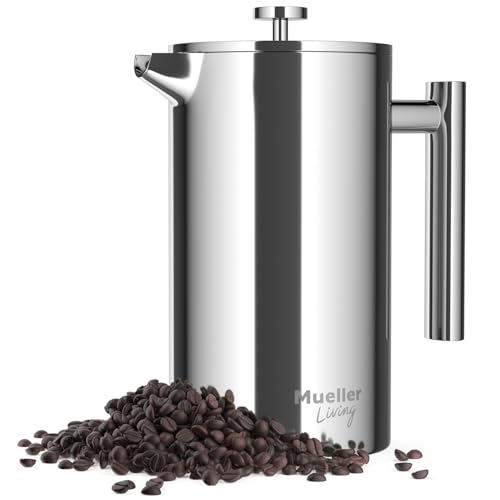
3. MuellerLiving French Press Coffee Maker, 34 oz — Best French Press Overall
The MuellerLiving is the French press for people who love press coffee and are tired of its two flaws: the glass beaker’s fragility and the gritty last sip. Its body is double-wall stainless, so it keeps the steep hot and cannot shatter, and its stacked filter screens catch more of the fine sediment that metal mesh usually lets through. The cup stays unmistakably French press — full, heavy, oily in the good way — just cleaner at the bottom of the mug.
Strengths
- Stainless double-wall body: unbreakable and heat-holding
- Layered filtration noticeably reduces sediment for a press
- 34 oz is the right batch for two drinkers or one committed one
Trade-offs
- Steel hides the steep — you judge by time, not by watching colour
- Press coffee will never be as clean as Chemex; cleaner is relative
- More parts to rinse than a glass press, though all simple
Key specs
- Capacity: 34 oz
- Body: Stainless steel, double insulated
- Filtration: Multi-layer filter system (4 filters)
- Build: Rust-free, food-grade materials
The insulation quietly improves the method itself: a press that holds temperature steeps more evenly across its four minutes than a glass beaker cooling from the moment the water lands. Combined with the finer filtration, the result is the most controlled version of press coffee in this guide — the pick for the drinker who wants the press flavour with the rough edges sanded down.
Ownership is straightforward: screens are the wear part on any press and are replaceable, the steel body is a decade object, and the whole thing goes in the dishwasher on days when hand-washing feels like too much. If one press must be recommended to a first-time press buyer, it is this one.
Technique tip for the MuellerLiving: because its filtration is finer than a classic press, it tolerates a slightly finer grind than press dogma allows, which buys back some extraction and sweetness without the mud. Experiment one notch finer than your usual press grind and taste — this is one of the few presses where that experiment ends well, and it is a good example of why each brewer’s own logic beats generic rules.
Between the two steel presses, let hand feel decide if you can: the MuellerLiving’s fit and finish in daily handling is where its small premium lives.
Best for: Press lovers who want rich coffee with less grit and no glass / Not suited for: Clarity seekers — that is the Chemex camp, honestly stated
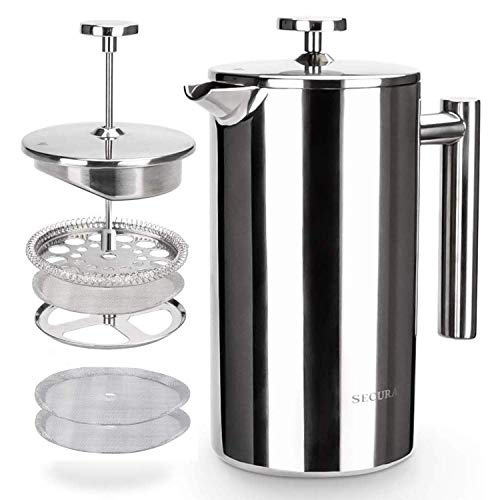
4. Secura French Press Coffee Maker, 34 oz — Best Insulated Steel Press Value
The Secura covers the same territory as the MuellerLiving — insulated stainless, 34 oz, sediment-taming screens — with its own emphasis: 304-grade steel, solid insulation that keeps a batch hot through a long breakfast, and spare screens included in the box, which is the kind of practical generosity press owners appreciate in year two. It is the value-leaning way into the unbreakable-press idea without giving up the heat retention that makes steel presses better than glass at the table.
Strengths
- Insulated steel keeps the batch hot for a slow morning
- Extra screens included — the wear part is covered from day one
- Doubles as a tea press, and for cold brew in summer
Trade-offs
- Similar steel trade-off: no visual on the brew
- Slightly utilitarian finish next to the design-led picks
- Rich press flavour profile is a camp choice, not a universal one
Key specs
- Capacity: 34 oz / 1 litre
- Body: 304 grade stainless steel, insulated
- Included: 2 extra filter screens
- Use: Coffee or tea pressing
Cold brew is the Secura’s hidden second job and worth the paragraph: coarse grounds, cold water, an overnight steep in the fridge, press in the morning. The insulated steel body that keeps hot coffee hot keeps cold brew cold at the table just as happily, and the fine screens handle the long steep’s sediment well. A press that works twelve months a year earns its cupboard space twice.
Between this and the MuellerLiving, the honest advice is to compare current prices and pick the better buy on the day — they are the two steel presses most worth owning, differentiated by details and deals rather than by a gap in quality. Check price on Amazon for both before deciding; this guide’s badges reflect design emphasis, not a feud.
The Secura’s insulation has a second audience beyond breakfast tables: home workers. A press made at nine is still honestly hot at the eleven o’clock refill, which removes the second kettle boil from the workday and the stale-microwave-reheat cup from the record entirely. Small dignities compound; a press that respects the second cup respects the person drinking it.
The Secura’s included spare screens sound like a footnote until the first screen frays in year two, at which point they become the reason it is still your press in year five.
Best for: Value-minded buyers wanting an insulated steel press / Not suited for: Anyone who wants to watch the coffee brew
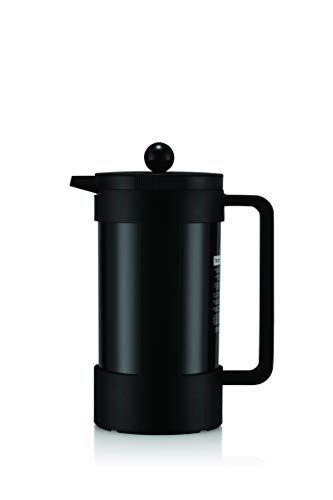
5. Bodum Bean French Press, 34 oz — Best Classic Glass Press
Some press drinkers want the classic instrument exactly as it has always been: a glass beaker where you can watch the coffee bloom and darken, a plunger with a mesh screen, and four unhurried minutes. The Bodum Bean is that instrument from the company most associated with popularising the press — a 34 oz glass beaker in a modern frame, sized for two to three drinkers, with the full-bodied, sediment-kissed cup that defines the method.
Strengths
- The authentic glass-press experience, from the category’s defining brand
- Watching the steep is genuinely useful for learning the method
- Replacement beakers are standard and widely stocked
Trade-offs
- Glass breaks — the press owner’s rite of passage, budgeted for or not
- Single-wall glass loses heat across a long breakfast
- The classic cup includes classic sediment
Key specs
- Capacity: 34 oz
- Body: Glass beaker in Bodum Bean frame
- Method: Classic French press, mesh filter
- Maker: Bodum — the French press specialist
There is a teaching argument for glass that steel cannot make: beginners learn extraction by watching it. The bloom, the crust forming, the colour deepening — a glass press makes the invisible visible for the first month of learning, after which many drinkers graduate to steel with their technique built. As a first press for a curious drinker, that visibility is a feature, and Bodum’s ubiquity means parts and beakers are never a hunt.
The Bean line’s lighter, more sustainable construction also suits households that found older presses heavy and overbuilt. Treat the beaker kindly — no metal spoons, no thermal shock from cold water into hot glass — and the classic experience lasts for years.
The Bodum Bean also deserves its place in a traveller’s kit more than glass suggests: at a rental house or a relative’s kitchen, it produces real coffee from any kettle, and its beaker is a standard size that can be replaced in most cities on earth if the worst happens. Fragility with universal parts availability is a different risk from fragility without it — Bodum’s ubiquity is a genuine ownership feature.
Bodum’s beaker sizing is an industry standard, which means a replacement bought anywhere on earth fits — an ownership fact worth more than many features in this guide.
Best for: Traditionalists and learners who want the classic glass press / Not suited for: Clumsy kitchens, travel, or kids-and-counters households

6. STANLEY Stay-Hot French Press, 48 oz — Best Large and Outdoor Press
Scale changes the French press from a two-person ritual into household infrastructure, and the Stanley is built for exactly that: 48 ounces of press coffee, in insulated stainless that holds it hot for up to four hours. Brew once at the start of a brunch, a work morning, or a campsite breakfast, and the pot serves the room at coffee temperature without reheating, a hot plate, or a second batch. It is the press for people whose coffee problem is volume.
Strengths
- Biggest batch here, held hot for hours by real insulation
- Stainless build takes household and outdoor knocks alike
- One brew serves a table — no queue at the kettle
Trade-offs
- 48 oz is too much hardware for a solo drinker’s daily cup
- Large size takes real storage space
- Press flavour at batch scale still means sediment in the last pour
Key specs
- Capacity: 48 oz — the largest press here
- Body: Insulated stainless steel, BPA-free
- Heat retention: Up to 4 hours hot, 9 hours cold
- Filter: Mesh filter for ground coffee
The stay-hot performance deserves its context: most presses are drunk within twenty minutes because they go cold, not because the coffee ran out. Insulation rewrites that pattern — the second and third cups across a slow morning taste like the first, which changes the press from an event into a supply. Households that currently brew two sequential small batches are the ones this was made for.
Stanley’s outdoor heritage also makes it the natural travel press for car campers and cabin weekends — the same unit, home and away, with no glass to wrap in a towel and pray over. If your coffee life crosses between kitchen and campsite, one durable tool for both is worth more than two fragile specialists.
Finally, the Stanley reframes what a press can be in a household with a garden or a deck: it is the brewer that goes outside. Morning coffee on the porch, a batch carried to a workshop, a press that lives at the cabin without ceremony — the insulated steel format removes the kitchen from the coffee, and for households whose best hours happen outdoors, that is the whole argument in one sentence.
The Stanley is the press to buy when the household’s coffee problem is stated in litres and hours rather than cups and minutes; it is infrastructure, and it behaves like it.
Best for: Big households, brunch hosts, and campers who brew for a group / Not suited for: Solo drinkers or minimal storage
Short on time? Go straight to the Chemex Classic 6-Cup for the headline pick, the Chemex Ottomatic as the alternative most buyers weigh against it, and the MuellerLiving French Press for the specialist option — then come back for the reasoning when the coffee is on.
Comparison Table
| Pick | Badge | Key spec | Best for |
|---|---|---|---|
| Chemex Pour-Over Glass Coffeemaker — Classic Series, 6-Cup | Best Overall — The Classic Chemex | 6-cup glass pour-over, wood collar, uses Chemex bonded filters | Drinkers who love bright, clean, flavour-separated coffee and enjoy a small ritual |
| Chemex Ottomatic Automatic Coffee Maker Set, 40 oz | Best Automatic Chemex Experience | Automatic pour-over brewer, includes 6-cup Chemex carafe, hot and iced | Chemex lovers whose mornings outgrew the manual ritual |
| MuellerLiving French Press Coffee Maker, 34 oz | Best French Press Overall | 34 oz stainless steel, double insulated, 4-filter system | Press lovers who want rich coffee with less grit and no glass |
| Secura French Press Coffee Maker, 34 oz | Best Insulated Steel Press Value | 34 oz (1 litre), 304 stainless steel, insulated, 2 extra screens | Value-minded buyers wanting an insulated steel press |
| Bodum Bean French Press, 34 oz | Best Classic Glass Press | 34 oz glass beaker press, sustainable design line | Traditionalists and learners who want the classic glass press |
| STANLEY Stay-Hot French Press, 48 oz | Best Large and Outdoor Press | 48 oz insulated stainless, up to 4 hours hot, mesh filter | Big households, brunch hosts, and campers who brew for a group |
How to Choose Between French Press and Chemex
Decide by the cup, not the equipment. If your favourite coffees are heavy, chocolatey, and coating — the kind that stand up to milk and winter — you are a press drinker. If your favourites are bright, floral, and delicate — the kind you drink black and describe like wine — you are a Chemex drinker. The filter explains it: metal mesh passes oils and micro-fines that create body; Chemex’s thick paper removes them, trading body for clarity. Most coffee lovers can settle the question with one honest weekend: borrow either brewer, make your usual beans both ways if you can, and notice which cup you reach for twice.
The practical differences that outlast the taste test
Effort: the press is more forgiving — dose, pour, wait, plunge — while the Chemex asks for a controlled pour and a few attentive minutes. Cleanup: the Chemex wins, since the filter and grounds lift out in one paper package, while the press leaves wet grounds to scoop and screens to rinse. Durability: steel presses are near-immortal, glass anything is mortal, and the Chemex is the most fragile object in this guide. Cost of running: press filters are permanent; Chemex filters are a modest, perpetual purchase. None of these decide alone, but together with taste they make the choice obvious for most kitchens.
What else you need to own
Both methods need a way to heat water — any kettle works, a gooseneck makes the Chemex pour far easier — and both reward a simple scale and a burr grinder more than any other upgrade. Neither needs electricity at the brewer, which is why both camps’ gear travels, camps, and survives power cuts with total indifference. Budget-wise, the manual picks here sit at the friendly end of coffee gear; the money you do not spend on a machine is best spent on the beans, where both methods will make you taste exactly what you bought.
Grind, Ratio, and Water: The Shared Fundamentals
Manual brewing rewards three habits regardless of camp. Grind fresh and match the method: coarse and even for the press, so the mesh can hold it back and the extraction stays sweet; medium-coarse for the Chemex, so the thick filter drains at the right pace. Dose by weight when you can — roughly one part coffee to fifteen parts water is the honest starting point for both, adjusted stronger or lighter across a few brews until it is yours. And use water just off the boil for the press, slightly rested for delicate Chemex beans, because boiling water scorches fine flavours while lukewarm water under-extracts everything.
Keep notes for the first two weeks — bean, dose, grind, time. Manual methods have few variables, which means a small notebook turns random mornings into a repeatable recipe faster than any equipment upgrade. That repeatability, not the gear, is what people are actually tasting when they say a home brewer makes café-level coffee.
Accessories That Complete a Press or Chemex Setup
The kettle is the first accessory and the only essential one. For the press, any kettle that boils is enough, because the pour is a flood, not a drawing. For the Chemex, a gooseneck kettle — with its controlled, thin stream — is close to essential equipment; it is the difference between performing the method and approximating it. Buy the kettle before any other upgrade, including a second brewer, and the Chemex you already own will taste like the upgrade happened to it.
A simple scale is the second accessory, and it serves both camps: weighing coffee and water turns the ratios in this guide from advice into repeatability. A burr grinder is the third and largest step — pre-ground coffee is workable in a press, which forgives, and noticeably limiting in a Chemex, which reveals. If the budget forces an order, it is kettle, then scale, then grinder, then — only then — another brewer.
Beyond those, the honest accessories are humble: a timer you already own in your phone, replacement screens for the press, a standing order of Chemex filters so the cupboard never runs dry mid-bag, and a small notebook. Manual brewing’s charm is that its complete professional toolkit costs less than one mid-range electric machine — the investment migrates to the beans, where both methods insist it belongs.
Which Beans Suit Which Brewer
Bean choice can settle the press-versus-Chemex question from the other direction. Coffees with chocolate, nut, and caramel characters — many Brazilian and Colombian lots, and most espresso blends — are flattered by the press, whose oils carry exactly those flavours. Coffees with floral, citrus, and berry characters — Ethiopian lots are the famous example — are flattered by the Chemex, whose filter lets those delicate notes arrive separately instead of blended into body. If your coffee shelf already leans one way, your brewer probably should too.
Roast level interacts the same way. Dark roasts in a Chemex can taste thin, because the filter removes the oils that were carrying the roast flavour; the same beans in a press taste complete. Light roasts in a press can taste muddy if the grind is imperfect, while the Chemex presents them at their best. Medium roasts are the diplomats that succeed in both, which is why a household unsure of its camp should start with a good medium roast and let the brewers argue their cases honestly.
Freshness flatters both and forgives neither: manual methods have nowhere to hide stale beans, because there is no machine between you and the extraction. Buy smaller, buy fresh, and grind as close to brewing as your setup allows — the press and the Chemex will both repay the discipline in the cup, in their opposite and equally convincing accents.
How to Brew: French Press and Chemex, Step by Step
French press, the reliable way
- Add coarse grounds — about one part coffee to fifteen parts water by weight.
- Pour water just off the boil over the grounds, saturating them all, and start a four-minute timer.
- Stir gently at the start to break the crust, and skim floating foam if you like a cleaner cup.
- Press the plunger down slowly, stopping just above the grounds bed — forcing it stirs sediment back in.
- Pour everything out promptly into mugs or a serving vessel; coffee left sitting on the grounds keeps extracting and turns bitter.
Chemex, the careful way
- Set the bonded filter in the brewer and rinse it thoroughly with hot water — this removes paper taste and warms the glass. Discard the rinse water.
- Add medium-coarse grounds and pour just enough water to wet them; wait about 45 seconds for the bloom.
- Pour the remaining water in slow, steady circles, keeping the level consistent and the total brew near four minutes.
- Let it drain fully, swirl the carafe once, and serve. The cup should taste clean and sweet; a sour cup usually means too coarse or too fast, a bitter one too fine or too slow.
Common Buying Mistakes
- Grinding press coffee too fine. Fine grounds slip the mesh, over-extract, and fill the cup with grit. Coarse and even is the press rule.
- Leaving coffee sitting in the press. The brew keeps extracting on the grounds. Decant it all, every time.
- Skipping the Chemex filter rinse. Unrinsed bonded filters add a paper note to the cleanest cup in coffee. Thirty seconds of hot water fixes it.
- Pouring Chemex water all at once. Flooding drowns the bloom and channels the extraction. Slow circles are the method, not a flourish.
- Metal spoons in glass beakers. The classic way to crack a press beaker. Wood or plastic in glass, always.
- Buying the brewer before the kettle. Both methods are only as good as the hot water delivery. A controllable kettle is half the system.
Final Recommendation
If your heart says rich and heavy: buy the MuellerLiving for the best all-round press, the Secura for insulated value, the Bodum Bean for the classic glass ritual, or the Stanley when the batch must be big and stay hot. If your heart says bright and clean: the Chemex Classic 6-Cup is the icon for a reason, and the Ottomatic is its weekday-friendly automatic form. There is no wrong camp — there is only the cup you will actually make every morning, and both sides of this guide make it beautifully.
For the electric side of the shelf, compare Best Coffee Makers and Best Coffee Makers For Your Home; press fans should also see Best Affordable French Press Coffee Makers, pour-over fans Best 1 Cup Pour Over Coffee Makers, and the flavour-first shortlist is Best Coffee Makers For Flavor.
The closing thought is the one this guide opened with, now earned: these are instruments, not appliances, and the hands are part of the specification. Choose the cup you love — heavy and rich, or bright and clean — buy the honest version of the instrument that makes it, and spend the savings on beans worthy of the method. A decade from now, both the press and the Chemex will still be in kitchens making exactly the coffee they make today, which is more than any machine with a screen will promise you.
Frequently Asked Questions
Is French press or Chemex coffee better?
Neither — they are different. The French press gives a heavy, rich, full-bodied cup with the coffee’s oils and a little sediment; the Chemex gives a clean, bright, delicate cup with almost none. Your taste decides: drinkers who love body and chocolate notes choose the press, drinkers who love clarity and floral notes choose the Chemex. Many households end up owning both for different beans and moods.
Do I need a special kettle for a Chemex?
A gooseneck kettle makes the slow, controlled pour much easier and is the natural partner purchase, but a regular kettle works with a steady hand and a slower pour. What you cannot skip is some way to heat water — both the Chemex and the French press are manual brewers with no heating element of their own.
Why does my French press coffee taste muddy or bitter?
Usually the grind is too fine, the steep ran long, or the coffee sat in the press after plunging. Use a coarse, even grind, time about four minutes, press slowly, and pour everything out immediately. If it is still muddy, a press with finer layered filtration — like the MuellerLiving in this guide — reduces sediment noticeably while keeping the press character.
How long do Chemex filters and press screens last?
Chemex filters are single-use paper — a modest ongoing purchase, bought in packs. French press screens are permanent but do wear and fray over years; they are replaceable parts, and the Secura in this guide includes spares in the box. Neither cost is significant next to the coffee itself.
Can a French press or Chemex make coffee for a group?
Yes, at their sizes: the 34 oz presses serve two to three drinkers, the Stanley’s 48 oz serves a table, and the Chemex 6-cup pours about three real mugs, with an 8-cup size above it. For a crowd beyond that, batch again — manual brewing is fast enough that a second round is a small ceremony rather than a chore.
Is the Chemex Ottomatic worth it over the manual Chemex?
If you love the Chemex cup and will actually brew it more often because the water is handled for you, yes — it uses the genuine carafe and filters, so the flavour is authentic. If the ritual itself is part of your pleasure, or the budget is firm, the manual Classic makes the identical cup for far less and will outlive any machine. It is a lifestyle question wearing a price tag.
Can I make cold brew in a French press or Chemex?
The French press is an excellent cold brewer: coarse grounds, cold water, twelve or more hours in the fridge, then press and serve over ice — the Secura and Stanley presses in this guide handle it particularly well. The Chemex can filter a cold brew concentrate beautifully after it has steeped elsewhere, but steeping in the Chemex itself is impractical since it is a dripper, not a vessel. So: press for making cold brew, Chemex for clarifying it.
How do I dispose of grounds and clean up with minimal mess?
For the press, let the grounds settle, pour off the last liquid, and scoop the grounds into the bin or compost with a spoon — never wash a full load of grounds down the sink, which plumbers and pipes both resent. For the Chemex, the whole filter lifts out as one package, which is the tidiest disposal in coffee. Both brewers then rinse clean with hot water; a weekly wash with a little detergent keeps oils from building into stale flavours.
Which is easier to learn, French press or Chemex?
The French press, comfortably: its steps are fewer, its timing forgiving, and its result good across a wide range of technique. The Chemex asks for a controlled pour and a little patience, rewarding practice with a clarity the press cannot reach. Many drinkers learn on the press, add the Chemex when curiosity strikes, and keep both — the total cost of the pair is still less than one mid-range electric machine.


