Disclosure: airfryerkitchensupply.com is reader-supported. When you buy through links on our site, we may earn an affiliate commission at no extra cost to you.
Where to buy
Every verified pick below is sold on Amazon: start with the top pick, the runner-up, the third pick, the fourth pick, the fifth pick, the final pick, and check price on Amazon the day you buy, since prices and stock move.
Finding the best coffee makers for teachers lounges is a different shopping problem from buying for a home kitchen, because a lounge machine has no single owner. It gets used by whoever walks in between classes, it is cleaned by whoever feels guilty, and it has to survive the 7:40 a.m. rush when half the staff arrives within ten minutes of the first bell. The machines that win in this environment are not the fanciest — they are the ones with capacity for a crowd, controls a substitute teacher can run without instructions, and parts that tolerate hard use and irregular descaling.
This guide splits the lounge problem into its two real shapes. Some lounges need volume above all: a urn that brews once in the morning and serves forty cups through the day. Others need a dependable carafe brewer for a department-sized group, ideally one that also handles the colleague who only drinks decaf or tea-adjacent pod drinks. All six picks cover one of those shapes, and the reviews are blunt about the shared-kitchen realities: glass carafes break, complicated machines get left dirty, and anything with a learning curve will be quietly bypassed for the ancient backup machine in the cupboard.
A note on buying for a shared space: whoever purchases should plan the unglamorous extras at the same time — a spare carafe for glass models, filters that match, and a descaling routine someone actually owns. The best lounge coffee maker is the one still working in March, not the one with the best first week in September.
One more reality shapes every recommendation below: a lounge machine is bought once but judged daily by people who did not choose it. That argues for boring reliability over cleverness at every decision point — proven formats, standard filters, replacement parts a school office can order without a treasure hunt. Where a pick below offers something clever, it is cleverness that survives a substitute teacher, a parent helper, and the last week before summer break.
In this guide
Quick Picks
Six machines earned a place here: two big urns for whole-staff volume, three carafe brewers sized for departments, and one two-way machine that ends the pods-versus-pot argument. Badges stay attached to each pick through its full review.
- Hamilton Beach 45 Cup Coffee Urn and Hot Beverage Dispenser 40515G — Best Overall for Teachers Lounges. Brews up to 45 cups at once and dispenses by the lever all day — the classic whole-staff solution that asks almost nothing of its users. Check price on Amazon
- West Bend 42-Cup Coffee Urn — Best Urn Runner-Up. Polished aluminium 42-cup urn with the same set-and-serve logic, a proven design for lounges, churches, and meeting rooms. Check price on Amazon
- Cuisinart PerfecTemp 14-Cup Programmable Coffee Maker DCC-3200 — Best Carafe Brewer for a Lounge. The largest mainstream carafe size, hotter brewing, and a brew-strength control — the department-lounge workhorse with a timer for the first arrival. Check price on Amazon
- Ninja CE251 Programmable Brewer 12-Cup — Best Mid-Size Lounge Brewer. 12-cup programmable brewer with Classic and Rich styles, a 70 oz removable reservoir, and a small-batch function that suits variable lounge traffic. Check price on Amazon
- Hamilton Beach FlexBrew Trio 2-Way Coffee Maker 49976 — Best for Mixed Pod and Pot Drinkers. One machine that brews a 12-cup pot from grounds or a single cup from a pod or grounds — the peace treaty for a divided lounge. Check price on Amazon
- Hamilton Beach Commercial 60 Cup Coffee Urn D50065 — Best for Whole-School Events. Commercial-grade 60-cup urn in polished stainless steel for the lounge that also caters assemblies, parents’ evenings, and PD days. Check price on Amazon
How These Picks Were Chosen
Each pick was confirmed against Amazon’s catalog — model, listing title, and ASIN matched before a link was earned. Shared-space criteria then did the ranking. Capacity came first, measured honestly in real mugs rather than the small ‘cups’ brewers are rated in. Second was simplicity: could a tired adult run this at 7 a.m. with no manual? Third was survivability — metal over glass where possible, common filter sizes, and designs that forgive a missed cleaning. Fourth was holding quality, because lounge coffee sits; thermal and urn formats hold flavour far better than a glass carafe cooking on a plate through third period.
We also weighted cost of ownership the way a school actually feels it: paper filters by the thousand, replacement carafes, and pod costs for the one hybrid pick are all discussed openly in the reviews. No pick here requires proprietary consumables except the pod side of the FlexBrew Trio, and that machine brews a full pot from grounds just as happily.
What was excluded matters too. Domestic pod machines were left out as primary lounge brewers because their cost per cup, multiplied by a staff, breaks any realistic lounge budget within a term — pods belong on the hybrid’s exception side, not at the centre. Small domestic drip machines under 10 cups were excluded on duty cycle: they are built for a pot a day, and a lounge is simply a harder life than that. Everything that remains is sized, built, and priced for shared institutional use.
The 6 Best Coffee Makers for Teachers Lounges

1. Hamilton Beach 45 Cup Coffee Urn and Hot Beverage Dispenser 40515G — Best Overall for Teachers Lounges
For a full staff lounge, the urn is the honest answer, and this Hamilton Beach is the format’s standard-bearer. It brews a large batch once, holds it hot, and serves it through a lever that works with a mug in one hand and a stack of grading in the other. There is no carafe to crack, no warming plate scorching the last cup, and no settings menu — the skill ceiling is ‘fill, plug in, wait for the ready light’, which is exactly right for a room used by sixty different people.
Strengths
- Whole-staff capacity from a single morning brew
- Lever dispensing is faster and safer than pouring a full carafe over a crowded counter
- Doubles as a hot water dispenser for tea drinkers and instant soup at lunch
Trade-offs
- A 45-cup batch is wasteful on days when only a handful of staff are in
- Urn coffee is batch coffee — good and hot, not café nuanced
- Needs a proper wash-out routine or old coffee oils turn the next batch stale
Key specs
- Capacity: Up to 45 cups per brew
- Format: Electric coffee urn with dispensing lever
- Serving: One-hand lever dispensing, no carafe to break
- Also serves: Hot water for tea and cocoa from the same unit
The lounge math favours the urn more than home logic suggests. One brew covers the before-school rush, the mid-morning refill crowd, and the after-lunch stragglers without anyone brewing a second pot or finding an empty carafe at the worst moment. Because the coffee is held in a sealed, heated tank rather than on an open plate, the last cup of the day tastes recognisably like the first — a trick glass carafes on plates simply cannot do over six hours.
Practical notes from real shared use: assign the Friday rinse to a rota, because urns forgive a lot but not a month of neglect, and keep a small card taped to the lid with the coffee-to-water measure that your staff actually likes. The dispenser lever also makes this the most accessible serving format in the guide for staff with limited grip strength — no heavy pot to lift and tilt.
One operational tip separates happy urn lounges from frustrated ones: brew the full batch in the morning rather than topping up through the day. Topping up mixes fresh coffee with hours-old coffee and produces a tank that is never quite either. A full morning brew, served down to the last cup, then a fresh smaller batch if the afternoon demands one, keeps quality honest and the urn’s cleaning simple.
If your lounge buys one thing this year, make it this urn and a permanent marker for the recipe card — the two together are the entire system.
Best for: Whole-school lounges that serve a crowd from one morning brew / Not suited for: Small department rooms where 45 cups would mostly be poured away
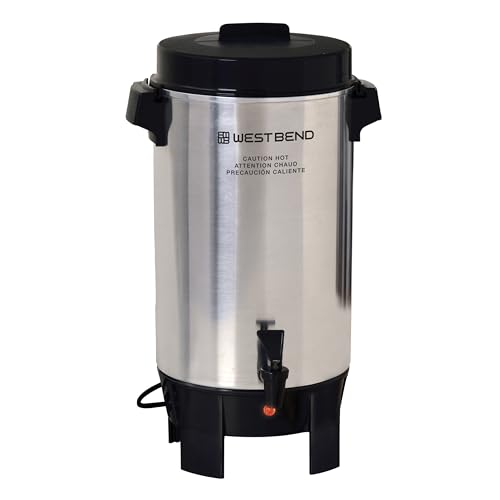
2. West Bend 42-Cup Coffee Urn — Best Urn Runner-Up
The West Bend is the other long-running answer to the same problem: a 42-cup polished aluminium urn that brews, holds, and dispenses with no fragile parts and no learning curve. Schools have run this style of urn for decades because the failure modes are few and obvious — it either heats or it does not — and because a dented aluminium body keeps working where a cracked glass carafe ends a machine’s career.
Strengths
- Near-identical crowd capacity to the top pick with a simpler, time-tested design
- Aluminium body shrugs off the knocks of a busy shared room
- Lever service keeps the queue moving between classes
Trade-offs
- Aluminium needs a real cleaning routine to avoid stale flavours building up
- No hot-water-only flexibility beyond what is brewed in it
- Oversized for small lounges, like any urn
Key specs
- Capacity: 42 cups per brew
- Body: Highly polished aluminium
- Format: Electric urn, lever dispensing
- Serving: Keeps coffee hot and ready through the day
Choosing between this and the Hamilton Beach comes down to small preferences: finish, which unit your district already stocks parts for, and which is the better buy on the day you order — check price on Amazon for both, because urn pricing moves with the school-year calendar. In daily service they are functionally siblings: brew early, serve all day, rinse on Friday.
One genuine difference in feel: the polished aluminium body reads more ‘event rental’ than ‘kitchen appliance’, which some lounges prefer — it looks intentional on a counter rather than like a home machine scaled up. For a lounge that doubles as a meeting and interview space, that tidier impression is worth something.
The West Bend’s long production history has a practical lounge benefit: it is a known quantity to any school or church kitchen that has ever catered an event, which means borrowed expertise — and occasionally a borrowed backup unit — is never far away. In institutional buying, being the standard choice is a feature in itself, because standards are what survive staff turnover.
The West Bend is the pick most likely to be understood instantly by every adult in the building, including the ones who will never read a manual.
Best for: Lounges wanting urn capacity in a classic metal body / Not suited for: Rooms serving fewer than a dozen coffee drinkers a day

3. Cuisinart PerfecTemp 14-Cup Programmable Coffee Maker DCC-3200 — Best Carafe Brewer for a Lounge
When a lounge serves a department rather than a whole school, a 14-cup carafe brewer is the right scale, and the DCC-3200 is the strongest mainstream option. Its PerfecTemp system brews hotter than basic machines — which is both a flavour upgrade and, in a lounge, a fairness upgrade, since the coffee tastes like coffee instead of warm bean water. The programmable timer matters here more than at home: set it for 7:15 and the first teacher through the door finds coffee ready instead of making it for everyone, every day, forever.
Strengths
- Biggest standard carafe capacity — fewer mid-morning rebrews
- Brew strength control settles the staff-room strong-versus-mild argument at the machine
- Adjustable plate temperature avoids scorching a pot that sits through morning classes
Trade-offs
- Glass carafe is the breakage risk every lounge eventually pays for — budget a spare
- 14 cups still empties fast on whole-staff days; it is a department-sized answer
- More controls than an urn means one colleague will eventually brew with the wrong setting
Key specs
- Capacity: 14-cup glass carafe
- Brewing: PerfecTemp hotter brewing technology
- Controls: Programmable, brew strength control, 1–4 cup setting
- Holding: Adjustable warming plate temperature
The strength control deserves emphasis because lounge politics are real: a shared machine with a bold setting ends the quiet war between the drink-it-black staff and everyone else, especially paired with a posted house ratio. The 1–4 cup setting also handles the after-school skeleton crew honestly, brewing a small batch that tastes right instead of a sad half-pot.
Ownership notes: the carafe is a standard, widely stocked replacement, which matters when (not if) it meets the edge of a sink. Keep the spare in the cupboard from day one and the machine’s downtime is ten minutes instead of a week of instant coffee and resentment.
Placement advice for this class of brewer: give it the counter spot nearest the water source, because a 14-cup machine filled by pitcher makes trips, and trips make spills, and spills in a lounge make enemies. If the machine must live away from the sink, a large dedicated water jug stored beside it is the accepted workaround — filled at night, ready for the timer’s morning.
Budget the spare carafe into the same order as the DCC-3200 and you have pre-answered the only bad morning this machine can give you.
Best for: Department-sized lounges wanting a programmable carafe brewer / Not suited for: Whole-staff rooms or anyone unwilling to manage a glass carafe

4. Ninja CE251 Programmable Brewer 12-Cup — Best Mid-Size Lounge Brewer
The CE251 is the lounge brewer for buildings where traffic is uneven — a full staff on Monday, a handful of people by Friday afternoon. The small-batch function brews a few cups properly instead of punishing the after-school crowd with a diluted mini-pot, and the Rich setting gives the morning rush a more intense cup from the same grounds. The removable 70 oz reservoir is a small feature with outsized lounge value: it fills at the sink instead of by juggling a pitcher over the machine, so the counter stays dry and the machine stays clean.
Strengths
- Small-batch mode matches real lounge traffic across the week
- Removable reservoir is easier and tidier for shared filling
- Rich mode offers a stronger house brew without changing the coffee order
Trade-offs
- 12 cups is a middle size — big departments will rebrew at peak
- Glass carafe, with the usual shared-kitchen breakage risk
- No pod option for the decaf-only or tea-leaning staff
Key specs
- Capacity: 12-cup glass carafe
- Reservoir: 70 oz removable water reservoir
- Brew styles: Classic and Rich
- Extras: Small batch function, 24-hour delay brew, adjustable warming plate
In practice the CE251’s strength is that nobody has to think about it. Delay brew covers the first arrival, the warming plate is adjustable so a pot surviving to lunch is drinkable, and the controls are labelled in plain words rather than icons. Lounges run on goodwill; a machine that never becomes a topic of complaint is doing its job perfectly.
It also plays well with a posted routine: the reservoir lifts out for a weekly wash, which is the single most-skipped cleaning task in shared kitchens and the main reason lounge coffee drifts toward tasting like the machine. If your lounge can manage one habit, make it that wash, on this or any brewer.
The CE251’s warming plate deserves one caution that applies to every lounge brewer: a plate left on high all day with an inch of coffee in the carafe is how lounges acquire their signature burnt smell. Teach the house the low-plate habit, or better, the habit of turning the machine off after lunch and letting the after-school crowd use the small-batch function fresh. Culture, once again, is a feature no manufacturer can ship.
The CE251 is the lounge brewer for the building whose staffroom doubles as a meeting room — presentable, quiet about its work, and easy to reset between groups.
Best for: Mid-size lounges with uneven daily traffic / Not suited for: Very large staffs or pod drinkers

5. Hamilton Beach FlexBrew Trio 2-Way Coffee Maker 49976 — Best for Mixed Pod and Pot Drinkers
Every lounge has the same minority: the decaf-only teacher, the one who drinks a flavoured pod at 2 p.m., the tea-adjacent colleague who wants one cup, not a pot. The FlexBrew Trio serves them without surrendering counter space to a second machine. The carafe side runs the morning pot from grounds like any honest drip brewer; the single-serve side takes pods or grounds for the exceptions. It is not the best pure carafe brewer here, nor the best pure pod machine — it is the best single purchase for a genuinely mixed room.
Strengths
- Ends the two-machine counter problem in mixed lounges
- Single side handles decaf and one-off cups without brewing a pot
- Grounds option on both sides keeps pod costs optional, not mandatory
Trade-offs
- Two systems to clean instead of one — assign both to the rota
- Pod side inherits pod cost if the lounge lets it become the default
- Carafe side is competent rather than class-leading on flavour
Key specs
- Capacity: 12-cup carafe, plus single-serve brewing
- Formats: K-Cup pods, pod packs, or ground coffee on the single side
- Footprint: One machine instead of two on a crowded lounge counter
- Use case: Pot for the crowd, single cup for decaf and odd hours
The budget conversation belongs in the open: if the single side becomes everyone’s default, the lounge’s coffee cost multiplies. The working arrangement in most schools is pot-first, pods for exceptions, with pods bought by the people who drink them. Set that norm on day one and the Trio is the most diplomatic appliance in the building.
For the odd-hours reality of teaching — the 6 p.m. marking session, the Saturday rehearsal — the single side also means nobody brews a full pot for one cup and leaves eleven cups to die on the plate. Small mercy, real savings, less stale coffee smell greeting the morning crew.
The Trio’s two sides age differently and are worth maintaining as the separate systems they are: the carafe side wants the standard descale-and-wash rhythm, while the single side wants its needle and basket kept clear, since pod residue builds quietly. A lounge rota that lists both explicitly — rather than a generic ‘clean coffee machine’ — is the difference between a hybrid that delights for years and one whose pod side mysteriously retires.
Set the Trio’s house rule on a sticky note on day one — pot first, pods for exceptions — while the norm is still yours to set.
Best for: Lounges split between pot drinkers and pod drinkers / Not suited for: Purist rooms that only ever brew full pots

6. Hamilton Beach Commercial 60 Cup Coffee Urn D50065 — Best for Whole-School Events
Some lounges are also the school’s catering department: professional development days, parents’ evenings, exam-week staff fuel, the retirement party. The D50065 is the commercial step up — 60 cups in polished stainless steel, built for institutions rather than kitchens. If your lounge regularly hosts more than its own staff, this is the machine that means never borrowing a second urn from the cafeteria again.
Strengths
- Largest capacity here, with commercial build quality to match
- Stainless body presents properly at public-facing school events
- One unit covers daily lounge duty and event duty
Trade-offs
- Genuinely oversized for a small lounge’s daily dozen drinkers
- Commercial tier pricing and counter footprint
- A 60-cup batch brewed for a quiet day is mostly waste
Key specs
- Capacity: 60 cups per brew
- Build: Commercial grade, polished stainless steel
- Format: Urn with dispensing tap
- Use case: Daily large lounge plus school events
The honest sizing advice: count your biggest regular day, not your biggest imaginable day. If PD days and parents’ evenings are monthly realities, the 60-cup capacity earns its counter space; if they happen twice a year, the 45-cup urn plus a borrowed backup is the smarter spend. Schools are full of equipment bought for the exceptional day and resented on all the ordinary ones.
Where it does fit, it fits completely. Stainless steel cleans up to a standard aluminium cannot quite match for public events, the dispensing tap keeps a queue of eighty parents moving, and the commercial rating means the duty cycle of a school year — daily brews, weekend events — is the use it was designed for rather than an abuse of it.
For event duty specifically, run the D50065’s first brew of the day a full cycle before doors open, because a 60-cup batch is a commitment of time as well as coffee. Schools that learn this once — and write the timing on the same card as the house recipe — find events become the machine’s finest hours rather than its most stressful ones. Capacity, like everything else in a school, rewards the prepared.
The D50065 also earns its keep in December and June, when schools run on events; a machine bought for the everyday that also swallows the exceptional is the definition of institutional value.
Best for: Large schools whose lounge doubles as event catering / Not suited for: Small lounges or departments
Short on time? Go straight to the Hamilton Beach 45-Cup Urn for the headline pick, the West Bend 42-Cup Urn as the alternative most buyers weigh against it, and the Cuisinart DCC-3200 for the specialist option — then come back for the reasoning when the coffee is on.
Comparison Table
| Pick | Badge | Key spec | Best for |
|---|---|---|---|
| Hamilton Beach 45 Cup Coffee Urn and Hot Beverage Dispenser 40515G | Best Overall for Teachers Lounges | 45-cup urn, lever dispensing, hot beverage dispenser | Whole-school lounges that serve a crowd from one morning brew |
| West Bend 42-Cup Coffee Urn | Best Urn Runner-Up | 42-cup, highly polished aluminium urn | Lounges wanting urn capacity in a classic metal body |
| Cuisinart PerfecTemp 14-Cup Programmable Coffee Maker DCC-3200 | Best Carafe Brewer for a Lounge | 14-cup glass carafe, PerfecTemp hotter brewing, adjustable warming plate | Department-sized lounges wanting a programmable carafe brewer |
| Ninja CE251 Programmable Brewer 12-Cup | Best Mid-Size Lounge Brewer | 12-cup, Classic & Rich brew, 70 oz removable water reservoir | Mid-size lounges with uneven daily traffic |
| Hamilton Beach FlexBrew Trio 2-Way Coffee Maker 49976 | Best for Mixed Pod and Pot Drinkers | 12-cup carafe plus single-serve side, pods or grounds | Lounges split between pot drinkers and pod drinkers |
| Hamilton Beach Commercial 60 Cup Coffee Urn D50065 | Best for Whole-School Events | 60-cup commercial urn, polished stainless steel | Large schools whose lounge doubles as event catering |
How to Choose a Coffee Maker for a Teachers Lounge
Start with the honest headcount of your busiest regular morning, then choose the format. Up to about ten drinkers: a 12 to 14-cup carafe brewer. Ten to thirty: the same brewer will rebrew once, or step to a 42–45 cup urn and brew once. Beyond that, or with event duty, the commercial urn earns its place. Lounge ‘cups’ are rated small — a brewer cup is roughly five to six ounces, so a 12-cup carafe pours about eight real mugs. Every capacity argument in a staff room has been lost to that arithmetic; do not repeat it.
Shared-use features that actually matter
Programmable start times matter more in a lounge than in any home, because the alternative is the same kind person making coffee for everyone daily until they stop. Removable reservoirs and filter baskets matter because shared machines are cleaned by whoever cares most, and designs that make cleaning easy get cleaned. Glass versus metal is a budget line, not a preference: price the replacement carafe before you buy, and keep a spare from day one. And plain-language controls beat clever ones — the machine will be operated by substitutes, visitors, and the sleep-deprived.
The consumables budget is the real budget
A lounge drinks coffee by the case. Ground coffee for carafe brewers and urns is the cheapest cost per cup by a wide margin; pods cost several times more per cup and should be the exception format, not the default, whatever machine you buy. Paper filters, descaler, and a spare carafe are rounding errors next to a year of pod purchases. Any lounge treasurer comparing machines should compare cost per cup over a school year, not sticker prices in September.
Setting Up a Lounge Coffee Station That Stays Working
The machine is half the system. The other half is a station layout and a rota that survive contact with a school year. Put the brewer where a queue can form without blocking the door or the microwave, keep mugs and supplies within arm’s reach so nobody opens random cupboards, and tape the house recipe — scoops per pot, in words — to the wall above the machine. Shared equipment fails socially before it fails mechanically: nobody owns it, so nobody maintains it. A named weekly owner, rotating, fixes that in a way no purchase can.
Supplies discipline matters too. One coffee, bought in bulk, that the staff broadly likes beats four competing bags people bring in and guard. Filters live in one labelled drawer. The descaler lives with the filters, and the first Friday of each month is descale day, owned by the rota. None of this is glamorous, and all of it is the difference between a lounge that smells like coffee and one that smells like an old machine.
Funding and Buying a Lounge Machine: Practical Notes
Lounge coffee money usually comes from a staff fund, a PTA kindness, or a departmental budget, and each source has its own paperwork gravity. The practical advice is identical for all three: buy the machine, the spare carafe if it has one, a term’s worth of filters, and the descaler in a single order, because the second purchase order for a forgotten extra is where good intentions go to die. Keep the receipt and the manual in the same drawer as the filters; the person troubleshooting in February is never the person who bought in September.
Consider also who owns the coffee itself. A small per-term contribution toward a bulk grounds order keeps quality consistent and ends the quiet resentment of the two staff members whose personal bags everyone drinks. The hybrid pick in this guide adds one wrinkle — pods — and the cleanest policy, used in many schools, is that pods are bought by the drinkers of pods. State it kindly, state it once, and the machine’s flexibility stays a pleasure instead of a budget leak.
Finally, plan the end of the story at the beginning: know the replacement carafe model, keep the descaler with the filters, and write the purchase date on the machine’s underside in marker. Institutional memory is short and staff turnover is real; the lounge that writes things down is the lounge whose second machine purchase goes as smoothly as its first.
Coffee Quality in a Lounge: Low-Effort Upgrades
A lounge will never be a café, and it does not need to be — it needs to be reliably decent, which is a lower bar that most lounges still fail for fixable reasons. The first is coffee age: grounds bought in bulk and stored in the original bag in a warm cupboard fade within weeks, so the bulk order should be sized to the term, stored airtight, and — this is the part everyone skips — dated with a marker when opened. The second is water: a machine scaled by hard school water brews cooler every month, and the monthly descale in the rota is worth more than any bean upgrade.
The third upgrade costs nothing: agree the house ratio and write it down. Lounge coffee is usually weak not because the machine is weak but because every brewer-by-committee doses by mood. One measured recipe, taped to the machine, outperforms a better machine running on guesswork. The fourth is the mug situation — a lounge with a shelf of identical, dishwasher-safe mugs cleans faster, stacks better, and quietly raises the whole operation’s dignity compared with a museum of novelty mugs, however beloved.
Finally, protect the last hour of the day. Coffee brewed at seven and sipped at three teaches staff to hate lounge coffee; a culture of a fresh small batch after lunch — easy on the carafe brewers here, natural on the urn’s second half-batch — resets the room’s opinion of the whole system. Quality in a shared space is a rhythm, not a purchase.
How to Set Up and Run a Lounge Coffee Maker
- Commission it properly. Run two full cycles of plain water before the first coffee, wash the carafe or urn, and brew one test pot to dial in the house ratio. Write the winning measure on a card taped to the machine.
- Post the three house rules. Whoever finishes the pot starts the next one or turns the machine off; the last person out rinses the carafe; Friday is wash day. Laminated, friendly, non-negotiable.
- Set the timer the night before. On programmable brewers, the evening prep — water, filter, grounds, timer — takes two minutes and gives the whole morning a better start.
- Descale monthly. School water and daily use scale a machine fast. A monthly descale on the rota keeps brew temperature, and therefore flavour, where it belongs.
- Store a spare carafe and filters on site. Breakage at 7:30 a.m. is a ten-minute problem if the spare is in the cupboard and a week-long problem if it is on a purchase order.
Common Buying Mistakes
- Buying a home machine for an institution’s workload. Domestic brewers run a pot a day; a lounge runs several. Urns and commercial builds exist for this duty cycle.
- Letting pods become the default. A pod-first lounge spends multiples of a grounds-first lounge over a school year. Pods are for exceptions and decaf.
- No spare carafe. The cheapest insurance in the building, skipped by almost every lounge until the morning it matters.
- Nobody owning the cleaning. Unowned machines get cleaned by nobody, and the coffee quietly becomes undrinkable by spring.
- Sizing for the biggest day of the year. Buy for the busiest regular week; borrow or rent capacity for the two exceptional days.
- Four competing coffee bags. One house coffee, bought in bulk, ends freshness problems and cupboard wars at once.
Final Recommendation
For most whole-staff lounges, buy the Hamilton Beach 45-Cup Urn and stop thinking about it — one brew, all day, nothing to break. Department rooms should take the Cuisinart DCC-3200 for its 14-cup capacity and timer, or the Ninja CE251 if traffic is uneven. The FlexBrew Trio is the diplomatic choice for mixed pod-and-pot staffs, and the Hamilton Beach Commercial 60-Cup is for schools whose lounge feeds events as well as staff.
Comparing against the office equivalents? See Best Coffee Makers For Office and Best Coffee Makers For Large Office, plus the church-hall sibling of this problem in Best Coffee Makers For Church. For the home side of your own kitchen, Best Coffee Makers For Your Home and the master list at Best Coffee Makers round out the picture.
Close with the human summary: a teachers lounge runs on small kindnesses, and a coffee machine that simply works — full in the morning, honest at noon, clean by Friday — is one of the few kindnesses a building can buy outright. Choose the format that fits your headcount, write the recipe on the card, name the rota, and let the machine disappear into the background of the school day, which is where the best staffroom equipment has always lived.
Frequently Asked Questions
How many cups does a teachers lounge actually need?
Count mugs, not brewer cups. A brewer ‘cup’ is about five to six ounces, so a 12-cup carafe pours roughly eight normal mugs. A lounge of twenty coffee drinkers who each have two mugs before lunch needs around forty mugs a morning — which is urn territory, or a carafe brewer on its second brew. Sizing by the printed cup count is the most common lounge buying mistake.
Is an urn better than a carafe brewer for a lounge?
For more than about fifteen regular drinkers, usually yes: one brew serves all day, there is no glass to break, and the coffee holds quality better than a carafe on a warming plate. For a small department room, a carafe brewer makes fresher coffee in smaller batches and takes less counter. The dividing line is your busiest regular morning, not your biggest event.
Who should clean and maintain the lounge coffee maker?
A named person on a rotating weekly rota — ‘everyone’ reliably means no one. The weekly job is a wash of carafe, basket, and reservoir; the monthly job is descaling. Posting both jobs next to the machine, with the house brew recipe, keeps a shared machine working all year instead of fading by spring.
Are pods a good idea for a school lounge?
As the exception, yes; as the default, they are the most expensive way to serve coffee ever devised. A hybrid machine like the FlexBrew Trio handles decaf drinkers and odd-hours single cups well. But a whole staff drinking pods daily costs several times more per year than the same staff drinking from a pot of grounds.
What coffee should a lounge buy?
One decent medium roast the staff broadly agrees on, bought in bulk, stored airtight, and used within a few weeks of opening. Consistency beats variety in a shared space: it lets you dial in one house ratio, ends the four-bag cupboard war, and bulk buying keeps the cost per cup at the grounds-coffee level that makes lounge coffee cheap to provide.
How do we stop the last cup tasting burnt?
Stop holding coffee on a high warming plate for hours. Urns hold heat gently in a sealed tank, thermal formats insulate, and on glass-carafe brewers an adjustable plate set low — like the Cuisinart’s — reduces scorching. The other fix is cultural: brew a fresh smaller batch in the afternoon instead of nursing the morning pot.
What is the cheapest way to run lounge coffee all year?
Ground coffee brewed in an urn or a carafe brewer, bought in bulk, with paper filters and a monthly descale. That combination costs a fraction per cup of any pod-based default. The single most expensive lounge habit is letting pods become everyone’s everyday method; keep them for decaf and exceptions, as this guide’s hybrid pick is designed to allow.
Should the lounge machine live on a timer?
If it has one, yes — a programmable start means coffee exists before the first class without depending on one early-arriving saint. Urns without timers can use their own rhythm: fill and switch on at arrival, since a large batch brews while the building wakes up. Either way, the goal is the same: no individual should be the coffee infrastructure.
Can the lounge use the school kitchen’s catering urn instead?
Borrowing works until the first clash of dates, and catering urns are usually stored far from the lounge and scaled for halls, not staffrooms. A dedicated lounge machine — even a modest carafe brewer — removes the negotiation, the transport, and the mystery of where the urn went. If budgets force a shared arrangement, schedule it like the shared resource it is, and expect the lounge to campaign for its own machine by Christmas.
What should a new teacher know about the lounge coffee system?
Three things, ideally from a laminated card rather than folklore: the house recipe and where the card lives, the rule about the last cup and the next pot, and whose rota week it is. Lounges that onboard their new staff into the coffee system in September keep it working all year; lounges that rely on osmosis find the system quietly renegotiated by every new arrival until nobody recognises it. The card is cheaper than the chaos.


