Disclosure: airfryerkitchensupply.com is reader-supported. When you buy through links on our site, we may earn an affiliate commission at no extra cost to you.
Where to buy
Every pick in this guide to the best bread machines for stone ground grains is sold through Amazon. Whole-grain-relevant details — kneading design, whole wheat programs, loaf capacity — are exactly what changes between revisions, so use the links below to confirm the exact model before you buy:
- Zojirushi Home Bakery Virtuoso Plus BB-PDC20BA — Check the current price on Amazon
- West Bend Hi-Rise Bread Maker — Check the current price on Amazon
- Breville Custom Loaf BBM800XL — Check the current price on Amazon
- KBS Premium 17-in-1 Bread Maker — Check the current price on Amazon
- KITCHENARM 29-in-1 Smart Bread Machine — Check the current price on Amazon
- Hamilton Beach Digital Bread Maker 29987 — Check the current price on Amazon
One clarification before the links, because it shapes the whole guide: no bread machine grinds grain. These machines knead and bake dough made from stone-ground flour. If a listing implies the machine itself mills grain, it is describing a different appliance — or describing this one wrongly.
Introduction
The best bread machines for stone ground grains are, first, machines that can knead — because stone-ground flour makes the most demanding dough a home baker will ever load into a pan. Stone milling keeps the whole grain in the flour: bran that cuts into developing dough structure, germ that enriches and weighs it down, and a thirst for water that changes week to week with the flour. The result, baked well, is bread with flavour no refined flour approaches. Baked in a weak machine, it is a dense brick with a raw centre. This guide ranks six machines by their ability to handle that dough honestly.
Let us settle the category confusion at the door, because this search attracts it. A bread machine does not mill grain — stone-ground or otherwise. Stone-ground flour is flour milled between stones, bought from a miller or produced at home in a separate grain mill, which is a different appliance with a different job. What this guide covers is the second half of the journey: once you have stone-ground flour, which bread machines can knead its heavy, bran-rich dough, proof it patiently and bake it through? Bakers who also want to mill at home should budget for a mill separately; no pick below pretends to be one.
Stone-ground dough also asks for schedule patience. Whole-grain doughs rise more slowly and benefit from longer kneading and, often, a rest before the knead even begins. The picks below were chosen for kneading strength first, whole-wheat programming second, and loaf capacity third — because a dense 100 percent whole-grain recipe in a large pan is the heaviest load a bread machine ever carries.
Key Takeaways
- Bread machines do not grind grain — stone-ground flour is the input, milling is a separate appliance.
- Bran-rich dough needs stronger kneading and more water than white dough.
- Use whole-wheat, artisan or custom schedules — never a white cycle.
- Check the dough five minutes into the knead and adjust the water by spoonfuls.
- Dual heaters or an oven finish solve the dense loaf’s under-baked centre.
In this guide
Quick Picks
Six machines ranked for heavy whole-grain work — dual heaters, dual paddles and whole-wheat programs, each with its compromise stated.
- Best Overall — Zojirushi Home Bakery Virtuoso Plus BB-PDC20BA: A premium 2 lb machine with a dedicated whole-wheat program and dual heaters — the most complete stone-ground flour platform here. Check the current price on Amazon
- Best for Large Dense Loaves — West Bend Hi-Rise Bread Maker: A 3 lb machine with dual knead blades and a traditional horizontal pan — built for the biggest, heaviest whole-grain recipes. Check the current price on Amazon
- Best Custom Control for Grain Recipes — Breville Custom Loaf BBM800XL: Custom-programmable cycles, a collapsible paddle and an automatic dispenser — tune the schedule to each stone-ground flour you bring home. Check the current price on Amazon
- Best Value Dual-Heater Pick — KBS Premium 17-in-1 Bread Maker: Dual heaters, convection, a ceramic pan and a 15-hour timer at a value tier — even baking for dense loaves, without the premium price. Check the current price on Amazon
- Best Program Library for Grain Variety — KITCHENARM 29-in-1 Smart Bread Machine: A 29-program machine with whole wheat settings and a homemade cycle — the widest recipe library for grain bakers on a budget. Check the current price on Amazon
- Best Budget Artisan Dough Pick — Hamilton Beach Digital Bread Maker 29987: A 2 lb machine with 14 settings including an artisan dough program and delay start — a budget route to whole-grain doughs finished your way. Check the current price on Amazon
How These Picks Were Chosen
Picks were chosen from bread machines verified through Amazon listing held for this site. Only models whose Amazon title confirmed the exact machine and program set received a purchase link, and spec boxes quote those verified listings. Grain mills were deliberately excluded: they are a different appliance category, and including one as a ‘bread machine’ pick would mislead the reader this guide exists to serve.
The filter was mechanical sympathy for whole grains. Kneading design came first — paddle torque and, where offered, dual paddles or dual heaters that treat dense dough seriously. Whole-wheat and long-cycle programming came second, because stone-ground doughs need time that basic cycles do not give. Capacity came third: honest whole-grain loaves are often baked large, and a machine at its limit with white dough is over its limit with stone-ground. Features irrelevant to grain — jam cycles, cake programs — carried no weight.
- Kneading strength: paddle torque and design that develop heavy, bran-rich dough instead of pushing it around the pan.
- Whole-wheat programming: longer knead and rise schedules that respect slow whole-grain fermentation.
- Baking power: heaters that bake a dense loaf through to the centre without a scorched crust.
- Capacity honesty: loaf sizes that accommodate dense whole-grain recipes without overfilling.
- Clear category role: the machine kneads and bakes stone-ground flour — milling is a separate appliance, stated plainly.
The 6 Best Bread Machines for Stone Ground Grains

Zojirushi Home Bakery Virtuoso Plus BB-PDC20BA — Best Overall
The Zojirushi Virtuoso Plus leads this guide because stone-ground baking rewards exactly its two signature strengths. First, kneading: its paddle work is the most thorough here, and whole-grain dough — which needs more development, not less, to overcome the bran’s interference — exposes any machine that merely stirs. Second, baking: the dual heaters, including the lid element, bake a dense whole-grain loaf evenly to the centre while finishing the top, eliminating the pale crown and gummy middle that define failed whole-grain machine loaves.
Strengths
- Most thorough kneading of heavy whole-grain dough here
- Dual heaters bake dense loaves through, with a finished top
- Dedicated whole-wheat program gives dough the time it needs
Trade-offs
- Premium tier price — check price on Amazon
- Large footprint
- No milling function — it kneads flour, as every bread machine does
| Specification | Detail |
|---|---|
| Capacity | 2 lb loaf |
| Programs | Includes whole-wheat and gluten-free programs |
| Heating | Dual heaters |
| Timer | 13-hour delay timer |
The dedicated whole-wheat program matters more than its name suggests. Whole-grain schedules typically knead longer and rise more patiently than white cycles, and stone-ground flour — coarser and thirstier than roller-milled whole wheat — sits at the demanding end of even that category. The program gives the dough its time; the 13-hour timer lets you stage the bake around your day, including an overnight rest for the flour and water that noticeably improves whole-grain texture.
The costs are the premium tier price and the footprint. But stone-ground bakers are, by definition, ingredient investors — the flour itself is a commitment — and a machine that wastes that flour on under-kneaded, under-baked loaves is the expensive option in disguise. This is the pick that treats the flour as seriously as the miller did.
For 100 percent stone-ground recipes, the Virtuoso Plus rewards one adjustment: give the flour and water their rest inside the pan before the whole-wheat cycle begins, using the timer to stage it. The dual heaters then finish what the patient start began — the most reliable full-grain routine in this guide.
Best for: serious whole-grain bakers using stone-ground flour regularly / Not suited for: occasional bakers or anyone expecting the machine to grind grain
Check the current price on Amazon

West Bend Hi-Rise Bread Maker — Best for Large Dense Loaves
The West Bend Hi-Rise attacks the stone-ground problem with geometry and muscle. Dual knead blades work the dough from two points, which matters in a large, heavy whole-grain batch where a single paddle can leave an under-developed core. The capacity — up to 3 lb — is the largest in this guide, and the horizontal pan produces a traditionally shaped loaf rather than the tall cube most machines impose, which suits dense whole-grain bread’s natural form and slices the way a bakery loaf slices.
Strengths
- Dual knead blades develop large, heavy doughs evenly
- Up to 3 lb capacity with a traditional horizontal loaf shape
- Three loaf sizes keep the big pan flexible
Trade-offs
- Largest footprint in this guide
- Dense 3 lb loads demand respect for capacity limits
- Baking evenness trails the dual-heater premium picks
| Specification | Detail |
|---|---|
| Capacity | Up to 3 lb, three loaf sizes |
| Kneading | Dual knead blades |
| Pan | Traditionally shaped horizontal bread pan |
| Programs | 12 programs including gluten free |
Twelve programs including gluten-free cover the household range, and three loaf sizes mean the big pan is a choice rather than an obligation — a 1.5 lb whole-grain loaf for the week, a 3 lb bake for a gathering. For bakers whose stone-ground routine involves volume — a big weekly loaf, bread for a family that eats it daily — this machine’s scale is its argument, and no other pick here makes it.
Scale brings its cautions. A 3 lb whole-grain dough is the heaviest load in home bread making; follow the recipe order, measure the flour by weight if you can, and do not exceed the rated capacity with dense doughs. Treated within its limits, the Hi-Rise is the volume whole-grain baker’s machine.
The Hi-Rise’s horizontal pan has a slicing dividend for dense loaves: the traditional shape cuts into even sandwich slices from end to end, where tall machine loaves taper. For a family eating whole-grain bread daily, that mundane virtue compounds across hundreds of loaves.
Best for: families baking large whole-grain loaves weekly / Not suited for: small kitchens or small households
Check the current price on Amazon

Breville Custom Loaf BBM800XL — Best Custom Control for Grain Recipes
Stone-ground flour is not one ingredient — it is a family of them, varying by grain, mill and season, and the Breville Custom Loaf is the pick for bakers who feel that variation. Its custom programming lets you lengthen the knead for a coarse, thirsty batch, extend the rise for a slow whole-grain dough, and save the result as your setting for that flour. Where fixed whole-wheat programs assume an average flour, the Breville assumes a baker — and for stone-ground work, the baker is right more often than the average.
Strengths
- Custom cycles adapt to each flour’s behaviour
- Collapsible paddle preserves the dense loaf’s crumb
- Dispenser times seed and grain additions correctly
Trade-offs
- Requires tuning loaves to dial in each flour
- Premium-mid tier — check price on Amazon
- No dedicated stone-ground preset — you build it
| Specification | Detail |
|---|---|
| Control | Custom programmable cycle settings |
| Paddle | Collapsible kneading paddle |
| Extras | Automatic fruit and nut dispenser |
| Crust | Custom crust settings |
The collapsible paddle solves the whole-grain loaf’s presentation problem: it folds away before baking, so the dense finished loaf comes out whole, without a paddle hole torn through a crumb that has no spare structure to lose. The automatic dispenser is equally at home here — seeded multigrain and cracked-grain loaves are stone-ground baking’s heartland, and timed additions fold seeds through the dough instead of shredding them at the first knead.
The investment is attention: custom settings reward bakers who take a loaf or two of notes per flour. Hands-off bakers should take the Zojirushi’s whole-wheat program instead. For the methodical whole-grain baker, this machine becomes a recipe book that kneads.
Seeded multigrain is where the Custom Loaf’s dispenser and custom cycles combine best: a longer knead for the base dough, seeds folded in late and intact, and a saved setting that reproduces the result. Stone-ground bakers who land on a signature loaf will find this machine remembers it for them.
Best for: methodical bakers working with varied stone-ground flours / Not suited for: hands-off bakers wanting one preset to trust
Check the current price on Amazon

KBS Premium 17-in-1 Bread Maker — Best Value Dual-Heater Pick
The KBS brings the stone-ground essentials — heat, time and capacity — to a value tier. Dual heaters with convection address the dense loaf’s central risk, the under-baked middle, by driving heat evenly through a heavy crumb instead of scorching the exterior while the centre lags. The 15-hour timer, the longest here, supports the overnight flour-and-water rest that whole-grain bakers swear by: load in the evening, let the schedule handle the morning.
Strengths
- Dual heaters bake dense loaves evenly at a value tier
- 15-hour timer suits overnight whole-grain staging
- Ceramic pan releases heavy doughs and loaves cleanly
Trade-offs
- Kneading is capable, not class-leading, on the coarsest doughs
- Touch panel lacks tactile feedback
- Brand ecosystem is thinner than the premium names
| Specification | Detail |
|---|---|
| Capacity | Up to 2.2 lb, three loaf sizes |
| Heating | Dual heaters, convection |
| Pan | Ceramic pan |
| Timer | 15-hour timer |
The ceramic pan is a genuine whole-grain plus. Dense doughs cling; a slick ceramic surface releases the finished loaf cleanly and, at the dough stage, lets you lift a shaped dough out without tearing. Three loaf sizes and crust colours cover the household range, the nut dispenser handles seeded loaves, and the 710W platform has the substance that value-tier whole-grain baking demands.
Kneading authority is capable rather than class-leading, so the coarsest, driest stone-ground doughs may need a scrape-down mid-knead and a splash more water than the recipe’s first draft. Within those ordinary whole-grain adjustments, the KBS delivers the dual-heater result at a price the premium picks do not approach.
The KBS’s convection deserves emphasis for dense loaves: moving air evens the bake in a way static elements struggle to match in a heavy crumb. If your past whole-grain loaves failed by gummy centre rather than by crust, this is the value-tier mechanism aimed at your exact problem.
Best for: value buyers who bake whole-grain loaves regularly / Not suited for: bakers of extremely coarse, dry doughs who never intervene
Check the current price on Amazon
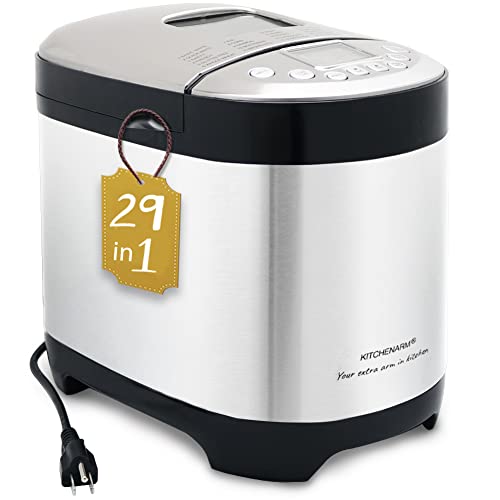
KITCHENARM 29-in-1 Smart Bread Machine — Best Program Library for Grain Variety
The KITCHENARM’s case is breadth with one crucial depth. The breadth: 29 programs spanning whole wheat, gluten-free and the rest of a grain-interested household’s repertoire, in three loaf sizes. The depth: the homemade cycle, whose settable timings let a stone-ground baker build the longer knead-and-rise schedule a particular flour demands and keep it. Most budget machines offer variety or flexibility; this one, unusually, offers both, and whole-grain baking is exactly where the combination pays.
Strengths
- 29 programs with explicit whole wheat focus
- Homemade cycle allows custom grain schedules
- Three loaf sizes suit varied households
Trade-offs
- Less polished interface and documentation
- Custom results require experimentation
- Single-heater baking trails the dual-heater picks on dense loaves
| Specification | Detail |
|---|---|
| Programs | 29-in-1 including whole wheat and homemade cycle |
| Loaf sizes | 1 lb, 1.5 lb and 2 lb |
| Settings | Includes gluten-free setting |
| Finish | Stainless steel |
Whole wheat positioning is explicit in this machine’s design — it is sold as a whole wheat bread making machine — and the program library reflects a grain-first brief: heartier cycles, properly timed, rather than a white-bread machine with a wheat afterthought. For households baking across grains — wheat this week, a multigrain blend next, a gluten-free loaf for a guest — the library absorbs the variety without new equipment.
Refinement is the trade: the interface and guidance are less polished than the premium brands, and extracting the homemade cycle’s best takes a notebook and a few loaves. For grain bakers who read recipes the way other people read novels, that is not a deterrent — it is the point.
Use the KITCHENARM’s smaller loaf sizes as your flour laboratory: each new stone-ground flour gets a 1 lb test bake with notes before it earns a full-size commitment. The machine’s breadth means the test program — whole wheat, homemade, a blend cycle — is always available.
Best for: grain-variety households wanting breadth plus flexibility / Not suited for: bakers wanting premium polish and guidance
Check the current price on Amazon

Hamilton Beach Digital Bread Maker 29987 — Best Budget Artisan Dough Pick
The Hamilton Beach 29987 is the budget entry to serious grain work, and its artisan setting is the reason. Artisan-style programs are built around longer, slower dough development — the direction stone-ground dough always wants to travel — and for bakers who finish loaves in the oven, an affordable machine with a credible artisan dough cycle is the whole requirement: knead my heavy dough properly, proof it warmly, and hand it over. This one does that at the friendliest tier in the guide.
Strengths
- Artisan setting suits slow whole-grain dough development
- Delay start supports overnight staging
- Friendly tier with a large owner community — check price on Amazon
Trade-offs
- In-machine dense loaves are good, not great
- Budget construction and single heater
- Kneading authority is the lightest here for very coarse doughs
| Specification | Detail |
|---|---|
| Capacity | 2 lb loaf |
| Programs | 14 programmable settings including artisan and gluten-free |
| Timer | Delay start |
| Model | 29987 |
Fourteen settings cover the practical household range, including gluten-free for mixed-requirement kitchens, and the delay start supports the overnight staging whole-grain bakers rely on. The 2 lb capacity matches standard whole-grain recipes without the overfill temptation of the giant pans. Hamilton Beach’s broad ownership base also means recipes, adjustments and community knowledge for this machine are easy to find — an underrated asset when a new flour misbehaves.
As an in-machine baker of dense loaves it is the most modest here — single-heater, budget construction — so whole-grain loaves baked fully in the pan will be good rather than great. Judged as a kneading and proofing partner for oven-finished stone-ground bread, it is the value pick of the guide.
The 29987’s artisan cycle plus a Dutch oven is the budget combination this guide would hand a new stone-ground baker without hesitation: the machine kneads and proofs, the oven finishes, and the total equipment cost stays below a single premium machine while the bread rivals any method.
Best for: budget bakers who finish stone-ground loaves in the oven / Not suited for: one-button bakers wanting premium in-machine results
Check the current price on Amazon
Comparison Table
For stone-ground work, weigh kneading and heating before program counts. The table lines up the six by the specs that decide a dense loaf’s fate.
| Pick | Badge | Key spec | Best for |
|---|---|---|---|
| Zojirushi Home Bakery Virtuoso Plus BB-PDC20BA | Best Overall | 2 lb capacity, whole-wheat program, dual heaters, 13-hour timer | serious whole-grain bakers using stone-ground flour regularly |
| West Bend Hi-Rise Bread Maker | Best for Large Dense Loaves | Up to 3 lb loaves, dual knead blades, horizontal pan, 12 programs | families baking large whole-grain loaves weekly |
| Breville Custom Loaf BBM800XL | Best Custom Control for Grain Recipes | Custom programmable cycles, collapsible paddle, automatic fruit and nut dispenser | methodical bakers working with varied stone-ground flours |
| KBS Premium 17-in-1 Bread Maker | Best Value Dual-Heater Pick | 17-in-1 programs, dual heaters with convection, ceramic pan, up to 2.2 lb | value buyers who bake whole-grain loaves regularly |
| KITCHENARM 29-in-1 Smart Bread Machine | Best Program Library for Grain Variety | 29 programs including whole wheat and homemade cycle, 1 / 1.5 / 2 lb sizes | grain-variety households wanting breadth plus flexibility |
| Hamilton Beach Digital Bread Maker 29987 | Best Budget Artisan Dough Pick | 2 lb capacity, 14 settings including artisan and gluten-free, delay start | budget bakers who finish stone-ground loaves in the oven |
How to Choose a Bread Machine for Stone-Ground Flour
Choosing among the best bread machines for stone ground grains starts with separating two purchases that this search tangles together: milling grain and baking with the flour. This guide covers the baking half. If you also want to mill, that is a grain mill — a separate appliance, bought separately, and worth researching on its own terms.
With that settled, the baking decision turns on kneading strength, schedule patience and how you finish the loaf. The sections below translate those into shopping terms, including the flour-side adjustments that matter as much as the machine.
Kneading is the whole-grain spec that matters most
Bran cuts dough structure as it develops, so whole-grain dough needs more and better kneading than white dough, not less. Judge machines by paddle design and motor substance: dual paddles for big loaves, proven single paddles in the premium machines, and honest torque everywhere. A machine that stalls or walks on a dense load will produce dense loaves no recipe can rescue. When in doubt, choose the stronger kneader over the longer program list.
Schedules: whole-wheat cycles and the overnight rest
Stone-ground dough rises slowly and hydrates slowly. A dedicated whole-wheat program builds in the longer knead and rise; a long delay timer enables the overnight flour-and-water rest that transforms whole-grain texture before the yeast even starts. Custom cycles let experienced bakers encode their own schedule per flour. Any one of these mechanisms serves; a machine with none of them will rush your dough, and rushed whole-grain dough is a brick with good intentions.
Hydration: the flour-side adjustment
Stone-ground flour drinks more water than roller-milled flour, and the amount varies by grain and batch. Expect to add water beyond a recipe’s first draft, a spoonful at a time, until the dough looks smooth and slightly tacky rather than dry and ragged. Machines cannot judge this — bakers can, through the lid, five minutes into the knead. That single check, and the confidence to adjust, improves whole-grain results more than any feature on any spec sheet in this guide.
In-machine bake or dough cycle to oven?
Dense loaves are the hardest in-machine bake: the centre must cook through before the crust over-colours, which is why dual heaters headline two picks here. The alternative — dough cycle, shape by hand, bake in a Dutch oven — sidesteps the problem entirely and produces the finest crust. Decide your finish first: oven-finish bakers can prioritise kneading and spend less; in-machine bakers should prioritise heating and spend accordingly.
Recipe sources that understand whole grains
Most bread machine recipes are written for refined flour, and adapting them is a skill in itself: whole-grain versions need more water, longer schedules and often a rest. Seek out recipes written for whole grains from the start — millers of stone-ground flour frequently publish them, tested against their own product — rather than converting white recipes by hope. When you do convert, change one variable at a time and write it down; whole-grain baking has enough natural variation from the flour itself without the recipe adding more.
The five-minute check, in detail
This guide mentions the five-minute dough check in several places because it is the highest-value habit in machine whole-grain baking, and it deserves a precise description. Five minutes into the knead, open the lid and look: the dough should be gathering into a single ball that cleans the pan’s sides as it turns, with a surface that looks smooth and feels — if you touch it with a dry fingertip — slightly tacky, like a sticky note. A shaggy mass that will not gather wants water, a spoonful at a time, waiting a minute between additions. A wet smear that coats the pan wants flour the same way. Two adjustments in the first knead rescue loaves that no later stage can, and after a dozen loaves the check takes ten seconds and becomes as automatic as preheating an oven.
How to Bake With Stone-Ground Flour in a Bread Machine
Stone-ground flour behaves differently from the flour most machine recipes assume. This workflow adjusts for its thirst, its bran and its slower rise, and works with every pick in this guide.
- Weigh the flour: stone-ground flour’s density varies; a scale removes the biggest variable in whole-grain baking before you start.
- Rest flour and water first: combine flour and most of the liquid in the pan and let it sit twenty to thirty minutes before starting the cycle. This hydration rest softens the bran and dramatically improves the knead.
- Add remaining ingredients and start a whole-wheat or custom cycle: choose the longest, gentlest schedule available — whole-grain dough is never in a hurry.
- Check the dough at five minutes: look through the lid. The dough should form a smooth, slightly tacky ball. Dry and ragged means add water a spoonful at a time; a wet smear means a spoonful of flour. This check is the whole craft.
- Let the rise finish by look, not clock: if the cycle ends before the dough has properly risen, give it more time in the warm pan rather than baking an under-proofed loaf.
- Choose your finish: bake in the machine for convenience, or turn out, shape and bake in a preheated Dutch oven for the best crust and crumb.
- Cool completely before slicing: dense whole-grain crumb sets as it cools and gums if cut hot. Patience here is an ingredient.
Keep a notebook per flour: water used, schedule chosen, result. Stone-ground flours vary enough that your notes, within a few loaves, become a better recipe book than any printed one.
What Stone Milling Does to Flour — and to Your Baking
To bake well with stone-ground flour, it helps to know what the stones actually did. Roller milling separates the grain into parts — white endosperm here, bran and germ removed there — and recombines some of them for wholemeal flour. Stone milling grinds the whole grain together in one pass, so everything the grain contained stays in the bag: the bran in flakes that physically interrupt dough structure, the germ with its oils and flavour, and the full mineral and fibre content. Two baking consequences follow. The flour is alive with variation — grind coarseness, grain variety and freshness all shift its behaviour — which is why this guide keeps returning to the baker’s judgement over any fixed recipe. And the flour is perishable in a way refined flour is not: the germ’s oils oxidise over months, so stone-ground flour rewards buying smaller amounts, storing them cool, and baking them fresh. None of this makes stone-ground flour difficult; it makes it an ingredient with a personality, and the machines in this guide were chosen for the kneading strength and schedule patience that personality requires.
Blending Flours: The Pragmatic Middle Path
Many experienced whole-grain bakers quietly practise a compromise worth stating aloud: they blend. A loaf of part stone-ground whole grain and part strong white flour keeps most of the flavour and nutrition story while gaining structure, rise and forgiveness — and it is dramatically kinder to lighter machines and to bakers still learning hydration by eye. There is no purity tribunal in home baking. The blend ratio is a dial, not a doctrine: start where the loaves succeed, and turn it toward more whole grain as your technique and your machine’s kneading prove themselves. The picks in this guide span that journey — the Hamilton Beach and KITCHENARM serve the blending phase happily, while the Zojirushi, West Bend and Breville stand ready at the 100 percent end. What matters is that the bread gets baked, eaten and baked again; a perfect loaf that happens twice a year feeds nobody. Stone-ground flour’s flavour is strong enough that even a half-measure loaf tastes unmistakably of the grain — which is, after all, the reason anyone sought the flour out in the first place.
Grains Beyond Wheat: Rye, Spelt and the Blended Frontier
Stone-ground baking rarely stops at wheat, and the machines in this guide meet the wider grain shelf with varying grace — worth mapping before your flour orders wander. Rye is the humbling one: its dough-forming proteins behave nothing like wheat’s, producing a sticky, dense dough that needs wheat’s structure beside it in most home recipes and a gentle hand with water. Spelt is the friendly ancient grain — flavourful, extensible, and prone to over-kneading, which argues for the shorter end of whole-wheat schedules and against marathon custom kneads. Cornmeal and cracked grains enter as additions rather than flours, best soaked before they meet the dough so their edges soften instead of cutting it. The through-line is that grain variety rewards the machines with schedule flexibility — the Breville’s custom cycles, the KITCHENARM’s homemade program — because each grain writes its own timetable. Bakers planning a one-flour life can ignore this frontier happily; bakers whose mill orders read like a harvest festival should weight flexibility accordingly.
The Economics of Stone-Ground at Home
Stone-ground flour costs more than commodity flour, and a clear-eyed guide should address whether the bread machine changes that arithmetic. It does, in two directions. First, the machine removes the labour cost that makes whole-grain baking a weekend-only event for many households — and a flour only used on weekends is a flour that ages, while a flour used twice weekly stays fresh and earns its premium in every loaf. Second, the machine’s consistency protects the investment: an under-kneaded, under-baked loaf wastes exactly the expensive ingredient, so the stronger kneaders and dual heaters in this guide are, in ingredient terms, insurance. Set against bakery prices for genuine stone-ground loaves, the home arithmetic is not close — the machine pays for itself in saved bakery loaves faster than almost any appliance in the kitchen, provided it is used. Which returns to the only economic variable that matters: choose the machine whose kneading and schedule fit your flour so well that baking becomes the week’s rhythm rather than its event.
Common Buying Mistakes
Expecting the bread machine to grind the grain
It cannot — no bread machine mills. Stone-ground flour arrives as flour, from a miller or from a separate home grain mill. Buying a bread machine to grind grain, or a mill to bake bread, strands both purchases.
Using a white-bread cycle for whole-grain dough
White cycles knead too briefly and rise too fast for bran-rich dough. The result is the classic dense brick, blamed on the flour. Use the whole-wheat, artisan or custom schedule the dough actually needs.
Following the recipe’s water exactly
Stone-ground flour’s thirst varies by grain and batch. A recipe’s water is a starting estimate; the five-minute dough check and spoon-by-spoon adjustment are how whole-grain bakers actually work.
Overfilling with dense dough
A pan at capacity with white dough is over capacity with stone-ground dough, which is heavier and rises differently. Respect the rated loaf size, and step down a size for 100 percent whole-grain recipes in large pans.
Slicing the loaf hot
Whole-grain crumb finishes setting as it cools. A hot slice compresses into gumminess and makes a well-baked loaf seem failed. Cool it fully — the flavour improves too.
Final Recommendation
For most stone-ground bakers, the Zojirushi Virtuoso Plus is the complete answer — kneading, whole-wheat programming and dual-heater baking in one machine. Volume bakers should take the West Bend Hi-Rise; methodical tuners, the Breville Custom Loaf; value buyers who still want dual heaters, the KBS; variety households, the KITCHENARM; and oven-finish bakers on a budget, the Hamilton Beach 29987 and its artisan dough cycle.
And keep the founding distinction in view: the best bread machines for stone ground grains do not grind anything. They honour what the miller made — a living, variable, flavourful flour — with the kneading strength and patience it demands. Choose the machine that respects the flour, check the dough at five minutes, and stone-ground bread becomes a weekly pleasure instead of an occasional experiment.
- Zojirushi Home Bakery Virtuoso Plus BB-PDC20BA — Check the current price on Amazon
- West Bend Hi-Rise Bread Maker — Check the current price on Amazon
- Breville Custom Loaf BBM800XL — Check the current price on Amazon
Best Bread Machines For Sourdough Best Affordable Bread Machines Best 2 Lb Bread Machines
Frequently Asked Questions
Does a bread machine grind stone-ground grain itself?
No. Bread machines knead and bake dough; they do not mill grain. Stone-ground flour is produced between millstones — by a commercial miller or in a separate home grain mill appliance — and then used in the bread machine like any flour. This guide covers the baking side of that journey.
Why is my stone-ground loaf dense?
The usual causes are under-hydration, too short a knead or rise, or a white-bread cycle. Rest the flour and water before starting, check and adjust the dough’s water at five minutes, use a whole-wheat or artisan schedule, and let the rise finish by the dough’s look rather than the clock.
Which cycle should I use for stone-ground flour?
A whole-wheat cycle if the machine has one; otherwise the longest artisan or custom schedule available. The KBS, KITCHENARM and Breville picks let you build or choose longer schedules, while the Zojirushi’s dedicated whole-wheat program is the set-and-trust option.
Can these machines handle 100 percent whole-grain recipes?
The stronger kneaders here — Zojirushi, West Bend with its dual blades, Breville — handle full whole-grain doughs credibly. Lighter machines do better with a proportion of strong white flour in the mix, and every machine does better when the dough’s hydration is checked and adjusted early.
Is stone-ground flour worth the extra effort?
For flavour, whole-grain bakers consistently say yes — stone milling keeps the germ and bran in the flour, and the bread tastes like the grain it came from. The effort is mostly learning: a hydration rest, a five-minute check, a longer schedule. The machines in this guide carry the rest.
What size loaf suits stone-ground recipes?
Standard whole-grain recipes map to the 2 lb class in most of these machines. For 100 percent whole-grain doughs in the largest pans, consider baking one size down — dense dough needs headroom to rise without finding the lid.
Should I sift stone-ground flour for a lighter loaf?
You can, and it is an old baker’s technique: sifting out part of the coarsest bran lightens the crumb noticeably, and the sifted bran can be sprinkled on top of the loaf or soaked and folded back in. Purists keep everything; pragmatists sift for sandwich loaves and keep the full flour for hearty ones. Both are legitimate uses of the same bag.
How should I store stone-ground flour?
Cool, sealed and in smaller quantities than refined flour. The germ oils that carry its flavour also oxidise over time, so buy what you will bake within a couple of months, keep it in an airtight container away from heat, and refrigerate or freeze surplus for longer storage. Fresh stone-ground flour is not a slogan — it is a measurable difference in the loaf.
Can I bake gluten-free recipes with stone-ground grains in these machines?
Several picks include gluten-free programs, and stone-ground gluten-free flours and grains — rice, sorghum, buckwheat and corn among them — work in those cycles. Expect the same whole-grain lessons in stronger form: hydration judged by eye, schedules kept gentle, and blends of grains outperforming single flours. The gluten-free programs on the Zojirushi, West Bend and KITCHENARM picks are the starting points.
Why does my whole-grain loaf fall in the middle?
Usually over-proofing or excess water — whole-grain doughs are eager to rise and poor at holding it, and a dough pushed past its structure collapses in the bake’s first minutes. Reduce the water slightly, shorten the final rise, and let the loaf’s look rather than the schedule’s ambition decide. Dual-heater machines forgive a little of this; none forgive a lot.
Best American Made Bread Machines 10 Best Bread Machines Best Can Openers For Seniors Battery Power


