Disclosure: airfryerkitchensupply.com is reader-supported. When you buy through links on our site, we may earn an affiliate commission at no extra cost to you.
Where to buy
Every pick in this guide to the best bread machines for sourdough is sold through Amazon. Program lists change between model revisions, and sourdough-relevant cycles are exactly the detail that shifts — use the links below to confirm the exact model and its cycle list before you buy:
- Cuisinart Convection Bread Maker CBK-210 — Check the current price on Amazon
- Zojirushi Home Bakery Virtuoso Plus BB-PDC20BA — Check the current price on Amazon
- Breville Custom Loaf BBM800XL — Check the current price on Amazon
- KITCHENARM 29-in-1 Smart Bread Machine — Check the current price on Amazon
- Panasonic Bread Machine SD-R2550 — Check the current price on Amazon
- KBS Premium 17-in-1 Bread Maker — Check the current price on Amazon
A plain warning that shapes this whole guide: a program named for sourdough on a spec sheet can mean anything from a true long ferment to a quick loaf with sourdough flavouring. The reviews below state, for each machine, what it actually does for a starter-based loaf.
Introduction
The best bread machines for sourdough need to be judged against an uncomfortable truth first: almost no bread machine runs a true sourdough cycle. Real sourdough is a long, slow, temperature-sensitive fermentation driven by a living starter, and the fixed, clock-driven programs of a bread machine — built around commercial yeast’s predictable schedule — are philosophically opposed to it. What the good machines in this guide actually offer is the honest workaround: a starter program on the one model that has one, and on the rest, flexible dough cycles, long timers and custom settings that let the machine knead and proof while you and your starter control the fermentation.
That is not a consolation prize. The hardest, messiest parts of sourdough at home are the kneading of a wet, sticky dough and the maintenance of a warm, steady proofing environment — exactly the parts a bread machine does well. The workflow most successful sourdough bakers settle into is hybrid: the machine mixes and kneads, the dough ferments on the machine’s dough cycle or in its warm pan for part of the rise, and the loaf finishes shaped by hand and baked in a real oven for a real crust. Every pick below was chosen for how well it supports that workflow.
If instead you want to press one button and receive sourdough, this guide will disappoint you honestly rather than sell you a fiction. One pick below comes closest, with a dedicated sourdough starter program. The others earn their places as the best tools for the hybrid method — which, not coincidentally, also produces the best bread.
Key Takeaways
- Almost no bread machine runs a true sourdough cycle — plan the hybrid method.
- The Cuisinart CBK-210 is the exception, with a sourdough starter program in its list.
- Machine kneads and proofs; you ferment, shape and finish in a real oven.
- Judge the dough, not the clock — starters ignore schedules.
- A fed, active starter matters more than any feature on any machine.
In this guide
Quick Picks
Six machines, one honest spectrum: a dedicated starter program at one end, and at the other, superb kneading-and-proofing partners for bakers who finish in the oven.
- Best Overall for Sourdough — Cuisinart Convection Bread Maker CBK-210: The only pick with a program set that includes sourdough starter, plus a convection fan for crust and 16 programs in a 2 lb machine. Check the current price on Amazon
- Best for the Hybrid Method — Zojirushi Home Bakery Virtuoso Plus BB-PDC20BA: A premium 2 lb machine with dual heaters and a 13-hour timer — the strongest kneading and most even baking platform for hybrid sourdough. Check the current price on Amazon
- Best Custom Control — Breville Custom Loaf BBM800XL: A custom-programmable machine with a collapsible paddle and automatic dispenser — bend the cycle timings toward your starter’s pace. Check the current price on Amazon
- Best Homemade Cycle Flexibility — KITCHENARM 29-in-1 Smart Bread Machine: A 29-program machine whose homemade cycle lets you set your own timings — the budget-friendly route to fermentation flexibility. Check the current price on Amazon
- Best Program Library — Panasonic Bread Machine SD-R2550: A 20-preset machine with an advanced temperature sensor and raisin-nut dispenser — consistent conditions for dough cycles, bake after bake. Check the current price on Amazon
- Best Value Dual-Heater Pick — KBS Premium 17-in-1 Bread Maker: A 17-in-1 machine with dual heaters, a ceramic pan, a 15-hour timer and three loaf sizes — long-timer flexibility at a value tier. Check the current price on Amazon
How These Picks Were Chosen
Picks were chosen from bread machines verified through Amazon listing held for this site. Only models whose Amazon title confirmed the exact machine and its program set received a purchase link, and spec boxes quote those verified listings. Marketing language about sourdough was treated with suspicion throughout: a model was credited with sourdough support only where a starter program, a genuinely flexible dough cycle, a long delay timer or custom programming gives the baker real control over fermentation time.
The criteria therefore put fermentation flexibility first — can the baker stretch, pause or program the schedule the starter demands? Kneading strength came second, because sourdough’s wet doughs punish weak paddles. Third was proofing environment: a machine that holds a warm, draft-free rise is doing real sourdough work even on a plain dough cycle. Features that matter for yeasted loaves but not for sourdough — rapid cycles, sweet bread programs — were ignored.
- Fermentation flexibility: a starter program, custom cycle or long timer that bends to the starter’s schedule instead of the clock’s.
- Kneading strength: enough paddle torque for wet, sticky, high-hydration sourdough doughs without stalling.
- Proofing environment: a warm, enclosed, draft-free rise inside the machine during the dough cycle.
- Honest sourdough labelling: what the machine actually does for starter-based loaves, stated plainly — no flavouring shortcuts passed off as fermentation.
- Oven-finish friendliness: a dough cycle that ends cleanly, with a pan and paddle that release wet dough without a fight.
The 6 Best Bread Machines for Sourdough

Cuisinart Convection Bread Maker CBK-210 — Best Overall for Sourdough
The Cuisinart CBK-210 leads this guide for the reason stated in its verified listing: among mainstream bread machines, its 16 programs include a sourdough starter program — a cycle designed around maintaining and using a starter rather than merely flavouring a quick loaf. That makes it the closest thing in this guide to a machine that speaks sourdough natively, and for bakers who want the machine to manage the starter side of the process, it is the obvious first look.
Strengths
- Program set includes a dedicated sourdough starter cycle
- Convection fan improves crust on in-machine loaves
- Full program range also supports the hybrid dough-cycle workflow
Trade-offs
- Starter programs still run on a schedule — your starter may not
- In-machine crust, even with convection, trails a Dutch oven finish
- Premium-mid tier — check price on Amazon
| Specification | Detail |
|---|---|
| Capacity | 2 lb loaf |
| Programs | 16 programs including sourdough starter |
| Baking | Convection fan for artisan-style crust |
| Extras | Automatic mix-in dispenser |
The supporting cast suits the hybrid workflow too. The convection fan works toward the crust sourdough bakers actually care about — the one department where in-machine loaves usually disappoint — and the automatic mix-in dispenser handles the seeds and grains that country-style sourdoughs often carry. Sixteen programs include the dough and custom flexibility to run the knead-and-proof partnership for fully hand-finished loaves as well, so the machine serves both the convenient and the craft approaches.
The honesty box still applies: even a starter program operates on a schedule, and a vigorous starter on a warm day will not read the manual. Expect to learn your starter’s timing against the machine’s over a few loaves. But as the starting point for machine-assisted sourdough, nothing else in this guide begins as close to the real process.
A workflow note for CBK-210 owners: use the starter program as the base camp, not the summit. Once you know how your starter behaves inside its schedule, the machine’s other cycles let you stage the dough work around your day — the program starts the partnership, and your judgement finishes it.
Best for: sourdough bakers who want real starter support in the machine / Not suited for: purists who ferment entirely by feel and hand
Check the current price on Amazon

Zojirushi Home Bakery Virtuoso Plus BB-PDC20BA — Best for the Hybrid Method
The Zojirushi Virtuoso Plus is the connoisseur’s hybrid partner. Its kneading is the most thorough in this guide — the machine develops wet sourdough dough properly rather than merely stirring it — and its dual heaters bake the most even in-machine loaf here, with a lid heater that prevents the pale, sunken top that betrays most bread machine bread. For the dough-cycle-to-oven workflow, you take the kneading and the warm enclosed proof; for an in-machine loaf, you get the best version of that compromise available.
Strengths
- Most thorough kneading of wet doughs in this guide
- Dual heaters bake the most even in-machine loaf
- 13-hour timer works as a fermentation staging tool
Trade-offs
- No dedicated sourdough starter program
- Premium tier price — check price on Amazon
- Large footprint for a bread machine
| Specification | Detail |
|---|---|
| Capacity | 2 lb loaf |
| Heating | Dual heaters |
| Timer | 13-hour delay timer |
| Programs | Includes whole-wheat and gluten-free programs |
The 13-hour timer deserves a sourdough-specific note: long timers are fermentation tools. Loading the machine so the dough cycle finishes when you are ready to shape — or staging an overnight slow start for a morning bake — is how experienced machine sourdough bakers bend the clock toward the starter. The whole-wheat program’s longer, gentler handling also suits the heavier doughs that part-wholemeal sourdoughs produce.
There is no dedicated sourdough cycle, and the price is the highest in this guide. What the money buys is execution quality at every step the machine does perform. If your method is hybrid and your standards are high, this is the machine that never becomes the weak link.
The Virtuoso Plus’s even baking has a sourdough-specific dividend: in-machine loaves emerge with a top crust that actually colours, which keeps the weekday in-machine option respectable in this household. Many hybrid bakers find their oven finishes reserved for weekends by choice rather than necessity.
Best for: hybrid bakers who knead and proof in the machine, bake in the oven / Not suited for: one-button sourdough seekers or tight budgets
Check the current price on Amazon

Breville Custom Loaf BBM800XL — Best Custom Control
The Breville Custom Loaf’s sourdough argument is in its name: custom. Where fixed programs force the starter onto the machine’s schedule, genuinely adjustable cycle settings let the baker lengthen the rises and reshape the sequence toward the fermentation the dough actually needs. For sourdough — a process whose entire art is timing — that adjustability is worth more than any single named program, and it makes the Breville the choice for bakers who already understand their starter and want a machine that can be taught to respect it.
Strengths
- Custom settings bend cycle timing toward real fermentation
- Collapsible paddle eliminates the hole in finished loaves
- Automatic dispenser times seeds and fruit correctly
Trade-offs
- Requires setup loaves to tune against your starter
- No named sourdough starter program
- Premium-mid tier — check price on Amazon
| Specification | Detail |
|---|---|
| Control | Custom programmable cycle settings |
| Paddle | Collapsible kneading paddle |
| Extras | Automatic fruit and nut dispenser |
| Finish | Brushed stainless steel |
Two details elevate daily use. The collapsible kneading paddle folds down before baking, so in-machine loaves come out without the characteristic paddle hole torn through the crumb — a small engineering grace that changes how the bread presents. The automatic fruit and nut dispenser handles seeded and fruited sourdough variants at the right moment in the cycle, without a beeper-and-lid-opening intervention.
Custom control demands a customiser: the first loaves involve dialling settings against your starter’s behaviour, and bakers who want the machine to simply know will prefer the Cuisinart above. For the baker who treats the machine as an instrument to be tuned, this is the most expressive one here.
Keep a written log taped inside a cupboard door for the Breville’s custom settings — starter proportion, stage times, result. Within a few loaves the log becomes a personal program library no manufacturer could ship, tuned to your culture and your kitchen’s temperature.
Best for: experienced bakers who want to program fermentation timing / Not suited for: beginners wanting the machine to decide everything
Check the current price on Amazon
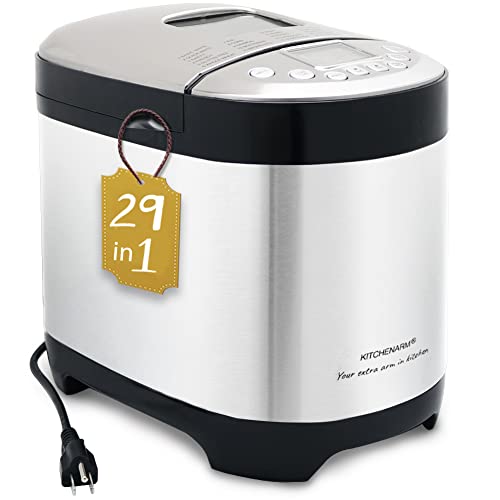
KITCHENARM 29-in-1 Smart Bread Machine — Best Homemade Cycle Flexibility
The KITCHENARM’s headline for sourdough is its homemade cycle: a program whose stage timings the baker sets, which is precisely the mechanism the hybrid method needs and precisely what most budget machines omit. Set a long, slow schedule that respects the starter, let the machine knead a wet dough you would rather not fight by hand, and either bake in the pan or lift the dough out for shaping and an oven finish. At its tier, that flexibility is remarkable.
Strengths
- Homemade cycle with baker-set timings suits real fermentation
- Three loaf sizes suit small households
- Strong capability for its tier — check price on Amazon
Trade-offs
- Interface and guidance are less polished than premium brands
- First custom loaves are trial and error
- No dedicated starter-maintenance program
| Specification | Detail |
|---|---|
| Programs | 29-in-1 including homemade cycle |
| Loaf sizes | 1 lb, 1.5 lb and 2 lb |
| Settings | Includes gluten-free and whole wheat |
| Finish | Stainless steel |
The 29-program library around the homemade cycle covers the rest of a household’s bread life — whole wheat for heartier sourdough blends, gluten-free for the other eaters in the house — and the three loaf sizes let small households avoid the waste of a forced 2 lb format. The stainless finish wipes down easily, a practical mercy in a machine that will live beside a flour-dusted starter jar.
Set expectations on refinement: the interface and documentation ask more of the baker than the premium brands do, and the first homemade-cycle loaves are experiments by definition. But the capability-to-price ratio for sourdough flexibility is the best in this guide, and capable bakers will extract results the spec sheet undersells.
The KITCHENARM’s three loaf sizes suit the experimental phase of sourdough particularly well: bake the 1 lb size while you are learning a schedule, and failed experiments cost grams of flour instead of a family loaf. Scale up once the timing is yours.
Best for: capable bakers wanting custom fermentation timing on a budget / Not suited for: beginners who want the machine to lead
Check the current price on Amazon
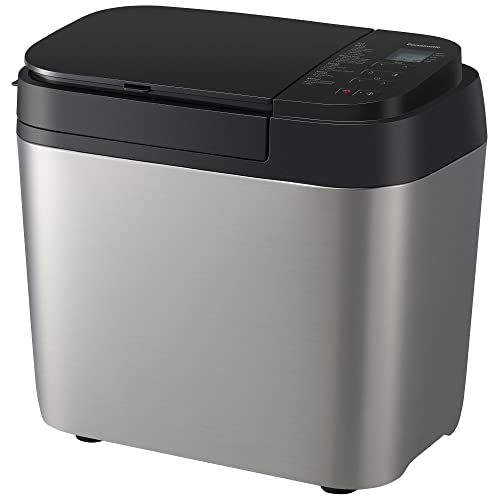
Panasonic Bread Machine SD-R2550 — Best Program Library
The Panasonic SD-R2550’s sourdough relevance is a component most guides would list as a footnote: its advanced temperature sensor. Fermentation is temperature before it is anything else, and a machine that actively manages its internal temperature gives the dough cycle a consistency that drafty kitchens and changing seasons otherwise steal. For the hybrid baker, a dough cycle whose warmth is sensed and held — rather than assumed — translates directly into more predictable rises from the same starter.
Strengths
- Temperature sensor holds proofing conditions steady
- 20 presets cover the full household repertoire
- Even, reliable baking builds dough-cycle confidence
Trade-offs
- No custom or sourdough-specific cycle
- Fermentation control is by preset choice, not programming
- Mid-premium tier — check price on Amazon
| Specification | Detail |
|---|---|
| Programs | 20 presets |
| Sensor | Advanced temperature sensor |
| Extras | Raisin and nut dispenser |
| Settings | Includes gluten-free baking |
Twenty presets cover the household breadth around the sourdough project, and the raisin-nut dispenser times additions properly for fruited and seeded loaves. Panasonic’s long bread machine heritage shows in the evenness of its ordinary loaves, which matters for confidence: a machine you trust on Tuesday’s sandwich bread is a machine whose dough cycle you will trust with Saturday’s sourdough.
There is no sourdough-specific or fully custom cycle, so fermentation control comes from choosing among presets and using the timer rather than programming stages. Bakers who want to author the schedule itself should look at the Breville or the KITCHENARM; bakers who want the machine to hold conditions steady while they manage timing will find the Panasonic’s temperament ideal.
The SD-R2550’s temperature management shows its worth most in winter, when kitchens swing cold overnight and starters sulk. A dough cycle whose warmth is sensed and held rescues winter fermentation consistency — the season when home sourdough usually goes quiet until spring.
Best for: hybrid bakers who value consistent proofing conditions / Not suited for: bakers who want to program every stage themselves
Check the current price on Amazon

KBS Premium 17-in-1 Bread Maker — Best Value Dual-Heater Pick
The KBS makes its sourdough case with two numbers: dual heaters and a 15-hour timer. The timer is the longest in this guide, and for fermentation staging that length is capability — an overnight dough cycle timed to finish at shaping hour, or a slow staged start that lets flavour develop before the kneading even begins. Dual heaters then give the in-machine bake a more even, better-coloured result than single-element value machines manage.
Strengths
- 15-hour timer — the longest fermentation staging window here
- Dual heaters improve in-machine bake evenness
- Ceramic pan releases wet dough and cleans easily
Trade-offs
- No sourdough-specific program
- Kneading is capable, not class-leading, on very wet doughs
- Touch panel is less tactile than dials and buttons
| Specification | Detail |
|---|---|
| Capacity | Up to 2.2 lb, three loaf sizes |
| Heating | Dual heaters, convection |
| Pan | Ceramic pan |
| Timer | 15-hour timer |
The ceramic pan is the other ownership plus: a slick, durable surface that releases wet dough cleanly at the shaping stage and scrubs clean afterwards without the anxiety of a scratched coating. Three loaf sizes and three crust colours cover household variety, the nut dispenser handles seeded loaves, and the touch panel keeps the top surface wipe-clean in a floury corner of the kitchen.
As with the other non-Cuisinart picks, there is no true sourdough cycle — the KBS is a hybrid partner, not a sourdough machine. Its kneading is capable rather than class-leading, so very wet doughs may need a mid-cycle scrape-down. At its value tier, the combination of timer length, dual heat and that ceramic pan is genuinely distinctive.
The KBS’s ceramic pan simplifies one hybrid step that other machines make awkward: lifting the proofed dough out cleanly for shaping. A slick pan, a gentle hand and the dough arrives at the bench intact, air and all — the quiet feature that hybrid bakers end up valuing daily.
Best for: value buyers who stage fermentation with long timers / Not suited for: bakers wanting a named starter program
Check the current price on Amazon
Comparison Table
For sourdough, read the fermentation column before the program count — what matters is how each machine bends to a starter’s schedule, not how many cycles it lists.
| Pick | Badge | Key spec | Best for |
|---|---|---|---|
| Cuisinart Convection Bread Maker CBK-210 | Best Overall for Sourdough | 16 programs including sourdough starter, convection fan, 2 lb capacity | sourdough bakers who want real starter support in the machine |
| Zojirushi Home Bakery Virtuoso Plus BB-PDC20BA | Best for the Hybrid Method | 2 lb capacity, dual heaters, 13-hour timer, whole-wheat and gluten-free programs | hybrid bakers who knead and proof in the machine, bake in the oven |
| Breville Custom Loaf BBM800XL | Best Custom Control | Custom programmable cycles, collapsible kneading paddle, automatic fruit and nut dispenser | experienced bakers who want to program fermentation timing |
| KITCHENARM 29-in-1 Smart Bread Machine | Best Homemade Cycle Flexibility | 29 programs including a homemade custom cycle, 1 / 1.5 / 2 lb loaf sizes | capable bakers wanting custom fermentation timing on a budget |
| Panasonic Bread Machine SD-R2550 | Best Program Library | 20 presets, advanced temperature sensor, raisin and nut dispenser | hybrid bakers who value consistent proofing conditions |
| KBS Premium 17-in-1 Bread Maker | Best Value Dual-Heater Pick | 17-in-1 programs, dual heaters, ceramic pan, 15-hour timer, up to 2.2 lb | value buyers who stage fermentation with long timers |
How to Choose a Bread Machine for Sourdough
Choosing among the best bread machines for sourdough begins with choosing your method, because the method decides the machine. The one-button dream does not exist for true sourdough; the hybrid reality — machine kneads and proofs, baker ferments and finishes — produces excellent bread and asks specific things of the equipment.
The sections below walk through those asks: fermentation control, kneading strength for wet dough, the in-machine versus oven-finish decision, and how to read sourdough claims on a spec sheet without being misled by them.
First, decide: in-machine loaf or oven finish?
An in-machine sourdough-style loaf is convenient and, in the better machines here, genuinely good — but its crust and shape are bounded by the pan. The oven finish — dough cycle in the machine, shaping by hand, baking in a Dutch oven or on a stone — is where machine-assisted sourdough becomes indistinguishable from fully handmade. If you plan the oven finish, prioritise kneading and dough-cycle quality over baking features. If you plan in-machine loaves, the convection and dual-heater picks earn their premiums.
Fermentation control is the real spec
Look past the program count to the mechanisms of control: a starter program, a homemade or custom cycle with settable stage times, and a long delay timer. Each is a different way of bending the machine to the starter. A 15-hour timer, for instance, is not a convenience feature for sourdough — it is the difference between a dough cycle that finishes when the fermentation is right and one that finishes when the clock says so.
Kneading wet dough is the strength test
Sourdough doughs run wetter and stickier than yeasted sandwich doughs, and they expose weak paddles and motors immediately — stalling, walking, or merely stirring the dough in circles. Dual-paddle and premium single-paddle designs develop the dough properly. If a machine’s reviews complain about ordinary doughs, it will not survive sourdough; the picks here were filtered for kneading credibility first.
How to read a sourdough claim
When a listing says sourdough, ask which of three things it means: a starter program that maintains or builds a starter (genuine), a long slow cycle suited to starter doughs (useful), or a quick loaf with sourdough flavouring (a different product wearing the name). This guide credits only the first two, says which is which in every review, and treats the third as what it is — flavoured bread, which some households enjoy, but not sourdough.
Reading a program list for sourdough value
When a bread machine’s program list is your only evidence, read it like a sourdough baker rather than a marketer. A starter program is the headline, but the supporting evidence matters nearly as much: a dough cycle that can run independently, a homemade or custom setting, a delay timer long enough to stage fermentation, and a whole-wheat cycle whose longer handling suits slow doughs. A machine with three of those four will serve the hybrid method well even without the named program. Conversely, a long list of novelty cycles — cakes, jams, yoghurts — tells you where the development budget went, and it was not toward your starter.
Pan, paddle and the wet-dough details
Sourdough dough is wet and clingy, and the hardware details decide how graciously a machine handles it. A pan coating in good condition releases the proofed dough without tearing its structure; a paddle that removes easily lets you take it out before the final rise for a cleaner loaf; a pan shape with gentle corners gives the paddle less dough to hide from. None of these appear in program counts, and all of them appear in daily use — which is why this guide’s reviews mention release and removal wherever the design earns it.
How to Make Sourdough With a Bread Machine (The Hybrid Method)
This is the workflow the picks in this guide were chosen to support. It uses the machine for what machines do best and keeps the fermentation — the soul of sourdough — under your control.
- Feed the starter first: refresh your starter several hours ahead so it is active and rising when the dough is mixed. The machine cannot rescue a sleepy starter.
- Mix flour and water in the pan, rest briefly: a short rest before adding starter and salt (an autolyse, in baker’s terms) makes the wet dough far easier for the paddle to develop.
- Add starter and salt, run the dough cycle: let the machine knead thoroughly. Check once early — wet dough sometimes climbs or hides in a corner; a single scrape-down fixes it.
- Ferment on your schedule, not the cycle’s: when the dough cycle ends, judge the dough, not the clock. If it needs more time, leave it in the warm pan with the machine off, or move it to a bowl, until it has risen and feels airy.
- Shape by hand: turn the dough out, shape it into its final form with surface tension, and place it in a basket or bowl for its final rise.
- Bake in a real oven: a preheated Dutch oven gives the crust and spring that define sourdough. Bake covered first, then uncovered to colour.
- Cool fully before slicing: the crumb is still setting as it cools. Cutting early makes even a perfect loaf seem gummy.
Keep notes on starter timing against your machine’s dough cycle for the first few loaves. Within a month, the partnership becomes predictable — and predictability is what turns sourdough from an event into a habit.
Understanding Your Starter as a Machine Setting
Bakers who succeed with machine-assisted sourdough eventually learn to think of the starter itself as the machine’s most important setting — one that changes daily. A starter fed the night before and kept warm is vigorous: it will ferment a dough hours faster than the same starter taken cold and sleepy from the fridge. That variability is not a flaw in the process; it is the process, and the hybrid method is designed around it. The practical habits are few. Feed on a rhythm the starter can rely on. Note, for your kitchen’s temperature, how long a fed starter takes to peak — that number, not any program’s, sets your baking day. Keep the proportion of starter in the recipe steady while you learn, so timing changes mean something. And when a loaf misbehaves, interrogate the starter before the machine: nine times in ten, the culture was underfed, over-acidic or simply not ready, and the finest kneading and proofing in this guide cannot ferment a dough whose engine was never started. Treat the starter as a colleague with moods, and the machine as the reliable pair of hands, and the partnership produces bread that neither could make as easily alone.
In-Machine Sourdough: Setting Fair Expectations
Because some readers will bake their sourdough entirely in the machine — workdays and energy levels being what they are — it is worth stating fairly what that loaf is and is not. It is not a failure. A well-made in-machine sourdough-style loaf, from an active starter on a long schedule in a good machine, is tangy, sliceable, excellent toast and a genuine improvement on supermarket bread. What it is not is the artisan boule: the pan dictates the shape, the crust stays comparatively soft because steam escapes the bake, and the crumb is more even and sandwich-like than open. The convection and dual-heater picks in this guide narrow that gap more than any machines before them, and for many households the in-machine loaf is the right weekday answer with the oven finish reserved for weekends. The mistake is only in the expectation — ordering the boule and judging the sandwich loaf for not being it. Choose consciously, use the longest schedule the machine offers, let the dough finish rising by its look, and the in-machine loaf earns its place in the rotation without apology.
Temperature: The Variable Nobody’s Program Controls
Ask experienced sourdough bakers what separates their good months from their bad ones and most will name temperature before technique. A starter ferments on a curve set by the warmth around it: lively and fast in a summer kitchen, slow and acidic in a winter one, and the dough follows the same law. Bread machines enter this story as temperature tools as much as kneading tools. The enclosed pan during a dough cycle is a small, stable climate — warmer than the counter, free of drafts — and that stability is a large part of why machine-assisted sourdough is more consistent than the countertop bowl method for many home bakers. The Panasonic pick in this guide makes the point explicit with its temperature sensor, but every machine here offers the enclosed-proof advantage. The baker’s part is to stop expecting identical timing across seasons. Keep the same recipe through the year and let the schedule breathe — shorter in July, longer in January — judging the dough by its rise and feel. The machine holds the climate steady; the calendar still belongs to you.
From First Loaf to House Loaf: The Learning Curve, Mapped
Machine sourdough has a predictable learning curve, and mapping it honestly keeps new bakers from quitting at the wrong point. The first loaves teach the machine: how its dough cycle handles your flour, where its warmth sits, how its timer stages against your starter’s peak. Expect bread that is good and imperfect. The next phase teaches the partnership: you adjust starter proportion, shift the cycle, learn your kitchen’s seasonal timing, and the loaves become reliably the bread your household plans around. The final phase is the house loaf — a recipe and rhythm so settled that sourdough stops being a project and becomes infrastructure, the bread that is simply always there. Most bakers who abandon the method quit in phase one, mistaking its lessons for the method’s ceiling. The machines in this guide were chosen to shorten phase one — credible kneading, honest schedules, forgiving dough cycles — but no machine skips it. Budget the first month as tuition, keep notes, and the house loaf arrives on schedule: yours.
Common Buying Mistakes
Believing a sourdough button means sourdough
Most sourdough-labelled cycles are quick loaves with flavouring or, at best, a schedule that assumes a starter behaves like packet yeast. Read what the cycle actually does — this guide’s reviews do that reading for the picks here — before paying for the word.
Expecting the machine’s clock to match your starter
A starter ferments faster on a warm day and slower in a cold kitchen; a fixed program knows neither. Bakers who judge the dough and use timers and dough cycles flexibly succeed; bakers who serve the clock get alternating under- and over-proofed loaves.
Skipping the oven finish and blaming the machine
An in-machine loaf has a pan-shaped ceiling on crust and form. If your sourdough ambitions are artisan, the dough-cycle-to-oven workflow is not a workaround — it is the method, and it is what most of these picks are best at.
Using a weak-kneading machine for wet dough
High-hydration sourdough stalls light paddles and leaves flour pockets that no rise can fix. Kneading credibility is a sourdough spec, not a luxury, which is why it filtered this guide’s picks.
Neglecting the starter because the machine feels automatic
The machine automates kneading and warmth; it does not automate the living culture the whole loaf depends on. A neglected, acidic starter produces dense, sour loaves in the finest machine ever built.
Final Recommendation
If you want the machine to participate in the starter itself, the Cuisinart CBK-210 is the pick — its program set includes sourdough starter support that the rest of the field does not offer. Hybrid bakers with high standards should take the Zojirushi Virtuoso Plus; programmers, the Breville Custom Loaf; condition-keepers, the Panasonic SD-R2550; and value hunters, the KITCHENARM for its homemade cycle or the KBS for its long timer and dual heaters.
The best bread machines for sourdough are not the ones that promise sourdough loudest. They are the ones that knead wet dough honestly, hold a warm proof, and bend their schedules toward a living starter. Choose by that standard, finish in the oven when it matters, and the machine becomes what it should be — the strong, silent partner in a genuinely handmade loaf.
- Cuisinart Convection Bread Maker CBK-210 — Check the current price on Amazon
- Zojirushi Home Bakery Virtuoso Plus BB-PDC20BA — Check the current price on Amazon
- Breville Custom Loaf BBM800XL — Check the current price on Amazon
Best Bread Machines For Stone Ground Grains Best Affordable Bread Machines Best 2 Lb Bread Machines
Frequently Asked Questions
Can a bread machine make real sourdough?
Not entirely on its own. Real sourdough fermentation runs on the starter’s schedule, not a fixed program. What the best machines do — and what this guide selects for — is knead the wet dough, hold a warm proof and offer starter programs, custom cycles or long timers that support a hybrid method finished by hand and in the oven.
Which pick has an actual sourdough program?
The Cuisinart CBK-210: its verified program list includes a sourdough starter program among its 16 programs. The other picks support sourdough through dough cycles, custom timing or long timers rather than a named starter cycle, and the reviews say so plainly.
Why did my in-machine sourdough come out dense?
Usually fermentation, not the machine: a starter that was not fully active, or a fixed cycle that ended the rise before the dough was ready. Feed the starter ahead, judge the dough rather than the clock, and consider the dough-cycle-plus-oven workflow for full control.
Can I bake the whole loaf in the machine?
Yes — every pick here bakes complete loaves, and the convection and dual-heater models do it best. Just know the ceiling: pan-shaped, softer-crusted bread. The oven finish exists for bakers who want the artisan crust and shape.
What loaf size suits sourdough in a machine?
The 2 lb class suits most sourdough recipes and gives the dough room to rise; several picks also offer smaller sizes for small households. Avoid overfilling a smaller pan with an ambitious recipe — sourdough rises on its own schedule and will find the lid.
Do I still need a Dutch oven if my machine has convection?
For a good loaf, no. For the defining sourdough crust — deep colour, crisp shell, open crumb — the Dutch oven’s trapped steam remains the home baker’s best tool, and it is why the hybrid method finishes there.
How do I know when my dough has risen enough in the machine?
By look and touch, not by the timer: the dough should have visibly expanded — roughly doubled for most recipes — look domed and airy rather than tight, and spring back slowly when pressed gently with a floured finger, leaving a slight dent. If it springs back instantly, it needs more time; if it collapses, it has gone too far.
Can I use the delay timer with sourdough dough?
Carefully. A starter dough left too long over-ferments and turns acidic and slack, so long delays suit the dough-cycle staging trick — timing the knead to finish at shaping hour — better than holding mixed dough for many hours. In cool kitchens a modest delay works; in warm ones, ferment on the counter under your eye instead.
Can I keep my starter in or near the bread machine?
Near, not in. A starter jar beside the machine — in the same warm corner of the kitchen — is a classic arrangement, and some bakers rest the jar on top of the machine during a bake to borrow gentle warmth. Inside the machine is for dough, not storage: the culture needs air, feeding and observation that a closed appliance cannot give it.
My sourdough tastes too sour — is that the machine?
Almost never. Sourness is set by the starter’s feeding rhythm and the dough’s fermentation length and warmth: a hungry, long-fermented dough turns acidic in any vessel. Feed the starter more regularly, shorten the warm fermentation, or use the starter younger, and the flavour balances — the machine merely hosted the process faithfully.
Best American Made Bread Machines 10 Best Bread Machines Best Blenders For Making Protein Shakes


