Disclosure: airfryerkitchensupply.com is reader-supported. When you buy through links on our site, we may earn an affiliate commission at no extra cost to you.
Where to buy
Finding the best blenders for individual smoothies means matching the machine to one person’s daily routine. An individual smoothie is a one-person job: roughly 12 to 20 ounces, blended in the same cup you drink from, rinsed in under a minute, and repeated tomorrow without a second thought. The machines below are all personal blenders verified through Amazon listing, and each one is linked so you can check price on Amazon and confirm exactly which cups and lids are in the box before you order. Cup counts and lid styles change between listing variations more often than motor specs do, so treat the listing — not any roundup, including this one — as the final word on what ships.
- nutribullet Pro+ Personal Blender N12-1001MK, 1200W (Best Overall) — check price on Amazon
- Ninja Nutri-Blender Pro BN401 with Auto-iQ, 1100 Peak Watts (Best for Frozen Fruit) — check price on Amazon
- nutribullet Turbo Personal Blender NB50400, 1000W (Best Compact Power) — check price on Amazon
- Ninja Fit Compact Personal Blender QB3001SS, 700W (Best Budget) — check price on Amazon
- magic bullet Personal Blender MBR-1101, 250W (Best for Tiny Counters) — check price on Amazon
- Ninja Blast Portable Blender BC151BK, Cordless, 18 oz (Best Cordless) — check price on Amazon
The best blenders for individual smoothies are not simply smaller versions of family pitchers. A personal blender wins or loses on a different set of details: whether the cup seals well enough to ride in a gym bag, whether the blade base rinses clean without a brush, whether the motor can chew a handful of frozen strawberries without stalling, and whether the whole routine — fill, blend, swap the blade for a lid, leave — takes less time than making coffee. If any step in that chain annoys you, the machine ends up in a cupboard and the smoothie habit dies with it.
That is why this guide ranks single-serve machines on the full daily loop rather than on raw power alone. Power still matters: a weak personal blender leaves berry seeds and spinach flecks floating in an otherwise thin drink, and frozen fruit is where underpowered motors go to struggle audibly. But cup design matters just as much. A 32-ounce cup you can actually finish beats a 72-ounce pitcher you have to decant, wash, and store, every single weekday morning.
Below you will find six verified picks that cover the realistic range of one-person blending: a strong all-rounder, a frozen-fruit specialist with automatic programs, a compact high-watt option, two genuinely inexpensive machines for first-time buyers, and a cordless model for desks, dorms, and travel. The buying guide then walks through cup sizes, motor strength, lid types, and cleaning, and the how-to section gives a repeatable morning routine that keeps a personal blender fast instead of fussy.
In this guide
Quick Picks
Six personal blenders, six different answers to the same question — how do I get one good smoothie, fast, every day, with almost nothing to wash?
- Best Overall: nutribullet Pro+ Personal Blender N12-1001MK, 1200W — the strongest all-round personal package here, with a pulse button for control and both 32 oz and 24 oz cups so one can be washing while the other is in use. Check the current price on Amazon.
- Best for Frozen Fruit: Ninja Nutri-Blender Pro BN401 with Auto-iQ, 1100 Peak Watts — Auto-iQ programs time the pulses for you, which makes it the easiest route to a smooth result from mostly-frozen ingredients. Check the current price on Amazon.
- Best Compact Power: nutribullet Turbo Personal Blender NB50400, 1000W — a 1000W base in a tidy footprint, with 32 oz and 24 oz cups and flip-top lids that are genuinely pleasant to drink from on the move. Check the current price on Amazon.
- Best Budget: Ninja Fit Compact Personal Blender QB3001SS, 700W — the sensible inexpensive starting point — 700W, two 16 oz cups, and enough ability for fruit, protein shakes, and modest frozen blends. Check the current price on Amazon.
- Best for Tiny Counters: magic bullet Personal Blender MBR-1101, 250W — the original personal blender format — a 250W base and a 22 oz cup with extra to-go cups, for soft-fruit smoothies, shakes, and small food-prep jobs. Check the current price on Amazon.
- Best Cordless: Ninja Blast Portable Blender BC151BK, Cordless, 18 oz — a USB-C rechargeable blender that works at a desk, in a dorm, or at the gym — no outlet, no base, just an 18 oz vessel you drink from. Check the current price on Amazon.
How These Picks Were Chosen
These picks were chosen against the daily reality of one-person blending rather than a laboratory spec sheet. Every model had to be verified through Amazon listing first — no ASIN, no place on the page — and then it had to answer the questions a solo drinker actually asks: Does the cup seal? Does the motor finish frozen fruit? Is the whole routine under two minutes including the rinse? Models that failed the verification step or existed only as marketplace ghosts were excluded regardless of reputation.
Within that filter, the shortlist was balanced deliberately across the ways individuals actually blend: corded power for the kitchen routine, automation for frozen-fruit drinkers, compact footprints for small homes, honest budget options for beginners, and one cordless outlier for people whose smoothie happens nowhere near a counter. If two machines were similar, the one with the better cup system won, because in this category the cup is the product you live with daily.
The 6 Best Blenders for Individual Smoothies

nutribullet Pro+ Personal Blender N12-1001MK, 1200W — Best Overall
The nutribullet Pro+ is the pick for someone who makes an individual smoothie nearly every day and wants it to handle whatever goes in — frozen fruit, a handful of greens, ice, nut butter — without a negotiation. Its 1200W base is at the strong end of the personal category, and the addition of a pulse button fixes the one complaint people have about classic push-down personal blenders: no way to knock ingredients down into the blades mid-blend.
Strengths
- 1200W motor is strong for the personal class and copes with frozen fruit and ice
- Pulse button adds real control for thick blends and stubborn pockets
- Two cup sizes (32 oz and 24 oz) cover big meal smoothies and standard servings
Trade-offs
- Push-and-twist operation is still less precise than a dial for texture tweaking
- Cup-and-blade footprint is bigger than the smallest rivals when counter space is tight
- Not the machine for hot liquids or family-size batches
| Motor | 1200W |
| Cups included | 32 oz cup and 24 oz cup |
| Controls | Push-down blending with pulse button |
| Lids | To-go travel lids (per Amazon listing) |
In daily use, the Pro+ earns its badge on consistency. A frozen banana, frozen berries, spinach, yogurt, and milk come out uniformly smooth without the gritty seed flecks that betray weaker personal blenders, and the pulse lets you break up the frozen plug that forms at the top of a thick blend before it becomes an air pocket the blades spin inside uselessly. The 32-ounce cup is the right size for a meal-replacement smoothie with room for greens; the 24-ounce is the weekday default. Everything except the blade base goes in the dishwasher, and the blade base itself rinses clean if you do it immediately — let smoothie dry on it and you will be scrubbing, as with every machine in this class.
Technique matters more at single-serve scale than in a big pitcher, because there is less liquid mass to keep ingredients moving. Load in this order: liquid first, then powders and soft ingredients, then greens, and frozen fruit last, closest to the top. When you invert the cup onto the base, the frozen pieces sit nearest the blades and get pulled down through the liquid instead of bridging across the top while the blades spin in a pocket of air.
Best for: daily individual smoothie makers who use frozen fruit and greens and want one machine that simply works / Not suited for: anyone who regularly blends for two or more people at once
Check on Amazon — check the current price on Amazon before you decide, since listings and included accessories change over time.
Ninja Nutri-Blender Pro BN401 with Auto-iQ, 1100 Peak Watts — Best for Frozen Fruit
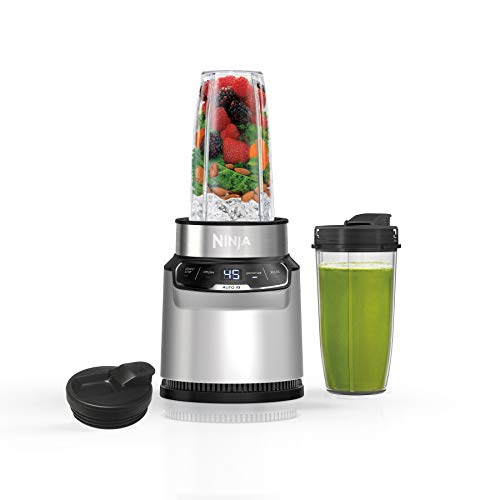
The Ninja Nutri-Blender Pro is built around a simple idea: most people ruin a personal smoothie in the first ten seconds by running the blades continuously while frozen chunks ride above them. Its Auto-iQ programs pulse, pause, and run in a pattern that pulls frozen fruit down into the blades, and with 1100 peak watts behind them, the result is a properly smooth drink from ingredients that stall lesser machines.
Strengths
- Auto-iQ programs automate the pulse-pause pattern frozen fruit needs
- 1100 peak-watt motor handles ice and frozen fruit confidently
- Two 24 oz cups with lids suit a standard individual serving
Trade-offs
- Programs are fixed — you follow Ninja’s timing rather than your own
- 24 oz cups are the ceiling; no larger option in the box
- Louder than the low-watt budget picks when working through ice
| Motor | 1100 peak watts |
| Programs | 2 Auto-iQ programs (per Amazon listing: smoothies, salsa and dips) |
| Cups included | (2) 24 oz to-go cups |
| Cleaning | Dishwasher-safe parts (per Amazon listing) |
Choose the BN401 if your smoothie formula starts in the freezer: frozen mango, frozen berries, a frozen banana, protein powder, and just enough liquid to get movement. The Auto-iQ smoothie program handles the stop-start work that a manual blender makes you do with a spoon and patience. Texture lands between a drink and a soft-serve when liquid is kept low, which is exactly what frozen-fruit fans want. The honest limitation is flexibility — the same automation that helps with frozen blends gives you less say over a delicate blend, and the 24-ounce ceiling means big appetites blend twice or step up to the nutribullet Pro+ above.
If a personal blend stalls, do not just keep holding the button — a stalled motor heats up and the smoothie does not improve. Stop, shake the sealed cup firmly twice, or open it and push the frozen plug down with a spoon, then blend again. Two ten-second bursts with a shake between them beat one forty-second grind for texture, for motor life, and for the seals on the cup.
Best for: frozen-fruit smoothie drinkers who want press-one-button results / Not suited for: tinkerers who want full manual control over every blend
Check on Amazon — check the current price on Amazon before you decide, since listings and included accessories change over time.
nutribullet Turbo Personal Blender NB50400, 1000W — Best Compact Power
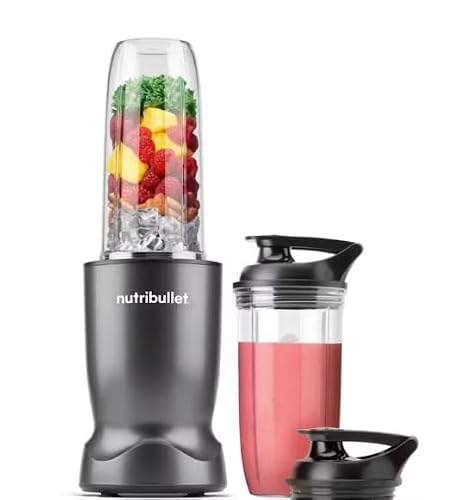
The nutribullet Turbo sits in the sweet spot for smaller kitchens: a 1000W motor that is comfortably strong enough for frozen fruit and greens, in a base that does not dominate the counter. The flip-top travel lids deserve specific mention — a lid you can drink from directly, that clicks shut and stays shut in a bag, is the difference between a smoothie you take with you and one you drink standing at the sink because the transfer cup was one dish too many.
Strengths
- 1000W motor covers frozen fruit, ice, and leafy greens for one serving
- Flip-top to-go lids are practical for commuting and gym bags
- 32 oz and 24 oz cups give a big and a standard option
Trade-offs
- No pulse button, so thick blends need a shake or a spatula pause
- Less headroom than the 1200W Pro+ for very dense, low-liquid blends
- Personal format only — no pitcher for sharing
| Motor | 1000W |
| Cups included | 32 oz cup and 24 oz cup |
| Lids | (2) flip-top travel to-go lids (per Amazon listing) |
| Use case (per Amazon listing) | Shakes, smoothies, food prep, frozen blending |
Think of the Turbo as the commuter’s blender. Blend in the 24-ounce cup, flip the blade base off, click the flip-top on, and the cup becomes the bottle — no decanting, no second container, one thing to wash at the office or at home that evening. The 1000W motor is honest power for this format: it will not match the Pro+ on a deliberately thick, low-liquid blend, but for the normal individual smoothie — fruit, greens, yogurt or milk, a scoop of powder — it finishes smooth and fast. Kitchens where the blender lives out on the counter benefit most, because the compact base is easy to leave in place, and a blender that stays out gets used.
For the smoothest individual result, give greens a head start. Blend the liquid and leafy greens alone for ten to fifteen seconds until the liquid is evenly green, then add fruit and frozen ingredients. Greens torn apart before the heavy fruit arrives cannot hide in flecks, and this one habit fixes most complaints about personal blenders leaving spinach confetti in an otherwise good smoothie.
Best for: commuters and small kitchens that want real power without a big base / Not suited for: anyone chasing the thickest possible smoothie-bowl texture
Check on Amazon — check the current price on Amazon before you decide, since listings and included accessories change over time.

Ninja Fit Compact Personal Blender QB3001SS, 700W — Best Budget
The Ninja Fit is the machine to buy when you are not yet sure the smoothie habit will stick. Its 700W base and pair of 16-ounce cups cover the classic beginner rotation — banana and berries, protein shakes after training, spinach hidden under mango — at the budget end of the category, in a footprint small enough for a dorm shelf or a crowded rental counter.
Strengths
- Budget-tier price positioning with a reputable blade design
- Two 16 oz cups with spout lids match a true single serving
- Compact base stores easily in small kitchens and dorms
Trade-offs
- 700W struggles with heavy ice loads and large frozen chunks
- 16 oz cups are small for meal-replacement smoothies with greens
- No programs or pulse finesse — simple push-down operation
| Motor | 700W |
| Cups included | (2) 16 oz to-go cups with spout lids |
| Cleaning | Dishwasher-safe parts (per Amazon listing) |
| Use case (per Amazon listing) | Smoothies, shakes and frozen drinks |
Set expectations correctly and the Fit is satisfying: fresh and lightly frozen ingredients blend smoothly, protein powder disappears completely, and the spout lids make the cups decent shaker-bottle replacements. Where it shows its tier is density — a cup packed with frozen fruit and minimal liquid will need a shake halfway, and ice crushing is a small-quantities game. That is a fair trade at this level, and it makes the Fit the honest recommendation for students, first apartments, and anyone whose smoothie is a supplement to breakfast rather than breakfast itself. If you outgrow it, you will know exactly which upgrade on this page fits, which is more than most first purchases teach you.
Cup hygiene is the quiet skill of personal blending. Rinse the cup and blade base immediately — thirty seconds under the tap now, or a soaking session later. If a blend sits, fill the cup with warm water and a drop of dish soap and run a five-second blend; the soapy vortex reaches the blade underside that sponges miss. Dry the blade base threads before storing, because trapped moisture in the threads is where old-smoothie smells are born.
Best for: beginners, students, and protein-shake drinkers on a budget / Not suited for: daily frozen-fruit smoothie makers who want a thick texture
Check on Amazon — check the current price on Amazon before you decide, since listings and included accessories change over time.

magic bullet Personal Blender MBR-1101, 250W — Best for Tiny Counters
The magic bullet is the machine that defined this category, and its modern listing keeps the same proposition: the smallest, simplest blender you can own, aimed at soft ingredients and small jobs. At 250W it is not pretending to be a frozen-fruit crusher. It is for the banana-and-milk smoothie, the protein shake, the quick salsa, the baby-soft puree in a cup — tasks where its size and simplicity are the entire point.
Strengths
- Smallest footprint here; lives happily in a drawer or tiny counter corner
- Simple push-down operation anyone can learn in one use
- Multiple cups included (per Amazon listing: 22 oz cup plus 3 to-go cups)
Trade-offs
- 250W is the weakest motor here — frozen fruit must be thawed or minimal
- Not suited to ice crushing beyond a cube or two in liquid
- Small capacity even by personal-blender standards
| Motor | 250W |
| Cups included | 22 oz cup; (3) to-go cups and (1) travel lid (per Amazon listing) |
| Cleaning | Dishwasher-safe parts (per Amazon listing) |
| Use case (per Amazon listing) | Smoothies, shakes and frozen drinks |
Judge the magic bullet as an appliance for soft work and it makes sense; judge it as a smoothie-bar machine and it will disappoint you, which is why it carries a specific badge rather than a general one. Its real strengths are storage and forgiveness: it fits where nothing else on this page fits, the cups double as storage containers, and the learning curve is zero, which matters in shared houses and offices. Let frozen strawberries sit on the counter for ten minutes while you do something else and it will blend them into a perfectly decent drink. Ask it to pulverize a cup of ice and you are asking the wrong tool — step up to the Ninja Fit at minimum, or the BN401 if ice is a daily habit.
Portion discipline keeps a personal blender honest. It is tempting to keep adding — another handful of berries, a bigger scoop — until the cup is over the max line, at which point the blend leaks, stalls, or both. Fill to the line, blend, and if you want more, drink some and top up. A personal blender rewards the recipe you can repeat identically every morning far more than the improvised giant that works once in three attempts.
Best for: tiny kitchens, offices, and soft-ingredient smoothie and shake drinkers / Not suited for: anyone whose smoothie starts with a freezer full of fruit and ice
Check on Amazon — check the current price on Amazon before you decide, since listings and included accessories change over time.

Ninja Blast Portable Blender BC151BK, Cordless, 18 oz — Best Cordless
The Ninja Blast removes the counter from the equation entirely. It is a cordless, rechargeable 18-ounce vessel with the blade built into the base, charged over USB-C, that blends where you are: at a desk between meetings, in a dorm room where outlets are contested territory, or in a gym bag for a post-workout shake mixed on the spot rather than carried warm for three hours.
Strengths
- Fully cordless with USB-C recharging — blends anywhere
- Leakproof sip lid makes the vessel itself the drinking bottle
- Crushes ice and frozen fruit within its portable class (per Amazon listing)
Trade-offs
- Battery power cannot match a corded 1000W+ base on dense blends
- 18 oz capacity is one modest serving, with no second cup in play
- You must remember to charge it; a flat battery means no smoothie
| Format | Cordless portable blender |
| Capacity | 18 oz vessel |
| Charging | USB-C rechargeable |
| Cleaning | Dishwasher-safe parts; leakproof design (per Amazon listing) |
The Blast’s value is timing. A protein shake blended at the gym, thirty seconds after a workout, tastes like a different product from the same shake blended at home and carried in a warm bag — and fresh blending also means greens and banana go in at their best instead of oxidizing in transit. Within its class the performance is credible: soft fruit, protein powder, milk or water, and a few ice cubes come together properly, and the vessel rinses in seconds. Be honest about the ceiling, though: a frozen-fruit-heavy, low-liquid blend is corded-blender work. Many owners end up pairing a Blast for away-from-home with one of the corded picks above for the kitchen, which is a legitimate two-machine answer to a one-person problem.
Frozen ingredients behave better slightly managed. Banana frozen in chunks rather than whole, berries spread flat in a freezer bag so they do not fuse into one iceberg, and a splash of liquid over the top before blending all shorten the blend and smooth the result. None of this is fussiness for its own sake — it is the difference between a ninety-second morning routine and a five-minute wrestling match you eventually stop bothering with.
Best for: desk workers, students, travelers, and gym-goers who blend away from a kitchen / Not suited for: anyone wanting one machine to handle thick frozen blends daily
Check on Amazon — check the current price on Amazon before you decide, since listings and included accessories change over time.
Comparison Table
| Pick | Badge | Key spec | Best for |
|---|---|---|---|
| nutribullet Pro+ Personal Blender N12-1001MK, 1200W | Best Overall | 1200W; 32 oz + 24 oz cups; pulse | Everyday one-person smoothies with frozen ingredients |
| Ninja Nutri-Blender Pro BN401 with Auto-iQ, 1100 Peak Watts | Best for Frozen Fruit | 1100 peak W; Auto-iQ; (2) 24 oz cups | Mostly-frozen individual smoothies |
| nutribullet Turbo Personal Blender NB50400, 1000W | Best Compact Power | 1000W; 32 oz + 24 oz cups; flip-top lids | Blend-and-go weekday routines |
| Ninja Fit Compact Personal Blender QB3001SS, 700W | Best Budget | 700W; (2) 16 oz cups | First personal blender; shakes and lighter smoothies |
| magic bullet Personal Blender MBR-1101, 250W | Best for Tiny Counters | 250W; 22 oz cup + to-go cups | Soft smoothies, shakes, small prep in tiny spaces |
| Ninja Blast Portable Blender BC151BK, Cordless, 18 oz | Best Cordless | Cordless; 18 oz; USB-C | Smoothies and shakes away from home |
Read the table by lifestyle first and motor second. The daily frozen-fruit maker and the desk-bound shake drinker are both buying an ‘individual smoothie blender,’ but they need almost opposite machines: one needs watts and cup volume, the other needs a battery and a lid that seals. Every pick here is good at its stated job; the mistakes happen when a machine is bought for a job it never claimed to do.
How to Choose the Best Blenders for Individual Smoothies
Start with your actual serving size, because it decides the cup you need. A light smoothie — fruit, yogurt, milk — is typically 12 to 16 ounces and fits any cup on this page. A meal smoothie with greens, oats, nut butter, and protein is 20 to 32 ounces once blended, and that pushes you to the nutribullet models with 32-ounce cups or to blending in two rounds. Buying a 16-ounce machine for a 24-ounce habit is the most common sizing error in this category, and no motor upgrade fixes it.
Next, be honest about frozen ingredients. Fresh fruit and protein powder ask almost nothing of a motor; frozen fruit and ice ask everything. As a working rule from the picks above: under about 700W, plan on thawing frozen fruit briefly or keeping frozen portions small; around 1000W and above, frozen-first smoothies become routine. Peak-watt marketing inflates this picture, so weigh the cup system and programs alongside the number — the BN401’s Auto-iQ pattern gets more from its watts than a simple push-down base gets from the same figure.
Cups, Lids, and the Daily Routine
The cup system is the product, in a real sense. Look for: at least two cups if the blender is a daily driver, so one can be in the dishwasher; a drinking lid you would actually use — flip-top and spout lids both work, and the better one is the one that seals in a bag; and threads and gaskets that rinse without trapping residue. A blender whose cup you dislike drinking from adds a glass to every smoothie, and small frictions like that are what quietly end routines.
Noise and footprint deserve a thought if you blend early. Personal blenders are loud in short bursts — there is no quiet option in this class, only shorter blends. A compact base that stays on the counter gets used more than a stronger one stored in a high cupboard, which is why the Turbo and the magic bullet earn their places despite not topping the power chart. Dorm and office users should go straight to the cordless Blast and accept its texture ceiling as the price of total freedom from outlets and bases.
What Individual Blenders Cannot Do
A personal blender is a specialist, and knowing its limits prevents the two classic disappointments. It cannot blend hot liquids — the sealed cup has no vent, pressure builds, and manufacturers exclude it for good reason; soup people need a pitcher blender or an immersion blender. And it cannot serve a crowd: three guests means three sequential blends and three rinses, at which point a 64-ounce pitcher machine is simply the right tool. Neither limit is a flaw. They are the trade you make for a one-minute cleanup and a cup that is also the glass.
Budget tiers in this category are honest if you read them correctly. The budget tier (the Ninja Fit and magic bullet) buys you soft and lightly frozen blending with real convenience. The mid tier buys frozen-fruit confidence and better lids. The upper tier buys the strongest motors, pulse control, and the cup capacity for meal-size smoothies. What extra money never buys in this category is a fundamentally different drink — it buys reliability on the hard days: the fully frozen banana, the low-liquid thick blend, the morning you are in a hurry and cannot nurse a stall.
A note on noise and neighbors, because personal blenders are morning machines and mornings have other people in them. Every pick here is loud for under a minute — there is no silent way to pulverize frozen fruit — but the routine can be considerate: blend with the cup fully seated (a rattling cup is half the noise), keep blends to the two-burst pattern rather than one long grind, and, in the thinnest-walled apartments, close the kitchen door for the forty seconds it takes. The cordless Blast, blending at a desk or in another room entirely, is the diplomatic option for the earliest risers. None of this should decide the purchase, but all of it decides whether the purchase stays welcome in a shared home.
How to Use a Personal Blender for a Perfect Individual Smoothie
This routine takes about ninety seconds once it is habit, and it is written for any personal blender on this page, corded or cordless.
- Add liquid first — milk, yogurt drink, juice, or water — up to roughly a third of the cup. Liquid first is what lets the vortex form.
- Add powders, nut butter, and soft ingredients next: protein powder, oats, yogurt, fresh banana. Powders go in wet surroundings so they do not cake on the walls.
- Add leafy greens, torn into smaller pieces, and press them gently into the liquid.
- Add frozen fruit and ice last, keeping total contents at or below the cup’s max line. Overfilling is the main cause of leaks and stalls.
- Seal the blade base firmly, invert the cup onto the base (or close the cordless vessel), and blend in bursts: 10–15 seconds, pause, shake if needed, then blend again until no chunks ride the surface.
- For the smoothest result, use the two-stage trick: blend liquid and greens alone for 10 seconds first, then add the rest and finish.
- Swap the blade base for the drinking lid immediately, rinse the blade base under the tap while it is still wet, and you are done — total washing: one blade base, later one cup.
Troubleshooting follows from the steps. Leaking almost always means an overfilled cup or a gasket that needs reseating — check both before blaming the machine. A burning smell on a new machine during a heavy frozen blend means the motor is working at its limit; stop, add a splash of liquid, and use shorter bursts. Grittiness with berries usually means the blend was too short rather than too weak: give seeds another twenty seconds and they largely disappear on the stronger machines here.
If your first week with a personal blender disappoints, debug in this order before blaming the machine: liquid quantity first (too little is the most common cause of stalls and grit), load order second (frozen last, always), piece size third (banana in chunks, not bricks), and blend time fourth (two bursts with a shake beat one long run). Change one variable per morning and the routine converges within the week. Personal blending is a small skill, and like most small skills it feels like the equipment’s fault for exactly as long as it takes to learn it — about five smoothies.
Personal Blenders and the Rest of Breakfast
A personal blender quietly takes over more than smoothies once it lives on the counter. The same cup that blends your morning drink purees a single serving of soup (cooled first — remember the sealed-cup rule), whips a pancake batter for one, emulsifies a salad dressing in the exact quantity a week of salads needs, and grinds a small batch of oat flour or breadcrumbs without hauling out a food processor. None of these jobs justifies the purchase alone, but together they explain why personal blenders, once adopted, so rarely leave the counter: the machine is sized to the way one person actually cooks, in single servings, repeatedly.
There is also a sustainability angle worth stating plainly. A personal blender uses a fraction of the water and time to wash that a pitcher demands, and a smoothie made at home in a reusable cup replaces a café drink in a disposable one several times a week. The greenest machine on this page is whichever one you keep using for years — which loops back to the real selection criterion of this entire guide: buy the cup system and routine you will still enjoy in year two, and the environmental and financial math takes care of itself.
Common Buying Mistakes
Mistake one: buying by wattage alone. A 1200W base with a cup you hate drinking from loses to a 700W base whose routine you love, every weekday of the year. Specs matter after the cup system fits your life, not before.
Mistake two: filling past the max line because ‘it will blend down.’ It blends down after it leaks, stalls, and coats the base threads. The line is a functional limit, not a suggestion, and respecting it also protects the gasket that keeps your gym bag dry.
Mistake three: treating a personal blender like a food processor. Thick doughs, dry grinding, and hot soup are other machines’ jobs. The personal blender’s sealed, narrow cup is brilliant for drinks and poor at everything that needs air, venting, or a wide working surface.
Mistake four: letting blends sit unwashed. Dried smoothie in blade threads and gaskets is the top cause of mystery odors and, eventually, leaks. The immediate rinse is a ten-second habit that doubles the pleasant life of the machine — and it is the entire reason this category exists.
Mistake five: ignoring replacement parts when buying. Cups crack, gaskets flatten, and blade bases dull — in a daily-use personal blender these are consumables, not defects. Before buying, confirm that replacement cups and gaskets for your model are actually sold and easy to order. A machine whose cups cannot be replaced becomes landfill the first time one drops on tile, while a machine with a healthy parts ecosystem can run for many years on small, cheap renewals.
Final Recommendation
For most people, the nutribullet Pro+ is the answer: the strongest motor here, a pulse button, and cups in both useful sizes. It is the machine least likely to be outgrown. If your smoothies start from frozen fruit and you want the machine to manage the process, the Ninja BN401’s Auto-iQ programs are the smarter buy, and if your smoothie happens at a desk or a gym rather than a kitchen, no corded machine competes with the Ninja Blast.
On a budget, the Ninja Fit covers the honest basics and teaches you what you actually need; the magic bullet remains the tiny-counter specialist for soft blends. Every pick here was verified against Amazon listing — check price on Amazon, confirm the cup set in the box, and buy the machine that matches the smoothie you really make, not the one you make twice a year.
One last practical note: buy the second cup before you think you need it. The entire personal-blender routine depends on a clean cup being ready when you are half awake; the morning you face a dirty cup in the sink and a meeting in forty minutes is the morning the habit wobbles. Every pick here either includes two cups or has them readily available — treat that not as an accessory question but as the core of the system you are buying.
Warranty and support, briefly, because daily-use appliances earn their keep over years: the major brands on this page all maintain real parts and service ecosystems, and that — more than any single feature — is what separates a five-year machine from a two-year one. Register the product, keep the receipt with the manual, and note the model number somewhere you will find it when a cup cracks in year three. It is unglamorous advice, and it is the difference between a blender that is a fixture and one that was a phase.
Start with the all-rounder: the nutribullet Pro+ covers the widest range of individual smoothies without a weakness that matters daily.
Prefer automatic programs for frozen fruit? The Ninja Nutri-Blender Pro BN401 is the press-and-walk-away option.
Blending away from the kitchen? The Ninja Blast is the only pick here that needs no counter and no outlet.
Keep exploring the shortlist: Best Blenders For Individual Servings Best Blenders For Kale Smoothies Best Blenders For Leafy Green Smoothies Best Blenders For Frozen Fruit Smoothies Best Blenders For Making Daiquiris.
Frequently Asked Questions
How big should a cup be for an individual smoothie?
For a light fruit smoothie, 16 to 20 ounces is plenty. For a meal smoothie with greens, oats, nut butter, and protein, choose a 24 to 32 ounce cup, because ingredients blend up in volume and you need headroom below the max line. When in doubt, size up: a bigger cup blends a small smoothie fine, but a small cup cannot blend a big one at all.
Can a personal blender crush ice?
The stronger models here — around 1000W and up — crush a few cubes in liquid without drama, and the Ninja BN401 is built for frozen work. The budget and mini models should treat ice as an occasional one-or-two-cube ingredient, not a base. No personal blender matches a full-size pitcher machine for sustained ice crushing.
Why does my personal blender leak?
Almost always one of three causes: the cup is filled past its max line, the blade base is not fully tightened, or the gasket is worn, twisted, or has dried residue on its sealing surface. Clean the gasket and threads, reseat the gasket flat, respect the fill line, and most leaks stop. Replacement gaskets are inexpensive when wear is the real cause.
Are personal blenders good for green smoothies?
Yes, with the right technique and enough motor. Blend liquid and greens alone first for ten seconds, then add fruit. Models around 1000W and above — the Pro+, the BN401, the Turbo — produce genuinely smooth green smoothies; the smallest models leave flecks unless greens are soft and portions modest. The kale and leafy-green guides in this series go deeper on fibrous greens specifically.
Can I blend hot soup in a personal blender?
No. Personal blender cups are sealed, and hot liquid creates pressure with nowhere to go, which is both a mess and a safety problem. Let soup cool substantially before any blending, or use a vented pitcher blender or an immersion blender in the pot. This is a hard limit of the format, not of any particular brand.
How long do personal blenders last?
The motor bases typically outlast the cups and gaskets, which are the wear parts — gaskets flatten and cup threads wear with daily use. Rinsing immediately, not overfilling, and not running long continuous blends on frozen loads all extend life. Expect the consumable parts, not the motor, to define the machine’s lifespan, and factor replacement cup availability into a daily-driver purchase.


