Disclosure: airfryerkitchensupply.com is reader-supported. When you buy through links on our site, we may earn an affiliate commission at no extra cost to you.
Where to buy
Every pick in this guide to the best large teapots is a real model sold on Amazon, and every one was verified against Amazon’s own catalog before it earned a place here. Capacities quoted are the ones stated in each verified listing. Use the links in this box to check the current price on Amazon for each one:
- Ehugos 1500ml (50 oz) Glass Teapot with Removable Infuser — Check the current price on Amazon
- Steinzeit Design Ceramic Teapot with Infuser, 44 oz, Black — Check the current price on Amazon
- London Pottery Farmhouse 4 Cup Ceramic Teapot with Infuser, 40.6 oz / 1200 ml — Check the current price on Amazon
- Teabloom Stovetop & Microwave Safe Glass Teapot, 40 oz — Check the current price on Amazon
- Primula Half Moon Teapot with Removable Infuser, 40 oz — Check the current price on Amazon
- HVH 40 oz Porcelain Teapot with Stainless Steel Infuser, Wabi Sabi Striped — Check the current price on Amazon
Teapot listings blur two things constantly: brim capacity versus sensible brewing capacity, and one silhouette sold in three sizes. Use the exact model links above and the size and material reviewed below are the size and material that arrive.
What ‘Large’ Really Means When You Brew for a Table
Shopping for the best large teapots starts with a translation problem: ‘large’ on a listing can mean anything from a generous four-cup pot to a catering vessel, and the number printed is usually the brim capacity — what the pot holds filled to the rim, not what it brews gracefully with room for leaves to move and water to pour without sloshing. As a working rule, a large teapot for home use starts around 40 ounces, serves four to six ordinary mugs across a sitting, and should be shopped by its usable capacity, which is roughly a mug less than the headline figure. Every pick in this guide is at or near that 40-ounce line or well above it, with the capacity taken from its verified listing rather than from marketing copy.
Size changes everything else about a teapot. A large pot is heavy when full — water alone in a 50-ounce pot weighs over three pounds before the vessel’s own weight — so handle design, balance, and lid security stop being aesthetic details and become safety features. Heat retention matters more too, because a big pot is usually brewed to be poured from over twenty or thirty minutes, not emptied at once; glass shows you the brew but surrenders heat fastest, ceramic holds a middle course, and thick porcelain and stoneware-style bodies keep a second round of pours honest. The infuser question also scales: a large pot with a small, cramped infuser basket strangles the very leaf expansion that makes loose-leaf tea worth brewing.
This guide therefore judges large teapots as serving tools, not just brewing vessels. Each pick was verified in Amazon’s catalog, and each review weighs capacity against pour control, infuser room, material behavior over a long table session, and the unglamorous question of whether the pot is pleasant to wash afterward. Whether your large-pot life is a family breakfast table, a book club, an office kitchen, or a slow Sunday with one person refilling a mug all morning, one of the six below is built for your version of ‘large.’
In this guide
Quick Picks
Six verified large teapots, ordered by the kind of table each one serves best — and each badge reappears where that pot’s full review begins.
- Ehugos 1500ml (50 oz) Glass Teapot with Removable Infuser — Best Overall Large. The largest verified pot in this guide at 1500 ml / 50 oz, in stovetop-safe glass with a stainless infuser — the pick for tables that empty a big pot and for blooming teas that deserve an audience. — Check price on Amazon
- Steinzeit Design Ceramic Teapot with Infuser, 44 oz, Black — Best Ceramic for Heat Retention. A 44-ounce premium ceramic pot with a removable strainer, in black — the pick for drinkers who pour slowly over a long morning and want the last mug to taste like the first. — Check price on Amazon
- London Pottery Farmhouse 4 Cup Ceramic Teapot with Infuser, 40.6 oz / 1200 ml — Best Traditional Farmhouse Pot. A classic farmhouse ceramic pot at 40.6 oz / 1200 ml with a stainless fine-mesh strainer — the traditionalist’s large pot, built for loose leaf or bags and finished in cheerful yellow. — Check price on Amazon
- Teabloom Stovetop & Microwave Safe Glass Teapot, 40 oz — Best Glass for Blooming Tea. A 40-ounce glass teapot and kettle in one — stovetop and microwave safe per the listing, with a removable glass infuser and two blooming teas included to start the ritual immediately. — Check price on Amazon
- Primula Half Moon Teapot with Removable Infuser, 40 oz — Best Easy-Clean Glass. A 40-ounce glass tea maker with a reusable fine-mesh stainless filter and a dishwasher-safe listing claim — the practical glass pick for households that brew often and wash without ceremony. — Check price on Amazon
- HVH 40 oz Porcelain Teapot with Stainless Steel Infuser, Wabi Sabi Striped — Best Porcelain with Character. A 40-ounce porcelain pot with a stainless infuser and a wabi-sabi striped finish, sized by its listing for six cups — the characterful pick for tables where the pot stays out and gets looked at. — Check price on Amazon
How These Picks Were Chosen
Verification here followed the house method with a size twist: each pot was located in Amazon’s catalog through the site’s product-verification system, its listing title was matched to the exact model under review, and the capacity printed in this guide was lifted from that matched title — 1500 ml on the largest pick, 44 ounces on the ceramic pick, 40.6 ounces on the farmhouse pick, and 40 ounces on the three remaining picks. That discipline matters in this category because teapot listings are notorious for size drift: the same product family often spans three capacities, and a review written against the wrong size is worse than no review. If a pot could not be matched with certainty at a genuinely large size, it was left out.
Selection then weighed five things. True usable capacity came first — all six picks sit at the large end of home teapots, not at the ‘large for one person’ end. Infuser design came second: every pick includes a removable infuser per its listing, and preference went to baskets with room for leaves to expand in a full pot. Third was pour behavior at full weight — spout and handle geometry as described by design and form, since a large pot that dribbles or strains the wrist fails its only job. Fourth was material honesty: glass, ceramic, and porcelain each got represented, with their real heat and fragility trade-offs stated rather than smoothed over. Fifth was cleaning: large pots that cannot fit a hand or a brush inside, or whose infusers trap leaves, were marked down in the trade-offs even when their brewing credentials were strong.
What did not decide the picks: decorative novelty, matching-set bundling, and any form of popularity measure. A large teapot is infrastructure for a ritual — it should brew well at volume, pour without drama, and still be earning its cupboard space in five years. The six below span glass, ceramic, and porcelain, and span the large category from its 40-ounce threshold to its 50-ounce home maximum, so the choice is about your table, not about which pot is ‘best’ in the abstract.
The 6 Best Large Teapots, Reviewed
Capacities below are quoted exactly as the verified listings state them — never rounded up, never translated into optimism. Each pot’s review lays out its ideal table and its wrong one, three strengths against three trade-offs, the listing-confirmed specs in a small box, and a verdict in a single line.

Ehugos 1500ml (50 oz) Glass Teapot with Removable Infuser — Best Overall Large
The Ehugos is for hosts whose tea service is measured in rounds: family tables, club meetings, and anyone who brews blooming teas and wants the unfurling visible to the whole table. Its stovetop-safe listing claim also suits brewers who like to keep a pot warm directly. If your household drinks two mugs and stops, a 50-ounce pot is mostly a washing burden — the 40-ounce picks below fit your life better and forgive more easily.
Strengths
- The largest capacity in this guide — 1500 ml / 50 oz per the verified listing — which is a true six-mug session without a refill kettle trip
- Stovetop-safe glass per the listing, so the pot can warm or re-warm directly instead of only receiving water
- Glass body turns blooming and loose-leaf brewing into a visual event and lets you judge brew strength by color at a glance
Trade-offs
- Glass is the most fragile material here and loses heat fastest; a long, slow table will notice the last pours cooling
- Full, it is the heaviest pour in the guide — water plus glass asks for a two-handed, confident lift, which not every user wants
- Hand-crafted glass rewards gentle handling and hand washing habits; it is not the pot for a chaotic shared kitchen
| Capacity | 1500 ml / 50 oz (listing) |
| Material | Glass, stovetop safe (listing claim) |
| Infuser | Removable, stainless (listing) |
Fifty ounces is the point where a teapot stops being a personal brewer and becomes table infrastructure, and the Ehugos is designed like it knows that. The stainless infuser matters at this scale: a small basket in a big pot produces weak, uneven tea because the leaves cannot circulate, while a properly sized removable basket lets a full charge of leaf open up and then lifts out cleanly so the second half of the pot does not stew into bitterness while the table talks. That lift-out moment, halfway through a gathering, is where large-pot brewing is won or lost, and a removable infuser is the mechanism that wins it.
The stovetop-safe claim, stated in the verified listing, changes how the pot can live in a kitchen. Most glass teapots are strictly receivers — kettle boils elsewhere, pot holds and cools. A stovetop-safe pot can be kept at drinking warmth through a long session and can re-warm the last third instead of surrendering it to the microwave. Respect the material anyway: glass and sudden temperature shocks are enemies, so warm the pot with a rinse of hot water before a full boil-temperature fill, and let it cool before cold water hits it in the sink. Treated with that much sense, it is the guide’s most capable large pot.
Best for: Hosts brewing for four to six people, blooming-tea drinkers, and anyone who wants one pot for the whole session / Not suited for: Small households, butterfingered shared kitchens, or anyone who hates hand-washing
Check on Amazon — check the current price on Amazon, confirming the size variant matches the capacity reviewed here.
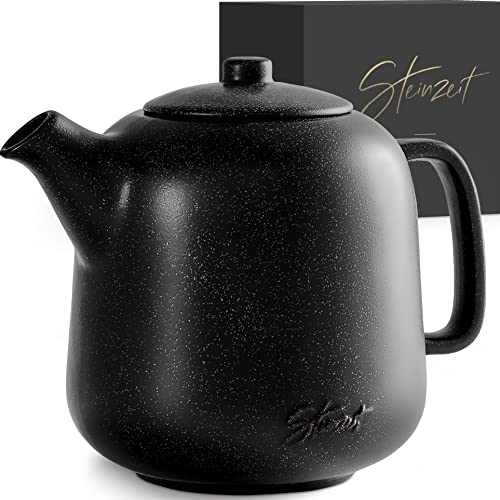
Steinzeit Design Ceramic Teapot with Infuser, 44 oz, Black — Best Ceramic for Heat Retention
The Steinzeit suits the slow-session drinker: one person working through a pot over a long morning, or two people over a lingering breakfast, where the tea must stay hot and unstewed across an hour. Ceramic’s heat retention is its whole argument. If you love watching a brew develop or serve blooming teas, glass serves you better; if your table empties a pot in ten minutes, retention is a feature you will never notice and the larger glass pick gives you more tea instead.
Strengths
- Ceramic body holds heat noticeably longer than glass across a slow session — the core reason to choose it at this size
- 44 oz capacity per the listing is the sweet spot for two committed drinkers or four ordinary mugs
- Removable strainer per the listing lets you lift the leaves out mid-session so a long pot does not over-steep
Trade-offs
- Opaque body: brew strength must be judged by time and experience, not by eye
- Ceramic chips if it meets tile or a farmhouse sink at the wrong angle, and black glaze shows every chip and water mark honestly
- Heavier in the hand than a glass pot of similar capacity, especially full
| Capacity | 44 oz (listing) |
| Material | Ceramic (listing) |
| Infuser | Removable strainer (listing) |
| Color | Black (listing) |
Heat retention is an unglamorous specification that decides whether a large teapot actually works as a large teapot. The entire point of brewing 44 ounces at once is to pour it over time; a pot that lets the tea fall lukewarm by the third mug has quietly converted your large pot into a medium pot with extra washing. Ceramic’s thermal mass is the straightforward fix, and it pairs with the removable strainer to solve the large pot’s second problem, over-steeping: leaves out at the right moment, heat held by the walls, and the session proceeds on your schedule instead of the tea’s.
The black, design-led presentation is not decoration for its own sake either. A pot that lives on a counter or a table between sessions — as large pots tend to, being too big for many cupboards — should look intentional in the room, and this one’s matte, modern profile does that in a way a purely utilitarian pot does not. It is the pick in this guide most likely to become a fixture rather than a stored tool, which for a daily ritual object is a genuine quality, not a vanity.
Best for: Slow solo sessions and couples who pour over an hour and want ceramic heat retention at a true large size / Not suited for: Blooming-tea drinkers and anyone who judges strength by color
Check on Amazon — check the current price on Amazon, confirming the size variant matches the capacity reviewed here.

London Pottery Farmhouse 4 Cup Ceramic Teapot with Infuser, 40.6 oz / 1200 ml — Best Traditional Farmhouse Pot
The London Pottery Farmhouse suits drinkers whose tea ritual is traditional: strong loose leaf or bags, milk likely, a pot that looks like a teapot has always looked. The fine-mesh stainless strainer makes it the strongest pick here for fine-cut teas that escape coarser baskets. If your taste runs modern-minimal, its farmhouse styling will feel like a costume; if you brew for six at a time, its 40.6 ounces is the floor of large, not the ceiling, and the 50-ounce pick serves you better.
Strengths
- Stainless steel fine-mesh strainer per the listing — the best leaf containment in this guide for fine teas and rooibos-style cuts
- Ceramic farmhouse body holds heat well and pours with the balanced feel a heritage potter’s shape refines over decades
- Works for loose tea or bags per the listing, so households split between the two are not forced into one ritual
Trade-offs
- At 40.6 oz it is large, not extra-large — big gatherings will still need a second brew
- Ceramic plus a colored glaze asks for hand-washing care to keep the finish at its best
- The traditional shape takes real cupboard width; it is not a slim, apartment-shelf pot
| Capacity | 40.6 oz / 1200 ml, 4 cup (listing) |
| Material | Ceramic (listing) |
| Infuser | Stainless steel fine mesh strainer, removable (listing) |
There is a reason the farmhouse teapot shape has survived essentially unchanged: the geometry works. A round belly gives leaves room and water circulation, the spout rises from low on the body so the pot pours completely without acrobatics, and the handle balances a full pot against the wrist instead of fighting it. London Pottery’s version adds the modern necessity — a fitted, fine-mesh stainless strainer — without disturbing the formula, and fine mesh is not a pedantic detail. Anyone who has poured a cup full of rooibos needles through a coarse basket understands that strainer quality is tea quality.
The 4-cup designation in the listing deserves translation, because teapot ‘cups’ are not mugs. Four teacups is roughly three generous mugs or four modest ones, which makes this the right large pot for a household table rather than an event. Buyers who routinely serve five or six mug-drinkers should read that honestly and step up in size; buyers whose ‘large’ means the family breakfast will find this pot sized exactly to their real life, with heat retention and straining quality the bigger glass pick cannot match.
Best for: Traditional tea households, fine-leaf and rooibos drinkers, and family breakfast tables / Not suited for: Six-mug gatherings or modern-minimal kitchens
Check on Amazon — check the current price on Amazon, confirming the size variant matches the capacity reviewed here.

Teabloom Stovetop & Microwave Safe Glass Teapot, 40 oz — Best Glass for Blooming Tea
The Teabloom suits the visual brewer: blooming-tea devotees, hosts who serve tea as a small ceremony, and kitchens short on storage where one vessel that both heats and brews earns its place. The included blooming teas make it the most gift-ready pick in this guide. If your priority is heat retention over a long session, ceramic beats it plainly; if you are rough on glass, its elegance will be short-lived.
Strengths
- Two-in-one design per the listing — stovetop and microwave safe, so it heats water and brews in a single vessel
- Removable glass infuser keeps the all-glass aesthetic unbroken, with no metal visible in the brew
- Includes two blooming teas per the listing, so the signature use case can be tried the day it arrives
Trade-offs
- Glass infusers have larger effective openings than fine mesh — the finest-cut teas can slip through where the London Pottery’s steel mesh would hold them
- Heat retention is glass-typical: plan to pour within a comfortable window or re-warm, which its stovetop safety at least makes easy
- At 40 oz it matches the guide’s large threshold rather than exceeding it — true crowds need the 50 oz pick
| Capacity | 40 oz (listing) |
| Material | Glass, stovetop & microwave safe (listing claim) |
| Infuser | Removable glass infuser (listing) |
| Included | 2 blooming teas (listing) |
Teabloom built its name on blooming tea, and this pot is that specialty generalized into a full-size brewer. The design insight is the glass infuser: a metal basket in a glass pot interrupts the very transparency you bought glass for, while a glass basket keeps the unfurling flower or the swirling leaves visually continuous. For the drinker who serves tea to guests as an experience — and at 40 ounces, this pot serves four — that continuity is the product, as much as the beverage is.
The two-in-one kettle-and-maker claim, stated plainly in the verified listing, has a practical consequence beyond novelty: fewer vessels to wash and store, and a re-warm path that does not involve a microwave-safe transfer or a second kettle boil. A 40-ounce pot that cools before the table finishes can simply go back to gentle heat. That closes the glass pot’s traditional weakness — cooling — with process rather than insulation, and for many households it closes it completely.
Best for: Blooming-tea lovers, ceremonial hosts, and small kitchens that value a heat-and-brew single vessel / Not suited for: Fine-cut tea drinkers needing mesh-level straining, or long slow sessions without re-warming
Check on Amazon — check the current price on Amazon, confirming the size variant matches the capacity reviewed here.
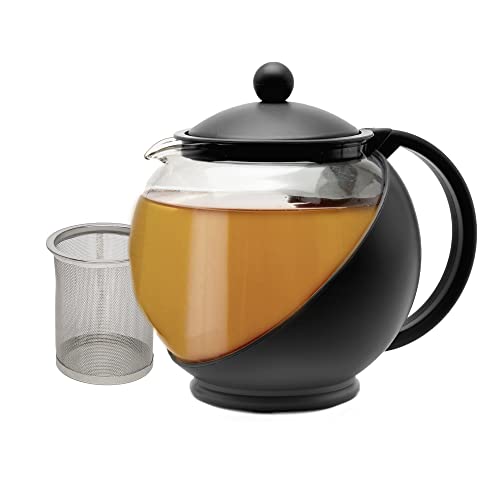
Primula Half Moon Teapot with Removable Infuser, 40 oz — Best Easy-Clean Glass
The Primula suits frequent brewers who love glass but live real lives: daily loose-leaf drinkers, shared households, and offices where a pot that can go in the dishwasher per its listing will actually get cleaned properly instead of ‘later.’ The fine-mesh filter covers fine teas better than glass infusers do. If your tea ritual is a slow, heat-critical session, ceramic still wins; if you want the visual drama of an all-glass infuser, the Teabloom is prettier about it.
Strengths
- Dishwasher safe per the verified listing — a rare, practical claim among glass teapots and the reason it earns its badge
- Reusable fine-mesh stainless steel filter per the listing handles fine-cut teas that escape glass infusers
- 40 oz glass body still shows brew color and strength, keeping glass’s main advantage intact
Trade-offs
- The half-moon design prioritizes function over ceremony; it looks like a tool, not a centerpiece
- Glass heat retention limits long sessions, as with every glass pick here
- Fine-mesh filters need a rinse-and-shake habit to keep from clogging with fine leaf dust over time
| Capacity | 40 oz (listing) |
| Material | Glass (listing) |
| Infuser | Removable, fine mesh stainless steel, reusable (listing) |
| Care | Dishwasher safe (listing claim) |
Cleanup is the hidden variable in teapot ownership: pots that are annoying to wash get brewed in less, rinsed late, and slowly seasoned with stale tea oils that flavor everything after. The Primula’s dishwasher-safe listing claim attacks that variable directly. A 40-ounce glass pot that can simply go in the machine after a session — and whose fine-mesh filter is reusable rather than disposable — is a pot designed for Tuesday mornings, not just Sunday ceremonies, and Tuesday mornings are where tea habits actually live.
It also makes the smart material pairing inside the glass family: glass where glass helps (the body, for visibility) and stainless fine mesh where mesh helps (the filter, for containment). That is the opposite of aesthetic purism and the better engineering for it. Households that brew a large pot daily — the exact people a large-teapot guide serves — will get more cumulative pleasure from this pot’s washability than from any marginal gain in ceremony, and its 40-ounce size keeps it on the right side of the large line without the wrist load of the 50-ounce pick.
Best for: Daily large-pot brewers who want glass visibility with dishwasher-easy cleanup and fine-mesh straining / Not suited for: Centerpiece seekers or heat-critical slow sessions
Check on Amazon — check the current price on Amazon, confirming the size variant matches the capacity reviewed here.
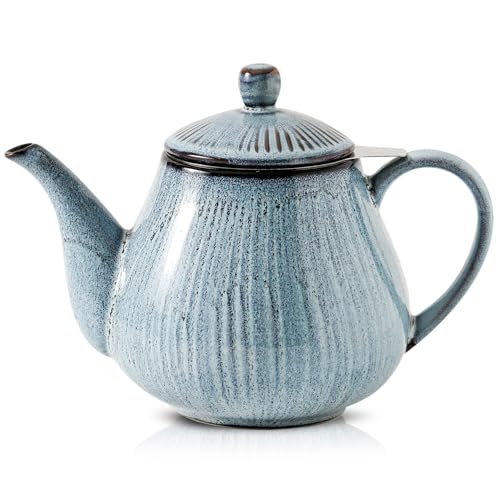
HVH 40 oz Porcelain Teapot with Stainless Steel Infuser, Wabi Sabi Striped — Best Porcelain with Character
The HVH suits drinkers who want porcelain’s clean taste and heat behavior in a pot with visible personality: the wabi-sabi striped finish makes each pot a table object, not an appliance. Its listing sizes it at six cups, the generous end of the 40-ounce class. If you need verified stovetop use or dishwasher claims, other picks state them and this one does not; if you brew the finest-cut teas, check the steel infuser’s mesh against your leaf, since the listing does not call it fine mesh.
Strengths
- Porcelain body: non-reactive, taste-neutral, and a step up in heat behavior and surface hardness from ordinary ceramic
- 40 oz capacity sized for six cups per the listing — honest large-pot territory for a group
- Stainless steel infuser per the listing keeps loose-leaf brewing straightforward and the pot easy to empty
Trade-offs
- The listing makes no stovetop or dishwasher claim, so treat it as a receiver pot and hand-wash it to protect the striped finish
- Wabi-sabi styling is a deliberate aesthetic — perfection-seekers may read its irregularity as flaws rather than character
- Porcelain at this size is still breakable and has real heft when full
| Capacity | 40 oz, 6 cups (listing) |
| Material | Porcelain (listing) |
| Infuser | Stainless steel (listing) |
| Finish | Striped series, Wabi sabi (listing) |
Porcelain is the connoisseur’s default for a reason that has nothing to do with fashion: it is fully vitrified, so it does not absorb flavors between a Monday lapsang and a Tuesday jasmine the way more porous bodies can, and its hard glaze releases tea oils with a simple rinse. In a large pot — where more surface meets more tea for longer — that neutrality compounds. The HVH pairs it with a stainless infuser and a six-cup brief, which makes it the quiet technician of this guide: the pot whose brews taste like the leaf, session after session.
The wabi-sabi striped finish then does the other job a large pot must do: justify its presence on the table. Large pots are seen more than small ones — they sit through the whole gathering — and a finish with intentional irregularity reads as crafted rather than manufactured. For the host whose tea service is part of how their home feels, that matters, and it costs nothing in function. Choose it when you want the 40-ounce class’s most tasteful balance of neutrality, capacity, and looks.
Best for: Varied-leaf drinkers who want porcelain neutrality at group size, in a pot with table presence / Not suited for: Anyone needing a stated stovetop or dishwasher claim
Check on Amazon — check the current price on Amazon, confirming the size variant matches the capacity reviewed here.
Comparison Table
The six large picks side by side. The real decision is material and session style: glass for visibility and re-warming, ceramic and porcelain for heat and neutrality, at capacities from the 40-ounce threshold to the 50-ounce ceiling.
| Pick | Badge | Key spec | Best for |
|---|---|---|---|
| Ehugos 1500ml (50 oz) Glass Teapot with Removable Infuser | Best Overall Large | 1500 ml / 50 oz glass, stovetop safe | Big tables and blooming teas |
| Steinzeit Design Ceramic Teapot with Infuser, 44 oz, Black | Best Ceramic for Heat Retention | 44 oz ceramic, removable strainer | Long, slow drinking sessions |
| London Pottery Farmhouse 4 Cup Ceramic Teapot with Infuser, 40.6 oz / 1200 ml | Best Traditional Farmhouse Pot | 40.6 oz ceramic, fine-mesh steel strainer | Family tables and fine teas |
| Teabloom Stovetop & Microwave Safe Glass Teapot, 40 oz | Best Glass for Blooming Tea | 40 oz glass, glass infuser, 2-in-1 kettle/maker | Blooming teas and tea ceremonies |
| Primula Half Moon Teapot with Removable Infuser, 40 oz | Best Easy-Clean Glass | 40 oz glass, fine-mesh filter, dishwasher safe claim | Everyday brewing and easy washing |
| HVH 40 oz Porcelain Teapot with Stainless Steel Infuser, Wabi Sabi Striped | Best Porcelain with Character | 40 oz porcelain, steel infuser, wabi-sabi finish | Flavor purists serving groups |
How to Choose the Best Large Teapots for Your Table
Convert the listing’s language into your language first. Teapot capacity is quoted to the brim, in ounces, milliliters, or ‘cups’ — and a teapot cup is a small teacup, not your mug. A 40-ounce pot brews about four honest mugs once you leave headroom for leaves and pouring; a 50-ounce pot, like this guide’s largest pick, serves five to six. Decide how many mugs your typical session actually empties, then buy the pot whose usable capacity matches it. Overshooting has real costs — more water heated, more weight lifted, more pot to wash — and undershooting means a second brew mid-gathering, which is the exact failure a large pot exists to prevent.
Material is the second decision, and each option is a genuine trade. Glass shows the brew, suits blooming teas, and in stovetop-safe versions can re-warm in place, but it sheds heat fastest and breaks easiest. Ceramic holds heat across a long session and feels substantial and traditional, but hides the brew and chips when abused. Porcelain is ceramic’s refined sibling — harder, more flavor-neutral, often prettier — at the cost of equal breakability. Cast iron and steel exist in the wider market too, with their own weight and care demands; within this verified guide, the glass-ceramic-porcelain triangle covers the realistic home choices, and your session length should arbitrate: fast-drinking tables can enjoy glass, slow tables should buy retention.
Third, interrogate the infuser, because at large sizes it decides tea quality. Leaves need room to expand — a full pot’s worth of loose leaf can swell to several times its dry volume — so the basket should be wide and deep relative to the pot, and it must lift out cleanly so you can stop the steep mid-session. Mesh fineness should match your leaf: fine mesh for rooibos and fine-cut teas, coarser baskets or glass infusers for whole-leaf and blooming teas. A large pot with a cramped or non-removable infuser is a large pot that makes mediocre tea at scale, which is worse than a small pot making good tea twice.
Finally, lift the thing in your imagination, full. Fifty ounces of water weighs over three pounds; add the pot and you are pouring four pounds with one wrist, at height, over cups. Handle size you can grip with a mitt, a lid that stays seated while pouring, and a spout that cuts off cleanly instead of dribbling down the pot’s side are not refinements at this size — they are the difference between a pot you use and a pot you apologize for. When a listing or review talks about balance and drip-free pouring for a large teapot, it is talking about the core function, not a luxury.
Matching Pot Size to Real Gatherings
Work backward from your actual calendar. A household breakfast of two mug-drinkers who each refill once empties roughly 40 ounces — the threshold size in this guide, and the reason so many large pots cluster there. A book club of five empties 50 ounces or more, which is the Ehugos pick’s home ground. An office kitchen pot that sits and pours all morning wants heat retention more than raw size, because its enemy is cooling, not volume — that is the ceramic pick’s argument. Sizing honestly to the recurring event, rather than to the biggest event of the year, keeps the pot in weekly use instead of holiday storage.
Also consider the second-pot strategy honestly: two mid-size pots brew two teas at once — one caffeinated, one herbal — and each stays in its ideal drinking window, while one giant pot commits the whole table to one leaf and one steep curve. For varied groups, the pair of 40-ounce pots can be the genuinely better service, and nothing in this guide’s enthusiasm for large pots should talk a host out of it. Large means large enough for your table’s real pattern, not the maximum the cupboard can hold.
One more sizing subtlety: brew strength scales imperfectly. Doubling a recipe that works in a small pot usually needs slightly less than double the leaf per ounce, because extraction in a deep, hot, full pot is efficient — and the removable infuser becomes your correction tool, letting you pull the basket early and taste rather than discovering an over-steeped pot at the table. Large-pot mastery is mostly this: size for the session, steep with the basket, remove on time, and let material retention carry the rest.
How to Brew a Full Large Pot Without Over-Steeping It
Brewing at volume follows the same chemistry as a small pot, with two large-pot disciplines added: warm the vessel, and get the leaves out on time.
- Warm the pot. Rinse the empty pot with hot water and let it stand a minute, then empty it. A cold ceramic or glass pot steals the first degrees of heat from a full brew — at large volumes, that theft is the difference between a lively pot and a flat one.
- Charge the infuser generously but loosely. Use roughly a teaspoon of leaf per mug’s worth of water as your starting ratio, placed in the basket with room to expand — never packed down.
- Fill with water at the right temperature for your leaf — a full rolling boil for black teas and herbals, noticeably off the boil for greens and delicate whites — poured over the leaves to wet them evenly.
- Time the steep for the leaf, not the pot size. Large pots do not need dramatically longer steeps; start with your usual time for that tea and adjust by taste on the next brew.
- Remove the infuser the moment the steep ends. This is the step that saves large pots: leaves left in a 40-ounce pot keep extracting into every subsequent cup, and the last mug becomes a different, bitterer beverage.
- Serve promptly, and hold the pot warm, not hot. A tea cosy, a warm counter spot, or — for stovetop-safe glass picks — the gentlest re-warm keeps the session’s second half honest without cooking the tea.
- Empty and rinse soon after. Leaves left sitting in a damp basket sour it; a prompt rinse keeps any pot — glass, ceramic, or porcelain — tasting neutral for the next, different tea.
If a pot does over-steep — a meeting runs long, the basket stays in — dilution is the graceful rescue: a splash of hot water per cup softens bitterness without discarding the brew, and a strongly over-steeped pot can be reborn as iced tea, where dilution and cold forgive what hot service would not. Note what happened and shorten the next steep or set a timer; large-pot brewing rewards cooks who treat the first three pots as calibration for every pot after.
Common Buying Mistakes
Buying brim capacity and drinking disappointment. A pot filled to its stated capacity sloshes, drips, and cannot hold its infuser properly. Shop by usable capacity — about a mug less than the headline — and the pot you receive will match the pot you imagined.
Leaving the leaves in. The single most common large-pot failure. A small pot is emptied before over-steeping matters; a large pot punishes a forgotten basket across every later cup. If a pot lacks a removable infuser, decant the finished tea into a second warm vessel — or choose one of the removable-infuser picks in this guide.
Skipping the warm-up rinse. Cold walls tax a brew’s temperature immediately, and at large volumes the loss is proportionally worse because the session depends on retained heat. Thirty seconds of hot water in the pot first is the cheapest quality upgrade in tea.
Ignoring the full-pot lift. Buyers fall for a silhouette and discover at the first full pour that the handle is a two-finger pinch grip under four pounds of tea. At large sizes, handle and balance are primary specifications — read for them, and be honest about the wrists at your table.
Using one pot for strongly flavored everything. Porous materials and baskets remember lapsang, chai spices, and mint. Rinse promptly, dedicate a pot to aggressive flavors if you drink them often, or favor porcelain and glass, which carry the least memory between teas.
Thermal-shocking glass. A cold glass pot meeting boiling water, or a hot one meeting a cold sink, can crack on the spot. Warm gradually, cool gradually — stovetop-safe describes heat tolerance in use, not immunity to sudden change.
Final Recommendation
The short version: the Ehugos 50 oz is the capacity champion and the right default for tables of four to six. The Steinzeit 44 oz ceramic is the slow-session pot, bought for heat retention. The London Pottery Farmhouse is the traditionalist’s choice, with the finest straining in the guide. The Teabloom is the ceremonial glass pick and a genuine two-in-one kettle-maker; the Primula is glass made practical, with a dishwasher-safe claim and fine mesh; and the HVH porcelain is the flavor purist’s group pot with table character. All six are honestly large — the differences are material, session length, and how you wash up after.
Buy for your recurring table, not your biggest one, respect the lift of a full pot, and always — always — pull the infuser when the steep is done. A large teapot run with those three disciplines turns tea from a per-cup chore into the easiest hospitality there is.
- Ehugos 1500ml (50 oz) Glass Teapot with Removable Infuser (Best Overall Large) — Check price on Amazon
- Steinzeit Design Ceramic Teapot with Infuser, 44 oz, Black (Best Ceramic for Heat Retention) — Check price on Amazon
- London Pottery Farmhouse 4 Cup Ceramic Teapot with Infuser, 40.6 oz / 1200 ml (Best Traditional Farmhouse Pot) — Check price on Amazon
Continue through this teapot cluster: Best Teapots Best Looking Teapots Best Glass Teapots Best Ceramic Teapots Best Teapots With Infusers.
Frequently Asked Questions
What size counts as a large teapot?
For home use, large starts around 40 ounces — roughly four mugs of brewed tea once you leave sensible headroom — and runs to about 50 ounces at the top of the home category, the size of the largest pick in this guide. Listings quote brim capacity, so treat the usable figure as about a mug less than the number printed.
How many people does a 40 oz teapot serve?
About four mug-drinkers one mug each, or two to three people across a session with refills. In teacup terms the same pot is often listed as six cups, because a traditional teacup is much smaller than a mug — the HVH pick in this guide is listed exactly that way at 40 oz.
Glass or ceramic: which is better for a large teapot?
It depends on session length. Glass shows the brew, suits blooming teas, and stovetop-safe glass can re-warm in place, but it loses heat fastest and breaks easiest. Ceramic and porcelain hold heat across a slow session and taste neutral, but hide the brew. Fast tables can choose glass happily; slow tables should buy retention.
Why does the last cup from a large pot taste bitter?
Because the leaves kept steeping in it. In a large pot, the tea poured last may have sat with the leaves far longer than the first cup. The fix is a removable infuser — fitted to every pick in this guide — lifted out the moment the steep finishes, or decanting the finished tea into a second warmed vessel.
Can I put a large glass teapot on the stove?
Only if its listing says stovetop safe — two glass picks in this guide state exactly that. Ordinary glass teapots are receivers for kettle-boiled water and can crack over direct heat. Even with a stovetop-safe pot, avoid thermal shock: warm it gradually and let it cool before cold water touches it.
How do I keep a large pot of tea hot?
Start with a warmed pot, brew at the correct temperature, remove the leaves on time, and then hold the pot warm with a tea cosy or a warm spot — or gently re-warm a stovetop-safe glass pot. Ceramic and porcelain bodies, like the Steinzeit and HVH picks, retain heat longest by material. Avoid leaving any pot over a naked flame or burner to stew.


