Disclosure: airfryerkitchensupply.com is reader-supported. When you buy through links on our site, we may earn an affiliate commission at no extra cost to you.
Where to buy
Hi-rise is the category where listings blur overall height and true outlet clearance, so every pick below was verified against its live Amazon listing, and the spec boxes separate the numbers that matter. Prices are not printed — use the check-price-on-Amazon links on each verified listing.
- Chicago Faucets 895-317ABCP Gooseneck Faucet (Best Overall Hi-Rise) — check price on Amazon
- Kraus Oletto KPF-2820SFS Pull-Down Kitchen Faucet (Best Modern Hi-Rise) — check price on Amazon
- Chicago Faucets 786-E3ABCP Kitchen Faucet (Best for 8-Inch Centers Commercial Installs) — check price on Amazon
- Kingston Brass Heritage Bridge KS1278ALBS (Best Traditional Hi-Rise) — check price on Amazon
- Kingston Brass French Country Widespread KB1795TXBS (Best Farmhouse Widespread) — check price on Amazon
- WEWE High-Arc Pull-Down Kitchen Faucet (Best Budget Tall) — check price on Amazon
People searching for the best hi rise kitchen faucets have usually graduated past ordinary high-arc models: the stockpot still does not fit, the canning kettle still will not fill, the mop bucket still lives in the bathtub. Hi-rise is the clearance-first end of the faucet world — goosenecks descended from commercial kitchens, tall pull-downs, raised bridge designs — where the spout’s working height is the product. This guide verifies six ways to buy that height, from an institutional Chicago Faucets gooseneck to a budget pull-down that solves the problem with hose instead of altitude, and then explains the geometry honestly: which height number matters, when a wand beats a taller spout, when a commercial faucet is the smartest money in the room, and when hi-rise is simply more clearance than your sink can use. Read the picks for the shortlist, then read the geometry sections before you order — in this category more than most, the five minutes with a tape measure are worth more than the five hours with the catalog.
In this guide
Quick Picks
Six verified routes to real clearance, from commercial gooseneck to budget wand:
- Best Overall Hi-Rise: Chicago Faucets 895-317ABCP Gooseneck Faucet — a true commercial gooseneck — the original hi-rise — from the faucet maker that equips institutions — Check on Amazon
- Best Modern Hi-Rise: Kraus Oletto KPF-2820SFS Pull-Down Kitchen Faucet — 16.6 inches of overall height with a pull-down wand, brass body and spot-free finish — Check on Amazon
- Best for 8-Inch Centers Commercial Installs: Chicago Faucets 786-E3ABCP Kitchen Faucet — an 8-inch-centers deck-mounted commercial faucet for standard widespread drilling — Check on Amazon
- Best Traditional Hi-Rise: Kingston Brass Heritage Bridge KS1278ALBS — an exposed-bridge faucet whose raised spout delivers height with period authenticity — Check on Amazon
- Best Farmhouse Widespread: Kingston Brass French Country Widespread KB1795TXBS — a widespread two-handle design in oil-rubbed bronze with a brass sprayer — Check on Amazon
- Best Budget Tall: WEWE High-Arc Pull-Down Kitchen Faucet — budget-tier height with a SUS304 body and a 20-inch pull-down reach — Check on Amazon
How These Picks Were Chosen
Verification followed the same discipline as every guide in this program: brand and model searched, the returned listing title matched to the exact model, and only then an ASIN linked. Specs come from those listings — note in particular that where a listing states overall height and spout height separately, both are printed, because the difference between them is the most common deception in this category, usually by omission rather than intent. Selection required genuine clearance advantage over a standard faucet: a true gooseneck rise, a top-of-class overall height in the pull-down field, or a raised architecture like a bridge. We also required a plausible ten-year story — commercial serviceability, brass construction, or, at the budget tier, correct materials with the trade-off stated plainly. Two of the six picks have no spray function at all, deliberately: hi-rise buyers split into wand people and pure-clearance people, and a guide that only serves one camp has not understood the keyword. The picks are ordered by how completely they answer the core hi-rise brief — verified clearance, credible construction, honest mounting — rather than by feature count, which is why a faucet with no electronics and no sprayer can stand first in a guide published in this decade.
The 6 Best Hi Rise Kitchen Faucets

1. Chicago Faucets 895-317ABCP Gooseneck Faucet — Best Overall Hi-Rise — Check on Amazon
If you want to know what a hi-rise faucet actually is, start here. Chicago Faucets builds plumbing for hospitals, schools and commercial kitchens — places where a faucet is cycled hundreds of times a day and serviced, never coddled — and the 895-317ABCP is that worldview in a deck-mounted gooseneck: a tall, honest swan neck, chrome finish, and internals designed to be rebuilt rather than replaced. It suits serious home cooks, canners and brewers who fill the tallest vessels they own, utility and prep sinks, and anyone who has worn out two residential faucets and wants the institutional answer. There is no spray wand and no styling theater. There is clearance, reach and durability in their purest form.
Strengths
- True gooseneck rise gives the deepest working clearance in this guide
- Commercial-grade construction built for institutional duty cycles
- Serviceable internals — designed to be rebuilt, not landfilled
Trade-offs
- No spray function — rinsing reach comes from the swivel alone
- Utilitarian chrome look will not flatter a styled kitchen
- Commercial fittings may need adapter attention on some residential installs
| Configuration | Deck-mounted gooseneck |
| Grade | Commercial (per Amazon listing notes) |
| Finish | Chrome |
The gooseneck is the oldest hi-rise architecture there is, and its virtue is geometric honesty: the spout rises in a continuous swan curve and the outlet points straight down at a height residential ‘high arc’ marketing rarely matches in practice. For filling a brew kettle, a canning pot or a tall vase, that geometry is the whole game — no wand to hold, no sprayer hose to manage, both hands free for the vessel. Chicago Faucets’ other virtue is institutional: the company publishes service documentation and sells parts for decades-old models, because its customers are facilities departments. A home buyer inherits that ecosystem. Choose this faucet when your priority list reads clearance, then durability, then everything else — and accept that rinsing a sheet pan means moving the pan, because the spout will not come to meet it.
Best for: canners, brewers and serious cooks filling the tallest vessels, plus utility sinks / Not suited for: anyone who relies on a pull-down sprayer for daily rinsing
Check the current price on Amazon before you commit — finish and configuration change what you pay, and the listing is the only place the live figure is accurate.

2. Kraus Oletto KPF-2820SFS Pull-Down Kitchen Faucet — Best Modern Hi-Rise — Check on Amazon
The Oletto answers the obvious question: what if you want hi-rise clearance and a modern pull-down wand in the same faucet? At 16.625 inches overall it stands taller than the mainstream high-arc field, its body is brass with a ceramic cartridge per the verified listing, and Kraus’s Reach technology keeps the wand usable across the sink rather than on a short leash. The spot-free stainless finish suits working kitchens that do not want to polish their faucet. It suits contemporary kitchens with deep sinks and tall cookware — the exact combination that makes standard faucets feel cramped — and buyers who want height without surrendering the sprayer.
Strengths
- Tallest modern pull-down package in this guide at 16.625 inches
- Brass body and ceramic cartridge — the right fundamentals
- Spot-free finish keeps a tall, visible faucet looking clean
Trade-offs
- Tall silhouette needs cabinet clearance — measure above the sink
- Single-hole design; multi-hole sinks need the deck plate
- Spout height is less than the headline overall height, as on all pull-downs
| Overall height | 16.625 inches |
| Spout height | 8.75 inches |
| Spout reach | 8.875 inches |
| Flow rate | 1.8 GPM |
| Body | Brass, ceramic cartridge (per Amazon listing) |
| Mounting | Single hole |
Read the Oletto’s spec box carefully, because it teaches the central hi-rise lesson: overall height is 16.625 inches but spout height — the clearance your pot actually gets — is 8.75 inches. That gap is normal for pull-downs, whose arcs peak high but deliver water lower, and it is why this guide insists on spout height as the comparison number. Within that honest accounting, the Oletto is still a tall faucet with a genuinely useful wand, and its brass construction separates it from budget tall faucets built on plastic cores. Pair it with a deep sink: the combination of a high outlet and a deep basin is where splash stays in the sink and tall vessels stop being a wrestling match.
Best for: modern kitchens with deep sinks that want maximum height plus a wand / Not suited for: low cabinets, shallow sinks, or buyers expecting gooseneck-level outlet height
Check the current price on Amazon before you commit — finish and configuration change what you pay, and the listing is the only place the live figure is accurate.

3. Chicago Faucets 786-E3ABCP Kitchen Faucet — Best for 8-Inch Centers Commercial Installs — Check on Amazon
The 786-E3ABCP is the commercial answer for the most common serious drilling pattern: 8-inch centers, deck mounted, with the valve body concealed below the deck for a clean top side and protected internals. It suits restaurants, church and school kitchens, busy prep spaces, and homes being fitted out to a commercial standard on a standard widespread sink. Like its gooseneck sibling it is built in the institutional tradition — made in the USA per the cache notes, engineered for service — and it trades the swan neck’s drama for a more conventional working profile that fits under shelving and into existing commercial setups.
Strengths
- Fits standard 8-inch-centers deck drilling exactly
- Concealed body keeps the deck clean and internals protected
- Commercial build and US manufacturing pedigree
Trade-offs
- Working profile is lower than the full gooseneck model
- Commercial aesthetic — no designer finishes
- Installation is a more involved deck-mount job than a drop-in residential faucet
| Configuration | Deck-mounted, concealed body |
| Mounting | 8-inch centers |
| Grade | Commercial (per Amazon listing notes) |
| Finish | Chrome |
Concealed-body deck faucets are how commercial kitchens keep a sanitary, wipeable deck: the working valves live below, the top shows only what needs to be touched, and a health inspector’s cloth finds no crevice farm around the base. For a home buyer the same design means the cleanest possible counter line around the faucet and internals sheltered from the daily flood a sink deck endures. The 8-inch-centers fit is the other half of the value — it drops onto the drilling that serious sinks and commercial decks already have. If your project is a hard-use kitchen being built once and built properly, this is the hi-rise family’s workhorse entry, and the gooseneck above it is the same philosophy with more air under the spout.
Best for: commercial and hard-use residential kitchens with 8-inch-centers drilling / Not suited for: single-hole sinks or style-led residential remodels
Check the current price on Amazon before you commit — finish and configuration change what you pay, and the listing is the only place the live figure is accurate.
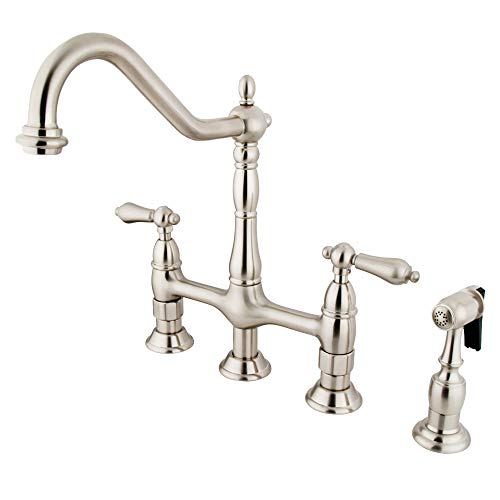
4. Kingston Brass Heritage Bridge KS1278ALBS — Best Traditional Hi-Rise — Check on Amazon
A bridge faucet is a hi-rise by architecture: the spout is carried on a raised bridge between the two valve posts, which lifts the outlet well above deck level while delivering the most traditional silhouette in plumbing. The Heritage Bridge pairs that geometry with an 8-3/4-inch spout reach and a brass side sprayer, in brushed nickel. It suits farmhouse, Victorian and period-revival kitchens where the faucet is a deliberate historical reference, and owners who want their extra clearance to arrive wearing the right costume. No modern centerset faucet, however tall, looks like this — that is precisely its market.
Strengths
- Raised bridge geometry gives real clearance with authentic period looks
- Long 8.75-inch reach suits deep farmhouse sinks
- Brass side sprayer extends rinsing beyond the spout’s swing
Trade-offs
- Needs the correct 8-inch spread plus a sprayer hole
- Exposed bridge is an extra surface to keep clean
- Period styling is a strong commitment for a whole kitchen
| Configuration | Bridge, two-handle, brass side sprayer |
| Spout reach | 8.75 inches |
| Finish | Brushed Nickel |
Buyers cross-shop the bridge against tall modern faucets on clearance numbers and miss its actual proposition: it is the only design in this guide where the height is inseparable from the heritage. The exposed bridge, the separate posts, the sprayer in matching brass — in a period kitchen these read as correct in a way a gooseneck never will, and in a modern kitchen they read as costume. Judge it as furniture first and plumbing second, while noting that the plumbing underneath is honest Kingston Brass hardware with a reach figure many modern faucets do not match. Confirm your hole spread before ordering; bridge geometry forgives nothing about drilling.
Best for: period and farmhouse kitchens wanting height with authentic bridge styling / Not suited for: modern kitchens or sinks without the matching hole spread
Check the current price on Amazon before you commit — finish and configuration change what you pay, and the listing is the only place the live figure is accurate.

5. Kingston Brass French Country Widespread KB1795TXBS — Best Farmhouse Widespread — Check on Amazon
The French Country widespread spreads its valves and spout across the deck as separate pieces, which gives two things a centerset cannot: freedom to fit wider, less standard drilling, and a composed, furniture-like presence across a big farmhouse sink. The oil-rubbed bronze finish and brass sprayer complete a warm, old-world brief. It suits large traditional kitchens, apron-front sink installations and buyers coordinating with bronze hardware elsewhere in the room. The 8-1/4-inch spout reach is sized for deep, wide basins where a short spout strands the stream against the back wall.
Strengths
- Widespread layout adapts to wider drilling patterns
- Oil-rubbed bronze finish anchors warm, traditional schemes
- Brass sprayer included for out-of-spout rinsing
Trade-offs
- Three separate pieces plus sprayer means more deck holes
- Dark bronze shows water spots differently — needs regular wiping
- Traditional presence will dominate a small sink
| Configuration | Widespread, two-handle, brass sprayer |
| Spout reach | 8.25 inches |
| Finish | Oil Rubbed Bronze |
Widespread faucets are the problem-solvers of the traditional world: because each component mounts independently, they absorb drilling patterns that defeat fixed centersets, including older and custom sinks. That adaptability, plus the visual rhythm of separate posts across a wide deck, is why the format survives. The French Country’s honest costs are installation time — more pieces, more connections, more care in alignment — and the bronze finish’s upkeep, which rewards a wipe-down habit with a deep, living patina and punishes neglect with spotty mineral prints. In the right kitchen neither cost matters. In a small or modern one, both do.
Best for: large farmhouse and traditional kitchens with wide or nonstandard drilling / Not suited for: compact sinks, modern schemes, or buyers wanting a one-piece install
Check the current price on Amazon before you commit — finish and configuration change what you pay, and the listing is the only place the live figure is accurate.
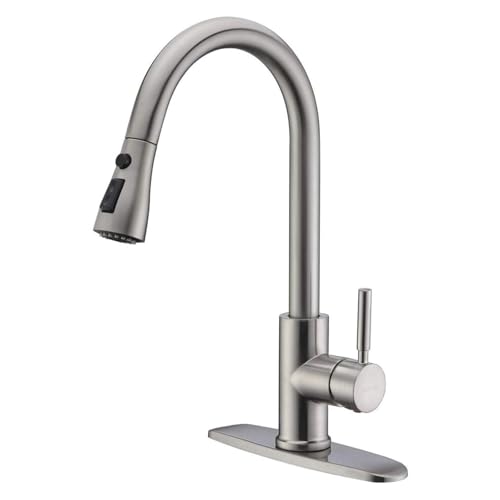
6. WEWE High-Arc Pull-Down Kitchen Faucet — Best Budget Tall — Check on Amazon
Not every tall-faucet need justifies a commercial or designer purchase, and the WEWE is the budget tier’s credible answer: a SUS 304 stainless body, a ceramic cartridge, a three-mode sprayer with rub-clean silicone nozzles, a full 360-degree swivel and a 20-inch pull-down reach per its verified listing. It suits rentals, first kitchens, laundry and utility rooms that occasionally fill tall buckets, and any buyer whose tall-vessel problem is occasional rather than daily. The wand compensates for what the fixed arc cannot do — where a gooseneck gives you height and asks you to bring the vessel, the WEWE’s wand goes to the vessel instead.
Strengths
- Stainless body and ceramic cartridge at a budget tier
- 20-inch wand reach fills vessels beside the sink, not just in it
- Silicone nozzles clear mineral scale with a fingertip
Trade-offs
- Fixed-arc clearance is high-arc class, not true gooseneck class
- Small-brand parts support is the long-term unknown
- Docking feel is functional rather than refined
| Body | SUS 304 stainless steel (per Amazon title) |
| Spray | 3-mode, silicone nozzles |
| Reach | 20-inch pull-down |
| Mounting | 1 or 3-hole |
The WEWE earns its place in a hi-rise guide by solving the tall-vessel problem from the other direction. A fixed gooseneck assumes the vessel comes under the spout; a long-reach wand lets you park a mop bucket or a water-cooler bottle beside the sink and bring the water to it. For utility spaces and rentals, that flexibility is worth more than raw spout height. The buying caveat is the standing budget-tier one: materials are right, service network is thin, and the rational owner prices in eventual replacement rather than repair. For a forever kitchen with daily tall-pot work, the Chicago Faucets picks are the honest recommendation; for everywhere else, this is the sensible spend.
Best for: rentals, utility rooms and occasional tall-vessel filling on a budget / Not suited for: daily heavy canning or brewing in a forever kitchen
Check the current price on Amazon before you commit — finish and configuration change what you pay, and the listing is the only place the live figure is accurate.
Comparison Table
| Pick | Badge | Key spec | Best for |
|---|---|---|---|
| Chicago Faucets 895-317ABCP Gooseneck Faucet | Best Overall Hi-Rise | Deck-mount gooseneck, commercial grade, chrome | canners, brewers and serious cooks filling the tallest vessels, plus utility sinks |
| Kraus Oletto KPF-2820SFS Pull-Down Kitchen Faucet | Best Modern Hi-Rise | 16.625in overall height, brass body, 1.8 GPM, single hole | modern kitchens with deep sinks that want maximum height plus a wand |
| Chicago Faucets 786-E3ABCP Kitchen Faucet | Best for 8-Inch Centers Commercial Installs | Deck mount, 8in centers, commercial grade, chrome | commercial and hard-use residential kitchens with 8-inch-centers drilling |
| Kingston Brass Heritage Bridge KS1278ALBS | Best Traditional Hi-Rise | Bridge design, brass sprayer, 8.75in spout reach | period and farmhouse kitchens wanting height with authentic bridge styling |
| Kingston Brass French Country Widespread KB1795TXBS | Best Farmhouse Widespread | Widespread, two-handle, brass sprayer, 8.25in reach, oil-rubbed bronze | large farmhouse and traditional kitchens with wide or nonstandard drilling |
| WEWE High-Arc Pull-Down Kitchen Faucet | Best Budget Tall | SUS304 body, 3-mode spray, 20in pull-down reach, 360° swivel | rentals, utility rooms and occasional tall-vessel filling on a budget |
How to Choose a Hi Rise Kitchen Faucet
Choose by the vessel, not by the adjective. Name the tallest thing you fill or wash — a specific stockpot, kettle, bucket or vase — and measure it. Your faucet’s spout height, measured from the floor of your sink basin, must clear that vessel with tilt room; every other number is secondary. Then decide how the water should arrive. A fixed gooseneck delivers hands-free filling at maximum height and asks the vessel to come to it. A tall pull-down delivers slightly less fixed clearance but sends a wand to vessels beside the sink. A bridge or widespread delivers height as part of a traditional design. Next, measure upward: tall faucets collide with low cabinets, shelves and window trim, so confirm the silhouette fits the wall behind your sink. Then your sink’s depth — hi-rise outlets over shallow basins splash enthusiastically, so deep sinks and tall faucets belong together. Finally, the drilling: commercial deck mounts, 8-inch centers, widespread patterns and single holes all appear in this guide, and the right faucet is the one whose mounting matches the sink you own.
Overall Height vs Spout Height: The Only Two Numbers That Matter
Listings lead with overall height because it is the biggest number, but your cookware never meets the top of the arc — it meets the outlet. Spout height, deck to outlet underside, is the clearance figure, and on pull-down faucets it is routinely seven or eight inches less than the headline. The Kraus Oletto in this guide is the honest example: 16.625 inches overall, 8.75 inches at the spout. A gooseneck inverts the relationship — its outlet sits near the top of its rise, which is why a commercial gooseneck of similar overall height delivers more working clearance than any pull-down. Neither is cheating; they are different geometries sold under one adjective. The buyer’s defense is simple: compare spout height to your tallest vessel, compare overall height to your cabinets, and never compare one faucet’s overall height to another’s spout height. Do that and the category’s marketing fog lifts immediately.
Gooseneck vs Tall Pull-Down: Two Philosophies of Height
The gooseneck philosophy is fixed and generous: maximum outlet height, a downward stream, both hands free, nothing to dock, nothing to retract, and a commercial service model measured in decades. Its rinsing strategy is movement — you move the dish under the water. The tall pull-down philosophy is mobile: slightly less fixed clearance, exchanged for a wand that rinses where the dish sits, fills what cannot fit in the sink at all, and turns the faucet into a hose with manners. Its failure mode is equally specific — docking and hose management under the sink. Households that fill tall vessels daily and rinse ordinarily should buy the gooseneck. Households whose rinsing is the heavy work — sheet pans, sink corners, big awkward items — should buy the pull-down and accept its modest fixed clearance. The bridge and widespread picks split the difference with height plus a side sprayer, at the price of more deck holes. There is no universal winner; there is a correct answer for your sink and your cooking, and it is knowable before you spend anything.
Splash, Sink Depth and Water Pressure
Height has a physics cost: water falling further arrives faster and bounces harder. In a deep basin — nine inches or more — a hi-rise stream lands contained, and the depth that demanded the tall faucet also tames it. In a shallow basin the same faucet will decorate your counter with every rinse. Mitigations exist: a quality aerator that shapes a coherent, aerated stream, a sprayer used for close work instead of the main stream, and honest self-knowledge about your water pressure, because a hi-rise on a high-pressure supply is the splash worst case. If your sink is shallow and your pressure is strong, the tall pull-down used mostly in wand mode may serve you better than a fixed gooseneck — the wand works close to the dishes, where fall distance is short. Match the faucet’s height to the basin’s depth, and the category’s one real drawback mostly disappears.
Commercial Faucets in Home Kitchens: What Transfers and What Does Not
Two of this guide’s picks come from the commercial world, so the translation deserves a direct treatment. What transfers: duty cycle, serviceability and parts longevity. A faucet engineered for a school cafeteria will not notice your family’s three meals a day, and its manufacturer expects to sell you a cartridge in fifteen years, not a new faucet. What does not transfer: styling range, spray features and residential convenience fittings. Commercial faucets assume a facilities mindset — standard tools, documented parts, no electronics — and they are finished in chrome because chrome is what survives. Installation can also differ: deck mounts and widespread centers are commercial norms, and supply connections may want an adapter’s attention on a residential rough-in. None of this is a warning off; it is a description of the bargain. You are trading features and finishes for a faucet that treats your kitchen as a light-duty assignment, and for the right buyer that is the best trade in this entire guide.
Budget Tiers for Hi-Rise Faucets, in Words
Prices are not printed on this site, so think in tiers. The budget tier — the WEWE — buys height-adjacent performance through a long wand and correct materials, and accepts thin parts support as its standing risk. The mid tier — the Kraus and the Kingston Brass pair — buys real construction: brass bodies, genuine raised architectures, finishes with depth, at the cost of either modern single-hole minimalism or period commitment, depending on which you choose. The commercial tier — the Chicago Faucets pair — is not priced by fashion at all; it is priced by duty rating, and it returns its cost as decades of service and rebuildability. A useful way to frame the decision: divide your expected years of ownership by how tall your tallest vessel is. Daily tall work over a long horizon argues for the commercial tier without hesitation. Occasional tall work argues for the wand. The middle, as usual, is where most kitchens honestly live.
Hi-Rise Faucets in Small Kitchens and Utility Rooms
The case for height is not limited to grand kitchens. In a small kitchen, counter space is the scarce resource, and a faucet that fills a tall pitcher or a coffee reservoir without a sideways dance returns counter space to cooking. In a utility or laundry room, the hi-rise case is stronger still: mop buckets, watering cans, humidifier tanks and pet bowls are all tall, awkward vessels, and the utility sink is where they belong — provided the faucet clears them. That is why the commercial gooseneck and the long-wand budget pick both appear in this guide: between them they cover the two utility patterns, the fixed tall spout for a dedicated laundry sink and the wand for a multipurpose room where the vessel parks beside the basin. If you are fitting out a utility space, measure the bucket first. It is the least glamorous measurement in this entire guide and the one most likely to be right about what you need.
Reading Hi-Rise Listings Without Being Fooled
This category’s listings reward a fixed reading order. First, find the spout height; if the listing prints only overall height, treat the clearance as unknown and look for the dimension diagram rather than the headline. Second, identify the architecture — gooseneck, pull-down, bridge, widespread — because the architecture predicts the ownership experience more than any feature list. Third, the mounting: holes, spread and deck style, checked against your sink before any other consideration. Fourth, the body material and cartridge, the two lines that predict the decade. Fifth, the spray arrangement, including the honest possibility that there is none, which is a legitimate design and not a defect. Every pick in this guide passed that order against its verified listing, and the spec boxes print the numbers the listings actually confirmed — including, pointedly, both height figures wherever a listing provided them.
Living With a Tall Faucet: The First Month
Owners of a first hi-rise faucet report the same adjustment curve. Week one is delight at the fills that used to be acrobatics, plus a few splashes while your hands learn the longer fall. Week two is workflow: sheet pans and roasting racks start getting washed properly instead of wiped apologetically, and the sink itself gets rinsed down more often because the swivel finally reaches its corners. By the end of the first month the faucet has reorganized small habits — the water filter pitcher lives in the sink during fills, the tall vase gets washed instead of dusted, the brew kettle fills at the sink instead of the tub. The adjustments are equally predictable: a lighter hand on the lever in a shallow basin, a towel’s new home on the counter edge in high-pressure homes, and on pull-down models a cabinet kept clear of the hose loop. None of this is marketing; it is the accumulated pattern of what changes when the most-used tool in the kitchen stops being the constraint on the vessels around it.
A Word on Water Flow at Height
Buyers occasionally worry that a taller faucet means weaker flow, as if the water resented the climb. In a pressurized home supply the height difference inside a faucet is negligible — your home’s pressure, measured in tens of pounds per square inch, does not notice a ten-inch rise. What does change at height is the stream’s behavior in the air: a longer fall lets a poorly shaped stream break up and spray, which is an aerator quality question, not a pressure question. This is one more reason the commercial picks punch above their price in daily satisfaction: their aerators are specified for coherent streams at institutional pressures. If a new hi-rise faucet feels weak, the diagnosis order is aerator first (remove, inspect, soak), then the supply stops and lines, then the home’s pressure at another fixture — the faucet’s height is innocent until all three are cleared.
Pairing a Hi-Rise Faucet With the Right Sink
Faucet and sink are one system, and hi-rise choices expose mismatches that standard faucets forgive. Depth is the first pairing: tall outlets belong over basins of nine inches or more, where the fall is contained and the clearance is usable; over a six-inch basin the same faucet is a splash machine with good intentions. Width is the second: a long-reach spout over a narrow basin strands its stream on the back wall, while a short reach over a wide farmhouse basin leaves the front half of the sink unserved — the bridge and widespread picks exist for those wide decks. Material is the third: a heavy commercial faucet wants a sink and deck that can carry it, which is a real consideration on thin stainless and on stone that must be drilled for widespread or deck-mount patterns. If you are replacing sink and faucet together, choose them together, in that order — sink geometry first, faucet architecture second — and the pairing problems in this section mostly solve themselves. If the sink is fixed, it has already made half your faucet decision; the measurements in the install section simply reveal which half.
How to Measure Your Sink and Install a Hi-Rise Faucet
Measurement comes before purchase, and for hi-rise faucets it has four parts. One: from the floor of your sink basin, measure up to the underside of your current spout — that is your current working clearance — and compare it with your tallest vessel’s height plus two inches of tilt room. Two: measure from the countertop up to the lowest cabinet, shelf or window trim above the sink; the new faucet’s overall height must clear it. Three: record your hole pattern — count, spread and deck thickness — because this category spans single-hole, 8-inch centers, widespread and commercial deck mounts. Four: note your basin depth, since a deep basin both needs and tames a tall faucet. Installation then follows the standard sequence with two hi-rise emphases. Shut off the water, drain the lines, photograph the old connections and remove the old faucet. Seat the new faucet on its gasket, tighten mounting hardware evenly, and — on tall models — check the silhouette is plumb before final tightening, because a tall faucet advertises a lean that a short one hides. Connect supplies hand-tight plus a quarter turn, flush the lines with the aerator removed for a full minute, then test: fill your tallest vessel to prove the clearance you bought, swivel through the full arc, and inspect every joint with a dry paper towel. On pull-down models, route the hose in a clear loop with the weight positioned as marked, and dock the wand twenty times to confirm the seat. Recheck under the sink after ten minutes of normal use.
Common Buying Mistakes
The classic hi-rise mistake is buying overall height and receiving spout height — measuring nothing, trusting the biggest number on the box, and discovering the stockpot still does not fit. Second is forgetting the wall: a tall faucet ordered into a low cabinet line or a window that opens inward, discovered on install day. Third is pairing maximum height with a shallow sink and high pressure, then blaming the faucet for a splash pattern that physics guaranteed. Fourth is ignoring the drilling — commercial deck mounts and widespread patterns are unforgiving of single-hole sinks. Fifth is skipping the vessel test after install: fill the tallest pot on day one, while returns are painless, not on the day of the big cook. Sixth, on pull-down models, is strangling the hose loop with cabinet clutter and concluding the docking is defective. Every one of these is prevented by the four measurements in the install section, which take less time than one return shipment.
Final Recommendation
Before the summary, one last piece of practical counsel: if two picks in this guide both fit your measurements, choose by the second decade, not the first month. Every faucet here will fill a pot on day one. The differences that matter — a cartridge you can still buy, a finish that still wipes clean, a hose or a bridge joint that has not loosened — announce themselves in years three through twelve, and they are exactly the differences the reviews above are organized around. The shortest honest summary: for pure clearance and lifetime durability, the Chicago Faucets gooseneck is the hi-rise benchmark, and its 8-inch-centers sibling covers commercial drilling. For a modern kitchen that wants height with a wand, the Kraus Oletto is the pick. For period kitchens, the Kingston Brass bridge and widespread deliver height in the correct costume, and for budget or utility use the WEWE’s long wand solves the tall-vessel problem sideways. If your clearance needs turn out to be ordinary after measuring, the mainstream field in our best high arc kitchen faucets guide will serve you for less commitment; traditional two-handle shoppers should see the best high arc 2 handle kitchen faucets, and anyone speccing a statement kitchen should finish with the best high end kitchen faucets.
Best High Arc Kitchen Faucets Best High Arc 2 Handle Kitchen Faucets Best High End Kitchen Faucets Best Kitchen Faucets Best Industrial Kitchen Faucets
Frequently Asked Questions
What makes a faucet ‘hi-rise’ rather than just high arc?
Working clearance. A hi-rise faucet’s outlet sits high enough — by gooseneck geometry, a tall pull-down body or a raised bridge — to fill and wash vessels that defeat standard faucets. The label is marketing, but the test is physical: measure spout height from your basin floor and compare it with your tallest pot.
Will a hi-rise faucet splash more?
It can, because water falls further and lands faster. Deep basins contain it; shallow basins with high water pressure are the splash-prone combination. A good aerator and using a sprayer or wand for close rinsing reduce it substantially. If your sink is shallow, favor the tall pull-down used in wand mode.
Are commercial gooseneck faucets a good idea at home?
For the right household, they are the best idea in this guide: unmatched clearance, institutional durability and parts support measured in decades. The costs are a plain chrome look, no spray wand, and commercial mounting patterns. Cooks who fill tall vessels daily tend to value exactly what commercial faucets offer.
Can a hi-rise faucet fit under my cabinets?
Only if its overall height clears the lowest obstruction above the sink — cabinet bottom, shelf or window trim. Measure that space before ordering; tall models in this category can exceed 16 inches overall. This is the second most common hi-rise return reason, after spout-height confusion.
Do bridge faucets really give hi-rise clearance?
Yes — the spout rides on a raised bridge between the valve posts, lifting the outlet well above the deck, and the long reaches on the Kingston Brass models suit deep farmhouse sinks. The clearance arrives with period styling and a specific 8-inch spread requirement, so it is a design decision as much as a plumbing one.
What if my tallest vessel still does not fit under any spout?
Use the wand strategy: a long-reach pull-down fills vessels parked beside the sink, which removes the height limit entirely — this is also the standard solution for water-cooler bottles, tall humidifier tanks and the other vessels that were never designed with any faucet in mind. The WEWE in this guide reaches 20 inches for exactly that job. For fixed-spout kitchens, a sprayer on a hose does the same work less elegantly.


