Disclosure: airfryerkitchensupply.com is reader-supported. When you buy through links on our site, we may earn an affiliate commission at no extra cost to you.
Where to buy
Every linked pick in this guide to the best freestanding natural gas grills is sold through Amazon, where you can check the current price on Amazon and confirm the words “Natural Gas” in the exact listing title before ordering. This is the one category where the listing check is a safety check: natural-gas and propane versions of the same grill look identical, use different orifices, and are not interchangeable. Every pick below is a factory natural-gas model or a verified convertible, as its review states.
- Weber Spirit E-325 Natural Gas Grill (Best Overall) — Check on Amazon
- Weber Spirit E-435 Natural Gas Grill (Best for Families and Sides) — Check on Amazon
- Broil King Baron 490 Pro Shadow, Natural Gas (674147) (Best Premium Alternative) — Check on Amazon
- Nexgrill Deluxe 6-Burner Natural Gas Grill with Griddle Insert (Best for Crowds) — Check on Amazon
- Monument Grills M415BZNG Natural Gas Grill (Best With Hose Included) — Check on Amazon
- Dyna-Glo Premier 3-Burner Natural Gas Grill (DGP397CNN-D) (Best Budget NG) — Check on Amazon
The best freestanding natural gas grills solve the only annoying part of gas grilling: the tank. Plumbed into your home’s natural gas line through a patio stub-out and a quick-disconnect hose, a natural gas grill never runs empty mid-cook, never needs an exchange run, and costs less per hour to run than propane in most regions. It is still a freestanding grill — a cart on wheels you can position, clean behind and take with you when you move (the plumbing stays; the grill goes) — just one whose fuel arrives by pipe instead of by bottle.
This guide is deliberately strict about what qualifies. Every pick is either a factory natural-gas model, sold and jetted for natural gas as listed, or a model whose verified listing explicitly states convertibility with a kit. We excluded propane models with hopeful forum-thread conversions, built-in natural-gas heads (not freestanding), and any listing where the fuel in the title did not match the fuel in the review. If you are cross-shopping from our propane guide, the model names will look familiar — the E-325, E-435 and others exist in both fuels — but the ASINs here are the natural-gas configurations only, verified as such.
Two honest constraints frame the whole category. First, you need a natural gas stub-out where the grill will live, installed or extended by a licensed professional in most jurisdictions; budget that work into the purchase if your patio lacks one. Second, a plumbed grill is tethered: the hose length defines its world, so placement is a decision, not an afternoon whim. Households that accept those two facts gain the most convenient grilling fuel there is — which is why natural gas owners almost never go back to tanks.
The category also rewards a moment of realism about who should not buy in. If your patio has no line and no renovation on the horizon, a natural gas grill is a beautiful paperweight; if your household moves every couple of years for work, the stub-out investment stays behind each time. The picks below are for settled households with a line or a line planned — for everyone else, our propane guide is not a lesser read, just the right one.
Finally, a note on heat expectations. Natural gas carries less energy per cubic foot than propane, so natural-gas models are jetted with larger orifices to deliver equivalent burner performance — a factory NG grill is not a weaker grill. What you should not expect is a propane grill to behave correctly on a home gas line without its manufacturer’s conversion kit and orifice change; that mismatch is precisely what this guide’s strictness exists to prevent.
In this guide
Quick Picks
If you only read one section, make it this one. These are the six best freestanding natural gas grills we would shortlist first, each chosen for a different kind of buyer rather than ranked by a single score.
- Weber Spirit E-325 Natural Gas Grill — Best Overall. The mainstream answer in plumbed form: three burners, a Boost sear zone and cast-iron grates, factory-jetted for natural gas — no tank, ever. — Check on Amazon
- Weber Spirit E-435 Natural Gas Grill — Best for Families and Sides. Four burners, sear zone and a side burner in factory natural-gas form — the whole outdoor kitchen, plumbed, in one Spirit cart. — Check on Amazon
- Broil King Baron 490 Pro Shadow, Natural Gas (674147) — Best Premium Alternative. The Canadian challenger: four burners, a side burner and a rear rotisserie burner in a blacked-out Shadow finish — for rotisserie devotees on natural gas. — Check on Amazon
- Nexgrill Deluxe 6-Burner Natural Gas Grill with Griddle Insert — Best for Crowds. Six burners, 775 square inches and a griddle insert on natural gas — party capacity that never empties a tank at the worst moment, because there is no tank. — Check on Amazon
- Monument Grills M415BZNG Natural Gas Grill — Best With Hose Included. A 4+1 burner stainless NG cart that includes the natural gas hose in the box — the connection hardware detail most buyers forget until delivery day. — Check on Amazon
- Dyna-Glo Premier 3-Burner Natural Gas Grill (DGP397CNN-D) — Best Budget NG. The honest entry ticket to plumbed grilling: three burners in a Premier cart, factory natural gas, model DGP397CNN-D — without premium-brand pricing. — Check on Amazon
How These Picks Were Chosen
We chose only freestanding carts whose natural-gas configuration we could verify through this site’s Amazon product listings: brand-and-model searches, then title matching where the returned listing itself states natural gas (or, for the one convertible pick, states the conversion arrangement in its title). In a category where a wrong link ships the wrong fuel system, that verification standard is not pedantry — it is the entire job.
Within the verified shortlist, we balanced the range the way households actually buy: Weber’s Spirit line in three and four burners for the mainstream, a Canadian premium alternative with a rotisserie burner, a six-burner capacity play with a griddle insert, a hose-included Monument for buyers who want the connection hardware in the box, and a three-burner Dyna-Glo as the honest budget door into plumbed grilling. Each review states plainly whether the model is factory NG or convertible, because that distinction matters for warranty and for who should do the work.
We also weighted the ownership details specific to plumbed fuel: hose and quick-disconnect inclusion, valve quality, and the brand’s support for NG-specific parts (valves and orifices differ from propane). A natural gas grill should be a fifteen-year appliance — there is no tank to blame and no reason to churn — so parts depth counted heavily.
The 6 Best Freestanding Natural Gas Grills

Weber Spirit E-325 Natural Gas Grill — Best Overall
Take the propane Spirit E-325 from our all-fuel guide — three burners, the Boost sear zone, porcelain-enamelled cast-iron grates, Weber Works rails — and remove its only chore. This factory natural-gas version, verified in the listing title itself, connects to your patio stub-out and simply works, cook after cook, with no tank gauge to watch and no exchange detour on the way home. For most plumbed households, this is the grill: sized for families of two to five, zone-capable, with a sear zone that gives gas’s convenience a steakhouse finish.
Strengths
- Factory NG — no conversion, no warranty grey zone
- Boost sear zone plus three-burner zone cooking
- Weber parts depth for NG-specific components
Trade-offs
- Requires a patio gas stub-out (professional install)
- Hose length fixes the grill’s position
- No side burner on this trim
| Fuel | Natural gas (factory model, per listing) |
| Burners | 3 |
| Sear zone | Sear Zone with Boost burners (per listing) |
| Grates | Porcelain-enamelled cast iron (per listing) |
The Weber ownership pattern applies in full: per-burner ignition, replaceable burners and heat tents jetted and valved for natural gas, and a parts catalogue that will still list this model when the neighbours’ anonymous carts are landfill. The cart keeps the (now empty) tank bay as storage, and the whole unit still rolls for cleaning — within the radius the hose allows, which is the one planning habit NG owners learn in week one.
Buy it if your stub-out exists or is budgeted, your headcount is family-sized, and you want the set-and-forget version of the most balanced gas grill we recommend. If you need a side burner or a fourth burner for crowds, its bigger sibling below is the same idea scaled up; if budget is the binding constraint, the Dyna-Glo further down opens the plumbed door for less.
Best for: Plumbed households of two to five who grill weekly / Not suited for: Renters or anyone without a gas line to the patio
Check on Amazon — check price on Amazon for the current configuration and delivery terms.

Weber Spirit E-435 Natural Gas Grill — Best for Families and Sides
The E-435 in natural gas is the maximum Spirit: the verified listing confirms four burners, the Boost sear zone and a side burner, all factory-jetted for your home line. The side burner changes character on a plumbed grill — on propane it shares a finite tank, but on natural gas it is simply another burner in your outdoor kitchen, free for the corn pot, the wok or the sauce that used to send you indoors. Households that cook whole meals outside will use it weekly; that is the honest test for choosing this trim.
Strengths
- Side burner becomes genuinely useful on unlimited fuel
- Four-burner capacity with a real sear zone
- Factory NG configuration, full Weber support
Trade-offs
- Priciest Spirit configuration
- Side burner wasted on protein-only grillers
- Same stub-out and tether constraints as all NG picks
| Fuel | Natural gas (factory model, per listing) |
| Burners | 4 + side burner (per listing) |
| Sear zone | Sear Zone with Boost (per listing) |
| Grates | Porcelain-enamelled cast iron (per listing) |
Capacity scales with the fourth burner: a full family dinner plus guests fits without the grate traffic management the three-burner demands, and the zone map stretches to sear-cook-hold simultaneously. Everything else is Spirit-standard — cast-iron grates, per-burner ignition, Weber Works rails, a decade of orderable parts — in a cart that still suits an ordinary patio rather than dominating it.
Choose it over the E-325 NG when your cooking includes sides and crowds regularly; choose the E-325 when it does not, and spend the difference on the stub-out work or a rotisserie kit. Either way, the plumbed versions of this line are the easiest ownership experience in gas grilling: light, cook, close the valve, done.
Best for: Families cooking complete meals outdoors / Not suited for: Minimalist grillers or tight patios
Check on Amazon — check price on Amazon for the current configuration and delivery terms.
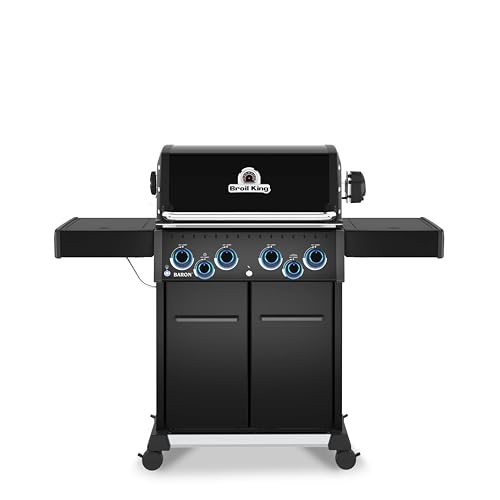
Broil King Baron 490 Pro Shadow, Natural Gas (674147) — Best Premium Alternative
Broil King builds its reputation on cooking systems — heavy grates, dual-tube burners and ovens that hold heat like a roast pan — and the Baron 490 Pro brings that philosophy to natural gas with a feature the Webers here do not offer: a rear rotisserie burner, confirmed in the verified listing alongside the four main burners and side burner. If your plumbed-grill dream involves chickens and roasts turning slowly over infrared heat while the main grate handles vegetables, this is the pick built around that picture.
Strengths
- Rear rotisserie burner — unique in this roundup
- Side burner plus four main burners
- Heavy cooking-system feel with strong parts support
Trade-offs
- Rotisserie kit itself may be a separate purchase — check the listing
- Less extensive accessory ecosystem than Weber
- Premium tier pricing
| Fuel | Natural gas (per listing) |
| Burners | 4 + side burner + rear rotisserie burner (per listing) |
| Model | 674147 Baron 490 Pro Shadow (per listing) |
The Shadow finish (blacked-out, contemporary) suits modern patios, and Broil King’s North American manufacturing base supports a real parts channel for NG valves and burners. In daily use the Baron feels a touch more old-school than the Spirits — the cooking system rewards cooks who preheat thoroughly and use the whole grate deliberately — which its loyal owners count as character rather than criticism.
Choose it for the rotisserie burner and the cooking-system feel; choose the Spirit E-435 NG for the broader accessory ecosystem and the Boost sear zone. Both are factory natural gas, both are decade-class purchases, and the fork between them is about how you cook, not which badge is better.
Best for: Rotisserie fans wanting a premium NG cart / Not suited for: Buyers who will never spin a chicken
Check on Amazon — check price on Amazon for the current configuration and delivery terms.
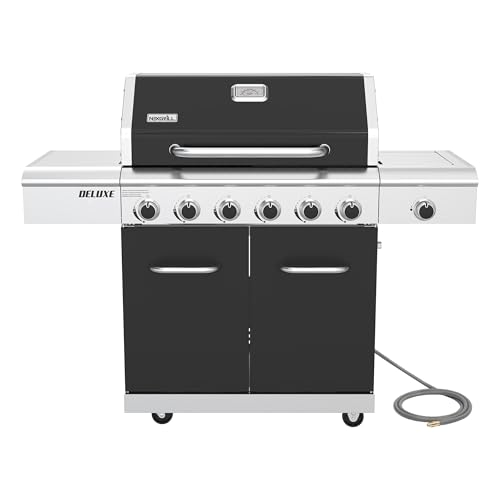
Nexgrill Deluxe 6-Burner Natural Gas Grill with Griddle Insert — Best for Crowds
Crowd grilling is where natural gas quietly shines brightest: a six-burner party cook on propane can empty a tired tank in front of twenty guests, while this Nexgrill Deluxe simply keeps burning. The verified listing stacks the specification — six burners plus a side burner, 775 square inches of cast-iron grate, 75,000 BTU total, electronic ignition, and a griddle insert that turns a section of the grill into a smash-burger and breakfast station. For the household whose patio is the neighbourhood’s summer kitchen, that is the brief, delivered in stainless at a value-brand price.
Strengths
- Six-burner, 775 sq in capacity on unlimited fuel
- Griddle insert adds a second cooking style
- Cast-iron grates and side burner included
Trade-offs
- Largest gas demand — installer must size the line
- Value-gauge stainless needs cover discipline
- Big footprint and a long assembly
| Fuel | Natural gas (per listing) |
| Cooking area | 775 sq in (per listing) |
| Output | 75,000 BTU (per listing) |
| Grates | Cast iron (per listing) |
| Extras | Griddle insert included (per listing) |
The Nexgrill contract from our other guides applies: lighter-gauge stainless that wants a cover and a wipe-down, burners and heat plates treated as mid-life service items, and assembly that rewards a patient hour. In exchange you get capacity and features that premium brands charge far more for, in the fuel configuration that makes capacity stress-free.
If your guest list is the specification and your budget is not Weber-Genesis-shaped, this is the natural gas pick. Just confirm your stub-out’s capacity with your installer — a six-burner grill at full song is the largest gas appliance many patios ever feed, and the line work should be sized for it.
Best for: Hosts cooking for crowds, often / Not suited for: Small households or small patios
Check on Amazon — check price on Amazon for the current configuration and delivery terms.

Monument Grills M415BZNG Natural Gas Grill — Best With Hose Included
The M415BZNG’s headline is a small sentence with large practical value: “with Natural Gas Hose”. Many natural-gas grills ship expecting you to source the quick-disconnect hose separately, and discovering that on assembly day — with the stub-out ready and dinner planned — is a rite of passage this Monument skips. Around that hose sits a stainless 4+1 burner cart at 50,000 BTU with a Broil Zone for fast heating, knob lights for evening cooks and an easy-clean grease arrangement, per the verified listing.
Strengths
- Natural gas hose included in the box
- 4+1 burners with a fast-heating Broil Zone
- Knob lights and easy-clean design for real evenings
Trade-offs
- Verify hose length suits your layout
- Value-tier stainless needs a cover habit
- Brand parts channel is thinner than Weber’s
| Fuel | Natural gas (per listing) |
| Burners | 4 + 1 (per listing) |
| Output | 50,000 BTU (per listing) |
| Included | Natural gas hose (per listing) |
Monument’s value proposition from our other guides holds here: more visible hardware per dollar, presentational stainless that rewards a cover, and parts treated as service items through the brand’s channel. The 4+1 layout (four main burners plus the extra burner the line is known for) gives a family-plus zone map, and knob lights are the rare gadget that genuinely helps in November at 6 p.m.
Choose it when you want a mid-size plumbed cart with the connection hardware handled, at a price that leaves budget for the stub-out work itself. Confirm the hose length against your planned grill position before ordering — included is excellent, but included-and-long-enough is the actual requirement.
Best for: Mid-size households wanting a complete NG package / Not suited for: Anyone needing maximum parts depth for a 15-year plan
Check on Amazon — check price on Amazon for the current configuration and delivery terms.

Dyna-Glo Premier 3-Burner Natural Gas Grill (DGP397CNN-D) — Best Budget NG
Natural gas grilling has a budget problem: the famous names price their NG trims at a premium, which pushes cost-conscious buyers back to tanks. The Dyna-Glo Premier DGP397CNN-D is the counter-argument — a three-burner freestanding cart in factory natural gas, verified by model number in the listing, at the tier where Dyna-Glo has always competed. Three burners still deliver a workable two-zone fire, and the Premier trim dresses the cart a step above the brand’s basic lines.
Strengths
- Lowest-cost route into factory natural gas
- Three burners still give two-zone cooking
- Premier trim dresses above the basic tier
Trade-offs
- Lighter construction than the Weber picks
- Thinner parts channel for NG components
- No sear zone or side burner
| Fuel | Natural gas (per listing) |
| Burners | 3 |
| Model | DGP397CNN-D (per listing) |
The savings show in the expected places: panel weight, grate specification and finish are a class below the Spirits, and the parts channel, while real, is not Weber-deep. What does not change is the fuel experience — the same endless gas, the same push-and-cook convenience — which is the actual product being bought. For a household adding a stub-out during other patio work, pairing it with this grill keeps the whole project in budget.
Buy it as the rational entry to plumbed grilling, keep it covered, and expect a mid-single-digit-year service life with wear-part swaps. If it converts you to natural gas for life — it converts most people — your next grill can be the decade-grade Weber, and this one will have earned its keep many times over.
Best for: Budget-conscious households adding a stub-out / Not suited for: Buyers wanting a fifteen-year flagship
Check on Amazon — check price on Amazon for the current configuration and delivery terms.
Comparison Table
| Pick | Badge | Key spec | Best for |
|---|---|---|---|
| Weber Spirit E-325 Natural Gas Grill | Best Overall | Factory natural gas, 3 burners, Sear Zone with Boost | Plumbed households of two to five who grill weekly |
| Weber Spirit E-435 Natural Gas Grill | Best for Families and Sides | Factory natural gas, 4 burners + side burner, Sear Zone with Boost | Families cooking complete meals outdoors |
| Broil King Baron 490 Pro Shadow, Natural Gas (674147) | Best Premium Alternative | Factory natural gas, 4 burners + side burner + rear rotisserie burner | Rotisserie fans wanting a premium NG cart |
| Nexgrill Deluxe 6-Burner Natural Gas Grill with Griddle Insert | Best for Crowds | Natural gas, 6 burners + side burner, 775 sq in, 75,000 BTU | Hosts cooking for crowds, often |
| Monument Grills M415BZNG Natural Gas Grill | Best With Hose Included | Natural gas, 4+1 burners, 50,000 BTU, NG hose included | Mid-size households wanting a complete NG package |
| Dyna-Glo Premier 3-Burner Natural Gas Grill (DGP397CNN-D) | Best Budget NG | Factory natural gas, 3 burners, Premier series cart | Budget-conscious households adding a stub-out |
All six are factory natural-gas models; none of the six requires a conversion kit to run on your home line as sold, and none is a built-in head — every one stands on its own cart, as this category’s name promises. Read the table by burner count and extras — sear zone (Weber), rotisserie burner (Broil King), griddle insert (Nexgrill), included hose (Monument) — because the fuel experience itself is identical across all of them: endless, and ready when you are.
How to Choose the Best Freestanding Natural Gas Grills
Start with the infrastructure question, because it gates everything: do you have a natural gas stub-out where the grill will live? If yes, this entire guide is open to you. If no, price the line work first — a licensed gas fitter extending a line to the patio is a normal, well-understood job, but its cost belongs in the grill budget, and in some homes the run is long enough to change which grill tier makes sense. Renters and anyone unsure about staying should stay with propane; the stub-out is a house investment, not a grill accessory.
Then choose configuration with the same discipline as any gas grill: three burners for zone-cooking families, four for sides and crowds, six for party houses. Layer the extras by your actual menu — a sear zone if steaks are weekly, a side burner if pots live outside in summer, a rotisserie burner if you spin birds, a griddle insert if breakfast and smash burgers are your signature. Every extra is a burner your gas line must feed, so mention the grill model when your fitter sizes the work.
Factory NG vs convertible: the distinction that matters
A factory natural-gas grill is built, jetted and warranted for natural gas as sold — and all six picks in this guide are sold in exactly that NG configuration. A convertible grill ships as propane with a manufacturer kit to change orifices and valves. Convertibles are legitimate when the kit is the manufacturer’s own and the work is done properly (ideally by a professional), but they add a step, a cost and a warranty conversation. If you know your fuel is natural gas, buy factory NG and skip the conversion chapter entirely.
Hoses, quick-disconnects and valves
The connection hardware is part of the product. A quality quick-disconnect lets you detach the grill for cleaning or winter repositioning; a shutoff valve at the stub-out is non-negotiable; and hose length decides placement more than wheels do. One pick here (the Monument) includes the hose; for the others, budget the correct hose and fittings, bought for outdoor natural-gas service, and have the fitter confirm the full assembly on install day.
What Size Natural Gas Line and Grill Do You Need?
Grill size follows the same headcount maths as propane — three burners for most families, four for meal-cookers, six for hosts — but natural gas adds a supply question propane never asks: can your home’s line deliver the grill’s full BTU demand alongside the furnace, water heater and stove? For most single-grill patios the answer is yes with standard sizing, but a six-burner grill at full output is a serious appliance load, and only your fitter can confirm your line’s capacity. Raise it during the quote, not after the first party.
Physically, plan the grill’s position as semi-permanent: hose reach, lid arc, and clearance from the house wall all fixed at install. The freestanding format still helps — the grill wheels within its radius for cleaning, and unhooks entirely if you move — but the daily reality is a grill with a home spot. Choose that spot for wind shelter and kitchen-door distance before the fitter arrives, and the installation lands right the first time.
Natural Gas vs Propane: The Full Honest Comparison
Convenience: natural gas wins outright — no tanks, no gauges, no mid-cook empties, no exchange trips. Cost per cook: natural gas wins in most regions, often substantially, because pipeline gas is cheaper per unit of heat than bottled propane. Portability: propane wins outright — a tank grill can live anywhere, move houses in a van, and work at a cabin with no utilities. Heat character: a draw — factory grills in each fuel are jetted to deliver their rated performance, and the food cannot tell which gas fed the burner.
Installation: propane wins on day one (zero work) and loses every day after (tank chores forever); natural gas inverts that — one professional job, then nothing. Environmental footprint per cook generally favours pipeline gas modestly, though both are fossil fuels and the difference should not be oversold. Resale and home value: a stub-out is a small patio asset that stays with the house; the grill itself, being freestanding, goes with you. The verdict most households reach: if the house is yours and the line is feasible, natural gas is the better ownership experience; if either is untrue, propane is not a consolation prize but the correct tool.
Safety and Code Basics for Plumbed Grills
Natural gas work is regulated for good reason, and this guide’s position is simple: line extensions, stub-outs and hard connections belong to licensed professionals under your local code, full stop. What owners should own is the daily layer: know where your stub-out shutoff valve is, keep the quick-disconnect clean and capped when detached, route the hose where it cannot be driven over, stepped on or rested against the hot firebox, and soap-test any connection you have disturbed before the next cook.
Treat the smell question seriously and boringly: the odorant in natural gas exists so leaks announce themselves; if you smell gas at the patio, close the stub-out valve, skip the cook, and call your gas utility or fitter. Ventilation is the other quiet rule — a plumbed grill is an outdoor appliance, and garage or enclosed-porch use is off the table regardless of how convenient the line location seems. None of this is onerous; it is the same respect you give a gas stove, moved outdoors.
Getting the Most From a Plumbed Grill, Season After Season
The NG owner’s advantage compounds with small habits. Because fuel is unlimited, preheat properly every time — ten full minutes with the lid down transforms searing and evenness, and costs you nothing in errands. Use the side burner (if fitted) as a true second station in summer to keep kitchen heat outdoors. And because the grill never leaves for tank reasons, invest in its spot: a level pad, a fitted cover, a hook for tools, and lighting for winter evenings turn a plumbed grill into the most-used appliance in the house.
Maintenance mirrors propane with two NG-specific notes: valves and orifices are fuel-specific parts (order by the NG model number, always), and the hose and quick-disconnect deserve an annual inspection for cracking, corrosion and debris — they are the entire fuel system between your house and your dinner. Keep those sound, keep the grease tray honest, and a natural gas grill will out-serve almost any other appliance you own.
Living With the Tether: Placement Wisdom From NG Owners
Ask long-term natural gas owners their one regret and it is rarely the grill — it is the spot. The stub-out went where the builder’s plan suggested, not where cooking actually happens, and the hose has enforced that compromise ever since. The lessons they pass on: put the grill where the cook’s back is to the prevailing wind, where the lid opens without threatening a railing or a low branch, where the kitchen door run is short in the rain, and where guests gather near — not downwind of — the smoke. A freestanding NG grill can be repositioned within its radius and even re-plumbed later, but both are easier to get right on paper before the fitter arrives.
The second lesson is to plan the radius, not just the point. Cleaning behind the grill, sweeping the patio, and pulling the cart out for its annual deep-clean all happen inside the hose’s circle. Leave working room in that circle, keep the hose’s path out of the main foot traffic (a hose cover strip solves the one unavoidable crossing), and the tether disappears from daily awareness within a month — which is precisely the convenience the fuel promises.
When Natural Gas Is the Wrong Answer
Honesty requires the counter-case. If you rent, if a move is likely within a couple of years, if your patio is far from the home’s gas line (long runs price the convenience away), or if your local code environment makes permitting slow and expensive, propane is the rational fuel and our freestanding gas guide is the right read. Likewise if you dream of grilling at a cabin, a beach house or a tailgate: a plumbed grill is a home appliance, magnificently convenient exactly where it is plumbed and useless everywhere else.
There is also a middle path some households choose deliberately: propane now, natural gas at the next patio renovation, buying a grill line (like the Spirits here) that exists in both fuels so the cooking experience carries over. Whichever branch you take, take it on purpose — the only wrong natural-gas purchase is the accidental one, a propane grill ordered for a plumbed patio or an NG grill ordered for a home with no line.
How to Connect a Freestanding Natural Gas Grill (and What to Leave to a Pro)
Be clear about the division of labour before touching anything: installing or extending the gas line and stub-out is licensed professional work in most jurisdictions. What follows is the owner’s side of the process — preparing, connecting the grill’s flexible hose to a finished stub-out as manufacturers intend, checking your work, and knowing the stop conditions that send you back to the professional.
- Confirm the stub-out is complete, capped and fitted with a shutoff valve, and that your grill is a factory natural-gas model (check the rating plate against the listing — never connect a propane-configured grill to a gas line).
- Position the grill in its home spot, level and clear of walls per the manual, and measure the hose run: the hose should reach with slack, without stretching, kinking or crossing walkways.
- With the stub-out valve closed, fit the quick-disconnect coupling per the grill and hose manufacturers’ instructions, using only fittings supplied or specified for outdoor natural-gas service.
- Connect the hose to the grill manifold, open the stub-out valve, and soap-test every joint you touched: bubbles mean close the valve and re-seat the fitting; repeat until every joint is bubble-free.
- Light each burner in turn and confirm steady, mostly blue flames across every tube; weak or lifting flames after a clean test mean stop and call your fitter — supply sizing is their department.
- Record the install: photograph the rating plate and connections, note the fitter’s details in the manual, and learn the shutoff valve’s location by heart before the first real cook.
After the first week, re-check the hose routing with fresh eyes — hoses settle, and a routing that clears the firebox when cold must also clear it when the cart shifts for cleaning. From then on, the connection joins the annual spring inspection, and grilling becomes the chore-free experience you bought.
Keep a simple rule for guests and family: anyone may cook, but only someone who has been shown the stub-out shutoff may connect or disconnect the grill. Thirty seconds of orientation per person is the entire training programme a plumbed grill needs, and it keeps the safety knowledge as distributed as the cooking enthusiasm.
Common Buying Mistakes
Connecting a propane grill to a gas line ‘to try it’. Different orifices, wrong fuel-air mix, genuine hazard. Factory NG or a manufacturer conversion kit fitted properly — there is no third option.
Skipping the fitter to save money. The line work is the safety system. An unpermitted, untested gas run risks the house to save the cost of a few dinners out; it is the worst economy in this guide.
Forgetting the hose when comparing prices. Some NG grills include it, many do not. A grill that looks cheaper can cost more connected — check the box contents, as with the Monument pick.
Placing the grill before the line is run. The stub-out location follows the grill’s home spot, wind shelter and kitchen distance — in that order. Decide the spot first, then have the line brought to it.
Assuming the home line can feed any grill. A six-burner at full output is a major load. Confirm capacity with your fitter, especially in homes with several other gas appliances.
Letting the quick-disconnect live dirty. Grit in the coupling defeats its seal and its convenience. Cap it when detached, keep it clean, and replace a damaged hose rather than nursing it.
Final Recommendation
For most plumbed households, the Spirit E-325 NG is the answer: factory natural gas, a sear zone, cast-iron grates and Weber’s parts depth, in the size most families actually use. Meal-cookers should step to the E-435 NG for its side burner; rotisserie devotees to the Broil King Baron; hosts to the six-burner Nexgrill; package-shoppers to the hose-included Monument; and budget projects to the Dyna-Glo Premier, which opens the plumbed door honestly.
Whichever cart you choose, spend the professionalism budget where it belongs — the line work — and the convenience budget on the grill. Then enjoy the strangest luxury in outdoor cooking: a grill that is always, simply, ready.
One closing check before you order anything: photograph your patio’s intended grill spot and the nearest point of your home’s gas line, and take both to the fitter’s quote. That single errand aligns the grill choice, the hose length and the line route — and it is the difference between an installation that takes one visit and a project that takes three.
The shortlist to act on first: Weber Spirit E-325 Natural Gas Grill (Best Overall), Weber Spirit E-435 Natural Gas Grill (Best for Families and Sides), Broil King Baron 490 Pro Shadow, Natural Gas (674147) (Best Premium Alternative). Open each listing, confirm the configuration matches your space and fuel supply, and check price on Amazon before you decide.
Keep researching the cluster: Best Freestanding Gas Grills Best Freestanding Grills Best Freestanding Bbq Grills Best Natural Gas Grills Best Gas Grills Best Weber Grills
Frequently Asked Questions
Can any propane grill be converted to natural gas?
No. Some models offer a manufacturer conversion kit with new orifices and valves; many cannot be converted at all, and improvised conversions are unsafe and warranty-voiding. If your fuel is natural gas, the clean path is a factory NG model like the six verified here.
Do natural gas grills get as hot as propane?
Yes, when factory-jetted for natural gas, as all these picks are. Natural gas has less energy per volume, so NG models use larger orifices to deliver equivalent burner output. A propane grill connected without conversion underperforms and burns incorrectly — that mismatch is a configuration error, not a property of the fuel.
How much does it cost to run a gas line to a patio?
It varies too much by region, distance and code requirements for a responsible single figure — which is why we print none. Get two quotes from licensed fitters; the run’s length from your existing line is the main driver. Many households fold the work into other patio or utility projects to share the visit cost.
Can I take my natural gas grill when I move?
Yes — that is the freestanding advantage. The stub-out and line stay with the house (a small selling point), and the grill disconnects at the quick-connect and travels with you, ready for the next home’s line. Keep the hose and fittings with the grill, capped and clean.
How long a hose can I use?
Use the hose length the grill manufacturer supplies or specifies for the model, and position the grill to suit it rather than extending with random fittings. Longer runs and extra joints are a fitter conversation, not a hardware-store improvisation.
What maintenance is specific to natural gas grills?
Two items: inspect the hose and quick-disconnect annually for cracking, corrosion and grit, and order replacement valves, orifices and burners by the NG model number — NG components are fuel-specific and not interchangeable with the propane versions of the same grill. Everything else (grates, heat tents, grease care, covers) matches propane ownership.
Does a natural gas grill need a regulator like propane?
Home natural gas is already delivered at low pressure, and factory NG grills are designed for that supply as specified in their manuals — another reason the factory configuration matters. Your fitter confirms supply pressure at install; owners should never add or remove pressure hardware on guesswork.


