Disclosure: airfryerkitchensupply.com is reader-supported. When you buy through links on our site, we may earn an affiliate commission at no extra cost to you.
Where to buy
All six picks are sold on Amazon and were verified against their actual listings. Prices and bundle contents change, so use the links to check price on Amazon and confirm what is included with the exact variant you are ordering.
- Béaba Babycook Neo — Best Overall steam-and-blend maker.
- Béaba Babycook Solo — Best Classic One-Handed Maker.
- nutribullet Baby Steam + Blend — Best for Storage Cups and Batch Flow.
- NutriBullet Baby Complete Food-Making System — Best Batch System.
- Momcozy AutoMeal Baby Food Maker — Best Self-Cleaning, Hands-Free.
- GROWNSY Baby Food Maker — Best Budget Steam-and-Blend.
What “Food Processor for Baby Food” Actually Means
The best food processors for baby food are, in practice, mostly not standard food processors at all. They are dedicated baby food makers — machines that steam and blend in one vessel — and there is a good mechanical reason for that. Making a smooth puree for a baby is a two-stage job: the food must first be cooked soft, then blended fine enough that no lumps remain. A countertop food processor only does the second stage, which means a pot, a steamer basket, a transfer, and more washing. A steam-and-blend maker collapses the whole process into one jar: food steams in a basket, then blends in place, and the parent washes one vessel instead of four. For a task you may repeat daily for months, that workflow difference is the entire category.
This guide therefore evaluates the machines the way parents actually use them: how fine and consistent a puree they produce, how the steaming and blending steps flow together, how the parts clean and how they can be sterilized, and how the batch sizes match real usage. A scope note, stated plainly: this article covers appliance performance only — pureeing, cleaning, and sterilizing the equipment. It does not give advice about what to feed a baby or when to start solids. Those are questions for your pediatrician, who knows your child; please ask them before beginning any weaning plan, and follow their guidance over anything printed on a product box, including the boxes of the machines below.
Every pick was verified against its real Amazon listing, so capacities, functions, and included accessories stated here match the manufacturers’ own listing titles. The six machines divide by working style: two Béaba steam-and-blend classics at different sizes, two nutribullet systems built around batch-and-store workflows, a self-cleaning hands-free Momcozy, and a budget GROWNSY that covers the core steam-and-blend job for less.
In this guide
Quick Picks
- Best Overall: Béaba Babycook Neo — a 42 oz steam-and-blend maker with dishwasher-safe cleanup, sized for real batches. Check the current price on Amazon.
- Best Classic One-Handed Maker: Béaba Babycook Solo — a 4-in-1 that steams, blends, defrosts, and reheats in 20 minutes or less, designed for one-handed operation. Check the current price on Amazon.
- Best for Storage Cups and Batch Flow: nutribullet Baby Steam + Blend — a steamer basket and pulse-cycle puree blending, with 2 oz and 4 oz storage cups included, BPA-free and dishwasher safe. Check the current price on Amazon.
- Best Batch System: NutriBullet Baby Complete Food-Making System — a 32 oz complete system built around making and storing larger quantities at once. Check the current price on Amazon.
- Best Self-Cleaning, Hands-Free: Momcozy AutoMeal — one-step auto steam and blend, a 6-blade design, automatic texture settings, and a self-cleaning cycle. Check the current price on Amazon.
- Best Budget Steam-and-Blend: GROWNSY Baby Food Maker — a steamer and blender with a BPA-free elevated steam basket, covering the core job at a budget tier. Check the current price on Amazon.
How These Picks Were Chosen
We evaluated dedicated baby food makers on the criteria that decide daily satisfaction: puree fineness and consistency (the machine’s core job), how completely the parts can be cleaned and sterilized, batch capacity, and how many hands and steps the workflow demands at 6 p.m. with a baby in one arm. Every product was verified against the airfry site’s own product data — exact model, ASIN, capacity, and the functions and materials the listing title itself states, including BPA-free food-contact claims where the manufacturer makes them. Products we could not verify were excluded rather than described from memory.
Two deliberate exclusions are worth explaining. Standard countertop food processors were not picked, even though they puree well, because they cannot steam and they multiply the washing-up; the how-to section below explains how to use one correctly if that is what you already own. And we make no health or nutrition claims for any machine: statements in this guide are limited to mechanical performance — how finely it blends, how its parts clean, how it sterilizes — because that is what an appliance review can honestly establish. Questions about feeding belong to your pediatrician.
The 6 Best Food Processors for Baby Food

Béaba Babycook Neo — Best Overall
The Babycook Neo is the refined version of the machine that defined this category: a 42 oz capacity — the largest steam-and-blend jar in this guide — in a steam-and-blend format designed for one-handed use. That one-handed point is not a gimmick; it is the lived reality of making baby food while holding a baby, and Béaba designs the whole interaction around it. The Neo’s cleanup story is a headline feature in its own listing: dishwasher-safe cleanup, which for a device used daily is the difference between a habit that sticks and a gadget that migrates to a cupboard. Its stated arc — from purees to solids — reflects texture range: the blending handles fine purees and, with shorter blending, softer, more textured results as you choose to make them.
Strengths
- 42 oz jar — the biggest steam-and-blend batch in this guide, so a cooking session stocks several meals.
- Dishwasher-safe cleanup is a stated design feature, critical for a daily-use appliance.
- One-handed operation philosophy throughout — steam, blend, and serve with a baby on your hip.
Trade-offs
- Premium tier pricing for the category; check the current price on Amazon.
- The large jar is more than a parent making tiny first batches needs on day one.
- As with all steam-and-blend makers, it is a single-purpose appliance once the puree stage passes.
| Mini spec box — verified from the manufacturer’s listing | |
|---|---|
| Capacity | 42 oz |
| Functions | Steam and blend |
| Operation | One-handed use design |
| Cleanup | Dishwasher-safe cleanup |
For parents who expect to make most purees at home for months, the Neo is the buy-once answer: the capacity means two or three sessions a week rather than daily small batches, and the cleaning design respects the reality that a machine washed grudgingly gets used reluctantly. It is the pick we would give at a baby shower for parents who have said they want to cook.
Best for: parents making purees at home regularly who want the largest batch and the easiest cleanup. / Not suited for: parents who expect to make only occasional small batches, or the tightest budgets.
Check on Amazon — check the current price on Amazon before ordering.

Béaba Babycook Solo — Best Classic One-Handed Maker
The Solo is the original Babycook formula at 37 oz: a 4-in-1 machine that steams, blends, defrosts, and reheats, completing a steam-and-blend cycle in 20 minutes or less according to its listing, and producing — per the manufacturer — up to 27 servings per session. The defrost and reheat functions matter more than they appear to: a freezer-based puree routine lives or dies on how gracefully frozen portions come back, and having that step inside the same vessel, rather than in a microwave with its hot spots, simplifies the daily loop. One-handed operation is again central to the design.
Strengths
- 4-in-1: steam, blend, defrost, and reheat in one vessel — the full daily workflow in one appliance.
- A full cycle in 20 minutes or less keeps weeknight puree-making realistic.
- 37 oz capacity with up to 27 servings per the manufacturer’s listing — genuine batch capability.
Trade-offs
- Slightly smaller than the Neo, and an older design language.
- Still a premium-tier appliance versus the budget pick below.
- Single-purpose once your child is past purees, like every machine here.
| Mini spec box — verified from the manufacturer’s listing | |
|---|---|
| Capacity | 37 oz |
| Functions | 4-in-1: steam, blend, defrost, reheat |
| Cycle time | 20 minutes or less (manufacturer listing) |
| Servings | Up to 27 servings per session (manufacturer listing) |
Choose the Solo over the Neo if the defrost-and-reheat loop is your planned routine — make a big batch on the weekend, freeze portions, and bring them back in the same machine all week. That closed loop is the Solo’s signature convenience, and for freezer-organized parents it can matter more than the Neo’s extra capacity and newer cleanup design.
Best for: freezer-batch parents who want defrosting and reheating inside the same machine. / Not suited for: parents who want the absolute largest jar or the newest cleanup design.
Check on Amazon — check the current price on Amazon; it sits in the premium tier.

nutribullet Baby Steam + Blend — Best for Storage Cups and Batch Flow
The nutribullet Baby Steam + Blend is built as an all-in-one system: a steamer basket for the cooking stage, a pulse cycle on the blending side for texture control, and — the detail that defines it — storage cups in 2 oz and 4 oz sizes included in the box, with BPA-free construction and dishwasher-safe parts stated in its listing. The pulse cycle deserves attention: texture control in pureeing is about stopping at the right moment, and a pulse control gives a parent that granularity better than a single continuous blend. The included cups close the loop from steaming to storing without decanting into random containers.
Strengths
- Storage cups (2 oz and 4 oz) included — the make-and-store loop works out of the box.
- Pulse-cycle blending gives deliberate control over puree texture.
- BPA-free and dishwasher-safe per the manufacturer’s listing — the two practical assurances parents ask about first.
Trade-offs
- Batch capacity is oriented to steady, moderate sessions rather than the Béaba jars’ largest loads.
- More system parts — basket, cups, lids — to keep together.
- No defrost/reheat function set like the Babycook Solo’s.
| Mini spec box — verified from the manufacturer’s listing | |
|---|---|
| Functions | Steam and blend (all-in-one system) |
| Steaming | Steamer basket included |
| Blending control | Pulse cycle |
| Included storage | 2 oz and 4 oz storage cups; BPA-free; dishwasher safe |
This is the pick for the organized parent who thinks in portions: steam, blend to the texture of the week, fill the labeled cups, refrigerate or freeze, done. The cup sizes being part of the system — rather than an aftermarket hunt — removes the friction that quietly kills homemade puree routines. If your instinct is to batch and portion, start here.
Best for: portion-and-store parents who want storage cups and pulse texture control in one system. / Not suited for: parents wanting the largest single batch or in-machine reheating.
Check on Amazon — check the current price on Amazon; it sits in the mid-range tier.

NutriBullet Baby Complete Food-Making System — Best Batch System
The original NutriBullet Baby system takes the blender-format approach: a 32 oz complete food-making system designed around making a batch and storing it in portions. Where the steam-and-blend machines integrate cooking, this system’s identity is throughput and storage — blend a large quantity of pre-cooked food smoothly, portion it, and stock the freezer. For parents who already steam or cook family food in quantity — a pot of vegetables cooked for everyone’s dinner, with a portion blended for the baby — that division of labor can fit the household’s existing cooking better than a dedicated steamer vessel.
Strengths
- 32 oz complete system sized for batch production and freezer stocking.
- Blender-format blending produces very smooth purees from pre-cooked ingredients.
- A system approach — making and storing treated as one workflow.
Trade-offs
- No integrated steaming — ingredients must be cooked before they reach the machine.
- Blender format means transferring food in and out, with more washing than a one-vessel maker.
- Confirm the exact storage components in the current listing before ordering, as bundles vary.
| Mini spec box — verified from the manufacturer’s listing | |
|---|---|
| Capacity | 32 oz |
| Type | Complete food-making system (blend and store) |
| Model | NBY-50100 |
| Format | Blender-style batch system |
The deciding question between this system and the steam-and-blend picks is where cooking happens in your house. If a parent already cooks vegetables and grains daily for the family, blending a portion in a batch system is nearly free extra work. If puree-making is its own separate event, the integrated steamers above will serve you better. Neither answer is wrong; they are different kitchens.
Best for: batch-oriented parents who cook ingredients separately and want a make-and-store system. / Not suited for: parents who want steaming integrated into the same vessel.
Check on Amazon — check the current price on Amazon; it sits in the mid-range tier.
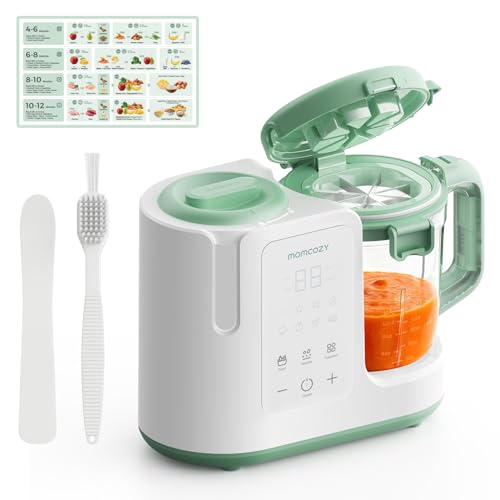
Momcozy AutoMeal Baby Food Maker — Best Self-Cleaning, Hands-Free
The AutoMeal’s pitch is automation: one-step auto steam and blend, automatic 3-stage texture settings, a 6-blade design in a 15 oz cup, and a self-cleaning function. The self-cleaning point deserves a fair framing: no self-clean cycle replaces washing and sterilizing parts that touch a baby’s food, and we would never suggest otherwise — but a machine that rinses its own blending chamber immediately after use prevents the dried-on puree cement that makes evening cleanup miserable, and that is a genuine daily benefit. The automatic texture settings likewise trade fine manual control for push-button repeatability, which many sleep-deprived parents will happily accept.
Strengths
- One-step auto steam and blend — the least hands-on workflow in this guide.
- Self-cleaning function tackles residue immediately, easing the real cleanup that follows.
- Auto 3-stage texture settings make results repeatable without technique.
Trade-offs
- 15 oz cup is the smallest batch here — fine for fresh daily batches, limiting for freezer stock-ups.
- Automation means less manual control over texture than a pulse-based machine.
- Self-cleaning supplements but never replaces proper washing and sterilizing of parts.
| Mini spec box — verified from the manufacturer’s listing | |
|---|---|
| Capacity | 15 oz cup |
| Blade | 6-blade design |
| Functions | One-step auto steam & blend; self-cleaning |
| Texture | Auto 3-stage texture settings |
Choose the AutoMeal if your honest self-assessment is that effort is the enemy: you want fresh puree daily with the fewest steps and the least cleanup resistance, and you are comfortable making smaller batches more often. Its automation is aimed squarely at the parents most likely to abandon a more manual machine by week three.
Best for: parents who prioritize hands-free operation and easy cleanup over batch size. / Not suited for: big-batch freezer stockers or parents who want manual texture control.
Check on Amazon — check the current price on Amazon; it sits in the mid-range tier.

GROWNSY Baby Food Maker — Best Budget Steam-and-Blend
The GROWNSY covers the category’s core job — steam, then blend, in one machine — at a budget tier, with a BPA-free elevated steam basket called out in its listing. The elevated basket detail matters mechanically: keeping food raised in the steam path cooks it evenly and keeps it out of the cooking water, and it is the kind of design point budget machines sometimes skip. For parents who want the integrated workflow without the premium brands’ pricing, this is the entry point that does not cut the defining feature.
Strengths
- Full steam-and-blend integration at a budget tier — the category’s core workflow, intact.
- BPA-free elevated steam basket, per the manufacturer’s listing.
- Simple brief: steam, blend, store — without paying for automation you may not need.
Trade-offs
- Fewer extras: no storage-cup system, no self-cleaning, no defrost/reheat suite.
- A newer brand with a shorter track record than Béaba or nutribullet.
- Confirm the full included-parts list on the current listing before ordering.
| Mini spec box — verified from the manufacturer’s listing | |
|---|---|
| Functions | Steamer and blender (baby food processor) |
| Steaming | BPA-free elevated steam basket |
| Color | White |
| Type | Budget steam-and-blend maker |
The budget logic here is sound: the puree stage lasts a season, and a machine that performs the core steam-and-blend job well for that season — without premium pricing — is a rational purchase, especially for parents unsure how much homemade puree their routine will actually sustain. If the habit proves permanent and volume grows, the Béaba jars are the upgrade path; if it does not, the GROWNSY has not punished the experiment.
Best for: budget-conscious parents who want the true steam-and-blend workflow. / Not suited for: parents wanting storage systems, automation, or an established premium brand.
Check on Amazon — check the current price on Amazon; it sits in the budget tier.
Comparison Table
| Pick | Badge | Key spec | Best for |
|---|---|---|---|
| Béaba Babycook Neo | Best Overall | 42 oz, steam & blend, dishwasher-safe cleanup | Regular home puree-making |
| Béaba Babycook Solo | Best Classic One-Handed Maker | 37 oz, 4-in-1 steam/blend/defrost/reheat | Freezer-batch routines |
| nutribullet Baby Steam + Blend | Best for Storage Cups and Batch Flow | Steamer basket, pulse cycle, 2 oz/4 oz cups | Portion-and-store parents |
| NutriBullet Baby Complete System | Best Batch System | 32 oz complete system | Blending pre-cooked batches |
| Momcozy AutoMeal | Best Self-Cleaning, Hands-Free | 15 oz, 6-blade, auto steam & blend, self-cleaning | Fresh daily batches, minimal effort |
| GROWNSY Baby Food Maker | Best Budget Steam-and-Blend | BPA-free elevated steam basket | Core workflow on a budget |
How to Choose a Baby Food Maker: Puree Performance, Cleaning, and Sterilizing
Judge these machines on three mechanical axes. The first is puree performance: how fine and how even the blend is, and how much control you have over stopping at a texture. Steam-and-blend makers have an inherent advantage — food blended hot and freshly steamed, in the same vessel, reaches smoothness with less added liquid and less scraping than food transferred between pots. Pulse controls and staged texture settings both serve the same goal: repeatability. A machine whose results you can reproduce on a tired Tuesday is worth more than one capable of a perfect puree only on a careful Sunday.
The second axis is cleaning, and it deserves more weight than any feature list gives it. A baby food maker is used daily, and every part that touches food must be washed after every use — jars, baskets, blades, lids, seals. Dishwasher-safe parts (a stated feature of the Babycook Neo and the nutribullet Steam + Blend) convert that from a sink session into a loading task. Look for designs where the jar, basket, and blade assembly come apart fully, because puree dries into a remarkably strong cement in seams and under blades. Self-cleaning cycles, like the Momcozy’s, are a useful first step that loosens residue immediately; they supplement washing, they never replace it.
The third axis is sterilizing. Parts that contact a baby’s food should be sterilized according to the manufacturer’s instructions — methods vary by model and material, and the manual for your specific machine is the authority, not a generic guide. Practically, this favors machines whose food-contact parts are few, robust, and rated by their makers for the sterilizing method you actually own, whether that is a countertop sterilizer, boiling, or a dishwasher’s sanitize cycle. Before buying, check the listing and manual for which methods the manufacturer approves for that model’s parts, and be skeptical of any routine a seller suggests that the manual does not. When in doubt about hygiene practices for your baby’s equipment, your pediatrician’s office can point you to current guidance.
Two smaller design questions round out the choice. The first is the water reservoir on steam models: a reservoir that is easy to fill, easy to see into, and easy to descale will be maintained; one that hides its water level behind opaque plastic gets run dry and scaled up. Check the listing photos and the manual’s descaling instructions before buying, especially if your tap water is hard. The second is honest one-handed design — not the claim, but the mechanics: can the jar be opened, the basket lifted, and the blend started with one hand while the other holds a baby? Machines designed around that constraint, as the Béaba line is, arrange their latches and controls accordingly, and the difference is felt at every single use. If you can, watch the manufacturer’s own operation video for the model you are considering and count the two-handed moments; that count predicts your daily friction better than any feature list.
Finally, size the batch to your real routine. The 37–42 oz Béaba jars suit two or three sessions a week with freezer storage between; the 15 oz Momcozy suits fresh daily batches; the nutribullet systems suit portion-and-store organization. There is no universally right capacity — there is only the match between a machine’s batch rhythm and a household’s week, and choosing that match honestly matters more than any single feature.
How to Make a Batch of Puree: The Steam-and-Blend Workflow
Whatever machine you choose, the workflow is the same shape. Prepare the ingredient as the machine’s manual directs — washed, peeled where appropriate, and cut into even pieces so the steam cooks them uniformly; even pieces are the whole secret to even steaming, and uneven steaming is the main cause of lumpy puree. Load the steam basket without packing it tight, fill the water reservoir to the level the manual specifies for that ingredient’s cooking time, and run the steam cycle. Different foods need different steaming times, and the manufacturer’s cooking guide for your model — not a generic chart — is the reference to follow.
When steaming finishes, keep the cooking liquid: it is the natural thinning liquid for the blend, and adding it back gradually is how you control consistency. Blend in stages — a first blend to break everything down, a pause to check, then shorter blends to approach the texture you want — rather than one long run, which overshoots. Check the puree by lifting the spoon: it should fall in a smooth ribbon for a fine puree, with no surviving chunks. If you find a lump, it almost always traces to an under-steamed piece, so the fix next batch is smaller, evener cutting rather than longer blending.
Portion promptly into the storage cups or trays you are using, cool and store them as your pediatrician’s and local food-safety guidance directs, and wash the machine right away — the single habit that most extends these appliances’ lives and keeps them hygienic is never letting puree dry inside them. Run the self-clean cycle if your model has one, then wash and sterilize the food-contact parts per the manual. The whole session, once it is a routine, is a modest block of time — which is precisely what these machines were designed to make true.
Using a Standard Food Processor for Baby Food Instead
If you already own a regular food processor, it can do the blending stage well, and buying a dedicated maker is a workflow choice rather than a necessity. The method: steam or cook the ingredient separately until fully soft, transfer it to the processor with a little of its cooking liquid, and process longer than you would for an adult texture, scraping down at least twice, because a big bowl’s blade leaves a layer riding above it. Work in modest batches — a family processor purees baby food best at a few cups at a time — and check carefully for lumps, since the wider bowl is less thorough at small volumes than a baby maker’s jar. Wash and sterilize the bowl, blade, and lid exactly as you would a dedicated maker’s parts. What you give up versus the picks above is the integrated steaming, the one-handed design, and the portioning systems; what you keep is a machine that remains fully useful long after the puree stage ends.
Steam-and-Blend vs. Blend-Only Systems: An Honest Comparison
The category splits into two architectures, and choosing between them is the real decision in this guide. Steam-and-blend makers — both Béabas, the nutribullet Steam + Blend, the Momcozy, and the GROWNSY — cook and puree in one vessel. Their advantage is the closed loop: fewer transfers, fewer dishes, one-handed potential, and purees blended hot, which reach smoothness easily. Their cost is single-purpose design and, on the smaller models, limited batch size. Blend-only systems — the NutriBullet Baby Complete System is this guide’s example — separate cooking from blending. Their advantage is batch throughput and flexibility: you cook in whatever pot the household already uses, in whatever quantity, and the system handles blending and storage. Their cost is the transfer step and the washing that comes with it.
Neither architecture is better in the abstract; they fit different kitchens. A household where baby food is a standalone production, cooked apart from family meals, gets the most from steam-and-blend integration. A household where the baby eats a blended portion of what the family eats — the same pot of vegetables, the same grains — gets more from a blend-and-store system, because the cooking is already happening. Be honest about which household yours is, and the shortlist in this guide narrows itself to two or three machines immediately. Parents who guess wrong are not stuck — both architectures make good puree — but they will feel a small, daily friction that the right architecture would have removed.
Keeping the Machine Hygienic Over Months of Daily Use
Daily use creates hygiene challenges that a first-week review never sees, so here is the longer view. Seals and gaskets are the weak point of every machine in this category: puree works into them, and a seal that is never removed and washed becomes the part you would least want near a baby’s food. Choose a machine whose seals come out for washing, and make removing them part of your weekly deep clean rather than a monthly discovery. Blades dull slowly on soft foods, which matters less for sharpness than for the extra blending time a dull blade needs — and extra blending time is extra friction heat in the puree, so a machine that starts taking noticeably longer to reach smoothness is telling you something about its blade or its load size.
Water reservoirs on steam models need attention too: mineral scale builds up wherever water is boiled repeatedly, and scale makes steaming slower and less even, which shows up downstream as lumpy puree that gets blamed on the blending. Descale on the schedule and with the method the manufacturer specifies for your model, using only what the manual approves. Storage cups and lids should be washed and sterilized with the same discipline as the machine’s own parts — they are food-contact surfaces in every sense that matters — and any cup with a damaged seal or a crack should leave service rather than be nursed along. None of this is elaborate; it is a weekly ten minutes layered on a daily two minutes, and it is the difference between a machine you trust in month five and one you quietly stop using.
Common Buying Mistakes
The first mistake is buying on capacity alone. A huge jar is only an advantage if your routine is batch-and-freeze; parents who make fresh small amounts daily are better served by a compact machine that washes fast. The second is treating self-cleaning as sterilizing: a rinse cycle is a convenience feature, and the parts still need proper washing and sterilizing per the manual, every time. The third is ignoring the parts count — every basket, blade, seal, and cup is a thing to wash daily, and systems with many small parts punish tired parents.
Fourth, shoppers assume any blender or processor result is fine enough without checking; lumps in puree come from under-steamed ingredients and under-blending, and the machine features that prevent them — good steam design, pulse control, a jar sized to the batch — are worth more than extra accessories. Fifth, buyers forget the appliance’s lifespan shape: the puree stage is a season, so weigh how much premium is sensible for a single-season tool against your budget, which is exactly the calculation that makes the budget GROWNSY rational for some families and the durable Béaba rational for others, especially with a second child in mind. Sixth, parents take feeding-timing or recipe advice from product marketing; take it from your pediatrician instead, and let the appliance be what it is — a tool for texture, cleaning, and convenience.
What to Check in the Box and the Manual Before the First Use
When the machine arrives, spend ten minutes on verification before the first batch — it prevents the commonest disappointments. Inventory the parts against the listing you ordered: jars, baskets, blades, seals, storage cups, and lids vary by bundle, and a missing basket discovered mid-recipe is a ruined afternoon. Read the manual’s cleaning and sterilizing sections first, not last, and confirm that the sterilizing method you own is one the manufacturer approves for this model’s parts; if it is not, decide your method now, while you can still adjust cheaply. Run one water-only steam cycle to clear any manufacturing residue and to learn the machine’s sounds and timing without food at stake.
Then make the first batch a simple, single-ingredient test whose only job is calibration: you are learning how this machine’s steam times and blend stages translate to texture, and how its parts come apart for washing, on a low-stakes run. Note what you learn — the water level that suited that ingredient, the blend duration that reached smoothness — because that notebook page becomes your personal manual, more useful within a week than the printed one. Finally, set up the storage side before you need it: cups washed, sterilized, and stacked where the finished puree will land, so the workflow you designed when choosing the machine is the workflow that actually happens at the counter.
Final Recommendation
Most parents should buy the Béaba Babycook Neo: the largest steam-and-blend jar here, one-handed design, and dishwasher-safe cleanup make it the most sustainable daily habit. Freezer-batch families may prefer the Babycook Solo for its in-machine defrost and reheat loop, portion organizers the nutribullet Baby Steam + Blend for its included storage cups, and parents who value automation above all the Momcozy AutoMeal. On a budget, the GROWNSY performs the core job honestly.
And one more time, because it matters more than any pick: this guide judges machines on pureeing, cleaning, and sterilizing performance only. For when to start solids and what to serve, ask your pediatrician. Exploring the wider cluster? See the best baby food processors and the best baby food processors and makers for the broader field, plus the best food processors for making baby food if you lean toward a standard processor. The best food processors for 2 persons and the best compact food processors cover the small-kitchen angle for new-parent households. Best Baby Food Processors Best Baby Food Processors And Makers Best Food Processors For Making Baby Food Best Food Processors For 2 Persons Best Compact Food Processors
Frequently Asked Questions
Is a dedicated baby food maker better than a regular food processor for purees?
For workflow, yes: a dedicated maker steams and blends in one vessel, is designed for one-handed use, and usually includes portioning storage, so the daily routine is shorter and the washing-up smaller. A regular processor blends steamed food perfectly well but requires separate cooking and more transfers. The puree quality can be excellent from both; the difference is effort per batch over months of daily use.
How do I sterilize baby food maker parts?
Follow the manual for your specific model — it is the authority on which sterilizing methods its materials are rated for. In general, wash all food-contact parts thoroughly first, then sterilize by the manufacturer-approved method, which may include a countertop sterilizer, boiling, steam bags, or a dishwasher sanitize cycle depending on the model. A machine’s self-cleaning cycle is a rinse convenience and is never a substitute for washing and sterilizing.
What batch size should I choose?
Match it to your routine. If you plan two or three cooking sessions a week with freezer storage, a 37–42 oz jar like the Béaba models fits. If you prefer fresh small batches daily, a compact cup like the Momcozy’s 15 oz is easier to wash and wastes less. Portion-and-store systems like the nutribullet’s suit parents who think in labeled cups. There is no wrong size — only a mismatch with your week.
Can these machines handle thicker textures as well as smooth purees?
Yes — texture is controlled by blending time and added liquid, and the picks here support that range mechanically: pulse cycles (nutribullet) and staged texture settings (Momcozy) exist precisely to stop at thicker results, and the Béaba listings describe use from purees to soft solids. What texture is appropriate for your child, and when, is a question for your pediatrician; the machines simply give you the mechanical range to follow that guidance.
Do baby food makers make enough for twins or for batch-freezing?
Capacity is the deciding spec: the 37–42 oz Béaba jars were designed for batch production, and the Solo’s listing cites up to 27 servings from a session, which is the scale a twins household or a weekend freezer session needs. Smaller-cup machines like the 15 oz Momcozy can certainly be run back-to-back, but if your plan is volume, start with a large-jar model rather than doubling a small machine’s cycles every session.
Are the food-contact parts BPA-free on these picks?
Where a manufacturer states it in the listing, we have said so: the nutribullet Baby Steam + Blend lists BPA-free construction, and the GROWNSY lists a BPA-free steam basket. For any model, the current listing and manual are the authoritative statements about materials — check them for the exact variant you are buying, and do not assume a claim from one model in a brand’s range applies to another.
What is the difference between the Babycook Neo and the Babycook Solo?
Capacity and emphasis. The Neo is the larger machine at 42 oz, with dishwasher-safe cleanup highlighted in its listing and a steam-and-blend brief. The Solo is 37 oz and adds defrosting and reheating to the function set, making it a 4-in-1 suited to a freezer-batch routine where portions come back in the same vessel. Choose the Neo for batch size and cleanup design, the Solo if the defrost-and-reheat loop is how your household will actually run.
Can I use a baby food maker for adult food too?
Mechanically, yes — these are steamers and blenders, and they handle small quantities of soups, sauces, smoothies, and dips for adults perfectly well. Many parents keep using them for single servings of soup or a quick sauce long after the puree stage. Just keep the hygiene discipline the same: parts washed and sterilized on the same schedule regardless of whose food the machine processed, and do not let adult use become a reason the deep-clean routine slips.
Why does my puree come out lumpy even after long blending?
Almost always, the cause is upstream of the blade: pieces cut unevenly steam unevenly, so some are soft while others are still firm, and no amount of blending fully erases a firm piece without over-processing the rest. Cut ingredients into small, even pieces, do not pack the steam basket, and check that the reservoir had the water level the manual specifies for that ingredient. If lumps persist with even cutting and correct water, the machine may need descaling — mineral buildup slows steaming noticeably.
How long will I use a baby food maker?
The intensive puree stage lasts a season rather than years, which is why this guide weighs purchase price against daily convenience honestly: some families rationally choose the budget steam-and-blend pick, others choose a durable premium maker with a second child or hand-me-down in mind. After the puree stage, the machines still serve for soups, sauces, and smoothies in small quantities, but buy for the season you are in, not for a decade of imagined use.


