Disclosure: airfryerkitchensupply.com is reader-supported. When you buy through links on our site, we may earn an affiliate commission at no extra cost to you.
Where to Buy
The fastest way to buy any pick in this guide to the best energy efficient toilets is through Amazon, where each verified model below is listed with its current specification details. Use the links in this box to check the current configuration before you order — toilet listings sometimes bundle different seats or rough-ins under one page, and the variant you select is the toilet you get.
- VORTEXTOVE Dual Flush Water-Saving One-Piece Elongated Toilet (W2111) — Best Overall. Check the current price on Amazon.
- Los Flexi Pressure Assisted Two-Piece Toilet, 1.0 GPF — Best Pressure-Assist Efficiency. Check the current price on Amazon.
- DeerValley DV-1F0437 Elongated One-Piece Toilet, Dual Flush 1.1/1.28 GPF — Best Verified Flush Power. Check the current price on Amazon.
- WOODBRIDGE T-0018 / B0735 One-Piece Dual Flush Toilet — Best Modern One-Piece. Check the current price on Amazon.
- KOHLER Wellworth Pressure Lite Elongated Toilet, 1.1 GPF (Less Seat) — Best Legacy Brand Pick. Check the current price on Amazon.
- Miuara Elongated Skirted Tall Toilet, Dual Flush 1.0/1.28 GPF — Best for Tall Users. Check the current price on Amazon.
If a pick shows as unavailable in your region, choose the next pick in the same badge family rather than substituting an unverified model — every recommendation in this guide was checked against its listing before inclusion.
If you searched for the best energy efficient toilets, here is the honest translation: toilets do not plug in. A standard gravity or pressure-assist toilet uses no electricity at all, so the ‘energy’ a toilet consumes is water — every gallon you flush had to be pumped, treated, delivered to your home, and carried away again, and that chain is where the energy cost lives. The only toilets that draw actual electricity are add-ons and alternatives: bidet seats, macerating pumps, and the small fans on some composting models. So this guide ranks toilets the way an engineer would — by gallons per flush (GPF), verified from each listing, and by whether the flush clears in one attempt.
Why does one-attempt clearing matter so much? Because the least efficient toilet in America is not the old 1.6 GPF model in your guest bath — it is the ultra-low-flow toilet that needs two flushes for solids. A 1.28 GPF toilet flushed twice uses 2.56 gallons, more than a single decisive flush from almost anything. That is why we weigh verified bulk-removal evidence, like the MaP scores printed in some listings, as heavily as the GPF figure itself. The six picks below span dual-flush, pressure-assist, and smart single-flush designs, and every GPF figure quoted comes from the product’s own verified listing title — we do not print numbers we could not confirm.
One more framing note before the picks: the current federal standard for new toilets is 1.6 GPF, and the EPA WaterSense benchmark for high-efficiency models is 1.28 GPF. Every pick in this guide meets or beats 1.28 GPF on its full flush, and several go far lower on their light flush. If you are replacing a pre-1994 toilet that uses 3.5 gallons or more per flush, any pick here will cut your toilet water use by well over half — the single biggest water upgrade most homes can make.
In this guide
Quick Picks: The Best energy efficient toilets
If you only read one section, make it this one. Each pick below carries a badge naming the job it does best, and the same badge appears at its full review further down so you can jump straight to the detail.
Best Overall — VORTEXTOVE Dual Flush Water-Saving One-Piece Elongated Toilet (W2111): The 0.8 GPF light flush is the lowest verified light-flush volume in this roundup. One-piece body has no tank-to-bowl seam to leak or trap grime. Check the current price on Amazon.
Best Pressure-Assist Efficiency — Los Flexi Pressure Assisted Two-Piece Toilet, 1.0 GPF: Pressure assist squeezes a forceful flush out of just 1.0 gallon. Tall 18.8-inch height is easier on knees for taller and older users. Check the current price on Amazon.
Best Verified Flush Power — DeerValley DV-1F0437 Elongated One-Piece Toilet, Dual Flush 1.1/1.28 GPF: MaP 1000g rating in the listing title signals top-tier bulk removal. Rimless bowl design removes the hidden rim channel that traps buildup. Check the current price on Amazon.
Best Modern One-Piece — WOODBRIDGE T-0018 / B0735 One-Piece Dual Flush Toilet: 1.0 GPF light flush undercuts most dual-flush rivals on liquid waste. Smooth one-piece skirt is quick to wipe down. Check the current price on Amazon.
Best Legacy Brand Pick — KOHLER Wellworth Pressure Lite Elongated Toilet, 1.1 GPF (Less Seat): Kohler’s Pressure Lite system delivers commercial-style force at 1.1 GPF. Elongated bowl in the classic Wellworth footprint fits many replacement jobs. Check the current price on Amazon.
Best for Tall Users — Miuara Elongated Skirted Tall Toilet, Dual Flush 1.0/1.28 GPF: Light flush of 1.0 GPF paired with a frugal 1.28 GPF full flush. 19-inch seat height is among the tallest in this roundup. Check the current price on Amazon.
How These Picks Were Chosen
We built the shortlist for the best energy efficient toilets from models whose listings we could verify, then ranked them on the criteria this category actually turns on: verified flush volume or waterless design, evidence of clearing performance (a MaP score, a certification, a named flushing platform, or a flush-valve specification printed in the listing), fit (rough-in, bowl shape, seat height), and the completeness of what ships in the box.
Two rules governed inclusion. First, no specification appears in this guide unless the product’s own verified listing states it — where a listing is silent on a figure, the review says so instead of estimating. Second, no static prices and no fixed ratings appear anywhere in the article: prices move, ratings move, and a buying guide should send you to the live listing for both. Picks are ordered by overall fit for the keyword, with badges flagging the specialist choices.
The 6 Best energy efficient toilets — Full Reviews

VORTEXTOVE Dual Flush Water-Saving One-Piece Elongated Toilet (W2111) — Best Overall
The VORTEXTOVE W2111 is built around one idea: most flushes do not need much water. Its top-press dual flush lets you choose a 0.8-gallon light flush for liquid waste or the full 1.28-gallon flush for solids, and that light-flush figure is the smallest verified number anywhere in this guide. The one-piece ceramic body keeps the silhouette compact, which helps in smaller bathrooms where a two-piece toilet with a separate tank can look bulky.
Strengths
- The 0.8 GPF light flush is the lowest verified light-flush volume in this roundup
- One-piece body has no tank-to-bowl seam to leak or trap grime
- Quick-release seat lifts off for fast cleaning around the hinges
Trade-offs
- Lesser-known brand, so long-term parts support is less proven than the legacy makers
- Top-press button gives less tactile feedback than a side lever for some users
- Compact footprint may feel short for taller users despite the elongated bowl
| Specification | Verified detail |
|---|---|
| Flush | Dual flush, top-press button |
| Flush volume | 0.8 / 1.28 GPF (from listing title) |
| Bowl | Elongated |
| Rough-in | 12 in |
| Seat | Quick-release soft-close V-seat included |
The quick-release soft-close seat is a practical touch: it pops off for cleaning and drops without slamming. Because this is a newer brand rather than a century-old plumbing name, we would pair it with a standard wax ring or silicone seal you can source anywhere, and keep the fill valve model noted in case a generic replacement is ever needed.
Through this guide’s lens — verified gallons per flush — the W2111 is the headline act. No other pick lets liquid waste leave on 0.8 gallons, and since liquid flushes dominate daily use, that is where annual savings concentrate. Its full flush matches the WaterSense benchmark rather than beating it, so solids cost the standard 1.28 gallons.
Best for: buyers who want a pick where the 0.8 gpf light flush is the lowest verified light-flush volume in this roundup. / Not suited for: anyone who would be put off because lesser-known brand, so long-term parts support is less proven than the legacy makers.
Check on Amazon — check the current price on Amazon and confirm the exact variant, seat inclusion, and rough-in on the listing before ordering.

Los Flexi Pressure Assisted Two-Piece Toilet, 1.0 GPF — Best Pressure-Assist Efficiency
The Los Flexi pairs two things that rarely meet: a pressure-assist flush and a 1.0 GPF rating. A sealed vessel inside the tank uses your home’s water pressure to compress air, then releases it for a fast, forceful flush that pushes waste through the trapway instead of relying on gravity alone. That is how it can claim strong clearing power while using less water than a standard 1.28 GPF toilet on every single flush, not just on a light-flush setting.
Strengths
- Pressure assist squeezes a forceful flush out of just 1.0 gallon
- Tall 18.8-inch height is easier on knees for taller and older users
- Pressure vessels tend to resist double-flushing because the first flush clears decisively
Trade-offs
- Pressure-assist flush is noticeably louder than a gravity flush
- Replacement pressure vessels cost more than a flapper or flush tower
- Tall bowl height can leave shorter users’ feet dangling
| Specification | Verified detail |
|---|---|
| Flush | Pressure assist |
| Flush volume | 1.0 GPF (from listing title) |
| Bowl | Elongated, ADA height |
| Seat height | 18.8 in comfort tall (from listing title) |
| Rough-in | 12 in |
The 18.8-inch comfort-tall elongated bowl suits taller households and anyone who finds standard-height toilets hard to rise from. The trade is noise and maintenance: pressure-assist flushes have a distinct whoosh, and when the vessel eventually wears, the replacement part costs more than gravity-flush internals. For a household that values water savings and sit-down comfort equally, it is a distinctive option.
Pressure assist is the efficiency strategy for homes that cannot trust gravity: the vessel makes 1.0 gallon behave like much more. Note that it uses its 1.0 GPF on every flush — there is no lighter option — yet that still beats a 1.28 single-flush toilet’s every-flush volume while clearing harder.
Best for: buyers who want a pick where pressure assist squeezes a forceful flush out of just 1.0 gallon. / Not suited for: anyone who would be put off because pressure-assist flush is noticeably louder than a gravity flush.
Check on Amazon — check the current price on Amazon and confirm the exact variant, seat inclusion, and rough-in on the listing before ordering.

DeerValley DV-1F0437 Elongated One-Piece Toilet, Dual Flush 1.1/1.28 GPF — Best Verified Flush Power
The DeerValley DV-1F0437 is the efficiency pick for people who refuse to trade away clearing power. Its listing cites a MaP score of 1000 grams — the maximum on the industry’s bulk-removal test — while the full flush uses just 1.28 gallons and the light flush only 1.1. That combination matters, because the most common failure of water-saving toilets is the double flush, which quietly erases the savings. A toilet that clears in one flush at 1.28 GPF genuinely uses less water than a weak 1.0 GPF model that needs two tries.
Strengths
- MaP 1000g rating in the listing title signals top-tier bulk removal
- Rimless bowl design removes the hidden rim channel that traps buildup
- Full flush is only 1.28 GPF, so even solids stay frugal
Trade-offs
- ADA chair height is less comfortable for shorter users and children
- Rimless designs depend on correct water pressure to rinse the full bowl
- Newer brand with a thinner installer network than legacy makers
| Specification | Verified detail |
|---|---|
| Flush | Dual flush |
| Flush volume | 1.1 / 1.28 GPF (from listing title) |
| Bulk removal | MaP 1000g (from listing title) |
| Bowl | Elongated, rimless, ADA chair height |
| Rough-in | 12 in |
The rimless elongated bowl at ADA chair height is easy to clean and comfortable for most adults. Rimless bowls spray water around an open ledge rather than through hidden rim jets, so there is no concealed channel for mineral scale and biofilm. If your household includes shorter adults or small children, try a chair-height toilet in a showroom first.
The DV-1F0437 is the evidence-first pick: MaP 1000g printed in the listing, a 1.28 ceiling on the full flush, and a 1.1 light flush. In efficiency terms it is the balanced portfolio — nothing extreme in any direction, everything verified, and a rimless bowl that stays cleaner with less water spent on scrubbing rinses.
Best for: buyers who want a pick where map 1000g rating in the listing title signals top-tier bulk removal. / Not suited for: anyone who would be put off because ada chair height is less comfortable for shorter users and children.
Check on Amazon — check the current price on Amazon and confirm the exact variant, seat inclusion, and rough-in on the listing before ordering.
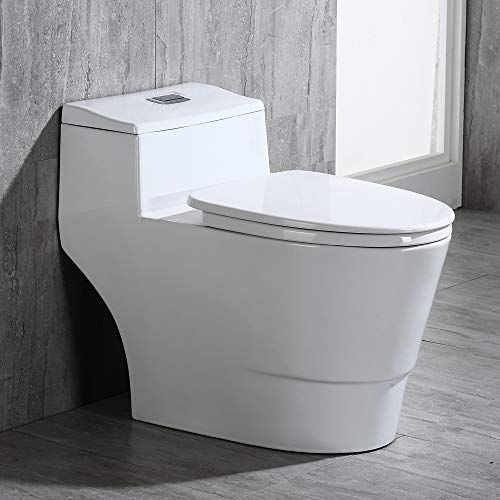
WOODBRIDGE T-0018 / B0735 One-Piece Dual Flush Toilet — Best Modern One-Piece
The WOODBRIDGE T-0018 (also listed as B0735) is a modern one-piece toilet whose dual flush splits 1.0 gallons for liquids and 1.6 gallons for solids. The light flush is the headline: at 1.0 GPF it beats the 1.1-gallon light flush found on several competitors, and since liquid flushes dominate daily use in most homes, that is where the savings accumulate. The smooth, skirted one-piece body also hides the trapway, giving it the clean-lined look WOODBRIDGE is known for.
Strengths
- 1.0 GPF light flush undercuts most dual-flush rivals on liquid waste
- Smooth one-piece skirt is quick to wipe down
- Soft-closing seat included in the box
Trade-offs
- Full flush is 1.6 GPF, so solids use more water than 1.28 GPF rivals
- One-piece toilets are heavy to maneuver during installation
- Modern styling may clash with traditional bathroom fixtures
| Specification | Verified detail |
|---|---|
| Flush | Dual flush |
| Flush volume | 1.0 / 1.6 GPF (from listing title) |
| Bowl | Elongated |
| Construction | One-piece |
| Seat | Soft-closing seat included |
Be honest about the other button, though: the 1.6 GPF full flush uses more water than a good 1.28 GPF single-flush toilet. Households that mostly need the full flush will save less than the dual-flush marketing suggests. This toilet makes the most sense for disciplined dual-flush users who will actually press the small button most of the time.
Judge the WOODBRIDGE by its light flush: 1.0 GPF is excellent, and in a home where the small button gets used honestly, its average flush volume can undercut nominally ‘better’ toilets. Its 1.6 full flush is the asterisk — households should be honest about their button discipline before choosing it.
Best for: buyers who want a pick where 1.0 gpf light flush undercuts most dual-flush rivals on liquid waste. / Not suited for: anyone who would be put off because full flush is 1.6 gpf, so solids use more water than 1.28 gpf rivals.
Check on Amazon — check the current price on Amazon and confirm the exact variant, seat inclusion, and rough-in on the listing before ordering.

KOHLER Wellworth Pressure Lite Elongated Toilet, 1.1 GPF (Less Seat) — Best Legacy Brand Pick
The Wellworth name has been in American bathrooms for decades, and this Pressure Lite version adds a pressure-assist vessel to that proven footprint. At 1.1 GPF it uses less water than a standard high-efficiency toilet while the pressure vessel delivers the kind of decisive, fast flush usually associated with commercial restrooms. For homes with long drain runs or older plumbing that punish weak flushes, that force is a practical form of efficiency: fewer clogs, fewer second flushes.
Strengths
- Kohler’s Pressure Lite system delivers commercial-style force at 1.1 GPF
- Elongated bowl in the classic Wellworth footprint fits many replacement jobs
- Kohler parts support is among the easiest to source years later
Trade-offs
- Seat is not included, so budget for one separately
- Pressure-assist flush is louder than gravity models
- Left-hand trip lever only on this listing
| Specification | Verified detail |
|---|---|
| Flush | Pressure Lite pressure assist |
| Flush volume | 1.1 GPF (from listing title) |
| Bowl | Elongated |
| Trip lever | Left-hand |
| Seat | Not included (less seat) |
Two buying notes from the listing itself: the seat is not included (‘less seat’), and the trip lever is left-hand. Neither is a flaw, but both belong in your plan before installation day. Kohler’s deep parts catalog is the long-term argument here — pressure vessels, seals, and levers for this platform remain widely stocked, which keeps a water-saving toilet saving water instead of being replaced early.
The Wellworth Pressure Lite’s 1.1 GPF is not the lowest figure here, but it may be the most durable saving: Kohler’s parts support means this toilet can be kept at peak efficiency for decades with seals and vessel parts, instead of degrading or being replaced. Efficiency over a 25-year service life beats a spec-sheet win that leaks by year five.
Best for: buyers who want a pick where kohler’s pressure lite system delivers commercial-style force at 1.1 gpf. / Not suited for: anyone who would be put off because seat is not included, so budget for one separately.
Check on Amazon — check the current price on Amazon and confirm the exact variant, seat inclusion, and rough-in on the listing before ordering.

Miuara Elongated Skirted Tall Toilet, Dual Flush 1.0/1.28 GPF — Best for Tall Users
The Miuara is aimed squarely at taller users and seniors: an 18.25-inch bowl height and 19-inch seat height make sitting and standing noticeably easier, while the dual flush keeps water use at 1.0 gallons for liquids and 1.28 for solids. That full-flush figure matters — many tall toilets still flush at 1.6 GPF, so this one saves on every flush type, not just the light one.
Strengths
- Light flush of 1.0 GPF paired with a frugal 1.28 GPF full flush
- 19-inch seat height is among the tallest in this roundup
- Skirted one-piece body wipes clean quickly
Trade-offs
- Very tall seat is wrong for shorter households
- Tornado-style rinse can be splashy for some users
- Brand lacks the long track record of legacy makers
| Specification | Verified detail |
|---|---|
| Flush | Dual flush (tornado) |
| Flush volume | 1.0 / 1.28 GPF (from listing title) |
| Bowl height | 18.25 in; 19 in seat height (from listing title) |
| Bowl | Elongated, skirted, one-piece |
| Design | ADA tall |
The skirted one-piece body hides the trapway and wipes down in seconds, and the listing describes a tornado-style dual flush that spins water around the bowl for coverage. The obvious caution is fit: a 19-inch seat is a long way down for a shorter person, and children may need a step. Buy this toilet for the tallest member of the household, not as a compromise for everyone.
For tall users, the Miuara’s efficiency numbers (1.0/1.28) are almost a bonus on top of the 19-inch seat height. It proves accessibility and efficiency are not enemies — a point worth making in a market where tall toilets are often older, thirstier designs.
Best for: buyers who want a pick where light flush of 1.0 gpf paired with a frugal 1.28 gpf full flush. / Not suited for: anyone who would be put off because very tall seat is wrong for shorter households.
Check on Amazon — check the current price on Amazon and confirm the exact variant, seat inclusion, and rough-in on the listing before ordering.
Comparison Table
| Pick | Badge | Key spec (verified) | Best for |
|---|---|---|---|
| VORTEXTOVE Dual Flush Water-Saving One-Piece Elongated Toilet (W2111) | Best Overall | 0.8 / 1.28 GPF (from listing title) | Overall |
| Los Flexi Pressure Assisted Two-Piece Toilet, 1.0 GPF | Best Pressure-Assist Efficiency | 1.0 GPF (from listing title) | Pressure-Assist Efficiency |
| DeerValley DV-1F0437 Elongated One-Piece Toilet, Dual Flush 1.1/1.28 GPF | Best Verified Flush Power | 1.1 / 1.28 GPF (from listing title) | Verified Flush Power |
| WOODBRIDGE T-0018 / B0735 One-Piece Dual Flush Toilet | Best Modern One-Piece | 1.0 / 1.6 GPF (from listing title) | Modern One-Piece |
| KOHLER Wellworth Pressure Lite Elongated Toilet, 1.1 GPF (Less Seat) | Best Legacy Brand Pick | 1.1 GPF (from listing title) | Legacy Brand Pick |
| Miuara Elongated Skirted Tall Toilet, Dual Flush 1.0/1.28 GPF | Best for Tall Users | 1.0 / 1.28 GPF (from listing title) | for Tall Users |
Key specs are quoted from each product’s verified listing. Where two picks share a headline figure, the deciding factors are usually the ones in the full reviews: bowl shape, seat height, what is included in the box, and how the flush achieves its result.
How to Choose an Energy Efficient Toilet
Start with the two numbers that decide everything: the full-flush GPF and, on dual-flush models, the light-flush GPF. Liquid waste accounts for the majority of flushes in most homes, so the light-flush figure does most of the saving. A dual-flush toilet at 1.0/1.6 GPF will usually beat a single-flush 1.28 GPF model in a real household, even though its full flush is thirstier, simply because most flushes are the small one. In a household of solids-heavy use — or one where nobody will bother with two buttons — the math flips, and a strong 1.28 single flush wins.
Second, demand evidence that the flush clears. MaP testing, run by independent labs, measures how many grams of simulated waste a toilet removes in a single flush; 1000g is the maximum score and 600g is a common professional comfort threshold. Where a listing prints a MaP score, we quote it. Where it does not, we say so rather than guessing. Third, match the mechanism to your plumbing: pressure-assist models shine on long or sluggish drain runs, while gravity dual-flush models are quieter and cheaper to maintain. Finally, confirm the rough-in (usually 12 inches), bowl shape, and seat height before falling for any specification.
Where the ‘Energy’ in a Toilet Actually Goes
It is worth understanding the full picture, because it changes what ‘efficient’ should mean to you. The water itself is the main cost: municipal water is pumped from source, filtered, treated, pressurized, and then the wastewater is collected and treated again. Saving a gallon per flush, multiplied by a household’s thousands of flushes per year, is a real energy saving at the system level even though your toilet has no plug. Hot water is not involved — toilets flush cold — so there is no heating cost to optimize.
The exceptions are worth naming so you can judge them clearly. Bidet seats draw electricity to heat water and seats; macerating and upflush toilets use a pump motor on every flush; smart toilets with heated seats, night lights, and motorized lids sip power continuously. None of the six picks in this guide needs electricity to flush — they are gravity or pressure-assist designs — and that is deliberate. If you add a bidet seat later, its energy use is modest and separate from the toilet decision you are making here.
Dual Flush vs Pressure Assist vs Single Flush: An Efficiency Comparison
Dual flush saves water by matching volume to need, and its weakness is human: guests guess, kids press both buttons, and some users default to the big flush. Real-world savings are real but smaller than the spec sheet promises. Pressure assist saves water a different way — by making a small volume violent enough to clear decisively — and its weaknesses are noise and pricier internals. A well-designed 1.28 GPF single flush is the idiot-proof option: one button, one volume, no behavior change required, and modern examples clear far better than the disappointing low-flow toilets of the 1990s.
Our honest ranking for a typical family home: dual flush first if your household will use it properly, pressure assist first if your drains are marginal or your current toilet clogs, and a proven 1.28 single flush if you want set-and-forget simplicity. All three strategies appear in the picks above, labeled clearly, so you can match the mechanism to your household rather than to a headline.
What a Gallon Saved Actually Adds Up To
Run the household arithmetic with your own numbers, because averages hide the story. A single person flushing five times a day on a 3.5 GPF toilet spends about 17.5 gallons daily on flushing alone. The same person on a dual-flush pick from this guide — say four light flushes at around 1.0 GPF and one full flush at 1.28 — spends about 5.3 gallons. That is roughly 4,400 gallons a year for one person, from one appliance, with no change in comfort or hygiene. Multiply by a family and by the share of homes still running pre-1994 toilets, and the reason utilities offer rebates for high-efficiency toilets stops being mysterious.
Rebates deserve a mention of their own: many water utilities offer a rebate — sometimes a substantial one — for replacing an old toilet with a WaterSense-labeled model, and some run free-toilet exchange programs for the oldest fixtures. The picks in this guide at 1.28 GPF or below are the class of models those programs target. Check your water utility’s website before you buy, keep the receipt and the old toilet’s disposal record if the program asks for it, and you may find the efficiency upgrade partly paid for by the same utility that sells you the water.
There is also a systems point worth understanding: peak demand. Water systems are sized and pumped for peaks, and residential toilets flush hardest in the morning peak. Millions of small flushes shave that peak, which is real energy infrastructure, not just bookkeeping. Your individual saving is water and money; the collective saving is pumping capacity and treatment load. Both are legitimate reasons to choose the lower verified GPF when the clearing evidence supports it.
Efficiency Over a Lifetime: Why Repairability Is a Green Spec
A toilet’s efficiency is not a fixed property of the day it is installed. Seals harden, fill valves drift, flush towers wear, and a toilet that leaves the showroom at 1.28 GPF can be flushing at an effective 1.6 with a slow leak by year seven. The models in this guide were chosen partly for what happens in year seven: Kohler, TOTO, and American Standard maintain parts catalogs measured in decades; dual-flush cartridges and pressure vessels on the specialist picks are replaceable units rather than sealed mysteries. When you compare two efficient toilets, compare their tenth year, not just their first.
Build the maintenance into the purchase decision. Before ordering, look up the replacement flush seal and fill valve for the exact model and confirm they are stocked and inexpensive. Note the model numbers in the same place you keep appliance records. Then set a genuinely small ritual: the dye test once a year, a listen for phantom refills when the house is quiet, a glance at the water level line whenever you happen to have the tank lid off. Ten minutes a year is the entire cost of keeping an efficient toilet efficient for its whole service life.
Finally, think about end-of-life honestly. Porcelain is recyclable as aggregate in some regions and landfill in others, and a toilet replaced at year eight because a proprietary part vanished has roughly double the manufacturing footprint per service-year of one repaired to year sixteen. Efficiency marketing counts gallons; lifetime thinking counts gallons and toilets. This guide’s bias toward proven platforms and stocked parts is deliberate — it is the same bias, applied over a longer horizon.
Budget Tiers for Efficient Toilets, Without the Price Tags
Efficient toilets sort into three honest tiers, and knowing which tier you are shopping keeps the comparison fair. The budget tier is the domain of value two-piece models and dual-flush conversions of thinking — straightforward 1.28 GPF gravity toilets from plumber-channel brands, bought for certified efficiency and parts availability rather than styling. The mid tier adds the refinements most households actually feel: dual flush with genuinely low light volumes, skirted one-piece bodies, included soft-close seats, and MaP-verified clearing. The premium tier — TOTO and KOHLER flagships and pressure-assist specialists — buys engineering depth: glazes, vessel systems, finish quality, and parts pipelines measured in decades.
The efficiency-per-dollar curve is not linear, and it flattens earlier than marketing suggests. Moving from an old 3.5 GPF toilet into any tier captures the great majority of the water saving; moving between tiers mostly buys comfort, quiet, cleaning ease, and service life. That is a liberating fact for budget shoppers: the least expensive pick in this guide that fits your bathroom and your household’s habits is an environmentally serious purchase. Spend up a tier for the bathroom you use most, where the refinements are felt daily, and let the guest bath ride on a solid budget pick.
One tier trap to avoid: the ultra-cheap no-name toilet whose efficiency exists only in its listing headline. Without a certification, a MaP score, or a parts trail, its real-world flush volume and clearing are unverifiable — and an unverifiable toilet that double-flushes is worse than a verified 1.6. Every pick in this guide cleared a verification bar; hold any alternative you consider to the same bar, at any tier, and the tier system will serve you well.
A Short History of the Efficient Flush — And Why the 1990s Reputation Is Dead
Context helps explain why some buyers still distrust low-flow toilets. When the 1.6 GPF mandate arrived in the 1990s, many makers simply shrank the tank on bowls designed for 3.5 gallons, and the results — weak flushes, chronic double-flushing, bowls that never rinsed — taught a generation that ‘efficient’ meant ‘bad’. That reputation is the single biggest obstacle the modern category faces, and it is now undeserved: the redesigns that followed enlarged flush valves, re-engineered trapways, glazed the full trapway path, and eventually produced pressure-assist and MaP-tested designs that out-clear the old water-hogs outright.
The lesson for today’s buyer is to judge evidence, not era. A toilet with a printed MaP score, a WaterSense label, or a named modern platform is a different species from the 1994 compromise in a relative’s guest bath. If your household’s skepticism comes from that era, the picks in this guide are the rebuttal — verified clearing at verified low volumes, from makers who publish their numbers.
How to Install a High-Efficiency Toilet (And Set It Up to Actually Save Water)
Turn off the water supply at the angle stop, flush to empty the tank, and sponge out the remaining bowl and tank water. Disconnect the supply line, remove the tank bolts (two-piece) and the bowl’s closet bolts, rock the old toilet gently to break the wax seal, and lift it clear. Scrape the flange clean, check that the flange sits roughly level with the finished floor, and replace it or add a repair ring if it is cracked or sits below floor level — a surprising share of ‘bad toilet’ problems are really bad flange problems.
Set a new wax ring (or a reusable silicone ring) on the flange or the bowl outlet per the ring’s instructions, lower the new toilet straight down with a helper — one-piece and pressure-assist models are heavy — and snug the closet bolts evenly, alternating sides, without over-torquing the porcelain. Connect the tank on two-piece models with the supplied gasket and bolts, hook up a braided supply line, and turn the water on slowly while checking every joint.
Now the efficiency setup, which most installers skip. On dual-flush models, confirm both buttons actuate and that the light flush is genuinely the small volume. Set the tank water level to the line marked inside the tank — overfilling wastes water on every flush and can leak silently into the overflow tube. Drop a food-coloring tablet or a few drops of dye in the tank and wait fifteen minutes without flushing: color in the bowl means a leaking flush seal, the single most common way an efficient toilet quietly wastes hundreds of gallons. Fix leaks before you celebrate the savings.
Common Buying Mistakes
Buying the lowest GPF without checking clearing power. A toilet that needs two flushes uses more water than the model it replaced. Look for MaP scores or a proven flushing platform, not just the smallest number.
Assuming ‘energy efficient’ means it plugs in or saves electricity. Standard toilets use no electricity. The saving is water. Judge GPF and flush quality; judge bidet seats and pumps separately if you add them.
Ignoring the rough-in measurement. A 10-inch or 14-inch rough-in bathroom will not accept a standard 12-inch toilet. Measure from the finished wall to the center of the flange bolts before ordering.
Letting a silent tank leak erase the upgrade. A worn flapper or flush seal can leak more water in a month than the new toilet saves. Do the dye test at install and once a year after.
Choosing chair height for every bathroom. Tall bowls are harder for shorter adults and children. Match seat height to the people who will actually use that bathroom.
Forgetting the seat. Several pro models are sold ‘less seat.’ Confirm what is in the box before installation day, or the project stalls over a seat.
Final Recommendation
For most households, start with the VORTEXTOVE W2111: its verified 0.8 GPF light flush is the lowest in this guide and its full flush still respects the 1.28 GPF benchmark. If your drains are sluggish or your current toilet clogs, the Los Flexi pressure-assist at 1.0 GPF or the KOHLER Wellworth Pressure Lite at 1.1 GPF trade a little noise for decisive clearing. If you want proof of power with your savings, the DeerValley DV-1F0437 pairs a MaP 1000g listing claim with a 1.1/1.28 dual flush. Tall households should look at the Miuara, and design-led remodels at the WOODBRIDGE.
Whichever you choose, do the dye test after installation and once a year — an efficient toilet with a leaking seal is just a toilet. For more comparisons across this cluster, see Best Energy Saving Toilets, Best Environmental Friendly Toilets, Best Environmental Toilets, and Best Fast Flush Toilets.
The shortlist, for a final check of current price and configuration on Amazon: VORTEXTOVE Dual Flush Water-Saving One-Piece Elongated Toilet (W2111) (Best Overall); Los Flexi Pressure Assisted Two-Piece Toilet, 1.0 GPF (Best Pressure-Assist Efficiency); DeerValley DV-1F0437 Elongated One-Piece Toilet, Dual Flush 1.1/1.28 GPF (Best Verified Flush Power); WOODBRIDGE T-0018 / B0735 One-Piece Dual Flush Toilet (Best Modern One-Piece); KOHLER Wellworth Pressure Lite Elongated Toilet, 1.1 GPF (Less Seat) (Best Legacy Brand Pick); Miuara Elongated Skirted Tall Toilet, Dual Flush 1.0/1.28 GPF (Best for Tall Users).
Frequently Asked Questions
Do energy efficient toilets really save money?
Yes, through water and sewer charges, which are usually billed together. Replacing a 3.5 GPF toilet with a 1.28 GPF model cuts flush water by roughly two-thirds, and toilets are typically the largest indoor water user in a home. The payback period depends on your local rates and household size, but for an older toilet it is one of the fastest-payback upgrades in the house.
What GPF counts as high efficiency?
The federal maximum for new toilets is 1.6 GPF. The EPA WaterSense benchmark is 1.28 GPF or less, with proven clearing performance. Dual-flush models rate their two volumes separately — for example 1.1/1.6 — and pressure-assist models in this guide go as low as 1.0 GPF on every flush.
Do efficient toilets clog more?
The first generation of low-flow toilets in the 1990s earned that reputation honestly. Modern designs — larger flush valves, better trapway geometry, pressure assist, and MaP-tested bowls — clear as well as or better than old 3.5 GPF models. The picks in this guide were chosen specifically for verified clearing evidence.
Does a toilet use electricity?
A standard gravity or pressure-assist toilet uses none. Electricity enters the picture only with bidet seats, macerating pumps, smart-toilet features, or the small fan on some composting toilets. The ‘energy’ saving of an efficient toilet is the water — and the pumping and treatment energy behind it — that you no longer use.
Is dual flush or pressure assist better for saving water?
Dual flush saves more in a disciplined household because most flushes are liquid and use the small volume. Pressure assist saves by clearing decisively at a low fixed volume, which suits homes with weak drains. If nobody in your house will use two buttons correctly, a strong 1.28 GPF single flush may save the most in practice.
How do I know my current toilet’s GPF?
Check inside the tank lid or on the bowl behind the seat for a stamped figure like 1.6 gpf or 3.5 gpf. Pre-1994 toilets are usually 3.5 GPF or more; 1994–2000s models are typically 1.6. No stamp? Measure the tank’s water displacement per flush, or simply date the toilet — age is a good proxy.


